The SASSI Blog

SASSI is an independent think tank dedicated to promoting peace and stability in South Asia. We are headquartered in Islamabad, Pakistan and we aim to make a leading contribution to regional and international academic and policy-orientated research discourses about South Asian security.

Sunday, February 28, 2010

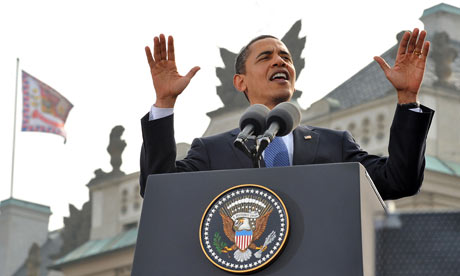
Barack Obama orders new nuclear review amid growing feud


President's hopes for reform create bitter tensions with National Security Council and Department of Defense

President Barack Obama has ordered the rewriting of the draft new US Nuclear Posture Review (NPR), amid frustration in the White House that the document fails to reflect his aspirations for a nuclear-weapons-free world and an end to "cold war thinking".

The review, drawn up by each administration, sets the doctrine justifying both the retention of nuclear weapons and the circumstances in which they might be used. It also determines more practical issues, including nuclear force readiness, targeting and war planning. More >>>

Unknown at 6:46 AM

Friday, February 26, 2010

China Still Resists Iran Sanctions

Despite Pressure, China Still Resists Iran Sanctions
WASHINGTON — February 25, 2010 Despite intense public and private pressure by the Obama administration, China has not yet shown any sign that it will support tougher sanctions against Iran, leaving a stubborn barrier before President Obama’s efforts to constrain Iran’s nuclear ambitions.
Diplomats from two major European allies said this week that China had refused even to “engage substantively” on the issue of sanctions, preferring to continue diplomatic efforts with Tehran. And one senior diplomat said he believed that the most likely outcome might be a decision by China to abstain from voting on a resolution in the United Nations Security Council.
Unknown at 7:27 AM

Thursday, February 25, 2010

Blix to oversee nuclear project


February 23. 2010 2:06PM GMT : Former UN chief weapons inspector Hans Blix heads the nine-member advisory board.

ABU DHABI // The inaugural meeting of the UAE’s international advisory group on nuclear energy brought the nation a step closer to achieving its ambitious goal of becoming the first Arab country to harness peaceful atomic power.


Since announcing its plan to develop a Dh150 billion (US$40 billion) nuclear energy programme in April 2008, the UAE has hurtled forward at breakneck speed. More >>>
Unknown at 9:51 AM

Friday, February 19, 2010

Stop at START


In his speech Wednesday at the National Defense University here, Vice President Joe Biden opened a new offensive in the administration’s war on nuclear proliferation and nuclear terrorism.

February 18, 2010 - One near-term objective is completion and ratification of a new Strategic Arms Reduction Treaty between the United States and Russia. But the ultimate goal, he said, remained the peace and security of a world without nuclear weapons.

In the absence of a roadmap from a Start accord to global zero, one can only assume that Mr. Biden meant the continued pursuit of similar, incremental arms control agreements. But piecemeal control efforts will never work; we have to think more boldly if we are to achieve global nuclear disarmament. More >>>
Unknown at 8:41 AM

Recalculating Iran's Pace of Uranium Enrichment


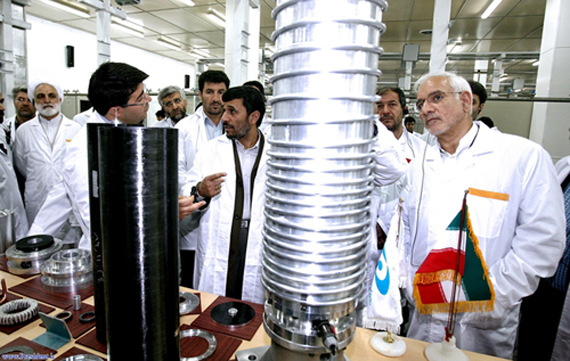
The clock marking off the time it may take Iran to produce enough highly enriched uranium (HEU) to pose a credible military nuclear threat is ticking more slowly than was once assumed.

That's the consensus of experts in the non-government arms control community, according to a briefing today by Ivan Oelrich and Ivanka Barzashka of the Federation of American Scientists in Washington, D.C.

Oelrich, a nuclear physicist and FAS vice president, and Barzashka, a FAS researcher, concluded last fall that estimates of Iran's potential HEU production rate should be lowered dramatically. Their assessment--based on an analysis of measurements made in Iran by inspectors for the International Atomic Energy Agency--appeared in last fall in the Bulletin of the Atomic Scientists. It drew skepticism at first, Oelrich says. But after a vigorous debate, others now appear to have accepted the idea that Iran's potential production rate of HEU (processed to yield 20% U-235) is only one-half to one-fifth as high as earlier estimates.

This downsizing is based on the performance of finicky centrifuges used to churn out HEU at Iran's main uranium processing facility in Natanz. The machines are far less efficient than the European-made ones from which they are illicit copies. Iran has put a huge effort into HEU production. But assessments by some nuclear experts--such as recent notes in blogs by Jeffrey Lewis of the New America Foundation and David Albright and Jaqueline Shire of the Institute for Science and International Security—suggest that Iran will be hard-pressed to turn out even small quantities (a few kilograms) of HEU in a year. Iran says that new, more efficient centrifuges will go online this spring. More >>>

Unknown at 4:40 AM

Sunday, February 14, 2010

Greg Mortenson’s Stones into Schools

Unknown at 8:15 PM
‹
›
Home
View web version

About SASSI

Unknown
View my complete profile
Powered by Blogger.