The SASSI Blog

SASSI is an independent think tank dedicated to promoting peace and stability in South Asia. We are headquartered in Islamabad, Pakistan and we aim to make a leading contribution to regional and international academic and policy-orientated research discourses about South Asian security.

Saturday, August 28, 2010

Iran goes nuclear

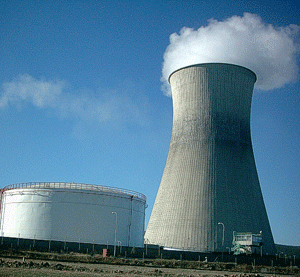
Russia turned on the switch to Iran's first nuclear power plant on Aug. 21 after repeated delays and more than 15 years of construction. 
The hard-liners in Iran celebrated it as a victory over "the Great Satan," repeating the famous phrase by Ayatollah Ruhollah Khomeini, father of the Islamic revolution. Their message: America can't do a damned thing.
The Iranians have managed to open a second front for their nuclear bomb project. The Bushehr nuclear power plant is now untouchable because any military action against its reactor containing plutonium would lead to widespread deadly contamination throughout the region. More >>>
Unknown at 12:51 PM

Wednesday, August 18, 2010

Desperation outpaces flood aid in Pakistan - CNN

Unknown at 6:22 AM

Rescuing Pakistan


Our view: U.S. has no choice but to hope that massive aid for flood victims will improve America's standing in key strategic nation 


The U.S.-Pakistan relationship is critical to American security interests and the fight against terrorism. It has also been marked in recent years by a jarring note of suspicion and distrust on both sides about the ultimate intentions of the other. U.S. officials have expressed increasing frustration with the Pakistani army's apparent unwillingness to go after Taliban insurgents based along the country's border with Afghanistan.


That's why the American response to one of Pakistan's worst-ever natural disasters is of such extraordinary importance. More >>>
Unknown at 1:18 AM

Monday, August 16, 2010

Pakistan floods global aid 'pitiful' - Clegg


The international response to the devastating floods in Pakistan has been "absolutely pitiful", Deputy Prime Minister Nick Clegg says. 

He said the UK was "doing a lot", but donations may still be less than hoped for because the public was "struggling to understand" the scale of the crisis.

Mr Clegg spoke as the Disasters Emergency Committee (DEC) said the total raised by Britons was now £15m.
At least 1,600 people are known to have died in the monsoon floods.
The Pakistani government says up to 20 million people have been affected and some six million are estimated to need urgent food aid.
Aid agencies say survivors, especially children, were also at risk from diseases such as cholera. More >>

Unknown at 11:41 AM

Friday, August 13, 2010

Bombing Iran

On the one hand, it's pretty hard to envision Barack Obama--whose candidacy was partly premised on reconciling America with the Muslim world--launching a military strike on Iran's  nuclear facilities. 


On the other hand you have data points like Jeffrey Goldberg's latest Atlantic opus, in which White House officials insist that "President Obama has by no means ruled out counterproliferation by force." Goldberg spends some time looking at the question of whether and how Israel might coordinate with Washington should Bibi Netanyahu decide that only force can deny Ahmadinejad and Khamenei the bomb

Read more: http://swampland.blogs.time.com/2010/08/13/bombing-iran/#ixzz0wWhIiVW0
Unknown at 3:10 PM

Thursday, August 12, 2010

Long, hot summer of fire, floods fits predictions


NEW YORK — 12 August 2010 - Floods, fires, melting ice and feverish heat: From smoke-choked Moscow to water-soaked Pakistan and the High Arctic, the planet seems to be having a midsummer breakdown. It's not just a portent of things to come, scientists say, but a sign of troubling climate change already under way.


The weather-related cataclysms of July and August fit patterns predicted by climate scientists, the Geneva-based World Meteorological Organization says — although those scientists always shy from tying individual disasters directly to global warming.

The experts now see an urgent need for better ways to forecast extreme events like Russia's heat wave and wildfires and the record deluge devastating Pakistan. They'll discuss such tools in meetings this month and next in Europe and America, under United Nations, U.S. and British government sponsorship.

"There is no time to waste," because societies must be equipped to deal with global warming, says British government climatologist Peter Stott More >>>
.

Unknown at 9:42 AM

Thursday, August 5, 2010

Arab States To Go Nuclear

Arab States Go Nuclear to Close Power Gap, Catch Up With Iran
Aug 5, 2010 - Historically, it has proven extremely difficult for countries in the Middle East to build  nuclear power plants. The idea of commercial reactors secretly processing weapons-grade nuclear material has always alarmed Washington, which for decades has used its clout in the region to keep the Mideast as nuclear-free as possible.

Today the U.S. is leading the way in imposing sanctions on Iran’s nuclear program. Israel also remains ready to protect its interests, as it did when its air force bombed the unfinished Osirak reactor in Iraq in 1981.
More >>>
Unknown at 1:06 PM

Tuesday, August 3, 2010

Pakistan Is Losing War With Taliban, Zardari Says

LONDON — On the eve of an official visit to Britain,Pakistan’s president, Asif Ali Zardari, was quoted in a French newspaper on Tuesday as saying that coalition forces were losing the war in Afghanistan because they had “lost the battle for the hearts and minds” of Afghans, and that theTaliban’s success lay “in knowing how to wait” for NATOforces to withdraw. 

The interview in the Le Monde appeared as Mr. Zardari headed for a five-day visit to Britain after talks in France, including a meeting at the Élysée Palace with PresidentNicolas Sarkozy, that officials on both sides described as harmonious. More >>>
Unknown at 11:43 AM

Monday, August 2, 2010

Is climate change South Asia's deadliest threat?


Tackling climate change is one of the most pressing issues facing South Asia. Regional leaders are meeting in Bhutan this week, but are they any nearer agreeing  to an action plan? The BBC's Navin Singh Khadka reports.
The issue of climate change is the main item on the agenda of the summit of the South Asian Association for Regional Cooperation (Saarc) summit under way in the Bhutanese capital Thimpu.
But given the poor track record of co-operation achieved by the regional grouping over other sensitive issues in the past, will the thorny issue of climate change become bogged down in rhetoric and recriminations?
Experts say the vulnerability of the region to climate change means that there is an urgent need for concrete action. More >>>
Unknown at 6:59 AM
‹
›
Home
View web version

About SASSI

Unknown
View my complete profile
Powered by Blogger.