Showing posts with label nuclear devices. Show all posts

Sunday, September 6, 2015

The Russell-Einstein Manifesto Fifty Years On

In the tragic situation which confronts humanity, we feel that scientists should assemble in conference to appraise the perils that have arisen as a result of the development of weapons of mass destruction, and to discuss a resolution in the spirit of the appended draft.

Dr. Albert Einstein

We are speaking on this occasion, not as members of this or that nation, continent, or creed, but as human beings, members of the species Man, whose continued existence is in doubt. The world is full of conflicts; and, overshadowing all minor conflicts, the titanic struggle between Communism and anti-Communism. Almost everybody who is politically conscious has strong feelings about one or more of these issues; but we want you, if you can, to set aside such feelings and consider yourselves only as members of a biological species which has had a remarkable history, and whose disappearance none of us can desire. We shall try to say no single word which should appeal to one group rather than to another. All, equally, are in peril, and, if the peril is understood, there is hope that they may collectively avert it. We have to learn to think in a new way. We have to learn to ask ourselves, not what steps can be taken to give military victory to whatever group we prefer, for there no longer are such steps; the question we have to ask ourselves is: what steps can be taken to prevent a military contest of which the issue must be disastrous to all parties?

http://www.spokesmanbooks.com/Spokesman/PDF/85russein.pdf


Friday, May 22, 2015

Book Review "The Path To Zero: Dialogues On Nuclear Dangers" By Richard Falk And David Krieger

This book ought to be required reading for college students everywhere in the world, and also for decision-makers.

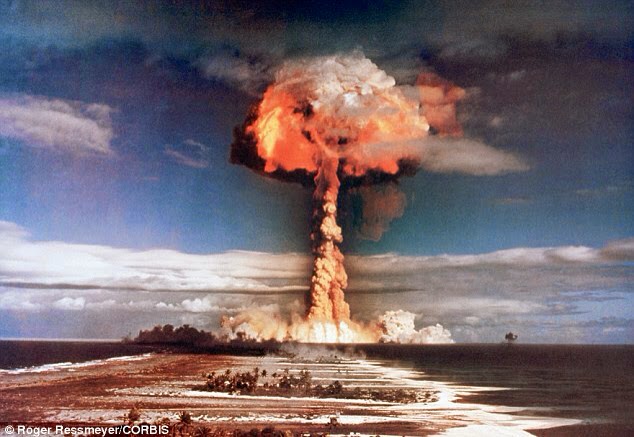
Mushroom cloud from the atomic bombing of Nagasaki on August 9, 1945

It shakes us out of our complacency and makes us realize that widespread, immediate and dedicated public action is urgently needed if we are to save human civilization and the biosphere from a thermonuclear catastrophe. The book is published by Paradigm Publishers, 2845 Wilderness Place, Boulder, CO 80301, USA. (www.paradigmpublishers.com) On the back cover there are endorsements, with which I entirely agree, by Archbishop Desmond Tutu and David Ellsberg.

“We are greatly privileged, like flies on the wall, to join this conversation between two remarkable stalwarts. Richard Falk and David Krieger, in the campaign for a nuclear-free world. It is unconscionable that so many of us seem to accept the prospect of our 'mutually assured destruction', the immoral massacre of millions of civilians, and to view with equanimity such a gross violation of international law. Falk and Krieger discuss persuasively and cogently the folly of reliance on nuclear weapons that can cause apocalyptic devastation. If we want to survive in a habitable world, then we have no choice: we must heed, and do so urgently, these lovers of mankind.” Archbishop Desmond Tutu, Nobel Peace Laureate

“In 'The Path to Zero', Falk and Krieger engage in a stunningly eloquent dialogue on a range of nuclear dangers, and our common responsibility to put an end to them. This is urgent reading for citizens, scientists, policy-makers and political leaders, actually for anyone who cares about the future of civilization and life on earth”, Daniel Ellsberg, Whistleblower

Other enthusiastic endorsements come from Jonathan Schell, Commander Robert Green and Maude Barlow.

The book has ten chapters: 1 The Nuclear Age; 2 Nuclear Deterrence; 3 Nuclear Proliferation; 4 Nuclear Arms Control and Nuclear Disarmament; 5 Nuclear Weapons and Militarism; 6 Nuclear Weapons and Nuclear Energy; 7 Nuclear Weapons and International Law; 8 Nuclear Weapons, Culture and Morality; 9 Nuclear Weapons and Democracy; 10 The Path to Zero.

The two authors

Richard Falk is Albert G. Milbank Professor of International Law and Practice Emeritus at Princeton, where he was a member of the faculty for 40 years. Since 2002 he has been a research professor at the University of California-Santa Barbara. He has been Special Rapporteur on Occupied Palestine for the UN Human Rights Council since 2008, and served on a panel of experts appointed by the President of the UN General Assembly, 2008-2009. He is the author or editor of numerous books, including “Legality and Legitimacy in Global Affairs” (Oxford 2012).

David Krieger is a Founder of the Nuclear Age Peace Foundation, and has served as President of the Foundation since 1982. Under his leadership, the Foundation has initiated many innovative projects for building peace, strengthening international law, abolishing nuclear weapons, and empowering peace leaders. Among other leadership positions, he is one of 50 Councilors from around the world on the World Future Council. He is the author and editor of numerous books and articles related to achieving peace in the Nuclear Age. A graduate of Occidental College, he holds MA and PhD degrees in political science from the University of Hawaii.

Flaws in the concept of nuclear deterrence

In discussing the concept of nuclear deterrence, the two authors emphasize the fact that it violates the fundamental ethical principles of every major religion. Dr. Krieger comments:

Krieger: “Who are we? What kind of culture would be content to base its security on threatening to murder hundreds of millions of innocent people? ”

The two authors also point out that the idea of deterrence is an unproved theory, based on the assumption that accidents will not happen, and that leaders are always rational. In fact, we know historically that the world has come extremely near to accidental nuclear war on very numerous occasions, and there are also many historical instances of irrational behavior by leaders. This cannot continue indefinitely without a catastrophe. See:http://www.cadmusjournal.org/article/issue-4/flaws-concept-nuclear-deterrance

The illegality of nuclear weapons

As Dr. Krieger and Prof. Falk point out, the threat or use of nuclear weapons violates international law. The fact that planning an aggressive war or conducting one is a crime according to the Nuremberg Principles is discussed. The two authors also review in detail the 1996 Advisory Opinion of the International Court of Justice, which was asked by the UN General Assembly and the World Health Organization to rule on the legality of the threat or use of nuclear weapons. The ICJ ruled that under almost all circumstances, the threat or use of nuclear weapons would be illegal. The only possible exception was the case where a country might be under attack and its very survival threatened. The Court gave no ruling on this extreme case. Finally, the ICJ ruled unanimously that states possessing nuclear weapons have an obligation to get rid of them within a short time-frame.

Falk: “It may be time for the General Assembly to put this question to the ICJ: What legal consequences arise from the persistent failure of the nuclear weapon states to fulfill their obligations under Article VI of the NPT. In my view, the nonnuclear states have also been irresponsible in not insisting on on mutuality of respect in the nonproliferation setting. It may be up to civil society actors to bring wider attention to this disrespect for the vital norms of international law...”

http://www.icj-cij.org/docket/files/93/7407.pdfhttp://www.currentconcerns.ch/index.php?id=711https://www.wagingpeace.org/author/john-avery/http://human-wrongs-watch.net/2015/03/27/tactical-nuclear-weapons-in-europe-the-dangers-are-very-great-today/http://www.countercurrents.org/avery250514.htm

Colonialism and exceptionalism

Falk: “We need to remember that the expansion of Europe at the expense of the non-Western world rested on violence and the superiority of European weaponry and strategic logistics, including naval power. This link between Western militarism and historical ascendancy is, in my view, one of the deep reasons why there is such an irrational attachment to nuclear weaponry, making it very diffiicult to renounce as the supreme expression of political violence.”

Krieger: “I would like to add that there is a general orientation in much of Western society to subordinate international law to geopolitical desire, in other words, not to allow international law to be a limiting factor in seeking geopolitical advantage. International law is thus applied when useful and ignored when self-interest and convenience dictate. This is a striking manifestation of the double standards that have served the interests of the powerful in both the colonial and postcolonial worlds.”

http://www.informationclearinghouse.info/article41866.htmhttp://www.informationclearinghouse.info/article36494.htm

The Nuclear Non-Proliferation Treaty

In discussing the Nuclear Non-Proliferation Treaty, Prof. Falk and Dr. Krieger point out that that it has several serious flaws: It is unsymmetrical, giving a special status to the nuclear weapons states, and forbidding all others to possess these weapons. The treaty encourages the “peaceful” use of nuclear energy, which in practice opens the door to acquisition of nuclear weapons by many nations and which exposes the world to radioactive fallout from accidents like Chernobyl and Fukushima, and very long-term dangers from radioactive wastes. Finally, membership in the NPT is not universal. Here are some comments by the two authors:

Falk: “In my view, the failure of the nuclear weapon states to pursue nuclear disarmament over a period of more than forty years, despite the injunction to do so by the International Court of Justice, is a material breach of the NPT that would give any party the option of pronouncing the treaty void.”

Krieger: “It would be wonderful to see a strong and concerted effort by non-nuclear-weapon states to challenge the nuclear weapons club. I think that the most effective thing that such states could do would be to start the process of negotiating a nuclear weapons convention and, if necessary, to do it without the nuclear weapon states.”

Falk: “My proposal is a two-year ultimatum by as many nonnuclear states as possible, threatening to withdraw from the NPT unless serious nuclear disarmament negotiations get underway.”

Dr. Krieger is not in complete agreement with Prof. Falk regarding such an ultimatum. He feels that even though it is flawed in many ways, it is still so valuable that its continuation ought not to be threatened.

Krieger: “One of the great problems with the NPT is that it encourages the peaceful use of nuclear energy, which actually opens the door to nuclear weapons proliferation. It ends up making the treaty work against itself. Of course, Israel is not a party to the treaty, nor are India and Pakistan. This demonstrates a fundamental weakness of international law, that is, the exemption of nations that do not sign a treaty from the law. This would be unworkable in domestic law, and it is equally so in international law.”

Krieger: “The nuclear plant operators are willing to downplay for short-term gain the catastrophic risks that are involved in the use of nuclear reactors to boil water. They are wiling to generate wastes that will adversely affect the health and well-being of of untold generations to follow us on the planet. ¡K The tragedy is that governments embrace and support this industry, demonstrating that they also do not place the interests of their people and the future at the forefront of their planning and decision making.”

http://www.baselpeaceoffice.org/article/global-wave-2015-and-peace-planet-un-nuclear-non-proliferation-conference

No first use; no hair-trigger alerted missiles

In their concluding chapter, the two authors agree that a No First Use declaration could be a useful first step. Prof. Falk comments:

Falk: “What conceivable justification, consistent with a deterrence rationale for the retention of nuclear weapons, is there for not assuring other governments that the United States will only use such weaponry in retaliation a prior attack with nuclear weaponry? It is rather clear that such a declaration, especially if backed up by non-nuclear deployments, would both give the United States some new claim to leadership with respect to the weaponry and exert enormous psychological pressure on other nuclear weapon states to follow the American lead.”

This, of course, could be linked to taking all nuclear weapons systems off hair-trigger alert, which is probably the most important first step towards avoiding the catastrophe of an accidental nuclear war. Dr Krieger comments:

Krieger: “Those responsible for maintaining nuclear arsenals on hair-trigger alert are delusional if they think that it can be maintained indefinitely without dire consequences.”

Developments since the publication of the book

Since the publication of Prof. Falk and Dr. Krieger's book in 2012, several events have taken place which the authors probably would have discussed if they had occurred earlier. For example, on 2 April, 2013, the Arms Trade Treaty was passed by a massive majority by a direct vote in the UN General Assembly. The ATT had remained blocked for more than 10 years in the consensus-bound Conference on Disarmament in Geneva. Its passage gives us hope that a Nuclear Weapons Convention can similarly be passed by a direct vote in the UN General Assembly, where the vast majority of nations are in favor of the complete abolition of nuclear weapons. Even if bitterly opposed by the nuclear weapons states, a Nuclear Weapons Convention would have great normative value.http://www.cadmusjournal.org/article/issue-6/arms-trade-treaty-opens-new-possibilities-un

Another development which Prof. Falk and Dr. Krieger would certainly have discussed, had it occurred earlier, is an heroic law suit by the Republic of the Marshall Islands, suing the nuclear weapons states for violation of Article VI of the Nuclear Non-Proliferation Treaty. In fact Dr. Krieger and his organization, the Nuclear Age Peace Foundation, are actively supporting the Marshall Islands in this David-versus-Goliath-like law suit. http://www.wagingpeace.org/tag/marshall-islands/

Finally, the two authors would probably have discussed the hubris of Washington's power-holders in threatening war with both Russia and China. The effect of this colossally misguided US action has been to firmly unite China and Russia. In fact the BRICS countries, with their vast resources, are now moving away from using the dollar as a reserve currency for international trade. The probable effect will be the collapse of the already-strained US economy, and as a consequence, the fall of the US Empire. Prof. Falk and Dr. Krieger both wonder whether they have been too America-centric in their discussions of nuclear abolition. The probable fall of the United States from its present position of global hegemony may mean that US leadership will not, in the future, be the key to nuclear abolition.http://www.countercurrents.org/roberts110515.htmhttp://www.truth-out.org/opinion/item/19734-hubris-versus-wisdomhttp://beforeitsnews.com/alternative/2014/04/wolfowitz-doctrine-us-plans-for-russia-2945824.html

Some conclusions

When the Cold War ended in 1991, many people heaved a sigh of relief and concluded that they no longer had to worry about the threat of a nuclear Armageddon. Prof. Falk and Dr. Krieger show us that this comforting belief is entirely false, that the dangers are greater than ever before, and that it is vital to bring this fact to the urgent attention of today's young people, who were born long after the tragic nuclear destruction of Hiroshima and Nagasaki, or perhaps even born after the end of the Cold War.

Ultimately, the complete abolition of nuclear weapons is linked with a change of heart, the replacement of narrow nationalism by loyalty to humanity as a whole, and the replacement of militarism by a just and enforcible system of international law.

John Avery received a B.Sc. in theoretical physics from MIT and an M.Sc. from the University of Chicago. He later studied theoretical chemistry at the University of London, and was awarded a Ph.D. there in 1965. He is now Lektor Emeritus, Associate Professor, at the Department of Chemistry, University of Copenhagen. Fellowships, memberships in societies: Since 1990 he has been the Contact Person in Denmark for Pugwash Conferences on Science and World Affairs. In 1995, this group received the Nobel Peace Prize for their efforts. He was the Member of the Danish Peace Commission of 1998. Technical Advisor, World Health Organization, Regional Office for Europe (1988- 1997). Chairman of the Danish Peace Academy, April 2004. http://www.fredsakademiet.dk/ordbog/aord/a220.htm. He can be reached at avery.john.s@gmail.com

Suggestions for further reading:

Ban Ki-moon. “The United Nations and security in a nuclear-weapon-free world.” Address to the East-West Institute, October 24, 2008. http://www.un.org/apps/news/infocus/sgspeeches/search_full.asp?statID=351

Green, Robert, “Breaking Free from Nuclear Deterrence.” Santa Barbara: Nuclear Age Peace Foundation, 10th Annual Frank K. Kelly Lecture on Humanity's Future, 2011, http://www.wagingpeace.org/wp-content/uploads/2013/06/2011_kelly_lecture.pdf

“Legality of the Threat or Use of Nuclear Weapons.” Advisory Opinion of the International Court of Justice, The Hague, July 8, 1996. http://www.icj-cij.org/docket/files/93/7407.pdf

McCloy-Zorin Accords. “Joint Statement of Agreed Principles for Disarmament Negotiations,” signed on September 20, 1961, unanimously adopted by the United Nations General Assembly on December 20, 1961. http://www.nuclearfiles.org/menu/key-issues/nuclear-weapons/issues/arms-control-disarmament/mccloy-zorin-accords_1961-09-20.htm

Model Nuclear Weapons Convention. “Convention on the Prohibition of the Development, Testing, Production, Stockpiling, Transfer, Use and Threat of Use of Nuclear Weapons and their Elimination, April 2007.” http://www.inesap.org/publications/nuclear-weapons-convention

Obama, Barak, Remarks of President Barak Obama, Hradcany Square, Prague, Czech Republic, April 5, 2009. http://prague.usembassy.gov/obama.html

Rotblat, Joseph, “Remember Your Humanity”, Nobel Lecture, Oslo, Norway, December 10, 1995, http://www.nobelprize.org/nobel_prizes/peace/laureates/1995/rotblat-lecture.html

Russell-Einstein Manifesto, issued in London, July 9, 1955, http://www.pugwash.org/about/manifesto.htm

Santa Barbara Declaration, “Reject Nuclear Deterrence: An Urgent Call to Action,” http://www.wagingpeace.org/santa-barbara-declaration-reject-nuclear-deterrence-an-urgent-call-to-action/

Treaty on the Non-Proliferation of Nuclear Weapons, entered into force on March 5, 1970.http://www.state.gov/www/global/arms/treaties/npt1.html

Vancouver Declaration. “Law's Imperative for the Urgent Achievement of a Nuclear-Weapon-Free World,” Vancouver, Canada, March 21, 2011. http://www.lcnp.org/wcourt/Feb2011VancouverConference/vancouverdeclaration.pdf


Thursday, December 4, 2014

UN Calls for Israel to 'Renounce Nuclear Weapons

The United Nations General Assembly overwhelmingly passed a resolution on Tuesday demanding that Israel "renounce possession of nuclear weapons" and open its arms to global regulation.

The measure, which is non-binding, was approved 161 to 5, with the United States, Canada, Palau, Micronesia, and Israel voting "no" and 18 countries abstaining.

Israel is the only Middle Eastern country that refuses to sign the Treaty on the Non-Proliferation of Nuclear Weapons, with India, Pakistan, and North Korea also declining.

While Israel does not publicly acknowledge its nuclear arsenal, its existence is widely known. A reportreleased by the Stockholm International Peace Research Institute this summer found that Israel unlawfully owns 80 nuclear warheads, making it the only Middle Eastern nuclear power.

Introduced by Egypt, the resolution calls for Israel to "accede to [the non-proliferation treaty] without further delay, not to develop, produce test or otherwise acquire nuclear weapons, to renounce possession of nuclear weapons." It also urges the state to subject itself to regulation by the International Atomic Energy Agency of the UN. More


Friday, August 8, 2014

Hiroshima and Nagasaki: The many retrospectives

Sixty-nine years ago, at 8:15 in the morning on August 6, the first atomic bomb exploded over Hiroshima. Three days later, another bomb was dropped on Nagasaki.

Estimates vary as to the number of people who died in those blasts, but the figure of at least 130,000 deaths for Hiroshima seems to be generally accepted, with another 70,000 for Nagasaki as of surveys conducted in November 1945.

With the anniversaries of those events have come many news and comment stories in the press. But how best to put the bombings into perspective, especially after so much time has passed? The problem—to loosely paraphrase Joseph Stalin, no stranger to death on an industrial scale—is that “one death is a tragedy, while a million deaths is a statistic.” (This is particularly true when dealing with dry analytical reports about security, which inevitably use phrases like “collateral damage,” “kilotons,” and “battlefield scenarios”—masking the fact that there are large numbers of very real human lives involved on the receiving end of a nuclear weapon.)

Consequently, some of the most powerful and compelling articles about the atomic bombing bring things back to the individual, dealing with just a single person and the most intimate, small details of his or her life at the moment of the bombing, as shown in this BBC multimedia piece on Hiroshima survivor Shinji Mikamo. For example, after the blast, while looking through the ruins of his family home, Mikamo found his father’s watch, which had stopped at precisely 8:15 am. In Mikamo’s words: “The unimaginable intense heat that reached several thousand degrees Fahrenheit from the blast had fused the shadows of the hands into the face of the timepiece, slightly displaced, leaving distinct marks where the hands had been at the moment of the explosion. It was enough to clearly see the exact moment the watch stopped.”

Other articles, such as this one in the Washington Post, tried a different approach to bring home the horror of the blasts. It focuses on a large and well-known symbol of the bombing: the dome of a concrete-and-steel structure that was one of the few buildings to survive the atomic blast in 1945. Now known as theHiroshima Peace Memorial, the building has become the epicenter of yearly memorials and services to remember the victims. Through the use of the article’s slide show, readers can see the dome as it looked immediately after the blast, and again over the years, until today. The memorial itself contains a museum with artifacts, exhibitions, and first-person survivor, or hibakusha, accounts.

There is something about seeing or hearing something first-hand, on-site; it really makes an impression. Knowing this, the mayor of Hiroshima asked leaders of nuclear-armed nations to see for themselves atomic bomb-scarred cities. “If you do, you will be convinced that nuclear weapons are an absolute evil that must no longer be allowed to exist,” Kazumi Matsui was quoted as saying by ABC News.

Not that there is anything wrong with standing back and taking a look at the big picture. Some media outlets have used the anniversary as an occasion to pause and think about nuclear weapons, such as thisTime magazine piece by Harvard's Elaine Scarry, which notes: “An appropriate way to reflect on these events might be to contemplate our current nuclear arsenal and ask why it is being kept in place. The U.S. has by far the most powerful arsenal on Earth. Our 14 Ohio-class submarines together carry the equivalent of at least 56,000 Hiroshima blasts. These ships are not a remnant of the Cold War. Eight were made after the opening of the Berlin Wall during the presidencies of George H.W. Bush and Bill Clinton.”

Over the years, of course, the Bulletin of Atomic Scientists has published its own rich lode of material—from all viewpoints—on the bombings of Hiroshima and Nagasaki. Highlights include The Sanctification of Hiroshima, a 1985 piece in which a physicist affiliated with the Manhattan Project supports the Hiroshima but not the Nagasaki bombing.

Meanwhile, John E. Coggle’s 1982 review of the 600-page book Hiroshima and Nagasaki: the Physical, Medical, and Social Effects of the Atomic Bombings, by The Committee for the Compilation of Materials on Damage Caused by the Atomic Bombs hews to a different perspective. Drawing on his background as a medical doctor, Coggle went over the informative, technical prose and the 200 statistical tables, diagrams, maps, and photographs that graphically depict the effects of thermal radiation, the shock wave and ionizing radiation, short-term and long-term biological effects, and the social and psychological impacts. Coggle used the phrase “encyclopedia of horror” to describe the book’s un-nerving but necessary content, noting: “As a radiation biologist one sees the words ‘Hiroshima and Nagasaki’ quite frequently but only in the arid academic context of science…”

At the end of the day, it can be worthwhile on the Hiroshima and Nagasaki anniversaries to think about the personal and the emotional—while keeping such clinical data in mind and ready to hand when it is necessary to debate proponents of ideas such as “battlefield nuclear weapons,” “limited nuclear war,” and the use of select nuclear strikes as a form of “de-escalation.”

Therefore, perhaps the most compelling of the stories in the Bulletin archive is a first-person recollection,Hiroshima Memories, by Hideko Tamura Friedman, who was just a young girl back on August 6, 1945. After moving to the United States and becoming a therapist in private practice and a part-time social worker in the Radiation Oncology Department at the University of Chicago Hospitals, Hideko excerpted this 1995 article from a longer, unpublished manuscript she was working on.

Hideko describes how she was reading a book when “a huge band of white light fell from the sky down to the trees.” She jumped up and hid behind a large pillar as an explosion shook the earth and pieces of the roof fell about her.

Hideko survived; some members of her family did not. “My father,” she wrote in in a heart-rending statement of fact, “brought Mama’s ashes home in his army handkerchief.”

Editor’s note: The Bulletin’s archives from 1945 to 1998, complete with the original covers and artwork, can be found here. http://books.google.ca/books?id=-wsAAAAAMBAJ&source=gbs_all_issues_r&cad=1. Anything after 1998 can be found via the search engine on the Bulletin’s home page.


Tuesday, August 5, 2014

Noam Chomsky, Why National Security Has Nothing to Do With Security

Think of it as the true end of the beginning. Last week, Theodore "Dutch" Van Kirk, the final member of the 12-man crew of the Enola Gay, the plane (named after its pilot’s supportive mother) that dropped the atomic bomb on Hiroshima, died at age 93.

Paul Tibbetts, Jr. in cockpit

When that first A-bomb left its bomb bay at 8:15 on the morning of August 6, 1945, and began its descent toward its target, the Aioli (“Live Together”) Bridge, it was inscribed with a series of American messages, some obscene, including “Greetings to the Emperor from the men of the Indianapolis.” (That ship had delivered to the Pacific island of Tinian parts of the very bomb that would turn Hiroshima into an inferno of smoke and fire -- “that awful cloud,” Paul Tibbetts, Jr., theEnola Gay's pilot, would call it -- and afterward was torpedoed by a Japanese submarine with the loss of hundreds of sailors.)

The bomb, dubbed Little Boy, that had gestated in the belly of the Enola Gay represented not only the near endpoint of a bitter global war of almost unimaginable destruction, but the birthing of something new. The way for its use had been paved by an evolution in warfare: the increasing targeting of civilian populations from the air (something that can be seen again today in the carnage of Gaza). The history of that grim development extends from German airship bombings of London (1915) by way of Guernica (1937), Shanghai (1937), and Coventry (1940), to the fire bombings of Dresden (1945) and Tokyo (1945) in the last year of World War II. It even had an evolutionary history in the human imagination, where for decades writers (among others) had dreamed of the unparalleled release of previously unknown forms of energy for military purposes.

On August 7, 1945, a previous age was ending and a new one was dawning. In the nuclear era, city-busting weapons would be a dime a dozen and would spread from the superpowers to many other countries, including Great Britain, China, India, Pakistan, North Korea, and Israel. Targeted by the planet’s major nuclear arsenals would be the civilian inhabitants not just of single cities but of scores and scores of cities, even of the planet itself. On August 6th, 70 years ago, the possibility of the apocalypse passed out of the hands of God or the gods and into human hands, which meant a new kind of history had begun whose endpoint is unknowable, though we do know that even a “modest” exchange of nuclear weapons between India and Pakistan would not only devastate South Asia, but thanks to the phenomenon of nuclear winter also cause widespread famine on a planetary scale.

In other words, 70 years later, the apocalypse is us. Yet in the United States, the only nuclear bomb you're likely to read about is Iran’s (even though that country possesses no such weapon). For a serious discussion of the U.S. nuclear arsenal, those more than 4,800 increasingly ill-kept weapons that could incinerate several Earth-sized planets, you need to look not to the country’s major newspapers or news programs but to comic John Oliver -- or TomDispatch regular Noam Chomsky. Tom

How Many Minutes to Midnight?
Hiroshima Day 2014

If some extraterrestrial species were compiling a history of Homo sapiens, they might well break their calendar into two eras: BNW (before nuclear weapons) and NWE (the nuclear weapons era). The latter era, of course, opened on August 6, 1945, the first day of the countdown to what may be the inglorious end of this strange species, which attained the intelligence to discover the effective means to destroy itself, but -- so the evidence suggests -- not the moral and intellectual capacity to control its worst instincts.

Day one of the NWE was marked by the “success” of Little Boy, a simple atomic bomb. On day four, Nagasaki experienced the technological triumph of Fat Man, a more sophisticated design. Five days later came what the official Air Force history calls the “grand finale,” a 1,000-plane raid -- no mean logistical achievement -- attacking Japan’s cities and killing many thousands of people, with leaflets falling among the bombs reading “Japan has surrendered.” Truman announced that surrender before the last B-29 returned to its base.

Those were the auspicious opening days of the NWE. As we now enter its 70th year, we should be contemplating with wonder that we have survived. We can only guess how many years remain.

Some reflections on these grim prospects were offered by General Lee Butler, former head of the U.S. Strategic Command (STRATCOM), which controls nuclear weapons and strategy. Twenty years ago, he wrote that we had so far survived the NWE “by some combination of skill, luck, and divine intervention, and I suspect the latter in greatest proportion.”

Reflecting on his long career in developing nuclear weapons strategies and organizing the forces to implement them efficiently, he described himself ruefully as having been “among the most avid of these keepers of the faith in nuclear weapons.” But, he continued, he had come to realize that it was now his “burden to declare with all of the conviction I can muster that in my judgment they served us extremely ill.” And he asked, “By what authority do succeeding generations of leaders in the nuclear-weapons states usurp the power to dictate the odds of continued life on our planet? Most urgently, why does such breathtaking audacity persist at a moment when we should stand trembling in the face of our folly and united in our commitment to abolish its most deadly manifestations?”

He termed the U.S. strategic plan of 1960 that called for an automated all-out strike on the Communist world “the single most absurd and irresponsible document I have ever reviewed in my life.” Its Soviet counterpart was probably even more insane. But it is important to bear in mind that there are competitors, not least among them the easy acceptance of extraordinary threats to survival.

Survival in the Early Cold War Years

According to received doctrine in scholarship and general intellectual discourse, the prime goal of state policy is “national security.” There is ample evidence, however, that the doctrine of national security does not encompass the security of the population. The record reveals that, for instance, the threat of instant destruction by nuclear weapons has not ranked high among the concerns of planners. That much was demonstrated early on, and remains true to the present moment.

In the early days of the NWE, the U.S. was overwhelmingly powerful and enjoyed remarkable security: it controlled the hemisphere, the Atlantic and Pacific oceans, and the opposite sides of those oceans as well. Long before World War II, it had already become by far the richest country in the world, with incomparable advantages. Its economy boomed during the war, while other industrial societies were devastated or severely weakened. By the opening of the new era, the U.S. possessed about half of total world wealth and an even greater percentage of its manufacturing capacity.

There was, however, a potential threat: intercontinental ballistic missiles with nuclear warheads. That threat was discussed in the standard scholarly study of nuclear policies, carried out with access to high-level sources -- Danger and Survival: Choices About the Bomb in the First Fifty Years by McGeorge Bundy, national security adviser during the Kennedy and Johnson presidencies.

Bundy wrote that “the timely development of ballistic missiles during the Eisenhower administration is one of the best achievements of those eight years. Yet it is well to begin with a recognition that both the United States and the Soviet Union might be in much less nuclear danger today if [those] missiles had never been developed.” He then added an instructive comment: “I am aware of no serious contemporary proposal, in or out of either government, that ballistic missiles should somehow be banned by agreement.” In short, there was apparently no thought of trying to prevent the sole serious threat to the U.S., the threat of utter destruction in a nuclear war with the Soviet Union.

Could that threat have been taken off the table? We cannot, of course, be sure, but it was hardly inconceivable. The Russians, far behind in industrial development and technological sophistication, were in a far more threatening environment. Hence, they were significantly more vulnerable to such weapons systems than the U.S. There might have been opportunities to explore these possibilities, but in the extraordinary hysteria of the day they could hardly have even been perceived. And that hysteria was indeed extraordinary. An examination of the rhetoric of central official documents of that moment like National Security Council Paper NSC-68 remains quite shocking, even discounting Secretary of State Dean Acheson’s injunction that it is necessary to be “clearer than truth.” Read More


Monday, July 21, 2014

Life after a nuclear war revealed: Computer models reveal Earth would suffer a 20-year-long winter and worldwide famine

The terrible fate of Earth after a nuclear war has been mapped out using computer models for the first time.

Worldwide famine, deadly frosts, global ozone losses of up to 50 per cent and more would greet any inhabitants of the planet still remaining after a nuclear conflict.

And the researchers hope their study of what they call a relatively 'small' nuclear war will serve as a deterrent against such weapons being used by any nation in the future.

THE AFTERMATH OF NUCLEAR WAR ACCORDING TO THE STUDY

Year 0

Five megatons of black carbon released into the atmosphere, which absorbs sunlight and begins to cool the planet. Black carbon rain also kills millions.

Year 1

Average surface temperature drops by 1°C (2°F).

Year 2

Crop growing season is shortened by 10 to 40 days.

Year 5

Earth is an average of 1.5°C (3°F) colder than the present day, colder than it has been in 1,000 years. There is also nine per cent less rainfall. The ozone is also up to 25 per cent thinner, increasing UV rays on Earth.

Year 10

Ozone recovers slightly to just 8 per cent less than modern day.

Year 20

Planet warms slightly to 0.5°C (1°F) lower than the present day.

Year 26

Rainfall increases to about 4.5 per cent less than today.

In it the researchers looked at the outcome of a ‘limited, regional nuclear war between India and Pakistan in which each side detonates 50 15-kiloton weapons.’

They then used computer models to examine the impact on the planet and its environment - and it makes for grim reading.

The immediate result of 100 nuclear weapons roughly the size of those dropped on Hiroshima and Nagasaki being detonated would be the release of five megatons of black carbon into the atmosphere.

Black carbon, not too dissimilar to soot, would block out the sun and can also be fatal to humans.

Following a spell of black carbon rain, a deadly weather front that would devastate what remained of humanity following the nuclear war, the temperature of Earth would begin to drop.

After a year the temperature would fall by 1°C (2°F), while after five it would be 1.5°C (3°F) cooler than it is now.

About 20 years after the conflict it would warm again to just 0.5°C (1°F) below today’s temperature.

Accompanying what the researchers call ‘the coldest average surface temperatures in the last 1,000 years’ would be a huge loss in ozone levels. They say that global ozone losses of 20 to 50 per cent would occur over populated areas, ‘levels unprecedented in human history

The drop in temperature would produce ‘killing frosts’ that reduce the world’s growing season by 10 to 40 days.

Meanwhile the eradication of up to half of the ozone would increase UV rays in some locations by as much as 80 per cent, raising the chance of developing skin cancer for large swathes of humanity.

Combined with the global cooling, this ‘would put significant pressures on global food supplies and could trigger a global nuclear famine.’

The planet’s falling temperature would also decrease the amount of rainfall.

Five years after the conflict Earth would see 9 per cent less rain, while 26 years after the war there would still be 4.5 per cent less rain.

The result of all this would be devastation and ultimately death for hundreds of millions, and perhaps billions.

But the researchers hope that their example of a relatively small nuclear war between two modestly armed nuclear nations, India and Pakistan, will encourage superpowers such as the U.S. and Russia to discuss nuclear disarmament.

‘Knowledge of the impacts of 100 small nuclear weapons should motivate the elimination of more than 17,000 nuclear weapons that exist today,’ they write. More

Above: US Missile Control Centre

Friday, June 20, 2014

India's Nuclear Doctrine: Stirrings of Change

In the beginning of April 2014, at a conference initiated by the Indian government, Manmohan Singh casually urged the creation of a global convention to forswear the first use of nuclear weapons. Why the Indian prime minister chose to make this major policy declaration in the last hours of his term in office is a mystery.
To unravel this mystery, it is important to note the context. Singh was addressing a conference at the Institute for Defense Studies and Analyses (IDSA) titled “A Nuclear Weapon-Free World: From Conception to Reality.” The IDSA is supported by the Indian Ministry of Defense and has been a favored venue for India’s leadership to make important policy declarations on national security. The Indian bureaucracies that deal with foreign policy and security issues often use this forum to articulate their preferences on arms control, nonproliferation, and disarmament issues. It would be natural if these bureaucracies wished to commend the virtues of continuity in policy to the new Indian government headed by Prime Minister Narendra Modi, who took office in May 2014.

Following Singh’s remarks, the then opposition Bharatiya Janata Party (BJP) instantly issued a rejoinder in its election manifesto, stating that the party “believes that the strategic gains acquired by India during the [earlier BJP-led] Atal Behari Vajpayee regime on the nuclear programme have been frittered away by [Singh’s] Congress.” Hence, the BJP pledged to “study in detail India’s nuclear doctrine, and revise and update it, to make it relevant to [the] challenges of current times.”

BJP spokespeople clarified that a review of India’s no-first-use policy would be accorded priority if the party came to power. This evoked great concern in some quarters that the BJP would abandon no first use, which has been a central feature of India’s nuclear doctrine since the country conducted a series of nuclear tests in 1998 and established itself as a nuclear weapons state. The BJP’s Modi, campaigning for the 2014 election, subsequently declared that there would be “no compromise” on no first use, which reflected India’s “cultural inheritance” (whatever that means). But as the respected Economic and Political Weekly commented in an editorial: “Given the BJP’s naturally aggressive posture, such clarifications must be viewed with some scepticism and it is legitimate to explore what may be on the agenda.”

All this rhetoric is par for the course in the heated atmosphere of the Indian electoral process. Disconcertingly, both the Congress party and the BJP have forgotten the historical record. India’s no-first-use policy was originally declared by the BJP and the National Democratic Alliance government after it conducted the May 1998 nuclear tests. The prime minister at the time, Atal Behari Vajpayee, stated thereafter that India would pursue a policy of no first use of nuclear weapons vis-à-vis other nuclear-armed states and would not use these weapons against nonnuclear countries. This restraint was also embedded in the BJP’s draft nuclear doctrine , declared in August 1999, which took several years to be finalized. It was finally endorsed by the Cabinet Committee on Security and officially promulgated in January 2003.

Consequently, India’s no-first-use policy and its nuclear doctrine are BJP formulations. The Congress party adopted them and, with Singh’s April speech, simply sought to extend no first use globally. This makes the BJP’s concern with its own no-first-use policy and nuclear doctrine part of the mystery of Singh’s proposal.

The Limitations of Nuclear Deterrence

There are valid grounds to revisit India’s nuclear doctrine, as much has happened over the intervening years that challenges the assumptions made by the BJP. On the conceptual front, the limitations of nuclear deterrence have become apparent. In important ways, India’s acquisition of nuclear weapons has not increased its security.

While nuclear weapons have obvious relevance for the external dimensions of national security, they cannot ameliorate threats to India’s territorial integrity that arise from domestic discontent or from crossborder militancy and terrorism emanating from Pakistan. In other words, nuclear weapons cannot provide any defense against the subconventional threats to India’s national security from extremist elements within its own territory or, especially, against those who receive moral and material assistance from across the border. As Singh repeatedly warned, the internal threats to India’s national security are critical to its overall national security challenges. Nuclear weapons provide no defense against these dangers.

The evidence in this regard is overwhelming and discernible from continuing unrest in the state of Jammu and Kashmir and in northeast India and from Maoist violence in central and east India. Further, after Pakistan followed suit with its own nuclear tests in 1998, India’s superiority in conventional forces was conspicuously eroded. This can be seen in India’s fitful responses to incidents of crossborder terrorism from Pakistan and its thus far confused approach to the concept of Cold Start and delay in establishing the forces required to operationalize it. [1]

Nuclear deterrence can only provide security against the use of nuclear weapons or a major conventional attack. This ineluctable reality evades India’s strategic elites and its armed forces establishment. They find it hard to accept that nuclear weapons, unlike other weapon systems, are not designed for use and cannot achieve strategic objectives like gaining territory or dominating populations. Moreover, these weapons’ immense destructive potential within very short time frames and their ability to cause genetic mutations over generations ensure that they are essentially meant to deter their use by an adversary. In other words, nuclear deterrence cannot accomplish any vital national security goals other than preventing an adversary from using nuclear weapons.

In a larger sense, no doubt, nuclear deterrence permits peaceful conditions to be established, a situation that is conducive to economic progress and the stimulation of regional trade and commerce. However, an entire spectrum of security threats also arises, ranging from border incursions to subconventional warfare and crossborder terrorism and militancy. Nuclear weapons provide no security against this range of existential security threats.

These fuller implications of the nuclear tests were not thought through before the tests were conducted in 1998. Perhaps these limitations surrounding nuclear deterrence were not knowable in advance. But this belief is questionable. It was known, for instance, that India would be subjected to punitive economic and technological sanctions that would affect its growth and poverty alleviation programs in response to the nuclear tests. Indeed, India’s earlier experience after its so-called “peaceful nuclear explosion” in May 1974 was a forewarning that further nuclear tests would not enable India’s entry into the Nuclear Non-Proliferation Treaty as a nuclear weapons state and that the imposition of more stringent sanctions was certain.

According to available evidence, the decision to conduct the nuclear tests in May 1998 was made by a very small coterie around Vajpayee. He and his advisers believed that India needed to go nuclear to meet the nuclear threats from Pakistan and China, elevate India in the comity of nations, and fulfill the pledge in the BJP’s 1996 election manifesto to conduct nuclear tests if the party came to power. The rest is history: sanctions on India’s civilian nuclear program were reinforced, severely impeding its progress—despite tall claims that the restrictions provided a fillip to indigenous research and development.

India’s Atomic Energy Commission has traditionally argued that sanctions on importing nuclear technology, equipment, and materials from abroad did not hurt, since the commission could harness the human and technical resources available in the country to meet its requirements. This bravado was first expressed after India conducted its 1974 nuclear test. It is clear, however, that despite some limited success, India remained dependent on foreign assistance to establish its nuclear infrastructure. This fact was reflected in the United Progressive Alliance government’s rationale for entering into the Indo-U.S. nuclear deal in 2008, namely to rescue India from its “ nuclear pariah” status and open the way for imports of nuclear materials and technology.

The establishment of nuclear deterrence vis-à-vis Pakistan had only limited value for India’s overall national security. It did not deter Pakistan’s crossborder incursions in winter 1998 and spring 1999 into the Kargil sector of Jammu and Kashmir, which led to a short but intense conflict ending in the ouster of Pakistan’s regular and irregular forces. Pakistan had the advantage of surprise, but its intruders were no match for India’s superior conventional forces, which were brought into the Kargil and neighboring sectors of the Line of Control. Yet despite India’s overwhelming superiority in conventional arms, the effects of nuclear deterrence inhibited it from attacking Pakistan’s lines of communications across the border or from enlarging the theater of conflict along the border to relieve pressure on the beleaguered Kargil sector. Pakistan was disadvantaged by its need to maintain the fiction that militants had conducted these intrusions, and therefore it could not openly deploy its regular forces to defend them. Significantly, these operations revealed that a nuclearized Pakistan had constrained New Delhi from launching a counteroffensive elsewhere along the Line of Control or into Pakistan to relieve pressure on Indian forces in Kargil. New Delhi decided that it would exhibit restraint and not expand the theater of conflict. Political considerations were said to be at play, as India wished to establish that it was a responsible nuclear power by not escalating the conflict.

There was also a subliminal desire among Indian leaders to paint Pakistan into a corner by highlighting its irresponsible conduct in attacking across recognized borders without any provocation. In pursuance of this policy of restraint, the Indian Air Force was given strict orders not to attack Pakistani territory across the Line of Control or enter Pakistan’s airspace. The ground forces were similarly prohibited from expanding the area of conflict along the Line of Control to relieve pressure on the Kargil sector. There is little doubt, however, that this restraint was also informed by New Delhi’s awareness that an escalation of this border conflict could become uncontrollable and lead inexorably toward the nuclear threshold.

Pakistan Ups the Ante

A similar sequence of events inhibited India during its border confrontation crisis with Pakistan after an attack by Pakistan-based militants on the Indian parliament in mid-December 2001. India moved large elements of its armed forces to the India-Pakistan border, where they remained for almost one year. Unable to mount an attack into Pakistan, they returned without achieving anything worthwhile. Again, in November 2008, New Delhi found itself constrained in retaliating against brazen attacks by Pakistan-sponsored militants on several high-profile targets in Mumbai.

More generally, it would seem that Pakistan has acquired virtual impunity in launching terrorist attacks at will into India through organizations that enjoy its patronage, like Lashkar-e-Taiba and Jamaat-ud-Dawa. Admittedly, these groups operate in collaboration with local militants like the Indian Mujahideen, but leadership, funding, training, and sanctuary are provided by Pakistan. Despite grave provocation by these groups, India has been unable to undertake any punitive counterstrike but has sought redress by painting Pakistan into an ideological corner within the international system.

A more general argument against nuclear deterrence was made by the four horsemen, George Shultz, Henry Kissinger, Sam Nunn, and William Perry, in 2007 in theWall Street Journal. “Nuclear weapons were essential to maintaining international security during the Cold War because they were a means of deterrence. The end of the Cold War made the doctrine . . . obsolete. Deterrence continues to be a relevant consideration for many states. . . . But reliance on nuclear weapons for this purpose is becoming increasingly hazardous and decreasingly effective.”

Pakistan’s decision to deploy tactical nuclear weapons in a battlefield mode along the India-Pakistan border can be surmised from a report by Hans M. Kristensen and Robert Norris of the Federation of American Scientists that identified Pakistan and China as either having or developing nonstrategic nuclear weapons. Pakistan had made clear, Kristensen told the Times of India , that it was developing its nuclear-capable Nasr (or Hatf IX) missile “for use against invading Indian troop formations that Pakistan doesn’t have the conventional capabilities to defeat.” These weapons, according to Indian experts, are meant to be used along the border in case of any skirmish with the Indian Army. The Nasr is described as “a 60-kilometer [37-mile] ballistic missile launched from a mobile twin-canister launcher.” According to Pakistan’s Inter Services Public Relations, the Nasr also has “shoot and scoot attributes” to serve as a quick response system to “add deterrence value” to Pakistan’s strategic weapons development program “at shorter ranges . . . to deter evolving threats.”

These developments have highlighted the insufficiency of India’s no-first-use policy to deter Pakistan’s destabilizing strategy. For one thing, this policy articulation frees Pakistan of the uncertainty and angst that India might contemplate the preemptive use of nuclear weapons to deal with terrorist attacks or limited conventional strikes by Pakistan. Pakistan could also go to the extent of deploying its short-range Nasr missile without being concerned that India would target it with its own nuclear missiles. For another, the determinism inherent in India’s nuclear doctrine that any level of nuclear attack will invite massive retaliation is too extreme to gain much credibility. It defies logic to threaten an adversary with nuclear annihilation to deter or defend against a tactical nuclear strike on an advancing military formation.

Moreover, in an adversarial situation between two nuclear powers, recourse to massive retaliation by one side would surely trigger a similar counterattack. How would the mutual annihilation that would undoubtedly ensue serve the ends of national security? This is a question that must induce greater reflection on how to devise a more appropriate strategy to meet Pakistan’s threat of using tactical nuclear weapons in crises along the India-Pakistan border.

Pakistan, for its part, has not countenanced a no-first-use policy on the grounds that the weaker conventionally armed power has to rely on nuclear weapons to ensure its security. However, conventional wisdom warns that deployment of nuclear weapons along the border makes these arms vulnerable to attack, which, in turn, could generate a “use or lose” mentality on the part of their possessor. A related danger that has not been sufficiently articulated is that nuclear missiles situated near the border could become vulnerable to targeting by long-range artillery, apart from special forces operations, highlighting the hair-trigger nature of such deployments. Pakistan argues that locating tactical nuclear weapons along the India-Pakistan border in a state of battle-readiness enables it to counter India’s Cold Start strategy, which envisages positioning offensive, battle-ready forces along the India-Pakistan border to deter any crossborder attack.

In this fashion, according to one nuclear expert, “Pakistan has upped the nuclear ante in South Asia by choosing to adopt tactical nuclear weapons . . . because they lower the nuclear threshold, the point at which nuclear weapons are brought into use. As such, they are straining South Asia’s deterrence stability, the idea that roughly equivalent nuclear capabilities will deter adversaries from using these weapons.” Pakistan claims that deploying its tactical nuclear weapons would provide it with “full spectrum deterrence” against India. Rawalpindi would also be enabled to counter any offensive operations India might contemplate against Pakistan in response to another Mumbai-style terrorist attack.

The particular danger of this deployment pattern is that it creates pressures to delegate to field commanders the authority to use these missiles in a crisis situation. Pakistani authorities insist that no such delegation would be necessary. In the end, and especially with the fog of war intervening, whatever arrangements were thought to control such weapons could never be foolproof. The possibility of human error would have to be accepted. But, with nuclear weapons entering the calculus, such errors could have horrific consequences.

Adding to these uncertainties is the fact that the internal situation in Pakistan has been rapidly deteriorating over the last few years, with extremist and religious fundamentalist groups exercising control over growing areas in the country. Political differences between the military and civilian leaderships in Pakistan are also increasing, with the judiciary functioning not as an umpire but as a third leg in an unstable relationship between elements of the country’s ruling elite. How this increasingly dysfunctional system can implement a responsible nuclear strategy is an open question.

An impasse has now been reached that threatens the stability of India-Pakistan relations. It is arguable that India’s commitment to a no-first-use posture has encouraged Pakistan to adopt its present adventurist strategy, secure in the belief that it could undertake provocative actions without the angst that India might contemplate a nuclear riposte. Its provocative actions would include promoting crossborder militancy and terrorism into India and even brazen actions like the attack on the Indian parliament in 2001 or the Mumbai attacks in 2008. Arguably, the adoption of a deliberately vague policy in regard to nuclear retaliation by India, instead of the certitude of a no-first-use declaration, might have better served India’s overall strategic ends.

Apart from that, the no-first-use policy, which has been incorporated into India’s nuclear doctrine, has several other infirmities.

An Inadequate Doctrine

The decision by the Cabinet Committee on Security to endorse India’s nuclear doctrine makes clear that India will use nuclear weapons only to retaliate against a nuclear attack on its territories or on Indian forces anywhere; that nuclear weapons will not be used against nonnuclear states; but that, in the event of a major attack by biological or chemical weapons, India retains the option of retaliating with nuclear weapons. This enumeration of India’s qualified no-first-use policy doctrine is flawed on several counts.

First, it does not address the possibility of an attack by nonstate actors, which is the present and imminent danger. Would the country hosting those nonstate actors be targeted following such an attack? And how would India address an attack by an international organization like al-Qaeda that is situated in several countries in the proximity of India?

Second, how would a “major attack” with biological or chemical weapons be identified? What is “major” and what is “minor” is debatable. This issue is significant since biological and chemical weapons are not truly weapons of mass destruction, but they are certainly weapons of mass disruption. Nonstate actors might favor these weapons due to the comparative ease of their manufacture, concealment, and transportation.

Third, serious difficulties arise in any attempt to identify the perpetrator of a biological or chemical weapons attack that could be undertaken by state or nonstate actors or, not inconceivably, by a nonstate actor assisted by a state actor. This issue is ultimately a question of reliable forensics, which is at a rudimentary stage of development. The difficulty in identifying those guilty of chemical weapon attacks in Syria is instructive here.

India’s no-first-use declaration cannot be separated from the country’s overall nuclear doctrine as it has been articulated since 1999. Inadequate as it is, this doctrine deserves to be reviewed in the light of changes over the past fifteen years.

The current nuclear doctrine dictates that nuclear retaliation against a first strike would be “massive” and designed to inflict “unacceptable damage” upon the attacker. This is an unrealistic certitude because, ethically, punishing large numbers of noncombatants contravenes the laws of war. Besides, threatening massive retaliation against any level of nuclear attack, which would inevitably trigger assured nuclear annihilation in a binary adversarial situation, is hardly a credible option. No doubt, it raises a ticklish question: Would India then favor a counterforce or countercity strategy? India’s stated adherence to an assured and massive second strike suggests the latter.

However, in addition to the other infirmities of a massive retaliation response, the uncomfortable reality is that the trade winds in May–September associated with the southwest monsoon blow from Pakistan into northern India. Consequently, secondary and tertiary radiation from a nuclear attack launched by India against Pakistan in these months would blow back into India’s agriculturally rich Punjab and Haryana states and, indeed, into New Delhi. India therefore faces a huge time constraint to mount a massive nuclear attack into Pakistan. Operationally, too, destroying the territory in dispute is feckless.

In a nuclear adversarial situation, moreover, the inevitability of mutual destruction must also be considered. Is a counterforce attack on the adversary’s military formations and assets the answer? The issue of uncontrollable escalation then arises, for which there is no reassuring answer. Leaving the problem of how India should retaliate to a nuclear first strike to the discretion of the prime minister would provide greater flexibility to mount the counterattack instead of threatening assured nuclear annihilation, which is just not credible.

India’s present chain of command with respect to nuclear weapons functions under the rubric of a Nuclear Command Authority and a Strategic Forces Command. The prime minister has been designated as the “release authority.” He has the unequivocal authority to decide whether, when, and how to use nuclear weapons. A Political Council headed by the prime minister constitutes the apex of this command structure. An Executive Council headed by the national security adviser serves the Political Council. Its composition includes the service chiefs and relevant government secretaries, including the scientific adviser to the prime minister.

The Strategic Forces Command is headed by a commander-in-chief; the incumbent comes from one of the three services of the Indian Armed Forces, on a rotating basis. The Strategic Forces Command is located within the Integrated Defense Headquarters in the Ministry of Defense. But it also functions under the Chiefs of Staff Committee. Its chairman is the most senior service chief, which ensures that the post rotates among the three services, without any fixed tenure. A conscious effort is evident, however, to assert the primacy of civilian control over the military at all levels of the nuclear command structure.

The element of doubt arising in this arrangement is that a tri-service command like the Strategic Forces Command should, logically, function under a single line of authority representing the three services, like a chief of defense staff, who would be a single-point adviser to the government on sensitive security issues. The proposal to establish a chief of defense staff, incidentally, is of ancient vintage and can be traced back to the Sino-Indian border conflict of 1962. The option of a chief of defense staff has been recommended by numerous inquiry committees, notably theArun Singh Committee on defense expenditure (in 1990) and, most recently, theNaresh Chandra Committee on national security. [2]

But this proposal to appoint a chief of defense staff who could provide a unified service view to the government on sensitive issues continues to languish since it has been resolutely opposed by the Indian Navy and Air Force. The attitude of the Ministry of Defense and the Government of India, which could force through a decision, can at best be described as studied insouciance. It remains unclear in these circumstances whether, in a crisis situation, the strategic forces commander would report to the chairman of the Chiefs of Staff Committee, which would be an unsatisfactory arrangement as far as civilian control is concerned, or whether he would report directly to the national security adviser and the Executive Council, which is equally unsatisfactory from an interservice coordination perspective.

It is for these reasons that it makes more sense for the decision about whether, when, and how to retaliate against a nuclear attack to remain the prime minister’s. Moreover, time would clearly be at a premium in a crisis situation. A committee system of decisionmaking is hardly suited to handle a fast-developing situation. Providing the “release authority” the greatest flexibility to decide how to mount the counterattack, according to the exigencies of the situation, provides a more workable solution to this problem.

The present doctrine fetishizes acquisition of a “credible minimum deterrent.” But India is seeking a force structure that is no different from that established by the United States or the former Soviet Union. India seeks a strategic triad comprising land-based, airborne, and underwater nuclear weapon systems that will require increasing resources.

It is arguable whether India’s strategic circumstances require a naval component for its deterrent or whether the country requires only a submarine-based deterrent, on the assumption that the nuclear deterrent posture ultimately rests on the survivability of the nuclear arsenal. Land- and air-based systems are more vulnerable to counterattack and destruction than submarine-based missiles are. That leads to the argument that taking the deterrent out to sea would ensure the acquisition of an invulnerable second strike capability. This question has not been seriously discussed in India, resulting in vociferous demands from the three services that the government concede some component of the nuclear deterrent to each of them.

Criticism is widespread that there is little transparency about the size and structure of India’s nuclear forces and what its credible minimum deterrent comprises in terms of weapons systems. Instead of debating this issue, official spokesmen have argued that it is impossible to define what a credible minimum deterrent requires since there can be no “fixity” in this regard, which suggests that the contours of the credible minimum deterrent are a moving target. Incidentally, India’s armed forces have been kept out of the nuclear decisionmaking process; hence, there is a touch of unreality about these declarations on nuclear force structures.

The survival of the chain of command also needs to be credibly ensured and made more transparent to provide leadership continuity in all eventualities. To achieve this objective, the Strategic Forces Command should be enjoined to maintain survivable, dispersed, and sheltered communications with multiple redundancies. Appropriate measures must be taken to ensure the safety and security of the nuclear stockpile at all times.

Conclusion

It should be emphasized that neither former Indian prime minister Manmohan Singh’s last-ditch attempt to universalize India’s qualified no-first-use policy nor the confusions created by BJP protagonists regarding their commitment to this policy are to be commended. A detailed study of India’s nuclear doctrine is required to address all the relevant issues in their totality.

Clearly, none of the underlying issues that bedevil the nuclear doctrine allows for easy answers. For instance, the question of whether the retaliatory nuclear counterattack should pursue a counterforce or countercity strategy can be argued interminably.

However, a reasoned debate on this and other controversial issues is overdue. India’s nuclear doctrine is not cast in tablets of stone. Circumstances change, making periodical reviews of the nuclear doctrine essential. India’s nuclear doctrine has not been revisited for over a decade. The issues that suggest themselves for review are India’s command-and-control arrangements, which require greater clarity; the threat held out of assured massive retaliation, which forebodes self-annihilation; imparting greater content to the objective of credible minimum deterrence; and revisiting or abandoning the no-first-use policy in light of its numerous deficiencies.

It would also be realistic to appreciate that India’s major nuclear security problems arise not from the postulates of its nuclear doctrine but from the complexities of its geostrategic situation. India confronts two nuclear adversaries—Pakistan and China—that enjoy close relations with each other. It is clear that Pakistan’s nuclear weapons are unequivocally directed against India and are under the command and control of the Pakistan Army. But the negotiation of nuclear issues and confidence-building measures has been left to Pakistan’s civilian bureaucracy, which clearly lacks authority and functions under the close supervision of the army. How, then, should India negotiate?

There is a global consensus that the real danger from Pakistan’s nuclear weapons emanates from militants gaining control over them. The impunity with which militants have attacked military installations and headquarters in Pakistan reveals the inability of the country’s armed forces to defend themselves, as well as the likely existence of insider collusion with nonstate actors. Still, the Pakistani establishment chooses to externalize its difficulties by undertaking dangerous maneuvers like developing its short-range Nasr missile for a tactical role, which is universally condemned as highly destabilizing.

The recent debate in India on reviewing the country’s no-first-use policy and its nuclear doctrine might only signify preelection rhetoric. But the essential problem that remains and will tax the government of Narendra Modi is how India plans to credibly engage Pakistan in the interests of nuclear stability in South Asia. More