Showing posts with label water companies. Show all posts

Sunday, August 24, 2014

Karachi thirsts for a water supply

KARACHI: On the outskirts of the slums of Pakistan’s biggest city, protesters burning tires and throwing stones have what sounds like a simple demand: They want water at least once a week.

In Karachi people go days without getting water from city trucks, sometimes forcing them to use groundwater contaminated with salt. A recent drought has only made the problem worse. And as the city of roughly 18 million people rapidly grows, the water shortages are only expected to get worse.

“During the last three months they haven’t supplied a single drop of water in my neighbourhood,” protester Yasmeen Islam said. “It doesn’t make us happy to come on the roads to protest but we have no choice anymore.”

Karachi gets most of its water from the Indus River — about 550 million gallons per day — and another 100 million gallons from the Hub Dam that is supplied by water from neighbouring Balochistan province. But in recent years, drought has hurt the city’s supply.

Misbah Fareed, a senior official with the Karachi Water and Sewerage Board that runs the city’s water supplies, said that only meets about half the city’s needs — 1.2 billion gallons a day.

Karachi’s water distribution network has exacerbated the problem by forcing much of the city to get its water through tankers instead of directly from pipes. The Karachi Water and Sewerage Board operates 12 water hydrants around the city where tankers fill up and then distribute. Even people in the richest areas of the city get their water through tankers that come a few times a week to fill up underground cisterns.

But criminals have illegally tapped into the city’s water pipes and set up their own distribution points where they siphon off water and sell it.

“I personally know some people previously associated with drug mafias who now switched to the water tanker business,” Fareed said. “Just imagine how lucrative the business is.”

Other areas of Pakistan pump massive amounts of groundwater. But in the coastal city of Karachi, the underground water is too salty to drink. Many people have pumps but they use the water for things such as showering or washing clothes.

The water shortage is exacerbated by Karachi’s massive population. Pakistani military operations and American drone strikes in the northern tribal regions, as well as natural disasters such as flooding and earthquakes, have pushed people toward a city long seen as the economic heart of Pakistan.

The city is trying to increase the amount of water it gets from the Indus River by building another canal — dubbed the K4 project. But even if they were to get political approval from the capital to take more water from the river, it would take a minimum of four years to build.

But analysts say supply isn’t the only problem. Farhan Anwar, who runs an organisation called Sustainable Initiatives in Karachi, said the Karachi Water and Sewerage Board is horribly overstaffed and many of those are political appointees. The cost for water is also very low and the agency doesn’t collect all that it’s due, Anwar said. That’s made it difficult to upgrade the ageing pipes the system does have, meaning contamination and leakages are common.

Meanwhile, Karachi residents have to spend more money or walk further and further to get water. One elderly resident Aisha Saleem said in recent months even the little water they get from the water board is salty.

“Women and kids have to go miles by foot and carry drinking water every day,” she said More


Thursday, June 26, 2014

Is the UN turning its back on the human right to water?

One of the biggest threats to economic and social development is that the world's freshwater supplies are rapidly becoming scarce and polluted. A new set of actors are now engaging in the global development arena to define and write the rules ofaccess to water to ensure people's needs are protected.

It is alarming to see that the human right to water and sanitation continues to be marginalised in UN policy discussions. The exclusion of this right to water in the most recent draft of the sustainable development goals reveals policy more conducive to promoting water security for economic growth than ensuring the preservation of watersheds and the equitable distribution of scarce water supplies.

When the UN general assembly passed a resolution in 2010 affirming water and sanitation as a human right, it was celebrated as a victory for communities dealing with the health impacts of polluted water, the indignity of not having access to clean drinking water and sanitation or the inability to produce food owing to water shortages. Social movements saw the human right to water and sanitation as a tool in the fight against a global water crisis produced by inequality, social exclusion and abuse of the water commons.

The global water crisis is also a big concern for industries seeking secure access to water supplies to sustain and expand operations in a never-ending quest for economic growth. The extractive industries, large drinks companies, big banks investing in water stocks, and companies involved in providing water and sanitation services have positioned themselves as stakeholders within global water policy discussions and as being able to provide solutions to the crisis.

The latest trend in global and national water policy is for corporations to participate in decision-making bodies and promote corporate-driven solutions through public-private partnerships. Over the past decade or so, the efforts of corporations such as Nestlé and Unilever to engage in global water policy discussions has shifted the debate from one of injustice and inequality to a depoliticised discussion of scarcity solved by technological fixes. These are offered by multinational corporations and market mechanisms that further deregulate water resource allocation.

When global policymakers – including the working group on sustainable development goals (SDGs) – focus simply on improving "water efficiency" for these ever-expanding industries without anchoring discussions of access to water as a right, they are ignoring communities that are challenging the very presence of the industries that are destroying watersheds.

The human right to water and sanitation holds promise for these communities. It has been invoked in Plachimada, in south India, to challenge Coca Cola's accessto aquifers; by anti-mining activists throughout Latin America; and, more recently, by the Kalahari Bushmen in a struggle to access traditional water sources on land coveted by industries such as tourism, diamond mining and fracking.

It has also been used to democratise water and sanitation services. In Uruguay, recognition of the human right to water led to the ban of private water services. When a recent ruling by a top Greek court blocked the privatisation of the country's largest water utility, in Athens, it was a victory for activists across Europe who had condemned forced privatisation through loan conditions in bailout packages for Greece, Portugal and Italy.

So it is deeply troubling that the human right to water continues to be contested at the UN. For those living without access to adequate drinking water and sanitation, the SDG on water focuses on universal access. As special rapporteur on the human right to safe drinking water and sanitation, Catarina de Albuquerque arguesthat an emphasis on universality alone fails to eliminate inequality.

At the very minimum, the human right to water calls for the elimination of discrimination and the adoption of special measures for marginalised communities. Social movements pursuing public control over water supplies, and democratic and participatory governance models, are also drawn to the elements of public participation in decision-making, accountability and access to justice underscored by the human right to water.

While this right is hardly the silver bullet for all global water woes, it goes a long way towards balancing unequal power relationships. More


Wednesday, January 8, 2014

Conflict over water in cross-border river basins – the need for peaceful cooperation by Peter Brabeck-Letmathe

In January 2005, I organised the first discussion on water at the World Economic Forum in Davos. Avishay Braverman, a leading Israeli politician, and then President of Ben Gurion University of the Negev, was one of the invited panelists. He spoke about the battle over water – some were even seeing the risks of war over water – in the Middle East and elsewhere.

But he made it very clear: “Water is not the reason for war; it is only an excuse for war." Another quote from Malidoma Somé, an initiated Elder into the Dagara Tribe of West Central Africa and holder of a Ph.D. in Political Science from the Sorbonne: “The Dagara tribe of West Central Africa successfully categorize their people into five different categories: fire, water, mineral, earth and nature. The "water" people are usually considered the peacemakers. They are the ones with the ability to reconcile differences, both differences within the self and differences with one another.”

Recently the rivalries between Egypt and Ethiopia have drawn worldwide attention. The two nations’ dispute over the construction of the Ethiopian giant dam is escalating.

Ethiopia announced its Ethiopian Grand Renaissance Dam project in 2011. The project is located in the Benishangul-Gumuz Region of Ethiopia, about 40km east of the border with Sudan. When completed, it will be one of the largest dams in Africa, with a capacity of 63 billion cubic meters, and since it was announced the project has caused a battle between Egypt and Ethiopia over water resources.

Ethiopian officials claim that the project is “win-win”, whereas Egyptians disagree, and some Egyptian politicians were even reported as saying that “it might be better to bomb the dam or to arm Ethiopian guerrillas to pressure the government in Addis Ababa” (Financial Times article, ‘Water: Battle of the Nile’).

The Nile, as one of the longest rivers in the world, passes through 11 countries: Democratic Republic of Congo, Burundi, Rwanda, Tanzania, Kenya, Uganda, Eritrea, Ethiopia, Sudan, South Sudan and Egypt. Two main tributaries, the White Nile and the Blue Nile, meet at Khartoum and flow northwards through the Sahara desert. Between 80-90%of the Nile’s flow comes from the Blue Nile and the other rivers (such as Atbara) which originate in the Ethiopian Highlands, while the White Nile contributes 10-20 % of the annual Nile discharge (State of the Nile Basin 2012).

In the northern part of the Nile basin, where Egypt, Sudan and South Sudan lie, there is virtually no rainfall in the summer. In contrast, the southern portion, which encompasses the Ethiopian Highlands, has heavy rains during the summer months. Evaporation is averagely high in the basin, but also varies from country to country. In the desert area, evaporation is low, as there is little available water despite higher temperatures. In contrast, the Ethiopian Highlands experience lower temperatures. Therefore, less rainfall is evaporated and more appears as run off. This link, to the Food and Agriculture Organization of the United Nations, highlights the natural water balance across each country around the Nile Basin. (See Table 1.)

Up to now, most of the water withdrawal from the Nile River has been used for irrigation in Egypt, Sudan and South Sudan, while upstream countries such as Ethiopia were barely using Nile waters. The latter are increasingly looking into the potential of Nile as a source of water and power supply, in order to develop their domestic economy including agricultural activities.

Fighting for water resources in the shared river basin is not something new. As a typical example, the uneven distribution of water resources in the Nile Basin, due to geological, historical, economic and political reasons, has caused tension between downstream countries (Egypt, Sudan and South Sudan) and those sitting upstream. In recent decades, rivalry between nations and threat for political security in the basin has escalated, with increasing water resource scarcity under the pressure of fast growing populations, economic development, and climate change.

A consensus among all involved stakeholders is key to settling the issue in the long term, and it should be based on a holistic understanding of the challenges and with a focus on sustainable development across the whole basin. This has technical, economic and political aspects. One is the loss of water from the river due to evaporation: for instance, less than half of the water entering the Sudd region, a vast swamp in South Sudan, flows out of it into the White Nile. The rest disappears through evaporation and evapotranspiration. More water is lost between Sudd and Assuan, and then, in particular, in Lake Assuan. Research therefore suggests that from a water economy view it would be better to withdraw water for irrigation upstream than downstream before large parts of it are lost through evaporation (Whittington et al., 2004). Goods with the water embedded in food grown further upstream could then be traded to supply downstream consumers (see my previous post on virtual water trade).

Another aspect to be considered is irrigation efficiencies. Let me illustrate this with FAO data on irrigation water requirement and agricultural water withdrawal between 1993 and 2007 in the countries in the basin. The country with the highest irrigation efficiency among these 11 countries is Egypt, at 76.5%, following by Uganda at 52.2%. The irrigation efficiency in the rest of the countries is only around 20%. Agricultural water withdrawal accounts for 93.6% of total water withdrawal. That makes 3.7 billion cubic meters of water loss from irrigation every year in the nation, accounting for 6% of the capacity of the reservoir under construction. Given the large percentage that agricultural water withdrawal represents of total water withdrawal - 73.4% on average in all of these countries - we know that a total of nearly 42 billion cubic meters of water withdrawn for irrigation every year from the river basin is lost.

Just by looking at this data, it is clear that establishing effective common cross-border water strategies and management schemes, and adopting tools such as the water cost curve strategy proposed by 2030 Water Resource Group to improve the efficiency in local water use (especially irrigation), are essential for relieving water shortage stress in the Basin and ultimately, avoid conflict.

A consensus, involving technical, economic, and political measures, will be the way out of the current situation that threatens peace and development in this region.

No doubt, the issue requires further discussion; I would welcome any thoughts and comments. More

Friday, August 16, 2013

GWP Expands Support for IWRM Studies – Apply Now!

GWP Expands Support for IWRM Studies – Apply Now!

Global Water Partnership signed a Memorandum of Understanding with the International WaterCentre (IWC) in Australia last year. As part of the collaboration, the two organisations are implementing a joint scholarship to support female water leaders from developing countries in their post-graduate studies on Integrated Water Resources Management (IWRM).

Reba Paul from Bangladesh was awarded the first GWP-IWC scholarship in 2013, and from 2014 there will be a second scholarship opportunity at IWC through the GWP - Ken Thiess Memorial Scholarship Fund.

To read more about the scholarship and for instructions on how to apply:

http://www.gwp.org/en/gwp-in-action/News-and-Activities/GWP-expands-support-for-IWRM-studies--apply-now/

Deadline for applications is September 13th 2013.

---
Global Water Partnership (GWP)
Drottninggatan 33
SE-111 51 Stockholm, SWEDEN
Phone: +46 8 1213 8600
Fax: +46 8 1213 8604
E-mail: gwp@gwp.org
Web:
www.gwp.org, www.gwptoolbox.org
Subscribe to
GWP NewsFlow.
Follow GWP on
http://twitter.com/GWPnews
Find us on
Facebook

2013 is the UN International Year of Water Cooperation

A water secure world - the mission of the Global Water Partnership is to support the sustainable development and management of water resources at all levels.

Wednesday, August 14, 2013

Peak Water: What Happens When the Wells Go Dry?

Peak oil has generated headlines in recent years, but the real threat to our future is peak water. There are substitutes for oil, but not for water. We can produce food without oil, but not without water.

We drink on average four liters of water per day, in one form or another, but the food we eat each day requires 2,000 liters of water to produce, or 500 times as much. Getting enough water to drink is relatively easy, but finding enough to produce the ever-growing quantities of grain the world consumes is another matter.

Grain consumed directly supplies nearly half of our calories. That consumed indirectly as meat, milk, and eggs supplies a large part of the remainder. Today roughly 40 percent of the world grain harvest comes from irrigated land. It thus comes as no surprise that irrigation expansion has played a central role in tripling the world grain harvest over the last six decades.

During the last half of the twentieth century, the world’s irrigated area expanded from close to 250 million acres (100 million hectares) in 1950 to roughly 700 million in 2000. This near tripling of world irrigation within 50 years was historically unique. But since then the growth in irrigation has come to a near standstill, expanding only 10 percent between 2000 and 2010.

In looking at water and our future, we face many questions and few answers. Could the world be facing peak water? Or has it already peaked?

Farmers get their irrigation water either from rivers or from underground aquifers. Historically, beginning with the Sumerians some 6,000 years ago, irrigation water came from building dams across rivers, creating reservoirs that then enabled them to divert the water onto the land through a network of gravity-fed canals. This method of irrigation prevailed until the second half of the twentieth century, where with few sites remaining for building dams, the prospects for expanding surface irrigation faded. Farmers then turned to drilling wells to tap underground water resources.

In doing so, they learned that there are two types of aquifers: those that are replenishable through rainfall, which are in the majority, and those that consist of water laid down eons ago, and thus do not recharge. The latter, known as fossil aquifers, include two strategically important ones, the deep aquifer under the North China Plain and the Ogallala aquifer under the U.S. Great Plains.

Tapping underground water resources helped expand world food production, but as the demand for grain continued climbing, so too did the amount of water pumped. Eventually the extraction of water began to exceed the recharge of aquifers from precipitation, and water tables began to fall. And then wells begin to go dry. In effect, overpumping creates a water-based food bubble, one that will burst when the aquifer is depleted and the rate of pumping is necessarily reduced to the rate of recharge.

Today some 18 countries, containing half the world’s people, are overpumping their aquifers. Among these are the big three grain producers—China, India, and the United States—and several other populous countries, including Iran, Pakistan and Mexico.

During the last couple of decades, several of these countries have overpumped to the point that aquifers are being depleted and wells are going dry. They have passed not only peak water, but also peak grain production. Among the countries whose use of water has peaked and begun to decline are Saudi Arabia, Syria, Iraq, and Yemen. In these countries peak grain has followed peak water.

Nowhere are falling water tables and the shrinkage of irrigated agriculture more dramatic than in Saudi Arabia, a country as water-poor as it is oil-rich. After the Arab oil export embargo in 1973, the Saudis realized they were vulnerable to a counter-embargo on grain. To become self-sufficient in wheat, they developed a heavily subsidized irrigated agriculture based heavily on pumping water from fossil aquifers.

After being self-sufficient in wheat for over 20 years, the Saudis announced in early 2008 that, with their aquifers largely depleted, they would reduce wheat planting by one eighth each year until 2016, when production would end. By then Saudi Arabia projects it will be importing some 15 million tons of wheat, rice, corn, and barley to feed its 30 million people. It is the first country to publicly project how aquifer depletion will shrink its grain harvest.

Syria, a country of 22 million people riddled by civil war, is also overpumping its underground water. Its grain production peaked in 2001 and during the years since has dropped 32 percent. It, too, is becoming heavily dependent on imported grain.

In neighboring Iraq, grain production has plateaued over the last decade. In 2012 it was dependent on the world market for two thirds of its consumption. In addition to aquifer depletion, both Syria and Iraq are also suffering from a reduced flow in the Tigris and Euphrates rivers as upstream Turkey claims more water for its own use.

In Yemen, a nation of 24 million people that shares a long border with Saudi Arabia, the water table is falling by roughly 6 feet a year as water use outstrips aquifer recharge. With one of the world’s fastest-growing populations and with water tables falling throughout the country, Yemen is fast becoming a hydrological basket case. Grain production has fallen by nearly half over the last 40 years. By 2015, irrigated fields will be a rarity and the country will be importing virtually all of its grain. Living on borrowed water and borrowed time, Yemen could disintegrate into a group of tribal fiefdoms warring over water.

Thus in the Arab Middle East the world is seeing the collision between population growth and water supply at the regional level. For the first time in history, grain production is dropping in a geographic region with nothing in sight to arrest the decline. Because of the failure of governments in the region to mesh population and water policies, each day now brings 9,000 more people to feed and less irrigation water with which to feed them.

Other countries with much larger populations are also near or beyond peak water. In Iran, a country with 77 million people, grain production dropped 10 percent between 2007 and 2012 as irrigation wells started to go dry. One quarter of its current grain harvest is based on overpumping. With its population growing by a million people per year, it, too, faces a day of reckoning.

Pakistan, with a population of 182 million that is growing by 3 million per year, is also mining its underground water. Most of its irrigation water comes from the Indus river system, but in the Pakistani part of the fertile Punjab plain, the drop in water tables appears to be similar to the better-known fall that is occurring in India.

Observation wells near the twin cities of Islamabad and Rawalpindi showed a fall in the water table between 1982 and 2000 that ranged from 3 to 6 feet a year. In the Pakistani province of Balochistan, which borders Afghanistan, water tables around the capital, Quetta, are falling by 3.5 meters (11.5 feet) per year—pointing to the day when the city will run out of water. Sardar Riaz A. Khan, former director of Pakistan’s Arid Zone Research Institute in Quetta, reports that six of Balochistan’s seven basins have exhausted their groundwater supplies, leaving their irrigated lands barren.

In a World Bank study, water expert John Briscoe says: “Pakistan is already one of the most water-stressed countries in the world, a situation which is going to degrade into outright water scarcity due to high population growth.” He then notes that “the survival of a modern and growing Pakistan is threatened by water.”

In Mexico—home to a population of 122 million that is projected to reach 156 million by 2050—the demand for water is outstripping supply. Mexico City’s water problems are well known. Rural areas are also suffering. In the agricultural state of Guanajuato, the water table is falling by 6 feet or more a year. In the northwestern wheat-growing state of Sonora, farmers once pumped water from the Hermosillo aquifer at a depth of 40 feet. Today they pump from over 400 feet. Mexico may be near peak water use. Peak grain may be imminent.

In addition to these small and midsize countries, aquifer depletion now also threatens harvests in the big three grain producers—China, India, and the United States—that together produce half of the world’s grain. The question is not whether water shortages will affect future harvests in these countries, but rather when they will do so.

Among the big three, dependence on irrigation varies widely. Some four fifths of China’s grain harvest comes from irrigated land, most of it drawing on surface water, principally the Yellow and Yangtze rivers. For India, three fifths of its grain is irrigated, mostly with groundwater. For the United States, only one fifth of the harvest is from irrigated land. The bulk of the grain crop is rain-fed, produced in the highly productive Midwestern Corn Belt where there is little or no irrigation.

Falling water tables are already adversely affecting harvest prospects in China, which rivals the United States as the world’s largest grain producer. A groundwater survey released in Beijing in 2001 indicated that the water table under the North China Plain, an area that produces half of the country’s wheat and a third of its corn, was falling fast. Overpumping has largely depleted the shallow aquifer, forcing well-drillers to turn to the region’s deep aquifer, which is not replenishable.

The survey reported that under Hebei Province in the heart of the North China Plain, the average level of the deep aquifer was dropping nearly 10 feet per year. Around some cities in the province, it was falling twice as fast. He Qingcheng, head of the groundwater monitoring team, notes that as the deep aquifer is depleted, the region is losing its last water reserve—its only safety cushion.

In 2010, He Qingcheng reported that Beijing was drilling down 1,000 feet to reach an aquifer, five times deeper than 20 years ago. His concerns are mirrored in the unusually strong language of a World Bank report on China’s water situation that foresees “catastrophic consequences for future generations” unless water use and supply can quickly be brought back into balance.

As serious as water shortages are in China, they are even more alarming in India, where the margin between food consumption and survival is so precarious. In India, whose population is growing by 15 million per year, irrigation depends heavily on underground water. And since there are no restrictions on well drilling, farmers have drilled more than 27 million irrigation wells and are pumping vast amounts of underground water.

In this global epicenter of well drilling, pumps powered by heavily subsidized electricity are dropping water tables at an alarming rate. Among the states most affected are Punjab, Haryana, Rajasthan, and Gujarat in the north and Tamil Nadu in the south. In North Gujarat the water table is falling by 20 feet per year. In Tamil Nadu, a state of 72 million people, water tables are falling everywhere. Kuppannan Palanisami of Tamil Nadu Agricultural University noted in 2004 that 95 percent of the wells owned by small farmers have dried up, reducing the irrigated area in the state by half over the preceding decade.

India’s grain harvest has been expanding rapidly in recent years, but in part for the wrong reason, namely massive overpumping. A World Bank study estimates that 15 percent of India’s food supply is produced by mining groundwater. Stated otherwise, 175 million Indians are now fed with grain produced with the unsustainable use of water. As early as 2004, Fred Pearce reported in New Scientist that “half of India’s traditional hand-dug wells and millions of shallower tube wells have already dried up, bringing a spate of suicides among those who rely on them. Electricity blackouts are reaching epidemic proportions in states where half of the electricity is used to pump water from depths of up to a kilometer.”

As India’s water tables fall, larger farmers are using modified oil-drilling technology to reach water, going as deep as 1,000 feet in some locations. In communities where underground water sources have dried up entirely, all agriculture is now rain-fed and drinking water must be trucked in. Tushaar Shah of the International Water Management Institute says of India’s water situation: “When the balloon bursts, untold anarchy will be the lot of rural India.”

In the United States, farmers are over-pumping in the Great Plains, including in several leading grain-producing states such as Texas, Oklahoma, Kansas, and Nebraska. In these states, irrigation has not only raised wheat yields but it has also enabled a shift from wheat to corn, a much higher-yielding crop. Kansas, for example, long known as the leading wheat state, now produces more corn than wheat.

Irrigated agriculture has thrived in these states, but the water is drawn from the Ogallala aquifer, a huge underground water body that stretches from Nebraska southwards to the Texas Panhandle. It is, unfortunately, a fossil aquifer, one that does not recharge. Once it is depleted, the wells go dry and farmers either go back to dryland farming or abandon farming altogether, depending on local conditions.

In Texas, a large grain and cattle state, whose northern part overlies the shallow end of the Ogallala, irrigated grain area peaked in 1975. Since then it has shrunk by two thirds, with the most precipitous drop in recent years. In Kansas the peak came in 1982 and irrigated grain area has since fallen 41 percent. Nebraska, now also a leading corn-producing state, saw its irrigated area peak most recently, in 2007. Even though aquifer depletion is reducing grain output in several key states, it is not yet sufficient to reduce the overall U.S. grain harvest, the bulk of which is produced in the rain-fed Midwestern Corn Belt.

At the international level, water conflicts, such as the one in the Nile river basin between Egypt and the upstream countries, make the news. But within countries it is the competition for water between cities and farms that preoccupies political leaders. Indeed, in many countries farmers now face not only a shrinking water supply as aquifers are pumped dry, but also a shrinking share of that shrinking supply.

In large areas of the United States, such as the southern Great Plains and the Southwest, virtually all water is now spoken for. The growing water needs of major cities and thousands of small towns often can be satisfied only by taking water from agriculture. As the value of water rises, more farmers are selling their irrigation rights to cities, letting their land dry up. Hardly a day goes by without the announcement of a new sale. Half or more of all sales are by individual farmers or their irrigation districts to cities and municipalities.

In the largest farm-to-city water transfer in U.S. history, farmers in California’s highly productive Imperial Valley agreed in 2003 to send San Diego County enough water to meet the household needs of close to one million people each year. The agreement spans 45 years. This could reduce food production in the Imperial Valley, a huge vegetable garden not only for California, but for countless other markets as well. Writing from the area in the New York Times, Felicity Barringer notes that many fear that “a century after Colorado River water allowed this land to be a cornucopia, unfettered urban water transfers could turn it back into a desert.”

Colorado, with a fast-growing population, has one of the world’s most active water markets. Cities and towns of all sizes are buying irrigation water rights from farmers and ranchers. In the Arkansas river basin, which occupies the southeastern quarter of the state, Colorado Springs and Aurora (a suburb of Denver) have already bought water rights to one third of the basin’s farmland. Aurora has purchased rights to water that was once used to irrigate 19,000 acres of cropland in the Arkansas valley. The U.S. Geological Survey estimates that 400,000 acres of farmland dried up statewide between 2000 and 2005.

Colorado is not alone in losing irrigation water. Farmers in rural India are also losing their irrigation water to cities. This is strikingly evident in Chennai (formerly Madras), a city of 9 million on the east coast. As a result of the city government’s inability to supply water to many of its people, a thriving tank-truck industry has emerged that buys water from nearby farmers and hauls it to the city’s thirsty residents.

For farmers near cities, the market price of water typically far exceeds the value of the crops they can produce with it. Unfortunately the 13,000 privately owned tank trucks hauling water to Chennai are mining the region’s underground water resources. As water tables fall, eventually even the deeper wells will go dry, depriving rural communities of both their food supply and their livelihood.

In the competition for water between farmers on the one hand and cities and industries on the other, farmers always lose. The economics do not favor agriculture. In countries such as China, where industrial development and the jobs associated with it are an overriding national economic goal, agriculture is becoming the residual claimant on the water supply.

Where virtually all water has been claimed, cities can typically get more water only by taking it from irrigation. Countries then import grain to offset the loss of irrigated grain production. Since it takes 1,000 tons of water to produce one ton of grain, importing grain is the most efficient way to import water. Thus trading in grain futures is, in a sense, trading in water futures. To the extent that there is a world water market, it is embodied in the world grain market.

We can now see how overpumping, whether in the Middle East or the U.S. Great Plains, can lead to aquifer depletion and shrinking grain harvests. In short, peak water can lead to peak grain. For some countries this is no longer merely a theoretical possibility. It is a reality.

Thus far, aquifer depletion has translated into shrinking harvests only in smaller countries in the Middle East. When we look at middle-sized countries such as Iran, Mexico, and Pakistan, with tightening water supplies, we see that Iran is already in deep trouble. It is feeling the effects of shrinking water supplies from overpumping. Pakistan may also have reached peak water. If so, peak grain may not be far behind. In Mexico, the water supply may have already peaked. With less water for irrigation, Mexico may be on the verge of a downturn in its grain harvest.

In summarizing prospects for the three big grain producers—the United States, China, and India—we see sharp contrasts. In the United States, the irrigated grainland is starting to shrink largely as a result of depletion of the Ogallala aquifer, making it more difficult to rapidly increase overall grain production.

China, with four fifths of its grain harvest coming from irrigated land, relies heavily on irrigation, but it is largely river water. A notable exception to this is the all-important North China Plain which relies heavily on underground water. With tight water supplies in northern China and with cities claiming more irrigation water, the shrinking water supply will likely reduce the harvest in some local situations. And before long it could more than offset production gains, leading to an absolute decline in China’s grain harvest.

Of the big three countries, the one most vulnerable to overpumping is India. Three fifths of its grain harvest comes from irrigated land. And since only a minor share of its irrigation water comes from rivers, India is overwhelmingly dependent on underground water. Its millions of wells, each powered with a diesel engine or electric motor, are dropping water tables at an alarming rate. Accurate data are hard to come by, but India may have already passed peak water. The question is, will peak water be followed by peak grain or is there enough unrealized technological potential remaining to raise yields enough to offset any imminent losses from wells going dry?

The world has quietly transitioned into a situation where water, not land, has emerged as the principal constraint on expanding food supplies. There is a large area of land that could produce food if water were available.

Water scarcity is not our only challenge. Just as harvests are shrinking in some countries because of aquifer depletion, they are shrinking in other countries because of soil erosion. Among the more dramatic examples are Mongolia and Lesotho, which have each seen their grain area shrink as a result of soil erosion. And as a result of overplowing and overgrazing, two huge new dust bowls are forming in the world today, one in northwest China and the other in the Sahelian region of Africa. These giant dust bowls dwarf the U.S. Dust Bowl of the 1930s.

The bottom line is that water constraints—augmented by soil erosion, the loss of cropland to nonfarm uses, a plateauing of yields in major producing areas, and climate change—are making it more difficult to expand world food production. The question raised is this: Is it conceivable that the negative influences on future food production could one day offset the positive ones, leading to a cessation in the world grain harvest? More

Adapted from ‘The real threat to our future is peak water’ by Lester R. Brown, published in the Observer on July 6, 2013.

Lester R. Brown is president of the Earth Policy Institute and author of Full Planet, Empty Plates: The New Geopolitics of Food Scarcity (W.W. Norton, 2012).


Tuesday, August 6, 2013

Turning Water Into Gold

For centuries, water has been seen as a free public good, with no price attached.

Shrinking Water Resources

But as droughts, population growth and farming demand deplete aquifers worldwide, water prices and demand for innovative water technology are set to steadily rise, said experts.

“The dry regions such as the American Southwest are getting drier,” said Simon Gottelier, an investment manager at Impax Asset Management in London.

Every place on the global map will need to spend money on water, said Gottelier. He predicts that the water industry will grow 5% to 7% each year on average.

Financial firms are meeting the demand for investable opportunities in some new ways. Texas-based Waterfund LLC, for one, is creating swaps, a derivative where one security is exchanged for another. The risk management firm has also teamed with IBM to craft a water index that finally pins a price on water use in the world’s 100 largest cities. Through these swaps, institutions can then hedge their risks when water prices rise.

The long view

Water stocks are a multi-decade opportunity, Gottelier said, for many reasons. One, and arguably the most urgent, is cleaning polluted water. The mighty Nile, which runs through nine nations and supports 80 million people throughout the region, is polluted, since heavy regulation only allocates water flow. Even though it’s polluted and carries diseases, the river water is used for farming, drinking and bathing.

The Nile River

And in water-starved China, 80% of the rivers and lakes are polluted, by World Bank estimates. Shanghai alone is spending tens of billions of yuan to fix the problem. India has a similar problem: over-polluted rivers such as the Ganges and Indus. The government is investing the equivalent of tens of millions of dollars on treatment facilities.

So, like many problems with a business-oriented solution, investors are seeking ways to profit from the surging demand for technology and systems to clean and filter contaminated water.

Companies are also eager to discover and extract more H2O. Seventy percent of the planet is covered in water, but only 3% of it is fresh. And that supply is mainly stashed in hard-to-reach places such as icecaps and deep underground reservoirs.

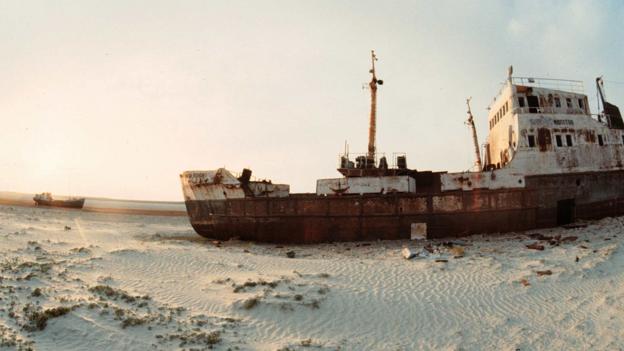
Easily gotten sources — reservoirs, lakes and rivers — are getting quickly depleted. The Aral Sea in Uzbekistan, for example, has shrunk so much that former fishing villages are now surrounded by desert land. Formerly part of the famous Silk Road, the Aral Sea will be completely dry within a decade.

Storied rivers such as the Nile and the Colorado in the US are also losing water as dams and other measures divert water from their flows for agricultural and other uses.

“Too much water is also being taken out of the Nile,” said Dr Jenny Kehl, director of the Center for Water Policy at the University of Wisconsin-Milwaukee. But the Nile isn’t alone, she added, since other great rivers such as the Jordan and the Mekong are also running drier as usage increases.

Deep underground aquifers, which store the freshest water, are also in rough shape as increased demand drains them dry. The problem is particularly acute in North Africa and the southwestern US, Kehl added.

Good news for water companies

Both dwindling supplies and dirtier water are translating into tighter water management. And that’s good news for the 300 global companies plying the water market. Most are in the US, followed by Europe, said Gottelier. Japan is a serious player, too.

Unlike taming carbon, water is a cheerier story.

“There are already lots of solutions in place,” said Cate Lamb, head of Carbon Disclosure Project’s water program. “So water management can shift much more rapidly than carbon.”

Repairing and monitoring crumbling, leaky pipes, pumps and valves is a key part of the water market. There are about 50 to 100 years of underinvestment in water supply upgrades in parts of Europe, said Gottelier, which leads to lots of leakage. In the US, the EPA estimates that upgrades to its aged water infrastructure will cost as much as $400 billion.

Water needs will translate into recurring business for infrastructure manufacturers such as Swiss-based Pentair Ltd, Texas based Flowserve Corp, and New York-based Xylem, said Matthew Sheldon, a portfolio manager for the Calvert Global Water Fund. “They all have very strong business models,” he said.

No surprise, then, that the $197 million Calvert fund’s largest holding is infrastructure stocks, along with technology plays for leak detection. Canada-based Pure Technologies Ltd which inspects and monitors pipelines, is a player in the water efficiency niche. The company is growing 20% to 30% per year, added Sheldon. UK-based Halma PLC also makes leak detection equipment.

Reusing water is the fastest growing niche though, said Sheldon. So water treatment and filtration companies such as Kurita Water Industries Ltd in Japan and China Everbright International in Hong Kong are set to prosper, said Sheldon.

“Much of the world is catching up with purification,” added Neil Berlant, a partner at Crowell, Weedon & Co, a brokerage and money management firm in Los Angeles. “Water treatment transcends all borders.”

Desalination, which removes salt from water, is being heavily used in Israel, Spain and Australia. The main reason: its price is decreasing.

“Up until now, desalination has been a small part of the water industry,” said Sheldon. “But it should begin accelerating next year.” Desalination players include big water utility companies such as VeoliaEnvironnement and Suez Environnement in France and the smaller pure-play company Energy Recovery in the US.

Oddly, few innovative emerging water companies are making waves. The initial public offering market, like the broader market, is still suffering. And new biological treatments for recovering energy and nutrients from waste water are still in their infancy, said Sheldon. More