Showing posts with label submarine. Show all posts

Thursday, August 23, 2012

Drowning Stability: The Perils of Naval Nuclearization and Brinkmanship in the Indian Ocean

In May 1998, the sun-scorched deserts of the Indian state of Rajasthan shook with a succession of nuclear explosions. Barely two weeks later, in a seemingly tit-for-tat response, Pakistan conducted its own series of detonations, in the remote western hills of Baluchistan.

Both nations’ previously concealed nuclear capabilities had suddenly burst out into the open, giving a new and terrifying form to the enduring rivalry that had convulsed the subcontinent for decades. Caught off guard, the international community reacted with indignation and dismay. Concerns over nuclear escalation in the event of another Indo-Pakistani conflict refocused Washington’s attention on South Asia and triggered the longest sustained level of bilateral Indo-American engagement in history. This had the unexpected benefit of enabling both democracies finally to find common ground, after many years of acrimony, chronic mistrust, and squandered opportunities. Fears of mass terrorism in the wake of 9/11 and subsequent revelations of extensive proliferation emanating from Pakistan added urgency to Western desires to preserve a modicum of crisis stability in South Asia, as well as to prevent any form of escalatory behavior that could spiral into nuclear conflict or further the spread of radioactive material.

More than ten years later, however, the international community’s sense of urgency seems to have waned, and the evolution of the nuclear postures and arsenals of both New Delhi and Islamabad no longer appear to evoke the same degree of concern, or even interest.

Symptomatic of this ebbing attention is the detached, disinvested manner in which much of the world has witnessed the ongoing shift of South Asian nuclear capabilities from land to sea.

When in July 2009 India launched its first nuclear submarine, S-2 (also known as the Advanced Technology Vessel, or ATV, and ultimately named Arihant), in a dry dock in the eastern port of Visakhapatnam, the reaction of much of the world to the event was remarkably subdued. The event was perfunctorily acknowledged abroad, and in India as well, as a technological and symbolic milestone in the nation’s rise to great-power status. Barring Pakistan, which reacted immediately and sharply to the news, scant commentary—scholarly or journalistic—was made about the impact that the introduction of sea-based delivery systems would have on the South Asian nuclear equation.

This article seeks to address this issue directly, asserting that it is only a matter of time before Pakistan formally brings nuclear weapons into its own fleet. The study first examines the key causes and motivations behind both nations’ lurches toward naval nuclearization. For both nations, a variety of factors explain the pursuit of sea-based deterrence. In particular, China’s nuclear role in the Indian Ocean is examined, both as a key enabler of Pakistani naval nuclearization and as a potential future military actor in the Arabian Sea. The second section charts the dangerous path that Indian and Pakistani navies appear to be taking, a path that combines dual-use systems (most notably nuclear-tipped cruise missiles), cultivated doctrinal ambiguity, and brinkmanship to render the future of nuclear stability in South Asia exceptionally bleak. It is argued that if this haphazard naval nuclearization remains unchecked, its destabilizing effect will spill over into the Persian Gulf and beyond. Without a concerted effort to integrate sea-based nuclear assets more effectively into both nations’ strategic thinking and into a bilateral dialogue, New Delhi and Islamabad may be unable to avoid escalation in a crisis and, ultimately, skirt nuclear disaster. More


Thursday, August 9, 2012

India to launch its first home-built nuclear submarine

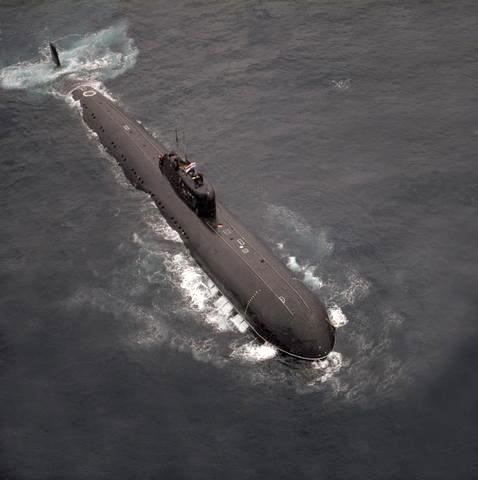
India will soon launch its first home-built nuclear submarine, capable of firing ballistic missiles, as the country escalates an arms race with China and Pakistan.

INS Arihant, planned to be the first of five submarines of its class, will be ready to begin sea trials, said Admiral Nirmal Verma, the navy commander. When the vessel eventually becomes operational, India will be able to launch nuclear missiles from the sea, land and air, joining a handful of countries possessing the "nuclear triad".

The strategic aim is to deter China and Pakistan and establish India as the leading power in the Indian Ocean.

"INS Arihant is steadily progressing towards becoming operational," said Adml Verma. "We are pretty close to putting it to sea."

The navy was poised to "complete the triad, and our maritime and nuclear doctrines will then be aligned to ensure our nuclear insurance comes from the sea," added Adml Verma. "Given our unequivocal 'no first-use commitment', a retaliatory strike capability that is credible and invulnerable is an imperative."

INS Arihant will carry the K-15 ballistic missile, which carries a nuclear warhead. However, this weapon has a relatively modest range of less than 500 miles, raising questions about its ability to hit a target in China.

Nonetheless, Adml Verma's statement is likely to provoke a strong reaction from Beijing, which warned India against 'arrogance' earlier this year following its successful launch of the Agni IV intercontinental ballistic missile, a land-based weapon which can strike any city in China.

Mohan Guruswamy, from the Centre for Policy Alternatives in New Delhi, said the imminent launch of the new submarine "changed the equation [between India and China] considerably."

He pointed out that India ws also planning to launch six nuclear-powered attack submarines, adding that within seven years the country should have a varied fleet which would, in theory, be able to block Chinese access to the Indian Ocean via the Strait of Malacca. "They could be sitting off Karachi – or China. It's an investment for the future," said Mr Guruswamy. More


Tuesday, June 5, 2012

Israel's Deployment of Nuclear Missiles on Subs from Germany

Many have wondered for years about the exact capabilities of the submarines Germany exports to Israel. Now, experts in Germany and Israel have confirmed that nuclear-tipped missiles have been deployed on the vessels. And the German government has long known about it.


The pride of the Israeli navy is rocking gently in the swells of the Mediterranean, with the silhouette of the Carmel mountain range reflected on the water's surface. To reach the Tekumah, you have to walk across a wooden jetty at the pier in the port of Haifa, and then climb into a tunnel shaft leading to the submarine's interior. The navy officer in charge of visitors, a brawny man in his 40s with his eyes hidden behind a pair of Ray-Ban sunglasses, bounces down the steps. When he reaches the lower deck, he turns around and says: "Welcome on board the Tekumah. Welcome to my toy."

He pushes back a bolt and opens the refrigerator, revealing zucchini, a pallet of yoghurt cups and a two-liter bottle of low-calorie cola. The Tekumah has just returned from a secret mission in the early morning hours.

The navy officer, whose name the military censorship office wants to keep secret, leads the visitors past a pair of bunks and along a steel frame. The air smells stale, not unlike the air in the living room of an apartment occupied solely by men. At the middle of the ship, the corridor widens and merges into a command center, with work stations grouped around a periscope. The officer stands still and points to a row of monitors, with signs bearing the names of German electronics giant Siemens and Atlas, a Bremen-based electronics company, screwed to the wall next to them.

The "Combat Information Center," as the Israelis call the command center, is the heart of the submarine, the place where all information comes together and all the operations are led. The ship is controlled from two leather chairs. It looks as if it could be in the cockpit of a small aircraft. A display lit up in red shows that the vessel's keel is currently located 7.15 meters (23.45 feet) below sea level.

"This was all built in Germany, according to Israeli specifications," the navy officer says,"and so were the weapons systems." The Tekuma, 57 meters long and 7 meters wide, is a showpiece of precision engineering, painted in blue and made in Germany. To be more precise, it is a piece of precision engineering made in Germany that is suitable for equipping with nuclear weapons.

No Room for Doubt

Deep in their interiors, on decks 2 and 3, the submarines contain a secret that even in Israel is only known to a few insiders: nuclear warheads, small enough to be mounted on a cruise missile, but explosive enough to execute a nuclear strike that would cause devastating results. This secret is considered one of the best kept in modern military history. Anyone who speaks openly about it in Israel runs the risk of being sentenced to a lengthy prison term. More


Monday, June 4, 2012

Pakistan’s 21st Century Naval Modernisation Programme – Indian nuclear submarine programme

In spite of progress being made to enhance bilateral ties, geopoltical rivalry between Pakistan and India continues to escalate. The most recent example was demonstrated by the launch of India’s Agni-5 nuclear-capable intermediate-range ballistic missile, which was closely followed by the launch Pakistan’s Hatf-4 Shaheen-1A nuclear-capable intermediate-range ballistic missile. While this strategic rivalry has been notable on land, escalation in the maritime domain has made Pakistan increasing concerned at India’s unprecedented plans to modernise its navy.

Comment

India’s naval modernization and expansion programme has continued to raise Pakistan’s suspicions and has contributed to escalating tensions. In 20 February this year, Pakistan Navy Chief Asif Sandila told Defense News, a flagship US-based publication, that: “The strategic dimension of India’s naval buildup is a cause of concern.” He added: “We are mindful of this development and taking necessary measures to restore the strategic balance.”

The sentiment expressed by other Pakistani defence commentators provides another revealing insight into how Pakistan is likely to fashion its future naval strategy. For instance, in 2002 Malik Ayaz Hussain Tiwana stated in the Defence Journal, one of Pakistan’s leading defence publications: “In any future conflict, Pakistan naval forces should be capable of selectively operating on India’s eastern seaboard, threatening its shipping and tying down a portion of the Indian Navy in the east.” He concluded: “Also, Pakistan naval units should be adequately equipped to challenge and break any enemy blockade attempted away from the ranges of our Air Force cover.”

Similarly, in December 2011, Masood-Ur-Rehman Khattak, a Research Fellow at the Islamabad-based South Asian Strategic Stability Institute, wrote in the Eurasia Review: “[The] Indian Navy is developing its overall capabilities at rapid pace. Induction of [an] aircraft carrier, nuclear submarines, network-centric and electronic warfare capabilities, latest radars, weapons and equipment, fast [attack] boats, frigates, surveillance and reconnaissance aircraft, satellites, UAVs and regular exercises at sea will make [the] Indian Navy a serious threat to Pakistan’s maritime interests in future.” Given that maritime trade constitutes 97 per cent of Pakistan’s total trade, it is evident that Pakistan is fearful that a modern and expanded Indian Navy could pose a greater threat to its sea lines of communications and, in the event of war, impose a naval blockade that would have a crippling effect on the nation’s economy. More


Sunday, June 3, 2012

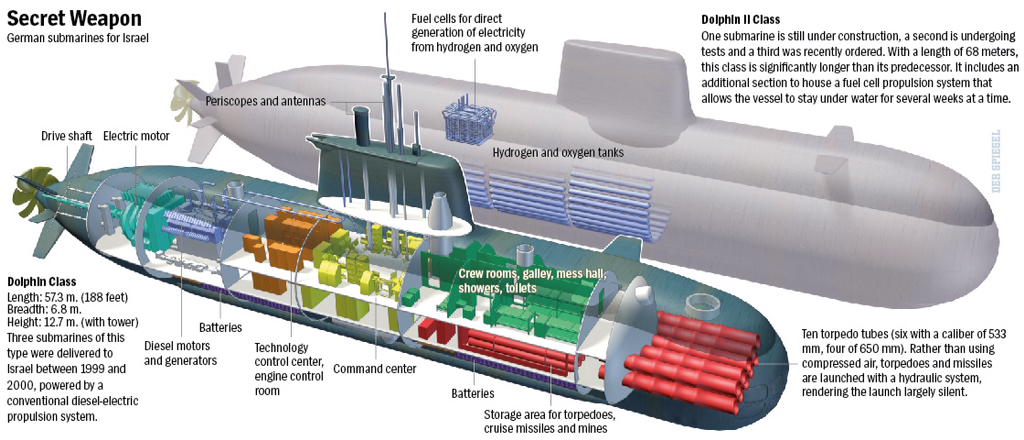
Israel Deploys Nuclear Weapons on German-Built Submarines

A German shipyard has already built three submarines for Israel, and three more are planned. Now SPIEGEL has learned that Israel is arming the submarines with nuclear-tipped cruise missiles. The German government has known about Israel's nuclear weapons program for decades, despite its official denials.

Germany is helping Israel to develop its military nuclear capabilities, SPIEGEL has learned. According to extensive research carried out by the magazine, Israel is equipping submarines that were built in the northern German city of Kiel and largely paid for by the German government with nuclear-tipped cruise missiles. The missiles can be launched using a previously secret hydraulic ejection system. Israeli Defence Minister Ehud Barak told SPIEGEL that Germans should be "proud" that they have secured the existence of the state of Israel "for many years."

In the past, the German government has always stuck to the position that it is unaware of nuclear weapons being deployed on the vessels. Now, however, former high-ranking officials from the German Defense Ministry, including former State Secretary Lothar Rühl and former chief of the planning staff Hans Rühle, have told SPIEGEL that they had always assumed that Israel would deploy nuclear weapons on the submarines. Rühl had even discussed the issue with the military in Tel Aviv.

Israel has a policy of not commenting officially on its nuclear weapons program. Documents from the archives of the German Foreign Ministry make it clear, however, that the German government has known about the program since 1961. The last discussion for which there is evidence took place in 1977, when then-Chancellor Helmut Schmidt spoke to then-Israeli Foreign Minister Moshe Dayan about the issue.

The submarines are built by the German shipyard HDW in Kiel. Three submarines have already been delivered to Israel, and three more will be delivered by 2017. In addition, Israel is considering ordering its seventh, eighth and ninth submarines from Germany.

The German government recently signed the contract for the delivery of the sixth vessel. According to information obtained by SPIEGEL, Chancellor Angela Merkel made substantial concessions to the Israelis. Not only is Berlin financing one-third of the cost of the submarine, around €135 million ($168 million), but it is also allowing Israel to defer its payment until 2015.

Merkel had tied the delivery of the sixth submarine to a number of conditions, including a demand that Israel stop its expansionist settlement policy and allow the completion of a sewage treatment plant in the Gaza Strip, which is partially financed with German money. So far, Israeli Prime Minister Benjamin Netanyahu has met none of the terms. More

Who is Israel planning to threaten with nuclear cruise missiles? What type of statement is this making? And what is Germany thinking in aiding and abetting this madness? Editor


Wednesday, January 4, 2012

Insanity: MAD in a world at risk


After years of delays, Russia has formally leased to India an advanced nuclear-powered submarine. For India, the move is a further indication of its shift towards the modernization of its naval capabilities. Russia, for its part, will be hoping the signing is a step away from a series of accidents that have haunted its navy for over a decade.

“The ceremony to sign the document was held on Thursday at the shipyard in Bolshoi Kamen in the Primorsky Territory, where the Nerpa nuclear submarine is currently deployed,” an official in the Russian Naval Chief of Staff’s office told ITAR-TASS on Friday.

The Indian Navy will now operate an “Akula” II nuclear attack submarine for the next ten years per a special lease agreement. The move should prove a boon to the Indian Navy, giving the country the ability to not only utilize the vessel for combat patrols and train in one of the world’s more advanced nuclear submarines, but also apply lessons learned to its own domestic nuclear submarine program.

“All of the naval tests and performance checks have been completed,” the Russian official explained.

The submarine signing is a welcome piece of good news for the Russian Navy. Russia’s armed forces have routinely been criticized for an alleged lack of focus on safety, especially since the 2000 sinking of the Russian submarine Kursk in 2000. Safety questions were again raised following a recent fire aboard a Russian Delta IV nuclear submarine,which sparked fears of a possible radiation leak. The fire started Thursday at an Arctic shipyard outside the Russian port city of Murmansk where the submarine “Yekaterinburg” was in dry dock. The fire has since been contained, with Russian officials claiming no radioactive contamination as a result of the blaze. Officials have stated the fire beganon wooden scaffolding before going on to engulf the submarine’s outer hull. The Yekaterinburg’s nuclear reactor had been shut down along with its nuclear-tipped missiles and other weaponry having been removed before being placed in dry dock. More

Acquisition and retention of nuclear weapons systems in a world facing dire resource shortages, including food and water, petroleum, rare earths, climate change and sea level rise is beyond insane, it is MAD all over again. All of the risks facing us are conflict triggers and can only be addressed if all nations work together. Who will make the first move towards nuclear disarmament? Editor


Wednesday, August 5, 2009

Sinking billions into nuclear weapons (when half your population are malnourished)


When Ms Gursharan Kaur, Prime Minister Manmohan Singh's wife, broke a coconut on the hull of the INS Arihant amidst the chanting of Vedic verses, the Indian government took a step towards realising its post-1998 quest for a grand nuclear weapons power status.

When the submarine is commissioned in a few years, India will have a 'second-strike capability': Even if its land-or air-based nuclear weapons are destroyed/immobilised, India can still fire a nuclear-tipped missile at the adversary from the ship, which can stay underwater for months at a time and is therefore hard to detect.

The Arihant's launch has been called a great achievement of indigenous technology, which gives 'real teeth' to nuclear deterrence and enhances India's security without threatening others.

Dr Singh said: 'We do not have any aggressive designs, nor do we seek to threaten anyone...' But the rationale of nuclear deterrence is based on inducing terror through mass destruction weapons.

According to that doctrine, you prevent your enemy from nuking you by threatening 'unacceptable damage' through an attack which instantly kills hundreds of thousands or millions of civilians. Nuclear deterrence is a deeply flawed doctrine and was described for half-a-century by India as morally 'abhorrent' and strategically irrational. More >>>