Showing posts with label Pakistan. Show all posts

Thursday, November 30, 2017

Tackling water security: Who owns the right to groundwater?

Tariq said that to understand water security there is a need to understand water scarcity. He explained, “The global yardstick for water scarcity is that if you have 1,700 cubic metres per person, per year then you are in a very comfortable water regime.”

He added that the moment this amount reduces, you start getting into water stress situations, water shortages and water scarcity.

“Plant the water, as the best place to store water is underground”

“The surplus water available for Pakistan doesn’t last for more than 30 days.” He elaborated that for the rest of the 335 days, Pakistan is in a semi-drought or drought-like condition.

The PWP CEO said that for an arid country like Pakistan there is a need to have 40% surface water storage. However, he deplored that the country has only 7% storage to counter the problem. He added that this is also reducing due to sedimentation, which leaves a big question mark on the country’s water security. More

Wednesday, August 23, 2017

Trump’s Request for India’s Help in Afghanistan Rattles Pakistan

Trump’s Request for India’s Help in Afghanistan Rattles Pakistan - The New York Times

However, Maria Sultan, a defense analyst based in Islamabad and director general of the South Asian Strategic Stability Institute, said the Trump policy was “not as bad as we were expecting. The responsibility has been essentially shifted to Afghanistan.”

She warned that intelligence-based operations against groups inside Pakistan might increase. “This will further reduce the space for cooperation between Pakistan and U.S. and will be counterproductive for a long-term relationship,” Ms. Sultan said. More

Tuesday, June 6, 2017

South Asia's Turn: Policies to Boost Competitiveness and Create the Next Export Powerhouse


South Asia is undergoing a rapid economic transformation and has the potential to become the next major middle-income region of the world. More than a million young people are reaching working age every month, and the population of the region’s mega agglomerations and sprawling cities is expanding at roughly the same pace. By 2030 more than a quarter of the world’s working adults will live in South Asia. But the region has not been particularly successful in integrating within itself and with the global economy. The demographic transition and urbanization on the one hand, and poor competitiveness on the other, are South Asia’s greatest opportunity and greatest challenge. View PDF

Sunday, April 3, 2016

Climate Change & Biodiversity (A Pakistan case study): Impact of Climate Change on biodiversity of Butterflies in Northern coniferous forests of Punjab,Pakistan

Climate change is an established fact but the way and the intensity in which the climate has been changing since 1975 has created an alarming situation in Pakistan .

The last decade was the warmest since instrumental records have been kept in the nineteenth century. Climate change is a major threat to biodiversity by causing changes in plant phonologies and a poleward shifts in birds and butterflies. In terrestrial ecosystem 28,586 significant biological changes are related with climate change. With a relatively short life-cycle and host-plant reliance, butterfly communities show quick response to climate change. Punjab has few coniferous forests which are home to many exotic species. Twenty two years climate analysis shows reduction in precipitation and an increase in extreme weather events. In short span of just twenty years 14 butterfly species have disappeared from very rich forests of Murree. The species which are present are also on the verge of extinction as with climate change the number of invasive species is coming upwards.

by Hassaan Bin Saadat (Author)

http://www.amazon.com/Climate-Change-Biodiversity-Pakistan-study/dp/3659244716


Saturday, December 19, 2015

HOW ROGUE TECHIES ARMED THE PREDATOR, ALMOST STOPPED 9/11, AND ACCIDENTALLY INVENTED REMOTE WAR

ON THE AFTERNOON of October 7, 2001, the first day of the war in Afghanistan, an Air Force pilot named Scott Swanson made history while sitting in a captain’s chair designed for an RV. His contribution to posterity was to kill someone in a completely novel way.

In the moments leading up to the act, Swanson was nervous. He sat in a darkened trailer tucked behind a parking garage at CIA headquarters in Langley, Virginia, remotely piloting a Predator drone over Kandahar, 6,900 miles away. Nearly everything about his rig had been cobbled together and hastily assembled. The Predator itself, one of just a handful in existence, was flying about 250 pounds heavier than usual. And the satellite communications link that connected Swanson to the aircraft would periodically shut down due to a power issue, which software engineers in California were frantically trying to patch.

When the order came through to take the shot, Swanson pulled a trigger on his joystick. A little more than a second later, a Hellfire missile slid off an aluminum rail on the Predator’s wing and sailed into the Afghan night.

Swanson’s target was a pickup truck parked outside a compound thought to be hiding Mullah Omar, the supreme commander of the Taliban. The missile killed two unidentified men believed to have been his bodyguards. It was the first time a US drone had fired a weapon in combat. It was the first time a modern drone had ever killed a human being. More


Thursday, August 20, 2015

Islamic Climate Change Declaration Calls for Zero Emissions Strategy


18 August 2015: Islamic leaders, during an International Islamic Climate Change Symposium, called on the world's 1.6 billion Muslims to take an active role in combating climate change and urged governments to agree to a new climate change agreement in Paris.


The Symposium convened to discuss proposed messages from the Islamic community and to mobilize stakeholders in advance of the Paris Climate Change Conference in December 2015. It also aimed to seek consensus on an ‘Islamic Declaration on Climate Change,' which was drafted and circulated for comments prior to the symposium.


Approximately 60 participants, including international development policymakers, faith group leaders, academics and other experts, attended the Symposium, which met from 17-18 August 2015, in Istanbul, Turkey. The event provided the opportunity for: networking with leaders from other faiths and secular organizations; promoting inter-faith and cross-movement cooperation around joint messages; focusing on the role and contribution of Muslims to the climate movement; and securing high-level representation from participating stakeholder groups. The Symposium reaffirmed that the Islamic faith community represents a significant section of the global population and, thus, can be influential in the climate change discourse.


The 'Islamic Declaration on Climate Change,' agreed to by participants, presents the moral case, based on Islamic teachings, for Muslims and people of all faiths to act on climate change. It was drafted by international Islamic scholars from around the world and is “in harmony” with the Papal Encyclical.


The Declaration urges: setting clear targets and monitoring systems; phasing out greenhouse gas emissions; committing to 100% renewable energy and/or a zero emissions strategy; and richer countries and oil-producing states to lead the way in phasing out their emissions by 2050. The Declaration also calls for, inter alia: the provision of financial and technical support to poorer countries to phase out greenhouse gases; limiting temperature rise to below 2°C, and preferably below 1.5°C; investing in a green economy; and prioritizing adaptation efforts with support to more vulnerable countries.


In addition, the Declaration urges corporations, finance and the business sector to, inter alia: reduce their carbon footprint; commit to 100% renewable energy and/or a zero emissions strategy; adopt a “circular economy that is wholly sustainable”; consider social and ecological responsibilities; and help in divesting from the fossil fuel driven economy.


Welcoming the Declaration, UNFCCC Executive Secretary Christiana Secretary Christiana Figueres said that Islam's teachings, which emphasize the “duty of humans as stewards of the Earth and the teacher's role as an appointed guide to correct behavior,” provides guidance to take action on climate change.


The Pew Research Center data estimates that 84% of the world's population is religiously affiliated, which points to the importance of support by faith groups for climate action. Many other faiths and denominations have also called for governments to act on climate change, including through the Papal Encyclical, a forthcoming Buddhist Declaration on climate change and a Rabbinic Letter on the Climate Crisis. [Symposium Website] [Islamic Declaration on Climate Change] [UNFCCC Press Release] [Climate Action Network Press Release] More


Tuesday, August 11, 2015

To avoid counting civilian deaths, Obama re-defined “militant” to mean “all military-age males in a strike zone

Virtually every time the U.S. fires a missile from a drone and ends the lives of Muslims, American media outlets dutifully trumpet in headlines that the dead were "militants" — even though those media outlets literally do not have the slightest idea of who was actually killed.

They simply cite always-unnamed "officials" claiming that the dead were "militants." It’s the most obvious and inexcusable form of rank propaganda: media outlets continuously propagating a vital claim without having the slightest idea if it’s true.

This practice continues even though key Obama officials have been caught lying, a term used advisedly, about how many civilians they’re killing. I’ve written and said many times before that in American media discourse, the definition of "militant" is any human being whose life is extinguished when an American missile or bomb detonates (that term was even used when Anwar Awlaki’s 16-year-old American son, Abdulrahman, was killed by a U.S. drone in Yemen two weeks after a drone killed his father, even though nobody claims the teenager was anything but completely innocent: "Another U.S. Drone Strike Kills Militants in Yemen").

This morning, the New York Times has a very lengthy and detailed article about President Obama’s counter-Terrorism policies based on interviews with "three dozen of his current and former advisers." I’m writing separately about the numerous revelations contained in that article, but want specifically to highlight this one vital passage about how the Obama administration determines who is a "militant." The article explains that Obama’s rhetorical emphasis on avoiding civilian deaths "did not significantly change" the drone program, because Obama himself simply expanded the definition of a "militant" to ensure that it includes virtually everyone killed by his drone strikes. Just read this remarkable passage;

Mr. Obama embraced a disputed method for counting civilian casualties that did little to box him in. It in effect counts all military-age males in a strike zone as combatants, according to several administration officials, unless there is explicit intelligence posthumously proving them innocent.

Counterterrorism officials insist this approach is one of simple logic: people in an area of known terrorist activity, or found with a top Qaeda operative, are probably up to no good. "Al Qaeda is an insular, paranoid organization — innocent neighbors don’t hitchhike rides in the back of trucks headed for the border with guns and bombs," said one official, who requested anonymity to speak about what is still a classified program.

This counting method may partly explain the official claims of extraordinarily low collateral deaths. In a speech last year Mr. Brennan, Mr. Obama’s trusted adviser, said that not a single noncombatant had been killed in a year of strikes. And in a recent interview, a senior administration official said that the number of civilians killed in drone strikes in Pakistan under Mr. Obama was in the "single digits" — and that independent counts of scores or hundreds of civilian deaths unwittingly draw on false propaganda claims by militants.

But in interviews, three former senior intelligence officials expressed disbelief that the number could be so low. The C.I.A. accounting has so troubled some administration officials outside the agency that they have brought their concerns to the White House. One called it "guilt by association" that has led to "deceptive" estimates of civilian casualties.

"It bothers me when they say there were seven guys, so they must all be militants," the official said. "They count the corpses and they’re not really sure who they are."

For the moment, leave the ethical issues to the side that arise from viewing "all military-age males in a strike zone as combatants"; that’s nothing less than sociopathic, a term I use advisedly, but I discuss that in the separate, longer piece I’ve written. For now, consider what this means for American media outlets. Any of them which use the term "militants" to describe those killed by U.S. strikes are knowingly disseminating a false and misleading term of propaganda. By "militant," the Obama administration literally means nothing more than: any military-age male whom we kill, even when we know nothing else about them. They have no idea whether the person killed is really a militant: if they’re male and of a certain age they just call them one in order to whitewash their behavior and propagandize the citizenry (unless conclusive evidence somehow later emerges proving their innocence).

What kind of self-respecting media outlet would be party to this practice? Here’s the New York Times documenting that this is what the term "militant" means when used by government officials. Any media outlet that continues using it while knowing this is explicitly choosing to be an instrument for state propaganda — not that that’s anything new, but this makes this clearer than it’s ever been. More


Wednesday, July 15, 2015

Pakistan, Bangladesh face ‘state failure’ as globe heats up

Study compiled by experts from US, UK, China and India underlines migration potential from warming world

India will face a huge influx of refugees from Afghanistan, Pakistan and Bangladesh should high degrees of climate change develop, according to one of the country’s senior military officials.

Drought and flooding linked to sea level rise would place the governments of those countries under "severe stress" and lead to large-scale migration, said Vice Admiral Pradeep Chauhan, head of the Indian Naval Academy.

"In India, this would combine with an internal population shift from rural to urban areas, further increasing demographic pressure in cities," he wrote in a climate risk study backed by the UK Foreign Office.

A significant influx of migrants could further destabilise what is known as India’s "Red Corridor", a belt of land running through east India where Marxist rebels are fighting the state.

"The temptation to solve this problem through military intervention could become overwhelming," he added.

Current greenhouse gas emissions will "likely as not" mean temperature increases of 4C above pre-industrial levels by 2150 said the study, with severe implications for human health and crop yields.

A N M Muniruzzaman, a retired Bangladeshi major general, said millions of people in his country could be displaced as a result of sea level rise.

"Flooding is projected to increase in many regions, but it could be a particular problem in South Asia due to the contribution of melting glaciers," he said.

Planning battle

Chauhan’s and Muniruzzaman’s comments were based on a war gaming exercise held in Delhi in March, hosted by the Council on Energy, Environment and Water.

Former military officials from India, China, the US, the UK, Bangladesh, Germany, the Netherlands, and Finland took part, along with scientists and diplomats.

"In the game, it was notable that increasing numbers of refugees contributed to several large countries becoming more isolationist in their foreign policies," says the study.

"Participants in our exercise considered it extremely likely that climate change would exacerbate humanitarian crises over the coming decades."

Long term water stress in South Asia could become so severe previous agreements over resource sharing between India, Pakistan, China and Bangladesh "could be broken", the study warns.

"At the high degrees of climate change possible in the long-term future, participants in our scenarios exercise considered that there could even be risks to the political integrity of states that are currently considered developed and stable."

Alex Randall from the UK-based Climate Change and Migration Coalition said the document presented a "one sided view of migration" seeing it only as a security threat.

"While there is growing evidence linking climate change to changing patterns of migration, there is little evidence suggesting that migrants and refugee present the kind of security threat suggested in the report," he said.

"There is also strong evidence indicating that migration could become a key way for some people to adapt to climate change." More


Thursday, June 25, 2015

The World’s Most Hostile International Water Basins

At the launch of A New Climate for Peace, a new report on climate-fragility risks produced for the G7 by a consortium of international partners including the Wilson Center, USAID Deputy Assistant Administrator Christian Holmes called water a common denominator for climate risk.

“How you manage your water programs…has a huge amount to do with how you mitigate the prospect for increased fragility,” he said. “Sometimes it’s the obvious that’s so easy to miss, and I think that the obvious on water as it relates to economic development is, essentially, the question of sustainable water supply.”

One of the most striking infographics from A New Climate for Peace touches on that question of supply. Using data from Oregon State University’s Transboundary Freshwater Dispute Database and adapted from a graphic that originally appeared in Popular Sciencelast year, the map shows the world’s most active – and tension-filled – international water basins.

Water is a common denominator for climate risk

The Transboundary Freshwater Dispute Database measures not only the frequency of hostile events in a basin, but cooperative ones as well, each on a sliding scale. Hostile events range from declarations of war (zero recorded from 1990 to 2008, the period of time encompassed by the graphic) to leaders using “language of discord.” Cooperative events range from “mild verbal support” to “voluntary unification into a single country.”

The total number of events is indicated by shades of blue – the darker the blue, the more transboundary events, both positive and negative. This is essentially the “hot list” of international water basins – which regions have the most official and unofficial chatter over water.

Circles superimposed on the basins represent the total number of hostile events. As the description text points out, however, “circle size does not automatically translate into conflict danger.” In some places, transboundary institutions and diplomatic frameworks allow different actors to work through their differences. Cooperative hostility, if you will. In the Danube River Basin, for example, the high number of “hostile” events is mitigated by strong cooperative incentives associated with European integration. Likewise in North America, where Canada, the United States, and Mexico share several basins with a high number of hostile events, there is little chance of violent conflict.

Water basins in South Asia, the Middle East, and East Africa are major hotspots with a high number of hostile events and weaker institutional frameworks to mitigate them. The Indus, Ganges-Brahmaputra-Meghna, Salween, Tigris-Euphrates, and Jordan basins witness a very high number of interactions, suggesting at least that continued dialogue could be a way forward to mitigate the risk of violent conflict or fragility. The Nile Basin has less activity reflecting the stalled negotiations between the basin’s 10 member states to replace colonial-era water agreements. The Mekong Basin, where the largest member, China, does not participate as a full member of the Mekong River Commission, shows less activity as well.

The map does a great job illustrating why it can be difficult to answer the question, where is the highest risk of water-related violence? Tensions between states and other freshwater basin actors isn’t necessarily a sign of impending violence if there’s a framework to resolve them. Likewise, lack of communication over a major natural resource can be a bad sign for cooperation when the resource in question is the Nile. More

More infographics from ‘A New Climate for Peace: Taking Action on Climate and Fragility Risks’ are available on NewClimateforPeace.org.


Wednesday, May 27, 2015

Al Jazeera journalist responds to U.S, labeling him Al Qaeda

Earlier this month, The Intercept reported that the U.S. government secretly labeled a prominent Al Jazeera journalist a member of Al Qaeda and placed him on a terror watch list.

The basis for the designation was unclear, but the reporter, Islamabad bureau chief Ahmad Zaidan, denies ever having been a member of the group. Reached last week in Doha, Qatar — where the state-funded Al Jazeera network is based — Zaidan spoke to The Intercept about the reaction to his work and the implications of being tracked by the U.S. government. “To monitor and bug journalists is absolutely immoral and unethical,” he said.

Zaidan was known for interviewing senior Al Qaeda figures, including Osama bin Laden, and he covered the wedding of bin Laden’s son in 2001. If it was those contacts that caused U.S. suspicions, Zaidan says, that runs counter to the purpose of journalism.

“Our job as journalists is to reach out to everybody. We are some sort of go-between in cases where the two parties are not talking to each other,” Zaidan said. “I was thinking that when I was interviewing bin Laden and interviewing these militants, that maybe at least [they can] hear each other, and maybe it can help humanity to reach some sort of middle way.”

Zaidan also sees discrimination behind the surveillance. “If Peter Bergen is meeting Osama bin Laden, or Robert Fisk is meeting Osama bin Laden, no problem,” he said. “But if a non-Westerner is meeting some wanted people, he should be doubted?”

Zaidan’s picture and watch list number appear in a 2012 National Security Agency presentation, which shows that analysts tracked his cell phone contacts and location data — or metadata — as part of a program that looked for people who moved like Al Qaeda couriers. The presentation and other NSA documents revealed that the U.S. was obtaining bulk call data records from Pakistani telecoms, and analyzing the metadata of tens of millions of Pakistani cell phones.

“Faisalabad, Lahore — these main cities are the residence of millions and millions of people,” Zaidan said. “They are following and surveilling every one of us. Who has made them the god of this globe?”

Zaidan says he has had good relations with the U.S. ambassador to Pakistan and has not had run-ins with U.S. authorities.

“I did not hide myself. Whenever I made an interview, I published it. If you have any objection to me, I am living in Islamabad, you can come ask for me anytime,” he said.

He noted that the United States is not the only country to have labeled him as Al Qaeda. Zaidan, who is Syrian, returned to his country for the first time in almost 35 years in early 2012, after the uprising began against President Bashar al-Assad. Zaidan reported from inside a stronghold of the Free Syrian Army, and soon after, he says Syrian state television aired a report claiming that he was a member of Al Qaeda and had been sent to Syria by the group’s leader, Ayman al-Zawahiri.

The allegations make him fear for his security. “If you are Al Qaeda, it means they can eliminate you. And I am afraid if somebody else might do something against me and he will put the blame on America now,” Zaidan said.

But when I asked if he regretted The Intercept publishing the story, Zaidan said: “My take, as a journalist, is that you have done your job. I can’t say, ‘Ok, if I have some information about Osama bin Laden, I have to publish it, but if you have something against Ahmad Zaidan or Al Jazeera, you should not publish it.’”

“This is the right of our audience,” he said. “We should not keep our audience in the dark otherwise we are like, in fact, the National Security Agency.” More


Monday, March 23, 2015

Climate change blamed as erratic downpours hit Pakistan’s harvests

Late rains were unusually heavy this year, say local farmers, affecting winter crops of wheat, oilseed and potato.

Anxious farmers in Pakistan waited for weeks for the rains to arrive – but when the skies finally opened, the downpour was so intense it destroyed crops and put the harvest in jeopardy.

"We weather scientists are really in shock, and so are farmers, who have suffered economic losses due to crop damage," says Muzammil Hussain, a weather forecasting scientist at the Pakistan Meteorological Department (PMD).

"The wind from the southeast has carried moisture from the Arabian Sea. Normally, the northeast wind brings rain during winter, and the southeast wind brings monsoon rains in summer. But the pattern has changed this year because of what is believed to be global warming."

Farmers across much of Pakistan plant winter crops of wheat, oilseed and potato late in the year and wait for rains to water the land.

This year, the rains arrived more than three weeks late and were unusually heavy, accompanied by violent hailstorms. Along with the rains, temperatures also dropped.

Ibrahim Mughal, chairman of the Pakistan Agri Forum, says excessive moisture due to heavy bouts of late rain is likely to lead to outbreaks of fungus on crops, and production could be halved.

"If the rains come a month ahead of the harvesting time [April to mid-May], it is always disastrous," he says. "It can hit production for a crop such as wheat by between 20% and 30%, and if the rain is accompanied by hailstorms and winds then the losses can escalate to more than 50%."

Arif Mahmood, a former director general at PMD, says the onset of winter across much of Pakistan is being delayed by two to three days every year, and there is an urgent need for farmers to adapt to such changes.

"Over recent years, winter has been delayed by 25 to 30 days, and also the intensity of the cold has increased, which has affected almost every field of life − from agriculture to urban life."

This year has also been marked by abrupt changes in temperature. Ghulam Rasul, a senior scientist at PMD, says big swings in temperature are likely to add to the problems being faced by millions of farmers in Pakistan.

"The average temperature during the first two weeks [of March] was between 11 and 13 degrees Celsius, but now it’s on a continuous upward trend and has reached 26˚C over the space of two days," he reports.

"The winter rains in the north and central area of Pakistan, and the sudden rise and fall in temperature, are related to climate change."

Serious damage

Similar storms and late winter rains have also caused serious damage across large areas of northern India.

The states of Uttar Pradesh and Maharashtra – the two most populous states in the country – have been particularly badly hit.

In Maharashtra, snow and landslides have blocked roads and cut off towns and villages.

In Uttar Pradesh, there are fears that more than 50% of the wheat crop has been lost in the eastern part of the state. More

This article was produced by the Climate News Network

For the Pakistan Metorlogical Department to claim be shocked by this event says to me that they have obviously not been following the global climate change discussion. Farming methods and water control and harvesting will have to change to mitigate the changing climate. Permaculture farming methods would be a good place to start. See http://permaculturenews.org/about-permaculture-and-the-pri/ Editor


Sunday, February 1, 2015

SASSI University to be launched on Feb 2

Islamabad - The South Asian Strategic Stability Institute (SASSI) would launch its University in collaboration with the CDA Training Academy on February 2.

Dr. Maria Sultan
Some of the courses offered by the University include Counter-terrorism and Security Studies, Nanotechnology, Information and Cyber Security, Peace and Conflict Studies, Governance and Public Policy, Town Planning and Architecture, Oriental and Interfaith Studies, and Media Sciences.
In a news release issued here on Friday, Dr Maria Sultan, Chairperson SASSI University said, the South Asian Strategic Stability Institute (SASSI) University is an autonomous non-profit research organization based on public-private partnership and is a degree-awarding institute dedicated to promoting peace and stability in South Asia.

Dr Sultan said that the University aims to make a leading contribution to regional and international academic and policy-oriented research discourses about the South Asian security.

A number of high officials, delegates, renowned think tanks, academicians, analysts and intellectuals from different organizations are invited to participate in the launching ceremony. More


Wednesday, January 28, 2015

A Literary Voice from Pakistan's Frontier

But then I think, why should I not speak, or act, why should I not be free?

- Hasina Gul

I first saw Hasina Gul in the summer of 2011 at the launch for the book, Modern Poetry of Pakistan (Dalkey Press, 2011), at Kuch Khaas, a center for Arts, Culture and Dialogue in Islamabad. As the author of eight books in Pashto and a well-recognized literary figure in her province of Khyber Pakhtunkhwa (also known as the “Frontier”) as well as neighboring Afghanistan, Hasina has had a long career as a radio broadcaster and scriptwriter.

At the book launch, I listened to her read from her work, which is featured in the anthology, but was not formally introduced to her. I remember she seemed tall, reticent, and serious to the point of sadness; it was only later that I learned she had just lost the baby she had carried until almost full term.

Our next meeting was at the Islamabad Literary Festival (ILF) in April 2014. Standing in the courtyard at Margalla Hotel, she seemed to be enjoying the spring air and buzz among the book stalls around her. The following day, we talked informally between literary panels, and she told me something about her life. While she spoke, Hasina’s eyes often appeared far away, until she suddenly broke into a wide smile. She was alternately thoughtful, and serious, but sudden flashes revealed a lightness of spirit.

The interview that follows is based on a series of lengthy telephone conversations, in Urdu, with Hasina about her life and work. During her early years, Hasina received immense support as a young woman and budding writer in a conservative society. But events later in her life, triggered by the rise of terrorism, and personal tragedy, indelibly marked her. ‘In the past,’ she reflects, ‘there was conservatism but there was also cultural debate. Now there is terrorism. There are abductions and killings. I have challenged life many times…”

Despite these trials, Hasina is insistent that she loves her home and has no wish to ever leave the place where she grew up. Although she now lives in Mardan in the Swat Valley, she was born and brought up in a suburb of Nowshera, near the province’s capital of Peshawar, and still frequently visits her family there.

Let’s talk a little about your family. You mentioned in an earlier conversation that your father was a scriptwriter for Radio Pakistan. Did he encourage you to write?

Hasina Gul (HG): My father was a scriptwriter for Radio Pakistan from 1954 onwards. I learned much about scriptwriting by reading his work, as well as through active guidance from him later. More


Thursday, January 15, 2015

University library place of learning in volatile Pakistan city

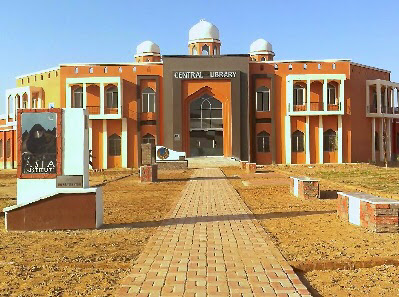
BANNU, Pakistan – Central Asia Institute (CAI) has completed and turned over to the Pakistan government a 34,000-square-foot university library in one of the most volatile regions of the country.

The Central Library at University of Science and Technology-Bannu is the only project of its kind that CAI has done. It was requested by the university’s founding vice chancellor, Asmat Ullah Khan, in 2011.

“This university is a newly established institution with a total age of six years since its inception in November 2005,” Khan wrote in his initial request. “The day-and-nights continuous efforts of the university administration have made a record progress in the developmental works and the quality education in this remote, underdeveloped region of the province, although the financial constraints have always been the main obstacles in the achievement of the desired objectives.”

One longed-for objective was a library.

“The university was in dire need of a library,” said CAI’s former Pakistan director, Lt. Col. (Ret.) Ilyas Mirza, who is from the region. “Their budget being too meager, (it) could hardly afford something of the size of what CAI donated to them.”

Plus, he added, “I wanted the youth of this area, victims of the war on terror, to have a state of-the-art library facility and access to a real source of learning.”

CONFLICT ZONE

Bannu’s location at the edge of North Waziristan, near the Pakistan-Afghanistan border, puts it in a sort of “no-go zone” for any international aid organizations, said CAI Co-Founder Greg Mortenson.

“Bannu, unfortunately, has become the epicenter of violence in the fighting between militants and the Pakistan police and army, and the U.S. further antagonizing the locals by drone bombings” Mortenson said. “It’s a consistently high-threat, high-conflict area, traditionally conservative, and often overlooked.”

The city is about 118 miles south of Peshawar, 23 miles east of the Pakistan-Afghan border, and just a little more than one mile east of North Waziristan, headquarters of the Pakistan Taliban and other terrorist networks.

The university is also just 700 meters from Bannu jail, which the Taliban attacked on April 15, 2012, just 15 days after work began on the library.

More than 200 heavily armed Tehreek-e-Taliban Pakistan (TTP) militants arrived predawn in numerous vehicles carrying AK-47s, hand grenades, and rocket launchers, according to news reports. They blew up the main gate, destroyed the boundary wall, and freed 384 prisoners, including some of Pakistan’s “most-wanted” criminals.

“The next 23 months were full of risk,” Mirza said. “Yet we continued and achieved something that CAI can be proud of.”

Acting Library Director Mohammad Hussain said the entire campus is grateful for the new library.

“I have been working at Bannu University since 2006, and we only had a room with some books for the library,” said Hussain, who is working on his PhD in library sciences from the University of Sargodha in Pakistan. “Now we have one of the best libraries in Khyber Pakhtunkhwa province that we are very proud of.”

CAMPUS CENTERPIECE

The two-story, red brick library situated in the center of the campus was completed in 2014.

“It is now for the university to encourage its faculty and students to make maximum use of it,” Mirza said. “Let it be turned into a real place of learning.”

Bannu is a conservative region and CAI and the university designed the library with separate study areas for males and females. However, some students do mingle in co-ed areas of the library while working on class projects.

In addition to the library, CAI donated a water-supply system for the university and awarded scholarships to nine graduate-level female students for two years of study.

Bannu is situated at the convergence of the Kurram and Gambila rivers, which irrigate the traditional barley, wheat, and corn crops. British visitors to the region in the mid 1800s referred to Bannu as a paradise, said Mortenson, who has visited the Bannu region several times since 1996. It also has a rich history as a place of religious tolerance.

“Until recently, it was a place where Muslims, Christians, Sikhs and Hindus lived in harmony for centuries,” he said.

Hamza Ameer, a writer who visited Bannu four times in 2014 to document the displacement of refugees from the North Waziristan conflict, described a special place in Bannu called Holy Street, “a symbol of religious harmony, patience, and acceptance for the world,” he wrote.

“The street starts with a church, whose wall is attached [to] a Shiite Imam Bargah [Mosque], wall of who is attached to a Hindu Ram Mandir [temple], attached to a Muslim mosque,” Ameer wrote.

FILL IT WITH BOOKS

But despite that history of tolerance, the region is now in turmoil. In addition to the fighting, the influx of Waziristan refugees, said to total as many as 500,000, has made the city and surrounding areas chaotic, Mirza said.

“The library should be a center of peace and calm amid all the conflict and difficulties,” he said.

Although CAI will remain in contact with library and university officials, maintenance of the new building and work to build a good collection of books is the responsibility of the university and Pakistan’s Ministry of Higher Education.

“We have very few resources to enhance the library,” Hussain said. “The KP Higher Education Commission and federal government do not have funds allocated for the ongoing maintenance of the library, and this year the federal government made significant cuts in education funding.”

At the present time, a library support group is being formed to raise awareness and generate more support for books, technology, training, and supplies. However, the recent militant activity, escalating conflict, and lack of federal funding have made progress difficult.

The university has received several donations of books, mostly science, technology, and curriculum-related. But it badly needs more books.

Hussain and others within the university administration expressed hope that libraries in the United States, Canada, and Europe might take an interest in their library and work with them to expand the collection.

“Any joint effort to promote higher education, reading, and learning in the region could also be a catalyst for promoting tolerance, just as the city of Bannu has done for two centuries,” Mortenson said.

Inquiries regarding library support or book donations can be directed to:

Central Library University of Science & Technology-Bannu Bannu, Khyber Pakhtunkhwa Province
Pakistan 28100
Phone + 92-928-633817
Email pro@ustb.edu.pk

QUOTE: “Books permit us to voyage through time, to tap the wisdom of our ancestors. The library connects us with the insight and knowledge … of the greatest minds that ever were, with the best teachers, drawn from the entire planet and from all our history, to instruct us without tiring, and to inspire us to make our own contribution to the collective knowledge of the human species.” ― Carl Sagan


Wednesday, January 14, 2015

Pakistani Taliban: The fault in their narrative

On December 16, 2014, Pakistani Taliban massacred over 132 children when they attacked a high school in Peshawar.

Taliban in the spring of 2013

They rationalized this attack as a reaction to the violence perpetrated against them (whether by the Pakistani military or US drones). This narrative attempts to shift blame for the violence away from the Taliban, creating an environment where the population becomes sympathetic to their rationales, even while disagreeing with their tactics. Therefore, it is increasingly important to challenge the Taliban narrative.

First, simply claiming to be fighting in reaction to military operations, does not make it true. Taliban in Pakistan were targeting civilians long before the start of any military campaigns. Lethal force was employed against them because the militants had started violence against the Pakistan state, rather than vice versa.

Second, while civilians are in fact being harmed by both the Pakistani military and the US drones, it is not clear if these victims are necessarily joining the Taliban. In fact, there is considerable evidence of child recruitment and forcible recruitment within the Taliban organizations.

Third, in the context of Afghanistan, in his study Jason Lyall found that while insurgents do increase their attacks after the use of force by the counter-insurgency, civilian casualties play an insignificant role in motivating these attacks. To put it simply, terrorist do not care about civilian casualties. By definition, terrorism is a tactic that deliberately targets civilians. Militants increase attacks because their own survival is threatened, and violence is a way of bolstering their bargaining leverage. The choice of targeting a school does show desperation on their part. To quote a Pakistani general, “The militants know they won’t be able to strike at the heart of the military, they don’t have the capacity. So they are going for soft targets.”

The use of lethal force against terrorist groups is a hard sell in today’s political climate, as experts often argue that it exacerbates the problem of terrorism. However, if the use of weapons is to be reduced in the “war against terrorism,” then it is important to challenge the terrorists’ narrative and condemn their actions in an unapologetic fashion. This will shrink the sympathetic space that makes it easier for these groups to operate, making their demise more likely. More


Saturday, September 20, 2014

Targeted Killing of Terrorists

High technology enables the United States and other countries to kill specific terrorists with limited collateral damage. Yet, as Nicholas Rostow reminds us, just because targeted killings may be arguably legal and even ‘prudential’, that doesn’t mean they avoid certain costs.

The struggle against terrorism—more specifically, the effort to prevent terrorist attacks—has raised difficult legal and policy issues including so-called targeted killing, or the killing of specific individuals because of their involvement in terrorist organizations and operations. As we shall see, this form of targeted killing involves domestic and international legal authorities and policy and prudential issues. A substantial number of countries confronting what they consider to be terrorist attacks and threats engage in targeted killings. Each has to resolve questions about authorities and prudence because, while terrorists are always criminals, they also may be lawful military targets. The dual character of terrorists leads to the conclusion that, as a matter of policy, a state should weigh the totality of the circumstances and conclude that no other action is reasonable to prevent a terrorist attack before engaging in the targeted killing. Careful analysis in advance may preempt problems later.

This essay addresses the question principally from the American perspective. It examines the authority, as a matter of U.S. law, for the United States to kill individual terrorists and the international legal context for such operations. The operating premise is that the targeted killing of al Qaeda leaders is emblematic of the subject under review in contrast to such domestic police action against terrorists as the arrest, prosecution, conviction, and execution of Timothy McVeigh, who was principally responsible for the bombing of the Federal office building in Oklahoma City in April 1995.1 The essay concludes that authority in domestic and international law exists for such operations and that, as a policy choice, the United States would do well to apply the Geneva Conventions of 1949 in the conflict with terrorists whether or not it is legally required. In any event, policymakers need to weigh the consequences of targeted killing operations because, like all military operations, unforeseen results—positive and negative—are likely.

Authorities for Targeted Killing

As spokesmen for the U.S. Government have emphasized,2 America’s use of force against terrorists takes place in the context of “armed conflict.” For practical and legal reasons they distinguish the conflict with al Qaeda and similar organizations from counterterrorism law enforcement at home or in other countries, which principally involves the police. This delimitation is commonsensical. It is also important. One does not want the U.S. Government engaging in military operations on American soil absent extraordinary circumstances. Authority for using the military instrument abroad against terrorists in the context of “armed conflict” comes from the Constitution and statute, and the use of armed force needs to comply with the international law of armed conflict (also known as the laws of war or international humanitarian law).

More than 200 years of practice have confirmed that the President has the responsibility to direct the Armed Forces to defend the country. The President accordingly had constitutional authority to order counterattacks by U.S. forces against terrorists who had engaged in attacks against the United States and its citizens even before September 11, 2001.

Presidents George W. Bush and Barack Obama have not had to rely on their constitutional authority alone. After September 11, 2001, Congress gave the President broad authority

to use all necessary and appropriate force against those nations, organizations, or persons he determines planned, authorized, committed, or aided the terrorist attacks that occurred on September 11, 2001, or harbored such organizations or persons, in order to prevent any future acts of international terrorism against the United States by such nations, organizations, or persons.3

This statute provided explicit authority for U.S. military operations in Afghanistan and against those the President determined were involved in the September 11 attacks. The words “necessary and appropriate” limit the use of the military instrument to those situations where police action, by the United States or the state in which the terrorist is found, is impossible. Had the perpetrators resembled Timothy McVeigh and been subject to arrest inside the United States, the use of the Armed Forces would have been neither necessary nor appropriate. One therefore should not expect remotely piloted aircraft attacks in London. In states unable or unwilling to take action to prevent their territories from being used by terrorists, the legal and practical situation is different. A use of force, as against Osama bin Laden, may be lawful as well as the only practicable course, especially when a host government withholds its cooperation. On balance, it became more important to the United States and to the international multilateral effort to suppress terrorism to capture or kill bin Laden than to be sensitive to a breach of Pakistan’s territorial integrity and amour propre.

The conduct of military operations pursuant to these constitutional and statutory authorities has to conform to U.S. legal obligations regarding armed conflict. In the main, the rules for American use of force are contained in the Geneva Conventions of 1949 and subsequent treaties to which the Nation is a party or, as in the case of some articles of the 1977 Protocols Additional to the 1949 Geneva Conventions, which Washington regards as accurate statements of the customary international law of armed conflict. In 2010 the State Department Legal Adviser stated that the United States applied “law of war principles,” including:

First, the principle of distinction, which requires that attacks be limited to military objectives and that civilians or civilian objects shall not be the subject of the attack; and

Second, the principle of proportionality, which prohibits attacks that may be expected to cause incidental loss of civilian life, injury to civilians, damage to civilian objects, or a combination thereof, that would be excessive in relation to the concrete and direct military advantage anticipated.4

In other words, if the target is lawful under the laws of armed conflict, a state may use weapons, including weapons delivered by remotely piloted, unmanned aerial vehicles, against such targets. In this sense, targeted killing is high technology sniping.

This analysis rests on the premise that the United States is in an armed conflict with al Qaeda as a result of the attacks of September 11, 2001, a conclusion that itself reflects a process of analysis. Under longstanding principles of international law, a state bears responsibility for uses of force from its territory about which it knew or should have known. That responsibility includes a duty to prevent and, if prevention proves impossible, suppress. When a state is unable or unwilling to discharge such international legal obligations, the victim state presumptively has rights of self-defense. Thus, when Afghanistan was the base from which the 9/11 attacks were conducted and when Afghanistan was unwilling or unable to take action against the perpetrators, the United States enjoyed the right to use force in self-defense to attack those actors in Afghanistan. This legal analysis provides the basis for the U.S. use of force in Afghanistan commencing in 2001.

Laws of War and Targeted Killing

Confusion has bedeviled discussion of the conflict between the United States and al Qaeda. Assuming that al Qaeda is a true nonstate actor, governments have had to decide whether the United States is in international armed conflict with al Qaeda and, if so, what rules apply. These questions are rooted in the language of the four Geneva Conventions of 1949.

By their terms, the Conventions apply to conflicts among the “High Contracting Parties” or to “armed conflict[s] not of an international character occurring in the territory of one of the High Contracting Parties.”5 This language means, respectively, conflicts between or among states and civil wars.6 Based on that language, the U.S. Supreme Court determined that the conflict with al Qaeda was a global, noninternational armed conflict to which Common Article 3 of the Geneva Conventions of 1949 applied because that seemed to be the only part of the Conventions that could apply to nonstate actors.7 While the effort to avoid placing alleged terrorists in a legal no-man’s land is laudable, the Supreme Court’s effort in this regard involved intellectual incoherence. As it must, the executive branch adheres to the Supreme Court decision. At the same time, without violating that decision, the U.S. Government may follow an intellectually coherent and simpler approach than the Supreme Court’s by following the Geneva Convention lead.8

The Geneva Convention Approach

The Geneva Conventions, binding as they are on all states, provide a useful guide to governments. They do so whether one uses military or law enforcement instruments against terrorists. If a government treats terrorists outside its jurisdiction or the jurisdiction of a state capable of using the criminal law against terrorists as subject to the Geneva Conventions, then its course is clear. If it captures a terrorist fighter, that fighter may be prosecuted for violations of the Geneva Conventions and then returned to prisoner of war status once a sentence, if any, is served. Prisoner of war status ends with the end of the conflict. Today it is difficult to foresee an end to the U.S. conflict with al Qaeda notwithstanding the deaths of so many al Qaeda leaders and followers.

Treating terrorists as if they are not combatants and are not entitled to prisoner of war status may be legally correct; it nonetheless puts a government in a policy and legal straitjacket. Terrorists inevitably fail the requirements set forth in the third Geneva Convention to wear a uniform, carry weapons openly, obey the laws of war, and operate in an organized fashion under a commander responsible for his or her subordinates, with rigorous systems of command and control, in order to enjoy the privileged status of combatant and prisoner of war upon capture.9 The terrorists’ failure in these respects does not make it easier to deal with detainees, as the American experience during the past 11 years demonstrates. As a result, a new approach is needed. That approach should be rooted in the law and in common sense. The Geneva Conventions provide both.

For the United States, acting as if terrorists captured in battlefield conditions are combatants and therefore prisoners of war would have a number of benefits. First, it would limit challenges to the legal status of detainees because they would not be held in what might appear to be legal limbo. As a result, whether they were held in prisoner of war facilities within the United States or at Guantánamo Bay would not matter in legal terms. Detainees would not acquire more rights by being held as prisoners of war within the United States than they do in Guantánamo Bay, and the administration should be able to close the prison facilities there without increasing its legal exposure. Second, it would clarify the status of prisoners for prison guards by making clear that the prisoners were not in a penitentiary status unless convicted of a crime. Third, it could improve the international reputation of the United States, which stands sullied as a result of allegations of torture and questions about its authority to hold alleged terrorists indefinitely, even those who might be acquitted at trial.

Since 9/11, the United States has traveled far in its quest to diminish, if not eliminate, the risk of terrorist attack. In the process it has revealed much about its willingness to engage in targeted killing and the conclusion that this tactic is useful and “wise” as well as legal.10 The argument for wisdom is that technology permits such a high degree of accuracy that collateral damage—the killing of bystanders—and the risk to American lives are reduced. The third test of wisdom is an act’s consequences. The wise strategist will weigh consequences of chosen tactics. For example, the negative consequences of the frequent U.S. use of remotely piloted aircraft to attack al Qaeda in Pakistan in 2011 led to an intense “Pakistani animus toward unilateral U.S. action [with] huge implications for America’s counterterrorism aspirations in the country.”11 To avoid negative consequences does not require inaction, but rather an effort at forethought and foresight. It is something that cannot be guaranteed even if one abides by the law. So far the United States has followed U.S. and international law by engaging in targeted killing as a combat tactic against military targets. Keeping to this line will be clarifying and simplifying even though one may argue that the law does not require treating terrorists as if they were military targets. Lawfulness by itself does not guarantee wisdom. But it is a good starting place. JFQ More