Showing posts with label Drones. Show all posts

Saturday, December 19, 2015

HOW ROGUE TECHIES ARMED THE PREDATOR, ALMOST STOPPED 9/11, AND ACCIDENTALLY INVENTED REMOTE WAR

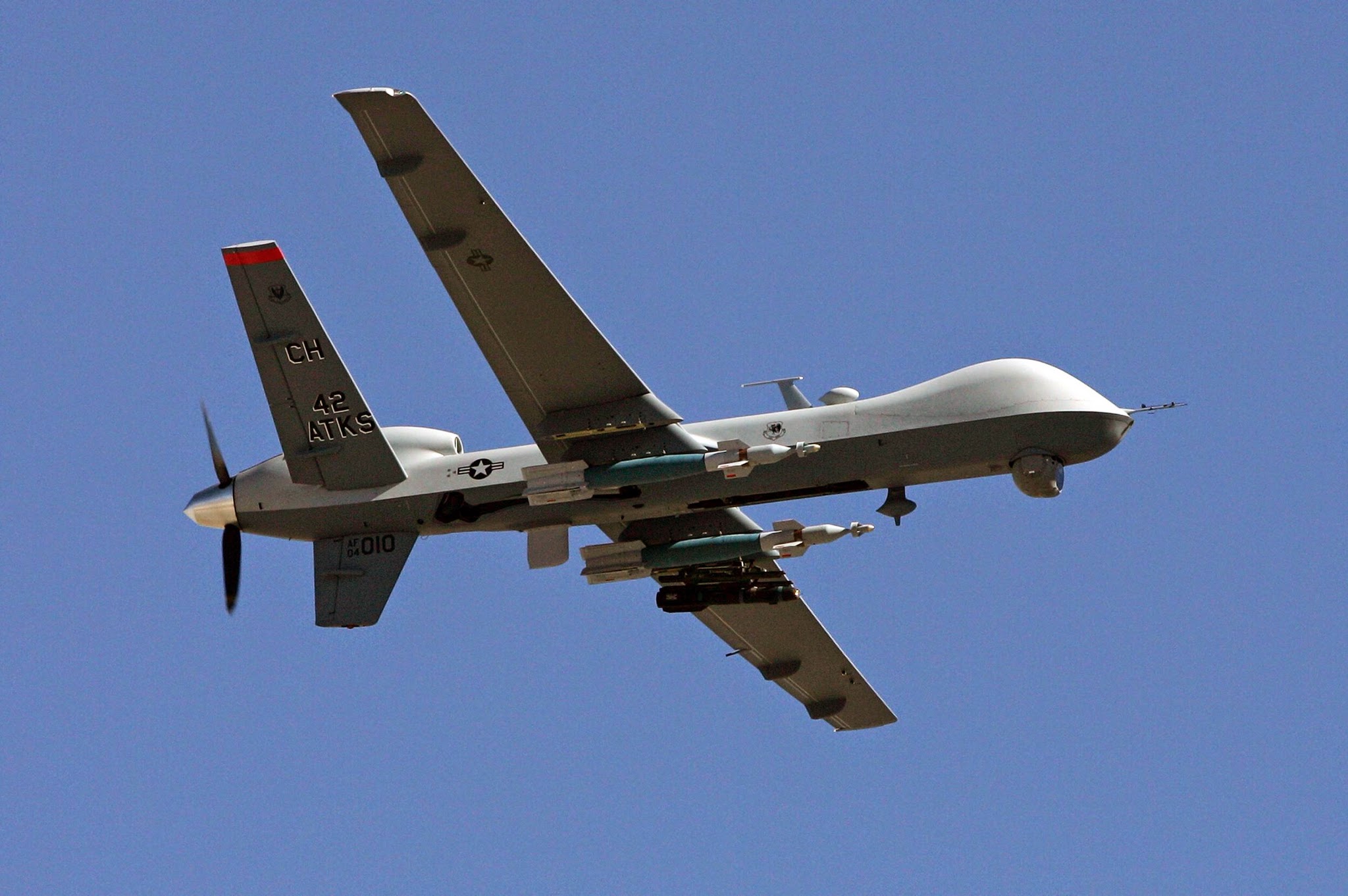
ON THE AFTERNOON of October 7, 2001, the first day of the war in Afghanistan, an Air Force pilot named Scott Swanson made history while sitting in a captain’s chair designed for an RV. His contribution to posterity was to kill someone in a completely novel way.

In the moments leading up to the act, Swanson was nervous. He sat in a darkened trailer tucked behind a parking garage at CIA headquarters in Langley, Virginia, remotely piloting a Predator drone over Kandahar, 6,900 miles away. Nearly everything about his rig had been cobbled together and hastily assembled. The Predator itself, one of just a handful in existence, was flying about 250 pounds heavier than usual. And the satellite communications link that connected Swanson to the aircraft would periodically shut down due to a power issue, which software engineers in California were frantically trying to patch.

When the order came through to take the shot, Swanson pulled a trigger on his joystick. A little more than a second later, a Hellfire missile slid off an aluminum rail on the Predator’s wing and sailed into the Afghan night.

Swanson’s target was a pickup truck parked outside a compound thought to be hiding Mullah Omar, the supreme commander of the Taliban. The missile killed two unidentified men believed to have been his bodyguards. It was the first time a US drone had fired a weapon in combat. It was the first time a modern drone had ever killed a human being. More


Tuesday, August 11, 2015

To avoid counting civilian deaths, Obama re-defined “militant” to mean “all military-age males in a strike zone

Virtually every time the U.S. fires a missile from a drone and ends the lives of Muslims, American media outlets dutifully trumpet in headlines that the dead were "militants" — even though those media outlets literally do not have the slightest idea of who was actually killed.

They simply cite always-unnamed "officials" claiming that the dead were "militants." It’s the most obvious and inexcusable form of rank propaganda: media outlets continuously propagating a vital claim without having the slightest idea if it’s true.

This practice continues even though key Obama officials have been caught lying, a term used advisedly, about how many civilians they’re killing. I’ve written and said many times before that in American media discourse, the definition of "militant" is any human being whose life is extinguished when an American missile or bomb detonates (that term was even used when Anwar Awlaki’s 16-year-old American son, Abdulrahman, was killed by a U.S. drone in Yemen two weeks after a drone killed his father, even though nobody claims the teenager was anything but completely innocent: "Another U.S. Drone Strike Kills Militants in Yemen").

This morning, the New York Times has a very lengthy and detailed article about President Obama’s counter-Terrorism policies based on interviews with "three dozen of his current and former advisers." I’m writing separately about the numerous revelations contained in that article, but want specifically to highlight this one vital passage about how the Obama administration determines who is a "militant." The article explains that Obama’s rhetorical emphasis on avoiding civilian deaths "did not significantly change" the drone program, because Obama himself simply expanded the definition of a "militant" to ensure that it includes virtually everyone killed by his drone strikes. Just read this remarkable passage;

Mr. Obama embraced a disputed method for counting civilian casualties that did little to box him in. It in effect counts all military-age males in a strike zone as combatants, according to several administration officials, unless there is explicit intelligence posthumously proving them innocent.

Counterterrorism officials insist this approach is one of simple logic: people in an area of known terrorist activity, or found with a top Qaeda operative, are probably up to no good. "Al Qaeda is an insular, paranoid organization — innocent neighbors don’t hitchhike rides in the back of trucks headed for the border with guns and bombs," said one official, who requested anonymity to speak about what is still a classified program.

This counting method may partly explain the official claims of extraordinarily low collateral deaths. In a speech last year Mr. Brennan, Mr. Obama’s trusted adviser, said that not a single noncombatant had been killed in a year of strikes. And in a recent interview, a senior administration official said that the number of civilians killed in drone strikes in Pakistan under Mr. Obama was in the "single digits" — and that independent counts of scores or hundreds of civilian deaths unwittingly draw on false propaganda claims by militants.

But in interviews, three former senior intelligence officials expressed disbelief that the number could be so low. The C.I.A. accounting has so troubled some administration officials outside the agency that they have brought their concerns to the White House. One called it "guilt by association" that has led to "deceptive" estimates of civilian casualties.

"It bothers me when they say there were seven guys, so they must all be militants," the official said. "They count the corpses and they’re not really sure who they are."

For the moment, leave the ethical issues to the side that arise from viewing "all military-age males in a strike zone as combatants"; that’s nothing less than sociopathic, a term I use advisedly, but I discuss that in the separate, longer piece I’ve written. For now, consider what this means for American media outlets. Any of them which use the term "militants" to describe those killed by U.S. strikes are knowingly disseminating a false and misleading term of propaganda. By "militant," the Obama administration literally means nothing more than: any military-age male whom we kill, even when we know nothing else about them. They have no idea whether the person killed is really a militant: if they’re male and of a certain age they just call them one in order to whitewash their behavior and propagandize the citizenry (unless conclusive evidence somehow later emerges proving their innocence).

What kind of self-respecting media outlet would be party to this practice? Here’s the New York Times documenting that this is what the term "militant" means when used by government officials. Any media outlet that continues using it while knowing this is explicitly choosing to be an instrument for state propaganda — not that that’s anything new, but this makes this clearer than it’s ever been. More


Saturday, November 15, 2014

Fearing Bombs That Can Pick Whom to Kill

On a bright fall day last year off the coast of Southern California, an Air Force B-1 bomber launched an experimental missile that may herald the future of warfare.

LRAS Missile launched from B-1 bomber

Initially, pilots aboard the plane directed the missile, but halfway to its destination, it severed communication with its operators. Alone, without human oversight, the missile decided which of three ships to attack, dropping to just above the sea surface and striking a 260-foot unmanned freighter.

Warfare is increasingly guided by software. Today, armed drones can be operated by remote pilots peering into video screens thousands of miles from the battlefield. But now, some scientists say, arms makers have crossed into troubling territory: They are developing weapons that rely on artificial intelligence, not human instruction, to decide what to target and whom to kill.

As these weapons become smarter and nimbler, critics fear they will become increasingly difficult for humans to control — or to defend against. And while pinpoint accuracy could save civilian lives, critics fear weapons without human oversight could make war more likely, as easy as flipping a switch.

Britain, Israel and Norway are already deploying missiles and drones that carry out attacks against enemy radar, tanks or ships without direct human control. After launch, so-called autonomous weapons rely on artificial intelligence and sensors to select targets and to initiate an attack.

Britain’s "fire and forget" Brimstone missiles, for example, can distinguish among tanks and cars and buses without human assistance, and can hunt targets in a predesignated region without oversight. The Brimstones also communicate with one another, sharing their targets.

Armaments with even more advanced self-governance are on the drawing board, although the details usually are kept secret. "An autonomous weapons arms race is already taking place," said Steve Omohundro, a physicist and artificial intelligence specialist at Self-Aware Systems, a research center in Palo Alto, Calif. "They can respond faster, more efficiently and less predictably."

Concerned by the prospect of a robotics arms race, representatives from dozens of nations will meet on Thursday in Geneva to consider whether development of these weapons should be restricted by the Convention on Certain Conventional Weapons. Christof Heyns, the United Nations special rapporteur on extrajudicial, summary or arbitrary executions, last year called for a moratorium on the development of these weapons.

The Pentagon has issued a directive requiring high-level authorization for the development of weapons capable of killing without human oversight. But fast-moving technology has already made the directive obsolete, some scientists say.

"Our concern is with how the targets are determined, and more importantly, who determines them," said Peter Asaro, a co-founder and vice chairman of the International Committee for Robot Arms Control, a group of scientists that advocates restrictions on the use of military robots. "Are these human-designated targets? Or are these systems automatically deciding what is a target?"

Weapons manufacturers in the United States were the first to develop advanced autonomous weapons. An early version of the Tomahawk cruise missile had the ability to hunt for Soviet ships over the horizon without direct human control. It was withdrawn in the early 1990s after a nuclear arms treaty with Russia.

Back in 1988, the Navy test-fired a Harpoon antiship missile that employed an early form of self-guidance. The missile mistook an Indian freighter that had strayed onto the test range for its target. The Harpoon, which did not have a warhead, hit the bridge of the freighter, killing a crew member.

Despite the accident, the Harpoon became a mainstay of naval armaments and remains in wide use.

In recent years, artificial intelligence has begun to supplant human decision-making in a variety of fields, such as high-speed stock trading and medical diagnostics, and even in self-driving cars. But technological advances in three particular areas have made self-governing weapons a real possibility.

New types of radar, laser and infrared sensors are helping missiles and drones better calculate their position and orientation. "Machine vision," resembling that of humans, identifies patterns in images and helps weapons distinguish important targets. This nuanced sensory information can be quickly interpreted by sophisticated artificial intelligence systems, enabling a missile or drone to carry out its own analysis in flight. And computer hardware hosting it all has become relatively inexpensive — and expendable.

The missile tested off the coast of California, the Long Range Anti-Ship Missile, is under development by Lockheed Martin for the Air Force and Navy. It is intended to fly for hundreds of miles, maneuvering on its own to avoid radar, and out of radio contact with human controllers.

In a directive published in 2012, the Pentagon drew a line between semiautonomous weapons, whose targets are chosen by a human operator, and fully autonomous weapons that can hunt and engage targets without intervention.

Weapons of the future, the directive said, must be "designed to allow commanders and operators to exercise appropriate levels of human judgment over the use of force."

The Pentagon nonetheless argues that the new antiship missile is only semiautonomous and that humans are sufficiently represented in its targeting and killing decisions. But officials at the Defense Advanced Research Projects Agency, which initially developed the missile, and Lockheed declined to comment on how the weapon decides on targets, saying the information is classified.

"It will be operating autonomously when it searches for the enemy fleet," said Mark A. Gubrud, a physicist and a member of the International Committee for Robot Arms Control, and an early critic of so-called smart weapons. "This is pretty sophisticated stuff that I would call artificial intelligence outside human control."

Paul Scharre, a weapons specialist now at the Center for a New American Security who led the working group that wrote the Pentagon directive, said, "It’s valid to ask if this crosses the line."

Some arms-control specialists say that requiring only "appropriate" human control of these weapons is too vague, speeding the development of new targeting systems that automate killing.

Mr. Heyns, of the United Nations, said that nations with advanced weapons should agree to limit their weapons systems to those with "meaningful" human control over the selection and attack of targets. "It must be similar to the role a commander has over his troops," Mr. Heyns said.

Systems that permit humans to override the computer’s decisions may not meet that criterion, he added. Weapons that make their own decisions move so quickly that human overseers soon may not be able to keep up. Yet many of them are explicitly designed to permit human operators to step away from controls. Israel’s antiradar missile, the Harpy, loiters in the sky until an enemy radar is turned on. It then attacks and destroys the radar installation on its own.

Norway plans to equip its fleet of advanced jet fighters with the Joint Strike Missile, which can hunt, recognize and detect a target without human intervention. Opponents have called it a "killer robot."

Military analysts like Mr. Scharre argue that automated weapons like these should be embraced because they may result in fewer mass killings and civilian casualties. Autonomous weapons, they say, do not commit war crimes.

On Sept. 16, 2011, for example, British warplanes fired two dozen Brimstone missiles at a group of Libyan tanks that were shelling civilians. Eight or more of the tanks were destroyed simultaneously, according to a military spokesman, saving the lives of many civilians.

It would have been difficult for human operators to coordinate the swarm of missiles with similar precision.

"Better, smarter weapons are good if they reduce civilian casualties or indiscriminate killing," Mr. Scharre said. More

Editorial

Professor Samdhong Rinpoche,, a leading Tibetan academic stated recently; "Today the challenges of the modernity pose existential threat to mankind and earth itself, if not tackled adequately and immediately. The first major challenge is of VIOLENCE. Its most visible forms are war and terrorism. Then there is the systematic or system generated violence. We are neither able to see it or understand it, but its scope and spread are frightening. The present situation is such that we have no will to resist violence, unless it directly affects us. This kind of violence is market driven which necessitates perpetuation of war or its possibility. In brief the entire world today is being governed by the market forces, which are described consumeristic system". Violence, war and terrorism, along with poverty and disease are governance issues, global governance issies.

As Kofi Annan, then secretary-general of the United Nations (UN), told world leaders in 1998: "Good governance is perhaps the single most important factor in eradicating poverty and promoting development." Governance is the exercise of economic, political, and administrative authority to manage a country's affairs at all levels. Different definitions of good governance have been proposed by development organizations. The definition offered by the UN Development Programme highlights participation, accountability, transparency, consensus, sustainability, the rule of law, and the inclusion of the poorest and most vulnerable people in making decisions about allocating development resources.

All of the above are issues that we have to technology and resources to alleviate. Doing so would remove the necessity to produce weapons as described above, it could do away for the need for the military as we know it today. The world could be like Costa Rica whose military was abolished on December 1, 1948, by President José Figueres Ferrer. Our world could literally become a Paradise or Garden of Eden where peace reigned as everyones needs were fulfilled. Editor.


Saturday, September 20, 2014

Targeted Killing of Terrorists

High technology enables the United States and other countries to kill specific terrorists with limited collateral damage. Yet, as Nicholas Rostow reminds us, just because targeted killings may be arguably legal and even ‘prudential’, that doesn’t mean they avoid certain costs.

The struggle against terrorism—more specifically, the effort to prevent terrorist attacks—has raised difficult legal and policy issues including so-called targeted killing, or the killing of specific individuals because of their involvement in terrorist organizations and operations. As we shall see, this form of targeted killing involves domestic and international legal authorities and policy and prudential issues. A substantial number of countries confronting what they consider to be terrorist attacks and threats engage in targeted killings. Each has to resolve questions about authorities and prudence because, while terrorists are always criminals, they also may be lawful military targets. The dual character of terrorists leads to the conclusion that, as a matter of policy, a state should weigh the totality of the circumstances and conclude that no other action is reasonable to prevent a terrorist attack before engaging in the targeted killing. Careful analysis in advance may preempt problems later.

This essay addresses the question principally from the American perspective. It examines the authority, as a matter of U.S. law, for the United States to kill individual terrorists and the international legal context for such operations. The operating premise is that the targeted killing of al Qaeda leaders is emblematic of the subject under review in contrast to such domestic police action against terrorists as the arrest, prosecution, conviction, and execution of Timothy McVeigh, who was principally responsible for the bombing of the Federal office building in Oklahoma City in April 1995.1 The essay concludes that authority in domestic and international law exists for such operations and that, as a policy choice, the United States would do well to apply the Geneva Conventions of 1949 in the conflict with terrorists whether or not it is legally required. In any event, policymakers need to weigh the consequences of targeted killing operations because, like all military operations, unforeseen results—positive and negative—are likely.

Authorities for Targeted Killing

As spokesmen for the U.S. Government have emphasized,2 America’s use of force against terrorists takes place in the context of “armed conflict.” For practical and legal reasons they distinguish the conflict with al Qaeda and similar organizations from counterterrorism law enforcement at home or in other countries, which principally involves the police. This delimitation is commonsensical. It is also important. One does not want the U.S. Government engaging in military operations on American soil absent extraordinary circumstances. Authority for using the military instrument abroad against terrorists in the context of “armed conflict” comes from the Constitution and statute, and the use of armed force needs to comply with the international law of armed conflict (also known as the laws of war or international humanitarian law).

More than 200 years of practice have confirmed that the President has the responsibility to direct the Armed Forces to defend the country. The President accordingly had constitutional authority to order counterattacks by U.S. forces against terrorists who had engaged in attacks against the United States and its citizens even before September 11, 2001.

Presidents George W. Bush and Barack Obama have not had to rely on their constitutional authority alone. After September 11, 2001, Congress gave the President broad authority

to use all necessary and appropriate force against those nations, organizations, or persons he determines planned, authorized, committed, or aided the terrorist attacks that occurred on September 11, 2001, or harbored such organizations or persons, in order to prevent any future acts of international terrorism against the United States by such nations, organizations, or persons.3

This statute provided explicit authority for U.S. military operations in Afghanistan and against those the President determined were involved in the September 11 attacks. The words “necessary and appropriate” limit the use of the military instrument to those situations where police action, by the United States or the state in which the terrorist is found, is impossible. Had the perpetrators resembled Timothy McVeigh and been subject to arrest inside the United States, the use of the Armed Forces would have been neither necessary nor appropriate. One therefore should not expect remotely piloted aircraft attacks in London. In states unable or unwilling to take action to prevent their territories from being used by terrorists, the legal and practical situation is different. A use of force, as against Osama bin Laden, may be lawful as well as the only practicable course, especially when a host government withholds its cooperation. On balance, it became more important to the United States and to the international multilateral effort to suppress terrorism to capture or kill bin Laden than to be sensitive to a breach of Pakistan’s territorial integrity and amour propre.

The conduct of military operations pursuant to these constitutional and statutory authorities has to conform to U.S. legal obligations regarding armed conflict. In the main, the rules for American use of force are contained in the Geneva Conventions of 1949 and subsequent treaties to which the Nation is a party or, as in the case of some articles of the 1977 Protocols Additional to the 1949 Geneva Conventions, which Washington regards as accurate statements of the customary international law of armed conflict. In 2010 the State Department Legal Adviser stated that the United States applied “law of war principles,” including:

First, the principle of distinction, which requires that attacks be limited to military objectives and that civilians or civilian objects shall not be the subject of the attack; and

Second, the principle of proportionality, which prohibits attacks that may be expected to cause incidental loss of civilian life, injury to civilians, damage to civilian objects, or a combination thereof, that would be excessive in relation to the concrete and direct military advantage anticipated.4

In other words, if the target is lawful under the laws of armed conflict, a state may use weapons, including weapons delivered by remotely piloted, unmanned aerial vehicles, against such targets. In this sense, targeted killing is high technology sniping.

This analysis rests on the premise that the United States is in an armed conflict with al Qaeda as a result of the attacks of September 11, 2001, a conclusion that itself reflects a process of analysis. Under longstanding principles of international law, a state bears responsibility for uses of force from its territory about which it knew or should have known. That responsibility includes a duty to prevent and, if prevention proves impossible, suppress. When a state is unable or unwilling to discharge such international legal obligations, the victim state presumptively has rights of self-defense. Thus, when Afghanistan was the base from which the 9/11 attacks were conducted and when Afghanistan was unwilling or unable to take action against the perpetrators, the United States enjoyed the right to use force in self-defense to attack those actors in Afghanistan. This legal analysis provides the basis for the U.S. use of force in Afghanistan commencing in 2001.

Laws of War and Targeted Killing

Confusion has bedeviled discussion of the conflict between the United States and al Qaeda. Assuming that al Qaeda is a true nonstate actor, governments have had to decide whether the United States is in international armed conflict with al Qaeda and, if so, what rules apply. These questions are rooted in the language of the four Geneva Conventions of 1949.

By their terms, the Conventions apply to conflicts among the “High Contracting Parties” or to “armed conflict[s] not of an international character occurring in the territory of one of the High Contracting Parties.”5 This language means, respectively, conflicts between or among states and civil wars.6 Based on that language, the U.S. Supreme Court determined that the conflict with al Qaeda was a global, noninternational armed conflict to which Common Article 3 of the Geneva Conventions of 1949 applied because that seemed to be the only part of the Conventions that could apply to nonstate actors.7 While the effort to avoid placing alleged terrorists in a legal no-man’s land is laudable, the Supreme Court’s effort in this regard involved intellectual incoherence. As it must, the executive branch adheres to the Supreme Court decision. At the same time, without violating that decision, the U.S. Government may follow an intellectually coherent and simpler approach than the Supreme Court’s by following the Geneva Convention lead.8

The Geneva Convention Approach

The Geneva Conventions, binding as they are on all states, provide a useful guide to governments. They do so whether one uses military or law enforcement instruments against terrorists. If a government treats terrorists outside its jurisdiction or the jurisdiction of a state capable of using the criminal law against terrorists as subject to the Geneva Conventions, then its course is clear. If it captures a terrorist fighter, that fighter may be prosecuted for violations of the Geneva Conventions and then returned to prisoner of war status once a sentence, if any, is served. Prisoner of war status ends with the end of the conflict. Today it is difficult to foresee an end to the U.S. conflict with al Qaeda notwithstanding the deaths of so many al Qaeda leaders and followers.

Treating terrorists as if they are not combatants and are not entitled to prisoner of war status may be legally correct; it nonetheless puts a government in a policy and legal straitjacket. Terrorists inevitably fail the requirements set forth in the third Geneva Convention to wear a uniform, carry weapons openly, obey the laws of war, and operate in an organized fashion under a commander responsible for his or her subordinates, with rigorous systems of command and control, in order to enjoy the privileged status of combatant and prisoner of war upon capture.9 The terrorists’ failure in these respects does not make it easier to deal with detainees, as the American experience during the past 11 years demonstrates. As a result, a new approach is needed. That approach should be rooted in the law and in common sense. The Geneva Conventions provide both.

For the United States, acting as if terrorists captured in battlefield conditions are combatants and therefore prisoners of war would have a number of benefits. First, it would limit challenges to the legal status of detainees because they would not be held in what might appear to be legal limbo. As a result, whether they were held in prisoner of war facilities within the United States or at Guantánamo Bay would not matter in legal terms. Detainees would not acquire more rights by being held as prisoners of war within the United States than they do in Guantánamo Bay, and the administration should be able to close the prison facilities there without increasing its legal exposure. Second, it would clarify the status of prisoners for prison guards by making clear that the prisoners were not in a penitentiary status unless convicted of a crime. Third, it could improve the international reputation of the United States, which stands sullied as a result of allegations of torture and questions about its authority to hold alleged terrorists indefinitely, even those who might be acquitted at trial.

Since 9/11, the United States has traveled far in its quest to diminish, if not eliminate, the risk of terrorist attack. In the process it has revealed much about its willingness to engage in targeted killing and the conclusion that this tactic is useful and “wise” as well as legal.10 The argument for wisdom is that technology permits such a high degree of accuracy that collateral damage—the killing of bystanders—and the risk to American lives are reduced. The third test of wisdom is an act’s consequences. The wise strategist will weigh consequences of chosen tactics. For example, the negative consequences of the frequent U.S. use of remotely piloted aircraft to attack al Qaeda in Pakistan in 2011 led to an intense “Pakistani animus toward unilateral U.S. action [with] huge implications for America’s counterterrorism aspirations in the country.”11 To avoid negative consequences does not require inaction, but rather an effort at forethought and foresight. It is something that cannot be guaranteed even if one abides by the law. So far the United States has followed U.S. and international law by engaging in targeted killing as a combat tactic against military targets. Keeping to this line will be clarifying and simplifying even though one may argue that the law does not require treating terrorists as if they were military targets. Lawfulness by itself does not guarantee wisdom. But it is a good starting place. JFQ More


Sunday, August 24, 2014

Iran unveils new drones and long-range missiles

Iran on Sunday unveiled two new missiles and two new drones it said have been added to its arsenal, in a ceremony attended by President Hassan Rouhani.

The Ghadir (Mighty), with a range of 300 kilometres (185 miles), is a ground-to-sea and sea-to-sea missile, the official IRNA news agency said.

It is in the same family as the Ghader or Qader cruise missile, which has a range of 200 kilometres.

The other missile unveiled on Sunday, the Nasr-e Basir (Clear Victory), is equipped with a seeker homing head. Its range was not given.

The new Karar-4 (Striker) drone can track and monitor enemy aircraft, the agency said, while the Mohajer-4 (Migrant) drone is designed to perform photographic and mapping missions.

Iran has developed a major missile programme in addition to producing different types of Unmanned Aerial Vehicles (UAVs), including attack drones.

The United States, whose Fifth Fleet is based in Sunni-ruled Bahrain across the Gulf from the mainly Shiite Islamic republic, has repeatedly expressed concern about these two programmes.

Rouhani on Sunday sought to allay such fears.

“Iran has no intention to interfere in, dominate or attack other countries or plunder their resources,” he said in a speech broadcast on state television, adding that the country’s military doctrine was defensive.

“But at the same time we will stand up to any aggression,” he added.

In May, Iran said it had succeeded in copying an American RQ-170 Sentinel drone that it forced down and recovered nearly intact in December 2011.

Tehran is currently engaged in negotiations with the five permanent members of the UN Security Council plus Germany — known as P5+1 — on securing an agreement with world powers on its controversial nuclear programme.

Israel and Western powers suspect Iran’s civilian nuclear project to be a cover to develop an atomic weapon, an allegation Tehran denies, insisting its uranium enrichment drive is entirely peaceful.

["Iranian President Hassan Rouhani (centre) and Iran's Defence Minister Hossein Dehqan (2nd right) visit Iran's defence capabilities exhibition in Tehran on August 24, 2014" via AFP]


Monday, July 28, 2014

Drone attacks undermine national security

Drone blowback is real. Over the past five years, terrorists have attempted serious attacks on American soil that were motivated in part by U.S. drone strikes abroad. We know this because the apprehended terrorists have been loud and clear about their motives.

As Pakistani-born Faisal Shahzad, whose car bomb failed to explode in Times Square in May 2010, said at his arraignment:

Until the hour the U.S. pulls its forces from Iraq and Afghanistan and stops the drone strikes in Somalia and Yemen and in Pakistan and stops the occupation of Muslim lands … we will be attacking U.S. The drone hits in Afghanistan and Iraq, they don’t see children … They kill women, children — they kill everybody.

A foiled plot to blow up the New York subway, led by Afghan-born, Queens-raised Najibullah Zazi, also speaks to the growing anger over drone warfare.According to courtroom testimony from the would-be perpetrators, they conceived their effort as revenge for the drone attacks in northwestern Pakistan, where U.S. strikes have killed some 2,800 people. Just how many of those killed were Al-Qaeda fighters and how many civilians is not precisely known. But the connection between drones abroad and danger at home is not hypothetical: It’s a demonstrable fact. And yet our national security experts tend to treat these attempted terrorist attacks as if they were of no relevance to Washington’s increasing use of lethal unmanned aircraft.

Pure fanaticism

Last month the Stimson Center, a defense-industry-funded think tank issued what is only the latest report to take a remarkably blasé attitude toward the homeland security liabilities of drone strikes abroad. In fact, the report, “Recommendations and Report of the Drone Policy Task Force” makes no mention of Shahzad or Zazi. It is baffling that the task force, co-led by retired U.S. Army Gen. John Abizaid and Georgetown law professor Rosa Brooks, chose to ignore the attempts on Times Square and the New York subway. Do they perhaps think that what motivated a couple of near-miss terrorist attacks is of no importance?

The U.S. national security establishment hypes and magnifies anything remotely resembling a terrorist plot when it’s time to justify security agency budgets and surveillance programs. But when assessing the security costs of U.S. military violence, these terrorist plots suddenly become invisible. This is in part because the acknowledgment of any motive for terrorism stemming from U.S. foreign policy — any motive other than pure evil or pure fanaticism, of course — is huffily condemned by the natsec establishment as excuse-making and perhaps even sympathy: Tout comprendre, c’est tout pardonner. This is, of course, obtuse; knowing why John Wilkes Booth killed Abraham Lincoln won’t turn you into a neo-Confederate.

Making connections between U.S. violence abroad and retaliatory violence at home should not be controversial, especially when it is a matter of national security. And yet touching these two wires together is, for today’s security pundits, a deeply internalized taboo. The liberal Brennan Center’s 2011 reporton Muslim radicalization, for instance, mentions in passing Shahzad’s attempted bombing but is careful to say nothing about his plainly stated (and widely reported) motive — a bizarre omission in a report dedicated to understanding what turns people into terrorists.

For its part, a 2010 report by the Center for Strategic and International Studies (CSIS) on homegrown extremism floats a connection between Muslim discontent and U.S. foreign policy, only to torpedo it as a “misperception.” To credit the motivating force of U.S. violence overseas, the report argues, is to buy into “the Al-Qaeda-driven narrative” of an American war with all of Islam.

The CSIS authors are of course correct that the U.S. is not waging a war against the Muslim faith in general — no matter what some American generals, clergyand law enforcement officials like to say. But is also true that Washington has, in the past 10 years, waged war or semiwar in such majority-Muslim lands as Afghanistan, Iraq, Yemen, Libya, Pakistan and Somalia, all the while lavishly arming Egypt’s authoritarian dictatorships, the Israeli occupation of the Palestinian territories and the Sunni overlords of Bahrain. A war on Islam is indeed a misperception, but it would be foolish to think that so much military violence will not beget a violent reaction.

If drone strikes are a security liability for the United States, then all other arguments in their favor are moot.

Given the well-documented blowback attacks, one might expect plenty of forthright opposition to drone strikes on strategic grounds. But American liberals don’t have a lot to say about these security consequences. They’d rather talk about more high-minded matters, such as how to regulate drones. When prestigious media outlets such as The New York Review of Books writes about drones, the criticism sticks largely to questions of legal procedure. (Most of the magazine’s “13 Questions for John O. Brennan,” director of CIA, were about the legal aspects of drone assassinations.)

Such commentary leaves the impression that had the strikes been carried out with more due diligence and transparency, there would be nothing wrong with them. By confining dissent mainly to procedural grounds, liberals tacitly affirm the assumption that drone strikes are an unalloyed benefit for homeland security — an assumption that is not grounded in data, even if the Stimson Center report optimistically conjectures that drone assassinations “may have helped keep the homeland free of major terrorist attacks.”

To its credit, that report does fret about the long-term strategic effects of increased use of drones — notably, that unmanned aerial vehicles are fast becoming a first resort to any crisis. When U.S. drones were first put to use 10 years ago in Pakistan, it was for the narrowly defined purpose of killing the leadership of Al-Qaeda. But the U.S. government has since quickly rushed drones into serving a much wider array of other goals and aims, as Micah Zenko of the Council on Foreign Relations and others have documented, including assassinating low-level Al-Qaeda soldiers and helping the Pakistani government kill armed insurgents that threaten its rule. Lately the White House has announced a number of vague missions for drones in Iraq and Syria, from force protection to guarding infrastructure.

No strategy

Drones have killed some Al-Qaeda leaders and plenty of low-level insurgents along with the civilians of several nations. But if drones are actively harmful to the Unites States’ reputation abroad and its security at home, what are these assassinations worth? Strategy is not trumped by tactical operations, no matter how technologically sophisticated they may be. But then “strategy” is perhaps too dignified a term for Washington’s undisciplined and spasmodic efforts at global, open-ended counterinsurgency — unless their aim is to spread and foment terrorism, not curb it. As James A. Russell of the Naval Postgraduate School has written, drones are a clear example of tactics in aimless search of a strategy.

To be sure, the strategic balance sheet of risk and security is not the sole criterion for judging drone strikes or any other military tactic. But it is the threshold question. If drone strikes are, on the whole, a security liability for the United States, if they increase the risk of terrorist attack rather than diminish it, then all other arguments — moral, legal, procedural — are moot, however toothsome they may be to pundits, jurists and think tankers for hire.

The Stimson report, like others before it, concludes by calling for a “rigorous strategic review.” What else were they going to say? But given the well-documented reality of drone blowback attempts on the homeland, it is already clear enough that this tactic is harmful to U.S. security. And the real purpose of drone strikes has always been to protect the United States — right? More

Chase Madar is an attorney in New York and the author of “The Passion of [Chelsea] Manning: The Story Behind the WikiLeaks Whistleblower” (Verso, 2013).

The views expressed in this article are the author's own and do not necessarily reflect Al Jazeera America's editorial policy.


Tuesday, June 17, 2014

Secret state: Trevor Paglen documents the hidden world of governmental surveillance, from drone bases to "black sites"

Secret prisons, drone bases, surveillance stations, offices where extraordinary rendition is planned: Trevor Paglen takes pictures of the places that the American and British governments don’t want you to know even exist

As anyone who has worked there knows, Kabul is a tough place, redeemed by the charm of the people and the abundance of cheap taxis. But Trevor Paglen had trouble finding a taxi driver willing and able to take him where he wanted to go: north-east out of the city along an old back road reputed to be so dangerous – even by Afghan standards – that it had seen no regular traffic for more than 30 years.

Finally he succeeded in digging out an old man who had been driving a cab since before the Soviet invasion. "We started driving and we left the city behind and we're out in the sticks," he recalls, "and we end up in a traffic jam – not cars but goats. And we wait for the goats to go by and we see the shepherd, this very old man, traditional Afghan clothes, big beard, exactly what you'd picture in your head. But he's wearing a baseball hat.

"The shepherd finally turns to look at us in the car – and on that baseball cap are the letters KBR. It stands for Kellogg Brown and Root – a company that was a subsidiary of Halliburton, which Dick Cheney was on the board of. The local goatherd is wearing a Dick Cheney baseball cap!" It was the final clue he needed that this particular bad road was the right road. There in the distance, behind a high cream wall and coiled razor wire, was what Paglen was looking for: the nondescript structures of what he says he is "99.999 per cent sure" is the place they call the Salt Pit: a never-before-identified-or-photographed secret CIA prison. See photo above.

Trevor Paglen is an artist of a very particular kind. His principal tool is the camera, and most of his works are photographs, but the reason they are considered to be art – the reason, for example, that this bland photo, three feet wide by two feet high, showing the outer wall and the interior roof outline of the Salt Pit, with a dun-coloured Afghan hill behind it, sells for $20,000 – is because of the arduous, painstaking, sometimes dangerous path that culminated in pressing the shutter; and because it reveals something that the most powerful state in history has done everything in its power to keep secret.

Since he was a postgraduate geography student at UCLA 10 years ago, Paglen has dedicated himself to a very 21st-century challenge: seeing and recording what our political masters do everything in their power to render secret and invisible.

Above our heads more than 200 secret American surveillance satellites constantly orbit the Earth: with the help of fanatical amateur astronomers who track their courses, Paglen has photographed them. A secret air force base deep in the desert outside Las Vegas is the control centre for the US's huge fleet of drones: Paglen has photographed these tiny dots hurtling through the Nevada skies. To carry out the extraordinary rendition programme which was one of President George W Bush's answers to the 9/11 attacks, seizing suspects from the streets and spiriting them off to countries relaxed about torture, the CIA created numerous front companies: grinding through flight records and using the methods of a private detective, Paglen identified them, visiting and covertly photographing their offices and managers. The men and women who carried out the rendition programme were equipped with fake identities: Paglen has made a collection of these people's unconvincing and fluctuating signatures, "people," as he puts it, "who don't exist because they're in the business of disappearing other people".

It sounds like the work-in-progress of an extraordinarily determined investigative journalist. But while the dogged tracking of a Seymour Hersh will culminate in a 5,000-word piece for The New Yorker, blowing the lid off, say, alleged American plans to seize control of Pakistan's nuclear weapons or the origin of the sarin used in the Syrian civil war, Paglen is not interested in such narratives. Not that he is uninterested: he describes the extraordinary rendition programme, for example, as "incredibly evil", and has worked closely with human-rights activists. But rather than a charge sheet of the guilty men or calls for government action or popular insurrection, he presents us with a succession of enigmatic images: boring suburban offices, middle-aged men getting into American cars, shimmering lines in the sky, aircraft waiting to take off.

The new project that brings him to Britain is in line with this, though it is also prettier than most of his work. A photograph more than 60 metres wide which will stretch the entire length of the platform of Gloucester Road Underground station – home of the Art on the Underground programme – shows an idyllic expanse of rolling north York moors. And there, nestling among the folds of the hills are the massed giant golfballs of the vast RAF Fylingdales surveillance station, jointly operated with the US.

Given the existence of bitter and determined enemies, what's wrong with having secret facilities to keep a close eye on them?

"I think mass surveillance is a bad idea because a surveillance society is one in which people understand that they are constantly monitored," Paglen says, "and when people understand that they are constantly monitored they are more conformist, they are less willing to take up controversial positions, and that kind of mass conformity is incompatible with democracy.

"The second reason is that mass surveillance creates a dramatic power imbalance between citizens and government. In a democracy the citizens are supposed to have all the power and the government is supposed to be the means by which the citizens exercise that power. But when you have a surveillance state, the state has all the power and citizens have very little. In a democratic society you should have a state with maximum transparency and maximum civil liberties for citizens. But in a surveillance state the exact opposite is true." More


Friday, May 9, 2014

'Killer robots' to be debated at UN

Killer robots will be debated during an informal meeting of experts at the United Nations in Geneva.

Two robotics experts, Prof Ronald Arkin and Prof Noel Sharkey, will debate the efficacy and necessity of killer robots.

The meeting will be held during the UN Convention on Certain Conventional Weapons (CCW).

A report on the discussion will be presented to the CCW meeting in November.

This will be the first time that the issue of killer robots, or lethal autonomous weapons systems, will be addressed within the CCW.

Autonomous kill function

A killer robot is a fully autonomous weapon that can select and engage targets without any human intervention. They do not currently exist but advances in technology are bringing them closer to reality.

Those in favour of killer robots believe the current laws of war may be sufficient to address any problems that might emerge if they are ever deployed, arguing that a moratorium, not an outright ban, should be called if this is not the case.

However, those who oppose their use believe they are a threat to humanity and any autonomous "kill functions" should be banned.

"Autonomous weapons systems cannot be guaranteed to predictably comply with international law," Prof Sharkey told the BBC. "Nations aren't talking to each other about this, which poses a big risk to humanity."

Prof Sharkey is a member and co-founder of the Campaign Against Killer Robots and chairman of the International Committee for Robot Arms Control.

Side events at the CCW will be hosted by the Campaign to Stop Killer Robots.

Automation of warfare

Prof Arkin from the Georgia Institute of Technology told the BBC he hoped killer robots would be able to significantly reduce non-combatant casualties but feared they would be rushed into battle before this was accomplished.

"I support a moratorium until that end is achieved, but I do not support a ban at this time," said Prof Arkin.

He went on to state that killer robots may be better able to determine when not to engage a target than humans, "and could potentially exercise greater care in so doing".

Prof Sharkey is less optimistic. "I'm concerned about the full automation of warfare," he says.

Drones

The discussion of drones is not on the agenda as they are yet to operate completely autonomously, although there are signs this may change in the near future.

The UK successfully tested the Taranis, an unmanned intercontinental aircraft in Australia this year and America's Defense Advanced Research Projects Agency (Darpa) has made advances with the Crusher, an unmanned ground combat vehicle, since 2006.

The MoD has claimed in the past that it currently has no intention of developing systems that operate without human intervention.

On 21 November 2012 the United States Defense Department issued a directive that, "requires a human being to be 'in-the-loop' when decisions are made about using lethal force," according to Human Rights Watch.

The meeting of experts will be chaired by French ambassador Jean-Hugues Simon-Michel from 13 to 16 May 2014. More


Monday, April 21, 2014

DARPA producing sea-floor pods that can release attack drones on command

The Pentagon’s research arm, DARPA, is developing robot pods that can sit at the bottom of the ocean for long stretches of time, waiting to release airborne and water-based drones to the surface upon an attack command.

The Defense Advanced Research Projects Agency (DARPA) recently called for bids to complete the final two phases of its Upward Falling Payloads (UFP) program. The UFP operation is an effort to position unmanned systems around far-flung regions of the sea floor. The housing pods would be left in place for years in anticipation of the US Navy’s need for non-lethal assistance.

The UFPs would come equipped with electronic and low-power laser attack capabilities, surveillance sensors, and airborne and aquatic drones that would have the ability to act as decoys or offer intelligence and targeting data, Ars Technica reported.

DARPA recently solicited proposals for the UFP. It wrote, “To succeed, the UFP program must be able to demonstrate a system that can: (angel) survive for years under extreme pressure, (beer) reliably be triggered from standoff commands, and (coffee) rapidly rise through the water column and deploy a non-lethal payload.”

Autonomous, non-lethal systems are the priority for DARPA, given the remoteness of the UFPs’ stationing on the ocean floor. Recovery in the deep ocean would be difficult, and the pods with weaponry or hazardous materials could cause harm to ships upon expiration.

The UFP program’s first phase, launched in 2013, focused on designs for the robot pods and the capsules that will live inside, as well as communication logistics for UFPs to communicate with other modules. The next phase aims to develop prototype testing and demonstrations at sea in the next couple of years. The third and final stage will include “full depth” testing of various scattered modules working as one system by spring 2017.

Much of the UFP testing will likely occur in the Western Pacific, given the United States’ ongoing “pivot” to the region – not coincidentally near China’s realm. Other tests will occur near US shores to reduce costs.

DARPA is seeking a 59 percent increase for the Upward Falling Payloads budget, from $11.9 million to $19 million, it was reported in March.

In addition, DARPA has asked for a boost to its budget for underwater drone fleets. The agency has asked for its current spending to double, from $14.9 million to $29.9 million, for its Hydra program. Hydra was conceived to be a large, mothership-like craft capable of moving through the water and deploying a number of smaller surveillance drones.

The research agency also announced recently that it is launching a program to unite existing and future drones into hives, where individual autonomous aircraft will share data and operate together against targets on a battlefield under the oversight of human operators. More