Showing posts with label Taliban. Show all posts

Wednesday, August 23, 2017

Trump’s Request for India’s Help in Afghanistan Rattles Pakistan

Trump’s Request for India’s Help in Afghanistan Rattles Pakistan - The New York Times

However, Maria Sultan, a defense analyst based in Islamabad and director general of the South Asian Strategic Stability Institute, said the Trump policy was “not as bad as we were expecting. The responsibility has been essentially shifted to Afghanistan.”

She warned that intelligence-based operations against groups inside Pakistan might increase. “This will further reduce the space for cooperation between Pakistan and U.S. and will be counterproductive for a long-term relationship,” Ms. Sultan said. More

Saturday, December 19, 2015

HOW ROGUE TECHIES ARMED THE PREDATOR, ALMOST STOPPED 9/11, AND ACCIDENTALLY INVENTED REMOTE WAR

ON THE AFTERNOON of October 7, 2001, the first day of the war in Afghanistan, an Air Force pilot named Scott Swanson made history while sitting in a captain’s chair designed for an RV. His contribution to posterity was to kill someone in a completely novel way.

In the moments leading up to the act, Swanson was nervous. He sat in a darkened trailer tucked behind a parking garage at CIA headquarters in Langley, Virginia, remotely piloting a Predator drone over Kandahar, 6,900 miles away. Nearly everything about his rig had been cobbled together and hastily assembled. The Predator itself, one of just a handful in existence, was flying about 250 pounds heavier than usual. And the satellite communications link that connected Swanson to the aircraft would periodically shut down due to a power issue, which software engineers in California were frantically trying to patch.

When the order came through to take the shot, Swanson pulled a trigger on his joystick. A little more than a second later, a Hellfire missile slid off an aluminum rail on the Predator’s wing and sailed into the Afghan night.

Swanson’s target was a pickup truck parked outside a compound thought to be hiding Mullah Omar, the supreme commander of the Taliban. The missile killed two unidentified men believed to have been his bodyguards. It was the first time a US drone had fired a weapon in combat. It was the first time a modern drone had ever killed a human being. More


Wednesday, January 14, 2015

Pakistani Taliban: The fault in their narrative

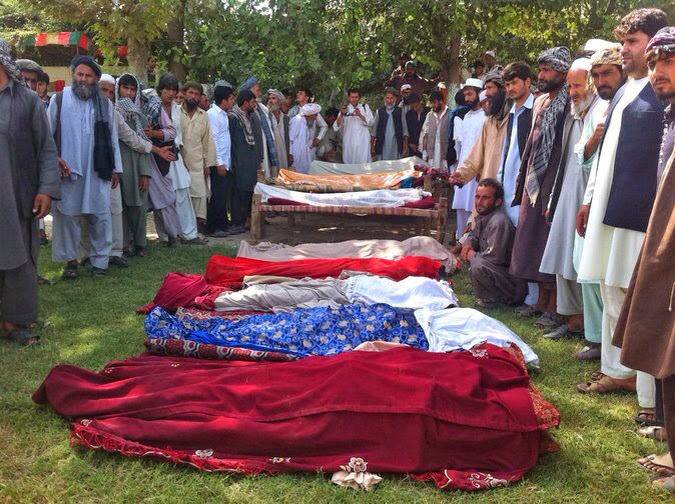
On December 16, 2014, Pakistani Taliban massacred over 132 children when they attacked a high school in Peshawar.

Taliban in the spring of 2013

They rationalized this attack as a reaction to the violence perpetrated against them (whether by the Pakistani military or US drones). This narrative attempts to shift blame for the violence away from the Taliban, creating an environment where the population becomes sympathetic to their rationales, even while disagreeing with their tactics. Therefore, it is increasingly important to challenge the Taliban narrative.

First, simply claiming to be fighting in reaction to military operations, does not make it true. Taliban in Pakistan were targeting civilians long before the start of any military campaigns. Lethal force was employed against them because the militants had started violence against the Pakistan state, rather than vice versa.

Second, while civilians are in fact being harmed by both the Pakistani military and the US drones, it is not clear if these victims are necessarily joining the Taliban. In fact, there is considerable evidence of child recruitment and forcible recruitment within the Taliban organizations.

Third, in the context of Afghanistan, in his study Jason Lyall found that while insurgents do increase their attacks after the use of force by the counter-insurgency, civilian casualties play an insignificant role in motivating these attacks. To put it simply, terrorist do not care about civilian casualties. By definition, terrorism is a tactic that deliberately targets civilians. Militants increase attacks because their own survival is threatened, and violence is a way of bolstering their bargaining leverage. The choice of targeting a school does show desperation on their part. To quote a Pakistani general, “The militants know they won’t be able to strike at the heart of the military, they don’t have the capacity. So they are going for soft targets.”

The use of lethal force against terrorist groups is a hard sell in today’s political climate, as experts often argue that it exacerbates the problem of terrorism. However, if the use of weapons is to be reduced in the “war against terrorism,” then it is important to challenge the terrorists’ narrative and condemn their actions in an unapologetic fashion. This will shrink the sympathetic space that makes it easier for these groups to operate, making their demise more likely. More


Sunday, June 1, 2014

The Wrong Afghan Friends

At a checkpoint on a dirt road in southeastern Afghanistan in 2012, Rahim Sarobi, a farmer, braked to a stop behind a knot of idling cars. Up ahead, Afghan gunmen were piled into the back of a Toyota Hilux. On the ground, tied to the rear fender by their wrists, lay two bloodied men, laboring to breathe.

Everyone was ordered out of their vehicles. The burly checkpoint commander, known simply as Azizullah, said the unfortunate pair had not slowed sufficiently at the checkpoint, and only the Taliban don’t slow down. But Mr. Sarobi and fellow motorists recognized the men as farmers from their village. They pleaded, but Azizullah would not listen. The motorists were ordered to follow the pickup as it dragged the men along six miles of rock-studded road. By the time the convoy reached Azizullah’s base, the pair were dead. Their bodies were left decomposing for days, a warning to anyone who thought of disobeying Azizullah.

Mr. Sarobi told me that story in Paktia Province last February. It echoes ominously against President Obama’s announcement on Tuesday that about 9,800 American troops will stay in Afghanistan after most have withdrawn this year. Special Operations Forces will continue training Afghans and assisting in counterterrorism. And if the current pattern holds, we can expect them, alongside the Central Intelligence Agency, to keep partnering with commanders like Azizullah to fight the Taliban.

Bear in mind that Azizullah is not a member of the Afghan army. He does not work for the Afghan National Police. He is not, in fact, under the authority of the Afghan government at all.

Instead, his militia, which has been supported by the Special Operations Forces, is part of a network of semi-independent rural paramilitary groups that owe their funding, weapons and very existence to America’s war on terror. By backing this network, the United States is fostering an environment of lawlessness and impunity, exacerbating Afghanistan’s longstanding problems, and creating fertile ground for the Taliban insurgency to survive. Using such strongmen seems to run counter to the doctrine laid out in 2006 in a much publicized Army/Marines counterinsurgency manual, which emphasized the need to convince citizens that America’s fighting forces will keep them safe.

On my trip to Paktia last winter, I met with other villagers who shared stories about the commander. A university student said he was at a village bazaar with his teenage cousin, who had fled his own village to escape Taliban threats. Azizullah’s militiamen accused the cousin of having ties to insurgents. He was arrested, taken to Azizullah’s compound, chained to a wall, raped repeatedly by militiamen, and released the next morning.

Azizullah’s crimes are detailed in a confidential dispatch, sent in 2010 to the United States military by United Nations officials, asking the Americans to sever ties with him. “A boy aged 16 was arrested by Commander Azizullah approximately four months ago in the Angur Ada area in Bermal district” states a copy of the dispatch that I obtained. “His father tried to intervene and told Azizullah he could arrest him instead of his son. The boy was released after 25 days, during which Azizullah sexually abused him.”

Afghans tell similar tales about other American-backed commanders, who hold sway over villages, districts or provinces. In southern Afghanistan’s Khas Oruzgan district, residents accuse Abdul Hakim Shujayee of going on multiple killing and raping rampages. Afghan officials in Kabul said their government tried to arrest him, but failed because he was protected by American Special Operations Forces. American officials say they have cut their ties with him, a claim that has been met with skepticism from residents. In 2011, in the village of Khosh Khadir in Daikundi Province, villagers told me that an American-supported strongman known as Lalay let his forces rampage through the village in response to a Taliban attack, hanging civilians from trees, abducting women, and setting homes and shops ablaze.

American authorities insist there is no proof of such allegations, and experts on Afghanistan often attach the caveat that enemies in Afghanistan tell wild tales about one another. But it is unclear whether an investigation has ever been conducted in any of these cases. American officials have told me that Azizullah and those like him are essential for combating the Taliban, and even the strongmen’s detractors acknowledge their Taliban-hunting prowess. Maj. Michael Waltz, a former Special Operations Forces officer who worked with Azizullah, put the argument this way in an interview: “We can’t sacrifice security for this multigenerational effort to build rule of law.”

In fact, the United States has favored counterterrorism over building Afghan state institutions and promoting the rule of law. Less than 10 percent of American funding in Afghanistan has gone to nonmilitary expenditures, even as Washington has poured millions into the coffers of regional strongmen with human rights records arguably as poor as the Taliban’s. One result: The writ of Hamid Karzai’s weak government is concentrated in the cities, while power brokers like Azizullah unofficially rule the countryside — especially the rural south and east. So villagers like those I met feel they have no recourse to justice or protection from predation — just the sort of grievance the insurgency exploits.

The Afghan government has tried to co-opt the strongmen by anointing them as governors and police chiefs. And in recent years, the United States has rebranded hundreds of militias as “Afghan Local Police,” placing them under nominal government authority. In most cases, though, the strongmen retain independent sources of revenue, including drug money or American patronage, as well as control over the militias. Their corruption infects the whole government; a Joint Chiefs of Staff report says the state has sometimes become, in effect, a collection of “criminal patronage networks.” The report also quotes an unnamed member of an interagency task force network as explaining: “The corruption piece is hard because security reigns supreme. We won’t remove corrupt officials if it looks like it will interrupt security.”

“Security,” in this context, does include protecting citizens from the Taliban — but not from predatory American-backed strongmen. Rural Afghans consistently told me they wanted freedom from both. But that is unlikely if American proxies continue the war on terror as it has been fought.

The most effective weapon against the Taliban would be a strong centralized state, responsive to citizens’ needs. This would require Americans to sever unilateral patronage relationships with rural power brokers and militias, and direct all funding to the state. (To deter corruption, international donors and Kabul could manage disbursement jointly, through trust funds.) The Afghan government should then absorb these forces into its ranks; with the strongmen stripped of American protection and independent revenue sources, integration should be easier. More


Friday, May 9, 2014

'Killer robots' to be debated at UN

Killer robots will be debated during an informal meeting of experts at the United Nations in Geneva.

Two robotics experts, Prof Ronald Arkin and Prof Noel Sharkey, will debate the efficacy and necessity of killer robots.

The meeting will be held during the UN Convention on Certain Conventional Weapons (CCW).

A report on the discussion will be presented to the CCW meeting in November.

This will be the first time that the issue of killer robots, or lethal autonomous weapons systems, will be addressed within the CCW.

Autonomous kill function

A killer robot is a fully autonomous weapon that can select and engage targets without any human intervention. They do not currently exist but advances in technology are bringing them closer to reality.

Those in favour of killer robots believe the current laws of war may be sufficient to address any problems that might emerge if they are ever deployed, arguing that a moratorium, not an outright ban, should be called if this is not the case.

However, those who oppose their use believe they are a threat to humanity and any autonomous "kill functions" should be banned.

"Autonomous weapons systems cannot be guaranteed to predictably comply with international law," Prof Sharkey told the BBC. "Nations aren't talking to each other about this, which poses a big risk to humanity."

Prof Sharkey is a member and co-founder of the Campaign Against Killer Robots and chairman of the International Committee for Robot Arms Control.

Side events at the CCW will be hosted by the Campaign to Stop Killer Robots.

Automation of warfare

Prof Arkin from the Georgia Institute of Technology told the BBC he hoped killer robots would be able to significantly reduce non-combatant casualties but feared they would be rushed into battle before this was accomplished.

"I support a moratorium until that end is achieved, but I do not support a ban at this time," said Prof Arkin.

He went on to state that killer robots may be better able to determine when not to engage a target than humans, "and could potentially exercise greater care in so doing".

Prof Sharkey is less optimistic. "I'm concerned about the full automation of warfare," he says.

Drones

The discussion of drones is not on the agenda as they are yet to operate completely autonomously, although there are signs this may change in the near future.

The UK successfully tested the Taranis, an unmanned intercontinental aircraft in Australia this year and America's Defense Advanced Research Projects Agency (Darpa) has made advances with the Crusher, an unmanned ground combat vehicle, since 2006.

The MoD has claimed in the past that it currently has no intention of developing systems that operate without human intervention.

On 21 November 2012 the United States Defense Department issued a directive that, "requires a human being to be 'in-the-loop' when decisions are made about using lethal force," according to Human Rights Watch.

The meeting of experts will be chaired by French ambassador Jean-Hugues Simon-Michel from 13 to 16 May 2014. More


Tuesday, October 1, 2013

The Forgotten War:12 Years In Afghanistan Down The Memory Hole

Will the U.S. still be meddling in Afghanistan 30 years from now? If history is any guide, the answer is yes. And if history is any guide, three decades from now most Americans will have only the haziest idea why.

Since the 1950s, the U.S. has been trying to mold that remote land to its own desires, first through an aid “war” in the midst of the Cold War with the Soviet Union; then, starting as the 1970s ended, an increasingly bitter and brutally hot proxy war with the Soviets meant to pay them back for supporting America’s enemies during the war in Vietnam. One bad war leads to another.

From then until the early 1990s, Washington put weapons in the hands of Islamic fundamentalist extremists of all sorts -- thought to be natural, devoutly religious allies in the war against “godless communism” -- gloated over the Red Army’s defeat and the surprising implosion of the Soviet empire, and then experienced its own catastrophic blowback from Afghanistan on September 11, 2001. After 50 years of scheming behind the scenes, the U.S. put boots on the ground in 2001 and now, 12 years later, is still fighting there -- against some Afghans on behalf of other Afghans while training Afghan troops to take over and fight their countrymen, and others, on their own.

Through it all, the U.S. has always claimed to have the best interests of Afghans at heart -- waving at various opportune moments the bright flags of modernization, democracy, education, or the rights of women. Yet today, how many Afghans would choose to roll back the clock to 1950, before the Americans ever dropped in? After 12 years of direct combat, after 35 years of arming and funding one faction or another, after 60 years of trying to remake Afghanistan to serve American aims, what has it all meant? If we ever knew, we’ve forgotten. Weary of official reports of progress, Americans tuned out long ago.

Back in 1991, as Steve Coll reports in Ghost Wars, an unnamed CIA agent mentioned the war in Afghanistan to President George H.W. Bush. Not long before, he had okayed the shipment of Iraqi weaponry captured in the first Gulf War -- worth $30 million -- to multiple factions of Islamist extremists then battling each other and probably using those secondhand Iraqi arms to destroy Afghanistan’s capital, Kabul. Still, Bush seemed puzzled by the CIA man’s question about the war. He reportedly asked, “Is that thing still going on?”

Such forgetfulness about wars has, it seems, become an all-American skill. Certainly, the country has had little trouble forgetting the war in Iraq, and why should Afghanistan be any different? Sure, the exit from that country is going to take more time and effort. No seacoast, no ships, bad roads, high tolls, IEDs. Trucking stuff out is problematic; flying it out, wildly expensive, especially since a lot of the things are really, really big. Take MRAPs, for example -- that’s Mine-Resistant Ambush-Protected vehicles -- 11,000 of them, weighing 14 tons or more apiece. For that workhorse transport plane, the C-17, a full load of MRAPs numbers only four.

The equipment inventory keeps changing, but estimates run to 100,000 shipping containers and about 50,000 vehicles to be removed by the end of 2014, adding up to more than $36 billion worth of equipment now classified as “retrograde.” The estimated shipping bill has quickly risen to $6 billion, and like the overall cost of the war, it is sure to keep rising.

Seven billion dollars worth of equipment -- about 20% of what the U.S. sent in to that distant land -- is simply being torn up, chopped down, split, shredded, stomped, and, when possible, sold off for scrap at pennies a pound. Toughest to break up are the weighty MRAPs. Introduced in 2007 at a cost of $1 million apiece to counteract deadly roadside bombs, they were later discovered to be no better at protecting American soldiers than the cheaper vehicles they replaced. Of the 11,000 shipped to Afghanistan, 2,000 are on the chopping block, leaving a mere 9,000 to be flown to Kuwait, four at a time, and shipped home or “repositioned” elsewhere to await some future enemy.

The military is not exaggerating when it calls this colossal destruction of surplus equipment historic. A disposal effort on this scale is unprecedented in the annals of the Pentagon. The centerpiece of this demolition derby may be the brand-new, 64,000-square-foot, $34-million, state-of-the art command center completed in Helmand Province just as most U.S. troops left, and now likely to be demolished. Or the new $45 million facility in Kandahar built as a repair center for armored vehicles, now used for their demolition, and probably destined to follow them. Taxpayers may one day want to ask some questions about such profligate and historic waste, but it’s sure to keep arms manufacturers happy, resupplying the military until we can get ourselves into another full-scale war.

So this exit is a really big job, and that’s without even mentioning the paperwork. All those exit plans, all the documents to be filed with the Afghan government for permission to export our own equipment, all the fines assessed for missing customs forms (already running to $70 million), all the export fees to be paid, and the bribes to be offered, and the protection money to be slipped to the Taliban so our enemies won’t shoot at the stuff being trucked out. All that takes time.

But when it comes right down to it, the United States has a surefire way of ending a war, no matter when it actually ends (or doesn’t). When we say it’s over, it’s over.

Enduring Operation Enduring Freedom

As it happens, things probably won’t be quite so decisively “over” for everybody. More


Saturday, June 1, 2013

Deal or no deal? - Negotiating with insurgents

April 19, 2009 marked a watershed in the Pakistani military establishment's unrealistic view of Islamist militant groups. The then general officer commanding, Major General Ejaz Awan, and his troops had convinced the aging Maulana Sufi Muhammad to denounce suicide bombings at a public rally in the heart of Mingora, the administrative headquarter of Swat valley.


Live on private TV channels, and facing thousands of people at the Grassy Ground, Sufi did not condemned violence, but declared Western-style democracy, the Pakistani parliament, the Supreme Court and the state un-Islamic, and thus turned the tables on the army. It was an utter shock to the military establishment which had hoped to take the sting out of Mullah Fazlullah's terror campaign by having his father-in-law speak against violence by Tehrik-e-Taliban Pakistan (TTP) in the valley.


All this happened in the context of the second peace deal in the area on February 19, 2009, which had taken place with mutual agreement between the Awami National Party and the General Headquarters, as yet another attempt to wrest Swat back from the TTP. But between February 19 and April 19, the TTP had ambushed or robbed dozens of military convoys, snatched government vehicles, practically run or occupied government offices, and sat in courts. The TTP had also ruthlessly executed three Pakistan Army commandos caught from the mountains between Swat and Buner.


This prompted a meeting at the GHQ on April 25, wherein the alarmed top brass decided to go for the kill. "When you raise a puppy, it becomes a member of the family, but when it develops rabies, it becomes an enemy, and that is the time to cull it," Gen Awan had remarked when reminded of the unholy nexus that had existed between some Taliban factions and the security apparatus.


The army seemed to have learned its first lesson the hard way. The eventual May 7 invasion of TTP strongholds in the Swat valley practically ended the peace deal and gradually took Swat to where it is today.


Similarly, the September 5, 2006 agreement in North Waziristan town had apparently ended hostilities between the Pakistani military and TTP rebels linked to the Afghan Taliban and Al Qaeda in the region. But the killing of about 50 soldiers and paramilitary men in an ambush in North Waziristan practically broke that truce.


Signed by representatives of all the tribes and the representatives of the Haqqanis, the 16-point agreement obligated the government to stop air and ground attacks against militants in Waziristan. In return, the militants agreed to cease cross-border movement into and out of Afghanistan, and to expel foreigners from North Waziristan, but "those who cannot leave will be allowed to live peacefully, respecting the law of the land and the agreement".


But until the suspension of the agreement in September 2007, following the ambush of a Pakistan Army convoy (as well as several other attacks), militants kept crossing the border, facilitating the passage of foreign fighters to Afghanistan via Waziristan, and hardly stopped the terrorist training camps being run in the mountainous Shawaal, Ladha and Makeen regions.


Whether a peace agreement with a non-state actor - whose rationale for rebelling against the state lies across the border or rests in a trans-national militant ideology - is worth pursuing requires a critical look at three such deals - in Shakai (South Waziristan), Miranshah (North Waziristan) and Swat.


Firstly, without a doubt, the TTP and its associates used the peace deals in Swat and North Waziristan as a cover to exploit the porous and compromised governance and security structures and continue their terrorist activities on both sides of the border. At least another four major peace deals between 2004 and 2009 had also fallen flat because of an inherent message of weakness from the panicked state and its institutions.


Secondly, the May 2004 Shakai Agreement - signed under a blitz of cameras by Naik Mohammad Wazir and General Safdar Hussein, filled up non-state actors with a sense of power, a larger-than-life stature. Under the FCR, a low-ranking official would simply summon a wayward tribesman and discuss with him the issue. In this case, a major general went to Naik Mohammad's home to sign the deal. The general, in fact, violated the "rules" that govern life in FATA, and ended up glorifying what the likes of Naik Mohammad did or do to the state.


Thirdly, almost all of the dozen or so peace deals or arrangements resulted in the release of scores of alleged fighters, and mobilized tens of millions in compensation given to people identified by the militants as the "victims of conflict." The insurgents succeeded in projecting the state as an aggressor, although the state institutions were only doing their duty under the constitution.


Lessons from the insurgencies currently raging in India, or those in Sri Lanka and Ireland, are very instructive in this regard. Most Indian and Sri Lankan security experts advise against approaching talks with non-state rebels from a position of weakness. A military solution is a must before going for any political solution, and that policy should be based on the understanding of the root cause of insurgencies. This is what a group of experts recommended after a debate on the "Counter Insurgency Operations in North East India: Operations without a policy", held at The Terrorism and Internal Security Cluster of the Institute for Defence Studies and Analyses (IDSA) on March 21, 2011. They also recommended that security forces fighting at the ground level should be given independence for taking decisions to curb the insurgency.


Writing for Strategic Studies Institute of the US Army War College (SSI), Durga Madhab (John) Mitra argues that careful consideration should be given to the likely outcome of governmental efforts, particularly in the areas already dominated by insurgents and in the areas inhabited by relatively isolated tribes. Outside influences inciting the insurgency should be denied access to vulnerable areas by construction of physical barriers, Mitra says.


Speaking of the lessons learned from the conflict in Ireland, Jonathan Powell, the author of Great Hatred, Little Room: Making Peace in Northern Ireland, and former chief of staff to premier Tony Blair, considers talks with "insurgents" as an absolutely essentials means for peace but also underlines the need for military pressure. If there is a political problem at the root of the conflict, then there has to be a political solution. That is not to say that security measures have no place. On the contrary, they are essential. Without security pressure downwards, insurgents will find life comfortable and have no incentive to make the tough decisions necessary for peace. But security pressure by itself without offering a political way out will simply cause the insurgents to fight to the last man. Powell also advises (probably the publicity-hungry Pakistani leadership) to maintain absolute secrecy while talking - directly or indirectly - to groups challenging the state. He cautions not to project breakthrough agreements as peace deals (the way Pakistani leadership touted all deals as the end, though they were only means to the end). More

Negotiating with insurgents can only be successful if both parties understand that they are negotiating from a level surface, and that has to be The Rule of Law. If the home territory of the insurgents is governed by some other rule of law (i.e. Tribal law or Sharia), then the negotiations will suffer. It is also necessary for both parties to know, at the start, the consequences under the law.

Sun Tzu stated in The Art of War

"The smartest strategy in war is the one that allows you to achieve your objectives without having to fight."

Sun Tzu believed that to win a battle by actually fighting is not the most desirable method. Avoiding war and achieving what one needs is clearly superior to a battle. The most desirable form of generalship is to get the enemy to surrender and incorporate the enemy forces into ones own.

To achieve ones own objectives in a conflict situation one has to communicate with the opponent. Communication may take different forms; it may be involve deception, show of force, involve other parties or involve negotiations with the opponent. The goal of such negotiations is to present the opponent with alternatives that are inferior to the opponent's surrender and the terms of surrender that the opponent would accept. Editor


Sunday, May 12, 2013

US anti-terror policy 'creates hundreds of new enemies'

The new US tool for fighting terrorists, the drones, creates more enemies than killing 'bad guys', Ibn Khaldun Chair of Islamic Studies at the American University in Washington, D.C., Akbar Ahmed, told RT.

Transcript of the interview here http://on.rt.com/e5ll5u


RT LIVE http://rt.com/on-air


Sunday, October 21, 2012

CIA chiefs face arrest over horrific evidence of bloody 'video-game' sorties by drone pilots

The Mail on Sunday today reveals shocking new evidence of the full horrific impact of US drone attacks in Pakistan.

A damning dossier assembled from exhaustive research into the strikes’ targets sets out in heartbreaking detail the deaths of teachers, students and Pakistani policemen. It also describes how bereaved relatives are forced to gather their loved ones’ dismembered body parts in the aftermath of strikes.

The dossier has been assembled by human rights lawyer Shahzad Akbar, who works for Pakistan’s Foundation for Fundamental Rights and the British human rights charity Reprieve.

Filed in two separate court cases, it is set to trigger a formal murder investigation by police into the roles of two US officials said to have ordered the strikes. They are Jonathan Banks, former head of the Central Intelligence Agency’s Islamabad station, and John A. Rizzo, the CIA’s former chief lawyer. Mr Akbar and his staff have already gathered further testimony which has yet to be filed.

How the attacks unfolded...t

‘We have statements from a further 82 victims’ families relating to more than 30 drone strikes,’ he said. ‘This is their only hope of justice.’

In the first case, which has already been heard by a court in Islamabad, judgment is expected imminently. If the judge grants Mr Akbar’s petition, an international arrest warrant will be issued via Interpol against the two Americans. More


CIA chiefs face arrest over horrific evidence of bloody 'video-game' sorties by drone pilots

The Mail on Sunday today reveals shocking new evidence of the full horrific impact of US drone attacks in Pakistan.

A damning dossier assembled from exhaustive research into the strikes’ targets sets out in heartbreaking detail the deaths of teachers, students and Pakistani policemen. It also describes how bereaved relatives are forced to gather their loved ones’ dismembered body parts in the aftermath of strikes.

The dossier has been assembled by human rights lawyer Shahzad Akbar, who works for Pakistan’s Foundation for Fundamental Rights and the British human rights charity Reprieve.

Filed in two separate court cases, it is set to trigger a formal murder investigation by police into the roles of two US officials said to have ordered the strikes. They are Jonathan Banks, former head of the Central Intelligence Agency’s Islamabad station, and John A. Rizzo, the CIA’s former chief lawyer. Mr Akbar and his staff have already gathered further testimony which has yet to be filed.

How the attacks unfolded...t

‘We have statements from a further 82 victims’ families relating to more than 30 drone strikes,’ he said. ‘This is their only hope of justice.’

In the first case, which has already been heard by a court in Islamabad, judgment is expected imminently. If the judge grants Mr Akbar’s petition, an international arrest warrant will be issued via Interpol against the two Americans. More


Monday, September 17, 2012

Al-Qa'ida Cashes In 'If you feed a scorpion, it will bite you'

September 17, 2012 "The Independent" -- A Damascus friend of mine called this weekend and was pretty chipper. "You know, we're all sorry about Christopher Stevens. This kind of thing is terrible and he was a good friend to Syria – he understood the Arabs." I let him get away with this, though I knew what was coming. "But we have an expression in Syria: 'If you feed a scorpion, it will bite you'." His message couldn't have been clearer.


Libya
The United States supported the opposition against Libya's Colonel Gaddafi, helped Saudi Arabia and Qatar pour cash and weapons to the militias and had now reaped the whirlwind. America's Libyan "friends" had turned against them, murdered US ambassador Stevens and his colleagues in Benghazi and started an al-Qa'ida-led anti-American protest movement that had consumed the Muslim world.

The US had fed the al-Qa'ida scorpion and now it had bitten America. And so Washington now supports the opposition against Syrian President Bashar al-Assad, was helping Saudi Arabia and Qatar pour cash and weapons to the militias (including Salafists and al-Qa'ida) and would, inevitably, be bitten by the same "scorpion" if Assad was overthrown.

My friend's sermon was not quite in line with Syrian government policy. Assad's argument is that Syria is not Libya, and that Syrians, with their history, culture, love of Arabism, etc, did not want a revolution. But the Arab fury at Hollywood's obscene little anti-prophet video has occasioned almost as much rewriting of history in the West.

The US media has already invented a new story in which America supported the Arab Spring saved the city of Benghazi when its people were about to be destroyed by Gaddafi's monstrous thugs – and has now been stabbed in the back by those treacherous Arabs in the very city rescued by the US.

The real narrative, however, is different. Washington propped up and armed Arab dictatorships for decades, Saddam being one of our favourites. We loved Mubarak of Egypt, we adored Ben Ali of Tunisia, we are still passionately in love with the autocratic Gulf states, the gas stations now bankrolling the revolutions we choose to support – and we did, for at least two decades, smile upon Hafez al-Assad; even, briefly, his son Bashar.

So we saved Benghazi with our air power and expected the Arab world to love us. We ignored the composition of the Libyan militias we supported – just as Clinton and Hague don't dwell on the make-up of the Free Syrian Army today. We pay no attention to Assad's warnings of "foreign fighters", just as we largely ignored the Salafists who were moving among the brave men who fought Gaddafi.

Go back further, and we did pretty much the same in Afghanistan after 1980. We backed the mujahedin against the Soviets without paying attention to their theology and we used Pakistan to funnel weapons to these men. And when some of them transmogrified into the Taliban and nurtured Osama bin Laden and the scorpion bit on 9/11, we cried "terrorism" and wondered why the Afghans "betrayed" us. Same story yesterday, when four US Special Forces were murdered by their ungrateful Afghan police "trainees". More


Wednesday, September 12, 2012

Pakistan-Russia: Can old rivals be strategic partners?

What was considered unimaginable in past may soon become a reality. When Army Chief Gen. Ashfaq Pervez Kayani lands in Moscow this month it would mark a paradigm shift and give a new dimension to the emerging relationship between the two nuclear-armed Asian nations.

Pakistan’s membership of anti-communist alliances like SEATO/ CENTO, shooting down of American U-2 spy plane over Soviet Union that took off from a Pakistani airbase on May 01, 1960, Moscow’s backing of 1971 Indian Army’s invasion of East Pakistan and Soviet Army’s defeat in US/Pakistan backed Afghan Jihad were stumbling blocks in normalization of Pak-Russia relations.

Gen Kayani’s upcoming visit follows in the heels of Air Chief Marshal Tahir Rafiq Butt’s landmark trip to Moscow last month, first ever by a PAF chief, to attend Russian Air Force’s centenary celebrations. The air chief termed his visit as significant towards ‘greater cooperation with Russia in the field of defence, particularly in air defence.’

Gen Kayani’s Moscow visit is significant as it takes place a few weeks before the Russian President Vladimir Putin’s arrival in Islamabad in early October, first ever by a Russian Head of State, for a regional conference also being attended by leaders of Pakistan, Afghanistan and Tajikistan.

The Moscow journey takes place in the backdrop of intense US pressure to launch North Waziristan’s anti-Haqqani offensive and incessant US drone attacks that continue to fuel terrorist backlash in major Pakistani cities. Foreign agencies continue to use Afghan soil to support Baloch insurgency and also instigate cross border attacks by Pakistani Taliban in Fata.

Is there a convergence in Pak-Russia geo-strategic/economic interests and goals in this region? Both countries are essential stakeholders in the Afghan endgame and seek a secure road map towards peaceful transition in Afghanistan after US/Nato withdrawal by 2014. More


Monday, August 27, 2012

As Afghanistan Turns

In a raucous session that brought lawmakers to blows this month, the Afghan parliament passed a no-confidence vote against the country's top security officials: the ministers of defense and interior. With Afghanistan struggling to take on more challenging pieces of its own defense burden from international troops, the decision came as an ill-timed surprise. Just as surprising was President Hamid Karzai's quick agreement that the two should go.

It is always hazardous to claim to see through the complexities of Afghan politics, but the ousters were clearly rooted, at least in part, in a fierce struggle for positioning in a post-America Afghanistan that may well implode.

One reason cited by officials and the media for the no-confidence vote is that the lawmakers had grown exasperated by the security forces' inability to stem or respond to artillery fire that has been pummeling Afghanistan from neighboring Pakistan. It's certainly true that people are frustrated by the shelling, but whether that is the reason or the excuse for the vote is less clear. Short of a declaration of war on Pakistan, an eminently political decision that would require at least some international coordination, it's not clear what the army could do.

A second reason cited for the ousters is that Karzai wants to demonstrate that he is at last taking action against corruption in his government, and the record of police and military personnel is particularly poor. However, having worked for two commanders of international military forces as well as for the Joint Staff on anti-corruption policy in Afghanistan, I have not observed Karzai, since 2003, make a good-faith move to address the institutionalized graft that plagues his country. Rather, he has obstructed anti-corruption efforts, directing ministers to shut down investigations, ordering detained suspects set free, and reportedly helping arrange the 2010 escape from Afghanistan of a former minister of religious affairs indicted on charges of corruption. It seems unlikely that high-mindedness is motivating the president now. More


Wednesday, May 30, 2012

Afghanistan: Mind the God gap

This month's NATO summit in Chicago has provided many writers and analysts a moment to debate possible outcomes of the U.S. endeavor in Afghanistan. Commentary ranges from David Ignatius "thinking the unthinkable" about the Taliban returning to Kabul, to former First Lady Laura Bush urging the international community to remember the women of Afghanistan. The meeting provides a timely inflection point about the price paid in blood and treasure, and the future return on this costly investment.

Yet there is a glaring gap in this conversation, one that ignores the on-the-ground reality of Afghanistan. It is the role of religion and its influence on the trajectory of the Afghan government. By paying it little or no heed, the United States is omitting a key piece of the complex jigsaw puzzle that is Afghanistan's future.

My meeting with Afghan Minister of Justice Habibullah Ghalib in Kabul drove home the importance of religion and its influence on matters of state. Our conversation in December 2010 quickly turned to the application of Islamic religious law to the affairs of men and women, especially the issue of apostasy, a topic which places core freedoms of religion and conscience at the center of government policy. At the time, a convert to Christianity was being detained, but similar cases had arisen where Muslims were charged with "criminal" activity considered blasphemous. He justified government actions on Islamic law, brushing aside my counterarguments for freedom of religion and belief based on international standards, the Afghan constitution, and even Qur'anic references.

It wasn't surprising that the Minister was unmoved in his view that apostasy and blasphemy were crimes to be punished by the state, as it reflected past Afghan government actions against Muslims and non-Muslims to stifle freedom of thought and restrict expression. However, it underscored the cost of not addressing the role of religious tenets in law and governance.

Afghanistan's legal system is a big part of the problem, despite Article 7 of the Afghan constitutionstating that the Afghan government "shall abide by" the Universal Declaration on Human Rights. In practice, Afghanistan has established a restrictive interpretation of Islamic law through the vague repugnancy clause in Article 3 that states that "no law can be contrary to the beliefs and provisions of the sacred religion of Islam." Consequently, there are no protections for individuals to dissent from state-imposed orthodoxy, debate the role of religion in law and society, advocate for the human rights of women and religious minorities, or question interpretations of Islamic precepts.

David Ignatius' "unthinkable" thought of a Taliban return to Kabul could happen, but perhaps even faster than he imagines. The Afghan constitution's provisions referencing undefined notions of Islamic law give Taliban sympathizers legal cover to apply their regressive religious interpretations through laws against human rights, religious freedom, and women's rights.

Religion matters in Afghanistan, and promoting religious freedom and tolerance can help achieve human rights and security goals. Repression of religious freedom strengthens the hand of violent religious extremists. As I've written elsewhere, conditions of full religious freedom allows for the peaceful sharing of differing views and interpretations. This openness can displace extremist influences from social and religious networks, thereby limiting their ability to influence populations of concern and turn them towards violence. Recent studies and research are building an empirical case that limitations on religious freedom lead to more, not less, societal instability. More


Monday, April 23, 2012

Our Own Worst Enemy

The brazen terrorist assault on Kabul on April 16 was the biggest attack on the Afghan capital in the last decade. For some 18 hours, strategically perched Taliban militants linked to the Haqqani network fired on government buildings, embassies, and foreign military bases. A total of 51 people died, including 36 militants. Some 74 were wounded in Kabul along with three neighboring provinces where government and military targets came under synchronized attack.

As evidence has mounted that the militants were trained and equipped across the border in Pakistan — where the Haqqani network has its core strongholds —questions have emerged over U.S.-Pakistani efforts to repair their already strained relations. U.S. intelligence officials have frequently accused the Pakistani Inter Services Intelligence (ISI) of supporting the rebel network's operations in Afghanistan.

Monday's attacks followed hot on the heels of a unanimously approved Pakistaniparliamentary resolution calling for specific conditions on security cooperation with U.S. agencies. The sweeping demands include an end to drone strikes in Pakistan, cessation of all unilateral overt and covert U.S. incursions, a ban on U.S. intelligence operations, an indefinite suspension of visas to private U.S. security contractors, and an unconditional U.S. apology for NATO airstrikes that killed 24 Pakistani soldiers last November.

How many of these conditions, if any, the United States would be willing to accept is unclear, although U.S. officials have taken pains to indicate their eagerness to renew relations. So far, rather than pointing fingers, U.S. Secretary of State Hillary Clinton has expressed the need for "shared responsibility for robust action" — which only underscores how critical the United States considers cooperation with Pakistan to be for regional security. More


Thursday, March 29, 2012

Pakistan tribal areas: what matters

Within Pakistan and internationally, there is a growing recognition that well-off tribesman will not become the tools of terrorist organizations. But will it come soon enough?

Since the most recent phase of US involvement in Afghanistan began, Pakistan has been a witness to

multiple terrorist attacks on its soil in one form or the other. It has been generally recognised that Pakistan has suffered grave consequences from this conflict. Unfortunately, media outlets and commentators consistently refer to terrorist activities taking place in Pakistan as being undertaken by the ‘Taliban’ or ‘Terrorist Organizations’.

It needs to be understood that every tribal man is not a terrorist. On analyzing tribal areas in Pakistan it is clear that there exist some traditional socio-political norms and values there which are understood as acts of terrorists by others. For instance, by the end of President Zia’s administration the majority of the population kept guns for self protection. Nowadays if an individual is armed they are termed as a terrorist by default.

There are a number of groups in tribal regions who are neither Taliban members nor terrorists but instead view them as criminals, to be despised by the majority of the population. The first such group is the country’s elite. These groups may have links with particular tribal regions in that they are involved in policy making or political representation for those regions. Unfortunately however, they are disconnected from the real issues facing the local population.

The second category is the middle class which makes up a substantial portion of society. This is an interesting group in that they want to be a part of progressive social developments and are equipped with some of the means to do so. However at the same time their progress is being hampered by a number of factors. They want to play a role in policy making and escape the influence of terrorism but are failing to do so, primarily due to the economic pressure under which they find themselves.

The third category consists of people living below the poverty line. These are the people who have actually suffered throughout. They essentially have no choice but to act according to the demands of external influences within their region. If they live in an area which is under the influence of the Taliban then they are compelled to adhere to their wishes, but if Taliban influence diminishes then this often precipitates a shift in the mindset of the local population.

The most pertinent example here is the operation that took place in the Swat region close to the Afghan-Pakistan border. Before the initiation of the operation in Swat the local populace was supportive of the Taliban and the majority of the young joined up with the Taliban in order to secure an income. The reason being that the poor run towards bread: that is to say they seek to grasp the maximum economic benefits from their actions.

After the army’s intervention in these areas people have become highly supportive of the state military forces. This is because they understand that state institutions are able to provide them with security. A man in uniform has rules to obey and is required to protect the interests of the state - he is answerable to the system because he is part of the system. The tribesmen feel that they are deprived of the basic necessities of life. They lead an isolated existence as no one is ready to bring them into the mainstream, in part because liberals are not ready to accommodate them within society.

President Musharraf ushered in change post 9/11 when he banned all jihadi organizations in Pakistan. Many jihadists fled to tribal areas and the relics of both Al-Qaeda and Afghani Taliban joined them in the Federally Administrated Tribal Areas (FATA). There they had initial success in recruiting members through economic rewards, and later through religious ideology. Al-Qaeda and the Taliban possess substantial strategic experience. They knew exactly how to deal with the tribesmen in order to use them for their own purposes. Initially, the tribesmen were committed to not attacking Pakistani state forces, but the Afghan Taliban and Al-Qaeda successfully turned the them against the state. They accomplished this by launching terrorist attacks within Pakistan, in turn forcing the army to launch military operations in FATA, previously designated as no-go areas for them.

The United States are currently engaged in peace talks with the Taliban. They have also pushed Pakistan to continue its military operations in these areas, inadvertently providing new opportunities to radicalise elements within FATA. This is a wake up call for Pakistan. They should be making intensive use of non-military strategies and projects. Haqooq-e-Balochistan should be given to the tribal areas of Balochistan, and the needs of the tribes must be treated in the same way as those of other Pakistani citizens. Quality education, implementation of proper security measures and job opportunities can transform this region from an extremist to a moderate hub. The US has to realize that assisting the development of FATA will be a benefit to their own cause. So called ‘Reconstruction Opportunity Zones’ can be very helpful if implemented properly. There is a growing recognition that well-off tribesman will not become the tools of terrorist organizations. This approach will damage those terrorist activities around the globe that take place under the banner of “Global Jihad”. More


Saturday, March 3, 2012

Clinton admits the U.S government created and funded Al-Qaeda?


Not only do we need to remember history, we also need to think of the possible outcome of our actions before before we initiate them.

Sunday, February 26, 2012

The trap being laid by Israel and its allies on both sides of the Atlantic

By accident or design, the third trilateral summit that recently brought President Mahmoud Ahmadinejad, President Hamid Karzai and President Asif Ali Zardari together in Islamabad, took place against the backdrop of a fragile strategic environment.

Tanvir Ahmad Khan

Afghanistan faces the consequences of Nato’s decision to withdraw the US-led armies by the end of 2014, with their active combat role ending as early as the summer of 2013. Iran is confronted by the United States and the European Union with an economic war that can easily degenerate into a full-fledged military conflict. Pakistan is reeling under the shocks suffered in its poorly conceived and poorly executed participation in the ‘global war on terror’, a situation greatly aggravated by astonishing misrule and poor governance.

The summit provided an opportunity to move towards a dynamic consensus on trilateral and bilateral issues in a revived awareness of an inner ring of immediate neighbours with long common borders. Understandably, Karzai hogged the limelight with his media interaction, his address at the National Defence University and with an endless queue of Pakistani politicians at his door. For Ahmadinejad’s sojourn, the spectre of Iran’s conflict with the West and its regional allies loomed large behind the summit. What could happen in Iran and the Gulf could be no less catastrophic than what has happened in Afghanistan over three decades. Pakistan’s leaders made appropriate statements about denying Pakistan’s soil for any hostile action against Iran and, in the bilateral context, about their resolve to proceed with the Iran-Pakistan gas pipeline.

The lynchpin of the western project for Afghanistan that can easily get derailed with disastrous consequences for the neighbours is the present effort to initiate a meaningful dialogue with the Taliban in Qatar, an enterprise to which the three presidents seem to have only a limited access. Afghanistan is walking a tight rope between efforts to influence the Qatar process and establishing an independent dialogue with the Taliban, with assistance from Pakistan. Karzai has only a limited leverage with the US in working out a peaceful transition to an inclusive Afghan dispensation beyond 2014. More


Logic, if brought to bear on regional relations would dictate that Afghanistan's immediate neighbors would be included in negotiations with the so called 'Taliban', and would not be left solely to states that will withdraw from the country shortly. Does this sound familiar? Editor.