Showing posts with label governance. Show all posts

Monday, October 27, 2014

Reality of National Security State Trumps 'Delusions' of U.S. Democracy

In the halls of U.S. government, "policy in the national security realm is made by the concealed institutions," political scientist argues in new book

"I think the American people are deluded."

So says Tufts University political scientist Michael J. Glennon, whose new book, National Security and Double Government (Oxford University Press), describes a powerful bureaucratic network that's really pulling the strings on key aspects of U.S. foreign policy.

The 'double government' explains why the Obama version of national security is virtually indistinguishable from the one he inherited from President George W. Bush.

The American public believes "that when they vote for a president or member of Congress or succeed in bringing a case before the courts, that policy is going to change," Glennon told the Boston Globe in an interview published Sunday. "Now, there are many counter-examples in which these branches do affect policy... But the larger picture is still true—policy by and large in the national security realm is made by the concealed institutions."

Glennon argues that because managers of the military, intelligence, diplomatic, and law enforcement agencies operate largely outside the institutions meant to check or constrain them—the executive branch, the courts, Congress—national security policy changes very little from one administration to the next.

This explains, he says, why the Obama version of national security is virtually indistinguishable from the one he inherited from President George W. Bush. It's also why Guantanamo is still open; why whistleblowers are being prosecuted more; why NSA surveillance has expanded; why drone strikes have increased.

"I was curious why a president such as Barack Obama would embrace the very same national security and counterterrorism policies that he campaigned eloquently against," Glennon said. Drawing on his own personal experiences as former legal counsel to the Senate Foreign Relations Committee, as well as conversations with dozens of individuals in U.S. military, law enforcement, and intelligence agencies and elected officials, Glennon drew the following conclusion: "National security policy actually bubbles up from within the bureaucracy. Many of the more controversial policies, from the mining of Nicaragua’s harbors to the NSA surveillance program, originated within the bureaucracy."

To dismantle this so-called "double government"—a phrase coined by British journalist and businessman Walter Bagehot to describe the British government in the 1860s—will be a challenge, Glennon admits. After all, "There is very little profit to be had in learning about, and being active about, problems that you can’t affect, policies that you can’t change."

But he is not hopeless. "The ultimate problem is the pervasive political ignorance on the part of the American people. And indifference to the threat that is emerging from these concealed institutions. That is where the energy for reform has to come from: the American people," he said. "The people have to take the bull by the horns." More

This work is licensed under a Creative Commons Attribution-Share Alike 3.0 License


Saturday, July 19, 2014

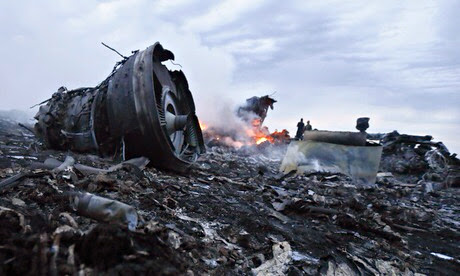
Sifting through the wreckage of MH17, searching for sense amid the horror

Any journalist should hesitate before saying this, but news can be bad for you. You don’t have to agree with the analyst who reckons “news is to the mind what sugar is to the body” to see that reading of horror and foreboding hour by hour, day after day, can sap the soul.

This week ended with a double dose, administered within the space of a few hours: Israel’s ground incursion into Gaza and, more shocking because entirely unexpected, the downing of Malaysia Airlines flight MH17 over Ukraine, killing all 298 on board.

So in Gaza we look at the wildly lopsided death tolls – nearly 300 Palestinians and two Israelis killed these past nine days.

The different responses these events stir in those of us who are distant, and the strategies we devise to cope with them, say much about our behaviour as consumers of news. But they also go some way to determining our reaction as citizens, as constituent members of the amorphous body we call public, or even world, opinion.

As I write, 18 of the 20 most-read articles on the Guardian website are about MH17. The entry into Gaza by Israeli forces stands at number 21. It’s not hard to fathom why the Malaysian jet strikes the louder chord. As the preacher might put it, “There but for the grace of God go I.” Stated baldly, most of us will never live in Gaza, but we know it could have been us boarding that plane in Amsterdam.

Which is why there is a morbid fascination with tales of the passenger who changed flights at the last minute, thereby cheating death, or with the crew member who made the opposite move, hastily switching to MH17 at the final moment, taking a decision that would have seemed so trivial at the time but which cost him his life. When we read about the debris – the holiday guidebooks strewn over the Ukrainian countryside, the man found next to an iPhone, the boy with his seatbelt still on – our imaginations put us on that flight. Of course we have sympathy for the victims and their families. But our fear is for ourselves.

It’s quite true that if the US truly decided that Israel’s 47-year occupation of Palestinian territory was no longer acceptable, that would bring change.

The reports from Gaza stir a different feeling. When we read the Guardian’s Peter Beaumont describe the sights he saw driving around the strip on Friday morningthree Palestinian siblings killed by an Israeli artillery shell that crashed into their bedroom, a father putting the remains of his two-year-old son into a plastic shopping bag – we are shaken by a different kind of horror. It is compassion for another human being, someone in a situation utterly different to ours. We don’t worry that this might happen to us, as we now might when we contemplate an international flight over a war zone. Our reaction is directed not inward, but outward. More

There is an interesting article by Chris Hedges entitled It's NOT going to be OK on the current economic disparity which, he believes could lead to a drastic decline in democracy as states respond to social protests. The question I ask is what can be done to slow or erradicate this process? Editor


Sunday, June 1, 2014

The Wrong Afghan Friends

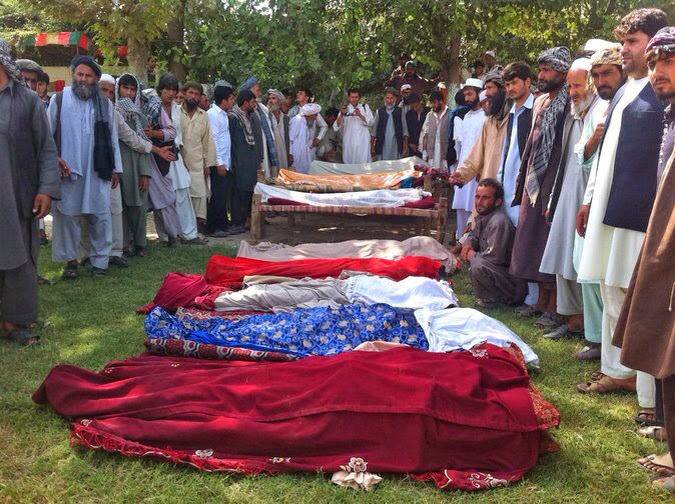
At a checkpoint on a dirt road in southeastern Afghanistan in 2012, Rahim Sarobi, a farmer, braked to a stop behind a knot of idling cars. Up ahead, Afghan gunmen were piled into the back of a Toyota Hilux. On the ground, tied to the rear fender by their wrists, lay two bloodied men, laboring to breathe.

Everyone was ordered out of their vehicles. The burly checkpoint commander, known simply as Azizullah, said the unfortunate pair had not slowed sufficiently at the checkpoint, and only the Taliban don’t slow down. But Mr. Sarobi and fellow motorists recognized the men as farmers from their village. They pleaded, but Azizullah would not listen. The motorists were ordered to follow the pickup as it dragged the men along six miles of rock-studded road. By the time the convoy reached Azizullah’s base, the pair were dead. Their bodies were left decomposing for days, a warning to anyone who thought of disobeying Azizullah.

Mr. Sarobi told me that story in Paktia Province last February. It echoes ominously against President Obama’s announcement on Tuesday that about 9,800 American troops will stay in Afghanistan after most have withdrawn this year. Special Operations Forces will continue training Afghans and assisting in counterterrorism. And if the current pattern holds, we can expect them, alongside the Central Intelligence Agency, to keep partnering with commanders like Azizullah to fight the Taliban.

Bear in mind that Azizullah is not a member of the Afghan army. He does not work for the Afghan National Police. He is not, in fact, under the authority of the Afghan government at all.

Instead, his militia, which has been supported by the Special Operations Forces, is part of a network of semi-independent rural paramilitary groups that owe their funding, weapons and very existence to America’s war on terror. By backing this network, the United States is fostering an environment of lawlessness and impunity, exacerbating Afghanistan’s longstanding problems, and creating fertile ground for the Taliban insurgency to survive. Using such strongmen seems to run counter to the doctrine laid out in 2006 in a much publicized Army/Marines counterinsurgency manual, which emphasized the need to convince citizens that America’s fighting forces will keep them safe.

On my trip to Paktia last winter, I met with other villagers who shared stories about the commander. A university student said he was at a village bazaar with his teenage cousin, who had fled his own village to escape Taliban threats. Azizullah’s militiamen accused the cousin of having ties to insurgents. He was arrested, taken to Azizullah’s compound, chained to a wall, raped repeatedly by militiamen, and released the next morning.

Azizullah’s crimes are detailed in a confidential dispatch, sent in 2010 to the United States military by United Nations officials, asking the Americans to sever ties with him. “A boy aged 16 was arrested by Commander Azizullah approximately four months ago in the Angur Ada area in Bermal district” states a copy of the dispatch that I obtained. “His father tried to intervene and told Azizullah he could arrest him instead of his son. The boy was released after 25 days, during which Azizullah sexually abused him.”

Afghans tell similar tales about other American-backed commanders, who hold sway over villages, districts or provinces. In southern Afghanistan’s Khas Oruzgan district, residents accuse Abdul Hakim Shujayee of going on multiple killing and raping rampages. Afghan officials in Kabul said their government tried to arrest him, but failed because he was protected by American Special Operations Forces. American officials say they have cut their ties with him, a claim that has been met with skepticism from residents. In 2011, in the village of Khosh Khadir in Daikundi Province, villagers told me that an American-supported strongman known as Lalay let his forces rampage through the village in response to a Taliban attack, hanging civilians from trees, abducting women, and setting homes and shops ablaze.

American authorities insist there is no proof of such allegations, and experts on Afghanistan often attach the caveat that enemies in Afghanistan tell wild tales about one another. But it is unclear whether an investigation has ever been conducted in any of these cases. American officials have told me that Azizullah and those like him are essential for combating the Taliban, and even the strongmen’s detractors acknowledge their Taliban-hunting prowess. Maj. Michael Waltz, a former Special Operations Forces officer who worked with Azizullah, put the argument this way in an interview: “We can’t sacrifice security for this multigenerational effort to build rule of law.”

In fact, the United States has favored counterterrorism over building Afghan state institutions and promoting the rule of law. Less than 10 percent of American funding in Afghanistan has gone to nonmilitary expenditures, even as Washington has poured millions into the coffers of regional strongmen with human rights records arguably as poor as the Taliban’s. One result: The writ of Hamid Karzai’s weak government is concentrated in the cities, while power brokers like Azizullah unofficially rule the countryside — especially the rural south and east. So villagers like those I met feel they have no recourse to justice or protection from predation — just the sort of grievance the insurgency exploits.

The Afghan government has tried to co-opt the strongmen by anointing them as governors and police chiefs. And in recent years, the United States has rebranded hundreds of militias as “Afghan Local Police,” placing them under nominal government authority. In most cases, though, the strongmen retain independent sources of revenue, including drug money or American patronage, as well as control over the militias. Their corruption infects the whole government; a Joint Chiefs of Staff report says the state has sometimes become, in effect, a collection of “criminal patronage networks.” The report also quotes an unnamed member of an interagency task force network as explaining: “The corruption piece is hard because security reigns supreme. We won’t remove corrupt officials if it looks like it will interrupt security.”

“Security,” in this context, does include protecting citizens from the Taliban — but not from predatory American-backed strongmen. Rural Afghans consistently told me they wanted freedom from both. But that is unlikely if American proxies continue the war on terror as it has been fought.

The most effective weapon against the Taliban would be a strong centralized state, responsive to citizens’ needs. This would require Americans to sever unilateral patronage relationships with rural power brokers and militias, and direct all funding to the state. (To deter corruption, international donors and Kabul could manage disbursement jointly, through trust funds.) The Afghan government should then absorb these forces into its ranks; with the strongmen stripped of American protection and independent revenue sources, integration should be easier. More


Saturday, August 31, 2013

Syria: U.S. War Making at the Expense of Democracy by Richard Falk

The U.S. Government rains drone missiles on civilian human targets anywhere in the world, continues to operate Guantanamo in the face of universal condemnation, whitewashed Abu Ghraib, Bagram, and the torture memos, committed aggression against Iraq and Afghanistan, and invests billions to sustain its unlawful global surveillance capabilities.

Richard Falk

Still, it has the audacity to lecture the world about ‘norm enforcement’ in the wake of the chemical weapons attack in the Ghouta suburb of Damascus. Someone should remind President Barack Obama and Secretary of State John Kerry that credibility with respect to international law begins at home and ends at the United Nations. Sadly, the American government loses out at both ends of this normative spectrum, and the days of Washington being able to deliver pious messages on the importance of international law are over. No one is listening, and that’s a relief, although it does provide material for those teams of writers working up material for the likes of Jon Stewart, Stephen Colbert, and the many standups at Comedy Central. Yet, of course, this geopolitical TV series is no laughing matter for the long ordeal of the Syrian people.

There is yet another disturbing dimension of this pre-war pseudo debate about recourse to force in retaliation for an alleged use of chemical weapons by Assad against his own people: should a democracy empower its elected leaders to commit the country to war without at least securing specific legislative authorization? The contrast between the approach of the British and American approach to this issue is illuminating. David Cameron, as Prime Minister, along with his Foreign Secretary, strongly favored joining with the United States in launching a punitive attack against Syria, but arranged a prior Parliamentary debate and vote, and clearly indicated his immediate acceptance of the surprising refusal to win backing for such a policy, a show of Parliamentary independence that had not occurred in the country since the late 18th century. Of course, given polls showing only 11% of British citizens supporting an attack on Syria, Cameron may be privately breathing a deep sigh of relief that the vote came out as it did! Obama should be so lucky! If only his powers as Commander-in-Chief included a tool with which to erase imprudent ‘red lines’!

Compare now the Obama approach: speeches informing the country about why it is important to punish the Assad regime so as to uphold American national security interests and to engender respect for international law and several consultations with Congressional leaders. What is absent from the Obama discourse is the word ‘authorization’ or ‘a decent respect for the opinions’ of humanity, as expressed at home and in the world. In my view, this continuing claim of presidential authority to wage war unilaterally, and absent a UN mandate, is creating a deep crisis of legitimacy not only for the U.S., but for all governments that purport to be democracies but commit to war on the decision of the chief executive, as France and Turkey appear to be doing. It is time to face up to this crisis.

Above all, the foundational idea of American republicanism was to demonstrate that the power to declare and wage war was subject to ‘checks and balances’ and ‘separation of powers,’ and in this crucial respect, was unlike the monarchical powers of English kings in war/peace contexts. This makes the Parliamentary rebuff to Cameron not only a revitalizing move for British democracy, but an ironic commentary on the degree to which American ‘democracy’ has perversely moved in an absolutist direction.

It is true that government lawyers as hired hands can always find legal justifications for desired lines of policy. We can count on White House lawyers do just this at the present time: working into the night at Office of the Legal Counsel to prepare breifing material on the broad scope of the powers of the president as Commander-in-Chief, reinforced by patterns of practice over the course of the last several decades, and rounded out with an interpretation of the War Powers Act that supposedly gives the president 60 days of discretionary war making before any obligation exists to seek approval from Congress. Lawyers might quibble, but democracy will be the loser if procedures for accountability and authorization are not restored with full solemnity. In this respect the law should follow, not lead, and what is at stake is whether the republican ideals of limited government would be better served by the original ideas of making it unconstitutional for a president to commit the country to war without a formal and transparent process of public deliberation in the Congress, which is that part of government charged with reflecting the interests and values of the citizenry. Let the lawyers be damned if they side with the warrior politicians, however ‘war weary’ they claim to be.

It is worth also noticing that the common arguments for presidential authority do not pertain. The United States is not responding to an attack or acting in the face of an imminent threat. There is no time urgency. Beyond this the American public, as is the case with the publics of all other Western democracies, oppose by large majorities acts of war against Syria. What makes this situation worse, still, is the refusal to test diplomacy. By international law norms, reinforced by the UN Charter, a use of force to resolve an international conflict is legally a matter of ‘last resort’ after diplomatic remedies have been exhausted. But here they are not even being tried in good faith, which would involve bringing Iran into the process as a major engaged player, and enlisting Russia's support rather than exhibiting post-Snowden pique. Obama claims that no one is more war weary than he is, but his behavior toward Syria, Iran, Egypt, and Russia convey the opposite message.

And finally, some urge what be called ‘a humanitarian right of exception,’ namely, that this crime against humanity committed against the Syrian people requires a proportionate response from the perspective of international morality, regardless of the constraints associated with international law. Disregarding ‘the slippery slope’ of moral assessments, this particular response is being presented as directed against the Assad regime, but not motivated by any commitment to end the civil war or to assassinate Assad. There are reasons for viewing Washington’s moralizing reaction to the horrifying chemical attacks of August 21, especially the rush to judgment with respect to attributing responsibility to the Assad regime without awaiting the results of the UN inspection team and the odd timing of a such a major attack just as the inspectors were arriving in Damascus. It is not only habitual skeptics that recall Colin Powell’s presentation of conclusive evidence of Iraq’s possession of WMD to the UN Security Council in the lead up to the unlawful Iraq War. We should by now understand that when a foreign policy imperative exists for the occupant of the White House, factoids replace facts, and moral/legal assessments become matters of bureaucratic and media duty.


Richard Falk | August 31, 2013 at 2:26 am | Categories: America, Commentary, Global Governance, International & Global Law, Syria | URL: http://wp.me/p19Wt7-lq