SASSI is an independent think tank dedicated to promoting peace and stability in South Asia.
We are headquartered in Islamabad, Pakistan and we aim to make a leading contribution to regional and international academic and policy-orientated research discourses about South Asian security.
A Russian pilot has been killed by US-armed terrorists in Syria. The Ron Paul Institute‘s Daniel McAdams writes the following about this new development:
“The scenario where a US-backed, US-supplied jihadist group in Syria uses US weapons to shoot down a Russian plane and then murders the pilot on the ground should be seen as a near-nightmare escalation, drawing the US and Russia terrifyingly closer to direct conflict.”
McAdams is not fearmongering; he is stating a plainly obvious fact. The Trump administration has just announced that it is restructuring its nuclear weapons policy to take a more aggressive stance toward Russia than that which was held by the previous administration. This is coming after this administration’s decision to arm Ukraine against Russia, a move Obama refused to take for fear of escalating tensions with Moscow, as well as its decision to continue to occupy Syria in order to effect regime change, along with numerous other escalations. The Council on Foreign Relations, which is without exaggeration as close to the voice of the US establishment as you can possibly get, is now openly admitting that the “United States is currently in a second Cold War with Russia. Read More
It's worth considering a subject that's seldom discussed here, though it should be. What if Russia's intervention in Syria -- its version of the American way of war (air power and more air power) -- proves to be somewhere between quagmirish and disastrous? Dominic Tierney at the Atlantic gives the subject some thought. Here's the end of the resulting piece. TomDispatch
President Putin
"In other words, Putin’s war may very well fail. But if it does, will he make concessions and abandon his ally? If the Russian president acts rationally, he should cut his losses. Putin, however, may not act rationally. When I researched my book on military disaster, The Right Way to Lose a War, I was struck by how poorly governments tend to handle battlefield reversals. From the United States in Vietnam to the Soviet Union in Afghanistan, leaders often respond to defeat with disastrous decisions that only worsen their plight. Rather than coolly looking for a way out of the predicament, they rage against the dying of the light."Part of the problem is what psychologists call “loss aversion.” Losing hurts twice as bad as winning feels good—whether in a tennis match or a war. The idea of accepting even a small loss can seem intolerable, and people are tempted to risk greater losses for a shot at the win. The gambler who drops 20 bucks in a casino doesn’t walk away; he doubles his bets. In a similar vein, the president who loses 1,000 soldiers in Vietnam doesn’t end the war; he sends half a million Americans into the mire.
Putin has repeatedly responded to the potential loss of client regimes with military force.
"It’s hard to imagine Putin accepting defeat. He has cultivated an image as the father of the Russian people, who is restoring the country as a world power. If Assad’s regime falls, Russia could lose its only military installation outside the former U.S.S.R.—the naval base in Tartus, Syria. Therefore, if the war effort collapses, Putin may want to salvage something from the wreckage, potentially moving the conflict into a dangerous new phase. He could intensify Russian air strikes or deploy “little green men”—as the Russian soldiers serving unofficially in eastern Ukraine were called. Once Russian troops start dying in Syria, all bets are off."Putin, moreover, has repeatedly responded to the potential loss of client regimes with military force. In 2008, the Russian military intervened in Georgia to punish pro-Western Georgian President Mikheil Saakashvili and protect the independence of the breakaway Georgian territories of Abkhazia and South Ossetia. Six years later, in 2014, Putin aided Ukrainian rebels and annexed Crimea following the toppling of pro-Russian Ukrainian President Viktor Yanukovych. In late 2015, with Assad’s forces reeling, Putin once again intervened to stabilize a client regime."And Putin has already raised the prospect of further military escalation, saying that Russia is using “far from everything we are capable of” in Syria and that “We also have other things as well and will use them if necessary.”
"What’s the solution? If Russia’s defeat could trigger hazardous escalation, this doesn’t mean a Russian victory is preferable. After all, if Assad somehow assumed a winning position, why would he negotiate a compromise peace that recognized the interests of all Syrian groups? Instead, the optimal opportunity for a peace deal may be a situation in which Putin believes a decisive triumph is not possible, but he can still save face by spinning the outcome as a success. In other words, he needs a story to tell the Russian people about the positive results of the mission. This narrative doesn’t need to be true, but it does need to havetruthiness, or a seeming plausibility. And so, to get Putin out of Syria, the United States might need to play along by avoiding boastful claims of a major Russian debacle. In 1989, after the Berlin Wall fell, U.S. President George H.W. Bush deliberately refused to declare the development a win—to avoid complicating the life of Soviet Premier Mikhail Gorbachev.
"Putin needs a victory speech. And Washington may have to help him write it." More
ON THE AFTERNOON of October 7, 2001, the first day of the war in Afghanistan, an Air Force pilot named Scott Swanson made history while sitting in a captain’s chair designed for an RV. His contribution to posterity was to kill someone in a completely novel way.
In the moments leading up to the act, Swanson was nervous. He sat in a darkened trailer tucked behind a parking garage at CIA headquarters in Langley, Virginia, remotely piloting a Predator drone over Kandahar, 6,900 miles away. Nearly everything about his rig had been cobbled together and hastily assembled. The Predator itself, one of just a handful in existence, was flying about 250 pounds heavier than usual. And the satellite communications link that connected Swanson to the aircraft would periodically shut down due to a power issue, which software engineers in California were frantically trying to patch.
When the order came through to take the shot, Swanson pulled a trigger on his joystick. A little more than a second later, a Hellfire missile slid off an aluminum rail on the Predator’s wing and sailed into the Afghan night.
Swanson’s target was a pickup truck parked outside a compound thought to be hiding Mullah Omar, the supreme commander of the Taliban. The missile killed two unidentified men believed to have been his bodyguards. It was the first time a US drone had fired a weapon in combat. It was the first time a modern drone had ever killed a human being. More
Russian military intervention in Syria has expanded considerably over the past month and may accelerate further if the destruction of Metrojet Flight 9628 over Sinai is proved to be the work of Islamic State (IS).
Russian and American representatives meet to discuss the situation in Syria on September 29, 2015
The US-led coalition against IS in Syria is meanwhile steadily losing its active members, even as the US escalates its bombing campaign and declares a greater willingness to deploy Special Forces units inside Syria. While the UK prevaricates on its involvement within Syria, Israel has launched new attacks on Hezbollah there and Turkey pursues its own interests against IS and Kurdish factions alike. The risks of accidental escalation between these disparate actors is rising as the complexity of the war grows.
Introduction
The October briefing reported a number of developments in the war in Syria, including the Russian intervention, a likely extension of the US-led air war and a change in US strategy towards arming opposition groups in preference to training them. Perhaps most significantly there were revised US intelligence estimates indicating that Islamic State (IS) was gaining new recruits in Syria and Iraq at a rate more than compensating for the heavy losses caused by the air strikes in both countries.
This briefing provides an updated analysis based on developments since mid-October as they apply to Syria in particular. Its main focus is on two developments early in November. One was the criticism of UK policy towards Syria by the Chief of the Defence Staff, General Sir Nicholas Houghton, who argued that the UK was letting its allies down by not joining in the air strikes against IS in Syria. The second was the destruction on 31 October of a Russian charter airliner shortly after it began a flight from Sharm el-Sheikh in southern Sinai to St Petersburg, killing all 224 passengers and crew.
Military Criticism of UK Inaction
The comments of General Houghton caused some concern as they were paralleled by a more controversial expression of opposition to the views of the new Labour Party Leader, Jeremy Corbyn, over the Trident nuclear weapons system. There has been concern that General Houghton has strayed too far into the political dimension with his Trident-related comments, but this has been less the case in relation to his views on attacking Syria in that there is already cross-party opposition to that policy.
What General Houghton’s comments have done is to focus attention on the nature of the air war in Syria which has involved nine coalition partners: Saudi Arabia, Bahrain, the United Arab Emirates (UAE), Morocco, Jordan, Canada and the United States plus, since September, Australia and France. Although the US has carried out around 95% of the attacks, the presence of a range of other countries has added weight to the idea of a united, broadly based and multinational coalition opposing IS in Syria.
The reality is actually quite different as six of the nine coalition partners have ceased undertaking air strikes in the past nine months, although some may still be involved in support operations. Bahrain ceased air strike operations nine months ago, the UAE and Morocco eight months ago, Jordan three months ago and Saudi Arabia just two months ago. These countries are all now more actively involved in their war in Yemen. The fifth country, Canada, under new Prime Minister Justin Trudeau, is withdrawing from all air strike operations over Syria and Iraq.
Of the remaining coalition partners, France is reported to have carried out just two air strikes over Syria with all of the rest of the 270 attacks being over Iraq. Finally, Australia’s air force has undertaken 434 air strikes but up to 2 October had only undertaken two attacks in Syria before pausing in its operations when Russia started its intervention. Belgium and Denmark also pulled out their fighter-bombers from operations over Iraq in July and September respectively.
To all intents and purposes, the air war that has evolved over Syria is now a US operation with minimal involvement from western allies and no operations being undertaken by regional allies. There certainly is an increased intensity of air strikes against IS in Syria but this is entirely down to increased US operations, especially from the Turkish base at Incirlik, less than 30 minutes flight from IS-controlled territory in northern Syria. It is thus fast becoming an American war and this may explain General Houghton’s concern, bearing in mind that it makes it far easier for IS propagandists to portray their role as being the guardians of Islam under persistent attack by the “far enemy” of the United States and its western allies.
Meanwhile, Russian air operations continue although at a lower level than those of the United States. The great majority continue to be against the opponents of the Assad regime and are serving to ensure that those areas of north west Syria that are strongly supportive of the regime are secure from opponents. There are occasional Russian air strikes against IS targets and, while these are of little military consequence, their political significance could be considerable following the destruction of the Russian airliner over Sinai. More
For the last few years, the Saudi kingdom’s insistence on pumping oil at high capacity has dramatically depressed oil prices. The result has undermined Saudi’s major oil rivals in OPEC – like Iran and Venezuela.
It has also hit Russia, hard.
Rating agency Standard & Poor forecasts that Russia’s budget deficit is set to swell to 4.4 per cent of GDP this year. Russia’s own finance ministry concedes that if expenditures continue at this rate, within sixteen months – by around the end of next year – its oil reserve funds will be exhausted.
Meanwhile, over the last year real incomes have dropped by 9.8 per cent, and food prices have spiked by 17 per cent, heightening the risk of civil unrest.
System failureh
Rumbling along beneath the surface of such financial woes are deeper systemic issues.
A report from the Swedish Defence Research Agency notes that “prolonged dry periods in southern Russia are having the effect of reducing the level of food production”.
Most of Russia’s wheat imports come from Kazakhstan, “where climate change is expected to exacerbate droughts. These impacts would make farming harder and food more expensive,” observe Dr. Marina Sharmina and Dr. Christopher Jones of the Tyndall Centre for Climate Change Research.
Russia’s looming energy crisis is the other elephant in the room. In 2013, HSBC forecasted that Russia would hit peak oil between 2018 and 2019, experiencing a brief plateau before declining by 30 per cent from 2020 to 2025.
That year, Fitch Ratings came to pretty much the same conclusion. And last year, Leonid Fedun, vice-president of Russia’s second largest oil producer, Lukoil, predicted that the production could peak earlier due to falling oil prices and US-EU sanctions.
Faced with overlapping economic, food and energy crises, Russia is well and truly on the brink. More
Furthermore, According to a recent report from the IMF, Saudi Arabia’s public debt is estimated to rise from below 2 percent of its GDP in 2014 up to 33 percent by the end of 2020. The report also shows that in the past three years, Saudi Arabia’s budget surplus was turned into a deficit reaching 21.6 percent of GDP in 2015. More
Iran has long been sending troops and material to help Syrian autocrat Bashar Assad wage war against his own people. But now Tehran is busy establishing a state within a state — which is why Assad now wants help from Russia.
Fear of his enemies was the primary reason for Bashar Assad’s call for help to Moscow. “But right after that came the fear of his friends,” says a Russian official who long worked in his country’s embassy in Damascus. The friend he refers to is Iran, the Syrian regime’s most important protector.
“Assad and those around him are afraid of the Iranians,” the Russian says. Anger over the arrogance of the Iranians, who treat Syria like a colony, is also part of it, the Russian continues. Most of all, though, the Syrians “mistrust Tehran’s goals, for which Assad’s position of power may no longer be decisive. That is why the Syrians absolutely want us in the country.”
What the Russian diplomat, who wants to remain anonymous, has to say is a bit jarring at first. Without the Shiite auxiliaries from Iran, Afghanistan, Pakistan, Iraq and Lebanon — whose recruitment and transfer is organized by the Iranian Revolutionary Guard — Assad’s rule would long since have come to an end. Yet his comments are complemented by a number of additional details that add up to an image of a behind-the-scenes power struggle — one which casts a new, scary light on the condition of the Syrian regime and on the country’s prospects as a whole.
The Iranian Revolutionary Guard has long planned and carried out the most important missions and operations of the Syrian regime. They were responsible, right down to the details, for the sporadically successful offensives in Aleppo in the north and Daraa in the south, which began in 2013. In Iran, the Revolutionary Guard is one of those groups intent on continuing the “Islamic Revolution” — the victory of Shiites over the Sunnis. They are a state within a state, one which owns several companies and is answerable only to Iran’s Supreme Leader Ali Khamenei. President Hassan Rohani has no power over the Revolutionary Guard whatsoever.
Their goals go far beyond merely reestablishing the status quo in Syria. In early 2013, Hojatoleslam Mehdi Taeb, one of the planners behind Iran’s engagement in Syria, said: “Syria is the 35th province of Iran and it is a strategic province for us.” For several decades, the alliance between the Assads and Iran was a profitable one, particularly in opposition to the Iraq of Saddam Hussein, which long had the upper hand in the region. But today, Assad depends on Iran to remain in power, and Tehran is taking advantage of the situation.
Using a variety of pathways, both civilian and military, Tehran is currently in the process of establishing itself in Syria. Military means are being employed to strengthen the holdings of the Shiite militia Hezbollah in areas near the border with Lebanon. To serve this goal, the Syrian National Defense Forces were established, troops that exist alongside the regular Syrian army and which includes tens of thousands of fighters who were trained in Iran. Still, the National Defense Forces have begun to disintegrate into local mafia militias and have actually accelerated the loss of state control over those regions.
Changes Afoot
It is, however, primarily in the civilian sector where significant changes are afoot. Just as in Damascus, Latakia and Jabla, increasing numbers of hosseiniehs — Shiite religious teaching centers — are opening. The centers are aimed at converting Sunnis, and even the Alawites, the denomination to which the Assads belong, to “correct” Shiite Islam by way of sermons and stipends. In addition, the government decreed one year ago that state-run religion schools were to teach Shiite material.
All of this is taking place to the consternation of the Alawites, who have begun to voice their displeasure. “They are throwing us back a thousand years. We don’t even wear headscarves and we aren’t Shiites,” Alawites complained on the Jableh News Facebook page. There were also grumblings when a Shiite mosque opened in Latakia and an imam there announced: “We don’t need you. We need your children and grandchildren.”
In addition, Iranian emissaries, either directly or via middlemen, have been buying land and buildings in Damascus, including almost the entire former Jewish quarter, and trying to settle Shiites from other countries there.
Talib Ibrahim, an Alawite communist from Masyaf who fled to the Netherlands many years ago, summarizes the mood as follows: “Assad wants the Iranians as fighters, but increasingly they are interfering ideologically with domestic affairs. The Russians don’t do that.”
That’s why Assad has now decided to place his fate in the hands of the religiously unproblematic Russia, which last week transferred aircraft and troops to its military base in the northern Syrian town of Latakia and began flying airstrikes. The fight against the Islamic State terror militia served as a pretext for the operation, but the initial air strikes have not targeted the Islamists at all. Rather, they have been flown against areas controlled by Syrian rebels. More
Earlier this month, The Interceptreported that the U.S. government secretly labeled a prominent Al Jazeera journalist a member of Al Qaeda and placed him on a terror watch list.
The basis for the designation was unclear, but the reporter, Islamabad bureau chief Ahmad Zaidan, denies ever having been a member of the group. Reached last week in Doha, Qatar — where the state-funded Al Jazeera network is based — Zaidan spoke to The Intercept about the reaction to his work and the implications of being tracked by the U.S. government. “To monitor and bug journalists is absolutely immoral and unethical,” he said.
Zaidan was known for interviewing senior Al Qaeda figures, including Osama bin Laden, and he covered the wedding of bin Laden’s son in 2001. If it was those contacts that caused U.S. suspicions, Zaidan says, that runs counter to the purpose of journalism.
“Our job as journalists is to reach out to everybody. We are some sort of go-between in cases where the two parties are not talking to each other,” Zaidan said. “I was thinking that when I was interviewing bin Laden and interviewing these militants, that maybe at least [they can] hear each other, and maybe it can help humanity to reach some sort of middle way.”
Zaidan also sees discrimination behind the surveillance. “If Peter Bergen is meeting Osama bin Laden, or Robert Fisk is meeting Osama bin Laden, no problem,” he said. “But if a non-Westerner is meeting some wanted people, he should be doubted?”
Zaidan’s picture and watch list number appear in a 2012 National Security Agency presentation, which shows that analysts tracked his cell phone contacts and location data — or metadata — as part of a program that looked for people who moved like Al Qaeda couriers. The presentation and other NSA documents revealed that the U.S. was obtaining bulk call data records from Pakistani telecoms, and analyzing the metadata of tens of millions of Pakistani cell phones.
“Faisalabad, Lahore — these main cities are the residence of millions and millions of people,” Zaidan said. “They are following and surveilling every one of us. Who has made them the god of this globe?”
Zaidan says he has had good relations with the U.S. ambassador to Pakistan and has not had run-ins with U.S. authorities.
“I did not hide myself. Whenever I made an interview, I published it. If you have any objection to me, I am living in Islamabad, you can come ask for me anytime,” he said.
He noted that the United States is not the only country to have labeled him as Al Qaeda. Zaidan, who is Syrian, returned to his country for the first time in almost 35 years in early 2012, after the uprising began against President Bashar al-Assad. Zaidan reported from inside a stronghold of the Free Syrian Army, and soon after, he says Syrian state television aired a report claiming that he was a member of Al Qaeda and had been sent to Syria by the group’s leader, Ayman al-Zawahiri.
The allegations make him fear for his security. “If you are Al Qaeda, it means they can eliminate you. And I am afraid if somebody else might do something against me and he will put the blame on America now,” Zaidan said.
But when I asked if he regretted The Intercept publishing the story, Zaidan said: “My take, as a journalist, is that you have done your job. I can’t say, ‘Ok, if I have some information about Osama bin Laden, I have to publish it, but if you have something against Ahmad Zaidan or Al Jazeera, you should not publish it.’”
“This is the right of our audience,” he said. “We should not keep our audience in the dark otherwise we are like, in fact, the National Security Agency.” More
Climate change was a key driver of the Syrian uprising, according to research which warns that global warming is likely to unleash more wars in the coming decades, with Eastern Mediterranean countries such as Jordan and Lebanon particularly at risk.
Experts have long predicted that climate change will be a major source of conflict as drought and rising temperatures hurt agriculture, putting a further strain on resources in already unstable regimes.
But the Syria conflict is the first war that scientists have explicitly linked to climate change. Researchers say that global warming intensified the region’s worst-ever drought, pushing the country into civil war by destroying agriculture and forcing an exodus to cities already straining from poverty, an influx of refugees from war-torn Iraq next door and poor government, the report finds.
“Added to all the other stressors, climate change helped kick things over the threshold into open conflict,” said report co-author Richard Seager, of Columbia University in New York.
“I think this is scary and it’s only just beginning. It’s going to continue through the current century as part of the general drying of the Eastern Mediterranean – I don’t see how things are going to survive there,” Professor Seager added.
Turkey, Lebananon, Israel, Jordan, Iraq and Afghanistan are among those most at risk from drought because of the intensity of the drying and the history of conflict in the region, he says. Israel is much better equipped to withstand climate change than its neighbours because it is wealthy, politically stable and imports much of its food. Drought-ravaged East African countries such as Somalia and Sudan are also vulnerable along with parts of Central America – especially Mexico, which is afflicted by crime, is politically unstable, short of water and reliant on agriculture, Prof Seager said.
The conflict in Syria began in spring 2011 and has evolved into a complex multinational war that has killed at least 200,000 people and displaced millions more, according to the Columbia study, which appears in the journal Proceedings of the National Academy of Sciences. It was preceded by a record drought that ravaged Syria between 2006 and 2010.The paper says the timing is unlikely to be a coincidence, citing a recent interview with a 38-year old farmer in Mohasen, an agricultural village in the north east of Syria.
Asked if the conflict was about the drought, Faten – a female farmer who did not want to give her last name – said: “Of course. The drought and unemployment were important in pushing people towards revolution. When the drought happened, we could handle it for two years, and then we said, ‘It’s enough’,” the report said.
The study combined climate, social and economic data relating to the so-called Fertile Crescent, spanning parts of Turkey and much of Syria and Iraq, where agriculture and herding are thought to have started 12,000 years ago and continue to be crucial.
The region has warmed by between 1 and 1.2C since 1900, reducing rainfall in the wet season by an average of 10 per cent. In addition to the warming – which has found to be caused by human greenhouse gas emissions – Syria has had to contend with rapid population growth, from 4 million in the 1950s to 22 million now.
The ruling al-Assad family encouraged water-intensive export crops such as cotton, while illegal drilling of irrigation wells dramatically depleted groundwater that might have provided valuable reserves, the report said. The drought’s effects were immediate. Agriculture production, which typically makes up a quarter of Syria’s economy, plummeted by a third.
In the hard-hit northeast, livestock herds were practically obliterated, cereal prices doubled and nutrition-related diseases among children increased dramatically. As many as 1.5m people fled from the country to the city.
“Whether it was a primary or substantial factor is impossible to know, but drought can lead to devastating consequences when coupled with pre-existing acute vulnerability,” said lead author Colin Kelley, who did the work at Columbia but is now the University of California, Santa Barbara.
The pressure exerted by climate change is even more dangerous because it comes against a backdrop of rising populations and growing scarcity of resources, experts say.
With demand for basic commodities such as wheat and copper set to soar over the next two decades, relatively small shocks to supply risk causing sudden price rises and triggering “overreactions or even militarised responses”, the Chatham House think-tank has warned.
Furthermore, while the effects of rising population and global warming may be felt hardest among the poorer countries most affected by climate change, the impact will be felt worldwide.
Global trade is so interconnected that no importer of resources is insulated from the problems of key exporters – a fact of concern to the UK, which imports 40 per cent of its food and a high proportion of fossil fuels and metals, the think-tank warns. More
Today al-Qaeda-type movements rule a vast area in northern and western Iraq and eastern and northern Syria, several hundred times larger than any territory ever controlled by Osama bin Laden.It is since bin Laden’s death that al-Qaeda affiliates or clones have had their greatest successes, including the capture of Raqqa in the eastern part of Syria, the only provincial capital in that country to fall to the rebels, in March 2013. In January 2014, ISIS took over Fallujah just forty miles west of Baghdad, a city famously besieged and stormed by US Marines ten years earlier. Within a few months they had also captured Mosul and Tikrit. The battle lines may continue to change, but the overall expansion of their power will be difficult to reverse. With their swift and multipronged assault across central and northern Iraq in June 2014, the ISIS militants had superseded al-Qaeda as the most powerful and effective jihadi group in the world.
These developments came as a shock to many in the West, including politicians and specialists whose view of what was happening often seemed outpaced by events. One reason for this was that it was too risky for journalists and outside observers to visit the areas where ISIS was operating, because of the extreme danger of being kidnapped or murdered. "Those who used to protect the foreign media can no longer protect themselves," one intrepid correspondent told me, explaining why he would not be returning to rebel-held Syria.
This lack of coverage had been convenient for the US and other Western governments because it enabled them to play down the extent to which the "war on terror" had failed so catastrophically in the years since 9/11. This failure is also masked by deceptions and self-deceptions on the part of governments. Speaking at West Point on America’s role in the world on May 28, 2014, President Obama said that the main threat to the US no longer came from al-Qaeda central but from "decentralized al-Qaeda affiliates and extremists, many with agendas focused on the countries where they operate." He added that "as the Syrian civil war spills across borders, the capacity of battle-hardened extremist groups to come after us only increases." This was true enough, but Obama’s solution to the danger was, as he put it, "to ramp up support for those in the Syrian opposition who offer the best alternative to terrorists." By June he was asking Congress for $500 million to train and equip "appropriately vetted" members of the Syrian opposition. It is here that there was a real intention to deceive, because, as Biden was to admit five months later, the Syrian military opposition is dominated by ISIS and by Jabhat al-Nusra, the official al-Qaeda representative, in addition to other extreme jihadi groups. In reality, there is no dividing wall between them and America’s supposedly moderate opposition allies.
An intelligence officer from a Middle Eastern country neighboring Syria told me that ISIS members "say they are always pleased when sophisticated weapons are sent to anti-Assad groups of any kind, because they can always get the arms off them by threats of force or cash payments." These are not empty boasts. Arms supplied by US allies such as Saudi Arabia and Qatar to anti-Assad forces in Syria have been captured regularly in Iraq. I experienced a small example of the consequences of this inflow of weapons even before the fall of Mosul, when, in the summer of 2014, I tried to book a flight to Baghdad on the same efficient European airline that I had used a year earlier. I was told it had discontinued flights to the Iraqi capital, because it feared that insurgents had obtained shoulder-held anti-aircraft missiles originally supplied to anti-Assad forces in Syria and would use them against commercial aircraft flying into Baghdad International Airport. Western support for the Syrian opposition may have failed to overthrow Assad, but it has been successful in destabilizing Iraq, as Iraqi politicians had long predicted.
The failure of the "war on terror" and the resurgence of al-Qaeda is further explained by a phenomenon which had become apparent within hours of the 9/11 attacks. The first moves from Washington made it clear that the anti-terror war would be waged without any confrontation with Saudi Arabia or Pakistan, two close US allies, despite the fact that without the involvement of these two countries 9/11 was unlikely to have happened. Of the nineteen hijackers that day, fifteen were Saudi. Bin Laden came from the Saudi elite. Subsequent US official documents stress repeatedly that financing for al-Qaeda and jihadi groups came from Saudi Arabia and the Gulf monarchies. As for Pakistan, its army and military service had played a central role since the early 1990s in propelling the Taliban into power in Afghanistan where they hosted bin Laden and al-Qaeda. After a brief hiatus during and after 9/11, Pakistan resumed its support for the Afghan Taliban. Speaking of the central role of Pakistan in backing the Taliban, the late Richard C. Holbrooke, US special representative to Afghanistan and Pakistan, said: "We may be fighting the wrong enemy in the wrong country."
The importance of Saudi Arabia in the rise and return of al-Qaeda is often misunderstood and understated. Saudi Arabia is influential because its oil and vast wealth make it powerful in the Middle East and beyond. But it is not financial resources alone that make it such an important player. Another factor is its propagating of Wahhabism, the fundamentalist, eighteenth-century version of Islam that imposes sharia law, relegates women to the status of second-class citizens, and regards Shia and Sufi Muslims as non-Muslims to be persecuted along with Christians and Jews.
This religious intolerance and political authoritarianism, which in its readiness to use violence has many similarities with European fascism in the 1930s, is getting worse rather than better. For example, in recent years, a Saudi who set up a liberal website on which clerics could be criticized was sentenced to a thousand lashes and seven years in prison. The ideology of al-Qaeda and ISIS draws a great deal from Wahhabism. Critics of this new trend in Islam from elsewhere in the Muslim world do not survive long; they are forced to flee or are murdered. Denouncing jihadi leaders in Kabul in 2003, an Afghan editor described them as "holy fascists" who were misusing Islam as "an instrument to take over power." Unsurprisingly, he was accused of insulting Islam and had to leave the country.
A striking development in the Islamic world in recent decades is the way in which Wahhabism is taking over mainstream Sunni Islam. In one country after another Saudi Arabia is putting up the money for the training of preachers and the building of mosques. A result of this is the spread of sectarian strife between Sunni and Shia. The latter find themselves targeted with unprecedented viciousness, from Tunisia to Indonesia. Such sectarianism is not confined to country villages outside Aleppo or in the Punjab; it is poisoning relations between the two sects in every Islamic grouping. A Muslim friend in London told me: "Go through the address books of any Sunni or Shia in Britain and you will find very few names belonging to people outside their own community."
Even before Mosul, President Obama was coming to realize that al-Qaeda–type groups were far stronger than they had been previously, but his recipe for dealing with them repeats and exacerbates earlier mistakes. "We need partners to fight terrorists alongside us," he told his audience at West Point. But who are these partners going to be? Saudi Arabia and Qatar were not mentioned by him, since they remain close and active US allies in Syria. Obama instead singled out "Jordan and Lebanon, Turkey and Iraq" as partners to receive aid in "confronting terrorists working across Syria’s borders."
There is something absurd about this, since the foreign jihadis in Syria and Iraq, the people whom Obama admits are the greatest threat, can only get to these countries because they are able to cross the 510-mile-long Turkish-Syrian border without hindrance from the Turkish authorities. Saudi Arabia, Turkey, and Jordan may now be frightened by the Frankenstein’s monster they have helped to create, but there is little they can do to restrain it. An unspoken purpose of the US insistence that Saudi Arabia, UAE, Qatar, and Bahrain take part or assist in the air strikes on Syria in September was to force them to break their former links with the jihadis in Syria.
There was always something fantastical about the US and its Western allies teaming up with the theocratic Sunni absolute monarchies of Saudi Arabia and the Gulf to spread democracy and enhance human rights in Syria, Iraq, and Libya. The US was a weaker power in the Middle East in 2011 than it had been in 2003, because its armies had failed to achieve their aims in Iraq and Afghanistan. Come the uprisings of 2011, it was the jihadi and Sunni-sectarian, militarized wing of rebel movements that received massive injections of money from the kings and emirs of the Gulf. The secular, nonsectarian opponents of the long-established police states were soon marginalized, reduced to silence, or killed. The international media was very slow to pick up on how the nature of these uprisings had changed, though the Islamists were very open about their sectarian priorities: in Libya, one of the first acts of the triumphant rebels was to call for the legalization of polygamy, which had been banned under the old regime.
ISIS is the child of war. Its members seek to reshape the world around them by acts of violence. The movement’s toxic but potent mix of extreme religious beliefs and military skill is the outcome of the war in Iraq since the US invasion of 2003 and the war in Syria since 2011. Just as the violence in Iraq was ebbing, the war was revived by the Sunni Arabs in Syria. It is the government and media consensus in the West that the civil war in Iraq was reignited by the sectarian policies of Iraqi prime minister Nouri al-Maliki in Baghdad. In reality, it was the war in Syria that destabilized Iraq when jihadi groups like ISIS, then called al-Qaeda in Iraq, found a new battlefield where they could fight and flourish.
It was the US, Europe, and their regional allies in Turkey, Saudi Arabia, Qatar, Kuwait, and United Arab Emirates that created the conditions for the rise of ISIS. They kept the war going in Syria, though it was obvious from 2012 that Assad would not fall. He never controlled less than thirteen out of fourteen Syrian provincial capitals and was backed by Russia, Iran, and Hezbollah. Nevertheless, the only peace terms he was offered at the Geneva II peace talks in January 2014 was to leave power. He was not about to go, and ideal conditions were created for ISIS to prosper. The US and its allies are now trying to turn the Sunni communities in Iraq and Syria against the militants, but this will be difficult to do while these countries are convulsed by war.
The resurgence of al-Qaeda–type groups is not a threat confined to Syria, Iraq, and their near neighbors. What is happening in these countries, combined with the growing dominance of intolerant and exclusive Wahhabite beliefs within the worldwide Sunni community, means that all 1.6 billion Muslims, almost a quarter of the world’s population, will be increasingly affected. It seems unlikely that non-Muslims, including many in the West, will be untouched by the conflict. Today’s resurgent jihadism, having shifted the political terrain in Iraq and Syria, is already having far-reaching effects on global politics, with dire consequences for us all. More
Think of the new “caliphate” of the Islamic State, formerly the Islamic State in Iraq and Syria (ISIS), as George W. Bush and Dick Cheney's gift to the world (with a helping hand from the Saudis and other financiers of extremism in the Persian Gulf). How strange that they get so little credit for its rise, for the fact that the outlines of the Middle East, as set up by Europe’s colonial powers in the wake of World War I, are being swept aside in a tide of blood.
Had George and Dick not decided on their “cakewalk” in Iraq, had they not raised the specter of nuclear destruction and claimed that Saddam Hussein’s regime was somehow linked to al-Qaeda and so to the 9/11 attacks, had they not sent tens of thousands of American troops into a burning, looted Baghdad (“stuff happens”), disbanded the Iraqi army, built military bases all over that country, and generally indulged their geopolitical fantasies about dominating the oil heartlands of the planet for eternity, ISIS would have been an unlikely possibility, no matter the ethnic and religious tensions in the region. They essentially launched the drive that broke state power there and created the kind of vacuum that a movement like ISIS was so horrifically well suited to fill.
All in all, it’s a remarkable accomplishment to look back on. In September 2001, when George and Dick launched their “Global War on Terror” to wipe out -- so they then claimed -- “terrorist networks” in up to 60 countries, or as they preferred to put it, “drain the swamp,” there were scattered bands of jihadis globally, while al-Qaeda had a couple of camps in Afghanistan and a sprinkling of supporters elsewhere. Today, in the wake of the invasions of Afghanistan and Iraq and an air power intervention in Libya, after years of drone (and non-drone) bombing campaigns across the Greater Middle East, jihadist groups are thriving in Yemen and Pakistan, spreading through Africa (along with the U.S. military), and ISIS has taken significant parts of Iraq and Syria right up to the Lebanese border for its own bailiwick and is still expanding murderously, despite a renewed American bombing campaign that may only strengthen that movement in the long run.
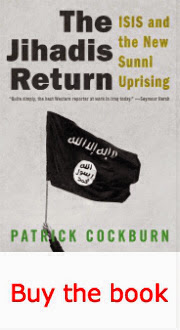
Has anyone covered this nightmare better than the world’s least embedded reporter, Patrick Cockburn of the British Independent? Not for my money. He’s had the canniest, clearest-eyed view of developments in the region for years now. As it happens, when he publishes a new book on the Middle East (the last time was 2008), he makes one of his rare appearances at TomDispatch. This month, his latest must-read work, The Jihadis Return: ISIS and the New Sunni Uprising, is out. Today, this website has an excerpt from its first chapter on why the war on terror was such a failure (and why, if Washington was insistent on invading someplace, it probably should have chosen Saudi Arabia). It includes a special introductory section written just for TomDispatch. Thanks go to his publisher, OR Books. Tom
Why Washington’s War on Terror Failed
The Underrated Saudi Connection
By Patrick Cockburn
[This essay is excerpted from the first chapter of Patrick Cockburn’s new book, The Jihadis Return: ISIS and the New Sunni Uprising, with special thanks to his publisher, OR Books. The first section is a new introduction written for TomDispatch.]
There are extraordinary elements in the present U.S. policy in Iraq and Syria that are attracting surprisingly little attention. In Iraq, the U.S. is carrying out air strikes and sending in advisers and trainers to help beat back the advance of the Islamic State of Iraq and the Levant (better known as ISIS) on the Kurdish capital, Erbil. The U.S. would presumably do the same if ISIS surrounds or attacks Baghdad. But in Syria, Washington’s policy is the exact opposite: there the main opponent of ISIS is the Syrian government and the Syrian Kurds in their northern enclaves. Both are under attack from ISIS, which has taken about a third of the country, including most of its oil and gas production facilities.
But U.S., Western European, Saudi, and Arab Gulf policy is to overthrow President Bashar al-Assad, which happens to be the policy of ISIS and other jihadis in Syria. If Assad goes, then ISIS will be the beneficiary, since it is either defeating or absorbing the rest of the Syrian armed opposition. There is a pretense in Washington and elsewhere that there exists a “moderate” Syrian opposition being helped by the U.S., Qatar, Turkey, and the Saudis. It is, however, weak and getting more so by the day. Soon the new caliphate may stretch from the Iranian border to the Mediterranean and the only force that can possibly stop this from happening is the Syrian army.
The reality of U.S. policy is to support the government of Iraq, but not Syria, against ISIS. But one reason that group has been able to grow so strong in Iraq is that it can draw on its resources and fighters in Syria. Not everything that went wrong in Iraq was the fault of Prime Minister Nouri al-Maliki, as has now become the political and media consensus in the West. Iraqi politicians have been telling me for the last two years that foreign backing for the Sunni revolt in Syria would inevitably destabilize their country as well. This has now happened.
By continuing these contradictory policies in two countries, the U.S. has ensured that ISIS can reinforce its fighters in Iraq from Syria and vice versa. So far, Washington has been successful in escaping blame for the rise of ISIS by putting all the blame on the Iraqi government. In fact, it has created a situation in which ISIS can survive and may well flourish.
Using the al-Qa'ida Label
The sharp increase in the strength and reach of jihadist organizations in Syria and Iraq has generally been unacknowledged until recently by politicians and media in the West. A primary reason for this is that Western governments and their security forces narrowly define the jihadist threat as those forces directly controlled by al-Qa‘ida central or “core” al-Qa‘ida. This enables them to present a much more cheerful picture of their successes in the so-called war on terror than the situation on the ground warrants.
In fact, the idea that the only jihadis to be worried about are those with the official blessing of al-Qa‘ida is naïve and self-deceiving. It ignores the fact, for instance, that ISIS has been criticized by the al-Qa‘ida leader Ayman al-Zawahiri for its excessive violence and sectarianism. After talking to a range of Syrian jihadi rebels not directly affiliated with al-Qa‘ida in southeast Turkey earlier this year, a source told me that “without exception they all expressed enthusiasm for the 9/11 attacks and hoped the same thing would happen in Europe as well as the U.S.”
Jihadi groups ideologically close to al-Qa‘ida have been relabeled as moderate if their actions are deemed supportive of U.S. policy aims. In Syria, the Americans backed a plan by Saudi Arabia to build up a “Southern Front” based in Jordan that would be hostile to the Assad government in Damascus, and simultaneously hostile to al-Qa‘ida-type rebels in the north and east. The powerful but supposedly moderate Yarmouk Brigade, reportedly the planned recipient of anti-aircraft missiles from Saudi Arabia, was intended to be the leading element in this new formation. But numerous videos show that the Yarmouk Brigade has frequently fought in collaboration with JAN, the official al-Qa‘ida affiliate. Since it was likely that, in the midst of battle, these two groups would share their munitions, Washington was effectively allowing advanced weaponry to be handed over to its deadliest enemy. Iraqi officials confirm that they have captured sophisticated arms from ISIS fighters in Iraq that were originally supplied by outside powers to forces considered to be anti-al-Qa‘ida in Syria. More
I have been struck by the unhelpfulness of ideology to my own efforts to think through the complexities of recommended or preferred policy in relation to Syria, and more recently, the Ukraine. There is no obvious posture to be struck by referencing a ‘left’ or ‘right’ identity. A convincing policy proposal depends on sensitivity to context and the particulars of the conflict.
Richard Falk
To insist that the left/right distinction obscures more than it reveals is not the end of the story. To contend that ideology is unhelpful as a guide for action is not the same as saying that it is irrelevant to the public debate. In the American context, to be on the left generally implies an anti-interventionist stance, while being on the right is usually associated with being pro-interventionist. Yet, these first approximations can be misleading, even ideologically. Liberals, who are deliberately and consigned to the left by the mainstream media, often favor intervention if the rationale for military force is primarily humanitarian.
Likewise, the neocon right is often opposed to intervention if it is not persuasively justified on the basis of strategic interests, which could include promoting ideological affinities. The neocon leitmotif is global leadership via military strength, force projection, friends and enemies, and the assertion and enforcement of red lines. When Obama failed to bomb Syria in 2013 after earlier declaring that the use of chemical weapons by the Assad regime was for him a red line this supposedly undermined the credibility of American power. My point is that ideology remains a helpful predictor of how people line up with respect to controversial uses of force, although relying on ideology is a lazy way to think if the purpose is to decide on the best course of action to take, which requires a sensitivity to the concrete realities of a particular situation. Such an analysis depends on context, and may include acknowledging the difficulties of intervention, and the moral unacceptability of nonintervention.
On a high level of abstraction, it is true that the hard right tends to find a justification for military action as the preferred solvent for any challenge to American foreign policy and the hard left is equally disposed to dismiss all calls for humanitarian intervention as sly anti-imperialist maneuvers, recalling Noam Chomsky’s dismissal of the Kosovo War in 1999 as ‘miltary humanism.’ In this sense it seems easier to proceed by dogma than to engage seriously with the existential complexities and uncertainties of the specifics pertaining to a conflict setting, and thus be willing to conclude either that ‘the situation is horrible, and something must be done’ and yet still believe that ‘the situation is horrible, but military intervention will only make it worse.’ This is the kind of conundrum that has perplexed and troubled me ever since the Syrian uprising in 2011 turned violent, unleashing the criminal fury of the Damascus regime, and attracting a variety of predatory outside forces on both sides. Often those on one side or the other of the debate fail to recognize the consequences of either a failed intervention or a refusal to intervene.
There are at least two problems that bedevil interpretation in these setting. To assess particularities of context requires a genuine familiarity with the specifics and changing dynamics of a conflict if persuasive policy recommendations are to be grounded in relevant knowledge rather than on knee jerk reactions. And secondly, no matter how expert, core uncertainties will persist, and the difficulties of making choices that involve killing and dying of others is a huge weight of responsibility if the policy risks and alternatives are carefully weighed.
I would add a third caveat—in the last fifty years military intervention has rarely worked out well for the target society or for the intervener; that is, historical experience would seem to call for what lawyers call ‘a presumption against intervention.’ This presumption is not intended as an absolute prohibition, but it does impose a burden of persuasion on the advocates of intervention. Often, also, the evidence pro and con intervention is doctored and manipulated one way or another to reflect the views of the government or of special interests. This was spectacularly illustrated by the lead up to the U.S. led attack on Iraq in 2003 where governmental efforts to strengthen the public case for intervention produced notorious fabrications. Rwanda in 1994, did present an exceptionally strong humanitarian case supportive of a limited military intervention with operational responsibility entrusted to the United Nations, but the bad experience of the Clinton presidency with the Somalia intervention during the prior year led the United States to oppose effectively a UN effort to prevent, or at least mitigate, a genocidal onslaught.
It would seem against such a background that the best solution in such situations might be procedural, that is, leaving the final policy decision in each instance up to a determination by the UN Security Council. If the Bush Administration had accepted the outcome of the Security Council vote that withheld approval for intervening in Iraq it would have been spared a humiliating strategic defeat that damaged America’s status as world leader. Allowing the Security Council to decide whether or not international force is required and justified also is consistent with the presumption against intervention due to the possibility that any of the five permanent members casting a negative vote counts as a veto.
The Obama approach has not fared much better than that of Bush. It induced members of the Security Council opposed to military intervention to accept the plea of NATO countries in 2011 to engage in a humanitarian operation to save the besieged civilian population of the Libyan city of Benghazi by way of establishing a No Fly Zone. Once the operation got underway, it completely ignored these UN guidelines, and used its air dominance to widen the scope of violence and carry out an unauthorized mission of regime-change. The aftermath in Libya casts further doubt on the overall wisdom of authorizing intervention in such a circumstance of internal strife. As well, the spillover from the refusal of the interveners to adhere to the limited UN mandate has been to undermine trust in such a way as to weaken any prospect for the UN to play a more robust role in resolving the Syrian conflict where the case for interference has become stronger than it ever was in Libya.
Beyond this issue of trust are questions of geopolitical alignment, especially encounters that align the U.S. and NATO on one side and Russia and/or China on the other. As yet, fortunately, there is no second cold war, although the neocons, and some in Europe, are beating the war drums in relation to the Ukraine in such a way as to point in that most unwelcome and totally unjustified direction. Russia’s sensitivity to hostile developments on its borders, previously expressed a few years ago in the 2008 crisis over Georgia, is now more potently evident in relation to the Ukraine and breakaway Crimea, which contains a strategic Russian naval base at Sevastopol that is the only Russian warm water port, as well as home to their Black Sea naval fleet. More
Libyan authorities allegedly intercepted a cache of mustard blister agent being smuggled to opposition forces in Syria, Arutz Sheva 7 reports.
Syrian Rebel Fighters
A separate Israeli news report quotes a Libyan military officer asserting that his country's armed forces had stopped a group of Islamic militants in possession of a container holding the deadly chemical, the news station said on Sunday. The military personnel took custody of the caustic substance, Libyan Col. Mansour al-Mazini added in the report by Israel's Channel 2.
The press claim did not cite the timing of the alleged incident. Libya finished destroying its mustard agent stockpile with international assistance in January, but hundreds of tons of chemical-arms ingredients are still awaiting destruction in the North African country.
Syrian President Bashar Assad's regime agreed to surrender its arsenal of mustard agent and other warfare chemicals in the aftermath of an August nerve gas strike. The government blamed its opponents for the incident, and Moscow has joined its Damascus ally in holding rebel forces responsible for the attack on opposition-controlled territory.
The Syrian government also has placed blame on its opponents for slower-than-expected progress in the disarmament operation, which was to have removed the regime's entire chemical arsenal from the country by early last month.
Norway's military released footage of a transport vessel removing the first batch of Syrian chemical-warfare materials in January as part of the disarmament operation, the Washington Post reported on Friday. More
As part of our push to maintain more regular contact with CWC Coalition members, we have started a weekly update on the Syrian chemical weapons destruction process. Please find links to updates from the first three weeks below:
We are making every effort to stay as up to date as possible on this process. If you have additional information, or have found well informed articles, please share them with the group, as we all benefit from transparency in this situation. We are working on broadening the scope of the destruction to include further information for civil society and will keep you updated accordingly.
In his nationally televised speech about Syria on 10 September, Obama laid the blame for the nerve gas attack on the rebel-held suburb of Eastern Ghouta firmly on Assad’s government, and made it clear he was prepared to back up his earlier public warnings that any use of chemical weapons would cross a ‘red line’: ‘Assad’s government gassed to death over a thousand people,’ he said. ‘We know the Assad regime was responsible … And that is why, after careful deliberation, I determined that it is in the national security interests of the United States to respond to the Assad regime’s use of chemical weapons through a targeted military strike.’ Obama was going to war to back up a public threat, but he was doing so without knowing for sure who did what in the early morning of 21 August.
He cited a list of what appeared to be hard-won evidence of Assad’s culpability: ‘In the days leading up to August 21st, we know that Assad’s chemical weapons personnel prepared for an attack near an area where they mix sarin gas. They distributed gas masks to their troops. Then they fired rockets from a regime-controlled area into 11 neighbourhoods that the regime has been trying to wipe clear of opposition forces.’ Obama’s certainty was echoed at the time by Denis McDonough, his chief of staff, who told the New York Times: ‘No one with whom I’ve spoken doubts the intelligence’ directly linking Assad and his regime to the sarin attacks.
But in recent interviews with intelligence and military officers and consultants past and present, I found intense concern, and on occasion anger, over what was repeatedly seen as the deliberate manipulation of intelligence. One high-level intelligence officer, in an email to a colleague, called the administration’s assurances of Assad’s responsibility a ‘ruse’. The attack ‘was not the result of the current regime’, he wrote. A former senior intelligence official told me that the Obama administration had altered the available information – in terms of its timing and sequence – to enable the president and his advisers to make intelligence retrieved days after the attack look as if it had been picked up and analysed in real time, as the attack was happening. The distortion, he said, reminded him of the 1964 Gulf of Tonkin incident, when the Johnson administration reversed the sequence of National Security Agency intercepts to justify one of the early bombings of North Vietnam. The same official said there was immense frustration inside the military and intelligence bureaucracy: ‘The guys are throwing their hands in the air and saying, “How can we help this guy” – Obama – “when he and his cronies in the White House make up the intelligence as they go along?”’
The complaints focus on what Washington did not have: any advance warning from the assumed source of the attack. The military intelligence community has for years produced a highly classified early morning intelligence summary, known as the Morning Report, for the secretary of defence and the chairman of the Joint Chiefs of Staff; a copy also goes to the national security adviser and the director of national intelligence. The Morning Report includes no political or economic information, but provides a summary of important military events around the world, with all available intelligence about them. A senior intelligence consultant told me that some time after the attack he reviewed the reports for 20 August through 23 August. For two days – 20 and 21 August – there was no mention of Syria. On 22 August the lead item in the Morning Report dealt with Egypt; a subsequent item discussed an internal change in the command structure of one of the rebel groups in Syria. Nothing was noted about the use of nerve gas in Damascus that day. It was not until 23 August that the use of sarin became a dominant issue, although hundreds of photographs and videos of the massacre had gone viral within hours on YouTube, Facebook and other social media sites. At this point, the administration knew no more than the public.
Obama left Washington early on 21 August for a hectic two-day speaking tour in New York and Pennsylvania; according to the White House press office, he was briefed later that day on the attack, and the growing public and media furore. The lack of any immediate inside intelligence was made clear on 22 August, when Jen Psaki, a spokesperson for the State Department, told reporters: ‘We are unable to conclusively determine [chemical weapons] use. But we are focused every minute of every day since these events happened … on doing everything possible within our power to nail down the facts.’ The administration’s tone had hardened by 27 August, when Jay Carney, Obama’s press secretary, told reporters – without providing any specific information – that any suggestions that the Syrian government was not responsible ‘are as preposterous as suggestions that the attack itself didn’t occur’.
The absence of immediate alarm inside the American intelligence community demonstrates that there was no intelligence about Syrian intentions in the days before the attack. And there are at least two ways the US could have known about it in advance: both were touched on in one of the top secret American intelligence documents that have been made public in recent months by Edward Snowden, the former NSA contractor.
On 29 August, the Washington Post, the Obama administration has never claimed to have specific information connecting Assad himself to the attack.) published excerpts from the annual budget for all national intelligence programmes, agency by agency, provided by Snowden. In consultation with the Obama administration, the newspaper chose to publish only a slim portion of the 178-page document, which has a classification higher than top secret, but it summarised and published a section dealing with problem areas. One problem area was the gap in coverage targeting Assad’s office. The document said that the NSA’s worldwide electronic eavesdropping facilities had been ‘able to monitor unencrypted communications among senior military officials at the outset of the civil war there’. But it was ‘a vulnerability that President Bashar al-Assad’s forces apparently later recognised’. In other words, the NSA no longer had access to the conversations of the top military leadership in Syria, which would have included crucial communications from Assad, such as orders for a nerve gas attack. (In its public statements since 21 AugustMore
The media that failed woefully in their coverage of Afghanistan, Iraq and Libya are the media that we are supposed now to believe are giving us the unvarnished truth in Syria.
Patrick Cockburn points out some of the reasons why we shouldn't trust journalists' war coverage. He also makes some good points about how war's greater exposure in the modern media often changes the nature of the fighting for the worse. Jonathan Cook - Journalist
The four wars fought in Afghanistan, Iraq, Libya and Syria over the past 12 years have all involved overt or covert foreign intervention in deeply divided countries. In each case the involvement of the West exacerbated existing differences and pushed hostile parties towards civil war. In each country, all or part of the opposition have been hard-core jihadi fighters. Whatever the real issues at stake, the interventions have been presented as primarily humanitarian, in support of popular forces against dictators and police states. Despite apparent military successes, in none of these cases have the local opposition and their backers succeeded in consolidating power and establishing stable states.
More than most armed struggles, the conflicts have been propaganda wars in which newspaper, television and radio journalists played a central role. In all wars there is a difference between reported news and what really happened, but during these four campaigns the outside world has been left with misconceptions even about the identity of the victors and the defeated. In 2001 reports of the Afghan war gave the impression that the Taliban had been beaten decisively even though there had been very little fighting. In 2003 there was a belief in the West that Saddam Hussein’s forces had been crushed when in fact the Iraqi army, including the units of the elite Special Republican Guard, had simply disbanded and gone home. In Libya in 2011 the rebel militiamen, so often shown on television firing truck-mounted heavy machine-guns in the general direction of the enemy, had only a limited role in the overthrow of Muammar Gaddafi, which was mostly brought about by Nato air strikes. In Syria in 2011 and 2012 foreign leaders and journalists repeatedly and vainly predicted the imminent defeat of Bashar al-Assad.
These misperceptions explain why there have been so many surprises and unexpected reversals of fortune. The Taliban rose again in 2006 because it hadn’t been beaten as comprehensively as the rest of the world imagined. At the end of 2001 I was able to drive – nervously but safely – from Kabul to Kandahar, but when I tried to make the same journey in 2011 I could go no further south on the main road than the last police station on the outskirts of Kabul. In Tripoli two years ago hotels were filled to capacity with journalists covering Gaddafi’s fall and the triumph of the rebel militias. But state authority still hasn’t been restored. This summer Libya almost stopped exporting oil because the main ports on the Mediterranean had been seized by mutinying militiamen, and the prime minister, Ali Zeidan, threatened to bomb ‘from the air and the sea’ the oil tankers the militiamen were using to sell oil on the black market.
Libya’s descent into anarchy was scarcely covered by the international media since they had long since moved on to Syria, and more recently Egypt. Iraq, home a few years ago to so many foreign news bureaux, has also dropped off the media map although up to a thousand Iraqis are killed each month, mostly as a result of the bombing of civilian targets. When it rained for a few days in Baghdad in January the sewer system, supposedly restored at a cost of $7 billion, couldn’t cope: some streets were knee-deep in dirty water and sewage. In Syria, many opposition fighters who had fought to defend their communities turned into licensed bandits and racketeers when they took power in rebel-held enclaves.
It wasn’t that reporters were factually incorrect in their descriptions of what they had seen. But the very term ‘war reporter’, though not often used by journalists themselves, helps explain what went wrong. Leaving aside its macho overtones, it gives the misleading impression that war can be adequately described by focusing on military combat. But irregular or guerrilla wars are always intensely political, and none more so than the strange stop-go conflicts that followed from 9/11. This doesn’t mean that what happened on the battlefield was insignificant, but that it requires interpretation. In 2003 television showed columns of Iraqi tanks smashed and on fire after US air strikes on the main highway north of Baghdad. If it hadn’t been for the desert background, viewers could have been watching pictures of the defeated German army in Normandy in 1944. But I climbed into some of the tanks and could see that they had been abandoned long before they were hit. This mattered because it showed that the Iraqi army wasn’t prepared to fight and die for Saddam. It was a pointer too to the likely future of the allied occupation. Iraqi soldiers, who didn’t see themselves as having been defeated, expected to keep their jobs in post-Saddam Iraq, and were enraged when the Americans dissolved their army. Well-trained officers flooded into the resistance, with devastating consequences for the occupying forces: a year later the Americans controlled only islands of territory in Iraq.
War reporting is easier than other types of journalism in one respect because the melodrama of events drives the story and attracts an audience. It may be risky at times, but the correspondent talking to camera, with exploding shells and blazing military vehicles behind him, knows his report will feature high up in any newscast. ‘If it bleeds it leads,’ is an old American media adage. The drama of battle inevitably dominates the news, but oversimplifies it by disclosing only part of what is happening. These oversimplifications were more than usually gross and deceptive in Afghanistan and Iraq, when they dovetailed with political propaganda that demonised the Taliban and later Saddam as evil incarnate, casting the conflict – particularly easy in the US in the hysterical atmosphere after 9/11 – as a black and white struggle between good and evil. The crippling inadequacies of the opposition were ignored.
By 2011 the complexity of the conflicts in Iraq and Afghanistan was evident to journalists in Baghdad and Kabul if not necessarily to editors in London and New York. But by then the reporting of the wars in Libya and Syria was demonstrating a different though equally potent form of naivety. A version of the spirit of 1968 prevailed: antagonisms that predated the Arab Spring were suddenly said to be obsolete; a brave new world was being created at hectic speed. Commentators optimistically suggested that, in the age of satellite television and the internet, traditional forms of repression – censorship, imprisonment, torture, execution – could no longer secure a police state in power; they might even be counter-productive. State control of information and communication had been subverted by blogs, satellite phones and even the mobile phone; YouTube provided the means to expose in the most graphic and immediate way the crimes and violence of security forces. More


 ©
©