Showing posts with label Saudi Arabia. Show all posts

Friday, October 30, 2015

The long-term petroleum price outlook - When will it escalate?

For the last few years, the Saudi kingdom’s insistence on pumping oil at high capacity has dramatically depressed oil prices. The result has undermined Saudi’s major oil rivals in OPEC – like Iran and Venezuela.

It has also hit Russia, hard.

Rating agency Standard & Poor forecasts that Russia’s budget deficit is set to swell to 4.4 per cent of GDP this year. Russia’s own finance ministry concedes that if expenditures continue at this rate, within sixteen months – by around the end of next year – its oil reserve funds will be exhausted.

Meanwhile, over the last year real incomes have dropped by 9.8 per cent, and food prices have spiked by 17 per cent, heightening the risk of civil unrest.

System failureh

Rumbling along beneath the surface of such financial woes are deeper systemic issues.

A report from the Swedish Defence Research Agency notes that “prolonged dry periods in southern Russia are having the effect of reducing the level of food production”.

Most of Russia’s wheat imports come from Kazakhstan, “where climate change is expected to exacerbate droughts. These impacts would make farming harder and food more expensive,” observe Dr. Marina Sharmina and Dr. Christopher Jones of the Tyndall Centre for Climate Change Research.

Russia’s looming energy crisis is the other elephant in the room. In 2013, HSBC forecasted that Russia would hit peak oil between 2018 and 2019, experiencing a brief plateau before declining by 30 per cent from 2020 to 2025.

That year, Fitch Ratings came to pretty much the same conclusion. And last year, Leonid Fedun, vice-president of Russia’s second largest oil producer, Lukoil, predicted that the production could peak earlier due to falling oil prices and US-EU sanctions.

Faced with overlapping economic, food and energy crises, Russia is well and truly on the brink. More

Furthermore, According to a recent report from the IMF, Saudi Arabia’s public debt is estimated to rise from below 2 percent of its GDP in 2014 up to 33 percent by the end of 2020. The report also shows that in the past three years, Saudi Arabia’s budget surplus was turned into a deficit reaching 21.6 percent of GDP in 2015. More


Friday, July 24, 2015

Is the Iran deal about staving off the coming oil shock - By Nafeez Ahmed

The Iran nuclear deal signals a major shift in the geopolitics of the Middle East. Integral to the equation is oil, economics, terror – and US hegemony.

The Bush administration had initiated a long-term covert strategy to undermine Iranian influence in the Middle East and Central Asia, combined with overt pressure through diplomatic initiatives and economic sanctions.

Under Obama, this strategy accelerated, largely in concert with other Gulf powers like Saudi Arabia, Qatar and the UAE, who have long sought to roll-back Iranian influence.

Yet even as the strategy accelerated, unlike its predecessors which openly declared their warmongering hostility to Iran, the Obama administration had used the pressure to forge an unprecedented deal with the country.

Averting regional war

The reasons for the shift are, of course, pragmatic. For years, US intelligence agencies have told the White House that there is simply no evidence Iran is trying to build a nuclear bomb.

And the International Atomic Energy Agency (IAEA) has repeatedly certified that uranium is not being enriched to levels necessary for weaponisation, nor is it being diverted to a secret weapons programme.

Meanwhile, senior US military officials have long warned that the sort of US-Iran military confrontation which frothing neoconservatives have been pining for would likely fail and destabilise the entire region.

What about an Israel-Iran confrontation? A classified Pentagon war simulation held in 2012 found that an Israeli attack on Iran would also lead to a wider regional war.

Unlike the neocons, for the military pragmatists in successive US administrations, war with Iran could never be a preferred option.

The added bonus is that Iran might notch down its involvement in Iraq and Syria.

Earlier this year, the US assured its allies at the Camp David summit that under the nuclear deal, Iran’s growing geopolitical influence in the region would be curtailed. Simultaneously, the US gave Saudi Arabia, Qatar, the UAE and others the green light to accelerate support to the Islamist militants of their choice in Syria.

George Friedman, founder and CEO of private US intelligence firm Stratfor – which operates closely with the Pentagon and State Department – forecasted the US-Iran détente four years ago.

His prescient assessment of its strategic rationale is worth noting. Friedman explained that by reaching “a temporary understanding with Iran,” the US would give itself room to withdraw while playing off Iran against the Sunni regimes, limiting Iran’s “direct controls” in the region, “while putting the Saudis, among others, at an enormous disadvantage”.

“This strategy would confront the reality of Iranian power and try to shape it,” wrote Friedman.

Ultimately, though, the US is betting on the rise of Turkey – hence the latter’s pivotal role in the new anti-IS rebel training strategy, despite Turkey’s military and financial sponsorship of IS. More


Monday, April 20, 2015

Saudi Arabia is 'biggest funder of terrorists says Hillary

Saudi Arabia is the single biggest contributor to the funding of Islamic extremism and is unwilling to cut off the money supply, according to a leaked note from Hillary Clinton.

The US Secretary of State says in a secret memorandum that donors in the kingdom still "constitute the most significant source of funding to Sunni terrorist groups worldwide" and that "it has been an ongoing challenge to persuade Saudi officials to treat terrorist financing emanating from Saudi Arabia as a strategic priority".

In a separate diplomatic cable published by WikiLeaks last night, the militant group which carried out the Mumbai bombings in 2008, Lashkar-e-Toiba, is reported to have secured money in Saudi Arabia via one of its charity offshoots which raises money for schools.

Saudi Arabia is accused, along with Qatar, Kuwait and the United Arab Emirates, of failing to prevent some of its richest citizens financing the insurgency against Nato troops in Afghanistan. Fund-raisers from the Taliban regularly travel to UAE to take advantage of its weak borders and financial regulation to launder money.

However, it is Saudi Arabia that receives the harshest assessment. The country from which Osama bin Laden and most of the 9/11 terrorists originated, according to Mrs Clinton, "a critical financial support base for al-Qa'ida, the Taliban, Lashkar-e-Toiba and other terrorist groups, including Hamas, which probably raise millions of dollars annually from Saudi sources, often during the Haj and Ramadan".

These pilgrimages, especially the Haj, are described as a "big problem" in another cable dated 29 May 2009. Detailing a briefing from the Saudi interior ministry to Richard Holbrooke, the US envoy to Afghanistan and Pakistan, it notes: "The Haj is still a major security loophole for the Saudis, since pilgrims often travel with large amounts of cash and the Saudis cannot refuse them entry into Saudi Arabia."

It also quotes one of the officials admitting that the Haj is "a vacuum in our security". The huge annual influx of Muslims from around the world offers a prime opportunity for militants and their donors to enter the kingdom to exchange funds, launder money through front companies and accept money from government-approved charities.

The memo underlines that the US supports the work of Islamic charities, but is frustrated that they are so easily exploited to fund terrorism.

"In 2002, the Saudi government promised to set up a charities committee that would address this issue, but has yet to do so," Mrs Clinton's cable reads, before seeming to admit with disappointment that merely "obtaining Saudi acknowledgement of the scope of this problem and a commitment to take decisive action" has proved hard. More


Friday, August 22, 2014

Tomgram: Patrick Cockburn, How to Ensure a Thriving Caliphate

Think of the new “caliphate” of the Islamic State, formerly the Islamic State in Iraq and Syria (ISIS), as George W. Bush and Dick Cheney's gift to the world (with a helping hand from the Saudis and other financiers of extremism in the Persian Gulf). How strange that they get so little credit for its rise, for the fact that the outlines of the Middle East, as set up by Europe’s colonial powers in the wake of World War I, are being swept aside in a tide of blood.

Had George and Dick not decided on their “cakewalk” in Iraq, had they not raised the specter of nuclear destruction and claimed that Saddam Hussein’s regime was somehow linked to al-Qaeda and so to the 9/11 attacks, had they not sent tens of thousands of American troops into a burning, looted Baghdad (“stuff happens”), disbanded the Iraqi army, built military bases all over that country, and generally indulged their geopolitical fantasies about dominating the oil heartlands of the planet for eternity, ISIS would have been an unlikely possibility, no matter the ethnic and religious tensions in the region. They essentially launched the drive that broke state power there and created the kind of vacuum that a movement like ISIS was so horrifically well suited to fill.

All in all, it’s a remarkable accomplishment to look back on. In September 2001, when George and Dick launched their “Global War on Terror” to wipe out -- so they then claimed -- “terrorist networks” in up to 60 countries, or as they preferred to put it, “drain the swamp,” there were scattered bands of jihadis globally, while al-Qaeda had a couple of camps in Afghanistan and a sprinkling of supporters elsewhere. Today, in the wake of the invasions of Afghanistan and Iraq and an air power intervention in Libya, after years of drone (and non-drone) bombing campaigns across the Greater Middle East, jihadist groups are thriving in Yemen and Pakistan, spreading through Africa (along with the U.S. military), and ISIS has taken significant parts of Iraq and Syria right up to the Lebanese border for its own bailiwick and is still expanding murderously, despite a renewed American bombing campaign that may only strengthen that movement in the long run.

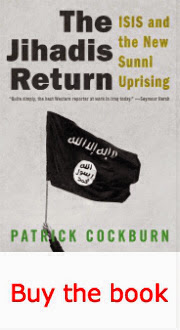
Has anyone covered this nightmare better than the world’s least embedded reporter, Patrick Cockburn of the British Independent? Not for my money. He’s had the canniest, clearest-eyed view of developments in the region for years now. As it happens, when he publishes a new book on the Middle East (the last time was 2008), he makes one of his rare appearances at TomDispatch. This month, his latest must-read work, The Jihadis Return: ISIS and the New Sunni Uprising, is out. Today, this website has an excerpt from its first chapter on why the war on terror was such a failure (and why, if Washington was insistent on invading someplace, it probably should have chosen Saudi Arabia). It includes a special introductory section written just for TomDispatch. Thanks go to his publisher, OR Books. Tom

Why Washington’s War on Terror Failed

The Underrated Saudi Connection

By Patrick Cockburn

[This essay is excerpted from the first chapter of Patrick Cockburn’s new book, The Jihadis Return: ISIS and the New Sunni Uprising, with special thanks to his publisher, OR Books. The first section is a new introduction written for TomDispatch.]

There are extraordinary elements in the present U.S. policy in Iraq and Syria that are attracting surprisingly little attention. In Iraq, the U.S. is carrying out air strikes and sending in advisers and trainers to help beat back the advance of the Islamic State of Iraq and the Levant (better known as ISIS) on the Kurdish capital, Erbil. The U.S. would presumably do the same if ISIS surrounds or attacks Baghdad. But in Syria, Washington’s policy is the exact opposite: there the main opponent of ISIS is the Syrian government and the Syrian Kurds in their northern enclaves. Both are under attack from ISIS, which has taken about a third of the country, including most of its oil and gas production facilities.

But U.S., Western European, Saudi, and Arab Gulf policy is to overthrow President Bashar al-Assad, which happens to be the policy of ISIS and other jihadis in Syria. If Assad goes, then ISIS will be the beneficiary, since it is either defeating or absorbing the rest of the Syrian armed opposition. There is a pretense in Washington and elsewhere that there exists a “moderate” Syrian opposition being helped by the U.S., Qatar, Turkey, and the Saudis. It is, however, weak and getting more so by the day. Soon the new caliphate may stretch from the Iranian border to the Mediterranean and the only force that can possibly stop this from happening is the Syrian army.

The reality of U.S. policy is to support the government of Iraq, but not Syria, against ISIS. But one reason that group has been able to grow so strong in Iraq is that it can draw on its resources and fighters in Syria. Not everything that went wrong in Iraq was the fault of Prime Minister Nouri al-Maliki, as has now become the political and media consensus in the West. Iraqi politicians have been telling me for the last two years that foreign backing for the Sunni revolt in Syria would inevitably destabilize their country as well. This has now happened.

By continuing these contradictory policies in two countries, the U.S. has ensured that ISIS can reinforce its fighters in Iraq from Syria and vice versa. So far, Washington has been successful in escaping blame for the rise of ISIS by putting all the blame on the Iraqi government. In fact, it has created a situation in which ISIS can survive and may well flourish.

Using the al-Qa'ida Label

The sharp increase in the strength and reach of jihadist organizations in Syria and Iraq has generally been unacknowledged until recently by politicians and media in the West. A primary reason for this is that Western governments and their security forces narrowly define the jihadist threat as those forces directly controlled by al-Qa‘ida central or “core” al-Qa‘ida. This enables them to present a much more cheerful picture of their successes in the so-called war on terror than the situation on the ground warrants.

In fact, the idea that the only jihadis to be worried about are those with the official blessing of al-Qa‘ida is naïve and self-deceiving. It ignores the fact, for instance, that ISIS has been criticized by the al-Qa‘ida leader Ayman al-Zawahiri for its excessive violence and sectarianism. After talking to a range of Syrian jihadi rebels not directly affiliated with al-Qa‘ida in southeast Turkey earlier this year, a source told me that “without exception they all expressed enthusiasm for the 9/11 attacks and hoped the same thing would happen in Europe as well as the U.S.”

Jihadi groups ideologically close to al-Qa‘ida have been relabeled as moderate if their actions are deemed supportive of U.S. policy aims. In Syria, the Americans backed a plan by Saudi Arabia to build up a “Southern Front” based in Jordan that would be hostile to the Assad government in Damascus, and simultaneously hostile to al-Qa‘ida-type rebels in the north and east. The powerful but supposedly moderate Yarmouk Brigade, reportedly the planned recipient of anti-aircraft missiles from Saudi Arabia, was intended to be the leading element in this new formation. But numerous videos show that the Yarmouk Brigade has frequently fought in collaboration with JAN, the official al-Qa‘ida affiliate. Since it was likely that, in the midst of battle, these two groups would share their munitions, Washington was effectively allowing advanced weaponry to be handed over to its deadliest enemy. Iraqi officials confirm that they have captured sophisticated arms from ISIS fighters in Iraq that were originally supplied by outside powers to forces considered to be anti-al-Qa‘ida in Syria. More


Friday, January 3, 2014

AREVA, EDF sign accords for Saudi nuclear program

RIYADH - EDF and AREVA signed two sets of agreements aimed at supporting the Saudi nuclear energy program on Monday, coinciding with the visit of French President François Hollande's to Riyadh. The two companies have signed Memorandums of Understanding (MoUs) with 5 Saudi industrial partners - Zamil Steel, Bahra Cables, Riyadh Cables, Saudi Pumps, Descon Olayan.

The agreements aim to develop the industrial and technical skills of local companies. They reflect AREVA and EDF's desire to build an extended network of Saudi suppliers for future nuclear projects in the country.

A second series of agreements signed with 4 Saudi universities - King Saud University in Riyadh, Dar Al Hekma College and Effat University in Jeddah and finally Prince Mohammed bin Fahd University in Al-Khobar - are intended to contribute to the development of nuclear expertise in the Kingdom.

These agreements follow on from the previous operations organized by EDF and AREVA, through their joint office in Riyadh. These include the "Suppliers' Days" in March and October 2013, the visit to France by Saudi industrial companies in November, the agreement signed with the local professional training institute (NIT) in July 2013, the visits to French nuclear facilities organized for Saudi university faculty members in June 2013 and internship offers made to Saudi students since the summer.

EDF CEO Henri Proglio said: "These new agreements underline EDF and AREVA's commitment alongside the Kingdom of Saudi Arabia to enable it to successfully implement its national energy strategy and in particular to develop its future nuclear program by contributing to the development of a local network of manufacturers and by training qualified engineers."

Luc Oursel, President and CEO of AREVA, added: "These agreements demonstrate the common will of EDF and AREVA to establish a true long-term partnership with the Kingdom of Saudi Arabia. They will enable the country to build a strong industrial base and a robust skills management program."

The EDF group, one of the leaders in the European energy market, is an integrated energy company active in all areas of the business: generation, transmission, distribution, energy supply and trading. The Group is the leading electricity producer in Europe. In France, it has mainly nuclear and hydropower generation facilities where 95.9 percent of the electricity output is CO2-free.

AREVA supplies advanced technology solutions for power generation with less carbon. Its expertise and unwavering insistence on safety, security, transparency and ethics are setting the standard, and its responsible development is anchored in a process of continuous improvement. Ranked first in the global nuclear power industry, AREVA's unique integrated offering to utilities covers every stage of the fuel cycle, nuclear reactor design and construction, and operating services. The group is actively developing its activities in renewable energies - wind, bioenergy, solar and energy storage - to become a European leader in this sector. More


Monday, December 30, 2013

Why Saudi Arabia and the U.S. don’t see eye to eye in the Middle East

Give credit to Vladimir Putin and his New York Times op-ed on Syria for sparking a new tactic for foreign leaders hoping to influence American public opinion. In recent weeks, Saudi Arabian political elites have followed Putin’s lead, using American outlets to express their distaste with the West’s foreign policy, particularly with regard to Syria and Iran.

In comments to the Wall Street Journal, prominent Saudi Prince Turki al-Faisal decried the United States for cutting a preliminary deal with Iran on its nuclear program without giving the Saudis a seat at the table, and for Washington’s unwillingness to oppose Assad in the wake of the atrocities he’s committed. Saudi Arabia’s ambassador to Britain followed with an op-ed in the New York Times entitled “Saudi Arabia Will Go It Alone.” The Saudis are clearly upholding the vow made by intelligence chief Bandar bin Sultan back in October to undergo a “major shift” away from the United States.

In light of the recent actions of the Obama administration, many allies are also frustrated and confused, and even hedging their bets in reaction to the United States’ increasingly unpredictable foreign policy. But of all the disappointed countries, none is more so than Saudi Arabia — and with good reason. That’s because the two countries have shared interests historically — but not core values — and those interests have recently diverged.

First, America’s track record in the Middle East in recent years has sowed distrust. The relationship began to deteriorate with the United States’ initial response to the Arab Spring, where its perceived pro-democratic stance stood at odds with the Saudi ruling elite. After Washington stood behind the elections that installed a Muslim Brotherhood government in Egypt and then spoke out against the Egyptian army’s attempt to remove President Mohammad Morsi, the Saudi royals were left to wonder where Washington would stand if similar unrest broke out on their soil.

Ian Bremmer

Second, while the oil trade has historically aligned U.S.-Saudi interests, the unconventional energy breakthrough in North America is calling this into question. The United States and Canada are utilizing hydraulic fracturing and horizontal drilling techniques, leading to a surge in domestic energy production. That development leaves America significantly less dependent on oil from the Middle East, and contributes to the U.S.’ shifting interests and increasing disengagement in the region. Not only does Saudi Arabia lose influence in Washington — many of the top American executives in the oil industry were their best conduits — but it also puts the Saudis on the wrong end of this long-term trend toward increasing global energy supply.

To say that oil is an integral part of Saudi Arabia’s economy is a gross understatement. Oil still accounts for 45 percent of Saudi GDP, 80 percent of budget revenue, and 90 percent of exports. In the months ahead, new oil supply is expected to outstrip new demand, largely on the back of improvements in output in Iraq and Libya. By the end of the first quarter of 2014, Saudi Arabia will likely have to reduce production to keep prices stable. And the trend toward more supply doesn’t take into account the potential for a comprehensive Iranian nuclear deal that would begin to ease sanctions and allow more Iranian crude to reach global markets.

It is this ongoing nuclear negotiation with Iran that poses the principal threat to an aligned United States and Saudi Arabia. An Iranian deal would undercut Saudi Arabia’s leadership over fellow Gulf States, as other Gulf Cooperation Council (GCC) members like Kuwait and the UAE would welcome resurgent trade with Iran. At the same time, Iran would emerge over the longer term as the chief competitor for influence across the broader region, serving as the nexus of Shi’ite power. The Saudis would find themselves most directly threatened by this Shi’ite resurgence within neighboring Bahrain, a majority Shi’ite state ruled by a Sunni regime that is backstopped by the Saudi royals.

The bottom line: the Saudis are actively competing with Iran for influence throughout the Middle East. That’s why the Saudis have the most at stake from any easing of sanctions on Iran, any normalization of relations with the West, or any nuclear breakthrough that gives Iran the ultimate security bargaining chip. The Saudis have reaped the benefits of an economically weak Iran — and they are not prepared to relinquish that advantage. Ultimately, any deal that exchanges Iranian economic security for delays in Iran’s nuclear program is a fundamental problem for Saudi Arabia — as is any failed deal that allows sanctions to unravel.

For all of these reasons, even though the United States will be buying Saudi oil for years to come and will still sell the Saudis weapons, American policy in the Middle East has now made the United States more hostile to Saudi interests than any other major country outside the region. That’s why the Saudis have been so vocal about the United States’ perceived policy failures.

But to say Obama has messed up the Middle East is a serious overstatement. What he has tried to do is avoid getting too involved in a messed up Middle East. Obama ended the war in Iraq. In Libya, he did everything possible to remain on the sidelines, not engaging until the GCC and Arab League beseeched him to — and even then, only in a role of “leading from behind” the French and the British.

Call the Obama policy “engaging to disengage.” In Syria, Obama did everything possible to stay out despite the damage to his international credibility. When the prospect for a chemical weapons agreement arose, he leapt at the chance to point to a tangible achievement that could justify the U.S. remaining a spectator to the broader civil war. In Iran, a key goal of Obama’s diplomatic engagement will be to avoid the use of military force down the road. It hasn’t always been pretty, but Obama has at least been trying to act in the best interests of the United States — interests that are diverging from Saudi Arabia’s. More


Wednesday, October 2, 2013

Oxfam takes aim at big food and beverage companies over sugar-linked land grabs

BANGKOK (Thomson Reuters Foundation) - Ever wonder where the sugar in a can of Coke or Pepsi or a mug of Ovaltine came from?

It may have come from land previously owned by indigenous and rural communities who are now landless and destitute after sugar companies forcibly evicted them, according to a new report from Oxfam.

Based on cases of land conflicts in Brazil and Cambodia, “Nothing sweet about it: How sugar fuels land grabs” faults some of the world’s biggest food and beverage companies - in particular Coca-Cola, PepsiCo and Associated British Foods (ABF) - for failing to ensure their sugar suppliers are not involved in land grabs.

“While our increasing appetite for sugar has health advocates ringing alarm bells… it has largely gone unnoticed that the sugar trade is also helping to fuel the problem of land grabs and disputes,” the report said.

It pointed to instances in which companies supplying sugar to these multinationals used political clout and threats to force local communities off their land, destroy their homes and pay inadequate compensation.

Coca-Cola and PepsiCo are two of the largest purchasers of sugar and ABF is the world’s second-largest sugar producer, Oxfam said. All use sugar in a wide range of processed foods, from soft drinks and yogurt to frozen meals and sauces.

“These companies continue to preside over supply chains within which the risks have increased of land grabs and land conflicts. Yet they are doing little if anything to prevent land grabs in their own supply chains,” the report said.

SUPPLY CHAINS UNDER SCRUTINY

The charity is asking the three companies to disclose their sources of sugar, palm oil, and soy commodities, to commit to zero tolerance for land grabbing and to publicly advocate that governments and traders invest in agriculture responsibly.

The report is the latest salvo in Oxfam’s Behind The Brands campaign, which aims to bring the 10 biggest food and drink brands - ABF, Coca-Cola, Danone, General Mills, Kellogg’s, Mars, Mondelez, Nestle, PepsiCo and Unilever - to account for what happens in their supply chains.

As a result of food companies relying on long chains of production, the biggest sugar buyers and producers “have failed to keep tabs on their industry’s insatiable demand for land, and the lengths to which the third party companies they work with will go to acquire it,” the report said.

In Cambodia’s Sre Ambel district in Koh Khong province, Thai company Khon Kaen Sugar (KSL) seized land from some 450 families in 2006. Demolition workers with bulldozers and excavators, accompanied by armed police, arrived without warning, activists say.

Six months after the company opened a sugar-processing factory in the district, Cambodia’s first shipment of sugar in four decades, 10,000 tonnes valued at roughly $3.31 million, was delivered to U.K. sugar giant Tate & Lyle, according to activists.

Oxfam says Coca-Cola and PepsiCo bottlers buy sugar from Tate & Lyle, who has said it has no plans to buy more from KSL. Activist say Tate & Lyle has already received 48,000 tons of sugar from Cambodia, estimated at €24 million.

LAND INTENSIVE

While soy and palm oil are also linked to land grabs, sugar is the most land-intensive, according to Oxfam.

Sugar is grown on 31million hectares of land globally - an area the size of Italy - and much of it is in the developing world, the report said.

The global sugar trade is worth around $47 billion, and the food and drinks industry accounts for more than half of the 176 million tonnes of sugar produced last year, it said. More


Wednesday, September 18, 2013

Is Capitalism to Blame For the Syrian War Drive?

Obama’s push for war in Syria seemed so deeply irrational, so crazed, that many people naturally asked, “Why is this happening?” And “who” wants it to happen?

Few Americans actually believed that Nobel Peace Prizing winning Obama suddenly wanted to bomb Syria because “Assad gassed his own people” (especially when zero evidence was given to prove this).

Many commentators have correctly stated that geopolitics is a main motivation for Obama wanting to bomb Syria, acting as a gateway to Iran. Other commentators have also correctly discussed the specific economic (capitalistic) interests as a war motive. And others still have, again correctly, focused on the importance of Israel as a factor towards pushing for war in Syria and eventually Iran. All three answers are correct, and have an inter-dependence that is complicated and difficult to quantify, since much of the truth is hidden from public view.

Problems arise in analysis, however, when one of these issues is separated from the broader context, as was done in a recent article by Jean Bricmont and Diana Johnstone. Their article, “The People Against the 800 Pound Gorilla,” focuses on the importance of the U.S. Israeli lobby — “the 800 Pound Gorilla” — and its push for war, while minimizing or dismissing other crucial economic and political motives.

The article makes many excellent points, especially how the Israeli lobby in the U.S., American Israel Public Affairs Committee (AIPAC), is fanatically pushing for war against Syria. Congress is also trying to be politically immune from ANY discussion about AIPAC activities, lest accusations of “anti-Semite” are indiscriminately flung at them.

The problem with the article, however, is that the authors elevate the Israeli gorilla to a weight class it doesn’t belong in; and in so doing the authors are forced to minimize the size of several other giant gorillas, whose combined weight overshadows the Israeli chimp.

One of the giant gorillas that the authors seek to shrink is the U.S. capitalist class. The following passage summarizes the author’s main point:

“People who think that capitalists want wars to make profits should spend time observing the board of directors of any big corporation: capitalists need stability, not chaos, and the recent wars only bring more chaos.”

This is, of course, true for many if not most U.S. corporations. The authors are also correct when they argue that the average writer who uses a capitalist-centered analysis to explain war wrongly “…sees capitalism as a unified actor issuing orders to obedient politicians on the basis of careful calculations.” The authors are correct that this type of clunky analysis lacks nuance and should be rejected.

But the authors also fail to give capitalism the nuance it deserves; they construct a capitalistic strawman so arid it spontaneously combusts. For example, the authors limit the definition of capitalism to a sector-specific basis, mentioning specific types of capitalists that are blamed for pushing war and dismissing them as lesser gorillas than the Israeli lobby.

In naming corporate names the authors make some good points, but somehow skip over the 1,600 pound gorilla in the room — the big banks, the motor force of capitalism in the U.S. The authors might respond to this criticism by saying the banks were purposely omitted because they do not “directly benefit” from war and are, therefore, not at the forefront of advocating it.

This would be false. As the dominant corporate sector in U.S. capitalism, the banks are also the most internationalist in scope; the recent second quarter profits of U.S. banks were $42.2 billion (!), most of this money was made in overseas investing using cheap Federal Reserve printed dollars. More


Tuesday, August 6, 2013

OPEC Nations Seek Cash For Solar Shift

Two of the largest oil producers are readying the Middle East's first big push into renewable energy, planning solar-power plants that will need more than $1.5 billion in financing by the end of 2014.

Saudi Arabia, the biggest member of the Organization of Petroleum Exporting Countries, and the United Arab Emirates, fourth-biggest in the group, are seeking to add 1,000 megawatts of solar capacity, enough to electrify 200,000 homes. The forecast expansion, which includes Jordan, will require loans and export credits, said Vahid Fotuhi, president of the Dubai-based Emirates Solar Industry Association.

Governments across the Middle East and North Africa consider sun and wind energy as crucial for meeting the needs of growing populations and economies, with Saudi Arabia leading the way. Oil-producers want to develop renewables to conserve more crude for export, while countries relying on imported fuel see local green power as a cheaper alternative.

State support for utilities and a growth in regional power demand of about 5 percent a year mean companies such as Abu Dhabi National Energy Co. (TAQA) can borrow at rates that are 100 basis points, or 1 percentage point, lower than Spain's Abengoa Solar SA.

Risk Profile

"If you see a rising population and rising energy demand, that really helps the risk profile," Amol Shitole, a credit analyst with SJS Markets Ltd. in Bangalore, India, said by telephone July 25. Projects that can pair local companies with international power-plant developers already known to lenders will have "strong support from banks," he said.

Renewables investment in the Middle East and North Africa rose 40 percent last year to $2.9 billion, according to the International Renewable Energy Agency. Spending on more than 100 projects under development, including those for solar, wind and geothermal power, could surge to about $13 billion in a few years, Abu Dhabi-based IRENA said yesterday in a report released jointly with U.A.E. government and a research group called the Renewable Energy Policy Network.

Saudi Arabia, the world's largest oil exporter, plans to invest more than $100 billion to generate about 41,000 megawatts from solar energy, or a third of its total power output, by 2032. That compares with about 16 megawatts of solar capacity today, a level that places the kingdom behind Egypt, Morocco, Algeria and the U.A.E., according to Bloomberg New Energy Finance.

Revolving Credits

Abu Dhabi National Energy, a conventional energy-producer known as Taqa, raised about $4 billion in loans this year and in 2012. The $2.5 billion in revolving credits it arranged in December include a three-year credit priced at 75 basis points more than the London interbank offered rate, and a five-year component priced at 100 basis points more than the Libor benchmark, data compiled by Bloomberg show.

Abengoa Solar, a partner in an Abu Dhabi sun-power plant, borrowed $142 million at 175 basis points more than Libor, according to data compiled by Bloomberg. Costs are even higher for First Solar Inc. (FSLR), the largest U.S. solar manufacturer and builder of Dubai's first solar electricity plant, which arranged a $431 million secured letter of credit at 225 basis points more than Libor, data gathered by Bloomberg show.

Backing from the Abu Dhabi government helped Taqa achieve an A rating, the sixth-highest investment grade, at Standard and Poor's. Abengoa SA (ABG), Abengoa Solar's Spanish parent, is rated B, six levels below investment grade. First Solar isn't rated. 'Green Sukuk'

"Bank loans will be the way to go for financing," rather than bond sales, said Shitole of SJS. Startup renewables projects would borrow more cheaply using loans and could issue bonds later to refinance their bank debt once the plants are earning steady income necessary to make regular interest payments, he said.

Lenders may hesitate to continue funding the massive expansion foreseen by Saudi Arabia as commercial banks seek to limit exposure to renewables projects, said Steve Mercieca, the Dubai-based chief executive officer of the Clean Energy Business Council. Governments should encourage the availability of Islamic bonds, or green sukuk, to help finance solar facilities under construction, he said.

"The Saudi market already has an attractive framework for building and funding traditional power plants, and liquidity is ample in local banks," Mercieca said. "Appetite is going to be substantial" for the funding of such projects, he said. Masdar Project

Taqa and its partners in the Ruwais Power Co. last week became the region's second company to sell a project bond, with repayment of interest linked to the utility's profit. The S2 power plant raised $825 million in bonds due in 2036 at a 6 percent margin, improving on the 6.2 percent margin on $1.5 billion of bonds Bahrain's government sold last week.

Masdar, Abu Dhabi's government-owned renewable energy company, opened the $750 million, 100 megawatt Shams 1 solar power plant, the region's largest, in March. Together with partners Abengoa Solar and French oil producer Total SA (FP), it borrowed a $612 million secured loan in March 2011, without disclosing terms on the debt that matures in 2033. More

Saturday, October 27, 2012

Is US Allied with and Actively Supporting Al Qaeda?

American political commentator professor James F. Tracy believes that the United States has been constantly allied with Al-Qaeda and has supported it militarily and financially.

“Major media have recently had to acknowledge that US-NATO interests are aligned with Al Qaeda in Syria, of course overlooking the fact that the US and Sunni States also recruited and armed these soldiers of fortune. What the Obama administration has sought to do with the alleged murder of Bin Laden in May 2011 is to close the chapter on the old, villainous Al Qaeda and open a chapter on the new and friendly Al Qaeda. This narrative is slowly unfolding, while Americans are instructed on a different bogey to fear, which now appears to be homegrown terrorism,” he said in an exclusive interview with Iran Review.

Prof. James F. Tracy is the Associate Professor of Media Studies at Florida Atlantic University in Boca Raton, where he teaches courses on media history and the role of journalism in the public sphere. Tracy’s scholarly work and commentary on media and politics have appeared in numerous academic journals, edited volumes, and alternative media news and opinion outlets. He is editor of Democratic Communiqué, journal of the Union for Democratic Communications, an affiliate of Project Censored, and a regular contributor to GlobalResearch.ca. Tracy’s latest work assessing Western press coverage of US-NATO military ventures and the human costs of war appears in Censored 2013: The Top Censored Stories and Media Analysis of 2011-2013 (Seven Stories Press, 2012).

Prof. Tracy took part in an interview with Iran Review to answer some questions regarding the influence of advocacy organizations on the U.S. government and the mutual relationship between these entities, the further limitation of civil liberties and individual freedoms in the United States, the challenges ahead of progressive, alternative journalism in the United States, Western mainstream media’s coverage of Iran and Syria affairs and the prospect of U.S. military expeditions in the Middle East.

Q: What do you think about the role of influential American think tanks and public diplomacy and advocacy organizations such as the Council on Foreign Relations or the National Endowment for Democracy in creating unrest and instability in the countries which are opposed to the United States policies? Do you find traces of their footsteps in the ongoing violence in Syria? Do they have plans to destabilize Iran so as to realize their mischievous objective of regime change in Tehran?

A: One can contend that the Council on Foreign Relations and the National Endowment for Democracy are much more than advocacy organizations. The question suggests the popular view that Western states and especially the United States are above such organizations in terms of decision making power and responsiveness to the populations they purportedly serve.

This is the idealization of a transcendent governing apparatus upheld in public opinion and touted in Western mainstream media. This is the myth the CFR specifically perpetuates about itself and the liberal state. In fact, the CFR is a branch of the Royal Institute of International Affairs and it has more or less dictated US foreign policy from within entities such as the US State Department since before World War Two.

This is not to say that every member of the CFR is involved in such maneuvers. Some are in the organization because they’re flattered to be asked and they see it as prestigious and fashionable, or they wish to network with other influential figures. Yet it is no mistake that membership is exclusive and participants all occupy strategic positions of power in major global corporations, in academe and the media, and in government, and thus can be mobilized to exert their influence as the CFR inner circle desires. They also openly share in the ideology of weakening the nation state and privileging global-regional and international bodies, such as the European Union and the United Nations.

It is through such organizations that they can get their policies enacted with little if any interference from the common people or their representatives at the national level. The CFR’s interests and activities, alongside the interests supported by the major philanthropic foundations such as the Ford Foundation, Rockefeller Foundations, and the Gates Foundation, are demonstrable manifestations of the deep state that truly runs the world, has priorities that differ greatly from the bulk of humanity, and has sought to exert itself since the 1920s.

The “Arab Spring” appears to be largely a maneuver of organizations such as the CFR and NED. This was evident from the onset with the high degree of Western media exposure afforded the fairly modest demonstrations in Tahrir Square that preceded Mubarak’s ouster by the Central Intelligence Agency. The same media outlets unquestioningly covered the Western and Sunni-backed deployment of Al Qaeda mercenary forces and NATO airpower against the most modern and socially progressive state on the African continent under the Obama administration’s “Responsibility to Protect” cover. A central bank was reportedly created in the back of a mercenary pickup truck. This was a colossal war crime that Western public opinion is left largely in the dark about. It also underscored liberal-progressive hypocrisy and credulousness in the US, evident in the pronouncements of public figures such as Juan Cole and Amy Goodman, who led the cheering section for Libya’s destruction. If the Bush administration successfully vanquished the probable leader of the African Union those on the Left would have been in a huff. When one of their purported own oversees such a campaign it’s not only condoned but applauded, much like the “humanitarian” bombing of Yugoslavia by Clinton.

As many of your readers are likely aware, Libya is significant because some of the same mercenary forces recruited by US intelligence and Sunni states that were employed there are now deployed in Syria. Like Libya, Syria is also a fairly modern state that is not hostile to the West but is regarded as being autonomous, particularly in its alliance with Iran and Hezbollah. It is also seen as a strategic threat to Israel in terms of Iran, and so must be dismantled before a more concerted campaign against Iran is to take place. I’m inclined to think that those determining policy for the Obama administration want compliant fundamentalist regimes installed throughout the Middle East. This will be disastrous to overall security in the region but I don’t believe that’s their goal. War is much more profitable and has much greater potential than peace for those who wish to exert control over resources.

Q: In one of your articles, you argue that the United States has become a police state, with such restrictive legislations and programs which the government has put into effect to limit the citizens’ personal freedoms and different types of civil liberties, such as the Sedition Act of 1798 which criminalizes the publication of “false, scandalous, and malicious writing” against the government and governmental officials. Would you please elaborate more on your notion of the United States becoming a police state?

A: I believe this was “The Paranoid Style of American Governance,” where I pointed out that the laws, policies, and organizational structure of the US government, how its exaggerated concern over surveillance and security is arrayed against the American people. The situation is comparable to how an increasingly delusional paranoid might approach human relationships s/he is involved in. As a result of the 1996 Effective Death Penalty and Anti-Terrorism Act following the Oklahoma City Murrah Federal Building bombing and the 2001 PATRIOT Act enacted after September 11, 2001 many of the civil liberties Americans have been guaranteed under the Constitution have been stolen, never to return.

Citizens cannot expect to be secure in their persons and papers. We are subjected to humiliating warrantless searches at transportation facilities. As a result of a string of legislation capped off by President Obama’s National Defense Authorization Act of December 2011 the government now reserves the right to jail or murder citizens on political grounds. There is little if any recourse because our political representation has to a large degree been bought off by private interests. The US increasingly looks like a totalitarian state and is one major event away from fully resembling the Soviet Union or an Eastern Bloc state circa 1970. The extent of the rollback in civil liberties is very overdone because a majority of Americans are ill-informed, politically unsophisticated, and in many instances even functionally illiterate. Thus they are unaware of the police state’s accelerated formation since the mid-1990s and unprepared to contest it. A combined regime of poor public education and the stultifying effects of mass media and culture have dumbed the American public down to the extent that its republic has been taken right out from underneath its nose.

Q: It’s widely believed that the United States, as its leaders claim, is a “beacon of freedom” since the mass media are allowed to publish every critical material at will, even if they threaten the national security, in such cases of war with another nation. Is this widely-accepted belief true? Don’t the mass media face any restriction or impediment by the government to censor certain stories or withhold from the public sensitive information? More


Friday, October 12, 2012

Soviet invasion Of Afghanistan a case Of mission creep, according to mew book and original Soviet documents

THE DEAD END PUBLISHED IN ENGLISH FOR THE FIRST TIME

Washington, DC, October 13, 2012 – Contrary to U.S. myths of a strategic Soviet offensive towards warm water ports on the Persian Gulf or Indian Ocean, it was "mission creep" that led the Soviet Union into its ill-fated invasion of Afghanistan in 1979, according to a new, richly documented account of early Soviet engagement in Afghanistan, published in English and in Russian today by the National Security Archive at www.nsarchive.org.

The groundbreaking book by two Russian authors - the historian and journalist Vladimir Snegirev and the veteran of Soviet foreign intelligence Valery Samunin - appears today in English under the title The Dead End: The Road to Afghanistan, together with 21 key documents from the National Security Archive's collection of Soviet and U.S. secret files on the Soviet war in Afghanistan and seven historic photographs from the period immediately before the invasion.

May 1 demonstration in Kabul, Babrak Karmal is in the center
The Archive's posting of the Russian original, Virus A: How We Got Infected by the Invasion of Afghanistan, appears on our Russian Page. It includes more than 150 original Russian-language documents from Soviet-era files gathered by the Archive - most of which are not available in Moscow archives today - and 42 photographs from the period that were obtained by the authors. This book, defined by the authors as a "political investigation," traces the process of the gradual Soviet engagement in the Afghan revolutionary process over the years 1978 and 1979, eventually culminating in the invasion of December 1979. The authors reconstruct the history of Soviet involvement on the basis of archival documents and extensive interviews with key participants ranging from top Afghan Communists to the late Ahmad Shah Masood to former KGB chief Vladimir Kryuchkov and Soviet ambassador A.M. Puzanov.

During the glasnost years of the late 1980s, Vladimir Snegirev wrote the first investigative stories published in the Soviet Union (in Komsomolskaya Pravda and Rossiyskaya Gazeta) about the invasion of Afghanistan, and has been pursuing this hidden history for the past 25 years. Retired KGB colonel Valery Samunin served in Afghanistan for more than seven years as a foreign intelligence officer, and applied his knowledge and contacts to develop Snegirev's investigation into a panoramic history of the decisionmaking that led to the disastrous Soviet intervention in 1979. More


Monday, September 17, 2012

Al-Qa'ida Cashes In 'If you feed a scorpion, it will bite you'

September 17, 2012 "The Independent" -- A Damascus friend of mine called this weekend and was pretty chipper. "You know, we're all sorry about Christopher Stevens. This kind of thing is terrible and he was a good friend to Syria – he understood the Arabs." I let him get away with this, though I knew what was coming. "But we have an expression in Syria: 'If you feed a scorpion, it will bite you'." His message couldn't have been clearer.


Libya
The United States supported the opposition against Libya's Colonel Gaddafi, helped Saudi Arabia and Qatar pour cash and weapons to the militias and had now reaped the whirlwind. America's Libyan "friends" had turned against them, murdered US ambassador Stevens and his colleagues in Benghazi and started an al-Qa'ida-led anti-American protest movement that had consumed the Muslim world.

The US had fed the al-Qa'ida scorpion and now it had bitten America. And so Washington now supports the opposition against Syrian President Bashar al-Assad, was helping Saudi Arabia and Qatar pour cash and weapons to the militias (including Salafists and al-Qa'ida) and would, inevitably, be bitten by the same "scorpion" if Assad was overthrown.

My friend's sermon was not quite in line with Syrian government policy. Assad's argument is that Syria is not Libya, and that Syrians, with their history, culture, love of Arabism, etc, did not want a revolution. But the Arab fury at Hollywood's obscene little anti-prophet video has occasioned almost as much rewriting of history in the West.

The US media has already invented a new story in which America supported the Arab Spring saved the city of Benghazi when its people were about to be destroyed by Gaddafi's monstrous thugs – and has now been stabbed in the back by those treacherous Arabs in the very city rescued by the US.

The real narrative, however, is different. Washington propped up and armed Arab dictatorships for decades, Saddam being one of our favourites. We loved Mubarak of Egypt, we adored Ben Ali of Tunisia, we are still passionately in love with the autocratic Gulf states, the gas stations now bankrolling the revolutions we choose to support – and we did, for at least two decades, smile upon Hafez al-Assad; even, briefly, his son Bashar.

So we saved Benghazi with our air power and expected the Arab world to love us. We ignored the composition of the Libyan militias we supported – just as Clinton and Hague don't dwell on the make-up of the Free Syrian Army today. We pay no attention to Assad's warnings of "foreign fighters", just as we largely ignored the Salafists who were moving among the brave men who fought Gaddafi.

Go back further, and we did pretty much the same in Afghanistan after 1980. We backed the mujahedin against the Soviets without paying attention to their theology and we used Pakistan to funnel weapons to these men. And when some of them transmogrified into the Taliban and nurtured Osama bin Laden and the scorpion bit on 9/11, we cried "terrorism" and wondered why the Afghans "betrayed" us. Same story yesterday, when four US Special Forces were murdered by their ungrateful Afghan police "trainees". More


Thursday, August 16, 2012

Saudi Arabia & Iran Are Overexploiting Their Groundwater Supplies

In the Middle East, water shortages are a widely accepted reality which many countries are trying to fight head on. Worldwide, however, the issue is not so pressing with environmental issues such as energy and emissions taking centre stage. Despite this, new research from McGill University in Montreal and Utrecht University in the Netherlands indicates that the world is increasingly dependent on an unsustainable supply of groundwater. They estimate that the world’s ‘water footprint’, which is defined as the area above ground required to sustain groundwater use, is about 3.5 times the actual area of the available aquifers. And this has huge implications not only on water supplies but for food and political security too.


Combining data from around the world, the research team has been able to measure the amount of water available and the water usage. The result which Tom Gleeson from McGill called ‘sobering’ indicate global overexploitation of groundwater in a number of regions across Asia and North America. The study suggests that around 1.7 billion people – mostly in Asia – are living in areas where underground water reserves are under threat. That means that we humans as well as the vast ecosystems that water supports, are blindly walking into crisis.

The areas that the research showed were under most stress include Saudi Arabia, Iran, northern India and parts of northern China. In the US, the areas included western Mexico, the High Plains and California’s Central Valley. The overexploitation of groundwater supplies in countries such as China, the US and India is linked to their global scale production of food.

“The relatively few aquifers that are being heavily exploited are unfortunately critical to agriculture in a number of different countries,” Tom Gleeson told Reuters. “So even though the number is relatively small, these are critical resources that need better management.”

The study found that Saudi Arabia had substantially depleted its own aquifers (as has Iran), which is why the country is buying up land in Africa to help ensure food security. However, it is not all bad news. According to the data gathered, groundwater depletion isn’t a worldwide problem and 80 percent of aquifers around the world aren’t being depleted. For example, some of the largest reserves of groundwater are under North African countries like Libya, Algeria, Egypt and Sudan and these haven’t been over-exploited yet.

The biggest scheme to get to this water was Libya’s $25 billion Great Manmade River project, built by the dictator Muammar Gaddafi to supply cities including Tripoli, Benghazi and Sirte with an estimated 6.5 million cubic meters of water a day. The problem is that once this water is taken out of these aquifers, it is not replenished and so the need to control our consumption of water is still a pressing issue.

Authors of the study suggest that limits on water extraction, more efficient irrigation and the promotion of diets with less meat (or no meat at all) could make water resources more sustainable. More