Showing posts with label human rights. Show all posts

Saturday, October 31, 2015

Exxon's Climate Change Cover-Up Is 'Unparalleled Evil,' Says Activist

Exxon Mobil's decision to hide research that confirmed fossil fuels' role in global warming for decades amounts to "unparalleled evil," environmentalist Bill McKibben said.

Bill McKibben

In an op-ed published Wednesday in The Guardian, the activist once called "the nation's leading environmentalist" said the oil giant set back by decades any effective action to curb climate change when it publicly disputed the very facts its research confirmed.

"To understand the treachery -- the sheer, profound, and I think unparalleled evil -- of Exxon, one must remember the timing," he wrote. "Global warming became a public topic in 1988, thanks to Nasa scientist James Hansen -- it’s taken a quarter-century and counting for the world to take effective action."

Over the past three weeks, the results of two independent investigations were published by the Pulitzer-Prize winning website Inside Climate News and the Los Angeles Times.

The evidence was damning.

By 1978, Exxon's senior scientists told management that carbon dioxide emissions from burning fossil fuels warmed the planet, according to the investigations. By 1982, the company's own analysis of climate models found temperatures could rise up to 5 degrees from the "connection between Exxon's major business and the role of fossil fuel combustion in contributing to the increase in atmospheric CO2." By 1991, a senior researcher at the company's Canadian subsidiary said such temperature rises "will clearly affect sea ice, icebergs, permafrost and sea levels."

"If at any point in that journey Exxon -- largest oil company on Earth, most profitable enterprise in human history -- had said: 'Our own research shows that these scientists are right and that we are in a dangerous place,' the faux debate would effectively have ended," McKibben wrote. "That’s all it would have taken; stripped of the cover provided by doubt, humanity would have gotten to work."

Yet, publicly, Exxon funded institutes to cook up reports denying the overwhelming consensus of the scientific community and, as it happens, its own researchers.

"[T]his company had the singular capacity to change the course of world history for the better and instead it changed that course for the infinitely worse," McKibben wrote. "In its greed Exxon helped -- more than any other institution -- to kill our planet."

Exxon did not return a call requesting comment. More


Tuesday, August 11, 2015

To avoid counting civilian deaths, Obama re-defined “militant” to mean “all military-age males in a strike zone

Virtually every time the U.S. fires a missile from a drone and ends the lives of Muslims, American media outlets dutifully trumpet in headlines that the dead were "militants" — even though those media outlets literally do not have the slightest idea of who was actually killed.

They simply cite always-unnamed "officials" claiming that the dead were "militants." It’s the most obvious and inexcusable form of rank propaganda: media outlets continuously propagating a vital claim without having the slightest idea if it’s true.

This practice continues even though key Obama officials have been caught lying, a term used advisedly, about how many civilians they’re killing. I’ve written and said many times before that in American media discourse, the definition of "militant" is any human being whose life is extinguished when an American missile or bomb detonates (that term was even used when Anwar Awlaki’s 16-year-old American son, Abdulrahman, was killed by a U.S. drone in Yemen two weeks after a drone killed his father, even though nobody claims the teenager was anything but completely innocent: "Another U.S. Drone Strike Kills Militants in Yemen").

This morning, the New York Times has a very lengthy and detailed article about President Obama’s counter-Terrorism policies based on interviews with "three dozen of his current and former advisers." I’m writing separately about the numerous revelations contained in that article, but want specifically to highlight this one vital passage about how the Obama administration determines who is a "militant." The article explains that Obama’s rhetorical emphasis on avoiding civilian deaths "did not significantly change" the drone program, because Obama himself simply expanded the definition of a "militant" to ensure that it includes virtually everyone killed by his drone strikes. Just read this remarkable passage;

Mr. Obama embraced a disputed method for counting civilian casualties that did little to box him in. It in effect counts all military-age males in a strike zone as combatants, according to several administration officials, unless there is explicit intelligence posthumously proving them innocent.

Counterterrorism officials insist this approach is one of simple logic: people in an area of known terrorist activity, or found with a top Qaeda operative, are probably up to no good. "Al Qaeda is an insular, paranoid organization — innocent neighbors don’t hitchhike rides in the back of trucks headed for the border with guns and bombs," said one official, who requested anonymity to speak about what is still a classified program.

This counting method may partly explain the official claims of extraordinarily low collateral deaths. In a speech last year Mr. Brennan, Mr. Obama’s trusted adviser, said that not a single noncombatant had been killed in a year of strikes. And in a recent interview, a senior administration official said that the number of civilians killed in drone strikes in Pakistan under Mr. Obama was in the "single digits" — and that independent counts of scores or hundreds of civilian deaths unwittingly draw on false propaganda claims by militants.

But in interviews, three former senior intelligence officials expressed disbelief that the number could be so low. The C.I.A. accounting has so troubled some administration officials outside the agency that they have brought their concerns to the White House. One called it "guilt by association" that has led to "deceptive" estimates of civilian casualties.

"It bothers me when they say there were seven guys, so they must all be militants," the official said. "They count the corpses and they’re not really sure who they are."

For the moment, leave the ethical issues to the side that arise from viewing "all military-age males in a strike zone as combatants"; that’s nothing less than sociopathic, a term I use advisedly, but I discuss that in the separate, longer piece I’ve written. For now, consider what this means for American media outlets. Any of them which use the term "militants" to describe those killed by U.S. strikes are knowingly disseminating a false and misleading term of propaganda. By "militant," the Obama administration literally means nothing more than: any military-age male whom we kill, even when we know nothing else about them. They have no idea whether the person killed is really a militant: if they’re male and of a certain age they just call them one in order to whitewash their behavior and propagandize the citizenry (unless conclusive evidence somehow later emerges proving their innocence).

What kind of self-respecting media outlet would be party to this practice? Here’s the New York Times documenting that this is what the term "militant" means when used by government officials. Any media outlet that continues using it while knowing this is explicitly choosing to be an instrument for state propaganda — not that that’s anything new, but this makes this clearer than it’s ever been. More


Wednesday, May 27, 2015

Al Jazeera journalist responds to U.S, labeling him Al Qaeda

Earlier this month, The Intercept reported that the U.S. government secretly labeled a prominent Al Jazeera journalist a member of Al Qaeda and placed him on a terror watch list.

The basis for the designation was unclear, but the reporter, Islamabad bureau chief Ahmad Zaidan, denies ever having been a member of the group. Reached last week in Doha, Qatar — where the state-funded Al Jazeera network is based — Zaidan spoke to The Intercept about the reaction to his work and the implications of being tracked by the U.S. government. “To monitor and bug journalists is absolutely immoral and unethical,” he said.

Zaidan was known for interviewing senior Al Qaeda figures, including Osama bin Laden, and he covered the wedding of bin Laden’s son in 2001. If it was those contacts that caused U.S. suspicions, Zaidan says, that runs counter to the purpose of journalism.

“Our job as journalists is to reach out to everybody. We are some sort of go-between in cases where the two parties are not talking to each other,” Zaidan said. “I was thinking that when I was interviewing bin Laden and interviewing these militants, that maybe at least [they can] hear each other, and maybe it can help humanity to reach some sort of middle way.”

Zaidan also sees discrimination behind the surveillance. “If Peter Bergen is meeting Osama bin Laden, or Robert Fisk is meeting Osama bin Laden, no problem,” he said. “But if a non-Westerner is meeting some wanted people, he should be doubted?”

Zaidan’s picture and watch list number appear in a 2012 National Security Agency presentation, which shows that analysts tracked his cell phone contacts and location data — or metadata — as part of a program that looked for people who moved like Al Qaeda couriers. The presentation and other NSA documents revealed that the U.S. was obtaining bulk call data records from Pakistani telecoms, and analyzing the metadata of tens of millions of Pakistani cell phones.

“Faisalabad, Lahore — these main cities are the residence of millions and millions of people,” Zaidan said. “They are following and surveilling every one of us. Who has made them the god of this globe?”

Zaidan says he has had good relations with the U.S. ambassador to Pakistan and has not had run-ins with U.S. authorities.

“I did not hide myself. Whenever I made an interview, I published it. If you have any objection to me, I am living in Islamabad, you can come ask for me anytime,” he said.

He noted that the United States is not the only country to have labeled him as Al Qaeda. Zaidan, who is Syrian, returned to his country for the first time in almost 35 years in early 2012, after the uprising began against President Bashar al-Assad. Zaidan reported from inside a stronghold of the Free Syrian Army, and soon after, he says Syrian state television aired a report claiming that he was a member of Al Qaeda and had been sent to Syria by the group’s leader, Ayman al-Zawahiri.

The allegations make him fear for his security. “If you are Al Qaeda, it means they can eliminate you. And I am afraid if somebody else might do something against me and he will put the blame on America now,” Zaidan said.

But when I asked if he regretted The Intercept publishing the story, Zaidan said: “My take, as a journalist, is that you have done your job. I can’t say, ‘Ok, if I have some information about Osama bin Laden, I have to publish it, but if you have something against Ahmad Zaidan or Al Jazeera, you should not publish it.’”

“This is the right of our audience,” he said. “We should not keep our audience in the dark otherwise we are like, in fact, the National Security Agency.” More


Monday, December 22, 2014

Prosecute Torturers and Their Bosses

Since the day President Obama took office, he has failed to bring to justice anyone responsible for the torture of terrorism suspects — an official government program conceived and carried out in the years after the attacks of Sept. 11, 2001.

He did allow his Justice Department to investigate the C.I.A.’s destruction of videotapes of torture sessions and those who may have gone beyond the torture techniques authorized by President George W. Bush. But the investigation did not lead to any charges being filed, or even any accounting of why they were not filed.

Mr. Obama has said multiple times that “we need to look forward as opposed to looking backwards,” as though the two were incompatible. They are not. The nation cannot move forward in any meaningful way without coming to terms, legally and morally, with the abhorrent acts that were authorized, given a false patina of legality, and committed by American men and women from the highest levels of government on down.

Americans have known about many of these acts for years, but the 524-page executive summary of the Senate Intelligence Committee’s report erases any lingering doubt about their depravity and illegality: In addition to new revelations of sadistic tactics like “rectal feeding,” scores of detainees were waterboarded, hung by their wrists, confined in coffins, sleep-deprived, threatened with death or brutally beaten. In November 2002, one detainee who was chained to a concrete floor died of “suspected hypothermia.”

These are, simply, crimes. They are prohibited by federal law, which defines torture as the intentional infliction of “severe physical or mental pain or suffering.” They are also banned by the Convention Against Torture, the international treaty that the United States ratified in 1994 and that requires prosecution of any acts of torture.

So it is no wonder that today’s blinkered apologists are desperate to call these acts anything but torture, which they clearly were. As the report reveals, these claims fail for a simple reason: C.I.A. officials admitted at the time that what they intended to do was illegal.

In July 2002, C.I.A. lawyers told the Justice Department that the agency needed to use “more aggressive methods” of interrogation that would “otherwise be prohibited by the torture statute.” They asked the department to promise not to prosecute those who used these methods. When the department refused, they shopped around for the answer they wanted. They got it from the ideologically driven lawyers in the Office of Legal Counsel, who wrote memos fabricating a legal foundation for the methods. Government officials now rely on the memos as proof that they sought and received legal clearance for their actions. But the report changes the game: We now know that this reliance was not made in good faith.

No amount of legal pretzel logic can justify the behavior detailed in the report. Indeed, it is impossible to read it and conclude that no one can be held accountable. At the very least, Mr. Obama needs to authorize a full and independent criminal investigation.

The American Civil Liberties Union and Human Rights Watch are to give Attorney General Eric Holder Jr. a letter Monday calling for appointment of a special prosecutor to investigate what appears increasingly to be “a vast criminal conspiracy, under color of law, to commit torture and other serious crimes.”

The question everyone will want answered, of course, is: Who should be held accountable? That will depend on what an investigation finds, and as hard as it is to imagine Mr. Obama having the political courage to order a new investigation, it is harder to imagine a criminal probe of the actions of a former president.

But any credible investigation should include former Vice President Dick Cheney; Mr. Cheney’s chief of staff, David Addington; the former C.I.A. director George Tenet; and John Yoo and Jay Bybee, the Office of Legal Counsel lawyers who drafted what became known as the torture memos. There are many more names that could be considered, including Jose Rodriguez Jr., the C.I.A. official who ordered the destruction of the videotapes; the psychologists who devised the torture regimen; and the C.I.A. employees who carried out that regimen.

One would expect Republicans who have gone hoarse braying about Mr. Obama’s executive overreach to be the first to demand accountability, but with one notable exception, Senator John McCain, they have either fallen silent or actively defended the indefensible. They cannot even point to any results: Contrary to repeated claims by the C.I.A., the report concluded that “at no time” did any of these techniques yield intelligence that averted a terror attack. And at least 26 detainees were later determined to have been “wrongfully held.” More


Wednesday, October 22, 2014

Mismanaging Climate Change

Pakistan’s extreme vulnerability to climate change is not a scientific secret but is, in fact, a logical certainty owing to its geographic location, inclined elevation, as well as demographics.

Former Minister Malik Amin Aslam Khan

The issue directly impacts upon the country’s already volatile water dynamics driven by the northern glaciers and the seasonal monsoon rains and, if not managed properly, could burden our economy to the tune of $6-14 billion per year (United Nations Framework Convention on Climate Change NEEDS study 2010). In response to this challenge, Pakistan’s National Climate Change Policy has laid out a comprehensive ‘to do’ list for the government, which was approved by the government but, unfortunately, has not been acted upon by the authorities. Oblivious to this apathy and inaction, Pakistan continues to face a mammoth challenge to not only climate-proof its future development path, but also take steps to cope with an issue, which is here to stay. These steps include establishing early warning systems, effective flood plain management, improving weather forecasting with cross-border data exchange and enhancing the disaster preparedness, as well as emergency response capabilities to deal with predicted climate-induced natural disasters.

To their credit, previous governments did begin to take concrete institutional building measures, such as establishing a very high-level Prime Minister’s Cabinet Committee on Climate Change, setting up a dedicated Ministry of Climate Change built on the debris of a misguidedly devolved Environment Ministry and creating a focused climate research centre i.e., the Global Change Impact Studies Centre. However, in one stroke of convenient denial, the present government has undone and dismantled all those measures by downgrading the ministry to a division level, drastically cutting the funds for the division, leaving it headless without an appointed minister and also drying up all finances for the climate research centre. It is, thus, not surprising, that the country received a rude wake-up call when, during the recent floods, the forces of nature once again caught it totally off guard and institutionally ill-prepared to deal with a situation, which had been predicted and forewarned time and again by climate experts.

The 2014 flood came in two surges. The first surge occurred due to exceptionally high rainfall in the rivers Jhelum, Chenab, Ravi and their catchments. It is a recorded fact that the Pakistan meteorological office gave clear warnings about this enhanced rainfall activity, which were not heeded to in a timely manner. The result of this negligence was that the Mangla Dam remained filled to the brim, while storm waters gathered upstream and, subsequently, the floodgates were forced open at the worst possible time when water levels were already dangerously peaking downstream. Had the water been incrementally released, as advised, the massive flood surge that eventually occurred could have been effectively prevented. Dams remain a double-edged sword — if used intelligently, they can be the best tool for controlling and regulating floods, but if used improperly, as they were on this occasion, they can quickly convert floods into mega human disasters.

This first human-induced deluge was followed by the second flood surge that occurred due to the unpredictably high ‘cloud-burst’ in Indian-held Kashmir. The information about this second surge was also received hours in advance as the water roared down River Chenab. Again, our own meteorological office issued a timely flood peak warning, but again, the reaction time and response measures of our government were found severely lacking.

The floods were triggered by climate-induced cloud-bursts and monsoonal shifts, but the human tragedy and destruction got multiplied due to poor government planning, human negligence and a criminal mixture of absence and apathy of relevant institutional response mechanisms.

Climate related calamities, including more flooding and an enhanced frequency of freak natural events are, unequivocally, predicted for Pakistan and it is time to take these warnings seriously, and for the government to heed to them by planning to deal with the consequences, limiting the damage and adapting to this shifting scenario. The recent floods, which are surely not the last one, have also rudely exposed the human, economic and environmental costs to be paid for our politically motivated aversion to building large dams, as well as the suicidal trend of encroaching upon flood plains and continuing to challenge the flood water boundaries.

Pakistan lies at the geographic crossroads of melting glaciers, shifting monsoons and enhanced disaster activity. This locational risk cannot be changed, but how we deal with this looming catastrophe can certainly be changed. What it requires is better responsive measures and heeding to technical advice and scientifically based warnings with timely decisions.

The political optics of wading through floodwaters and post disaster bear hugs with destitute and frustrated victims is beginning to lose its vote-gathering lustre. As we haplessly subject millions to avoidable disasters, it is time to face up to reality. Climate-proofing of infrastructure, conserving the yearly deluge of water that is callously flushed into the Arabian Sea and effectively enforced flood plains management needs to get the priority it deserves. The politics of underpasses and overpasses has to give way to the politics of common sense, based on what Pakistan’s real challenges are and what it is predicted to face up to in the near future. Governing with confused priorities and institutional mismanagement will continue to worsen the responses forced upon us as we face up to the unpredictability of climate change. More

Published in The Express Tribune, October 19th, 2014.


Wednesday, August 13, 2014

The Yuri Orlov File

Yuri Orlov

Human Rights Legend and Distinguished Physicist Turns 90

Founder of Moscow Helsinki Group Endured Gulag and Exile, Still Teaches at Cornell

Web Posting Includes KGB and Politburo Documents on Orlov's Dissident Career, Declassified U.S. Reports on the Human Rights Challenge Orlov Faced, Complete Orlov Physics Publications List, First Publication in English of Orlov's Historic 1956 Speech Criticizing the Communist Party, and Video of Orlov-Reagan White House Meeting from 1986

National Security Archive Electronic Briefing Book No. 482 Posted August 13, 2014

Compiled and edited by Svetlana Savranskaya and Tom BlantonEditorial assistance by Anya Melyakova and Allison Brady. Special thanks to Sidney Orlov

For more information contact: 202/994-7000 or nsarchiv@gwu.edu

Washington, D.C., August 13, 2014 -- Marking the 90th birthday of the human rights legend and distinguished physicist Yuri Orlov, the National Security Archive at George Washington University (www.nsarchive.org) and the Memorial Society in Moscow (www.memo.ru) today posted online an extensive collection of formerly secret Soviet and U.S. documents on Orlov's career as a Soviet dissident, including the first English-language translation of his historic 1956 speech at his physics institute in Moscow, and his 1976 founding of the Moscow Helsinki Group.

The posting also includes Orlov's complete publications list as a still-active research physicist, his 2009 Vernon Hughes Memorial Lecture at the Brookhaven National Laboratory, and never-before-published video of Orlov's White House meeting with President Ronald Reagan in 1986.

The documents include detailed KGB, Communist Party Central Committee and Politburo documents, together with parallel CIA and White House assessments, that suggest how courageous human rights activism by leading Soviet scientists like Orlov as early as 1956 fundamentally threatened the repressive Soviet system while setting the stage for the late 1980s perestroika/glasnost period that ended the Cold War.

The documents show that through organizing the Moscow Helsinki Group (with Lyudmila Alexeyeva) in May 1976, Orlov institutionalized human rights monitoring based on the principles in the 1975 Helsinki Final Act, signed by the USSR and even published in Pravda. Multiple other Helsinki groups soon followed throughout Eastern and Western Europe, the U.S. and the Soviet Union, contributing enormous intellectual capital to the international human rights movement and to social processes that culminated in the peaceful revolutions of 1989. The Moscow Helsinki Group remains the oldest still-functioning human rights organization in Russia, and Orlov subsequently became honorary chairman of the International Helsinki Federation.


Check out today's posting at the National Security Archive's Website -http://www2.gwu.edu/~nsarchiv/NSAEBB/NSAEBB482/

Find us on Facebook - http://www.facebook.com/NSArchive

Unredacted, the Archive blog - http://nsarchive.wordpress.com/

________________________________________________________
THE NATIONAL SECURITY ARCHIVE is an independent non-governmental research institute and library located at The George Washington University in Washington, D.C. The Archive collects and publishes declassified documents acquired through the Freedom of Information Act (FOIA). A tax-exempt public charity, the Archive receives no U.S. government funding; its budget is supported by publication royalties and donations from foundations and individuals.


Tuesday, June 17, 2014

Secret state: Trevor Paglen documents the hidden world of governmental surveillance, from drone bases to "black sites"

Secret prisons, drone bases, surveillance stations, offices where extraordinary rendition is planned: Trevor Paglen takes pictures of the places that the American and British governments don’t want you to know even exist

As anyone who has worked there knows, Kabul is a tough place, redeemed by the charm of the people and the abundance of cheap taxis. But Trevor Paglen had trouble finding a taxi driver willing and able to take him where he wanted to go: north-east out of the city along an old back road reputed to be so dangerous – even by Afghan standards – that it had seen no regular traffic for more than 30 years.

Finally he succeeded in digging out an old man who had been driving a cab since before the Soviet invasion. "We started driving and we left the city behind and we're out in the sticks," he recalls, "and we end up in a traffic jam – not cars but goats. And we wait for the goats to go by and we see the shepherd, this very old man, traditional Afghan clothes, big beard, exactly what you'd picture in your head. But he's wearing a baseball hat.

"The shepherd finally turns to look at us in the car – and on that baseball cap are the letters KBR. It stands for Kellogg Brown and Root – a company that was a subsidiary of Halliburton, which Dick Cheney was on the board of. The local goatherd is wearing a Dick Cheney baseball cap!" It was the final clue he needed that this particular bad road was the right road. There in the distance, behind a high cream wall and coiled razor wire, was what Paglen was looking for: the nondescript structures of what he says he is "99.999 per cent sure" is the place they call the Salt Pit: a never-before-identified-or-photographed secret CIA prison. See photo above.

Trevor Paglen is an artist of a very particular kind. His principal tool is the camera, and most of his works are photographs, but the reason they are considered to be art – the reason, for example, that this bland photo, three feet wide by two feet high, showing the outer wall and the interior roof outline of the Salt Pit, with a dun-coloured Afghan hill behind it, sells for $20,000 – is because of the arduous, painstaking, sometimes dangerous path that culminated in pressing the shutter; and because it reveals something that the most powerful state in history has done everything in its power to keep secret.

Since he was a postgraduate geography student at UCLA 10 years ago, Paglen has dedicated himself to a very 21st-century challenge: seeing and recording what our political masters do everything in their power to render secret and invisible.

Above our heads more than 200 secret American surveillance satellites constantly orbit the Earth: with the help of fanatical amateur astronomers who track their courses, Paglen has photographed them. A secret air force base deep in the desert outside Las Vegas is the control centre for the US's huge fleet of drones: Paglen has photographed these tiny dots hurtling through the Nevada skies. To carry out the extraordinary rendition programme which was one of President George W Bush's answers to the 9/11 attacks, seizing suspects from the streets and spiriting them off to countries relaxed about torture, the CIA created numerous front companies: grinding through flight records and using the methods of a private detective, Paglen identified them, visiting and covertly photographing their offices and managers. The men and women who carried out the rendition programme were equipped with fake identities: Paglen has made a collection of these people's unconvincing and fluctuating signatures, "people," as he puts it, "who don't exist because they're in the business of disappearing other people".

It sounds like the work-in-progress of an extraordinarily determined investigative journalist. But while the dogged tracking of a Seymour Hersh will culminate in a 5,000-word piece for The New Yorker, blowing the lid off, say, alleged American plans to seize control of Pakistan's nuclear weapons or the origin of the sarin used in the Syrian civil war, Paglen is not interested in such narratives. Not that he is uninterested: he describes the extraordinary rendition programme, for example, as "incredibly evil", and has worked closely with human-rights activists. But rather than a charge sheet of the guilty men or calls for government action or popular insurrection, he presents us with a succession of enigmatic images: boring suburban offices, middle-aged men getting into American cars, shimmering lines in the sky, aircraft waiting to take off.

The new project that brings him to Britain is in line with this, though it is also prettier than most of his work. A photograph more than 60 metres wide which will stretch the entire length of the platform of Gloucester Road Underground station – home of the Art on the Underground programme – shows an idyllic expanse of rolling north York moors. And there, nestling among the folds of the hills are the massed giant golfballs of the vast RAF Fylingdales surveillance station, jointly operated with the US.

Given the existence of bitter and determined enemies, what's wrong with having secret facilities to keep a close eye on them?

"I think mass surveillance is a bad idea because a surveillance society is one in which people understand that they are constantly monitored," Paglen says, "and when people understand that they are constantly monitored they are more conformist, they are less willing to take up controversial positions, and that kind of mass conformity is incompatible with democracy.

"The second reason is that mass surveillance creates a dramatic power imbalance between citizens and government. In a democracy the citizens are supposed to have all the power and the government is supposed to be the means by which the citizens exercise that power. But when you have a surveillance state, the state has all the power and citizens have very little. In a democratic society you should have a state with maximum transparency and maximum civil liberties for citizens. But in a surveillance state the exact opposite is true." More


Thursday, May 29, 2014

Putting Climate Polluters in the Dock

Can Caribbean governments take legal action against other countries that they believe are warming the planet with devastating consequences?

A former regional diplomat argues the answer is yes. Ronald Sanders, who is also a senior research fellow at London University, says such legal action would require all Small Island Developing States (SIDS) acting together.

He believes the Hague-based International Court of Justice (ICJ) would be amenable to hearing their arguments, although the court’s requirement that all parties to a dispute agree to its jurisdiction would be a major stumbling block.

“It is most unlikely that the countries that are warming the planet, which incidentally now include India and China, not just the United States, Canada and the European Union…[that] they would agree to jurisdiction,” Sanders told IPS.

“The alternative, if countries wanted to press the issue of compensation for the destruction caused by climate change, is that they would have to go to the United Nations General Assembly.”

Sanders said that the Caribbean Community (CARICOM) countries could “as a group put forward a resolution stating the case that they do believe, and there is evidence to support it, that climate change and global warming is having a material effect… on the integrity of their countries.

“We’re seeing coastal areas vanishing and we know that if sea level rise continues large parts of existing islands will disappear and some of them may even be submerged, so the evidence is there.”

Sanders pointed to the damaging effects of flooding and landslides in St. Vincent and the Grenadines, St. Lucia, and Dominica as 2013 came to an end.

The prime minister of St. Vincent and the Grenadines, Dr. Ralph Gonsalves, described the flooding and landslides as “unprecedented” and gave a preliminary estimate of damage in his country alone to be in excess of 60 million dollars.

“People who live in the Caribbean know from their own experience that climate change is real,” Sanders said.

“They know it from days and nights that are hotter than in the past, from more frequent and more intense hurricanes or freak years like the last one when there were none, from long periods of dry weather followed by unseasonal heavy rainfall and flooding, and from the recognisable erosion of coastal areas and reefs.”

At the U.N. climate talks in Warsaw last November, developing countries fought hard for the creation of a third pillar of a new climate treaty to be finalised in 2015. After two weeks and 36 straight hours of negotiations, they finally won the International Mechanism for Loss and Damage (IMLD), to go with the mitigation (emissions reduction) and adaptation pillars.

The details of that mechanism will be hammered out at climate talks in Bonn this June, and finally in Paris the following year. As chair of the Alliance of Small Island States (AOSIS), Nauru will be present at a meeting in New Delhi next week of the BASIC group (Brazil, South Africa, India and China) to try and build a common platform for the international talks.

“It isn’t just the Caribbean, of course,” Sanders said. “A number of other countries in the world – the Pacific countries – are facing an even more pressing danger than we are at the moment. There are countries in Africa that are facing this problem, and countries in Asia,” he told IPS.

“Now if they all join together, there is a moral case to be raised at the United Nations and maybe that is the place at which we would more effectively press it if we acted together. It would require great leadership, great courage and great unity,” he added.

Pointing to the OECD countries, Sir Ronald said they act together, consult with each other and come up with a programme which they then say is what the international standard must be and the developing countries must accept it.

“Why do the developing countries not understand that we could reverse that process? We can stand up together and say look, this is what we are demanding and the developed countries would then have to listen to what the developing countries are saying,” Sir Ronald said.

Following their recent 25th inter-sessional meeting in St. Vincent, Jamaican Prime Minister Portia Simpson Miller praised the increased focus that CARICOM leaders have placed on the issue of climate change, especially in light of the freak storm last year that devastated St. Lucia, Dominica and St. Vincent and the Grenadines.

At that meeting, heads of government agreed on the establishment of a task force on climate change and SIDS to provide guidance to Caribbean climate change negotiators, their ministers and political leaders in order to ensure the strategic positioning of the region in the negotiations.

In Antigua, where drought has persisted for months, water catchments are quickly drying up. The water manager at the state-owned Antigua Public utilities Authority (APUA), Ivan Rodrigues, blames climate change.

“We know that the climate is changing and what we need to do is to cater for it and deal with it,” he told IPS.

But he is not sold on the idea of international legal action against the large industrialised countries.

“I think what will cause [a reversal of their practices] is consumer activism,” he said. “The argument may not be strong enough for a court of law to actually penalise a government.”

But Sanders firmly believes an opinion from the International Court of Justice would make a huge difference.

“We could get an opinion. If the United Nations General Assembly were to accept a resolution that, say, we want an opinion from the International Court of Jurists on this matter, I think we could get an opinion that would be favourable to a case for the Caribbean and other countries that are affected by climate change,” he told IPS.

“If there was a case where countries, governments and large companies knew that if they continue these harmful practices, action would be taken against them, of course they would change their position because at the end of the day they want to be profitable and successful. They don’t want to be having to fight court cases and losing them and then having to pay compensation,” he added. More


Sunday, May 25, 2014

The empire strikes back: How Brandeis foreshadowed Snowden and Greenwald

So-called liberals attack the whistle-blower duo -- and a brilliant Supreme Court justice saw it all coming

In the famous wiretapping case Olmstead v. United States, argued before the Supreme Court in 1928, Justice Louis Brandeis wrote one of the most influential dissenting opinions in the history of American jurisprudence. Those who are currently engaged in what might be called the Establishment counterattack againstGlenn Greenwald and Edward Snowden, including the eminent liberal journalists Michael Kinsley and George Packer, might benefit from giving it a close reading and a good, long think.

Brandeis’ understanding of the problems posed by a government that could spy on its own citizens without any practical limits was so far-sighted as to seem uncanny. (We’ll get to that.) But it was his conclusion that produced a flight of memorable rhetoric from one of the most eloquent stylists ever to sit on the federal bench. Government and its officers, Brandeis argued, must be held to the same rules and laws that command individual citizens. Once you start making special rules for the rulers and their police – for instance, the near-total impunity and thick scrim of secrecy behind which government espionage has operated for more than 60 years – you undermine the rule of law and the principles of democracy.

“Our Government is the potent, the omnipresent teacher,” Brandeis concluded. “For good or for ill, it teaches the whole people by its example. Crime is contagious. If the Government becomes a lawbreaker, it breeds contempt for law; it invites every man to become a law unto himself; it invites anarchy. To declare that in the administration of the criminal law the end justifies the means — to declare that the Government may commit crimes in order to secure the conviction of a private criminal — would bring terrible retribution.”

Kinsley’s anti-Greenwald screed in the New York Times Book Review, and Packer’slonger and subtler essay for the British magazine Prospect, deliberately ignore or finesse the question of what the government has taught us through its black budgets, its institutional paranoia, its super-secret and extra-constitutional spycraft. Those two articles, and others like them, amount to a sophisticated effort to change the subject on the Greenwald-Snowden affair now that its initial impact has faded, and also to reassure by way of bewilderment: In the face of all this confusion about who’s right and who’s wrong, the best policy is to keep calm, carry on and leave all this boring stuff to the experts. Instead of focusing on the larger issues of privacy, power and secrecy articulated by Brandeis or on the corroded nature of contemporary democracy, Kinsley and Packer urge us to deplore the perceived personality defects or political misjudgments of Greenwald and Snowden, and throw up a virtual smokescreen of invidious comparison. OK, maybe that whole NSA thing wasn’t super awesome – but you could be living in Communist Russia!

You know, I have some criticisms of Glenn Greenwald too, and I’d be happy to share them with you, or with him, on some other occasion. George Packer is no dolt, and he scores a few hits on both Greenwald and Snowden in his enormous and detailed article, which at least on the surface is much more evenhanded and thoughtful than Kinsley’s drive-by hackwork. But to observe that Greenwald can make infelicitous or inconsistent statements at times, or that his argument about the chilling cultural effect of mass surveillance is not well worked out, does not add up to “a pervasive absence of intellectual integrity.” For that I’m afraid that Packer – still in ideological rehab, it seems, for his “liberal interventionist” support of the Iraq War and the neoconservative foreign-policy agenda – had better look in the mirror.

When Greenwald derides mainstream journalists (in his response to Kinsley) as “jingoistic media courtiers” tasked with attacking “anyone who voices any fundamental critiques of American political culture,” he is not being polite or diplomatic, and is no doubt painting with too broad a brush. There are numerous exceptions, and as Greenwald surely knows, the newsrooms of the New York Times, the Washington Post and the Wall Street Journal have over the decades been the sites of vigorous internal debate about how best to cover issues of surveillance, espionage and national security. But as a general tendency, he’s more right than wrong, and in this instance Kinsley and Packer are fighting a vigorous rearguard action on behalf of the entrenched interests of the Beltway elite, the self-described serious grownups of the “permanent government” and their well-connected media allies.

Any pretense of a critical relationship toward power — which was once supposed to be the journalist’s role in a democratic society — has been abandoned altogether (in Kinsley’s case) or eaten away to nothing by reasonable-sounding nuance and dispassionate analysis, as with Packer. Kinsley’s review has already been subjected to widespread mockery, even by “mainstream” commentators like the Washington Post’s Erik Wemple, and no wonder; it reads as if it had been cranked out during a single Acela Express trip from New York to D.C. (and filed by the time he reached Wilmington). Kinsley appears to feel that the entire topic of Greenwald and Snowden is beneath him, and that it raises no questions to which the right-thinking people in his circle don’t already know the answers: Journalists have no special rights or privileges, David Gregory was being “perfectly reasonable” when he accused Greenwald on “Meet the Press” of being a criminal, and we simply can’t allow “newspapers and reporters to chase down and publish any national security leaks they can find.” Who gets to decide how, when and whether government secrets are released? Why, the government, of course! Isn’t it obvious? More

Dissenting opinion of Justice Louis D. Brandeis in Olmstead v. United States


Friday, March 28, 2014

UN backs resolution presented by Pakistan on drones

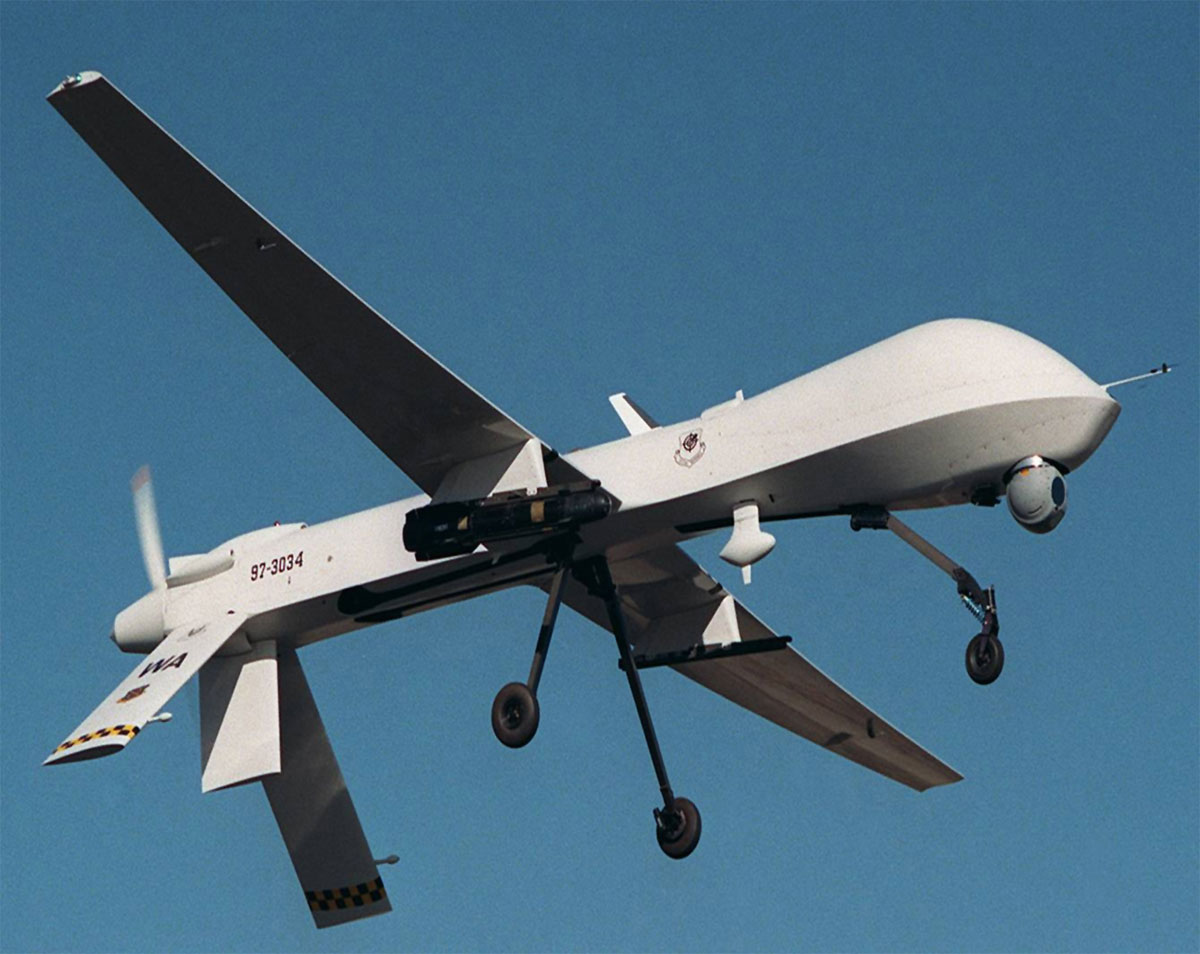
GENEVA: The United Nations called on all states on Friday to ensure that the use of armed drones complies with international law, backing a proposal from Pakistan seen as taking aim at the United States.

A resolution presented by Pakistan on behalf of co-sponsors including Yemen and Switzerland did not single out any state. The United States is the biggest drone user in conflicts including those in Pakistan, Yemen, Afghanistan and Somalia.

“The purpose of this resolution is not to shame or name anyone, as we are against this approach,” Pakistan's ambassador Zamir Akram told the UN Human Rights Council.

“It is about supporting a principle.”

The United States prizes drones for their accuracy against al Qaeda and Taliban militants. Pakistan says they kill civilians and infringe its sovereignty.

“The United States is committed to ensuring that our actions, including those involving remotely piloted aircraft, are undertaken in accordance with all applicable domestic and international laws and with the greatest possible transparency, consistent with our national security needs,” Paula Schriefer, US deputy assistant secretary of state, told the talks.

The resolution was adopted by a vote of 27 states in favour to six against, with 14 abstentions at the 47-member Geneva forum. The United States, Britain and France voted against.

The Council “urges all states to ensure that any measures employed to counter terrorism, including the use of remotely piloted aircraft or armed drones, comply with their obligations under international law ... in particular the principles of precaution, distinction and proportionality.”

The text voiced concern at civilian casualties resulting from the use of remotely-piloted aircraft or armed drones, as highlighted by the UN special investigator on counter-terrorism Ben Emmerson in a recent report.

It called on UN human rights boss Navi Pillay to organise expert discussions on armed drones and report back in September.

The United States, Britain and France said it was not appropriate for the forum to put weapons systems on its agenda.

The Obama administration preferred to discuss drones under an initiative of Switzerland and the International Committee of the Red Cross, which it hoped would provide a “non-politicised forum” where military experts can discuss law of war issues, Schriefer said.

Akram, speaking before the vote, said opposition “can only lead to the conclusion that these states are guilty of violating applicable international law and demonstrate that they are afraid of being exposed in the expert panel.”

A separate UN human rights watchdog called on the Obama administration on Thursday to limit its use of drones and to curb US surveillance activities.


Wednesday, December 11, 2013

Wednesday, October 30, 2013

Given that only five lawmakers turned up for this briefing will send a loud message to the people in Pakistan, Yemen and Somalia stating 'America Does Not Care'.

Despite being heralded as the first time in history that U.S. lawmakers would hear directly from the survivors of a U.S. drone strike, only five elected officials chose to attend the congressional briefing that took place Tuesday.

Pakistani schoolteacher Rafiq ur Rehman and his two children—9 year-old daughter Nabila and 13 year-old son Zubair—came to Washington, DC to give their account of a U.S. drone attack that killed Rafiq's mother, Momina Bibi, and injured the two children in the remote tribal region of North Waziristan last October.

According to journalist Anjali Kamat, who was present and tweeting live during the hearing, the only lawmakers to attend the briefing organized by Rep. Alan Grayson (D-Fla.), were Rep. John Conyers (D-Mich.), Rep. Jan Schakowsky (D-Ill.), Rep. Rush Holt (D-NJ) and Rep. Rick Nolan (D-Minn.).

Before the handful of reporters and scant lawmakers, however, Rafiq and his children gave dramatic testimony which reportedly caused the translator to break down into tears.

In her testimony, Nabila shared that she was picking okra with her grandmother when the U.S. missile struck and both children described how they used to play outside but are now too afraid.

"I no longer love blue skies. In fact, I now prefer grey skies. Drones don't fly when sky is grey," said Zubair, whose leg was injured by shrapnel during the strike.

“My grandmother was nobody’s enemy," he added.

"Nobody has ever told me why my mother was targeted that day," Rafiq wrote in an open letter to President Barack Obama last week. "The media reported that the attack was on a car, but there is no road alongside my mother's house. Several reported the attack was on a house. But the missiles hit a nearby field, not a house. All reported that five militants were killed. Only one person was killed – a 65-year-old grandmother of nine."

"But the United States and its citizens probably do not know this," Rafiq continued. "No one ever asked us who was killed or injured that day. Not the United States or my own government. Nobody has come to investigate nor has anyone been held accountable."

He concluded, "Quite simply, nobody seems to care."

You can watch a recording of the briefing below and here:

The purpose of the briefing, Grayson told the Guardian, is "simply to get people to start to think through the implications of killing hundreds of people ordered by the president, or worse, unelected and unidentifiable bureaucrats within the Department of Defense without any declaration of war."

The family was joined by their legal representative Jennifer Gibson of the UK human rights organization Reprieve. Their Islamabad-based lawyer, Shahzad Akbar, was also supposed to be present but was denied a visa by the US authorities—"a recurring problem," according to Reprieve, "since he began representing civilian victims of drone strikes in 2011."

"The onus is now on President Obama and his Administration to bring this war out of the shadows and to give answers," said Gibson.

Also present was U.S. filmmaker Robert Greenwald, who first met Rafiq when he traveled to Pakistan to interview the drone strike victims for his documentaryUnmanned: America's Drone Wars. Before the briefing, Greenwald told the Guardian that he hoped the briefing "will begin the process of demanding investigation. Innocent people are being killed." More