Showing posts with label counterinsurgency. Show all posts

Friday, March 28, 2014

UN backs resolution presented by Pakistan on drones

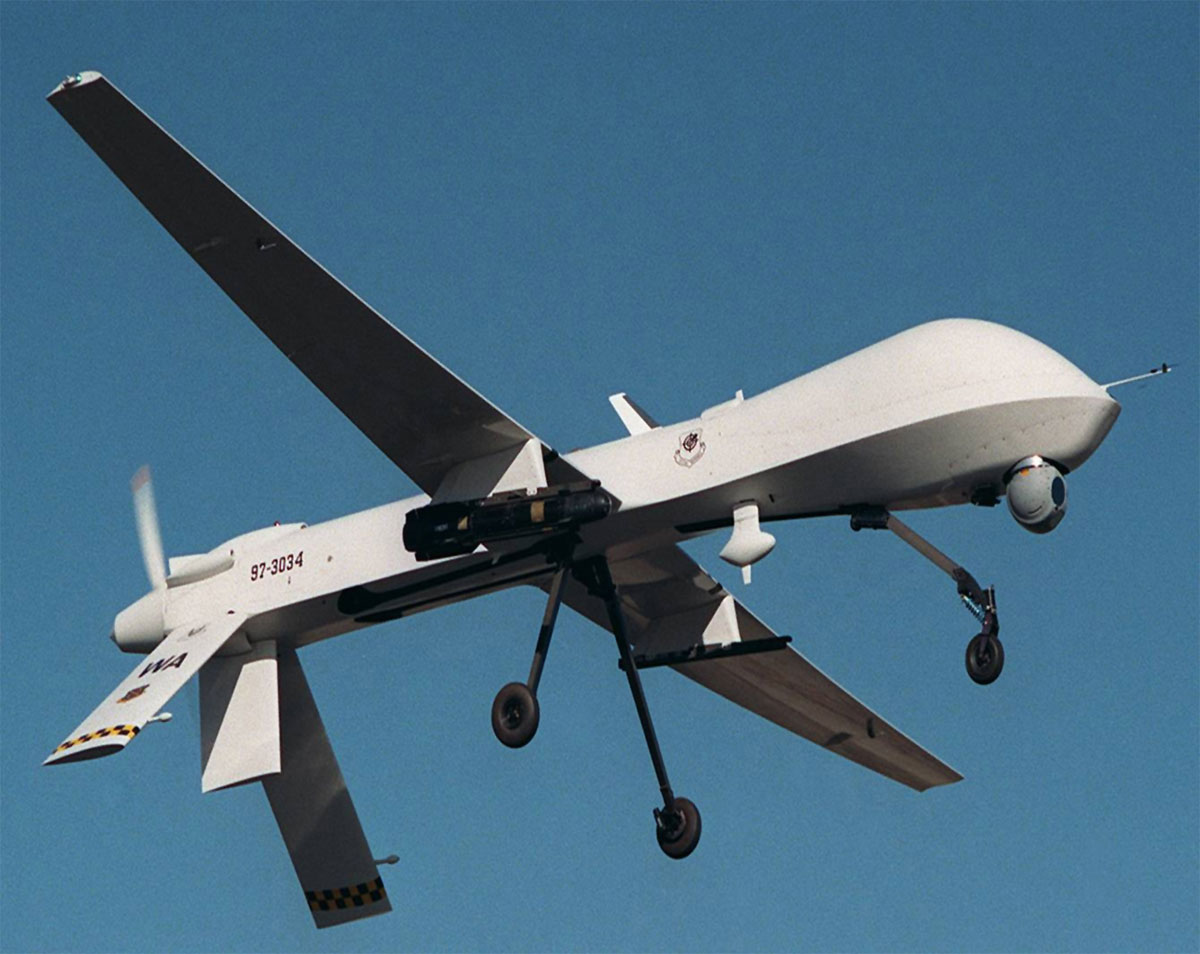
GENEVA: The United Nations called on all states on Friday to ensure that the use of armed drones complies with international law, backing a proposal from Pakistan seen as taking aim at the United States.

A resolution presented by Pakistan on behalf of co-sponsors including Yemen and Switzerland did not single out any state. The United States is the biggest drone user in conflicts including those in Pakistan, Yemen, Afghanistan and Somalia.

“The purpose of this resolution is not to shame or name anyone, as we are against this approach,” Pakistan's ambassador Zamir Akram told the UN Human Rights Council.

“It is about supporting a principle.”

The United States prizes drones for their accuracy against al Qaeda and Taliban militants. Pakistan says they kill civilians and infringe its sovereignty.

“The United States is committed to ensuring that our actions, including those involving remotely piloted aircraft, are undertaken in accordance with all applicable domestic and international laws and with the greatest possible transparency, consistent with our national security needs,” Paula Schriefer, US deputy assistant secretary of state, told the talks.

The resolution was adopted by a vote of 27 states in favour to six against, with 14 abstentions at the 47-member Geneva forum. The United States, Britain and France voted against.

The Council “urges all states to ensure that any measures employed to counter terrorism, including the use of remotely piloted aircraft or armed drones, comply with their obligations under international law ... in particular the principles of precaution, distinction and proportionality.”

The text voiced concern at civilian casualties resulting from the use of remotely-piloted aircraft or armed drones, as highlighted by the UN special investigator on counter-terrorism Ben Emmerson in a recent report.

It called on UN human rights boss Navi Pillay to organise expert discussions on armed drones and report back in September.

The United States, Britain and France said it was not appropriate for the forum to put weapons systems on its agenda.

The Obama administration preferred to discuss drones under an initiative of Switzerland and the International Committee of the Red Cross, which it hoped would provide a “non-politicised forum” where military experts can discuss law of war issues, Schriefer said.

Akram, speaking before the vote, said opposition “can only lead to the conclusion that these states are guilty of violating applicable international law and demonstrate that they are afraid of being exposed in the expert panel.”

A separate UN human rights watchdog called on the Obama administration on Thursday to limit its use of drones and to curb US surveillance activities.


Thursday, January 9, 2014

NSA Insiders reveal what went wrong.

In a memo to President Obama, former National Security Agency insiders William Binney, Thomas Drake, Edward Loomis and J. Kirk Wiebe explain how NSA leaders botched intelligence collection and analysis before 9/11, covered up the mistakes, and violated the constitutional rights of the American people, all while wasting billions of dollars and misleading the public.

January 7, 2014

MEMORANDUM FOR: The President

FROM: Former NSA Senior Executives/Veteran Intelligence Professionals for Sanity (VIPS)

SUBJECT: Input for Your Decisions on NSA

EXECUTIVE SUMMARY

Official Washington – from Senate Intelligence Committee chair Dianne Feinstein to NSA Director Keith Alexander to former Vice President Dick Cheney to former FBI Director Robert Mueller – has been speaking from the same set of NSA talking points acquired recently via a Freedom of Information request. It is an artful list, much of it designed to mislead. Take this one, for example:

– NSA AND ITS PARTNERS MUST MAKE SURE WE CONNECT THE DOTS SO THAT THE NATION IS NEVER ATTACKED AGAIN LIKE I WAS ON 9/11

At a hearing of the Senate Judiciary Committee on October 2, Senator Feinstein showed her hand when she said: “I will do everything I can to prevent this [NSA’s bulk] program from being canceled.” Declaring that 9/11 “can never be allowed to happen in the United States of America again,” Feinstein claimed that intelligence officials did not have enough information to prevent the terrorist attacks.

Mr. President, we trust you are aware that the lack-of-enough-intelligence argument is dead wrong. Feinstein’s next dubious premise – that bulk collection is needed to prevent another 9/11 – is unproven and highly unlikely (not to mention its implications for the privacy protections of the Fourth Amendment).

Given the closed circle surrounding you, we are allowing for the possibility that the smell from these rotting red herrings has not yet reached you – even though your own Review Group has found, for example, that NSA’s bulk collection has thwarted exactly zero terrorist plots.

The sadder reality, Mr. President, is that NSA itself had enough information to prevent 9/11, but chose to sit on it rather than share it with the FBI or CIA. We know; we were there. We were witness to the many bureaucratic indignities that made NSA at least as culpable for pre-9/11 failures as are other U.S. intelligence agencies.

We prepared this Memorandum in an effort to ensure that you have a fuller picture as you grapple with what to do about NSA. What follows is just the tip of an iceberg of essential background information – much of it hidden until now – that goes to the core of serious issues now front and center.

The drafting process sparked lively discussion of the relative merits of your Review Group’s recommendations. We have developed very specific comments on those recommendations. We look forward to an opportunity to bring them to your attention.

_________

Introduction

We write you with a sense of urgency looking toward your upcoming decisions regarding the activities of the National Security Agency. We the undersigned (William Binney, Thomas Drake, Edward Loomis, and Kirk Wiebe) worked with NSA for a total of 144 years, most of them at senior levels. Our mission required the highest technical skills to keep the country safe from foreign enemies, while protecting the privacy rights of U.S. citizens under the Fourth Amendment to the U.S. Constitution.

For us, the 21st Century arrived with serious management and technical shortcomings at NSA in meeting the huge challenges posed by the digital and Internet age and the huge problems accompanying the transition from a Cold War footing over 40 years to an increasingly complex world with many asymmetric threats.

NSA management’s reaction in this environment not only opened the door to the attacks of 9/11 but led to violation of what had been the “First Commandment” at NSA; namely, “Thou Shalt Not Eavesdrop on Americans Without a Court Warrant.” Under the circumstances, three of us (Binney, Loomis, and Wiebe) left; Drake had just come on board in hopes of playing a constructive role in addressing the challenges at NSA.

We all share an acute sense of regret for NSA’s demonstrable culpability for what happened on 9/11, and – for those of us working there before the terrorist attacks – a remorse for not having been able to stop them. We tried; but it is hard to escape a nagging regret that, somehow, we should have tried harder.

We were there; we know what happened. And we know how what happened has been successfully covered up – until now. Calamities like this tend to happen again if there is no accountability for what happened before. You need the unvarnished truth. The flood of revelations now in the public domain frees us to address facts and events formerly hidden behind a convenient, cover-up classification regime. We feel bound by the solemn oath we took to support and defend the Constitution of the United States against all enemies, foreign and domestic, to make truths known to you that you may find as unconscionable as we do.

Why do we still care? Because we have consciences; because the oath we took has no expiration date; because we know – as few others do – how critically important it is for our country to have a well functioning, Constitution-abiding National Security Agency; and because we know how that ship can be steered back on course at that important place of work by improving its ability to find terrorists and other criminals in massive amounts of data, while protecting the right to privacy and citizen sovereignty.

Getting in the Door

It comes to us as no surprise that there is strong resistance on the part of the Establishment when it comes to giving us a hearing – a shunning of the very people who know what happened and how to take steps to prevent it from happening again.

Our predicament calls to mind that of our colleague veteran intelligence professionals, who were ignored by Official Washington and an obsequious media, when we knew that fraudulent (not mistaken) intelligence was being used to “justify” the launching of an aggressive war on Iraq 11 years ago. Establishment Washington barred the doors in 2002-2003. Just five years later our own clearances were taken away.

Now, once again the voices of seasoned intelligence professionals are being muted, in favor of a closed group of officials with huge incentive to cover up their failure to keep America safe and their playing fast and loose with the Fourth Amendment.

Mr. President, we have given up hope that your palace guard will let us in. Our chances of reaching you seem far better via this Memorandum, the 28th of its kind issued since early 2003, prepared at the behest of the Steering Group of our Veteran Intelligence Professionals for Sanity (VIPS). If this gets past your in-box protectors, we encourage you to pay more heed to it than your predecessor did to VIPS’ warnings in the months before the attack on Iraq.

In one limited sense, we are better off than our colleagues 11 years ago. This time, mainstream media have been unable to ignore the documentary evidence of rank dishonesty on the part of senior NSA and other intelligence officials. This time the media has come to us, seeking our views. This time we can comment rather freely on matters that until now were hidden under TOP SECRET stamps.

On December 26, for example, The Wall Street Journal published a lengthy front-page article, quoting NSA’s former Senior Technical Director William Binney (undersigned) and former chief of NSA’s SIGINT Automation Research Center Edward Loomis (undersigned) warning that NSA is drowning in useless data lacking adequate privacy provisions, to the point where it cannot conduct effective terrorist-related surveillance and analysis.

A recently disclosed internal NSA briefing document corroborates the drowning, with the embarrassing admission, in bureaucratize, that NSA collection has been “outpacing” NSA’s ability to ingest, process, and store data – let alone analyze the take.

54 Now Down to Zero ‘Thwarts’

It is not difficult to connect NSA’s collect-everything approach with one principal finding of the Review Group you appointed to look into NSA programs; namely, that exactly zero terrorist plots have been prevented by NSA’s bulk trawling for telephone call records. One Review Group member, your former Chicago law professor colleague, Geoffrey Stone, has confessed to being “absolutely” surprised at the group’s finding of zero. Clearly, the statements of top NSA officials left Stone wholly unprepared for the truth. More


Monday, April 15, 2013

The Enemy-Industrial Complex By Tom Engelhardt

How to Turn a World Lacking in Enemies into the Most Threatening Place in the Universe

Tom Engelhardt

The communist enemy, with the “world’s fourth largest military,” has been trundling missiles around and threatening the United States with nuclear obliteration. Guam, Hawaii,Washington: all, it claims, are targetable. The coverage in the media has been hair-raising. The U.S. is rushing an untested missile defense system to Guam, deploying missile-interceptor ships off the South Korean coast, sending “nuclear capable” B-2 Stealth bombers thousands of miles on mock bombing runs, pressuring China, and conducting large-scale war games with its South Korean ally.

Only one small problem: there is as yet little evidence that the enemy with a few nuclear weapons facing off (rhetorically at least) against an American arsenal of 4,650 of them has the ability to miniaturize and mount even one on a missile, no less deliver it accurately, nor does it have a missile capable of reaching Hawaii or Washington, and I wouldn't count on Guam either.

It also happens to be a desperate country, one possibly without enough fuel to fly a modern air force, whose people, on average, are inches shorter than their southern neighbors thanks to decades of intermittent famine and malnutrition, and who are ruled by a bizarre three-generational family cult. If that other communist, Karl Marx, hadn’t once famously written that history repeats itself “first as tragedy, then as farce,” we would have had to invent the phrase for this very moment.

In the previous century, there were two devastating global wars, which left significant parts of the planet in ruins. There was also a "cold war" between two superpowers locked in a system of mutual assured destruction (aptly acronymed as MAD) whose nuclear arsenals were capable of destroying the planet many times over. Had you woken up any morning in the years between December 7, 1941, and December 26, 1991, and been told that the leading international candidate for America's Public Enemy Number One was Kim Jong-un’s ramshackle, comic-opera regime in North Korea, you might have gotten down on your hands and knees and sent thanks to pagan gods.

The same would be true for the other candidates for that number one position since September 11, 2001: the original al-Qaeda (largely decimated), al-Qaeda in the Arabian Peninsula located in poverty-stricken areas of poverty-stricken Yemen, the Taliban in poverty-stricken Afghanistan, unnamed jihadis scattered across poverty-stricken areas of North Africa, or Iran, another rickety regional power run by not particularly adept theocrats.

All these years, we’ve been launching wars and pursuing a “global war on terror." We’ve poured money into national security as if there were no tomorrow. From our police to our borders, we’ve up-armored everywhere. We constantly hear about “threats” to us and to the “homeland.” And yet, when you knock on the door marked “Enemy,” there’s seldom anyone home.

Few in this country have found this striking. Few seem to notice any disjuncture between the enemy-ridden, threatening, and deeply dangerous world we have been preparing ourselves for (and fighting in) this last decade-plus and the world as it actually is, even those who lived through significant parts of the last anxiety-producing, bloody century.

You know that feeling when you wake up and realize you’ve had the same recurrent nightmare yet again? Sometimes, there’s an equivalent in waking life, and here’s mine: every now and then, as I read about the next move in the spreading war on terror, the next drone assassination, the next ratcheting up of the surveillance game, the next expansion of the secrecy that envelops our government, the next set of expensive actions taken to guard us -- all of this justified by the enormous threats and dangers that we face -- I think to myself: Where’s the enemy? And then I wonder: Just what kind of a dream is this that we’re dreaming?

A Door Marked “Enemy” and No One Home

Let’s admit it: enemies can have their uses. And let’s admit as well that it’s in the interest of some in our country that we be seen as surrounded by constant and imminent dangers on an enemy-filled planet. Let’s also admit that the world is and always will be a dangerous place in all sorts of ways.

Still, in American terms, the bloodlettings, the devastations of this new century and the last years of the previous one have been remarkably minimal or distant; some of the worst, as in the multi-country war over the Congo with its more than five million dead have passed us by entirely; some, even when we launched them, have essentially been imperial frontier conflicts, as in Iraq and Afghanistan, or interventions of little cost (to us) as in Libya, or frontier patrolling operations as in Pakistan, Yemen, Somalia, and Northern Africa. (It was no mistake that, when Washington launched its special operations raid on Abbottabad, Pakistan, to get Osama bin Laden, it was given the code name “Geronimo” and the message from the SEAL team recording his death was “Geronimo-E KIA” or “enemy killed in action.”)

And let’s admit as well that, in the wake of those wars and operations, Americans now have more enemies, more angry, embittered people who would like to do us harm than on September 10, 2001. Let’s accept that somewhere out there are people who, as George W. Bush once liked to say, “hate us" and what we stand for. (I leave just what we actually stand for to you, for the moment.)

So let’s consider those enemies briefly. Is there a major state, for instance, that falls into this category, like any of the great warring imperial European powers from the sixteenth century on, or Nazi Germany and Imperial Japan in World War II, or the Soviet Union of the Cold War era? Of course not.

There was admittedly a period when, in order to pump up what we faced in the world, analogies to World War II and the Cold War were rife. There was, for instance, George W. Bush’s famed rhetorical construct, the Axis of Evil (Iraq, Iran, and North Korea), patterned by his speechwriter on the German-Italian-Japanese “axis” of World War II. It was, of course, a joke construct, if reality was your yardstick. Iraq and Iran were then enemies. (Only in the wake of the U.S. invasion and occupation of Iraq have they become friends and allies.) And North Korea had nothing whatsoever to do with either of them. Similarly, the American occupation of Iraq was once regularly compared to the U.S. occupations of Germany and Japan, just as Saddam Hussein had long been presented as a modern Hitler.

In addition, al-Qaeda-style Islamists were regularly referred to as Islamofascists, while certain military and neocon types with a desire to turn the war on terror into a successor to the Cold War took to calling it “the long war,” or even “World War IV.” But all of this was so wildly out of whack that it simply faded away.

As for who’s behind that door marked “Enemy,” if you opened it, what would you find? As a start, scattered hundreds or, as the years have gone by, thousands of jihadis, mostly in the poorest backlands of the planet and with little ability to do anything to the United States. Next, there were a few minority insurgencies, including the Taliban and allied forces in Afghanistan and separate Sunni and Shia ones in Iraq. There also have been tiny numbers ofwannabe Islamic terrorists in the U.S. (once you take away the string of FBI sting operations that have regularly turned hopeless slackers and lost teenagers into the most dangerous of fantasy Muslim plotters). And then, of course, there are those two relatively hapless regional powers, Iran and North Korea, whose bark far exceeds their potential bite.

The Wizard of Oz on 9/11

The U.S., in other words, is probably in less danger from external enemies than at any moment in the last century. There is no other imperial power on the planet capable of, or desirous of, taking on American power directly, including China. It’s true that, on September 11, 2001, 19 hijackers with box cutters produced a remarkable, apocalyptic, and devastating TV show in which almost 3,000 people died. When those giant towers in downtown New York collapsed, it certainly had the look of nuclear disaster (and in those first days, the media was filled was nuclear-style references), but it wasn’t actually an apocalyptic event. More

 

Wednesday, December 26, 2012

Obama and the Kurdish Question: Drones Are Not the Answer

The role of the Obama administration in suppressing the long-running Kurdish uprising in Turkey is largely unknown.

But a few weeks ago a U.S. diplomat dropped an intriguing clue. Francis J. Ricciardone, Jr., Obama's ambassador to Turkey, revealed that the U.S. had secretly offered Turkey what was, in effect, a bin Laden-style assassination of the top leadership of the PKK (Kurdistan Workers Party), the rebels who have been fighting the U.S.-equipped Turkish army since 1984.

"Your enemies are our enemies," Ricciardone told Turkish reporters at a news conference in Ankara. "The power of the multidisciplinary approach is what got bin Laden in the end, and we would like to share that and exploit that intimately."

When I heard the ambassador's remarks, I had just left Syria, where a different Kurdish group is struggling for its own autonomy. I was en route at the time to Mt. Qandhil, one of the highest mountains in neighboring Iraq, where PKK rebels have a sanctuary. I was seeking reaction to news that Turkey was quietly negotiating with Abdullah Ocalan, the notorious PKK founder who was captured in 1999 with U.S. assistance, and who since then, has become a cause célèbre with many Kurds in the Middle East.

The 28-year-old Kurdish uprising in Turkey has resulted in 40,000 deaths, most of them Kurds. The U.S. considers the PKK a terrorist group, but experts say both the rebels and Turkish troops have committed human rights abuses. Today, the struggle goes beyond military conflict. Since 2009, some 8,000 Kurdish civilians have been arrested in Turkey. That includes lawyers and at least 100 journalists -- more than in Iran or China.

This fall, some 700-1,000 prisoners went on hunger strike in Turkey, demanding that Ocalan be removed from solitary confinement and that Kurds receive broadcasting rights, education in their native tongue and ethnic recognition in the Turkish constitution. Turkey claims that most of the prisoners have ties to the PKK, but according to Human Rights Watch, many Kurds were arrested in a "crackdown on legal pro-Kurdish politics."

Against this backdrop came Ambassador Ricciardone's startling disclosure: the administration's misguided proposal to target the Kurdish rebel leadership. In fact, the PKK is not al-Qaeda, nor has it targeted Americans -- and Turkey wisely rejected the U.S. offer. "Bin Laden was caught in a house," Prime Minister Tayyip Erdogan sought to explain diplomatically, "but the struggle here is in mountainous geography."

After rebuffing the assassination proposal, Turkey successfully negotiated an end to the vexing hunger strike, which had garnered considerable support in southeast Turkey, where most of the country's 15 million Kurds reside. Had the cockamamie scheme succeeded, the killings would likely have turned Kurdish public opinion against the U.S. and given the rebels a powerful recruiting tool. More


Tuesday, November 13, 2012

General David Petraeus's fatal flaw: not the affair, but his Afghanistan surge

More than three years ago, I sat in an overflow room in Washington, DC's Willard Hotel listening to General David Petraeus explain (pdf) how the only solution for the failing war in Afghanistan was a "comprehensive counterinsurgency (COIN) strategy", modeled after the one that had allegedly achieved so much success in Iraq.

Petraeus handing over to Allen
Petraeus's speech came at the annual meeting of the Center for New American Security, a DC-based thinktank that had become a locus of COIN thinking in DC. And Petraeus was at the peak of his power and acclaim – heralded by both Democrats and Republicans as the man responsible for saving the Iraq war.

The four-star general's in-depth powerpoint presentation (pdf), with its discussion of securing and serving the population, "understanding local circumstances" separating irreconcilables from reconcilables and living "among the people" was the apogee of COIN thinking, which dominated national security debates in Washington in 2008 and 2009. But, like Petraeus's career, COIN and its usefulness as a tool for US militaryplanners now lies in tatters.

With last week's revelations that Petraeus was having an affair as director of the CIA with his biographer Paula Broadwell, this tawdry story is likely to become the most glaring black mark on Petraeus's career. But while his behavior was reckless, arrogant and, frankly, just plain stupid, it's ironic that Petraeus is likely to be remembered more for that one personal act rather than his most grave professional mistake – namely, that same counter-insurgency strategy in Afghanistan for which he was one of Washington's most influential proponents.

The event at CNAS was the quintessential example of the blinders and hubris that were so pervasive among COIN boosters and, in particular, Petraeus. They were convinced that the surge in Iraq and the use of counterinsurgency tactics there had turned the tide. But as we know now – and should have even been aware then – the reality was far more complicated. More