Showing posts with label Iraq. Show all posts

Saturday, December 19, 2015

HOW ROGUE TECHIES ARMED THE PREDATOR, ALMOST STOPPED 9/11, AND ACCIDENTALLY INVENTED REMOTE WAR

ON THE AFTERNOON of October 7, 2001, the first day of the war in Afghanistan, an Air Force pilot named Scott Swanson made history while sitting in a captain’s chair designed for an RV. His contribution to posterity was to kill someone in a completely novel way.

In the moments leading up to the act, Swanson was nervous. He sat in a darkened trailer tucked behind a parking garage at CIA headquarters in Langley, Virginia, remotely piloting a Predator drone over Kandahar, 6,900 miles away. Nearly everything about his rig had been cobbled together and hastily assembled. The Predator itself, one of just a handful in existence, was flying about 250 pounds heavier than usual. And the satellite communications link that connected Swanson to the aircraft would periodically shut down due to a power issue, which software engineers in California were frantically trying to patch.

When the order came through to take the shot, Swanson pulled a trigger on his joystick. A little more than a second later, a Hellfire missile slid off an aluminum rail on the Predator’s wing and sailed into the Afghan night.

Swanson’s target was a pickup truck parked outside a compound thought to be hiding Mullah Omar, the supreme commander of the Taliban. The missile killed two unidentified men believed to have been his bodyguards. It was the first time a US drone had fired a weapon in combat. It was the first time a modern drone had ever killed a human being. More


Wednesday, February 25, 2015

ISIS Is Proof of the Failed "War on Terror"

Today al-Qaeda-type movements rule a vast area in northern and western Iraq and eastern and northern Syria, several hundred times larger than any territory ever controlled by Osama bin Laden.
It is since bin Laden’s death that al-Qaeda affiliates or clones have had their greatest successes, including the capture of Raqqa in the eastern part of Syria, the only provincial capital in that country to fall to the rebels, in March 2013. In January 2014, ISIS took over Fallujah just forty miles west of Baghdad, a city famously besieged and stormed by US Marines ten years earlier. Within a few months they had also captured Mosul and Tikrit. The battle lines may continue to change, but the overall expansion of their power will be difficult to reverse. With their swift and multipronged assault across central and northern Iraq in June 2014, the ISIS militants had superseded al-Qaeda as the most powerful and effective jihadi group in the world.

These developments came as a shock to many in the West, including politicians and specialists whose view of what was happening often seemed outpaced by events. One reason for this was that it was too risky for journalists and outside observers to visit the areas where ISIS was operating, because of the extreme danger of being kidnapped or murdered. "Those who used to protect the foreign media can no longer protect themselves," one intrepid correspondent told me, explaining why he would not be returning to rebel-held Syria.

This lack of coverage had been convenient for the US and other Western governments because it enabled them to play down the extent to which the "war on terror" had failed so catastrophically in the years since 9/11. This failure is also masked by deceptions and self-deceptions on the part of governments. Speaking at West Point on America’s role in the world on May 28, 2014, President Obama said that the main threat to the US no longer came from al-Qaeda central but from "decentralized al-Qaeda affiliates and extremists, many with agendas focused on the countries where they operate." He added that "as the Syrian civil war spills across borders, the capacity of battle-hardened extremist groups to come after us only increases." This was true enough, but Obama’s solution to the danger was, as he put it, "to ramp up support for those in the Syrian opposition who offer the best alternative to terrorists." By June he was asking Congress for $500 million to train and equip "appropriately vetted" members of the Syrian opposition. It is here that there was a real intention to deceive, because, as Biden was to admit five months later, the Syrian military opposition is dominated by ISIS and by Jabhat al-Nusra, the official al-Qaeda representative, in addition to other extreme jihadi groups. In reality, there is no dividing wall between them and America’s supposedly moderate opposition allies.

An intelligence officer from a Middle Eastern country neighboring Syria told me that ISIS members "say they are always pleased when sophisticated weapons are sent to anti-Assad groups of any kind, because they can always get the arms off them by threats of force or cash payments." These are not empty boasts. Arms supplied by US allies such as Saudi Arabia and Qatar to anti-Assad forces in Syria have been captured regularly in Iraq. I experienced a small example of the consequences of this inflow of weapons even before the fall of Mosul, when, in the summer of 2014, I tried to book a flight to Baghdad on the same efficient European airline that I had used a year earlier. I was told it had discontinued flights to the Iraqi capital, because it feared that insurgents had obtained shoulder-held anti-aircraft missiles originally supplied to anti-Assad forces in Syria and would use them against commercial aircraft flying into Baghdad International Airport. Western support for the Syrian opposition may have failed to overthrow Assad, but it has been successful in destabilizing Iraq, as Iraqi politicians had long predicted.

The failure of the "war on terror" and the resurgence of al-Qaeda is further explained by a phenomenon which had become apparent within hours of the 9/11 attacks. The first moves from Washington made it clear that the anti-terror war would be waged without any confrontation with Saudi Arabia or Pakistan, two close US allies, despite the fact that without the involvement of these two countries 9/11 was unlikely to have happened. Of the nineteen hijackers that day, fifteen were Saudi. Bin Laden came from the Saudi elite. Subsequent US official documents stress repeatedly that financing for al-Qaeda and jihadi groups came from Saudi Arabia and the Gulf monarchies. As for Pakistan, its army and military service had played a central role since the early 1990s in propelling the Taliban into power in Afghanistan where they hosted bin Laden and al-Qaeda. After a brief hiatus during and after 9/11, Pakistan resumed its support for the Afghan Taliban. Speaking of the central role of Pakistan in backing the Taliban, the late Richard C. Holbrooke, US special representative to Afghanistan and Pakistan, said: "We may be fighting the wrong enemy in the wrong country."

The importance of Saudi Arabia in the rise and return of al-Qaeda is often misunderstood and understated. Saudi Arabia is influential because its oil and vast wealth make it powerful in the Middle East and beyond. But it is not financial resources alone that make it such an important player. Another factor is its propagating of Wahhabism, the fundamentalist, eighteenth-century version of Islam that imposes sharia law, relegates women to the status of second-class citizens, and regards Shia and Sufi Muslims as non-Muslims to be persecuted along with Christians and Jews.

This religious intolerance and political authoritarianism, which in its readiness to use violence has many similarities with European fascism in the 1930s, is getting worse rather than better. For example, in recent years, a Saudi who set up a liberal website on which clerics could be criticized was sentenced to a thousand lashes and seven years in prison. The ideology of al-Qaeda and ISIS draws a great deal from Wahhabism. Critics of this new trend in Islam from elsewhere in the Muslim world do not survive long; they are forced to flee or are murdered. Denouncing jihadi leaders in Kabul in 2003, an Afghan editor described them as "holy fascists" who were misusing Islam as "an instrument to take over power." Unsurprisingly, he was accused of insulting Islam and had to leave the country.

A striking development in the Islamic world in recent decades is the way in which Wahhabism is taking over mainstream Sunni Islam. In one country after another Saudi Arabia is putting up the money for the training of preachers and the building of mosques. A result of this is the spread of sectarian strife between Sunni and Shia. The latter find themselves targeted with unprecedented viciousness, from Tunisia to Indonesia. Such sectarianism is not confined to country villages outside Aleppo or in the Punjab; it is poisoning relations between the two sects in every Islamic grouping. A Muslim friend in London told me: "Go through the address books of any Sunni or Shia in Britain and you will find very few names belonging to people outside their own community."

Even before Mosul, President Obama was coming to realize that al-Qaeda–type groups were far stronger than they had been previously, but his recipe for dealing with them repeats and exacerbates earlier mistakes. "We need partners to fight terrorists alongside us," he told his audience at West Point. But who are these partners going to be? Saudi Arabia and Qatar were not mentioned by him, since they remain close and active US allies in Syria. Obama instead singled out "Jordan and Lebanon, Turkey and Iraq" as partners to receive aid in "confronting terrorists working across Syria’s borders."

There is something absurd about this, since the foreign jihadis in Syria and Iraq, the people whom Obama admits are the greatest threat, can only get to these countries because they are able to cross the 510-mile-long Turkish-Syrian border without hindrance from the Turkish authorities. Saudi Arabia, Turkey, and Jordan may now be frightened by the Frankenstein’s monster they have helped to create, but there is little they can do to restrain it. An unspoken purpose of the US insistence that Saudi Arabia, UAE, Qatar, and Bahrain take part or assist in the air strikes on Syria in September was to force them to break their former links with the jihadis in Syria.

There was always something fantastical about the US and its Western allies teaming up with the theocratic Sunni absolute monarchies of Saudi Arabia and the Gulf to spread democracy and enhance human rights in Syria, Iraq, and Libya. The US was a weaker power in the Middle East in 2011 than it had been in 2003, because its armies had failed to achieve their aims in Iraq and Afghanistan. Come the uprisings of 2011, it was the jihadi and Sunni-sectarian, militarized wing of rebel movements that received massive injections of money from the kings and emirs of the Gulf. The secular, nonsectarian opponents of the long-established police states were soon marginalized, reduced to silence, or killed. The international media was very slow to pick up on how the nature of these uprisings had changed, though the Islamists were very open about their sectarian priorities: in Libya, one of the first acts of the triumphant rebels was to call for the legalization of polygamy, which had been banned under the old regime.

ISIS is the child of war. Its members seek to reshape the world around them by acts of violence. The movement’s toxic but potent mix of extreme religious beliefs and military skill is the outcome of the war in Iraq since the US invasion of 2003 and the war in Syria since 2011. Just as the violence in Iraq was ebbing, the war was revived by the Sunni Arabs in Syria. It is the government and media consensus in the West that the civil war in Iraq was reignited by the sectarian policies of Iraqi prime minister Nouri al-Maliki in Baghdad. In reality, it was the war in Syria that destabilized Iraq when jihadi groups like ISIS, then called al-Qaeda in Iraq, found a new battlefield where they could fight and flourish.

It was the US, Europe, and their regional allies in Turkey, Saudi Arabia, Qatar, Kuwait, and United Arab Emirates that created the conditions for the rise of ISIS. They kept the war going in Syria, though it was obvious from 2012 that Assad would not fall. He never controlled less than thirteen out of fourteen Syrian provincial capitals and was backed by Russia, Iran, and Hezbollah. Nevertheless, the only peace terms he was offered at the Geneva II peace talks in January 2014 was to leave power. He was not about to go, and ideal conditions were created for ISIS to prosper. The US and its allies are now trying to turn the Sunni communities in Iraq and Syria against the militants, but this will be difficult to do while these countries are convulsed by war.

The resurgence of al-Qaeda–type groups is not a threat confined to Syria, Iraq, and their near neighbors. What is happening in these countries, combined with the growing dominance of intolerant and exclusive Wahhabite beliefs within the worldwide Sunni community, means that all 1.6 billion Muslims, almost a quarter of the world’s population, will be increasingly affected. It seems unlikely that non-Muslims, including many in the West, will be untouched by the conflict. Today’s resurgent jihadism, having shifted the political terrain in Iraq and Syria, is already having far-reaching effects on global politics, with dire consequences for us all. More

The above is excerpted from Patrick Cockburn’s book, Rise of the Islamic State (Verso, 2015).


Friday, August 29, 2014

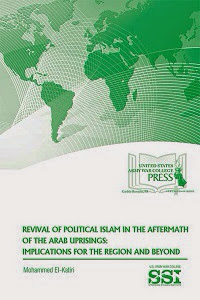
Revival of Political Islam in the Aftermath of Arab Uprisings: Implications for the Region and Beyond

Revival of Political Islam in the Aftermath of Arab Uprisings: Implications for the Region and Beyond


Authored by Dr. Mohammed El-Katiri.

Brief Synopsis

View the Executive Summary

Regime change during the Arab Spring allowed Islamist political forces that had long been marginalized to achieve political influence in Tunisia, Egypt, and Libya. Morocco’s first government led by an Islamist party has been in power since January 2012. This trend caused widespread concern over the future direction of these states; but despite the tragic example of Egypt, few negative predictions have yet been borne out. The author cautions against an overly simplistic assessment of this rise in the influence and power of political Islam. He shows that the political crises besetting each of these Islamist governments are not necessarily of their own making, but instead are determined by objective circumstances. Dr. El-Katiri describes how, in several key respects, the aims of Islamist parties are in line with U.S. aspirations for the region.

Download PDF


Friday, August 22, 2014

Tomgram: Patrick Cockburn, How to Ensure a Thriving Caliphate

Think of the new “caliphate” of the Islamic State, formerly the Islamic State in Iraq and Syria (ISIS), as George W. Bush and Dick Cheney's gift to the world (with a helping hand from the Saudis and other financiers of extremism in the Persian Gulf). How strange that they get so little credit for its rise, for the fact that the outlines of the Middle East, as set up by Europe’s colonial powers in the wake of World War I, are being swept aside in a tide of blood.

Had George and Dick not decided on their “cakewalk” in Iraq, had they not raised the specter of nuclear destruction and claimed that Saddam Hussein’s regime was somehow linked to al-Qaeda and so to the 9/11 attacks, had they not sent tens of thousands of American troops into a burning, looted Baghdad (“stuff happens”), disbanded the Iraqi army, built military bases all over that country, and generally indulged their geopolitical fantasies about dominating the oil heartlands of the planet for eternity, ISIS would have been an unlikely possibility, no matter the ethnic and religious tensions in the region. They essentially launched the drive that broke state power there and created the kind of vacuum that a movement like ISIS was so horrifically well suited to fill.

All in all, it’s a remarkable accomplishment to look back on. In September 2001, when George and Dick launched their “Global War on Terror” to wipe out -- so they then claimed -- “terrorist networks” in up to 60 countries, or as they preferred to put it, “drain the swamp,” there were scattered bands of jihadis globally, while al-Qaeda had a couple of camps in Afghanistan and a sprinkling of supporters elsewhere. Today, in the wake of the invasions of Afghanistan and Iraq and an air power intervention in Libya, after years of drone (and non-drone) bombing campaigns across the Greater Middle East, jihadist groups are thriving in Yemen and Pakistan, spreading through Africa (along with the U.S. military), and ISIS has taken significant parts of Iraq and Syria right up to the Lebanese border for its own bailiwick and is still expanding murderously, despite a renewed American bombing campaign that may only strengthen that movement in the long run.

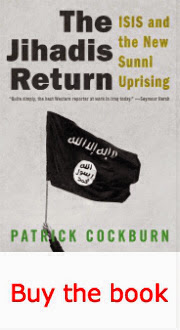
Has anyone covered this nightmare better than the world’s least embedded reporter, Patrick Cockburn of the British Independent? Not for my money. He’s had the canniest, clearest-eyed view of developments in the region for years now. As it happens, when he publishes a new book on the Middle East (the last time was 2008), he makes one of his rare appearances at TomDispatch. This month, his latest must-read work, The Jihadis Return: ISIS and the New Sunni Uprising, is out. Today, this website has an excerpt from its first chapter on why the war on terror was such a failure (and why, if Washington was insistent on invading someplace, it probably should have chosen Saudi Arabia). It includes a special introductory section written just for TomDispatch. Thanks go to his publisher, OR Books. Tom

Why Washington’s War on Terror Failed

The Underrated Saudi Connection

By Patrick Cockburn

[This essay is excerpted from the first chapter of Patrick Cockburn’s new book, The Jihadis Return: ISIS and the New Sunni Uprising, with special thanks to his publisher, OR Books. The first section is a new introduction written for TomDispatch.]

There are extraordinary elements in the present U.S. policy in Iraq and Syria that are attracting surprisingly little attention. In Iraq, the U.S. is carrying out air strikes and sending in advisers and trainers to help beat back the advance of the Islamic State of Iraq and the Levant (better known as ISIS) on the Kurdish capital, Erbil. The U.S. would presumably do the same if ISIS surrounds or attacks Baghdad. But in Syria, Washington’s policy is the exact opposite: there the main opponent of ISIS is the Syrian government and the Syrian Kurds in their northern enclaves. Both are under attack from ISIS, which has taken about a third of the country, including most of its oil and gas production facilities.

But U.S., Western European, Saudi, and Arab Gulf policy is to overthrow President Bashar al-Assad, which happens to be the policy of ISIS and other jihadis in Syria. If Assad goes, then ISIS will be the beneficiary, since it is either defeating or absorbing the rest of the Syrian armed opposition. There is a pretense in Washington and elsewhere that there exists a “moderate” Syrian opposition being helped by the U.S., Qatar, Turkey, and the Saudis. It is, however, weak and getting more so by the day. Soon the new caliphate may stretch from the Iranian border to the Mediterranean and the only force that can possibly stop this from happening is the Syrian army.

The reality of U.S. policy is to support the government of Iraq, but not Syria, against ISIS. But one reason that group has been able to grow so strong in Iraq is that it can draw on its resources and fighters in Syria. Not everything that went wrong in Iraq was the fault of Prime Minister Nouri al-Maliki, as has now become the political and media consensus in the West. Iraqi politicians have been telling me for the last two years that foreign backing for the Sunni revolt in Syria would inevitably destabilize their country as well. This has now happened.

By continuing these contradictory policies in two countries, the U.S. has ensured that ISIS can reinforce its fighters in Iraq from Syria and vice versa. So far, Washington has been successful in escaping blame for the rise of ISIS by putting all the blame on the Iraqi government. In fact, it has created a situation in which ISIS can survive and may well flourish.

Using the al-Qa'ida Label

The sharp increase in the strength and reach of jihadist organizations in Syria and Iraq has generally been unacknowledged until recently by politicians and media in the West. A primary reason for this is that Western governments and their security forces narrowly define the jihadist threat as those forces directly controlled by al-Qa‘ida central or “core” al-Qa‘ida. This enables them to present a much more cheerful picture of their successes in the so-called war on terror than the situation on the ground warrants.

In fact, the idea that the only jihadis to be worried about are those with the official blessing of al-Qa‘ida is naïve and self-deceiving. It ignores the fact, for instance, that ISIS has been criticized by the al-Qa‘ida leader Ayman al-Zawahiri for its excessive violence and sectarianism. After talking to a range of Syrian jihadi rebels not directly affiliated with al-Qa‘ida in southeast Turkey earlier this year, a source told me that “without exception they all expressed enthusiasm for the 9/11 attacks and hoped the same thing would happen in Europe as well as the U.S.”

Jihadi groups ideologically close to al-Qa‘ida have been relabeled as moderate if their actions are deemed supportive of U.S. policy aims. In Syria, the Americans backed a plan by Saudi Arabia to build up a “Southern Front” based in Jordan that would be hostile to the Assad government in Damascus, and simultaneously hostile to al-Qa‘ida-type rebels in the north and east. The powerful but supposedly moderate Yarmouk Brigade, reportedly the planned recipient of anti-aircraft missiles from Saudi Arabia, was intended to be the leading element in this new formation. But numerous videos show that the Yarmouk Brigade has frequently fought in collaboration with JAN, the official al-Qa‘ida affiliate. Since it was likely that, in the midst of battle, these two groups would share their munitions, Washington was effectively allowing advanced weaponry to be handed over to its deadliest enemy. Iraqi officials confirm that they have captured sophisticated arms from ISIS fighters in Iraq that were originally supplied by outside powers to forces considered to be anti-al-Qa‘ida in Syria. More


Wednesday, July 16, 2014

How Saudi Arabia Helped Isis Take Over the North of Iraq

How far is Saudi Arabia complicit in the Isis takeover of much of northern Iraq, and is it stoking an escalating Sunni-Shia conflict across the Islamic world?

Some time before 9/11, Prince Bandar bin Sultan, once the powerful Saudi ambassador in Washington and head of Saudi intelligence until a few months ago, had a revealing and ominous conversation with the head of the British Secret Intelligence Service, MI6, Sir Richard Dearlove. Prince Bandar told him: “The time is not far off in the Middle East, Richard, when it will be literally ‘God help the Shia’. More than a billion Sunnis have simply had enough of them.”

The fatal moment predicted by Prince Bandar may now have come for many Shia, with Saudi Arabia playing an important role in bringing it about by supporting the anti-Shia jihad in Iraq and Syria. Since the capture of Mosul by the Islamic State of Iraq and the Levant (Isis) on 10 June, Shia women and children have been killed in villages south of Kirkuk, and Shia air force cadets machine-gunned and buried in mass graves near Tikrit.

In Mosul, Shia shrines and mosques have been blown up, and in the nearby Shia Turkoman city of Tal Afar 4,000 houses have been taken over by Isis fighters as “spoils of war”. Simply to be identified as Shia or a related sect, such as the Alawites, in Sunni rebel-held parts of Iraq and Syria today, has become as dangerous as being a Jew was in Nazi-controlled parts of Europe in 1940.

There is no doubt about the accuracy of the quote by Prince Bandar, secretary-general of the Saudi National Security Council from 2005 and head of General Intelligence between 2012 and 2014, the crucial two years when al-Qa’ida-type jihadis took over the Sunni-armed opposition in Iraq and Syria. Speaking at the Royal United Services Institute last week, Dearlove, who headed MI6 from 1999 to 2004, emphasised the significance of Prince Bandar’s words, saying that they constituted “a chilling comment that I remember very well indeed”.

He does not doubt that substantial and sustained funding from private donors in Saudi Arabia and Qatar, to which the authorities may have turned a blind eye, has played a central role in the Isis surge into Sunni areas of Iraq. He said: “Such things simply do not happen spontaneously.” This sounds realistic since the tribal and communal leadership in Sunni majority provinces is much beholden to Saudi and Gulf paymasters, and would be unlikely to cooperate with Isis without their consent.

Dearlove’s explosive revelation about the prediction of a day of reckoning for the Shia by Prince Bandar, and the former head of MI6′s view that Saudi Arabia is involved in the Isis-led Sunni rebellion, has attracted surprisingly little attention. Coverage of Dearlove’s speech focused instead on his main theme that the threat from Isis to the West is being exaggerated because, unlike Bin Laden’s al-Qa’ida, it is absorbed in a new conflict that “is essentially Muslim on Muslim”. Unfortunately, Christians in areas captured by Isis are finding this is not true, as their churches are desecrated and they are forced to flee. A difference between al-Qa’ida and Isis is that the latter is much better organised; if it does attack Western targets the results are likely to be devastating.

The forecast by Prince Bandar, who was at the heart of Saudi security policy for more than three decades, that the 100 million Shia in the Middle East face disaster at the hands of the Sunni majority, will convince many Shia that they are the victims of a Saudi-led campaign to crush them. “The Shia in general are getting very frightened after what happened in northern Iraq,” said an Iraqi commentator, who did not want his name published. Shia see the threat as not only military but stemming from the expanded influence over mainstream Sunni Islam of Wahhabism, the puritanical and intolerant version of Islam espoused by Saudi Arabia that condemns Shia and other Islamic sects as non-Muslim apostates and polytheists.

Dearlove says that he has no inside knowledge obtained since he retired as head of MI6 10 years ago to become Master of Pembroke College in Cambridge. But, drawing on past experience, he sees Saudi strategic thinking as being shaped by two deep-seated beliefs or attitudes. First, they are convinced that there “can be no legitimate or admissible challenge to the Islamic purity of their Wahhabi credentials as guardians of Islam’s holiest shrines”. But, perhaps more significantly given the deepening Sunni-Shia confrontation, the Saudi belief that they possess a monopoly of Islamic truth leads them to be “deeply attracted towards any militancy which can effectively challenge Shia-dom”.

Western governments traditionally play down the connection between Saudi Arabia and its Wahhabist faith, on the one hand, and jihadism, whether of the variety espoused by Osama bin Laden and al-Qa’ida or by Abu Bakr al-Baghdadi’s Isis. There is nothing conspiratorial or secret about these links: 15 out of 19 of the 9/11 hijackers were Saudis, as was Bin Laden and most of the private donors who funded the operation.

The difference between al-Qa’ida and Isis can be overstated: when Bin Laden was killed by United States forces in 2011, al-Baghdadi released a statement eulogising him, and Isis pledged to launch 100 attacks in revenge for his death.

But there has always been a second theme to Saudi policy towards al-Qa’ida type jihadis, contradicting Prince Bandar’s approach and seeing jihadis as a mortal threat to the Kingdom. Dearlove illustrates this attitude by relating how, soon after 9/11, he visited the Saudi capital Riyadh with Tony Blair.

He remembers the then head of Saudi General Intelligence “literally shouting at me across his office: ’9/11 is a mere pinprick on the West. In the medium term, it is nothing more than a series of personal tragedies. What these terrorists want is to destroy the House of Saud and remake the Middle East.’” In the event, Saudi Arabia adopted both policies, encouraging the jihadis as a useful tool of Saudi anti-Shia influence abroad but suppressing them at home as a threat to the status quo. It is this dual policy that has fallen apart over the last year.

Saudi sympathy for anti-Shia “militancy” is identified in leaked US official documents. The then US Secretary of State Hillary Clinton wrote in December 2009 in a cable released by Wikileaks that “Saudi Arabia remains a critical financial support base for al-Qa’ida, the Taliban, LeT [Lashkar-e-Taiba in Pakistan] and other terrorist groups.” She said that, in so far as Saudi Arabia did act against al-Qa’ida, it was as a domestic threat and not because of its activities abroad. This policy may now be changing with the dismissal of Prince Bandar as head of intelligence this year. But the change is very recent, still ambivalent and may be too late: it was only last week that a Saudi prince said he would no longer fund a satellite television station notorious for its anti-Shia bias based in Egypt.

The problem for the Saudis is that their attempts since Bandar lost his job to create an anti-Maliki and anti-Assad Sunni constituency which is simultaneously against al-Qa’ida and its clones have failed.

By seeking to weaken Maliki and Assad in the interest of a more moderate Sunni faction, Saudi Arabia and its allies are in practice playing into the hands of Isis which is swiftly gaining full control of the Sunni opposition in Syria and Iraq. In Mosul, as happened previously in its Syrian capital Raqqa, potential critics and opponents are disarmed, forced to swear allegiance to the new caliphate and killed if they resist.

The West may have to pay a price for its alliance with Saudi Arabia and the Gulf monarchies, which have always found Sunni jihadism more attractive than democracy. A striking example of double standards by the western powers was the Saudi-backed suppression of peaceful democratic protests by the Shia majority in Bahrain in March 2011. Some 1,500 Saudi troops were sent across the causeway to the island kingdom as the demonstrations were ended with great brutality and Shia mosques and shrines were destroyed.

An alibi used by the US and Britain is that the Sunni al-Khalifa royal family in Bahrain is pursuing dialogue and reform. But this excuse looked thin last week as Bahrain expelled a top US diplomat, the assistant secretary of state for human rights Tom Malinowksi, for meeting leaders of the main Shia opposition party al-Wifaq. Mr Malinowski tweeted that the Bahrain government’s action was “not about me but about undermining dialogue”.

Western powers and their regional allies have largely escaped criticism for their role in reigniting the war in Iraq. Publicly and privately, they have blamed the Iraqi Prime Minister Nouri al-Maliki for persecuting and marginalising the Sunni minority, so provoking them into supporting the Isis-led revolt. There is much truth in this, but it is by no means the whole story. Maliki did enough to enrage the Sunni, partly because he wanted to frighten Shia voters into supporting him in the 30 April election by claiming to be the Shia community’s protector against Sunni counter-revolution.

But for all his gargantuan mistakes, Maliki’s failings are not the reason why the Iraqi state is disintegrating. What destabilised Iraq from 2011 on was the revolt of the Sunni in Syria and the takeover of that revolt by jihadis, who were often sponsored by donors in Saudi Arabia, Qatar, Kuwait and United Arab Emirates. Again and again Iraqi politicians warned that by not seeking to close down the civil war in Syria, Western leaders were making it inevitable that the conflict in Iraq would restart. “I guess they just didn’t believe us and were fixated on getting rid of [President Bashar al-] Assad,” said an Iraqi leader in Baghdad last week.

Of course, US and British politicians and diplomats would argue that they were in no position to bring an end to the Syrian conflict. But this is misleading. By insisting that peace negotiations must be about the departure of Assad from power, something that was never going to happen since Assad held most of the cities in the country and his troops were advancing, the US and Britain made sure the war would continue.

The chief beneficiary is Isis which over the last two weeks has been mopping up the last opposition to its rule in eastern Syria. The Kurds in the north and the official al-Qa’ida representative, Jabhat al-Nusra, are faltering under the impact of Isis forces high in morale and using tanks and artillery captured from the Iraqi army. It is also, without the rest of the world taking notice, taking over many of the Syrian oil wells that it did not already control.

Saudi Arabia has created a Frankenstein’s monster over which it is rapidly losing control. The same is true of its allies such as Turkey which has been a vital back-base for Isis and Jabhat al-Nusra by keeping the 510-mile-long Turkish-Syrian border open. As Kurdish-held border crossings fall to Isis, Turkey will find it has a new neighbour of extraordinary violence, and one deeply ungrateful for past favours from the Turkish intelligence service.

As for Saudi Arabia, it may come to regret its support for the Sunni revolts in Syria and Iraq as jihadi social media begins to speak of the House of Saud as its next target. It is the unnamed head of Saudi General Intelligence quoted by Dearlove after 9/11 who is turning out to have analysed the potential threat to Saudi Arabia correctly and not Prince Bandar, which may explain why the latter was sacked earlier this year.

Nor is this the only point on which Prince Bandar was dangerously mistaken. The rise of Isis is bad news for the Shia of Iraq but it is worse news for the Sunni whose leadership has been ceded to a pathologically bloodthirsty and intolerant movement, a sort of Islamic Khmer Rouge, which has no aim but war without end.

The Sunni caliphate rules a large, impoverished and isolated area from which people are fleeing. Several million Sunni in and around Baghdad are vulnerable to attack and 255 Sunni prisoners have already been massacred. In the long term, Isis cannot win, but its mix of fanaticism and good organisation makes it difficult to dislodge.

“God help the Shia,” said Prince Bandar, but, partly thanks to him, the shattered Sunni communities of Iraq and Syria may need divine help even more than the Shia. More


Thursday, October 3, 2013

Diary by Patrick Cockburn

The media that failed woefully in their coverage of Afghanistan, Iraq and Libya are the media that we are supposed now to believe are giving us the unvarnished truth in Syria.

Patrick Cockburn points out some of the reasons why we shouldn't trust journalists' war coverage.
He also makes some good points about how war's greater exposure in the modern media often changes the nature of the fighting for the worse. Jonathan Cook - Journalist

The four wars fought in Afghanistan, Iraq, Libya and Syria over the past 12 years have all involved overt or covert foreign intervention in deeply divided countries. In each case the involvement of the West exacerbated existing differences and pushed hostile parties towards civil war. In each country, all or part of the opposition have been hard-core jihadi fighters. Whatever the real issues at stake, the interventions have been presented as primarily humanitarian, in support of popular forces against dictators and police states. Despite apparent military successes, in none of these cases have the local opposition and their backers succeeded in consolidating power and establishing stable states.

More than most armed struggles, the conflicts have been propaganda wars in which newspaper, television and radio journalists played a central role. In all wars there is a difference between reported news and what really happened, but during these four campaigns the outside world has been left with misconceptions even about the identity of the victors and the defeated. In 2001 reports of the Afghan war gave the impression that the Taliban had been beaten decisively even though there had been very little fighting. In 2003 there was a belief in the West that Saddam Hussein’s forces had been crushed when in fact the Iraqi army, including the units of the elite Special Republican Guard, had simply disbanded and gone home. In Libya in 2011 the rebel militiamen, so often shown on television firing truck-mounted heavy machine-guns in the general direction of the enemy, had only a limited role in the overthrow of Muammar Gaddafi, which was mostly brought about by Nato air strikes. In Syria in 2011 and 2012 foreign leaders and journalists repeatedly and vainly predicted the imminent defeat of Bashar al-Assad.

These misperceptions explain why there have been so many surprises and unexpected reversals of fortune. The Taliban rose again in 2006 because it hadn’t been beaten as comprehensively as the rest of the world imagined. At the end of 2001 I was able to drive – nervously but safely – from Kabul to Kandahar, but when I tried to make the same journey in 2011 I could go no further south on the main road than the last police station on the outskirts of Kabul. In Tripoli two years ago hotels were filled to capacity with journalists covering Gaddafi’s fall and the triumph of the rebel militias. But state authority still hasn’t been restored. This summer Libya almost stopped exporting oil because the main ports on the Mediterranean had been seized by mutinying militiamen, and the prime minister, Ali Zeidan, threatened to bomb ‘from the air and the sea’ the oil tankers the militiamen were using to sell oil on the black market.

Libya’s descent into anarchy was scarcely covered by the international media since they had long since moved on to Syria, and more recently Egypt. Iraq, home a few years ago to so many foreign news bureaux, has also dropped off the media map although up to a thousand Iraqis are killed each month, mostly as a result of the bombing of civilian targets. When it rained for a few days in Baghdad in January the sewer system, supposedly restored at a cost of $7 billion, couldn’t cope: some streets were knee-deep in dirty water and sewage. In Syria, many opposition fighters who had fought to defend their communities turned into licensed bandits and racketeers when they took power in rebel-held enclaves.

It wasn’t that reporters were factually incorrect in their descriptions of what they had seen. But the very term ‘war reporter’, though not often used by journalists themselves, helps explain what went wrong. Leaving aside its macho overtones, it gives the misleading impression that war can be adequately described by focusing on military combat. But irregular or guerrilla wars are always intensely political, and none more so than the strange stop-go conflicts that followed from 9/11. This doesn’t mean that what happened on the battlefield was insignificant, but that it requires interpretation. In 2003 television showed columns of Iraqi tanks smashed and on fire after US air strikes on the main highway north of Baghdad. If it hadn’t been for the desert background, viewers could have been watching pictures of the defeated German army in Normandy in 1944. But I climbed into some of the tanks and could see that they had been abandoned long before they were hit. This mattered because it showed that the Iraqi army wasn’t prepared to fight and die for Saddam. It was a pointer too to the likely future of the allied occupation. Iraqi soldiers, who didn’t see themselves as having been defeated, expected to keep their jobs in post-Saddam Iraq, and were enraged when the Americans dissolved their army. Well-trained officers flooded into the resistance, with devastating consequences for the occupying forces: a year later the Americans controlled only islands of territory in Iraq.

War reporting is easier than other types of journalism in one respect because the melodrama of events drives the story and attracts an audience. It may be risky at times, but the correspondent talking to camera, with exploding shells and blazing military vehicles behind him, knows his report will feature high up in any newscast. ‘If it bleeds it leads,’ is an old American media adage. The drama of battle inevitably dominates the news, but oversimplifies it by disclosing only part of what is happening. These oversimplifications were more than usually gross and deceptive in Afghanistan and Iraq, when they dovetailed with political propaganda that demonised the Taliban and later Saddam as evil incarnate, casting the conflict – particularly easy in the US in the hysterical atmosphere after 9/11 – as a black and white struggle between good and evil. The crippling inadequacies of the opposition were ignored.

By 2011 the complexity of the conflicts in Iraq and Afghanistan was evident to journalists in Baghdad and Kabul if not necessarily to editors in London and New York. But by then the reporting of the wars in Libya and Syria was demonstrating a different though equally potent form of naivety. A version of the spirit of 1968 prevailed: antagonisms that predated the Arab Spring were suddenly said to be obsolete; a brave new world was being created at hectic speed. Commentators optimistically suggested that, in the age of satellite television and the internet, traditional forms of repression – censorship, imprisonment, torture, execution – could no longer secure a police state in power; they might even be counter-productive. State control of information and communication had been subverted by blogs, satellite phones and even the mobile phone; YouTube provided the means to expose in the most graphic and immediate way the crimes and violence of security forces. More

Monday, September 23, 2013

National Security Archive

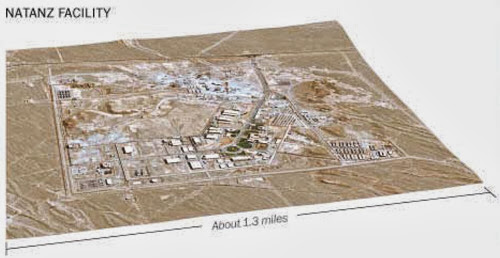
Natanz Facility

Underground Facilities: Intelligence and Targeting Issues (New Documents)

U.S. Intelligence: Hiding of Military Assets by "Rogue Nations" and Other States a Major Security Challenge for 21st Century

U.S. Documents Describe Monitoring Effort Going Back to Early Cold War Years

National Security Archive Electronic Briefing Book No. 439

UPDATE -- September 23, 2013

Originally Posted -- March 23, 2012

For more information contact:
Jeffrey T. Richelson - 202/994-7000
nsarchiv@gwu.edu


Washington, D.C., September 23, 2013 -- While the focus on Syria's chemical weapons use, and the possibility of military action against Syrian government targets pushed aside, for a while, the issue of how to deal with Iran's nuclear program, the two situations have one thing in common -- their reported reliance on underground facilities to shield the production and storage of weapons of mass destruction.

Documents posted today by the National Security Archive show that such sites in Syria are only the latest in a long line of alleged and real underground facilities that have posed a high priority challenge for U.S. and allied intelligence collection and analysis efforts, as well as for military planners. There may be more than 10,000 such facilities worldwide, many of them in hostile territory, and many presumably intended to hide or protect lethal military equipment and activities, including weapons of mass destruction, that could threaten U.S. or allied interests.

Today's posting features 21 new documents, in addition to the 41 records from the Archive's initial March 23, 2012, posting on this subject. The new materials include several concerning a key topic of Cold War intelligence collection and analysis -- hardened and underground communications facilities. Also included for the first time are draft charters for the National Reconnaissance Office (NRO) working group on hardened and buried targets. The majority of the new materials consist of reports from the Asian Studies Detachment (ASD) of the 500th Military Group of the Army Intelligence and Security Command. The ASD reports, based on open source intelligence, focus on various aspects of hardened and buried facilities in North Korea and China.

The 21 new items, with one exception, were acquired via Freedom of Information Act requests or research in the National Archives. The original posting described in detail the agencies and programs the U.S. government has brought to the task of identifying and assessing underground structures in foreign countries since World War II.


Check out today's posting at the National Security Archive website -http://www.gwu.edu/~nsarchiv/NSAEBB/NSAEBB439/

Find us on Facebook - http://www.facebook.com/NSArchive

Unredacted, the Archive blog - http://nsarchive.wordpress.com/


________________________________________________________
THE NATIONAL SECURITY ARCHIVE is an independent non-governmental research institute and library located at The George Washington University in Washington, D.C. The Archive collects and publishes declassified documents acquired through the Freedom of Information Act (FOIA). A tax-exempt public charity, the Archive receives no U.S. government funding; its budget is supported by publication royalties and donations from foundations and individuals.


Thursday, July 25, 2013

Shocking 'Extermination' Fantasies By the People Running America's Empire on Full Display at Aspen Summit

Security Forum participants expressed total confidence in American empire, but could not contain their panic at the mention of Snowden.


Seated on a stool before an audience packed with spooks, lawmakers, lawyers and mercenaries, CNN’s Wolf Blitzer introduced recently retired CENTCOM chief General James Mattis. “I’ve worked with him and I’ve worked with his predecessors,” Blitzer said of Mattis. “I know how hard it is to run an operation like this.”

Reminding the crowd that CENTCOM is “really, really important,” Blitzer urged them to celebrate Mattis: “Let’s give the general a round of applause.”

Following the gales of cheering that resounded from the room, Mattis, the gruff 40-year Marine veteran who once volunteered his opinion that “it’s fun to shoot some people,” outlined the challenge ahead. The “war on terror” that began on 9/11 has no discernable end, he said, likening it to the “the constant skirmishing between [the US cavalry] and the Indians” during the genocidal Indian Wars of the 19th century.

“The skirmishing will go on likely for a generation,” Mattis declared.

Mattis’ remarks, made beside a cable news personality who acted more like a sidekick than a journalist, set the tone for the entire 2013 Aspen Security Forum this July. A project of the Aspen Institute, the Security Forum brought together the key figures behind America’s vast national security state, from military chieftains like Mattis to embattled National Security Agency Chief General Keith Alexander to top FBI and CIA officials, along with the bookish functionaries attempting to establish legal groundwork for expanding the war on terror.

Partisan lines and ideological disagreements faded away inside the darkened conference hall, as a parade of American securitocrats from administrations both past and present appeared on stage to defend endless global warfare and total information awareness while uniting in a single voice of condemnation against a single whistleblower bunkered inside the waiting room of Moscow International Airport: Edward Snowden.

With perhaps one notable exception, none of the high-flying reporters junketed to Aspen to act as interlocutors seemed terribly interested in interrogating the logic of the war on terror. The spectacle was a perfect window into the world of access journalism, with media professionals brown-nosing national security elites committed to secrecy and surveillance, avoiding overly adversarial questions but making sure to ask the requisite question about how much Snowden has caused terrorists to change their behavior.

Jeff Harris, the communications director for the Aspen Institute, did not respond to questions I submitted about whether the journalists who participated in the Security Forum accepted fees. (It is likely that all relied on Aspen to at least cover lodging and travel costs). CNN sponsored the forum through a special new website called CNN Security Clearance, promoting the event through Twitter and specially commissioned op-eds from participating national security figures like former CIA director John McLaughlin.

Another forum sponsor was Academi, the private mercenary corporation formerly known as Blackwater. In fact, Academi is Blackwater’s third incarnation (it was first renamed “Xe”) since revelations of widespread human rights abuses and possible war crimes in Iraq and Afghanistan threw the mercenary firm into full damage control mode. The Aspen Institute did not respond to my questions about whether accepting sponsorship from such an unsavory entity fit within its ethical guidelines.

'Exterminating People'

John Ashcroft, the former Attorney General who prosecuted the war on terror under the administration of George W. Bush, appeared at Aspen as a board member of Academi. Responding to a question about U.S. over-reliance on the “kinetic” approach of drone strikes and special forces, Ashcroft reminded the audience that the U.S. also likes to torture terror suspects, not just “exterminate” them.

“It's not true that we have relied solely on the kinetic option,” Ashcroft insisted. “We wouldn't have so many detainees if we'd relied on the ability to exterminate people…We've had a blended and nuanced approach and for the guy who's on the other end of a Hellfire missile he doesn't see that as a nuance.”

Security Forum participants expressed total confidence in American empire, but could not contain their panic at the mention of Snowden.

Hearty laughs erupted from the crowd and fellow panelists. With a broad smile on her face, moderator Catherine Herridge of Fox News joked to Ashcroft, “You have a way with words.”

But Ashcroft was not done. He proceeded to boast about the pain inflicted on detainees during long CIA torture sessions: “And maybe there are people who wish they were on the end of one of those missiles.”

Competing with Ashcroft for the High Authoritarian prize was former NSA chief Michael Hayden, who emphasized the importance of Obama’s drone assassinations, at least in countries the U.S. has deemed to be Al Qaeda havens. “Here's the strategic question,” Hayden said. “People in Pakistan? I think that's very clear. Kill 'em. People in Yemen? The same. Kill 'em.”

“We don’t smoke [drug] cartel leaders but personally I’d support it,” remarked Philip Mudd, the former deputy director of Bush’s Counterterrorism Center, earning more guffaws from his fellow panelists and from Herridge. Ironically, Mudd was attempting to argue that counter-terror should no longer be a top U.S. security priority because it poses less of a threat to Americans than synthetic drugs and child obesity.

Reflection was not on the agenda for most of the Security Forum’s participants. When asked by a former US ambassador to Denmark the seminal question “This is a great country, why are we always the bad guy?,” Mudd replied, “They think that anything the U.S. does [in the Middle East], even though we helped Muslim communities in Bosnia and Kuwait, everything is rewritten to make us the bad guys.”

The clamoring about U.S. invasions, drone strikes, bankrolling of Israel’s occupation, and general political meddling, could all be written off as fevered anti-Americanism borne from the desert canyons of the paranoid Arab mind.

And the wars could go on.

Delusions of Empire

Throughout the three days of the Security Forum, the almost uniformly white cast of speakers were called on to discuss recent geopolitical developments, from "Eye-rak" and "Eye-ran" to Egypt, where a military coup had just toppled the first elected government in the country’s history.

Mattis carefully toed the line of the Obama administration, describing the overthrow of Egypt’s government not as a coup, but as “military muscle saddled on top of this popular uprising.”

Warning that using terms like “coup” could lead to a reduction in U.S. aid to Egypt, where the military controls about one-third of the country’s economy, Mattis warned, “We have to be very careful about passing laws with certain words when the reality of the world won’t allow you to.”

Wolf Blitzer mentioned that Egypt’s new military-imposed foreign minister, Nabil Fahmy, had been a fixture in Washington during the Mubarak days. “These are people the West knows, the U.S. knows,” he said of the new cabinet in Cairo. “I assume from the U.S. perspective, the United States is so much more happy with this.”

Later, one of the few Arab participants in the forum, Al Jazeera DC bureau chief Abderrahim Foukara, claimed that the Arab revolts were inspired by the U.S. invasion of Iraq. “The iconic image of Saddam being pulled out of a hole did something to the dynamic between ruler and ruled in the Arab world,” Foukara claimed.

With the revolts blurring the old boundaries imposed on the Arab world during the late colonial era, former CIA director John McLaughlin rose from the audience to call for the U.S. to form a secret, Sikes-Picot-style commission to draw up a new set of borders.

“The American government should now have such a group asking how we should manage those lines and what should those lines be,” McLaughlin told the panelists, who dismissed the idea of a new Great Game even as they discussed tactics for preserving U.S. dominance in the Middle East.

Security Forum participants expressed total confidence in American empire, but could not contain their panic at the mention of Snowden.


ABC’s Chris Isham asked Jim Jeffrey, the former U.S. ambassador to Iraq, why, with a recession on its hands and Middle Eastern societies spiraling out of control, should the U.S. remain militarily involved in the region. Without hesitation, Jeffrey rattled off the reasons: Saudi Arabia, Turkey, Israel, and “world oil markets.”

“What could we have done better?” Isham asked the ambassador.

“Probably not too much.”

NSA Heroes, Saving Lives of Potential Consumers

While participants in the Security Forum expressed total confidence in American empire, they could not contain their panic, outrage, and fear at the mere mention of Snowden.

“Make no mistake about it: These are great people who we’re slamming and tarnishing and it’s wrong. They’re the heroes, not this other and these leakers!” NSA chief General Keith Alexander proclaimed, earning raucous applause from the crowd.

Snowden’s leaks had prompted a rare public appearance from Alexander, forcing the normally imperious spy chief into the spotlight to defend his agency’s Panopticon-style programs and its dubious mechanisms of legal review. Fortunately for him, NBC’s Pete Williams offered him the opportunity to lash out at Snowden and the media that reported the leaks, asking whether the "terrorists” (who presumably already knew they were being spied on) had changed their behavior as a result of the leaks.

“We have concrete proof that terrorists are taking action, making changes, and it’s gonna make our job harder,” Alexander declared, offering nothing to support his claim.

Alexander appeared in full military regalia, with colorful decorations and medallions covering his left breast. Casting himself as a stern but caring father who has the best interests of all Americans at heart, even if he can't fully disclose his methods, he turned to the crowd and explained, “The bad guys…hide amongst us to kill our people. Our job is to stop them without impacting your civil liberties and privacy and these programs are set up to do that.”

“The reason we use secrecy is not to hide it from the American people, but to hide it from the people who walk among you and are trying to kill you,” Alexander insisted.

Corporations like AT&T, Google and Microsoft that had been compelled to hand over customer data to the NSA “know that we’re saving lives,” the general claimed. With a straight face, he continued, “And that’s good for business because there’s more people out there who can buy their products.”

Self-Reporting

So who were the "bad guys” who “walk among us,” and how could Americans be sure they had not been ensnared by the NSA’s all-encompassing spying regime, either inadvertently or intentionally? Nearly all the Security Forum participants involved in domestic surveillance responded to this question by insisting that the NSA had the world’s most rigorous program of oversight, pointing to Congress and the Foreign Intelligence Surveillance Act (FISA) courts as the best and only means of ensuring that “mistakes” are corrected.

“We have more oversight on this [PRISM] program than any other program in any government that I’m aware of,” Alexander proclaimed, ramming home a talking point repeated throughout the forum.

“I can assure these are some of the judges who are renowned for holding the government to a very high standard,” John Carlin, the Assistant US Attorney General for National Security, stated.

But in the last year, FISA courts received 1,856 applications for surveillance from the government. In 100 percent of cases, they were approved. As for Congress, only two senators, Ron Wyden and Mark Udall, demanded the NSA explain why PRISM was necessary or questioned its legality. Despite the fact that the entire regime of oversight was a rubber stamp, or perhaps because of it, none of those who appeared at the Security Forum to defend it were willing to consider any forum of independent civilian review. More