Showing posts with label air force. Show all posts

Monday, September 23, 2013

National Security Archive

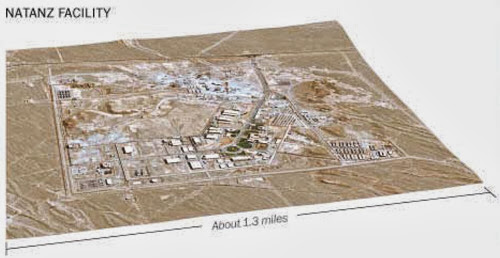
Natanz Facility

Underground Facilities: Intelligence and Targeting Issues (New Documents)

U.S. Intelligence: Hiding of Military Assets by "Rogue Nations" and Other States a Major Security Challenge for 21st Century

U.S. Documents Describe Monitoring Effort Going Back to Early Cold War Years

National Security Archive Electronic Briefing Book No. 439

UPDATE -- September 23, 2013

Originally Posted -- March 23, 2012

For more information contact:
Jeffrey T. Richelson - 202/994-7000
nsarchiv@gwu.edu


Washington, D.C., September 23, 2013 -- While the focus on Syria's chemical weapons use, and the possibility of military action against Syrian government targets pushed aside, for a while, the issue of how to deal with Iran's nuclear program, the two situations have one thing in common -- their reported reliance on underground facilities to shield the production and storage of weapons of mass destruction.

Documents posted today by the National Security Archive show that such sites in Syria are only the latest in a long line of alleged and real underground facilities that have posed a high priority challenge for U.S. and allied intelligence collection and analysis efforts, as well as for military planners. There may be more than 10,000 such facilities worldwide, many of them in hostile territory, and many presumably intended to hide or protect lethal military equipment and activities, including weapons of mass destruction, that could threaten U.S. or allied interests.

Today's posting features 21 new documents, in addition to the 41 records from the Archive's initial March 23, 2012, posting on this subject. The new materials include several concerning a key topic of Cold War intelligence collection and analysis -- hardened and underground communications facilities. Also included for the first time are draft charters for the National Reconnaissance Office (NRO) working group on hardened and buried targets. The majority of the new materials consist of reports from the Asian Studies Detachment (ASD) of the 500th Military Group of the Army Intelligence and Security Command. The ASD reports, based on open source intelligence, focus on various aspects of hardened and buried facilities in North Korea and China.

The 21 new items, with one exception, were acquired via Freedom of Information Act requests or research in the National Archives. The original posting described in detail the agencies and programs the U.S. government has brought to the task of identifying and assessing underground structures in foreign countries since World War II.


Check out today's posting at the National Security Archive website -http://www.gwu.edu/~nsarchiv/NSAEBB/NSAEBB439/

Find us on Facebook - http://www.facebook.com/NSArchive

Unredacted, the Archive blog - http://nsarchive.wordpress.com/


________________________________________________________
THE NATIONAL SECURITY ARCHIVE is an independent non-governmental research institute and library located at The George Washington University in Washington, D.C. The Archive collects and publishes declassified documents acquired through the Freedom of Information Act (FOIA). A tax-exempt public charity, the Archive receives no U.S. government funding; its budget is supported by publication royalties and donations from foundations and individuals.


Friday, September 20, 2013

US Air Force once dropped live hydrogen bomb on North Carolina - report

The US Air Force inadvertently dropped an atomic bomb over North Carolina in 1961. If a simple safety switch had not prevented the explosive from detonating, millions of lives across the northeast would have been at risk, a new document has revealed.

The revelation offers the first conclusive evidence after decades of speculation that the US military narrowly avoided a self-inflicted disaster. The incident is explained in detail in a recently declassified document written by Parker F. Jones, supervisor of the nuclear weapons safety department at Sandia National Laboratories.

The document - written in 1969 and titled “How I Learned to Mistrust the H-bomb,” a play on the Stanley Kubrick film title “Dr. Strangelove or: How I Learned to Stop Worrying and Love the Bomb” - was disclosed to the Guardian by journalist Eric Schlosser.

Three days after President John F. Kennedy’s inauguration, a B-52 bomber carrying two Mark 39 hydrogen bombs departed from Goldsboro, North Carolina on a routine flight along the East Coast. The plane soon went into a tailspin, throwing the bombs from the B-52 into the air within striking distance of multiple major metropolitan centers.

Each of the explosives carried a payload of 4 megatons - roughly the same as four million tons of TNT explosive - which could have triggered a blast 260 times more powerful than the atomic bomb that wiped out Hiroshima at the end of World War II.

One of the bombs performed in the same way as those dropped over Japan less than 20 years before - by opening its parachute and engaging its trigger mechanisms. The only thing that prevented untold thousands, or perhaps millions, from being killed was a simple low voltage switch that failed to flip.

That hydrogen bomb, known as MK 39 Mod 2, descended onto tree branches in Faro, North Carolina, while the second explosive landed peacefully off Big Daddy’s Road in Pikeville. Jones determined that three of the four switches designed to prevent unintended detonation on MK 39 Mod 2 failed to work properly, and when a final firing signal was triggered that fourth switch was the only safeguard that worked.

That hydrogen bomb, known as MK 39 Mod 2, descended onto tree branches in Faro, North Carolina, while the second explosive landed peacefully off Big Daddy’s Road in Pikeville. Jones determined that three of the four switches designed to prevent unintended detonation on MK 39 Mod 2 failed to work properly, and when a final firing signal was triggered that fourth switch was the only safeguard that worked.

Nuclear fallout from a detonation could have risked millions of lives in Baltimore, Washington DC, Philadelphia, New York City, and the areas in between.

“The MK Mod 2 bomb did not possess adequate safety for the airborne alert role in the B-52,” Jones wrote in his 1969 assessment. He determined “one simple, dynamo-technology, low voltage switch stood between the United States and a major catastrophe…It would have been bad news – in spades.”

Before Schlosser brought the document to light through a Freedom of Information Act request, the US government long denied that any such event ever took place.

“The US government has consistently tried to withhold information from the American people in order to prevent questions being asked about our nuclear weapons policy,” he told the Guardian. “We were told there was no possibility of these weapons accidentally detonating, yet here’s one that very nearly did.”

In “Command and Control,” Schlosser’s new book on the nuclear arms race between the US and the Soviet Union, the journalist writes that he discovered a minimum of 700 “significant” accidents involving nuclear weapons in the years between 1950 and 1968. More


Tuesday, March 26, 2013

Darpa’s Next Drone Could Be a Datalink Between Planes and Ships

The Pentagon’s far-out research scientists aren’t just trying to build a drone that can operate off the deck of a small warship. They’re starting to describe their new-mark flying robot as a device that bridges the communication systems between ships and aircraft.

And if they can pull it off, Darpa will be giving the U.S. military a capability it badly needs for one of its major initiatives.

Last month, Darpa announced a program to design something called the TERN, for Tactically Exploitative Reconnaissance Node, a surveillance and strike drone that can fly up to 900 miles from the deck of a destroyer or Littoral Combat Ship. Darpa wants it to be “substantially beyond current state-of-the-art aviation capabilities from smaller ships,” according to the full, formal solicitation for the drone that the agency released Tuesday.

And how. The solicitation seems to emphasize the “Node” aspect of TERN. Among the intriguing requirements that Darpa “encouraged” its potential research teams to explore is the ability for the drone to “exploit cooperation between aircraft and ship to achieve enhanced performance. Such cooperation could potentially take the form of data exchange, external energy addition, or manipulation of the recovery environment.”

That doesn’t sound like too much, but the implications are significant, and they go way beyond drone warfare.

Most significantly, the Navy and the Air Force are working on a master concept for future partnered operations called AirSea Battle. AirSea Battle is inchoate and confusing. Its Pentagon architects have yet to articulate how specifically long-range bombers and stealth jets are supposed to work alongside carrier strike groups, submarines or close-to-shore fighters like the Littoral Combat Ship.

But even if they figure all that out, the leaders of the Navy and Air Force have conceded that they’ll still face another “foundational” challenge, as the former Air Force chief of staff put it in May. Navy ships and Air Force planes don’t have a common communications architecture. “Our links need to be similar,” Adm. Jonathan Greenert told a panel discussion on AirSea Battle back then, “or at least minimally compatible.” If you can’t talk to each other, you can’t fight together.

It’s unclear how the Navy and the Air Force will come to speak the same language. The TERN program points to a potential solution: Design the data links on a long-endurance drone at sea to be bilingual. It surely won’t be easy to build a software layer that can communicate with both Air Force planes and Navy ships. But it’s probably easier, and cheaper, than retrofitting the communications systems on planes, subs and ships for maximum compatibility or demanding that defense companies build future flying and sailing platforms with that goal in mind. More


Friday, November 30, 2012

This Drone Notion Is Starting to Get Serious

It was only two days ago that Battleland posted a photo of the Navy’s X-47B Unmanned Combat Aircraft System demonstrator “landing” gently on the flight deck of the USS Harry S Truman – with help from a crane.

Meanwhile, back on land, this video of a second Northrop Grumman aircraft shows its first-ever catapult launch Thursday at the Navy test center at Pax River, Md. That’s a steam-powered kick-in-the-pants to power a warplane off a relatively short carrier deck.

It’s something drones will have to do if they’re ever to play a key role in naval aviation (the new Ford class of carriers is planning to use electromagnetic power instead of steam to deliver the kick).

Unlike most earlier drones, with their piddling engines and propellers, the jet-powered X-47B looks – and sounds, thanks to its Pratt & Whitney F-16 engine – like a real warplane. More