Showing posts with label Middle East. Show all posts

Tuesday, January 19, 2016

What Happens If Russia Loses in Syria?

It's worth considering a subject that's seldom discussed here, though it should be. What if Russia's intervention in Syria -- its version of the American way of war (air power and more air power) -- proves to be somewhere between quagmirish and disastrous? Dominic Tierney at the Atlantic gives the subject some thought. Here's the end of the resulting piece. TomDispatch

President Putin

"In other words, Putin’s war may very well fail. But if it does, will he make concessions and abandon his ally? If the Russian president acts rationally, he should cut his losses. Putin, however, may not act rationally. When I researched my book on military disaster, The Right Way to Lose a War, I was struck by how poorly governments tend to handle battlefield reversals. From the United States in Vietnam to the Soviet Union in Afghanistan, leaders often respond to defeat with disastrous decisions that only worsen their plight. Rather than coolly looking for a way out of the predicament, they rage against the dying of the light."Part of the problem is what psychologists call “loss aversion.” Losing hurts twice as bad as winning feels good—whether in a tennis match or a war. The idea of accepting even a small loss can seem intolerable, and people are tempted to risk greater losses for a shot at the win. The gambler who drops 20 bucks in a casino doesn’t walk away; he doubles his bets. In a similar vein, the president who loses 1,000 soldiers in Vietnam doesn’t end the war; he sends half a million Americans into the mire.

Putin has repeatedly responded to the potential loss of client regimes with military force.

"It’s hard to imagine Putin accepting defeat. He has cultivated an image as the father of the Russian people, who is restoring the country as a world power. If Assad’s regime falls, Russia could lose its only military installation outside the former U.S.S.R.—the naval base in Tartus, Syria. Therefore, if the war effort collapses, Putin may want to salvage something from the wreckage, potentially moving the conflict into a dangerous new phase. He could intensify Russian air strikes or deploy “little green men”—as the Russian soldiers serving unofficially in eastern Ukraine were called. Once Russian troops start dying in Syria, all bets are off."Putin, moreover, has repeatedly responded to the potential loss of client regimes with military force. In 2008, the Russian military intervened in Georgia to punish pro-Western Georgian President Mikheil Saakashvili and protect the independence of the breakaway Georgian territories of Abkhazia and South Ossetia. Six years later, in 2014, Putin aided Ukrainian rebels and annexed Crimea following the toppling of pro-Russian Ukrainian President Viktor Yanukovych. In late 2015, with Assad’s forces reeling, Putin once again intervened to stabilize a client regime."And Putin has already raised the prospect of further military escalation, saying that Russia is using “far from everything we are capable of” in Syria and that “We also have other things as well and will use them if necessary.”

"What’s the solution? If Russia’s defeat could trigger hazardous escalation, this doesn’t mean a Russian victory is preferable. After all, if Assad somehow assumed a winning position, why would he negotiate a compromise peace that recognized the interests of all Syrian groups? Instead, the optimal opportunity for a peace deal may be a situation in which Putin believes a decisive triumph is not possible, but he can still save face by spinning the outcome as a success. In other words, he needs a story to tell the Russian people about the positive results of the mission. This narrative doesn’t need to be true, but it does need to havetruthiness, or a seeming plausibility. And so, to get Putin out of Syria, the United States might need to play along by avoiding boastful claims of a major Russian debacle. In 1989, after the Berlin Wall fell, U.S. President George H.W. Bush deliberately refused to declare the development a win—to avoid complicating the life of Soviet Premier Mikhail Gorbachev.

"Putin needs a victory speech. And Washington may have to help him write it." More


Friday, November 20, 2015

The War in Syria: Complex and More Dangerous

Russian military intervention in Syria has expanded considerably over the past month and may accelerate further if the destruction of Metrojet Flight 9628 over Sinai is proved to be the work of Islamic State (IS).

Russian and American representatives meet to discuss the situation in Syria on September 29, 2015

The US-led coalition against IS in Syria is meanwhile steadily losing its active members, even as the US escalates its bombing campaign and declares a greater willingness to deploy Special Forces units inside Syria. While the UK prevaricates on its involvement within Syria, Israel has launched new attacks on Hezbollah there and Turkey pursues its own interests against IS and Kurdish factions alike. The risks of accidental escalation between these disparate actors is rising as the complexity of the war grows.

Introduction

The October briefing reported a number of developments in the war in Syria, including the Russian intervention, a likely extension of the US-led air war and a change in US strategy towards arming opposition groups in preference to training them. Perhaps most significantly there were revised US intelligence estimates indicating that Islamic State (IS) was gaining new recruits in Syria and Iraq at a rate more than compensating for the heavy losses caused by the air strikes in both countries.

This briefing provides an updated analysis based on developments since mid-October as they apply to Syria in particular. Its main focus is on two developments early in November. One was the criticism of UK policy towards Syria by the Chief of the Defence Staff, General Sir Nicholas Houghton, who argued that the UK was letting its allies down by not joining in the air strikes against IS in Syria. The second was the destruction on 31 October of a Russian charter airliner shortly after it began a flight from Sharm el-Sheikh in southern Sinai to St Petersburg, killing all 224 passengers and crew.

Military Criticism of UK Inaction

The comments of General Houghton caused some concern as they were paralleled by a more controversial expression of opposition to the views of the new Labour Party Leader, Jeremy Corbyn, over the Trident nuclear weapons system. There has been concern that General Houghton has strayed too far into the political dimension with his Trident-related comments, but this has been less the case in relation to his views on attacking Syria in that there is already cross-party opposition to that policy.

What General Houghton’s comments have done is to focus attention on the nature of the air war in Syria which has involved nine coalition partners: Saudi Arabia, Bahrain, the United Arab Emirates (UAE), Morocco, Jordan, Canada and the United States plus, since September, Australia and France. Although the US has carried out around 95% of the attacks, the presence of a range of other countries has added weight to the idea of a united, broadly based and multinational coalition opposing IS in Syria.

The reality is actually quite different as six of the nine coalition partners have ceased undertaking air strikes in the past nine months, although some may still be involved in support operations. Bahrain ceased air strike operations nine months ago, the UAE and Morocco eight months ago, Jordan three months ago and Saudi Arabia just two months ago. These countries are all now more actively involved in their war in Yemen. The fifth country, Canada, under new Prime Minister Justin Trudeau, is withdrawing from all air strike operations over Syria and Iraq.

Of the remaining coalition partners, France is reported to have carried out just two air strikes over Syria with all of the rest of the 270 attacks being over Iraq. Finally, Australia’s air force has undertaken 434 air strikes but up to 2 October had only undertaken two attacks in Syria before pausing in its operations when Russia started its intervention. Belgium and Denmark also pulled out their fighter-bombers from operations over Iraq in July and September respectively.

To all intents and purposes, the air war that has evolved over Syria is now a US operation with minimal involvement from western allies and no operations being undertaken by regional allies. There certainly is an increased intensity of air strikes against IS in Syria but this is entirely down to increased US operations, especially from the Turkish base at Incirlik, less than 30 minutes flight from IS-controlled territory in northern Syria. It is thus fast becoming an American war and this may explain General Houghton’s concern, bearing in mind that it makes it far easier for IS propagandists to portray their role as being the guardians of Islam under persistent attack by the “far enemy” of the United States and its western allies.

Meanwhile, Russian air operations continue although at a lower level than those of the United States. The great majority continue to be against the opponents of the Assad regime and are serving to ensure that those areas of north west Syria that are strongly supportive of the regime are secure from opponents. There are occasional Russian air strikes against IS targets and, while these are of little military consequence, their political significance could be considerable following the destruction of the Russian airliner over Sinai. More


Tuesday, March 3, 2015

Climate change key in Syrian conflict – and it will trigger more war in future

Climate change was a key driver of the Syrian uprising, according to research which warns that global warming is likely to unleash more wars in the coming decades, with Eastern Mediterranean countries such as Jordan and Lebanon particularly at risk.

Experts have long predicted that climate change will be a major source of conflict as drought and rising temperatures hurt agriculture, putting a further strain on resources in already unstable regimes.

But the Syria conflict is the first war that scientists have explicitly linked to climate change. Researchers say that global warming intensified the region’s worst-ever drought, pushing the country into civil war by destroying agriculture and forcing an exodus to cities already straining from poverty, an influx of refugees from war-torn Iraq next door and poor government, the report finds.

“Added to all the other stressors, climate change helped kick things over the threshold into open conflict,” said report co-author Richard Seager, of Columbia University in New York.

“I think this is scary and it’s only just beginning. It’s going to continue through the current century as part of the general drying of the Eastern Mediterranean – I don’t see how things are going to survive there,” Professor Seager added.

Turkey, Lebananon, Israel, Jordan, Iraq and Afghanistan are among those most at risk from drought because of the intensity of the drying and the history of conflict in the region, he says. Israel is much better equipped to withstand climate change than its neighbours because it is wealthy, politically stable and imports much of its food. Drought-ravaged East African countries such as Somalia and Sudan are also vulnerable along with parts of Central America – especially Mexico, which is afflicted by crime, is politically unstable, short of water and reliant on agriculture, Prof Seager said.

The conflict in Syria began in spring 2011 and has evolved into a complex multinational war that has killed at least 200,000 people and displaced millions more, according to the Columbia study, which appears in the journal Proceedings of the National Academy of Sciences. It was preceded by a record drought that ravaged Syria between 2006 and 2010.The paper says the timing is unlikely to be a coincidence, citing a recent interview with a 38-year old farmer in Mohasen, an agricultural village in the north east of Syria.

Asked if the conflict was about the drought, Faten – a female farmer who did not want to give her last name – said: “Of course. The drought and unemployment were important in pushing people towards revolution. When the drought happened, we could handle it for two years, and then we said, ‘It’s enough’,” the report said.

The study combined climate, social and economic data relating to the so-called Fertile Crescent, spanning parts of Turkey and much of Syria and Iraq, where agriculture and herding are thought to have started 12,000 years ago and continue to be crucial.

The region has warmed by between 1 and 1.2C since 1900, reducing rainfall in the wet season by an average of 10 per cent. In addition to the warming – which has found to be caused by human greenhouse gas emissions – Syria has had to contend with rapid population growth, from 4 million in the 1950s to 22 million now.

The ruling al-Assad family encouraged water-intensive export crops such as cotton, while illegal drilling of irrigation wells dramatically depleted groundwater that might have provided valuable reserves, the report said. The drought’s effects were immediate. Agriculture production, which typically makes up a quarter of Syria’s economy, plummeted by a third.

In the hard-hit northeast, livestock herds were practically obliterated, cereal prices doubled and nutrition-related diseases among children increased dramatically. As many as 1.5m people fled from the country to the city.

“Whether it was a primary or substantial factor is impossible to know, but drought can lead to devastating consequences when coupled with pre-existing acute vulnerability,” said lead author Colin Kelley, who did the work at Columbia but is now the University of California, Santa Barbara.

The pressure exerted by climate change is even more dangerous because it comes against a backdrop of rising populations and growing scarcity of resources, experts say.

With demand for basic commodities such as wheat and copper set to soar over the next two decades, relatively small shocks to supply risk causing sudden price rises and triggering “overreactions or even militarised responses”, the Chatham House think-tank has warned.

Furthermore, while the effects of rising population and global warming may be felt hardest among the poorer countries most affected by climate change, the impact will be felt worldwide.

Global trade is so interconnected that no importer of resources is insulated from the problems of key exporters – a fact of concern to the UK, which imports 40 per cent of its food and a high proportion of fossil fuels and metals, the think-tank warns. More


Sunday, January 4, 2015

Abu Dhabi summit to discuss water security challenges

More than 32,000 global leaders from 170 countries representing government, industry, investment and research to Abu Dhabi, will provide an upfront look at affordable technologies to enable sustainable water resource management to help meet the Middle East’s rising demand for water.

Hosted by Masdar, Abu Dhabi’s renewable energy company, ADSW is a yearly platform that addresses the interconnected challenges of energy and water security, climate risk and sustainable development.

Running from January 17 to 24, ADSW includes the World Future Energy Summit (WFES), the world’s foremost event dedicated to the advancement of renewable energy, energy efficiency and clean technology; and the International Water Summit (IWS), which provides a business approach to addressing water scarcity, sustainable growth and economic development in arid regions.

“The Mena region is in a truly unique position to solve the challenge of water security,” remarked Raed Bkayrat, vice president of development for Saudi Arabia at First Solar, which is participating in WFES.

“While the region is quite arid, it also has one of the highest solar irradiances of any region in the world, and much of the population has ready access to seawater. Accordingly, solar photovoltaic projects are proving to be sustainable means of powering water desalination in the region, ensuring that the supply of clean water will keep up with the region’s increasing demand for it,” he noted.

Masdar took a major step by launching a pilot project to test energy-efficient desalination technologies – such as reverse osmosis and forward osmosis – powered by renewable energy.

The company awarded contracts to Abengoa, Degremont, Sidem/Veolia and Trevi Systems to build the desalination plants, which are expected to enable the implementation of cost-competitive desalination plants powered by renewable energy in the UAE and abroad.

“Engaging different sectors of the industry is really crucial to bring forward innovative solutions, as well as pilot projects that demonstrate to governments the value of new integrated systems,” Bkayrat added.

Both WFES and IWS will offer numerous keynote addresses, panel discussions and workshops as well as exhibitors introducing affordable technologies to enable sustainable water resource management.

Along with WFES and IWS, ADSW will include the second EcoWaste and the seventh Zayed Future Energy Prize Award Ceremony; it also coincides with the Fifth General Assembly of the International Renewable Energy Agency.-TradeArabia News Service More


Wednesday, August 6, 2014

All in the Timing: The Weapons of Mass Destruction Free Zone in the Middle East - Patricia Mary Lewis

The Helsinki Conference process established by the 2010 nuclear Non-Proliferation Treaty (NPT) Review Conference is the most significant opportunity to increase stability and prevent nuclear catastrophe in the Middle East that has presented itself in recent years. If states fail to take this opportunity, the consequences will be severe.

The Helsinki Conference process established by the 2010 nuclear Non-Proliferation Treaty (NPT) Review Conference is the most significant opportunity to increase stability and prevent nuclear catastrophe in the Middle East that has presented itself in recent years – coming at a time when the Iranian nuclear capabilities issue is being seriously and sustainably addressed, and when the instability in the region is all too plain to see. If states fail to take this opportunity, the consequences will be severe. Now is a time for leadership. Serious efforts to forge an agreement between Israel and Egypt would make all the difference and could help the region’s security in a time of considerable danger.

However, progress towards a weapons of mass destruction (WMD) free zone in the Middle East has been sporadic. A deadline of December 2012 was not met and no follow-on date has yet been announced for the Helsinki conference. There are three main scenarios that could play out in the period leading up to the next NPT Review Conference in April 2015. They are:

  • a Helsinki conference that has a successful outcome and leads to a process towards a WMD free zone negotiation that includes regional security measures to support the zone,
  • a Helsinki conference that results in no positive outcome and no follow-on process, and
  • no Helsinki conference before the 2015 Review Conference.

In the event of a successful Helsinki conference before 2015 there are a number of proposals to develop the zone.

  • Begin regional negotiations through a set of working groups or committees that divide the workload into nuclear weapons, chemical weapons, biological weapons, means of delivery including missiles, supportive measures/confidence- and security-building measures, wider regional security issues, and verification and other technical measures.
  • Install capacity-building measures to implement and verify the WMD free zone, such as training inspectors, developing common methodologies and learning how to use technical instruments for monitoring.
  • Involve civil society and the general public in the debate, and foster a wide discussion among all segments of the societies in the region, including young political leaders, young scientists and young journalists.

In the event of a failed or abandoned Helsinki conference it may still be possible to undertake the following measures.

  • Revamp the 1991 Madrid peace process and the multilateral tracks that it established which led to the Oslo Peace Accord and the Israeli–Jordanian Peace Treaty and see if the approach taken at that time could be adapted for today. This will require Egypt and Israel to enter into direct negotiations in order to get the ball rolling.
  • Revert to the UN Security Council to request a consideration of Resolution 687 that established the ceasefire in Iraq in 1991, which contains references to the Middle East WMD free zone.
  • Employ the UN General Assembly by building on the UN resolution that has been adopted annually calling for the ‘Establishment of a nuclear-weapon-free zone in the region of the Middle East’.
  • Establish a building-blocks approach aiming to establish a zone through a set of parallel or sequential commitments to sign and ratify the extant treaties such as the Chemical Weapons Convention (CWC), the Biological Weapons Convention (BWC), the NPT and the Comprehensive Test Ban Treaty (CTBT). Other measures could include a highly-enriched-uranium-free zone, separate agreements on non-attack of nuclear facilities (including cyber attacks), missile tests launch notifications, nuclear security assurances and transparency measures.

Research Paper: All in the Timing: The Weapons of Mass Destruction Free Zone in the Middle East


Sunday, January 5, 2014

Is it 1914 all over again? We are in danger of repeating the mistakes that started WWI, says a leading historian

History never repeats itself, but it sure does rhyme, it has been said. Now an internationally respected historian is warning that today's world bears a number of striking similarities with the build-up to the First World War.

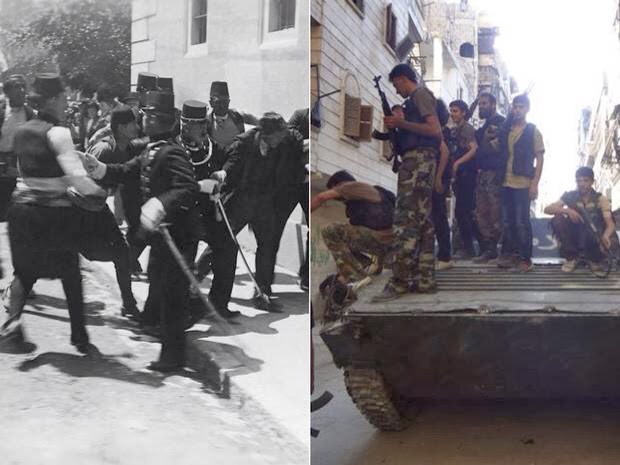
The newly mechanised armies of the early 20th century produced unprecedented slaughter on the battlefields of the "war to end all wars" after a spark lit in the Balkans with the assassination of the Austro-Hungarian Empire's Archduke Franz Ferdinand.

Professor Margaret MacMillan, of the University of Cambridge, argues that the Middle East could be viewed as the modern-day equivalent of this turbulent region. A nuclear arms race that would be likely to start if Iran developed a bomb "would make for a very dangerous world indeed, which could lead to a recreation of the kind of tinderbox that exploded in the Balkans 100 years ago – only this time with mushroom clouds," she writes in an essay for the Brookings Institution, a leading US think-tank.

"While history does not repeat itself precisely, the Middle East today bears a worrying resemblance to the Balkans then," she says. "A similar mix of toxic nationalisms threatens to draw in outside powers as the US, Turkey, Russia, and Iran look to protect their interests and clients."

Professor MacMillan highlights a string of other parallels between today and a century ago. Modern-day Islamist terrorists mirror the revolutionary communists and anarchists who carried out a string of assassinations in the name of a philosophy that sanctioned murder to achieve their vision of a better world. And in 1914, Germany was a rising force that sought to challenge the pre-eminent power of the time, the UK. Today, the growing power of China is perceived as a threat by some in the US.

Transitions from one world power to another are always seen as dangerous times. In the late 1920s, the US drew up plans for a war with the British Empire that would have seen the invasion of Canada, partly because it was assumed conflict would break out as America took over as the world's main superpower.

Professor MacMillan, whose book The War That Ended Peace was published last year, said right-wing and nationalist sentiments were rising across the world and had also been a factor before the First World War

In China and Japan, patriotic passions have been inflamed by the dispute over a string of islands in the East China Sea, known as the Senkakus in Japan and Diaoyus in China. "Increased Chinese military spending and the build-up of its naval capacity suggest to many American strategists that China intends to challenge the US as a Pacific power, and we are now seeing an arms race between the two countries in that region," she writes in her essay. "The Wall Street Journal has authoritative reports that the Pentagon is preparing war plans against China – just in case."

The US has a mutual self-defence treaty with Japan and in 2012 it specifically confirmed that this covered the Senkaku Islands. In November, China set up an "air defence" zone over the islands and a few days later two American B-52 bombers flew over the islands in defiance of Beijing.

"It is tempting – and sobering –to compare today's relationship between China and the US with that between Germany and England a century ago," Professor MacMillan writes. She points to the growing disquiet in the US over Chinese investment in America while "the Chinese complain that the US treats them as a second-rate power".

Another similarity highlighted by the historian is the belief that a full-scale war between the major powers is unthinkable after such a prolonged period of peace. "Now, as then, the march of globalisation has lulled us into a false sense of safety," she says. "The 100th anniversary of 1914 should make us reflect anew on our vulnerability to human error, sudden catastrophes, and sheer accident.

"Instead of muddling along from one crisis to another, now is the time to think again about those dreadful lessons of a century ago in the hope that our leaders, with our encouragement, will think about how they can work together to build a stable international order." More


Thursday, October 3, 2013

Diary by Patrick Cockburn

The media that failed woefully in their coverage of Afghanistan, Iraq and Libya are the media that we are supposed now to believe are giving us the unvarnished truth in Syria.

Patrick Cockburn points out some of the reasons why we shouldn't trust journalists' war coverage.
He also makes some good points about how war's greater exposure in the modern media often changes the nature of the fighting for the worse. Jonathan Cook - Journalist

The four wars fought in Afghanistan, Iraq, Libya and Syria over the past 12 years have all involved overt or covert foreign intervention in deeply divided countries. In each case the involvement of the West exacerbated existing differences and pushed hostile parties towards civil war. In each country, all or part of the opposition have been hard-core jihadi fighters. Whatever the real issues at stake, the interventions have been presented as primarily humanitarian, in support of popular forces against dictators and police states. Despite apparent military successes, in none of these cases have the local opposition and their backers succeeded in consolidating power and establishing stable states.

More than most armed struggles, the conflicts have been propaganda wars in which newspaper, television and radio journalists played a central role. In all wars there is a difference between reported news and what really happened, but during these four campaigns the outside world has been left with misconceptions even about the identity of the victors and the defeated. In 2001 reports of the Afghan war gave the impression that the Taliban had been beaten decisively even though there had been very little fighting. In 2003 there was a belief in the West that Saddam Hussein’s forces had been crushed when in fact the Iraqi army, including the units of the elite Special Republican Guard, had simply disbanded and gone home. In Libya in 2011 the rebel militiamen, so often shown on television firing truck-mounted heavy machine-guns in the general direction of the enemy, had only a limited role in the overthrow of Muammar Gaddafi, which was mostly brought about by Nato air strikes. In Syria in 2011 and 2012 foreign leaders and journalists repeatedly and vainly predicted the imminent defeat of Bashar al-Assad.

These misperceptions explain why there have been so many surprises and unexpected reversals of fortune. The Taliban rose again in 2006 because it hadn’t been beaten as comprehensively as the rest of the world imagined. At the end of 2001 I was able to drive – nervously but safely – from Kabul to Kandahar, but when I tried to make the same journey in 2011 I could go no further south on the main road than the last police station on the outskirts of Kabul. In Tripoli two years ago hotels were filled to capacity with journalists covering Gaddafi’s fall and the triumph of the rebel militias. But state authority still hasn’t been restored. This summer Libya almost stopped exporting oil because the main ports on the Mediterranean had been seized by mutinying militiamen, and the prime minister, Ali Zeidan, threatened to bomb ‘from the air and the sea’ the oil tankers the militiamen were using to sell oil on the black market.

Libya’s descent into anarchy was scarcely covered by the international media since they had long since moved on to Syria, and more recently Egypt. Iraq, home a few years ago to so many foreign news bureaux, has also dropped off the media map although up to a thousand Iraqis are killed each month, mostly as a result of the bombing of civilian targets. When it rained for a few days in Baghdad in January the sewer system, supposedly restored at a cost of $7 billion, couldn’t cope: some streets were knee-deep in dirty water and sewage. In Syria, many opposition fighters who had fought to defend their communities turned into licensed bandits and racketeers when they took power in rebel-held enclaves.

It wasn’t that reporters were factually incorrect in their descriptions of what they had seen. But the very term ‘war reporter’, though not often used by journalists themselves, helps explain what went wrong. Leaving aside its macho overtones, it gives the misleading impression that war can be adequately described by focusing on military combat. But irregular or guerrilla wars are always intensely political, and none more so than the strange stop-go conflicts that followed from 9/11. This doesn’t mean that what happened on the battlefield was insignificant, but that it requires interpretation. In 2003 television showed columns of Iraqi tanks smashed and on fire after US air strikes on the main highway north of Baghdad. If it hadn’t been for the desert background, viewers could have been watching pictures of the defeated German army in Normandy in 1944. But I climbed into some of the tanks and could see that they had been abandoned long before they were hit. This mattered because it showed that the Iraqi army wasn’t prepared to fight and die for Saddam. It was a pointer too to the likely future of the allied occupation. Iraqi soldiers, who didn’t see themselves as having been defeated, expected to keep their jobs in post-Saddam Iraq, and were enraged when the Americans dissolved their army. Well-trained officers flooded into the resistance, with devastating consequences for the occupying forces: a year later the Americans controlled only islands of territory in Iraq.

War reporting is easier than other types of journalism in one respect because the melodrama of events drives the story and attracts an audience. It may be risky at times, but the correspondent talking to camera, with exploding shells and blazing military vehicles behind him, knows his report will feature high up in any newscast. ‘If it bleeds it leads,’ is an old American media adage. The drama of battle inevitably dominates the news, but oversimplifies it by disclosing only part of what is happening. These oversimplifications were more than usually gross and deceptive in Afghanistan and Iraq, when they dovetailed with political propaganda that demonised the Taliban and later Saddam as evil incarnate, casting the conflict – particularly easy in the US in the hysterical atmosphere after 9/11 – as a black and white struggle between good and evil. The crippling inadequacies of the opposition were ignored.

By 2011 the complexity of the conflicts in Iraq and Afghanistan was evident to journalists in Baghdad and Kabul if not necessarily to editors in London and New York. But by then the reporting of the wars in Libya and Syria was demonstrating a different though equally potent form of naivety. A version of the spirit of 1968 prevailed: antagonisms that predated the Arab Spring were suddenly said to be obsolete; a brave new world was being created at hectic speed. Commentators optimistically suggested that, in the age of satellite television and the internet, traditional forms of repression – censorship, imprisonment, torture, execution – could no longer secure a police state in power; they might even be counter-productive. State control of information and communication had been subverted by blogs, satellite phones and even the mobile phone; YouTube provided the means to expose in the most graphic and immediate way the crimes and violence of security forces. More

Sunday, September 15, 2013

Resolving the Syrian Chemical Weapons Crisis: Sunlight and Shadows By Richard Falk

The Putin Moment: Not only did Vladimir Putin exhibit a new constructive role for Russia in 21st statecraft, spare Syria and the Middle East from another cycleof escalating violence, but he articulated this Kremlin initiative in the form of a direct appeal to the American people.

There were reasons to be particularly surprised by this display of Russian diplomacy: not since Nikita Khrushchev helped save the world from experiencing the catastrophe of nuclear war in the Cuban missile crisis of 1962 by backing down and agreeing to a face-saving formula for both superpowers, had Moscow distinguished itself in any positive way with respect to the conduct of international relations; for Putin to be so forthcoming, without being belligerent, was particularly impressive in view of Obama’s rather ill-considered cancellation only a few weeks ago of a bilateral meeting with the Russian leader because of Washington’s supposed anger at the refusal of the Russian government to turn the NSA whistleblower, Edward Snowden, over to the United States for criminal prosecution under American espionage laws; and finally, considering that Putin has much blood on his hands given past policies pursued in relation to Chechnya and in the autocratic treatment of domestic political opposition, it was hard to expect anything benevolent during his watch. And so Putin is emerging as a virtual ‘geopolitical black swan,’ making unanticipated moves of such a major character as to have the potential to transform the character of conflict management and resolution in the 21st century. It should be understood that Putin could have stayed on the sidelines, and benefitted from seeing Obama sink deeper and deeper into the Syrian quagmire, and instead he stepped in with a momentous move that seems to have served the regional and global interest.

Putin has explained in a coherent manner in his opinion piece that was published in the NY Times on September 11th attacks) that his approach to Russian foreign policy relies on two instruments: soft power and economic diplomacy. He acknowledged American leadership, but only if exercised within a framework of respect for international law and the UN Charter. And he appropriately took issue with Obama’s sentiments expressed a night earlier to the effect that America in its leadership role had a unique entitlement to use force to overcome injustice in situations other than self-defense and even without authorization by the UN Security Council. It was Putin, perhaps disingenuously, who claimed (quite correctly) that such a prerogative was “extremely dangerous.” He rejected Obama’s pretension that a unilateral discretion with respect to the use of force could be inferred from American exceptionalism. Whether disingenuous or not, the requirement of a Security Council authorization for non-defensive uses of force, while sometimes preventing a peacekeeping response by the UN to certain tragic situations of civil strife and humanitarian crisis overall contributed to finding diplomatically agreed upon solutions for conflict and enabled the UN (unlike the League of Nations) to persist despite severe tensions among its dominant members. Let hope that this Putin vituoso exhibition of creative diplomacy prompts his counterpart in the White House to explore more diligently soft power opportunities that will better protect American national interests, while simultaneously serving the global interest in war prevention and the rejection of militarism, and might also have the added benefit of reversing the steady decline of American credibility as a benevolent global leader ever since the end of the Cold War.(without invoking the symbolism of the twelfth anniversary of the 9/11

Constitutional Balance: Perhaps what might be of even greater importance than averting an ill-considered punitive attack on Syria, is the grounding of recourse to war on the major republican premise of Congressional authorization. There is little doubt that here the efficient cause and anti-hero was David Cameron, who turned to Parliament to support his wish to join with Obama in the attack coalition despite the anti-war mood in British public opinion. Cameron was politically spared by the vote of the House of Commons to withhold authorization. It is hard to believe that Obama’s decision to seek authorization from the U.S. Congress was not a belated realization that if Britain deferred to its Parliament as an expression of constitutional democracy, it would be unseemly for the United States to go to war without the formal backing of Congress. Of course, the Putin initiative saved Obama from the near certain embarrassment of being turned down by Congress, which would mean that either he would follow in Cameron’s and face savage criticism from his hawkish boosters or insist upon his authority as Commander in Chief to act on his own, a prerogative that seems constitutional dubious to support a bill of impeachment. Beyond this, theWar Powers Act that would seem to require some emergency justification for the presidential bypassing of Congress in the context of a proposed military action. Hopefully, we are witnessing, without an accompanying acknowledgement, the downfall of the ‘imperial presidency’ that got its start during the Vietnam War. The governmental pendulum in the United States may have started to swing back toward the separation of powers and checks and balances, and thus be more in keeping with the original republican hopes of limited executive authority, especially in relation to war making. This renewal of republican constitutionalism, combined with growing populist skepticism about military adventures abroad, might make this Syrian crisis of decision a welcome tipping point, reversing the unhealthy subordination of Congress in war/peace situations during the last half century and anti-democratic disregard of the views of the citizenry. More

Saturday, May 11, 2013

Rethinking ‘Red Lines’ by Richard Falk

The Wrong ‘Red Line’ (expanded and revised Al-Jazeera opinion piece)

Richard Falk

There are widespread reports circulating in the media that President Obama had not fully appreciated the political consequences of responding to a question at an August press conference that asked about the consequences of a possible future use of chemical weapons by the Assad regime. Obama replied that such a use, should it occur, would be to cross ‘a red line.’ Such an assertion was widely understood to be a threat by Obama either to launch air strikes or to provide rebel forces with major direct military assistance, including weaponry. There have been sketchy reports that Syria did make some use chemical weapons, as well as allegations that the reported use was ‘a false flag’ operation, designed to call Obama’s bluff. As the New York Times notes in a frontpage story on May 7th, Obama “finds himself in a geopolitical box, his credibility at stake with frustratingly few good options.” Such a policy dilemma raised tactical issues for the U.S. Government about how to intervene in the Syrian civil war without risking a costly and uncertain involvement in yet another Middle Eastern war. Not responding also raises delicate questions of presidential leadership in a highly polarized domestic political atmosphere, already shamelessly exploited by belligerent Republican lawmakers backed by a feverish media that always seem to be pushing Obama to pursue a more muscular foreign policy in support of alleged America’s global interests, as if hard power geopolitics still is the key to global security.

UN HQ - New York

What is missing from the debate on Syria, and generally from the challenge to American foreign policy, is a more fundamental red line that the United States at another time and place took the lead in formulating—namely, the unconditional prohibition of the use of international force by states other than in cases of self-defense against a prior armed attack. This prohibition was the core idea embodied in the United Nations Charter, embedded in contemporary international law, and it was also a natural sequel to the prosecution and punishment of surviving German and Japanese leaders afterWorld War II for their commission of Crimes against Peace, which was the international crime associated with engaging in aggressive warfare. The only lawful exception to this prohibition was a use of force consistent with the terms of a prior authorization given by theUN Security Council. The key hope for world peace was this consensus among the winners in World War II that in the future aggressive war and any acquisition of territory by force, even acquired in the exercise of self-defense, must be outlawed without exceptions. Such authorizations by the Security Council were obtained by the West in the Gulf War of 1991 and again in the NATO Libya War of 2011, but in each instance the actual undertaking became controversial as a result of the scope and intensity of the military operations far exceeding the UN mandate. As a consequence, there was a loss of trust on the part of China and Russia in endorsing limited uses of force under UN auspices, which became evident in the course of the gridlocked debate about what to do in response to the regionally dangerous violence in Syria that combined internal strife with external proxy involvements threatening the expansion of the war zone in a variety of menacing ways.

UN Logo

Actually the Charter red line has been surprisingly well respected over the period since 1945, at least in clear instances of border-crossing sustained violence. The UN authorized the defense of South Korea in response to an armed attack by North Korea in 1950. The UN, with surprising U.S. support, even exerted effective pressure in 1956 on the United Kingdom, France, and Israel to withdraw from territory seized after their attack on Egypt, which was the sole prominent example of law prevailing over geopolitics. In 1991 the UN successfully authorized force that followed sanctions, and succeeded in restoring the sovereignty of Kuwait after Iraq’s aggressive occupation and annexation of the country in the previous year. The UN red line held up reasonably well until the end of the last century, although all along its interpretation was subject to geopolitical manipulations by reference to a variety of loopholes and evasions associated with claims of humanitarian intervention, as well as a variety of strategically motivated covert interventions (e.g. Iran 1953, Guatemala 1954). This pattern of evasion was a prominent feature of the Cold War as both sides intervened in foreign states or in their respective spheres of influence (e.g. South Vietnam, Eastern Europe, Afghanistan) to uphold by force of arms an ideological alignment with one or the other superpower. Such uses of international force by rival superpowers without engaging the UN framework definitely eroded the authority of the anti-aggression red line and its stature in international law, but it did not lead political actors to call for its abandonment in view of the behavior of leading states. It is true that some anti-legalist international law specialists who subscribed to a realist worldview felt that patterns of state practice overrode the claims of international law and the UN Charter, and that, in effect, the red line had been erased, at least for the top tier of sovereign states. Although not made explicit, the American position was increasingly exhibiting the psychological characteristics of geopolitical bipolarity: no red line for American foreign policy, while maintaining a bright red line for others, especially for adversary states.

What weakened this red line even more decisively was undoubtedly the American led ‘coalition of the willing’ attack on Iraq in 2003 after an American plea for UN permission to use force had been rebuffed by the Security Council despite a concerted effort to convince its members that Iraq’s supposed possession of weapons of mass destruction was such a great menace to world peace as to justify what amounted to a ‘preventive war’. This undisguised defiance of this most fundamental red line of international law by the United States also defied world public opinion that had expressed itself in the most massive anti-war demonstrations in all of history held in some 80 countries on February 15, 2003, a little more than a month before the ‘shock and awe’ start of the Iraq War. Richard Perle, often touted as the most astute of the neocon intellectuals who fashioned American strategic policy during the Bush years, was exultant about this seemingly definitive breach of the red line, celebrating American aggression against Iraq in a Guardian article aptly headlined, “Thank God for the Death of the UN.” [March 20, 2003] Although the authority of the UN was definitely flouted by the invasion and occupation of Iraq, the UN is far from dead as an Organization in its manifold efforts to address the concerns of the world, and even its red line, although covered with dust, has not yet been erased. Maybe we should really thank God that the collective global consciousness is so forgetful!

What is baffling about the Obama approach is that it purports to be very mindful of the importance of exhibiting respect for international law. Just last September in a speech to the General Assembly Obama said, “We know from painful experience that the path to security prosperity does not lie outside the boundaries of international law..” In his Second Inaugural Obama repeated the sentiment: “We will defend our people and uphold values through strength of arms and rule of law.” And in arguing on behalf of taking collective action against states that violate international law told the Nobel Peace Prize audience in Stockholm, “[t]hose that claim respect for international law cannot avert their eyes when those laws are flouted.”

Barak Obama

And yet, when reflecting on intervening in Syria or resort to a military option in relation to Iran’s nuclear program, Obama is silent about the relevance of international law, although neither instance of contemplated uses of force can be remotely claimed to be justified as either individual or collective self-defense. And for obvious reasons, there is also no mention of circumventing the red line by failing to seek authorization for a contemplated used of force from the Security Council. Presumably since approval would not be forthcoming due to the anticipated opposition of Russia and China it was not even worth considering as a public tactic. It is true that the Clinton presidency in participating via NATO in the Kosovo War proceeded also to embark on a non-defensive war without seeking prior authorization for somewhat similar reasons as any resolution on Kosovo proposing use of force was sure to be vetoed by Russia and China. The Kosovo precedent generated worries about non-defensive military undertakings lacking a legal foundation. These were offset in the belief that a humanitarian catastrophe had been averted. The Kosovo undertaking was convincingly justified at the time on credible moral grounds of imminent genocide, on political grounds as enjoying support from almost all of Kosovo’s European neighbors, and on practical grounds as a military intervention that was feasible. In effect, the legitimacy of the was allowed to offset its illegality. As it turned out the military undertaking and political follow up was more difficult than anticipated, but still achieved at a reasonable cost, within a relatively short period, and productive of zero casualties among the intervening forces.

The question raised is whether from an overall perspective, the red line of international law at stake in Syria is more like Iraq or Kosovo/Libya. It is unlike Iraq in the sense that there is an ongoing unresolved civil war in Syria that is actively destabilizing the region and already spilling over national borders to cause unrest in neighboring countries. Syria is also the scene of severe Crimes Against Humanity that are being mainly committed by the regime. Finally, at present, there is no end of the violence is in sight give the relative strength of the two sides. It is, however, unlike Kosovo/Libya as there are proxy states acting as participants on both sides, the Damascus regime despite its behavior maintains considerable internal support while the opposition is widely viewed with deep suspicion and fear as to its democratic credentials, its lack of inclusiveness, and its uncertain respect for non-Sunni minorities. In a sense it is essential that each conflict be assessed within its own distinctive context, which should raise for discussion whether the red lines of international law and UN authority should be crossed in this instance on behalf of the blue lines of legitimacy (saving a vulnerable people from a humanitarian catastrophe) and white lines of feasibility (likelihood of success with minimum loss of life and high probability of positive net effects).

What is strange in all this is that Obama talks the talk, but seems unwilling to walk the walk. Such a disjunction invites cynicism about law and morality, and induces despair on the part of those of us who believe the world we inhabit badly needs red lines, but the right red lines.

Finally, it has been argued that the changing nature of conflict has made the red line embedded in the UN Charter obsolete or at least in need of a drastically modified interpretation. The rationale for rethinking the Charter approach to the use of force is associated with the global security situation that has resulted from terrorist attacks since 9/11 leading to the global war on terror being waged on a battlefield without national limits and increasingly doing the killing via reliance on robotic warfare on the one side and very primitive forms of disruptive violence by political extremists on the other side. Traditional ideas of deterrence, containment, and territorial defense seem almost irrelevant in relation to global security regimes when the perceived assailants are individuals who cannot be deterred, and are operating in non-territorial networks and exhibiting a readiness to die to complete their mission. As matters are proceeding the policy about force is being formulated without bothering with the red lines of international law and the UN, regressively producing once again a world of unregulated sovereign states and extremist non-states essentially deciding on their own when war is permissible. The recent Israeli air strikes on Syrian targets is illustrative: unprovoked and non-defensive, yet eliciting scant criticism in the media or even commentary about the dangers of unilateralism with respect to uses of international force. Such normative chaos in a world where already nine countries possess nuclear weapons seems like a prescription for eventual species suicide, an impression reinforced by the failure to take precautionary steps with respect to the menace of global warming. Never has the world more needed red lines that are drawn by major states, and upheld by them out of the realization that the national interest has also merged with the global interest. Arguably the red lines of the Charter need to be modified in light of the rise of non-state actors and the advent of non-territorial warfare, but such an undertaking is no where on the agenda of major states, and so the world drifts back to the pre-World War I era of unrestricted warfare, at least on the level of geopolitics. More