Showing posts with label war. Show all posts

Sunday, February 4, 2018

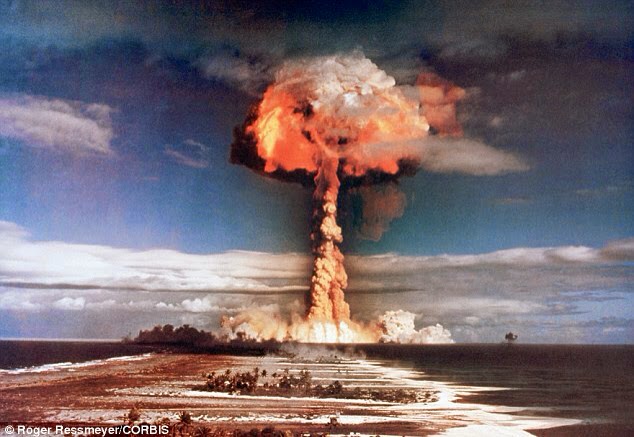
The Increasing Likelihood Of Nuclear War Should Straighten Out All Our Priorities


A Russian pilot has been killed by US-armed terrorists in Syria. The Ron Paul Institute‘s Daniel McAdams writes the following about this new development:

“The scenario where a US-backed, US-supplied jihadist group in Syria uses US weapons to shoot down a Russian plane and then murders the pilot on the ground should be seen as a near-nightmare escalation, drawing the US and Russia terrifyingly closer to direct conflict.”

McAdams is not fearmongering; he is stating a plainly obvious fact. The Trump administration has just announced that it is restructuring its nuclear weapons policy to take a more aggressive stance toward Russia than that which was held by the previous administration. This is coming after this administration’s decision to arm Ukraine against Russia, a move Obama refused to take for fear of escalating tensions with Moscow, as well as its decision to continue to occupy Syria in order to effect regime change, along with numerous other escalations. The Council on Foreign Relations, which is without exaggeration as close to the voice of the US establishment as you can possibly get, is now openly admitting that the “United States is currently in a second Cold War with Russia. Read More

Saturday, November 15, 2014

Fearing Bombs That Can Pick Whom to Kill

On a bright fall day last year off the coast of Southern California, an Air Force B-1 bomber launched an experimental missile that may herald the future of warfare.

LRAS Missile launched from B-1 bomber

Initially, pilots aboard the plane directed the missile, but halfway to its destination, it severed communication with its operators. Alone, without human oversight, the missile decided which of three ships to attack, dropping to just above the sea surface and striking a 260-foot unmanned freighter.

Warfare is increasingly guided by software. Today, armed drones can be operated by remote pilots peering into video screens thousands of miles from the battlefield. But now, some scientists say, arms makers have crossed into troubling territory: They are developing weapons that rely on artificial intelligence, not human instruction, to decide what to target and whom to kill.

As these weapons become smarter and nimbler, critics fear they will become increasingly difficult for humans to control — or to defend against. And while pinpoint accuracy could save civilian lives, critics fear weapons without human oversight could make war more likely, as easy as flipping a switch.

Britain, Israel and Norway are already deploying missiles and drones that carry out attacks against enemy radar, tanks or ships without direct human control. After launch, so-called autonomous weapons rely on artificial intelligence and sensors to select targets and to initiate an attack.

Britain’s "fire and forget" Brimstone missiles, for example, can distinguish among tanks and cars and buses without human assistance, and can hunt targets in a predesignated region without oversight. The Brimstones also communicate with one another, sharing their targets.

Armaments with even more advanced self-governance are on the drawing board, although the details usually are kept secret. "An autonomous weapons arms race is already taking place," said Steve Omohundro, a physicist and artificial intelligence specialist at Self-Aware Systems, a research center in Palo Alto, Calif. "They can respond faster, more efficiently and less predictably."

Concerned by the prospect of a robotics arms race, representatives from dozens of nations will meet on Thursday in Geneva to consider whether development of these weapons should be restricted by the Convention on Certain Conventional Weapons. Christof Heyns, the United Nations special rapporteur on extrajudicial, summary or arbitrary executions, last year called for a moratorium on the development of these weapons.

The Pentagon has issued a directive requiring high-level authorization for the development of weapons capable of killing without human oversight. But fast-moving technology has already made the directive obsolete, some scientists say.

"Our concern is with how the targets are determined, and more importantly, who determines them," said Peter Asaro, a co-founder and vice chairman of the International Committee for Robot Arms Control, a group of scientists that advocates restrictions on the use of military robots. "Are these human-designated targets? Or are these systems automatically deciding what is a target?"

Weapons manufacturers in the United States were the first to develop advanced autonomous weapons. An early version of the Tomahawk cruise missile had the ability to hunt for Soviet ships over the horizon without direct human control. It was withdrawn in the early 1990s after a nuclear arms treaty with Russia.

Back in 1988, the Navy test-fired a Harpoon antiship missile that employed an early form of self-guidance. The missile mistook an Indian freighter that had strayed onto the test range for its target. The Harpoon, which did not have a warhead, hit the bridge of the freighter, killing a crew member.

Despite the accident, the Harpoon became a mainstay of naval armaments and remains in wide use.

In recent years, artificial intelligence has begun to supplant human decision-making in a variety of fields, such as high-speed stock trading and medical diagnostics, and even in self-driving cars. But technological advances in three particular areas have made self-governing weapons a real possibility.

New types of radar, laser and infrared sensors are helping missiles and drones better calculate their position and orientation. "Machine vision," resembling that of humans, identifies patterns in images and helps weapons distinguish important targets. This nuanced sensory information can be quickly interpreted by sophisticated artificial intelligence systems, enabling a missile or drone to carry out its own analysis in flight. And computer hardware hosting it all has become relatively inexpensive — and expendable.

The missile tested off the coast of California, the Long Range Anti-Ship Missile, is under development by Lockheed Martin for the Air Force and Navy. It is intended to fly for hundreds of miles, maneuvering on its own to avoid radar, and out of radio contact with human controllers.

In a directive published in 2012, the Pentagon drew a line between semiautonomous weapons, whose targets are chosen by a human operator, and fully autonomous weapons that can hunt and engage targets without intervention.

Weapons of the future, the directive said, must be "designed to allow commanders and operators to exercise appropriate levels of human judgment over the use of force."

The Pentagon nonetheless argues that the new antiship missile is only semiautonomous and that humans are sufficiently represented in its targeting and killing decisions. But officials at the Defense Advanced Research Projects Agency, which initially developed the missile, and Lockheed declined to comment on how the weapon decides on targets, saying the information is classified.

"It will be operating autonomously when it searches for the enemy fleet," said Mark A. Gubrud, a physicist and a member of the International Committee for Robot Arms Control, and an early critic of so-called smart weapons. "This is pretty sophisticated stuff that I would call artificial intelligence outside human control."

Paul Scharre, a weapons specialist now at the Center for a New American Security who led the working group that wrote the Pentagon directive, said, "It’s valid to ask if this crosses the line."

Some arms-control specialists say that requiring only "appropriate" human control of these weapons is too vague, speeding the development of new targeting systems that automate killing.

Mr. Heyns, of the United Nations, said that nations with advanced weapons should agree to limit their weapons systems to those with "meaningful" human control over the selection and attack of targets. "It must be similar to the role a commander has over his troops," Mr. Heyns said.

Systems that permit humans to override the computer’s decisions may not meet that criterion, he added. Weapons that make their own decisions move so quickly that human overseers soon may not be able to keep up. Yet many of them are explicitly designed to permit human operators to step away from controls. Israel’s antiradar missile, the Harpy, loiters in the sky until an enemy radar is turned on. It then attacks and destroys the radar installation on its own.

Norway plans to equip its fleet of advanced jet fighters with the Joint Strike Missile, which can hunt, recognize and detect a target without human intervention. Opponents have called it a "killer robot."

Military analysts like Mr. Scharre argue that automated weapons like these should be embraced because they may result in fewer mass killings and civilian casualties. Autonomous weapons, they say, do not commit war crimes.

On Sept. 16, 2011, for example, British warplanes fired two dozen Brimstone missiles at a group of Libyan tanks that were shelling civilians. Eight or more of the tanks were destroyed simultaneously, according to a military spokesman, saving the lives of many civilians.

It would have been difficult for human operators to coordinate the swarm of missiles with similar precision.

"Better, smarter weapons are good if they reduce civilian casualties or indiscriminate killing," Mr. Scharre said. More

Editorial

Professor Samdhong Rinpoche,, a leading Tibetan academic stated recently; "Today the challenges of the modernity pose existential threat to mankind and earth itself, if not tackled adequately and immediately. The first major challenge is of VIOLENCE. Its most visible forms are war and terrorism. Then there is the systematic or system generated violence. We are neither able to see it or understand it, but its scope and spread are frightening. The present situation is such that we have no will to resist violence, unless it directly affects us. This kind of violence is market driven which necessitates perpetuation of war or its possibility. In brief the entire world today is being governed by the market forces, which are described consumeristic system". Violence, war and terrorism, along with poverty and disease are governance issues, global governance issies.

As Kofi Annan, then secretary-general of the United Nations (UN), told world leaders in 1998: "Good governance is perhaps the single most important factor in eradicating poverty and promoting development." Governance is the exercise of economic, political, and administrative authority to manage a country's affairs at all levels. Different definitions of good governance have been proposed by development organizations. The definition offered by the UN Development Programme highlights participation, accountability, transparency, consensus, sustainability, the rule of law, and the inclusion of the poorest and most vulnerable people in making decisions about allocating development resources.

All of the above are issues that we have to technology and resources to alleviate. Doing so would remove the necessity to produce weapons as described above, it could do away for the need for the military as we know it today. The world could be like Costa Rica whose military was abolished on December 1, 1948, by President José Figueres Ferrer. Our world could literally become a Paradise or Garden of Eden where peace reigned as everyones needs were fulfilled. Editor.


Monday, July 21, 2014

Life after a nuclear war revealed: Computer models reveal Earth would suffer a 20-year-long winter and worldwide famine

The terrible fate of Earth after a nuclear war has been mapped out using computer models for the first time.

Worldwide famine, deadly frosts, global ozone losses of up to 50 per cent and more would greet any inhabitants of the planet still remaining after a nuclear conflict.

And the researchers hope their study of what they call a relatively 'small' nuclear war will serve as a deterrent against such weapons being used by any nation in the future.

THE AFTERMATH OF NUCLEAR WAR ACCORDING TO THE STUDY

Year 0

Five megatons of black carbon released into the atmosphere, which absorbs sunlight and begins to cool the planet. Black carbon rain also kills millions.

Year 1

Average surface temperature drops by 1°C (2°F).

Year 2

Crop growing season is shortened by 10 to 40 days.

Year 5

Earth is an average of 1.5°C (3°F) colder than the present day, colder than it has been in 1,000 years. There is also nine per cent less rainfall. The ozone is also up to 25 per cent thinner, increasing UV rays on Earth.

Year 10

Ozone recovers slightly to just 8 per cent less than modern day.

Year 20

Planet warms slightly to 0.5°C (1°F) lower than the present day.

Year 26

Rainfall increases to about 4.5 per cent less than today.

In it the researchers looked at the outcome of a ‘limited, regional nuclear war between India and Pakistan in which each side detonates 50 15-kiloton weapons.’

They then used computer models to examine the impact on the planet and its environment - and it makes for grim reading.

The immediate result of 100 nuclear weapons roughly the size of those dropped on Hiroshima and Nagasaki being detonated would be the release of five megatons of black carbon into the atmosphere.

Black carbon, not too dissimilar to soot, would block out the sun and can also be fatal to humans.

Following a spell of black carbon rain, a deadly weather front that would devastate what remained of humanity following the nuclear war, the temperature of Earth would begin to drop.

After a year the temperature would fall by 1°C (2°F), while after five it would be 1.5°C (3°F) cooler than it is now.

About 20 years after the conflict it would warm again to just 0.5°C (1°F) below today’s temperature.

Accompanying what the researchers call ‘the coldest average surface temperatures in the last 1,000 years’ would be a huge loss in ozone levels. They say that global ozone losses of 20 to 50 per cent would occur over populated areas, ‘levels unprecedented in human history

The drop in temperature would produce ‘killing frosts’ that reduce the world’s growing season by 10 to 40 days.

Meanwhile the eradication of up to half of the ozone would increase UV rays in some locations by as much as 80 per cent, raising the chance of developing skin cancer for large swathes of humanity.

Combined with the global cooling, this ‘would put significant pressures on global food supplies and could trigger a global nuclear famine.’

The planet’s falling temperature would also decrease the amount of rainfall.

Five years after the conflict Earth would see 9 per cent less rain, while 26 years after the war there would still be 4.5 per cent less rain.

The result of all this would be devastation and ultimately death for hundreds of millions, and perhaps billions.

But the researchers hope that their example of a relatively small nuclear war between two modestly armed nuclear nations, India and Pakistan, will encourage superpowers such as the U.S. and Russia to discuss nuclear disarmament.

‘Knowledge of the impacts of 100 small nuclear weapons should motivate the elimination of more than 17,000 nuclear weapons that exist today,’ they write. More

Above: US Missile Control Centre

Sunday, January 5, 2014

Is it 1914 all over again? We are in danger of repeating the mistakes that started WWI, says a leading historian

History never repeats itself, but it sure does rhyme, it has been said. Now an internationally respected historian is warning that today's world bears a number of striking similarities with the build-up to the First World War.

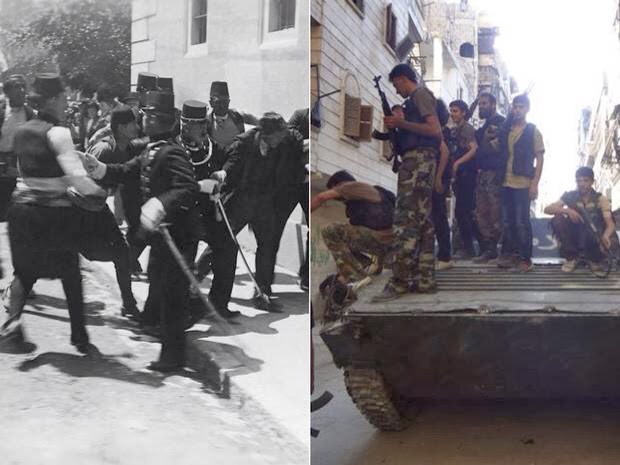
The newly mechanised armies of the early 20th century produced unprecedented slaughter on the battlefields of the "war to end all wars" after a spark lit in the Balkans with the assassination of the Austro-Hungarian Empire's Archduke Franz Ferdinand.

Professor Margaret MacMillan, of the University of Cambridge, argues that the Middle East could be viewed as the modern-day equivalent of this turbulent region. A nuclear arms race that would be likely to start if Iran developed a bomb "would make for a very dangerous world indeed, which could lead to a recreation of the kind of tinderbox that exploded in the Balkans 100 years ago – only this time with mushroom clouds," she writes in an essay for the Brookings Institution, a leading US think-tank.

"While history does not repeat itself precisely, the Middle East today bears a worrying resemblance to the Balkans then," she says. "A similar mix of toxic nationalisms threatens to draw in outside powers as the US, Turkey, Russia, and Iran look to protect their interests and clients."

Professor MacMillan highlights a string of other parallels between today and a century ago. Modern-day Islamist terrorists mirror the revolutionary communists and anarchists who carried out a string of assassinations in the name of a philosophy that sanctioned murder to achieve their vision of a better world. And in 1914, Germany was a rising force that sought to challenge the pre-eminent power of the time, the UK. Today, the growing power of China is perceived as a threat by some in the US.

Transitions from one world power to another are always seen as dangerous times. In the late 1920s, the US drew up plans for a war with the British Empire that would have seen the invasion of Canada, partly because it was assumed conflict would break out as America took over as the world's main superpower.

Professor MacMillan, whose book The War That Ended Peace was published last year, said right-wing and nationalist sentiments were rising across the world and had also been a factor before the First World War

In China and Japan, patriotic passions have been inflamed by the dispute over a string of islands in the East China Sea, known as the Senkakus in Japan and Diaoyus in China. "Increased Chinese military spending and the build-up of its naval capacity suggest to many American strategists that China intends to challenge the US as a Pacific power, and we are now seeing an arms race between the two countries in that region," she writes in her essay. "The Wall Street Journal has authoritative reports that the Pentagon is preparing war plans against China – just in case."

The US has a mutual self-defence treaty with Japan and in 2012 it specifically confirmed that this covered the Senkaku Islands. In November, China set up an "air defence" zone over the islands and a few days later two American B-52 bombers flew over the islands in defiance of Beijing.

"It is tempting – and sobering –to compare today's relationship between China and the US with that between Germany and England a century ago," Professor MacMillan writes. She points to the growing disquiet in the US over Chinese investment in America while "the Chinese complain that the US treats them as a second-rate power".

Another similarity highlighted by the historian is the belief that a full-scale war between the major powers is unthinkable after such a prolonged period of peace. "Now, as then, the march of globalisation has lulled us into a false sense of safety," she says. "The 100th anniversary of 1914 should make us reflect anew on our vulnerability to human error, sudden catastrophes, and sheer accident.

"Instead of muddling along from one crisis to another, now is the time to think again about those dreadful lessons of a century ago in the hope that our leaders, with our encouragement, will think about how they can work together to build a stable international order." More


Sunday, October 27, 2013

We're one 'Oops' away from Armageddon

Out of America: The greatest threat to the US from atomic weapons is accidental detonation. And, worryingly, it has nearly happened.

Let's start with a simple, astounding fact. In the 68 years after Hiroshima and Nagasaki, apart from scheduled nuclear tests, not a single nuclear warhead has exploded. The remarkable thing is not that nuclear weapons have never featured in a hot war. Basic human sanity – awareness of the devastation that would be caused by today's far more powerful devices – has ensured that. What is truly astonishing is that since 1945, no nuclear weapon has gone off by accident.

Today the topic, here in the United States or among the original nuclear powers, seems almost irrelevant. We take atomic weapons for granted. Not so perhaps in the Middle East, or in the Indian subcontinent, or North Korea. But we British, Americans, Russians, French, and Chinese have virtually forgotten about them, certain they will never be used in anger.

Not that they no longer exist. The US, according to the Center for Arms Control and Non-Proliferation here in Washington, currently has around 4,650 strategic missiles, 1,950 of which are deployed, the rest on stand-by. No figures are published, but upkeep, support and modernisation of the nuclear force reputedly costs at least $50bn (£31bn) a year.

Drive across the plains of North Dakota, Wyoming or Montana, and you might notice the odd small gravelled area by the road, with some gadgets protruding from the earth, protected by barbed wire and ferocious "Keep Off" signs. You might think it is an electricity sub-station. In fact you are passing one of 450 concrete silos on the northern plains that contain a Minuteman III intercontinental ballistic missile (ICBM) with a single warhead, each capable of obliterating Hiroshima 27 times over.

That however is as physically close as ordinary punters will ever come to America's nuclear deterrent. The rest is aboard bombers within the sealed perimeters of vast air force bases, or hidden beneath the ocean on 14 Trident submarines – out of sight, and entirely out of mind.

But it was not always thus. If you want an idea of what might have been, read Eric Schlosser's enthralling Command and Control, that weaves together the post-1945 history of the US deterrent with a frame-by-frame recreation of the country's most celebrated brush with accidental Armageddon.

It happened back on 18 September 1980 at a missile silo in rural Arkansas. The silo contained a Titan II fitted with a W-53 warhead, the most potent in the US arsenal, with a 9-megaton yield, 600 times more than Hiroshima.

A worker doing routine maintenance dropped a spanner that fell into the silo and ruptured the missile's fuel tank. Fumes swiftly built up in the confined space. Nine hours later the Titan II blew up, utterly destroying the silo and sending its 740-ton launch closure door spinning into the night sky and depositing the warhead 50 yards away. The safety devices held and it didn't go off, but one person was killed and 29 injured. Local residents had been evacuated – but much difference that would have made, had the worst occurred.

In his researches, however, Schlosser unearthed a yet more terrifying nuclear near miss, 19 years earlier. In January 1961, a B-52 carrying two hydrogen bombs broke up in midair over North Carolina. The bombs came to earth amid the wreckage, and on one of them three out of four automatic arming mechanisms had gone ahead. Only a last safety switch held, preventing a calamity that would have wiped out or rendered uninhabitable much of the East Coast. In comparison, the Cuban missile crisis was a virtual non-event.

And this was just one of at least 700 significant "incidents" between 1950 and 1968 in the US. You wonder how many others went unreported. Imagine, too, the brushes with disaster there must have been in the Soviet Union during the period. But as far as we know, none ever produced an accidental, full-scale nuclear detonation.

Since then, thanks to diminishing stockpiles and improved safety procedures, such "incidents" have been far fewer. But never rule out the human factor. Somehow, for example, in contravention of rules set in place after North Carolina, six cruise missiles fitted with live nuclear warheads were carried on a flight in 2007 from North Dakota to Louisiana without authorisation. Apparently, loaders confused dummy warheads with the real thing.

And even in these past couple of weeks, human frailties have made one wonder. In one bizarre episode, the three-star admiral who was the second ranking officer at US Strategic Command, whose brief includes the country's nuclear strike forces, was removed from duty after being caught using counterfeit poker chips at a casino at Council Bluffs, Iowa just across the river from Strategic Command's HQ at Offutt Air Force base in Omaha Nebraska.

A few days earlier, Major General Michael Carey was sacked from his command of the 20th Air Force, responsible for those Minuteman III missile silos in North Dakota, Wyoming and Montana, and their launch centres. Both instances involved "unfortunate personal behaviour", a senior Pentagon official told the Associated Press news agency, stressing however that the country's nuclear deterrent force was "safe, secure and effective".

But new revelations last week make one wonder. Earlier this year, two of the three nuclear wings under the 20th Air Force performed badly in a safety and security inspection, and 17 military personnel were made to undergo retraining. Moreover, on two occasions doors to launch control centres were left unlocked, in breach of regulations, AP reported – on one occasion when an on-site food order was being delivered. Of course the guy from Domino's Pizza can't just wander in off the street and press the button, but even so ….

Such is the surreal banality of America's nuclear weapons today. No wonder morale is said to be poor at the ICBM sites, in the rearmost line of battle, of a war that will never be fought. Back in the 1960s, 1970s and 1980s, at the height of the Cold War, the greatest nuclear threat to America was accidental detonation of an American weapon. That remains the case now. Let's hope the dumb luck holds. More


Thursday, October 3, 2013

Diary by Patrick Cockburn

The media that failed woefully in their coverage of Afghanistan, Iraq and Libya are the media that we are supposed now to believe are giving us the unvarnished truth in Syria.

Patrick Cockburn points out some of the reasons why we shouldn't trust journalists' war coverage.
He also makes some good points about how war's greater exposure in the modern media often changes the nature of the fighting for the worse. Jonathan Cook - Journalist

The four wars fought in Afghanistan, Iraq, Libya and Syria over the past 12 years have all involved overt or covert foreign intervention in deeply divided countries. In each case the involvement of the West exacerbated existing differences and pushed hostile parties towards civil war. In each country, all or part of the opposition have been hard-core jihadi fighters. Whatever the real issues at stake, the interventions have been presented as primarily humanitarian, in support of popular forces against dictators and police states. Despite apparent military successes, in none of these cases have the local opposition and their backers succeeded in consolidating power and establishing stable states.

More than most armed struggles, the conflicts have been propaganda wars in which newspaper, television and radio journalists played a central role. In all wars there is a difference between reported news and what really happened, but during these four campaigns the outside world has been left with misconceptions even about the identity of the victors and the defeated. In 2001 reports of the Afghan war gave the impression that the Taliban had been beaten decisively even though there had been very little fighting. In 2003 there was a belief in the West that Saddam Hussein’s forces had been crushed when in fact the Iraqi army, including the units of the elite Special Republican Guard, had simply disbanded and gone home. In Libya in 2011 the rebel militiamen, so often shown on television firing truck-mounted heavy machine-guns in the general direction of the enemy, had only a limited role in the overthrow of Muammar Gaddafi, which was mostly brought about by Nato air strikes. In Syria in 2011 and 2012 foreign leaders and journalists repeatedly and vainly predicted the imminent defeat of Bashar al-Assad.

These misperceptions explain why there have been so many surprises and unexpected reversals of fortune. The Taliban rose again in 2006 because it hadn’t been beaten as comprehensively as the rest of the world imagined. At the end of 2001 I was able to drive – nervously but safely – from Kabul to Kandahar, but when I tried to make the same journey in 2011 I could go no further south on the main road than the last police station on the outskirts of Kabul. In Tripoli two years ago hotels were filled to capacity with journalists covering Gaddafi’s fall and the triumph of the rebel militias. But state authority still hasn’t been restored. This summer Libya almost stopped exporting oil because the main ports on the Mediterranean had been seized by mutinying militiamen, and the prime minister, Ali Zeidan, threatened to bomb ‘from the air and the sea’ the oil tankers the militiamen were using to sell oil on the black market.

Libya’s descent into anarchy was scarcely covered by the international media since they had long since moved on to Syria, and more recently Egypt. Iraq, home a few years ago to so many foreign news bureaux, has also dropped off the media map although up to a thousand Iraqis are killed each month, mostly as a result of the bombing of civilian targets. When it rained for a few days in Baghdad in January the sewer system, supposedly restored at a cost of $7 billion, couldn’t cope: some streets were knee-deep in dirty water and sewage. In Syria, many opposition fighters who had fought to defend their communities turned into licensed bandits and racketeers when they took power in rebel-held enclaves.

It wasn’t that reporters were factually incorrect in their descriptions of what they had seen. But the very term ‘war reporter’, though not often used by journalists themselves, helps explain what went wrong. Leaving aside its macho overtones, it gives the misleading impression that war can be adequately described by focusing on military combat. But irregular or guerrilla wars are always intensely political, and none more so than the strange stop-go conflicts that followed from 9/11. This doesn’t mean that what happened on the battlefield was insignificant, but that it requires interpretation. In 2003 television showed columns of Iraqi tanks smashed and on fire after US air strikes on the main highway north of Baghdad. If it hadn’t been for the desert background, viewers could have been watching pictures of the defeated German army in Normandy in 1944. But I climbed into some of the tanks and could see that they had been abandoned long before they were hit. This mattered because it showed that the Iraqi army wasn’t prepared to fight and die for Saddam. It was a pointer too to the likely future of the allied occupation. Iraqi soldiers, who didn’t see themselves as having been defeated, expected to keep their jobs in post-Saddam Iraq, and were enraged when the Americans dissolved their army. Well-trained officers flooded into the resistance, with devastating consequences for the occupying forces: a year later the Americans controlled only islands of territory in Iraq.

War reporting is easier than other types of journalism in one respect because the melodrama of events drives the story and attracts an audience. It may be risky at times, but the correspondent talking to camera, with exploding shells and blazing military vehicles behind him, knows his report will feature high up in any newscast. ‘If it bleeds it leads,’ is an old American media adage. The drama of battle inevitably dominates the news, but oversimplifies it by disclosing only part of what is happening. These oversimplifications were more than usually gross and deceptive in Afghanistan and Iraq, when they dovetailed with political propaganda that demonised the Taliban and later Saddam as evil incarnate, casting the conflict – particularly easy in the US in the hysterical atmosphere after 9/11 – as a black and white struggle between good and evil. The crippling inadequacies of the opposition were ignored.

By 2011 the complexity of the conflicts in Iraq and Afghanistan was evident to journalists in Baghdad and Kabul if not necessarily to editors in London and New York. But by then the reporting of the wars in Libya and Syria was demonstrating a different though equally potent form of naivety. A version of the spirit of 1968 prevailed: antagonisms that predated the Arab Spring were suddenly said to be obsolete; a brave new world was being created at hectic speed. Commentators optimistically suggested that, in the age of satellite television and the internet, traditional forms of repression – censorship, imprisonment, torture, execution – could no longer secure a police state in power; they might even be counter-productive. State control of information and communication had been subverted by blogs, satellite phones and even the mobile phone; YouTube provided the means to expose in the most graphic and immediate way the crimes and violence of security forces. More

Tuesday, October 1, 2013

The Forgotten War:12 Years In Afghanistan Down The Memory Hole

Will the U.S. still be meddling in Afghanistan 30 years from now? If history is any guide, the answer is yes. And if history is any guide, three decades from now most Americans will have only the haziest idea why.

Since the 1950s, the U.S. has been trying to mold that remote land to its own desires, first through an aid “war” in the midst of the Cold War with the Soviet Union; then, starting as the 1970s ended, an increasingly bitter and brutally hot proxy war with the Soviets meant to pay them back for supporting America’s enemies during the war in Vietnam. One bad war leads to another.

From then until the early 1990s, Washington put weapons in the hands of Islamic fundamentalist extremists of all sorts -- thought to be natural, devoutly religious allies in the war against “godless communism” -- gloated over the Red Army’s defeat and the surprising implosion of the Soviet empire, and then experienced its own catastrophic blowback from Afghanistan on September 11, 2001. After 50 years of scheming behind the scenes, the U.S. put boots on the ground in 2001 and now, 12 years later, is still fighting there -- against some Afghans on behalf of other Afghans while training Afghan troops to take over and fight their countrymen, and others, on their own.

Through it all, the U.S. has always claimed to have the best interests of Afghans at heart -- waving at various opportune moments the bright flags of modernization, democracy, education, or the rights of women. Yet today, how many Afghans would choose to roll back the clock to 1950, before the Americans ever dropped in? After 12 years of direct combat, after 35 years of arming and funding one faction or another, after 60 years of trying to remake Afghanistan to serve American aims, what has it all meant? If we ever knew, we’ve forgotten. Weary of official reports of progress, Americans tuned out long ago.

Back in 1991, as Steve Coll reports in Ghost Wars, an unnamed CIA agent mentioned the war in Afghanistan to President George H.W. Bush. Not long before, he had okayed the shipment of Iraqi weaponry captured in the first Gulf War -- worth $30 million -- to multiple factions of Islamist extremists then battling each other and probably using those secondhand Iraqi arms to destroy Afghanistan’s capital, Kabul. Still, Bush seemed puzzled by the CIA man’s question about the war. He reportedly asked, “Is that thing still going on?”

Such forgetfulness about wars has, it seems, become an all-American skill. Certainly, the country has had little trouble forgetting the war in Iraq, and why should Afghanistan be any different? Sure, the exit from that country is going to take more time and effort. No seacoast, no ships, bad roads, high tolls, IEDs. Trucking stuff out is problematic; flying it out, wildly expensive, especially since a lot of the things are really, really big. Take MRAPs, for example -- that’s Mine-Resistant Ambush-Protected vehicles -- 11,000 of them, weighing 14 tons or more apiece. For that workhorse transport plane, the C-17, a full load of MRAPs numbers only four.

The equipment inventory keeps changing, but estimates run to 100,000 shipping containers and about 50,000 vehicles to be removed by the end of 2014, adding up to more than $36 billion worth of equipment now classified as “retrograde.” The estimated shipping bill has quickly risen to $6 billion, and like the overall cost of the war, it is sure to keep rising.

Seven billion dollars worth of equipment -- about 20% of what the U.S. sent in to that distant land -- is simply being torn up, chopped down, split, shredded, stomped, and, when possible, sold off for scrap at pennies a pound. Toughest to break up are the weighty MRAPs. Introduced in 2007 at a cost of $1 million apiece to counteract deadly roadside bombs, they were later discovered to be no better at protecting American soldiers than the cheaper vehicles they replaced. Of the 11,000 shipped to Afghanistan, 2,000 are on the chopping block, leaving a mere 9,000 to be flown to Kuwait, four at a time, and shipped home or “repositioned” elsewhere to await some future enemy.

The military is not exaggerating when it calls this colossal destruction of surplus equipment historic. A disposal effort on this scale is unprecedented in the annals of the Pentagon. The centerpiece of this demolition derby may be the brand-new, 64,000-square-foot, $34-million, state-of-the art command center completed in Helmand Province just as most U.S. troops left, and now likely to be demolished. Or the new $45 million facility in Kandahar built as a repair center for armored vehicles, now used for their demolition, and probably destined to follow them. Taxpayers may one day want to ask some questions about such profligate and historic waste, but it’s sure to keep arms manufacturers happy, resupplying the military until we can get ourselves into another full-scale war.

So this exit is a really big job, and that’s without even mentioning the paperwork. All those exit plans, all the documents to be filed with the Afghan government for permission to export our own equipment, all the fines assessed for missing customs forms (already running to $70 million), all the export fees to be paid, and the bribes to be offered, and the protection money to be slipped to the Taliban so our enemies won’t shoot at the stuff being trucked out. All that takes time.

But when it comes right down to it, the United States has a surefire way of ending a war, no matter when it actually ends (or doesn’t). When we say it’s over, it’s over.

Enduring Operation Enduring Freedom

As it happens, things probably won’t be quite so decisively “over” for everybody. More