Showing posts with label Hiroshima. Show all posts

Saturday, August 1, 2015

Nuclear Nonproliferation

Our 70th Anniversary Homework: Confronting the Myths and Learning the Lessons of Hiroshima and Nagasaki.

Seventy years ago, two nuclear weapons targeted against cities which met the criteria of having “densely packed workers’ homes,” killed more than 200,000 people in the Japanese cities of Hiroshima and Nagasaki. In the years that have followed, many more have suffered and died from cancers, radiation disease, genetic damage and other fallout from the atom bombings.

The myths that the A-bombings were necessary to end the war against Japan and that they saved the lives of half a million US troops remain widely believed. The myths serve as the ideological foundation for continuing U.S. preparations for nuclear war, which in turn has served as the primary driver of nuclear weapons proliferation and the creation of deterrent nuclear arsenals

It is no accident that this wartime propaganda took on a life of its own. Japanese and other journalists’ film footage and photos of the devastation wrought by the A-bombs taken within days of the A-bombings, were seized by U.S. Occupation forces and were locked away in Pentagon vaults for more than two decades. In 1995, the Smithsonian Museum’s initially excellent 50th anniversary exhibition was censored beyond recognition to prevent people from seeing what the A-bombs inflicted on human beings. Also removed were the facts that U.S. Secretary of War Stimson had advised Truman that Japan’s surrender “could be arranged on terms acceptable to the United States” without the atom bombings. (That arrangement was later deemed acceptable – even necessary – by U.S. military occupation authorities.) Indeed, before it was sterilized, the exhibit included quotations from senior US wartime military leaders including Admiral Leahy and General (later President) Eisenhower who thought, “It wasn’t necessary to hit [Japanese] with that awful thing.”

Scholars now know that numerous factors contributed to Truman’s decision to destroy Hiroshima and Nagasaki and their civilian populations. These include Truman’s political calculations as he looked to the 1948 presidential election, vengeance, racism, institutional inertia, and the callousness that came with already having burned more than sixty Japanese cities to the ground.

But, as General Leslie Groves, the commander of the Manhattan Project, told senior scientist Joseph Rotblat, the bombs came to be designed for the Soviet Union. The determinative reasons for the A-bombings were to bring the war to an immediate end so that the US could avoid sharing influence with the USSR in Northern China, Manchuria and Korea and to intimidate Stalin and other Soviet leaders by demonstrating the apocalyptic power of nuclear weapons and Washington’s willingness to use them – even against civilians. Little Boy and Fat Man, as the bombs were named, announced the beginning of the Cold War.

Americans also continue to suffer from the misconception that nuclear weapons have not been used since the Nagasaki A-bombing on August 9, 1945. In fact, the US, and to a lesser degree the other nuclear powers, have repeatedly used their nuclear arsenals. Long ago, Daniel Ellsberg, a senior Pentagon nuclear war planner for Presidents Kennedy, Johnson and Nixon, explained that the US has repeatedly used nuclear weapons “in the way that you use a gun when you point it at someone’s head in a confrontation….whether or not you pull the trigger...[and] You’re also using it when you have it on your hip ostentatiously.” During wars and international crises, the US has prepared and/or threatened to initiate nuclear war on at least thirty occasions - at least 15 times during the Korean and Vietnam Wars and crises with China, and at least 10 times to reinforce US Middle East hegemony. And each of the other eight nuclear powers has made such threats or preparations at least once.

Eric Schlosser, author of Command and Control, reported last December to the International Conference on the Consequences of Nuclear Weapons, attended by representatives of 158 governments that luck, not state policies and regulations, best explains why humanity has survived nuclear blackmail, reckless dependence on deterrence, miscalculations and nuclear accidents.

Still more sobering are the recent scientific studies demonstrating that even a “small” exchange of 50-100 nuclear weapons targeted against cities would result in fires, smoke that would cause global cooling, and up to two billion deaths from famine.

All of which lead to a series of existential questions: As we race against time to save our civilizations from the impending ravages of climate change, why are our governments preparing to inflict nuclear annihilation? Why do we tolerate the continued deployment and stockpiling of nearly 16,000 nuclear weapons, 90% of them in U.S. and Russian arsenals? Why have the P-5 nuclear powers (US, Russia, Britain, France and China) refused to implement their 45 year-old Nuclear Non-Proliferation Treaty (NPT) obligation to begin negotiations for the complete elimination of their nuclear arsenals? And why did the US condemn this past spring’s NPT Review Conference to failure by refusing to honor its long-standing commitment to co-convene a conference to lay the foundations for a nuclear weapons and weapons of mass destruction-free zone in the Middle East?

There are high costs to denying history and reality. In a worst case scenario, the failure of the US and the other nuclear powers to heed the warning of A-bomb survivors that human beings and nuclear weapons cannot coexist is the end to life on earth as we know it.

The majority of the world’s governments are not in similar denial. The NPT Review Conference’s one achievement was the commitment of the vast majority of the world’s governments the Humanitarian Pledge. Initiated by Austria, 113 governments pledged “to cooperate with all relevant stakeholders, states, international organizations, the Red Cross and Red Crescent Movement, parliamentarians and civil society, in efforts to stigmatize, prohibit and eliminate nuclear weapons in light of their unacceptable humanitarian consequences and associated risks.” The gulf between the non-nuclear weapons states and the nuclear powers has widened, and in time the former may use their economic, political and other power in the struggle to secure humanity’s future.

On August 6, many in Japan will appreciate the silent presence of U.S. Ambassador Caroline Kennedy at Hiroshima’s official 70th anniversary commemoration, but there will be no apology. And, even as we celebrate and work for the implementation of the nuclear deal with Iran, the sorry truth is that the US is now on track to spend one trillion dollars to “modernize” its nuclear arsenal and delivery systems, with the other nuclear powers following the U.S. lead. And, despite his pledge in Prague, President Obama has retired fewer nuclear weapons that any other US post-Cold War President.

As the US-Russian confrontation, marked by implicit and explicit nuclear threats remids us, we are living on borrowed time. Seventy years after the Hiroshima and Nagasaki A-bombings, human survival still hanging in the balance. Midst the carnival of the 2016 presidential election, let us insist that those who seek to rule us and the world finally learn the lessons of Hiroshima and Nagasaki: Never again to anyone! No more Hiroshimas! No More Nagasakis! No more nuclear weapons!


Friday, August 8, 2014

Hiroshima and Nagasaki: The many retrospectives

Sixty-nine years ago, at 8:15 in the morning on August 6, the first atomic bomb exploded over Hiroshima. Three days later, another bomb was dropped on Nagasaki.

Estimates vary as to the number of people who died in those blasts, but the figure of at least 130,000 deaths for Hiroshima seems to be generally accepted, with another 70,000 for Nagasaki as of surveys conducted in November 1945.

With the anniversaries of those events have come many news and comment stories in the press. But how best to put the bombings into perspective, especially after so much time has passed? The problem—to loosely paraphrase Joseph Stalin, no stranger to death on an industrial scale—is that “one death is a tragedy, while a million deaths is a statistic.” (This is particularly true when dealing with dry analytical reports about security, which inevitably use phrases like “collateral damage,” “kilotons,” and “battlefield scenarios”—masking the fact that there are large numbers of very real human lives involved on the receiving end of a nuclear weapon.)

Consequently, some of the most powerful and compelling articles about the atomic bombing bring things back to the individual, dealing with just a single person and the most intimate, small details of his or her life at the moment of the bombing, as shown in this BBC multimedia piece on Hiroshima survivor Shinji Mikamo. For example, after the blast, while looking through the ruins of his family home, Mikamo found his father’s watch, which had stopped at precisely 8:15 am. In Mikamo’s words: “The unimaginable intense heat that reached several thousand degrees Fahrenheit from the blast had fused the shadows of the hands into the face of the timepiece, slightly displaced, leaving distinct marks where the hands had been at the moment of the explosion. It was enough to clearly see the exact moment the watch stopped.”

Other articles, such as this one in the Washington Post, tried a different approach to bring home the horror of the blasts. It focuses on a large and well-known symbol of the bombing: the dome of a concrete-and-steel structure that was one of the few buildings to survive the atomic blast in 1945. Now known as theHiroshima Peace Memorial, the building has become the epicenter of yearly memorials and services to remember the victims. Through the use of the article’s slide show, readers can see the dome as it looked immediately after the blast, and again over the years, until today. The memorial itself contains a museum with artifacts, exhibitions, and first-person survivor, or hibakusha, accounts.

There is something about seeing or hearing something first-hand, on-site; it really makes an impression. Knowing this, the mayor of Hiroshima asked leaders of nuclear-armed nations to see for themselves atomic bomb-scarred cities. “If you do, you will be convinced that nuclear weapons are an absolute evil that must no longer be allowed to exist,” Kazumi Matsui was quoted as saying by ABC News.

Not that there is anything wrong with standing back and taking a look at the big picture. Some media outlets have used the anniversary as an occasion to pause and think about nuclear weapons, such as thisTime magazine piece by Harvard's Elaine Scarry, which notes: “An appropriate way to reflect on these events might be to contemplate our current nuclear arsenal and ask why it is being kept in place. The U.S. has by far the most powerful arsenal on Earth. Our 14 Ohio-class submarines together carry the equivalent of at least 56,000 Hiroshima blasts. These ships are not a remnant of the Cold War. Eight were made after the opening of the Berlin Wall during the presidencies of George H.W. Bush and Bill Clinton.”

Over the years, of course, the Bulletin of Atomic Scientists has published its own rich lode of material—from all viewpoints—on the bombings of Hiroshima and Nagasaki. Highlights include The Sanctification of Hiroshima, a 1985 piece in which a physicist affiliated with the Manhattan Project supports the Hiroshima but not the Nagasaki bombing.

Meanwhile, John E. Coggle’s 1982 review of the 600-page book Hiroshima and Nagasaki: the Physical, Medical, and Social Effects of the Atomic Bombings, by The Committee for the Compilation of Materials on Damage Caused by the Atomic Bombs hews to a different perspective. Drawing on his background as a medical doctor, Coggle went over the informative, technical prose and the 200 statistical tables, diagrams, maps, and photographs that graphically depict the effects of thermal radiation, the shock wave and ionizing radiation, short-term and long-term biological effects, and the social and psychological impacts. Coggle used the phrase “encyclopedia of horror” to describe the book’s un-nerving but necessary content, noting: “As a radiation biologist one sees the words ‘Hiroshima and Nagasaki’ quite frequently but only in the arid academic context of science…”

At the end of the day, it can be worthwhile on the Hiroshima and Nagasaki anniversaries to think about the personal and the emotional—while keeping such clinical data in mind and ready to hand when it is necessary to debate proponents of ideas such as “battlefield nuclear weapons,” “limited nuclear war,” and the use of select nuclear strikes as a form of “de-escalation.”

Therefore, perhaps the most compelling of the stories in the Bulletin archive is a first-person recollection,Hiroshima Memories, by Hideko Tamura Friedman, who was just a young girl back on August 6, 1945. After moving to the United States and becoming a therapist in private practice and a part-time social worker in the Radiation Oncology Department at the University of Chicago Hospitals, Hideko excerpted this 1995 article from a longer, unpublished manuscript she was working on.

Hideko describes how she was reading a book when “a huge band of white light fell from the sky down to the trees.” She jumped up and hid behind a large pillar as an explosion shook the earth and pieces of the roof fell about her.

Hideko survived; some members of her family did not. “My father,” she wrote in in a heart-rending statement of fact, “brought Mama’s ashes home in his army handkerchief.”

Editor’s note: The Bulletin’s archives from 1945 to 1998, complete with the original covers and artwork, can be found here. http://books.google.ca/books?id=-wsAAAAAMBAJ&source=gbs_all_issues_r&cad=1. Anything after 1998 can be found via the search engine on the Bulletin’s home page.


Tuesday, August 5, 2014

Noam Chomsky, Why National Security Has Nothing to Do With Security

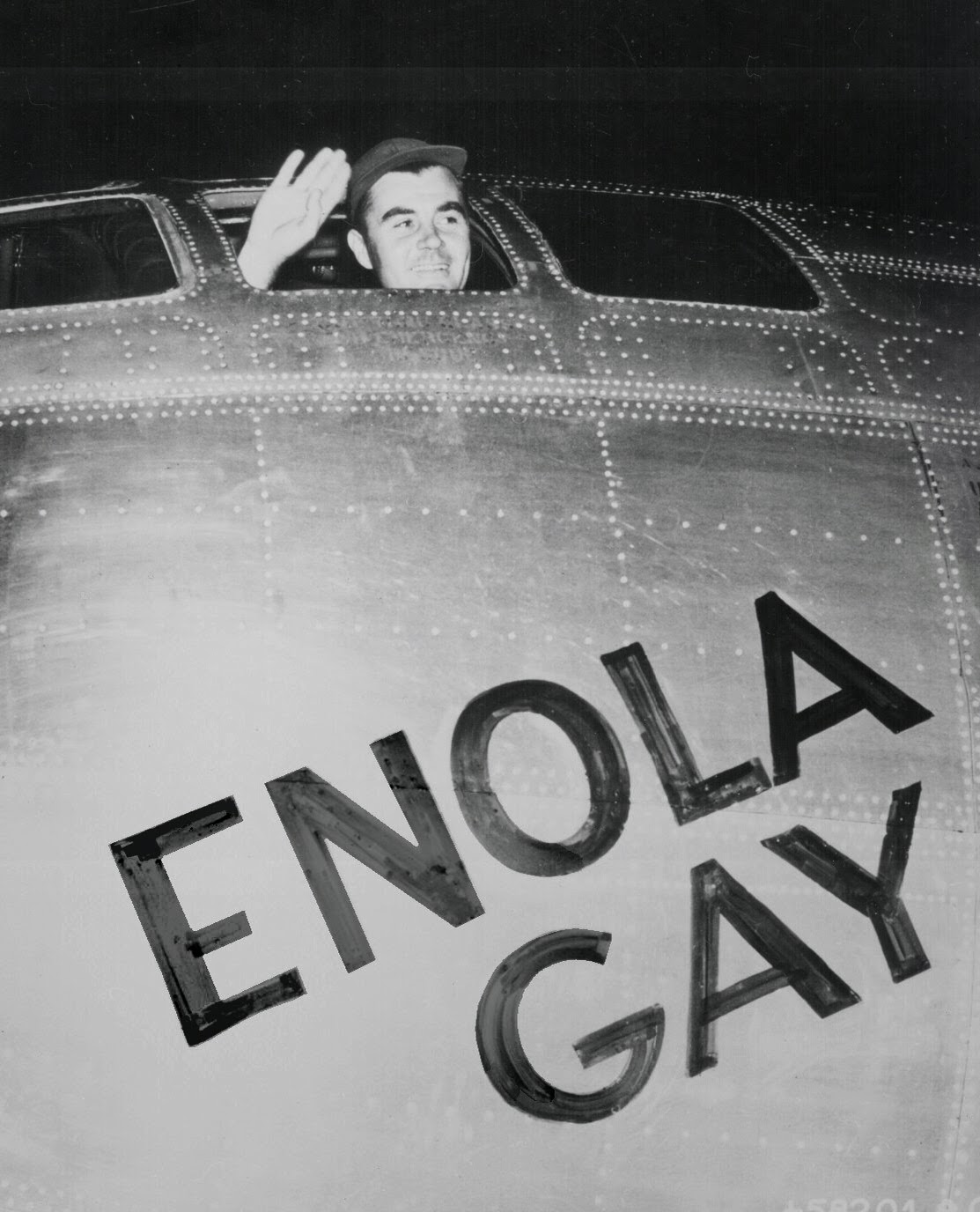
Think of it as the true end of the beginning. Last week, Theodore "Dutch" Van Kirk, the final member of the 12-man crew of the Enola Gay, the plane (named after its pilot’s supportive mother) that dropped the atomic bomb on Hiroshima, died at age 93.

Paul Tibbetts, Jr. in cockpit

When that first A-bomb left its bomb bay at 8:15 on the morning of August 6, 1945, and began its descent toward its target, the Aioli (“Live Together”) Bridge, it was inscribed with a series of American messages, some obscene, including “Greetings to the Emperor from the men of the Indianapolis.” (That ship had delivered to the Pacific island of Tinian parts of the very bomb that would turn Hiroshima into an inferno of smoke and fire -- “that awful cloud,” Paul Tibbetts, Jr., theEnola Gay's pilot, would call it -- and afterward was torpedoed by a Japanese submarine with the loss of hundreds of sailors.)

The bomb, dubbed Little Boy, that had gestated in the belly of the Enola Gay represented not only the near endpoint of a bitter global war of almost unimaginable destruction, but the birthing of something new. The way for its use had been paved by an evolution in warfare: the increasing targeting of civilian populations from the air (something that can be seen again today in the carnage of Gaza). The history of that grim development extends from German airship bombings of London (1915) by way of Guernica (1937), Shanghai (1937), and Coventry (1940), to the fire bombings of Dresden (1945) and Tokyo (1945) in the last year of World War II. It even had an evolutionary history in the human imagination, where for decades writers (among others) had dreamed of the unparalleled release of previously unknown forms of energy for military purposes.

On August 7, 1945, a previous age was ending and a new one was dawning. In the nuclear era, city-busting weapons would be a dime a dozen and would spread from the superpowers to many other countries, including Great Britain, China, India, Pakistan, North Korea, and Israel. Targeted by the planet’s major nuclear arsenals would be the civilian inhabitants not just of single cities but of scores and scores of cities, even of the planet itself. On August 6th, 70 years ago, the possibility of the apocalypse passed out of the hands of God or the gods and into human hands, which meant a new kind of history had begun whose endpoint is unknowable, though we do know that even a “modest” exchange of nuclear weapons between India and Pakistan would not only devastate South Asia, but thanks to the phenomenon of nuclear winter also cause widespread famine on a planetary scale.

In other words, 70 years later, the apocalypse is us. Yet in the United States, the only nuclear bomb you're likely to read about is Iran’s (even though that country possesses no such weapon). For a serious discussion of the U.S. nuclear arsenal, those more than 4,800 increasingly ill-kept weapons that could incinerate several Earth-sized planets, you need to look not to the country’s major newspapers or news programs but to comic John Oliver -- or TomDispatch regular Noam Chomsky. Tom

How Many Minutes to Midnight?
Hiroshima Day 2014

If some extraterrestrial species were compiling a history of Homo sapiens, they might well break their calendar into two eras: BNW (before nuclear weapons) and NWE (the nuclear weapons era). The latter era, of course, opened on August 6, 1945, the first day of the countdown to what may be the inglorious end of this strange species, which attained the intelligence to discover the effective means to destroy itself, but -- so the evidence suggests -- not the moral and intellectual capacity to control its worst instincts.

Day one of the NWE was marked by the “success” of Little Boy, a simple atomic bomb. On day four, Nagasaki experienced the technological triumph of Fat Man, a more sophisticated design. Five days later came what the official Air Force history calls the “grand finale,” a 1,000-plane raid -- no mean logistical achievement -- attacking Japan’s cities and killing many thousands of people, with leaflets falling among the bombs reading “Japan has surrendered.” Truman announced that surrender before the last B-29 returned to its base.

Those were the auspicious opening days of the NWE. As we now enter its 70th year, we should be contemplating with wonder that we have survived. We can only guess how many years remain.

Some reflections on these grim prospects were offered by General Lee Butler, former head of the U.S. Strategic Command (STRATCOM), which controls nuclear weapons and strategy. Twenty years ago, he wrote that we had so far survived the NWE “by some combination of skill, luck, and divine intervention, and I suspect the latter in greatest proportion.”

Reflecting on his long career in developing nuclear weapons strategies and organizing the forces to implement them efficiently, he described himself ruefully as having been “among the most avid of these keepers of the faith in nuclear weapons.” But, he continued, he had come to realize that it was now his “burden to declare with all of the conviction I can muster that in my judgment they served us extremely ill.” And he asked, “By what authority do succeeding generations of leaders in the nuclear-weapons states usurp the power to dictate the odds of continued life on our planet? Most urgently, why does such breathtaking audacity persist at a moment when we should stand trembling in the face of our folly and united in our commitment to abolish its most deadly manifestations?”

He termed the U.S. strategic plan of 1960 that called for an automated all-out strike on the Communist world “the single most absurd and irresponsible document I have ever reviewed in my life.” Its Soviet counterpart was probably even more insane. But it is important to bear in mind that there are competitors, not least among them the easy acceptance of extraordinary threats to survival.

Survival in the Early Cold War Years

According to received doctrine in scholarship and general intellectual discourse, the prime goal of state policy is “national security.” There is ample evidence, however, that the doctrine of national security does not encompass the security of the population. The record reveals that, for instance, the threat of instant destruction by nuclear weapons has not ranked high among the concerns of planners. That much was demonstrated early on, and remains true to the present moment.

In the early days of the NWE, the U.S. was overwhelmingly powerful and enjoyed remarkable security: it controlled the hemisphere, the Atlantic and Pacific oceans, and the opposite sides of those oceans as well. Long before World War II, it had already become by far the richest country in the world, with incomparable advantages. Its economy boomed during the war, while other industrial societies were devastated or severely weakened. By the opening of the new era, the U.S. possessed about half of total world wealth and an even greater percentage of its manufacturing capacity.

There was, however, a potential threat: intercontinental ballistic missiles with nuclear warheads. That threat was discussed in the standard scholarly study of nuclear policies, carried out with access to high-level sources -- Danger and Survival: Choices About the Bomb in the First Fifty Years by McGeorge Bundy, national security adviser during the Kennedy and Johnson presidencies.

Bundy wrote that “the timely development of ballistic missiles during the Eisenhower administration is one of the best achievements of those eight years. Yet it is well to begin with a recognition that both the United States and the Soviet Union might be in much less nuclear danger today if [those] missiles had never been developed.” He then added an instructive comment: “I am aware of no serious contemporary proposal, in or out of either government, that ballistic missiles should somehow be banned by agreement.” In short, there was apparently no thought of trying to prevent the sole serious threat to the U.S., the threat of utter destruction in a nuclear war with the Soviet Union.

Could that threat have been taken off the table? We cannot, of course, be sure, but it was hardly inconceivable. The Russians, far behind in industrial development and technological sophistication, were in a far more threatening environment. Hence, they were significantly more vulnerable to such weapons systems than the U.S. There might have been opportunities to explore these possibilities, but in the extraordinary hysteria of the day they could hardly have even been perceived. And that hysteria was indeed extraordinary. An examination of the rhetoric of central official documents of that moment like National Security Council Paper NSC-68 remains quite shocking, even discounting Secretary of State Dean Acheson’s injunction that it is necessary to be “clearer than truth.” Read More


Sunday, October 27, 2013

We're one 'Oops' away from Armageddon

Out of America: The greatest threat to the US from atomic weapons is accidental detonation. And, worryingly, it has nearly happened.

Let's start with a simple, astounding fact. In the 68 years after Hiroshima and Nagasaki, apart from scheduled nuclear tests, not a single nuclear warhead has exploded. The remarkable thing is not that nuclear weapons have never featured in a hot war. Basic human sanity – awareness of the devastation that would be caused by today's far more powerful devices – has ensured that. What is truly astonishing is that since 1945, no nuclear weapon has gone off by accident.

Today the topic, here in the United States or among the original nuclear powers, seems almost irrelevant. We take atomic weapons for granted. Not so perhaps in the Middle East, or in the Indian subcontinent, or North Korea. But we British, Americans, Russians, French, and Chinese have virtually forgotten about them, certain they will never be used in anger.

Not that they no longer exist. The US, according to the Center for Arms Control and Non-Proliferation here in Washington, currently has around 4,650 strategic missiles, 1,950 of which are deployed, the rest on stand-by. No figures are published, but upkeep, support and modernisation of the nuclear force reputedly costs at least $50bn (£31bn) a year.

Drive across the plains of North Dakota, Wyoming or Montana, and you might notice the odd small gravelled area by the road, with some gadgets protruding from the earth, protected by barbed wire and ferocious "Keep Off" signs. You might think it is an electricity sub-station. In fact you are passing one of 450 concrete silos on the northern plains that contain a Minuteman III intercontinental ballistic missile (ICBM) with a single warhead, each capable of obliterating Hiroshima 27 times over.

That however is as physically close as ordinary punters will ever come to America's nuclear deterrent. The rest is aboard bombers within the sealed perimeters of vast air force bases, or hidden beneath the ocean on 14 Trident submarines – out of sight, and entirely out of mind.

But it was not always thus. If you want an idea of what might have been, read Eric Schlosser's enthralling Command and Control, that weaves together the post-1945 history of the US deterrent with a frame-by-frame recreation of the country's most celebrated brush with accidental Armageddon.

It happened back on 18 September 1980 at a missile silo in rural Arkansas. The silo contained a Titan II fitted with a W-53 warhead, the most potent in the US arsenal, with a 9-megaton yield, 600 times more than Hiroshima.

A worker doing routine maintenance dropped a spanner that fell into the silo and ruptured the missile's fuel tank. Fumes swiftly built up in the confined space. Nine hours later the Titan II blew up, utterly destroying the silo and sending its 740-ton launch closure door spinning into the night sky and depositing the warhead 50 yards away. The safety devices held and it didn't go off, but one person was killed and 29 injured. Local residents had been evacuated – but much difference that would have made, had the worst occurred.

In his researches, however, Schlosser unearthed a yet more terrifying nuclear near miss, 19 years earlier. In January 1961, a B-52 carrying two hydrogen bombs broke up in midair over North Carolina. The bombs came to earth amid the wreckage, and on one of them three out of four automatic arming mechanisms had gone ahead. Only a last safety switch held, preventing a calamity that would have wiped out or rendered uninhabitable much of the East Coast. In comparison, the Cuban missile crisis was a virtual non-event.

And this was just one of at least 700 significant "incidents" between 1950 and 1968 in the US. You wonder how many others went unreported. Imagine, too, the brushes with disaster there must have been in the Soviet Union during the period. But as far as we know, none ever produced an accidental, full-scale nuclear detonation.

Since then, thanks to diminishing stockpiles and improved safety procedures, such "incidents" have been far fewer. But never rule out the human factor. Somehow, for example, in contravention of rules set in place after North Carolina, six cruise missiles fitted with live nuclear warheads were carried on a flight in 2007 from North Dakota to Louisiana without authorisation. Apparently, loaders confused dummy warheads with the real thing.

And even in these past couple of weeks, human frailties have made one wonder. In one bizarre episode, the three-star admiral who was the second ranking officer at US Strategic Command, whose brief includes the country's nuclear strike forces, was removed from duty after being caught using counterfeit poker chips at a casino at Council Bluffs, Iowa just across the river from Strategic Command's HQ at Offutt Air Force base in Omaha Nebraska.

A few days earlier, Major General Michael Carey was sacked from his command of the 20th Air Force, responsible for those Minuteman III missile silos in North Dakota, Wyoming and Montana, and their launch centres. Both instances involved "unfortunate personal behaviour", a senior Pentagon official told the Associated Press news agency, stressing however that the country's nuclear deterrent force was "safe, secure and effective".

But new revelations last week make one wonder. Earlier this year, two of the three nuclear wings under the 20th Air Force performed badly in a safety and security inspection, and 17 military personnel were made to undergo retraining. Moreover, on two occasions doors to launch control centres were left unlocked, in breach of regulations, AP reported – on one occasion when an on-site food order was being delivered. Of course the guy from Domino's Pizza can't just wander in off the street and press the button, but even so ….

Such is the surreal banality of America's nuclear weapons today. No wonder morale is said to be poor at the ICBM sites, in the rearmost line of battle, of a war that will never be fought. Back in the 1960s, 1970s and 1980s, at the height of the Cold War, the greatest nuclear threat to America was accidental detonation of an American weapon. That remains the case now. Let's hope the dumb luck holds. More


Saturday, August 4, 2012

In Hiroshima's Shadow - Noam Chomsky

August 6, the anniversary of Hiroshima, should be a day of somber reflection, not only on the terrible events of that day in 1945, but also on what they revealed: that humans, in their dedicated quest to extend their capacities for destruction, had finally found a way to approach the ultimate limit.

This year‚ Aug. 6 memorials have special significance. They take place shortly before the 50th anniversary of, "the most dangerous moment in human history," in the words of the historian and John F. Kennedy adviser Arthur M. Schlesinger Jr., referring to the Cuban missile crisis.

Graham Allison writes in the current issue of Foreign Affairs that Kennedy, "ordered actions that he knew would increase the risk not only of conventional war but also nuclear war," with a likelihood of perhaps 50 percent, he believed, an estimate that Allison regards as realistic.

Kennedy declared a high-level nuclear alert that authorized, "NATO aircraft with Turkish pilots ... (or others) ... to take off, fly to Moscow, and drop a bomb."

None were more shocked by the discovery of missiles in Cuba than the men in charge of the similar missiles that the U.S. had secretly deployed in Okinawa six months earlier, surely aimed at China, at a moment of elevated regional tensions.

Kennedy took Chairman Nikita Khrushchev, "right to the brink of nuclear war and he looked over the edge and had no stomach for it," according to Gen. David Burchinal, then a high-ranking official in the Pentagon planning staff. One can hardly count on such sanity forever.

Khrushchev accepted a formula that Kennedy devised, ending the crisis just short of war. The formula‚ boldest element, Allison writes, was, "a secret sweetener that promised the withdrawal of U.S. missiles from Turkey within six months after the crisis was resolved." These were obsolete missiles that were being replaced by far more lethal, and invulnerable, Polaris submarines.

In brief, even at high risk of war of unimaginable destruction, it was felt necessary to reinforce the principle that U.S. has the unilateral right to deploy nuclear missiles anywhere, some aimed at China or at the borders of Russia, which had previously placed no missiles outside the USSR. Justifications of course have been offered, but I do not think they withstand analysis.

An accompanying principle is that Cuba had no right to have missiles for defense against what appeared to be an imminent U.S. invasion. The plans for Kennedy‚ terrorist programs, Operation Mongoose, called for, "open revolt and overthrow of the Communist regime," in October 1962, the month of the missile crisis, recognizing that, "final success will require decisive U.S. military intervention."

The terrorist operations against Cuba are commonly dismissed by U.S. commentators as insignificant CIA shenanigans. The victims, not surprisingly, see matters rather differently. We can at last hear their voices in Keith Bolender‚, "Voices from the Other Side: An Oral History of Terrorism Against Cuba." More