Showing posts with label nuclear war. Show all posts

Friday, May 22, 2015

Book Review "The Path To Zero: Dialogues On Nuclear Dangers" By Richard Falk And David Krieger

This book ought to be required reading for college students everywhere in the world, and also for decision-makers.

Mushroom cloud from the atomic bombing of Nagasaki on August 9, 1945

It shakes us out of our complacency and makes us realize that widespread, immediate and dedicated public action is urgently needed if we are to save human civilization and the biosphere from a thermonuclear catastrophe. The book is published by Paradigm Publishers, 2845 Wilderness Place, Boulder, CO 80301, USA. (www.paradigmpublishers.com) On the back cover there are endorsements, with which I entirely agree, by Archbishop Desmond Tutu and David Ellsberg.

“We are greatly privileged, like flies on the wall, to join this conversation between two remarkable stalwarts. Richard Falk and David Krieger, in the campaign for a nuclear-free world. It is unconscionable that so many of us seem to accept the prospect of our 'mutually assured destruction', the immoral massacre of millions of civilians, and to view with equanimity such a gross violation of international law. Falk and Krieger discuss persuasively and cogently the folly of reliance on nuclear weapons that can cause apocalyptic devastation. If we want to survive in a habitable world, then we have no choice: we must heed, and do so urgently, these lovers of mankind.” Archbishop Desmond Tutu, Nobel Peace Laureate

“In 'The Path to Zero', Falk and Krieger engage in a stunningly eloquent dialogue on a range of nuclear dangers, and our common responsibility to put an end to them. This is urgent reading for citizens, scientists, policy-makers and political leaders, actually for anyone who cares about the future of civilization and life on earth”, Daniel Ellsberg, Whistleblower

Other enthusiastic endorsements come from Jonathan Schell, Commander Robert Green and Maude Barlow.

The book has ten chapters: 1 The Nuclear Age; 2 Nuclear Deterrence; 3 Nuclear Proliferation; 4 Nuclear Arms Control and Nuclear Disarmament; 5 Nuclear Weapons and Militarism; 6 Nuclear Weapons and Nuclear Energy; 7 Nuclear Weapons and International Law; 8 Nuclear Weapons, Culture and Morality; 9 Nuclear Weapons and Democracy; 10 The Path to Zero.

The two authors

Richard Falk is Albert G. Milbank Professor of International Law and Practice Emeritus at Princeton, where he was a member of the faculty for 40 years. Since 2002 he has been a research professor at the University of California-Santa Barbara. He has been Special Rapporteur on Occupied Palestine for the UN Human Rights Council since 2008, and served on a panel of experts appointed by the President of the UN General Assembly, 2008-2009. He is the author or editor of numerous books, including “Legality and Legitimacy in Global Affairs” (Oxford 2012).

David Krieger is a Founder of the Nuclear Age Peace Foundation, and has served as President of the Foundation since 1982. Under his leadership, the Foundation has initiated many innovative projects for building peace, strengthening international law, abolishing nuclear weapons, and empowering peace leaders. Among other leadership positions, he is one of 50 Councilors from around the world on the World Future Council. He is the author and editor of numerous books and articles related to achieving peace in the Nuclear Age. A graduate of Occidental College, he holds MA and PhD degrees in political science from the University of Hawaii.

Flaws in the concept of nuclear deterrence

In discussing the concept of nuclear deterrence, the two authors emphasize the fact that it violates the fundamental ethical principles of every major religion. Dr. Krieger comments:

Krieger: “Who are we? What kind of culture would be content to base its security on threatening to murder hundreds of millions of innocent people? ”

The two authors also point out that the idea of deterrence is an unproved theory, based on the assumption that accidents will not happen, and that leaders are always rational. In fact, we know historically that the world has come extremely near to accidental nuclear war on very numerous occasions, and there are also many historical instances of irrational behavior by leaders. This cannot continue indefinitely without a catastrophe. See:http://www.cadmusjournal.org/article/issue-4/flaws-concept-nuclear-deterrance

The illegality of nuclear weapons

As Dr. Krieger and Prof. Falk point out, the threat or use of nuclear weapons violates international law. The fact that planning an aggressive war or conducting one is a crime according to the Nuremberg Principles is discussed. The two authors also review in detail the 1996 Advisory Opinion of the International Court of Justice, which was asked by the UN General Assembly and the World Health Organization to rule on the legality of the threat or use of nuclear weapons. The ICJ ruled that under almost all circumstances, the threat or use of nuclear weapons would be illegal. The only possible exception was the case where a country might be under attack and its very survival threatened. The Court gave no ruling on this extreme case. Finally, the ICJ ruled unanimously that states possessing nuclear weapons have an obligation to get rid of them within a short time-frame.

Falk: “It may be time for the General Assembly to put this question to the ICJ: What legal consequences arise from the persistent failure of the nuclear weapon states to fulfill their obligations under Article VI of the NPT. In my view, the nonnuclear states have also been irresponsible in not insisting on on mutuality of respect in the nonproliferation setting. It may be up to civil society actors to bring wider attention to this disrespect for the vital norms of international law...”

http://www.icj-cij.org/docket/files/93/7407.pdfhttp://www.currentconcerns.ch/index.php?id=711https://www.wagingpeace.org/author/john-avery/http://human-wrongs-watch.net/2015/03/27/tactical-nuclear-weapons-in-europe-the-dangers-are-very-great-today/http://www.countercurrents.org/avery250514.htm

Colonialism and exceptionalism

Falk: “We need to remember that the expansion of Europe at the expense of the non-Western world rested on violence and the superiority of European weaponry and strategic logistics, including naval power. This link between Western militarism and historical ascendancy is, in my view, one of the deep reasons why there is such an irrational attachment to nuclear weaponry, making it very diffiicult to renounce as the supreme expression of political violence.”

Krieger: “I would like to add that there is a general orientation in much of Western society to subordinate international law to geopolitical desire, in other words, not to allow international law to be a limiting factor in seeking geopolitical advantage. International law is thus applied when useful and ignored when self-interest and convenience dictate. This is a striking manifestation of the double standards that have served the interests of the powerful in both the colonial and postcolonial worlds.”

http://www.informationclearinghouse.info/article41866.htmhttp://www.informationclearinghouse.info/article36494.htm

The Nuclear Non-Proliferation Treaty

In discussing the Nuclear Non-Proliferation Treaty, Prof. Falk and Dr. Krieger point out that that it has several serious flaws: It is unsymmetrical, giving a special status to the nuclear weapons states, and forbidding all others to possess these weapons. The treaty encourages the “peaceful” use of nuclear energy, which in practice opens the door to acquisition of nuclear weapons by many nations and which exposes the world to radioactive fallout from accidents like Chernobyl and Fukushima, and very long-term dangers from radioactive wastes. Finally, membership in the NPT is not universal. Here are some comments by the two authors:

Falk: “In my view, the failure of the nuclear weapon states to pursue nuclear disarmament over a period of more than forty years, despite the injunction to do so by the International Court of Justice, is a material breach of the NPT that would give any party the option of pronouncing the treaty void.”

Krieger: “It would be wonderful to see a strong and concerted effort by non-nuclear-weapon states to challenge the nuclear weapons club. I think that the most effective thing that such states could do would be to start the process of negotiating a nuclear weapons convention and, if necessary, to do it without the nuclear weapon states.”

Falk: “My proposal is a two-year ultimatum by as many nonnuclear states as possible, threatening to withdraw from the NPT unless serious nuclear disarmament negotiations get underway.”

Dr. Krieger is not in complete agreement with Prof. Falk regarding such an ultimatum. He feels that even though it is flawed in many ways, it is still so valuable that its continuation ought not to be threatened.

Krieger: “One of the great problems with the NPT is that it encourages the peaceful use of nuclear energy, which actually opens the door to nuclear weapons proliferation. It ends up making the treaty work against itself. Of course, Israel is not a party to the treaty, nor are India and Pakistan. This demonstrates a fundamental weakness of international law, that is, the exemption of nations that do not sign a treaty from the law. This would be unworkable in domestic law, and it is equally so in international law.”

Krieger: “The nuclear plant operators are willing to downplay for short-term gain the catastrophic risks that are involved in the use of nuclear reactors to boil water. They are wiling to generate wastes that will adversely affect the health and well-being of of untold generations to follow us on the planet. ¡K The tragedy is that governments embrace and support this industry, demonstrating that they also do not place the interests of their people and the future at the forefront of their planning and decision making.”

http://www.baselpeaceoffice.org/article/global-wave-2015-and-peace-planet-un-nuclear-non-proliferation-conference

No first use; no hair-trigger alerted missiles

In their concluding chapter, the two authors agree that a No First Use declaration could be a useful first step. Prof. Falk comments:

Falk: “What conceivable justification, consistent with a deterrence rationale for the retention of nuclear weapons, is there for not assuring other governments that the United States will only use such weaponry in retaliation a prior attack with nuclear weaponry? It is rather clear that such a declaration, especially if backed up by non-nuclear deployments, would both give the United States some new claim to leadership with respect to the weaponry and exert enormous psychological pressure on other nuclear weapon states to follow the American lead.”

This, of course, could be linked to taking all nuclear weapons systems off hair-trigger alert, which is probably the most important first step towards avoiding the catastrophe of an accidental nuclear war. Dr Krieger comments:

Krieger: “Those responsible for maintaining nuclear arsenals on hair-trigger alert are delusional if they think that it can be maintained indefinitely without dire consequences.”

Developments since the publication of the book

Since the publication of Prof. Falk and Dr. Krieger's book in 2012, several events have taken place which the authors probably would have discussed if they had occurred earlier. For example, on 2 April, 2013, the Arms Trade Treaty was passed by a massive majority by a direct vote in the UN General Assembly. The ATT had remained blocked for more than 10 years in the consensus-bound Conference on Disarmament in Geneva. Its passage gives us hope that a Nuclear Weapons Convention can similarly be passed by a direct vote in the UN General Assembly, where the vast majority of nations are in favor of the complete abolition of nuclear weapons. Even if bitterly opposed by the nuclear weapons states, a Nuclear Weapons Convention would have great normative value.http://www.cadmusjournal.org/article/issue-6/arms-trade-treaty-opens-new-possibilities-un

Another development which Prof. Falk and Dr. Krieger would certainly have discussed, had it occurred earlier, is an heroic law suit by the Republic of the Marshall Islands, suing the nuclear weapons states for violation of Article VI of the Nuclear Non-Proliferation Treaty. In fact Dr. Krieger and his organization, the Nuclear Age Peace Foundation, are actively supporting the Marshall Islands in this David-versus-Goliath-like law suit. http://www.wagingpeace.org/tag/marshall-islands/

Finally, the two authors would probably have discussed the hubris of Washington's power-holders in threatening war with both Russia and China. The effect of this colossally misguided US action has been to firmly unite China and Russia. In fact the BRICS countries, with their vast resources, are now moving away from using the dollar as a reserve currency for international trade. The probable effect will be the collapse of the already-strained US economy, and as a consequence, the fall of the US Empire. Prof. Falk and Dr. Krieger both wonder whether they have been too America-centric in their discussions of nuclear abolition. The probable fall of the United States from its present position of global hegemony may mean that US leadership will not, in the future, be the key to nuclear abolition.http://www.countercurrents.org/roberts110515.htmhttp://www.truth-out.org/opinion/item/19734-hubris-versus-wisdomhttp://beforeitsnews.com/alternative/2014/04/wolfowitz-doctrine-us-plans-for-russia-2945824.html

Some conclusions

When the Cold War ended in 1991, many people heaved a sigh of relief and concluded that they no longer had to worry about the threat of a nuclear Armageddon. Prof. Falk and Dr. Krieger show us that this comforting belief is entirely false, that the dangers are greater than ever before, and that it is vital to bring this fact to the urgent attention of today's young people, who were born long after the tragic nuclear destruction of Hiroshima and Nagasaki, or perhaps even born after the end of the Cold War.

Ultimately, the complete abolition of nuclear weapons is linked with a change of heart, the replacement of narrow nationalism by loyalty to humanity as a whole, and the replacement of militarism by a just and enforcible system of international law.

John Avery received a B.Sc. in theoretical physics from MIT and an M.Sc. from the University of Chicago. He later studied theoretical chemistry at the University of London, and was awarded a Ph.D. there in 1965. He is now Lektor Emeritus, Associate Professor, at the Department of Chemistry, University of Copenhagen. Fellowships, memberships in societies: Since 1990 he has been the Contact Person in Denmark for Pugwash Conferences on Science and World Affairs. In 1995, this group received the Nobel Peace Prize for their efforts. He was the Member of the Danish Peace Commission of 1998. Technical Advisor, World Health Organization, Regional Office for Europe (1988- 1997). Chairman of the Danish Peace Academy, April 2004. http://www.fredsakademiet.dk/ordbog/aord/a220.htm. He can be reached at avery.john.s@gmail.com

Suggestions for further reading:

Ban Ki-moon. “The United Nations and security in a nuclear-weapon-free world.” Address to the East-West Institute, October 24, 2008. http://www.un.org/apps/news/infocus/sgspeeches/search_full.asp?statID=351

Green, Robert, “Breaking Free from Nuclear Deterrence.” Santa Barbara: Nuclear Age Peace Foundation, 10th Annual Frank K. Kelly Lecture on Humanity's Future, 2011, http://www.wagingpeace.org/wp-content/uploads/2013/06/2011_kelly_lecture.pdf

“Legality of the Threat or Use of Nuclear Weapons.” Advisory Opinion of the International Court of Justice, The Hague, July 8, 1996. http://www.icj-cij.org/docket/files/93/7407.pdf

McCloy-Zorin Accords. “Joint Statement of Agreed Principles for Disarmament Negotiations,” signed on September 20, 1961, unanimously adopted by the United Nations General Assembly on December 20, 1961. http://www.nuclearfiles.org/menu/key-issues/nuclear-weapons/issues/arms-control-disarmament/mccloy-zorin-accords_1961-09-20.htm

Model Nuclear Weapons Convention. “Convention on the Prohibition of the Development, Testing, Production, Stockpiling, Transfer, Use and Threat of Use of Nuclear Weapons and their Elimination, April 2007.” http://www.inesap.org/publications/nuclear-weapons-convention

Obama, Barak, Remarks of President Barak Obama, Hradcany Square, Prague, Czech Republic, April 5, 2009. http://prague.usembassy.gov/obama.html

Rotblat, Joseph, “Remember Your Humanity”, Nobel Lecture, Oslo, Norway, December 10, 1995, http://www.nobelprize.org/nobel_prizes/peace/laureates/1995/rotblat-lecture.html

Russell-Einstein Manifesto, issued in London, July 9, 1955, http://www.pugwash.org/about/manifesto.htm

Santa Barbara Declaration, “Reject Nuclear Deterrence: An Urgent Call to Action,” http://www.wagingpeace.org/santa-barbara-declaration-reject-nuclear-deterrence-an-urgent-call-to-action/

Treaty on the Non-Proliferation of Nuclear Weapons, entered into force on March 5, 1970.http://www.state.gov/www/global/arms/treaties/npt1.html

Vancouver Declaration. “Law's Imperative for the Urgent Achievement of a Nuclear-Weapon-Free World,” Vancouver, Canada, March 21, 2011. http://www.lcnp.org/wcourt/Feb2011VancouverConference/vancouverdeclaration.pdf


Tuesday, August 5, 2014

Noam Chomsky, Why National Security Has Nothing to Do With Security

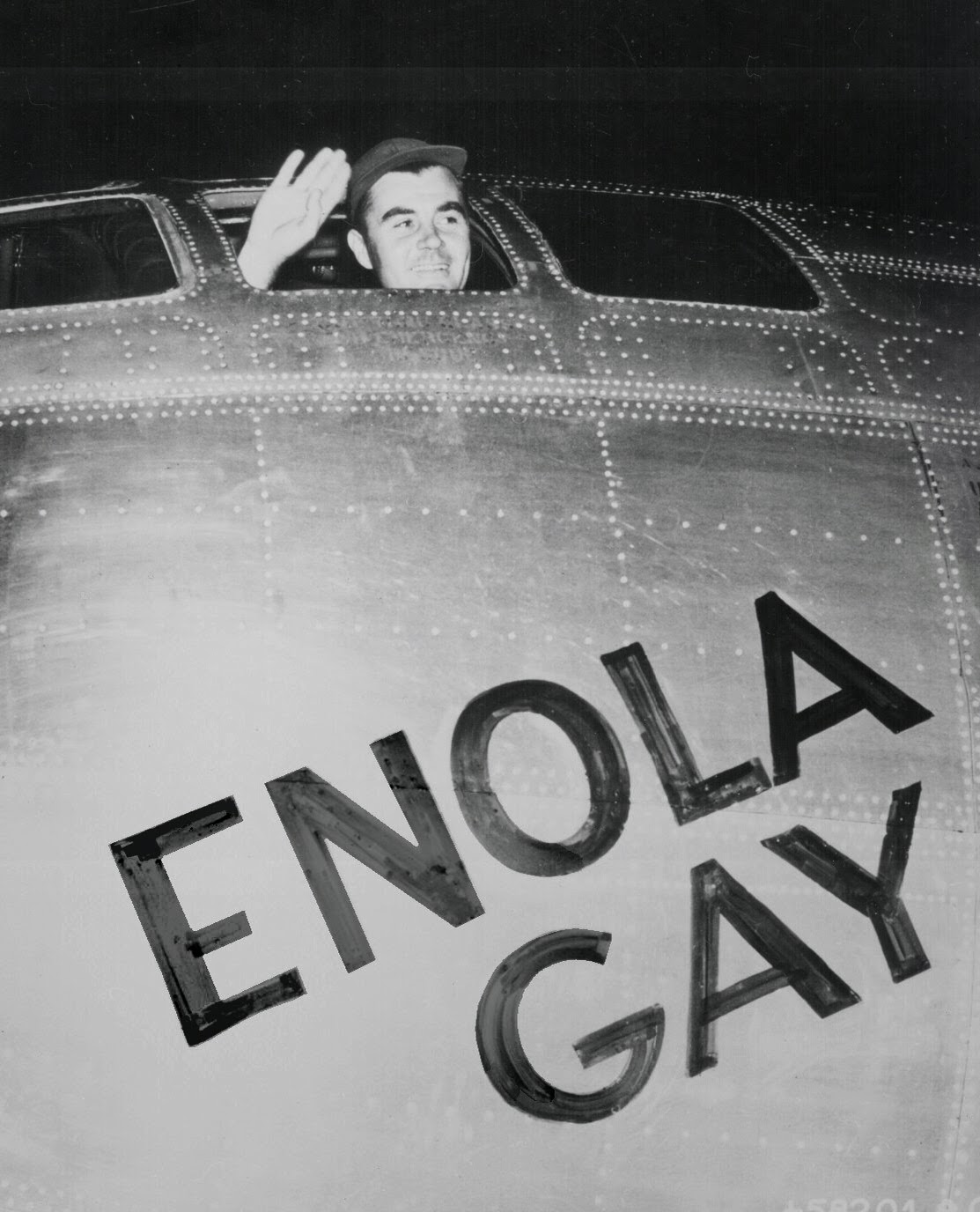
Think of it as the true end of the beginning. Last week, Theodore "Dutch" Van Kirk, the final member of the 12-man crew of the Enola Gay, the plane (named after its pilot’s supportive mother) that dropped the atomic bomb on Hiroshima, died at age 93.

Paul Tibbetts, Jr. in cockpit

When that first A-bomb left its bomb bay at 8:15 on the morning of August 6, 1945, and began its descent toward its target, the Aioli (“Live Together”) Bridge, it was inscribed with a series of American messages, some obscene, including “Greetings to the Emperor from the men of the Indianapolis.” (That ship had delivered to the Pacific island of Tinian parts of the very bomb that would turn Hiroshima into an inferno of smoke and fire -- “that awful cloud,” Paul Tibbetts, Jr., theEnola Gay's pilot, would call it -- and afterward was torpedoed by a Japanese submarine with the loss of hundreds of sailors.)

The bomb, dubbed Little Boy, that had gestated in the belly of the Enola Gay represented not only the near endpoint of a bitter global war of almost unimaginable destruction, but the birthing of something new. The way for its use had been paved by an evolution in warfare: the increasing targeting of civilian populations from the air (something that can be seen again today in the carnage of Gaza). The history of that grim development extends from German airship bombings of London (1915) by way of Guernica (1937), Shanghai (1937), and Coventry (1940), to the fire bombings of Dresden (1945) and Tokyo (1945) in the last year of World War II. It even had an evolutionary history in the human imagination, where for decades writers (among others) had dreamed of the unparalleled release of previously unknown forms of energy for military purposes.

On August 7, 1945, a previous age was ending and a new one was dawning. In the nuclear era, city-busting weapons would be a dime a dozen and would spread from the superpowers to many other countries, including Great Britain, China, India, Pakistan, North Korea, and Israel. Targeted by the planet’s major nuclear arsenals would be the civilian inhabitants not just of single cities but of scores and scores of cities, even of the planet itself. On August 6th, 70 years ago, the possibility of the apocalypse passed out of the hands of God or the gods and into human hands, which meant a new kind of history had begun whose endpoint is unknowable, though we do know that even a “modest” exchange of nuclear weapons between India and Pakistan would not only devastate South Asia, but thanks to the phenomenon of nuclear winter also cause widespread famine on a planetary scale.

In other words, 70 years later, the apocalypse is us. Yet in the United States, the only nuclear bomb you're likely to read about is Iran’s (even though that country possesses no such weapon). For a serious discussion of the U.S. nuclear arsenal, those more than 4,800 increasingly ill-kept weapons that could incinerate several Earth-sized planets, you need to look not to the country’s major newspapers or news programs but to comic John Oliver -- or TomDispatch regular Noam Chomsky. Tom

How Many Minutes to Midnight?
Hiroshima Day 2014

If some extraterrestrial species were compiling a history of Homo sapiens, they might well break their calendar into two eras: BNW (before nuclear weapons) and NWE (the nuclear weapons era). The latter era, of course, opened on August 6, 1945, the first day of the countdown to what may be the inglorious end of this strange species, which attained the intelligence to discover the effective means to destroy itself, but -- so the evidence suggests -- not the moral and intellectual capacity to control its worst instincts.

Day one of the NWE was marked by the “success” of Little Boy, a simple atomic bomb. On day four, Nagasaki experienced the technological triumph of Fat Man, a more sophisticated design. Five days later came what the official Air Force history calls the “grand finale,” a 1,000-plane raid -- no mean logistical achievement -- attacking Japan’s cities and killing many thousands of people, with leaflets falling among the bombs reading “Japan has surrendered.” Truman announced that surrender before the last B-29 returned to its base.

Those were the auspicious opening days of the NWE. As we now enter its 70th year, we should be contemplating with wonder that we have survived. We can only guess how many years remain.

Some reflections on these grim prospects were offered by General Lee Butler, former head of the U.S. Strategic Command (STRATCOM), which controls nuclear weapons and strategy. Twenty years ago, he wrote that we had so far survived the NWE “by some combination of skill, luck, and divine intervention, and I suspect the latter in greatest proportion.”

Reflecting on his long career in developing nuclear weapons strategies and organizing the forces to implement them efficiently, he described himself ruefully as having been “among the most avid of these keepers of the faith in nuclear weapons.” But, he continued, he had come to realize that it was now his “burden to declare with all of the conviction I can muster that in my judgment they served us extremely ill.” And he asked, “By what authority do succeeding generations of leaders in the nuclear-weapons states usurp the power to dictate the odds of continued life on our planet? Most urgently, why does such breathtaking audacity persist at a moment when we should stand trembling in the face of our folly and united in our commitment to abolish its most deadly manifestations?”

He termed the U.S. strategic plan of 1960 that called for an automated all-out strike on the Communist world “the single most absurd and irresponsible document I have ever reviewed in my life.” Its Soviet counterpart was probably even more insane. But it is important to bear in mind that there are competitors, not least among them the easy acceptance of extraordinary threats to survival.

Survival in the Early Cold War Years

According to received doctrine in scholarship and general intellectual discourse, the prime goal of state policy is “national security.” There is ample evidence, however, that the doctrine of national security does not encompass the security of the population. The record reveals that, for instance, the threat of instant destruction by nuclear weapons has not ranked high among the concerns of planners. That much was demonstrated early on, and remains true to the present moment.

In the early days of the NWE, the U.S. was overwhelmingly powerful and enjoyed remarkable security: it controlled the hemisphere, the Atlantic and Pacific oceans, and the opposite sides of those oceans as well. Long before World War II, it had already become by far the richest country in the world, with incomparable advantages. Its economy boomed during the war, while other industrial societies were devastated or severely weakened. By the opening of the new era, the U.S. possessed about half of total world wealth and an even greater percentage of its manufacturing capacity.

There was, however, a potential threat: intercontinental ballistic missiles with nuclear warheads. That threat was discussed in the standard scholarly study of nuclear policies, carried out with access to high-level sources -- Danger and Survival: Choices About the Bomb in the First Fifty Years by McGeorge Bundy, national security adviser during the Kennedy and Johnson presidencies.

Bundy wrote that “the timely development of ballistic missiles during the Eisenhower administration is one of the best achievements of those eight years. Yet it is well to begin with a recognition that both the United States and the Soviet Union might be in much less nuclear danger today if [those] missiles had never been developed.” He then added an instructive comment: “I am aware of no serious contemporary proposal, in or out of either government, that ballistic missiles should somehow be banned by agreement.” In short, there was apparently no thought of trying to prevent the sole serious threat to the U.S., the threat of utter destruction in a nuclear war with the Soviet Union.

Could that threat have been taken off the table? We cannot, of course, be sure, but it was hardly inconceivable. The Russians, far behind in industrial development and technological sophistication, were in a far more threatening environment. Hence, they were significantly more vulnerable to such weapons systems than the U.S. There might have been opportunities to explore these possibilities, but in the extraordinary hysteria of the day they could hardly have even been perceived. And that hysteria was indeed extraordinary. An examination of the rhetoric of central official documents of that moment like National Security Council Paper NSC-68 remains quite shocking, even discounting Secretary of State Dean Acheson’s injunction that it is necessary to be “clearer than truth.” Read More


Tuesday, July 22, 2014

Studies by Once Top Secret Government Entity Portrayed Terrible Costs of Nuclear War

Studies by Once Top Secret Government Entity Portrayed Terrible Costs of Nuclear War


After Briefing on Likely Death Tolls, JFK Remarked: "And We Call Ourselves the Human Race"

Net Evaluation Subcommittee Nevertheless Initially Projected U.S. Prevailing in Global Nuclear Conflict -- Although Final Report Described a "Nuclear Stalemate"

Some Studies Depicted U.S. as Launching First, Preemptively

National Security Archive Electronic Briefing Book No. 480

Posted - July 22, 2014

For more information contact:
William Burr - 202/994-7000 or nsarchiv@gwu.edu

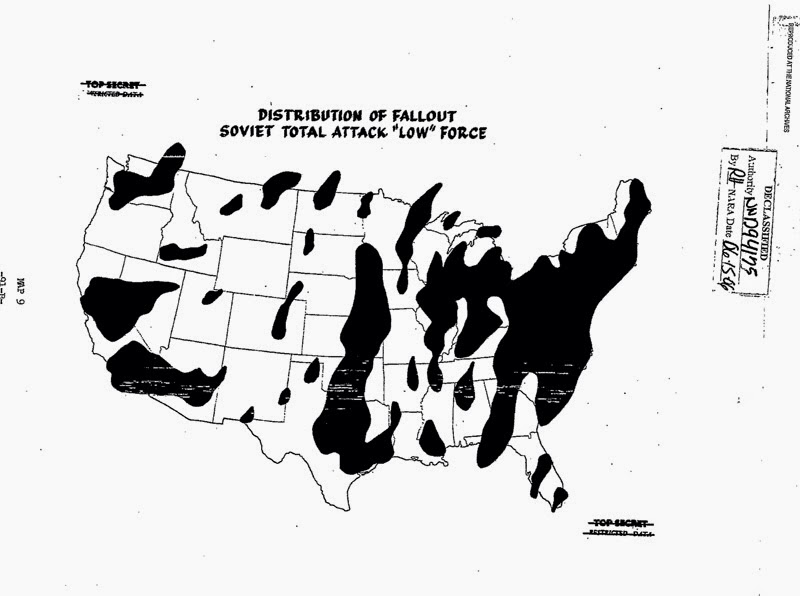
Washington, D.C., July 22, 2014 -- On the morning of 20 July 1961, while the Berlin Crisis was simmering, President John F. Kennedy and the members of the National Security Council heard a briefing on the consequences of nuclear war by the NSC's highly secret Net Evaluation Subcommittee. The report, published in excerpts today for the first time by the National Security Archive, depicted a Soviet surprise attack on the United States in the fall of 1963 that began with submarine-launched missile strikes against Strategic Air Command bases. An estimated 48 to 71 million Americans were "killed outright," while at its maximum casualty-producing radioactive fallout blanketed from 45 to 71 percent of the nation's residences. In the USSR and China, at the end of one month 67 and 76 million people, respectively, had been killed.

This was President Kennedy's first exposure to a NESC report, but the secret studies of nuclear war scenarios had been initiated by his predecessor, Dwight D. Eisenhower. It may have been after this briefing, described by Secretary of State Dean Rusk as "an awesome experience," that a dismayed Kennedy turned to Rusk, and said: "And we call ourselves the human race."

The NESC reports on nuclear war were multi-volume, highly classified studies and none has ever been declassified in their entirety. (Indeed, for years the very existence of the NESC was a well-kept secret.) The summaries published here today -- for the annual reports from 1957 to 1963 -- provide a glimpse of the full reports, although important elements remain classified. Besides the summaries and fuller reports for 1962 and 1963, today's posting includes a number of special studies prepared by the NESC, including an especially secret report requested by President Eisenhower that led to the production of the comprehensive U.S. nuclear war plan in 1960, the Single Integrated Operational Plan (SIOP).


Check out today's posting at the National Security Archive's Nuclear Vault -http://www2.gwu.edu/~nsarchiv/nukevault/ebb480/

Find us on Facebook - http://www.facebook.com/NSArchive

Unredacted, the Archive blog - http://nsarchive.wordpress.com/

________________________________________________________
THE NATIONAL SECURITY ARCHIVE is an independent non-governmental research institute and library located at The George Washington University in Washington, D.C. The Archive collects and publishes declassified documents acquired through the Freedom of Information Act (FOIA). A tax-exempt public charity, the Archive receives no U.S. government funding; its budget is supported by publication royalties and donations from foundations and individuals.


Sunday, October 27, 2013

We're one 'Oops' away from Armageddon

Out of America: The greatest threat to the US from atomic weapons is accidental detonation. And, worryingly, it has nearly happened.

Let's start with a simple, astounding fact. In the 68 years after Hiroshima and Nagasaki, apart from scheduled nuclear tests, not a single nuclear warhead has exploded. The remarkable thing is not that nuclear weapons have never featured in a hot war. Basic human sanity – awareness of the devastation that would be caused by today's far more powerful devices – has ensured that. What is truly astonishing is that since 1945, no nuclear weapon has gone off by accident.

Today the topic, here in the United States or among the original nuclear powers, seems almost irrelevant. We take atomic weapons for granted. Not so perhaps in the Middle East, or in the Indian subcontinent, or North Korea. But we British, Americans, Russians, French, and Chinese have virtually forgotten about them, certain they will never be used in anger.

Not that they no longer exist. The US, according to the Center for Arms Control and Non-Proliferation here in Washington, currently has around 4,650 strategic missiles, 1,950 of which are deployed, the rest on stand-by. No figures are published, but upkeep, support and modernisation of the nuclear force reputedly costs at least $50bn (£31bn) a year.

Drive across the plains of North Dakota, Wyoming or Montana, and you might notice the odd small gravelled area by the road, with some gadgets protruding from the earth, protected by barbed wire and ferocious "Keep Off" signs. You might think it is an electricity sub-station. In fact you are passing one of 450 concrete silos on the northern plains that contain a Minuteman III intercontinental ballistic missile (ICBM) with a single warhead, each capable of obliterating Hiroshima 27 times over.

That however is as physically close as ordinary punters will ever come to America's nuclear deterrent. The rest is aboard bombers within the sealed perimeters of vast air force bases, or hidden beneath the ocean on 14 Trident submarines – out of sight, and entirely out of mind.

But it was not always thus. If you want an idea of what might have been, read Eric Schlosser's enthralling Command and Control, that weaves together the post-1945 history of the US deterrent with a frame-by-frame recreation of the country's most celebrated brush with accidental Armageddon.

It happened back on 18 September 1980 at a missile silo in rural Arkansas. The silo contained a Titan II fitted with a W-53 warhead, the most potent in the US arsenal, with a 9-megaton yield, 600 times more than Hiroshima.

A worker doing routine maintenance dropped a spanner that fell into the silo and ruptured the missile's fuel tank. Fumes swiftly built up in the confined space. Nine hours later the Titan II blew up, utterly destroying the silo and sending its 740-ton launch closure door spinning into the night sky and depositing the warhead 50 yards away. The safety devices held and it didn't go off, but one person was killed and 29 injured. Local residents had been evacuated – but much difference that would have made, had the worst occurred.

In his researches, however, Schlosser unearthed a yet more terrifying nuclear near miss, 19 years earlier. In January 1961, a B-52 carrying two hydrogen bombs broke up in midair over North Carolina. The bombs came to earth amid the wreckage, and on one of them three out of four automatic arming mechanisms had gone ahead. Only a last safety switch held, preventing a calamity that would have wiped out or rendered uninhabitable much of the East Coast. In comparison, the Cuban missile crisis was a virtual non-event.

And this was just one of at least 700 significant "incidents" between 1950 and 1968 in the US. You wonder how many others went unreported. Imagine, too, the brushes with disaster there must have been in the Soviet Union during the period. But as far as we know, none ever produced an accidental, full-scale nuclear detonation.

Since then, thanks to diminishing stockpiles and improved safety procedures, such "incidents" have been far fewer. But never rule out the human factor. Somehow, for example, in contravention of rules set in place after North Carolina, six cruise missiles fitted with live nuclear warheads were carried on a flight in 2007 from North Dakota to Louisiana without authorisation. Apparently, loaders confused dummy warheads with the real thing.

And even in these past couple of weeks, human frailties have made one wonder. In one bizarre episode, the three-star admiral who was the second ranking officer at US Strategic Command, whose brief includes the country's nuclear strike forces, was removed from duty after being caught using counterfeit poker chips at a casino at Council Bluffs, Iowa just across the river from Strategic Command's HQ at Offutt Air Force base in Omaha Nebraska.

A few days earlier, Major General Michael Carey was sacked from his command of the 20th Air Force, responsible for those Minuteman III missile silos in North Dakota, Wyoming and Montana, and their launch centres. Both instances involved "unfortunate personal behaviour", a senior Pentagon official told the Associated Press news agency, stressing however that the country's nuclear deterrent force was "safe, secure and effective".

But new revelations last week make one wonder. Earlier this year, two of the three nuclear wings under the 20th Air Force performed badly in a safety and security inspection, and 17 military personnel were made to undergo retraining. Moreover, on two occasions doors to launch control centres were left unlocked, in breach of regulations, AP reported – on one occasion when an on-site food order was being delivered. Of course the guy from Domino's Pizza can't just wander in off the street and press the button, but even so ….

Such is the surreal banality of America's nuclear weapons today. No wonder morale is said to be poor at the ICBM sites, in the rearmost line of battle, of a war that will never be fought. Back in the 1960s, 1970s and 1980s, at the height of the Cold War, the greatest nuclear threat to America was accidental detonation of an American weapon. That remains the case now. Let's hope the dumb luck holds. More


Friday, May 24, 2013

Nuclear Winter of Our Discontent

Always interesting when the Army starts poking around the nation’s nuclear stockpile – seeing as the service is no longer a big player in the atomic realm – to see if atomic weapons still make sense.

Ward Wilson isn’t a soldier – he’s a senior fellow at the Center for Nonproliferation Studies at theMonterey Institute of International Studies – but his musing on the topic appears in the latest issue of Parameters, the Army’s professional journal.

By re-studying the U.S. nuclear bombing of Japan that ended World War II in 1945, and the brush with World War III that 1962’s Cuban missile crisis represented, Wilson tries to revamp our understanding of the utility of nuclear weapons.

What this new scholarship reveals is that the failure rate of nuclear deterrence is potentially higher than theory admits.

Nuclear deterrence has to be perfect, or close to perfect. A catastrophic all-out nuclear war could result from any failure of nuclear deterrence, so there is little margin for error. One could say for nuclear deterrence, failure is not an option. Yet these documented cases of nuclear deterrence failure raise the possibility that we have been far luckier, and have run far greater risks, than we imagined. If nuclear deterrence has a high rate of failure, continuing to rely on it for the safety and security of the United States would seem to guarantee its eventual catastrophic failure.

One of the great strengths of the military mind is its insistence on experience-based thinking. In the case of nuclear weapons, there has historically been plenty of theory, but not as much sensible, pragmatic thinking. It is time for a little more pragmatic analysis.

Sobering stuff. Full thing here.


Monday, April 22, 2013

Obama accused of nuclear U-turn as guided weapons plan emerges

Plan to spend $10bn on updating nuclear bombs goes against 2010 pledge not to deploy new weapons, say critics

Barack Obama has been accused of reneging on his disarmament pledges after it emerged the administration was planning to spend billions on upgrading nuclear bombs stored in Europe to make the weapons more reliable and accurate.

Under the plan, nearly 200 B61 gravity bombs stockpiled in Belgium, the Netherlands, Germany, Italy and Turkey would be given new tail fins that would turn them into guided weapons that could be delivered by stealth F35 fighter-bombers.

"This will be a significant upgrade of the US nuclear capability in Europe," said Hans Kristensen, a nuclear weapons expert at the Federation of Nuclear Scientists. "It flies directly in the face of the pledges Obama made in 2010 that he would not deploy new weapons."

In its Nuclear Posture Review in 2010, the US undertook to do reduce the role and numbers of its nuclear weapons, in part by not developing new nuclear warheads, and pledging it would not "support new military missions or provide for new military capabilities".

According to newly published budget figures, the US will spend about$10bn (£6.5bn) on a life extension programme for the B61 bombs, andanother $1bn on adding controllable tail fins. Kristensen said the tail kit would give it a new mission and new capabilities, once some of the upgraded weapons were deployed as scheduled in Europe in 2019 or 2020.

"What will be going back to Europe will be a guided nuclear bomb," he said. "Especially when you combine it with F35 with stealth characteristics, that expands the targets you can hold at risk from Europe, because by placing the explosion closer to the target you can choose a lower explosive yield. That is very important as there is less radioactive fallout. For many people this is a great concern because it means making nuclear weapons more 'usable'."

The new B61 Mk12 will be a 50 kilotonne weapon, like most of the "tactical" nuclear bombs currently in Europe. The bigger, strategic versions of the B61, stockpiled in the US, would be discontinued. Some European countries, led by Germany, have attempted to get the American B61 bombs withdrawn from Europe on the grounds they serve no military purpose following the end of the cold war and that they represent a security risk because of the possibility of their theft by terrorists. But some eastern European states have resisted their withdrawal, fearing it would show a weakening of US commitment to defend them against Russia.

US administration officials say the addition of tail fins to the bomb does not represent a significant change in its mission and therefore does not break the 2010 pledge. They insist that Obama remains committed to the disarmament agenda he outlined in a 2009 landmark speech in Prague, in which he promised to work towards a world free of nuclear weapons.

Since then, the US signed the new Start treaty with Russia, limiting both sides' strategic arsenals to 1,550 deployed warheads each. This spring, Obama was expected to make a speech outlining proposals to make further cuts to about 1,100 warheads. But US officials have said the crisis over North Korea and the time needed to install a second-term national security team have delayed the speech.

Obama's national security adviser, Tom Donilon, went to Moscow earlier this month to deliver a message from the president to his Russian counterpart, Vladimir Putin, which included proposals to cut the two countries' nuclear arsenals and finding a compromise in the long-running dispute over US plans for a missile defence system in Europe. Sources familiar with the talks described the Russian response as positive. Obama and Putin are to meet at the G8 meeting at Lough Erne in Northern Ireland in June, but it is unclear whether the new nuclear weapons cuts will be ready by then.

Joseph Cirincione, the president of the Ploughshares Fund, an arms control pressure group, said the B61 modernisation plans were largely driven by domestic political considerations but risked sending mixed messages to Russia at a time when Washington and Moscow needed to strike a deal. More


Thursday, March 28, 2013

Noam Chomsky: If Nuclear War Doesn't Get Us, Climate Change Will

In the twenty-first century, humanity will likely burn out in a nuclear holocaust or fade away amid the gradually mounting effects of climate change. That was Noam Chomsky's prediction during a question-and-answer session in 2009 that still resonates today.

By moving forward with a missile defense policy that upsets the balance of nuclear deterrence with Russia, "we're consciously increasing the threat of nuclear war," Chomsky said. As for the effects of climate change, "nobody knows the exact details, but everybody knows that the longer you wait, the worse it's going to be."

More


Wednesday, December 12, 2012

Statement by President Clinton at 1996 Adoptation of CTBT

On the day the CTBT was born.


The William Clinton Presidential Library recently uploaded a short video to its Youtube channel featuring the first statement by former U.S. President Clinton after the UN General Assembly resoundingly adopted the Comprehensive Nuclear-Test-Ban Treaty on 10 September 1996 after more than two years of negotiations.

Tuesday, November 20, 2012

Millennials on the next nuclear generation

In the 42 years since the Nuclear Non-Proliferation Treaty (NPT) came into force, much has changed in the world -- the Cold War has ended, the global number of nuclear weapons has decreased, yet the number of nuclear-armed states has increased. What do the next four decades hold in store for nonproliferation and disarmament? For the Millennial Generation, this is no theoretical question -- in about 2054 they will be completing their careers and settling into retirement. Below, Maryam Javan Shahraki of Iran, Selim Can Sazak of Turkey, and Beenish Pervaiz of Pakistan respond to this topic: Forty-two years after the Nuclear Non-Proliferation Treaty went into force, where will the world be in another 42 years? How many states will be nuclear-armed? How many nuclear weapons will exist? And will the NPT survive?

Blueprint for avoiding the crisis by Maryam Javan Shahraki

Forty-two years ago, amid the Cold War, the Nuclear Non-Proliferation Treaty (NPT) came into force. The treaty's original purpose was, among other things, to prevent countries like Italy, West Germany, and Japan from building nuclear weapons. But since the end of the Cold War, the goal has evolved into maintaining the global nuclear order. Today, the NPT has 189 signatories and is the arms control treaty with the greatest international acceptance. But the treaty's success in stopping the spread of nuclear weapons is debatable, and serious questions surround the NPT's credibility and effectiveness as the world's central mechanism against further proliferation.

When considering these issues, it is useful to keep in mind just how dangerous a nuclear crisis can be. This year marks the 50th anniversary of the Cuban Missile Crisis, which brought the world to the brink of nuclear catastrophe. The world survived -- but there is no guarantee it would survive a similar crisis in the future. Indeed, the key lesson of the Cuban Missile Crisis is the importance of preventing a crisis through diplomatic and political efforts before the brink of nuclear war is reached. No matter how imperfect the NPT might be, the treaty still represents a crucial diplomatic tool for anticipating and preventing nuclear crises.

Credibility challenge. Few people dispute that the treaty is necessary; instead, the crucial challenges that it faces involve its effectiveness and credibility. The treaty need not be changed or replaced but, if it is to meet its global objectives, it must be implemented fairly.

One crucial issue related to fairness involves the nuclear weapon states' responsibility to pursue disarmament as defined in the NPT: Each nuclear weapon state commits to taking good-faith steps toward disarmament, a key element of the treaty's central bargain. But this is far from being fully implemented. The United States and Russia control a vast majority of the planet's nuclear weapons and are capable of destroying the world several times over. Since the end of the Cold War, nuclear strategies have changed in many countries, including in the five nuclear weapon states recognized under the treaty. But the central security attitude of the Cold War -- that the more nuclear weapons you have, the more powerful you are -- remains strong.

A similar problem is that the treaty's principles are applied differently to different non-nuclear weapon states. In a glaring example, India in 2008 concluded a nuclear cooperation agreement with the United States, and also received a waiver from the Nuclear Suppliers Group allowing it to engage in nuclear trade with few restrictions. But India is one of only three states, along with Pakistan and Israel, never to have acceded to the NPT (as for the other two nuclear-armed states, North Korea ratified the treaty, but later withdrew, and South Africa joined the treaty after surrendering its nuclear arsenal); nor have these countries, with the exception of South Africa, ratified the Comprehensive Nuclear Test Ban Treaty (though Israel has signed it). It is a mistake to ignore these countries' nonproliferation responsibilities just because they might enjoy good relations with the United States, especially when a treaty signatory like Iran faces international pressure while pursuing its inalienable right to a peaceful nuclear energy program. (Meanwhile, every nuclear-armed state is a potential proliferator, but this fact receives little attention.)

Uneven application of standards could force some countries' nuclear programs underground. But even more important, the treaty's credibility and effectiveness are weakened when different states' obligations and rights are treated unevenly.

Problems and solutions. For the treaty to have survived for 42 years is a great success. But the NPT suffers from serious shortcomings -- both inside and outside the regime. Several steps could be taken to address these shortcomings. First, the world should recommit itself to eliminating nuclear weapons, instead of focusing on nonproliferation to the exclusion of disarmament. Nuclear weapons are exceedingly dangerous no matter who possesses them, and all states -- large or small, treaty signatories or not -- should accept shared responsibility for eliminating them.

Second, variable standards and unjust rules must be avoided. Prioritizing one nation's political interests over global security could bring about the treaty's ultimate failure. The point of the NPT regime is to make the world a safer place, with fewer nuclear bombs. Therefore, the very idea of the treaty is undermined by using the NPT to prevent State X from exercising its legitimate rights while supporting State Y as it exercises the very same rights.

Third, the tendency to turn nuclear issues into security issues -- to remove them from the diplomatic realm and from the context of the treaty -- should be resisted. Indeed, to declare a nuclear dispute an existential threat to the global community, instead of seeking political and diplomatic solutions discredits the treaty itself and also risks turning disputes into crises. As the world should have learned from the Cuban Missile Crisis, last-minute crisis management must not be depended upon. More


Monday, October 1, 2012

Paul Rogers: What chances for nuclear disarmament in the second decade?

Paul Rogers: What chances for nuclear disarmament in the second decade?

Published on Oct 1, 2012 by TalkWorks.info Films

TALKWORKS FILMS 2012: 'Talking About Nuclear Disarmament'—http://www.talkworks.info/ In association with DIFFERENT FILMS—http://www.different-films.com/INFINITE/ Global Perspectives Series 2012—Leading experts and policymakers talk about the global drive to free the world of nuclear threats in the 21st century. 'A Century on the Edge—and of Hope' Part 1: "What chances for nuclear disarmament in the second decade?" Professor Paul Rogers, Professor of Peace Studies at Bradford University UK & Sustainable Security Consultant to the Oxford Research Group speaking to TalkWorks in July 2012 about his latest thinking on the security threats facing humankind in the second decade of the 21st century. Parts 2 & 3 forthcoming in October: —"What is the likely outcome of the present Middle East nuclear crisis?" —"What are the chances for global peace and security in the second decade?"


Wednesday, April 25, 2012

South Asian Nuclear War Would Upend World Food Supply: Analysis

A nuclear exchange between India and Pakistan would produce airborne debris that would poison distant crop fields with radioactive material and curb worldwide precipitation and heat levels, disrupting global agriculture and potentially causing the starvation of more than 1 billion people, according to an independent analysis issued on Tuesday (see GSN, Feb. 24, 2011).

The expert behind the assessment said he marshaled empirical evidence in support of admonitions that a nuclear conflict might have unplanned international repercussions, Agence France-Presse reported.

"It is not just the arsenals of the U.S. and Russia that pose a threat to the whole world," Ira Helfand, a Massachusetts doctor with the International Physicians for the Prevention of Nuclear War, said in an interview with AFP. "Even these smaller [arsenals] pose an existential threat to our civilization, if not to our species. It would certainly end modern society as we know it."

Climatic alterations resulting from a nuclear conflict would cut the U.S. corn yield by a mean level of one-tenth for 10 years, according to the analysis. Soybean growth would suffer a comparable decrease, falling most significantly in the initial five years following the exchange, it adds.

Chinese rice generation would take a mean-level hit of 21 percent in the 48 months following such an event and endure a 10 percent decline for six subsequent years, Helfand determined.

The calculations do not consider boosts in ultraviolet radiation or the possibility of new weather cycles resulting in the rapid, deadly freezing of commercial vegetation, meaning agricultural tolls of a nuclear conflict might exceed Helfand's projections, AFP reported.

The analyst said more profound weather shifts would result if either Washington or Moscow employed a relatively limited part of its nuclear stockpile in an offensive. More


Sunday, January 29, 2012

Is the World Really Safer Without the Soviet Union? By Mikhail Gorbachev

 January 29, 2012The Nation” — Since the breakup of the Soviet Union twenty years ago, Western commentators have often celebrated it as though what disappeared from the world arena in December 1991 was the old Soviet Union, the USSR of Stalin and Brezhnev, rather than the reforming Soviet Union of perestroika. 
Moreover, discussion of its consequences has focused mostly on developments inside Russia. Equally important, however, have been the consequences for international relations, in particular lost alternatives for a truly new world order opened up by the end of the cold war.   
 
Following my election as general secretary of the Communist Party in March 1985, the Soviet leadership formulated a new foreign policy agenda. One of the key ideas of our reforms, or perestroika, was new political thinking, based on the recognition of the world’s interconnectedness and interdependence. The top priority was to avert the threat of nuclear war. Our immediate international goals included ending the nuclear arms race, reducing conventional armed forces, settling numerous regional conflicts involving the Soviet Union and the United States, and replacing the division of the European continent into hostile camps with what I called a common European home. More