Showing posts with label Japan. Show all posts

Saturday, August 1, 2015

Nuclear Nonproliferation

Our 70th Anniversary Homework: Confronting the Myths and Learning the Lessons of Hiroshima and Nagasaki.

Seventy years ago, two nuclear weapons targeted against cities which met the criteria of having “densely packed workers’ homes,” killed more than 200,000 people in the Japanese cities of Hiroshima and Nagasaki. In the years that have followed, many more have suffered and died from cancers, radiation disease, genetic damage and other fallout from the atom bombings.

The myths that the A-bombings were necessary to end the war against Japan and that they saved the lives of half a million US troops remain widely believed. The myths serve as the ideological foundation for continuing U.S. preparations for nuclear war, which in turn has served as the primary driver of nuclear weapons proliferation and the creation of deterrent nuclear arsenals

It is no accident that this wartime propaganda took on a life of its own. Japanese and other journalists’ film footage and photos of the devastation wrought by the A-bombs taken within days of the A-bombings, were seized by U.S. Occupation forces and were locked away in Pentagon vaults for more than two decades. In 1995, the Smithsonian Museum’s initially excellent 50th anniversary exhibition was censored beyond recognition to prevent people from seeing what the A-bombs inflicted on human beings. Also removed were the facts that U.S. Secretary of War Stimson had advised Truman that Japan’s surrender “could be arranged on terms acceptable to the United States” without the atom bombings. (That arrangement was later deemed acceptable – even necessary – by U.S. military occupation authorities.) Indeed, before it was sterilized, the exhibit included quotations from senior US wartime military leaders including Admiral Leahy and General (later President) Eisenhower who thought, “It wasn’t necessary to hit [Japanese] with that awful thing.”

Scholars now know that numerous factors contributed to Truman’s decision to destroy Hiroshima and Nagasaki and their civilian populations. These include Truman’s political calculations as he looked to the 1948 presidential election, vengeance, racism, institutional inertia, and the callousness that came with already having burned more than sixty Japanese cities to the ground.

But, as General Leslie Groves, the commander of the Manhattan Project, told senior scientist Joseph Rotblat, the bombs came to be designed for the Soviet Union. The determinative reasons for the A-bombings were to bring the war to an immediate end so that the US could avoid sharing influence with the USSR in Northern China, Manchuria and Korea and to intimidate Stalin and other Soviet leaders by demonstrating the apocalyptic power of nuclear weapons and Washington’s willingness to use them – even against civilians. Little Boy and Fat Man, as the bombs were named, announced the beginning of the Cold War.

Americans also continue to suffer from the misconception that nuclear weapons have not been used since the Nagasaki A-bombing on August 9, 1945. In fact, the US, and to a lesser degree the other nuclear powers, have repeatedly used their nuclear arsenals. Long ago, Daniel Ellsberg, a senior Pentagon nuclear war planner for Presidents Kennedy, Johnson and Nixon, explained that the US has repeatedly used nuclear weapons “in the way that you use a gun when you point it at someone’s head in a confrontation….whether or not you pull the trigger...[and] You’re also using it when you have it on your hip ostentatiously.” During wars and international crises, the US has prepared and/or threatened to initiate nuclear war on at least thirty occasions - at least 15 times during the Korean and Vietnam Wars and crises with China, and at least 10 times to reinforce US Middle East hegemony. And each of the other eight nuclear powers has made such threats or preparations at least once.

Eric Schlosser, author of Command and Control, reported last December to the International Conference on the Consequences of Nuclear Weapons, attended by representatives of 158 governments that luck, not state policies and regulations, best explains why humanity has survived nuclear blackmail, reckless dependence on deterrence, miscalculations and nuclear accidents.

Still more sobering are the recent scientific studies demonstrating that even a “small” exchange of 50-100 nuclear weapons targeted against cities would result in fires, smoke that would cause global cooling, and up to two billion deaths from famine.

All of which lead to a series of existential questions: As we race against time to save our civilizations from the impending ravages of climate change, why are our governments preparing to inflict nuclear annihilation? Why do we tolerate the continued deployment and stockpiling of nearly 16,000 nuclear weapons, 90% of them in U.S. and Russian arsenals? Why have the P-5 nuclear powers (US, Russia, Britain, France and China) refused to implement their 45 year-old Nuclear Non-Proliferation Treaty (NPT) obligation to begin negotiations for the complete elimination of their nuclear arsenals? And why did the US condemn this past spring’s NPT Review Conference to failure by refusing to honor its long-standing commitment to co-convene a conference to lay the foundations for a nuclear weapons and weapons of mass destruction-free zone in the Middle East?

There are high costs to denying history and reality. In a worst case scenario, the failure of the US and the other nuclear powers to heed the warning of A-bomb survivors that human beings and nuclear weapons cannot coexist is the end to life on earth as we know it.

The majority of the world’s governments are not in similar denial. The NPT Review Conference’s one achievement was the commitment of the vast majority of the world’s governments the Humanitarian Pledge. Initiated by Austria, 113 governments pledged “to cooperate with all relevant stakeholders, states, international organizations, the Red Cross and Red Crescent Movement, parliamentarians and civil society, in efforts to stigmatize, prohibit and eliminate nuclear weapons in light of their unacceptable humanitarian consequences and associated risks.” The gulf between the non-nuclear weapons states and the nuclear powers has widened, and in time the former may use their economic, political and other power in the struggle to secure humanity’s future.

On August 6, many in Japan will appreciate the silent presence of U.S. Ambassador Caroline Kennedy at Hiroshima’s official 70th anniversary commemoration, but there will be no apology. And, even as we celebrate and work for the implementation of the nuclear deal with Iran, the sorry truth is that the US is now on track to spend one trillion dollars to “modernize” its nuclear arsenal and delivery systems, with the other nuclear powers following the U.S. lead. And, despite his pledge in Prague, President Obama has retired fewer nuclear weapons that any other US post-Cold War President.

As the US-Russian confrontation, marked by implicit and explicit nuclear threats remids us, we are living on borrowed time. Seventy years after the Hiroshima and Nagasaki A-bombings, human survival still hanging in the balance. Midst the carnival of the 2016 presidential election, let us insist that those who seek to rule us and the world finally learn the lessons of Hiroshima and Nagasaki: Never again to anyone! No more Hiroshimas! No More Nagasakis! No more nuclear weapons!


Tuesday, September 16, 2014

India-Japan proliferation: delinquency or a crime? By Mobeen Tariq

The ongoing India-Japan negotiations on a civil nuclear agreement were the hallmark of Indian Premier Modi’s recent visit to Japan.


Modi could not achieve the breakthrough on the much sought after civil nuclear deal. There are issues in the prospective Japan-India Nuclear Cooperation Agreement that can have multiple, deplorable implications. India possesses nuclear weapons and has tested these several times. It is not a signatory of the Nuclear Nonproliferation Treaty (NPT). If nonproliferation norms and Japanese traditional championing of these were to be followed, Tokyo cannot enter into nuclear trade with New Delhi.

Nuclear technology is the key to Japan’s energy sector and affects its industrial output. Overblown safety fears after the Fukushima nuclear power plant accident in 2011 affected the public’s sentiment against nuclear energy but the economic realities have changed the government’s and public’s behaviour. Japan is one of the major traders of nuclear technology for peaceful purposes and a member of the Nuclear Suppliers Group (NSG) that was founded in 1975 after India tested a nuclear weapons device using fissile material diverted from fuel provided for nuclear power generation.

India claims to have a huge energy deficit and not having enough uranium to fuel its existing and upcoming nuclear power plants that will add millions of volts to its impoverished energy mix. New Delhi boasts a fat purse and exerts sufficient political influence to woo some nuclear supplier states in foregoing their domestic and international nonproliferation commitments to trade with India. That is why the US arm-twisted the members of the NSG in giving India an exceptional waiver to trade with that country. Japan was also part of that Faustian bargain but Tokyo could not be charmed into becoming the 12th capital with which India could trade in nuclear materials. Giving a NSG waiver was delinquency but nuclear trading or allowing New Delhi to become a member of the group would be a crime. That is perhaps why Japan has demurred from signing a nuclear deal with India.

For its own sake, Japan is gearing up to start a massive nuclear fuel reprocessing plant that can produce nine tonnes of weapons usable plutonium annually, enough for 2,000 atomic bombs!

For its own sake, Japan is gearing up to start a massive nuclear fuel reprocessing plant that can produce nine tonnes of weapons usable plutonium annually, enough for 2,000 atomic bombs! This is in spite of the fact that 150,000 of its people remain homeless and that the nuclear disaster has cost almost $ 100 billion. Japan is a rational state and has reverted to nuclear energy because it is considered a safe and inexhaustible source of energy and a panacea against its dependence on hydrocarbon imports from the Middle East and elsewhere. The South China Sea is gradually becoming a powder keg due to US and Chinese competition, forcing Japan to hedge its bets on safer energy production alternatives to fossil fuels.

Indian negotiations for a civil nuclear deal with Japan started in Tokyo in June 2010. Two consecutive rounds followed in October 2010 and November 2010 in New Delhi and Tokyo. However, India slowed the pace of negotiations in the wake of the Fukushima disaster in March 2011. The last round of talks was held in November 2013. Japanese companies such as specialist reactor vessel manufacturer JSW are keen on signing a nuclear deal but the government has insisted that India agree to more stringent inspections than those required under nuclear cooperation pacts with other countries. In the longer run, Japan will have to make a choice between its trade and geopolitical interests against non-proliferation commitments.

Another hold up in the nuclear deal has been India’s refusal to accept limited liability for commercial operators who supply equipment. The Indian Civil Liability for Nuclear Damage Act of 2010 is only acceptable to states where their governments provide a financial cushion to the nuclear industry in taking the huge liability enforced by India. The prospective Japan-India Nuclear Cooperation Agreement would be a de facto legitimisation of India’s nuclear weapons status. Every gram of nuclear fuel that India would import from Japan would allow its indigenous uranium to be used for nuclear weapons production. If Japan enters a deal with India it joins a dozen others in effectively participating in New Delhi’s burgeoning nuclear weapons production.

India has invested heavily in nuclear technology for prestige and power. In his recent book The Power of Promise: Examining Nuclear Energy in India, Ramana explains how India’s Department of Aatomic Energy first acquired its present political clout, and how the Atomic Energy Commission, which reports directly to the Prime Minister, achieved its immunity to public scrutiny despite repeated failures to meet India’s nuclear energy needs. This domestic dynamic complements Indian global power ambition and some states happily let this happen for their short-term economic and geopolitical interests. It is just a matter of time that Faust will do what he is best at: having bought souls, he will ultimately challenge his hosts.

The writer is a freelance columnist


Friday, August 8, 2014

Hiroshima and Nagasaki: The many retrospectives

Sixty-nine years ago, at 8:15 in the morning on August 6, the first atomic bomb exploded over Hiroshima. Three days later, another bomb was dropped on Nagasaki.

Estimates vary as to the number of people who died in those blasts, but the figure of at least 130,000 deaths for Hiroshima seems to be generally accepted, with another 70,000 for Nagasaki as of surveys conducted in November 1945.

With the anniversaries of those events have come many news and comment stories in the press. But how best to put the bombings into perspective, especially after so much time has passed? The problem—to loosely paraphrase Joseph Stalin, no stranger to death on an industrial scale—is that “one death is a tragedy, while a million deaths is a statistic.” (This is particularly true when dealing with dry analytical reports about security, which inevitably use phrases like “collateral damage,” “kilotons,” and “battlefield scenarios”—masking the fact that there are large numbers of very real human lives involved on the receiving end of a nuclear weapon.)

Consequently, some of the most powerful and compelling articles about the atomic bombing bring things back to the individual, dealing with just a single person and the most intimate, small details of his or her life at the moment of the bombing, as shown in this BBC multimedia piece on Hiroshima survivor Shinji Mikamo. For example, after the blast, while looking through the ruins of his family home, Mikamo found his father’s watch, which had stopped at precisely 8:15 am. In Mikamo’s words: “The unimaginable intense heat that reached several thousand degrees Fahrenheit from the blast had fused the shadows of the hands into the face of the timepiece, slightly displaced, leaving distinct marks where the hands had been at the moment of the explosion. It was enough to clearly see the exact moment the watch stopped.”

Other articles, such as this one in the Washington Post, tried a different approach to bring home the horror of the blasts. It focuses on a large and well-known symbol of the bombing: the dome of a concrete-and-steel structure that was one of the few buildings to survive the atomic blast in 1945. Now known as theHiroshima Peace Memorial, the building has become the epicenter of yearly memorials and services to remember the victims. Through the use of the article’s slide show, readers can see the dome as it looked immediately after the blast, and again over the years, until today. The memorial itself contains a museum with artifacts, exhibitions, and first-person survivor, or hibakusha, accounts.

There is something about seeing or hearing something first-hand, on-site; it really makes an impression. Knowing this, the mayor of Hiroshima asked leaders of nuclear-armed nations to see for themselves atomic bomb-scarred cities. “If you do, you will be convinced that nuclear weapons are an absolute evil that must no longer be allowed to exist,” Kazumi Matsui was quoted as saying by ABC News.

Not that there is anything wrong with standing back and taking a look at the big picture. Some media outlets have used the anniversary as an occasion to pause and think about nuclear weapons, such as thisTime magazine piece by Harvard's Elaine Scarry, which notes: “An appropriate way to reflect on these events might be to contemplate our current nuclear arsenal and ask why it is being kept in place. The U.S. has by far the most powerful arsenal on Earth. Our 14 Ohio-class submarines together carry the equivalent of at least 56,000 Hiroshima blasts. These ships are not a remnant of the Cold War. Eight were made after the opening of the Berlin Wall during the presidencies of George H.W. Bush and Bill Clinton.”

Over the years, of course, the Bulletin of Atomic Scientists has published its own rich lode of material—from all viewpoints—on the bombings of Hiroshima and Nagasaki. Highlights include The Sanctification of Hiroshima, a 1985 piece in which a physicist affiliated with the Manhattan Project supports the Hiroshima but not the Nagasaki bombing.

Meanwhile, John E. Coggle’s 1982 review of the 600-page book Hiroshima and Nagasaki: the Physical, Medical, and Social Effects of the Atomic Bombings, by The Committee for the Compilation of Materials on Damage Caused by the Atomic Bombs hews to a different perspective. Drawing on his background as a medical doctor, Coggle went over the informative, technical prose and the 200 statistical tables, diagrams, maps, and photographs that graphically depict the effects of thermal radiation, the shock wave and ionizing radiation, short-term and long-term biological effects, and the social and psychological impacts. Coggle used the phrase “encyclopedia of horror” to describe the book’s un-nerving but necessary content, noting: “As a radiation biologist one sees the words ‘Hiroshima and Nagasaki’ quite frequently but only in the arid academic context of science…”

At the end of the day, it can be worthwhile on the Hiroshima and Nagasaki anniversaries to think about the personal and the emotional—while keeping such clinical data in mind and ready to hand when it is necessary to debate proponents of ideas such as “battlefield nuclear weapons,” “limited nuclear war,” and the use of select nuclear strikes as a form of “de-escalation.”

Therefore, perhaps the most compelling of the stories in the Bulletin archive is a first-person recollection,Hiroshima Memories, by Hideko Tamura Friedman, who was just a young girl back on August 6, 1945. After moving to the United States and becoming a therapist in private practice and a part-time social worker in the Radiation Oncology Department at the University of Chicago Hospitals, Hideko excerpted this 1995 article from a longer, unpublished manuscript she was working on.

Hideko describes how she was reading a book when “a huge band of white light fell from the sky down to the trees.” She jumped up and hid behind a large pillar as an explosion shook the earth and pieces of the roof fell about her.

Hideko survived; some members of her family did not. “My father,” she wrote in in a heart-rending statement of fact, “brought Mama’s ashes home in his army handkerchief.”

Editor’s note: The Bulletin’s archives from 1945 to 1998, complete with the original covers and artwork, can be found here. http://books.google.ca/books?id=-wsAAAAAMBAJ&source=gbs_all_issues_r&cad=1. Anything after 1998 can be found via the search engine on the Bulletin’s home page.


Tuesday, August 5, 2014

Noam Chomsky, Why National Security Has Nothing to Do With Security

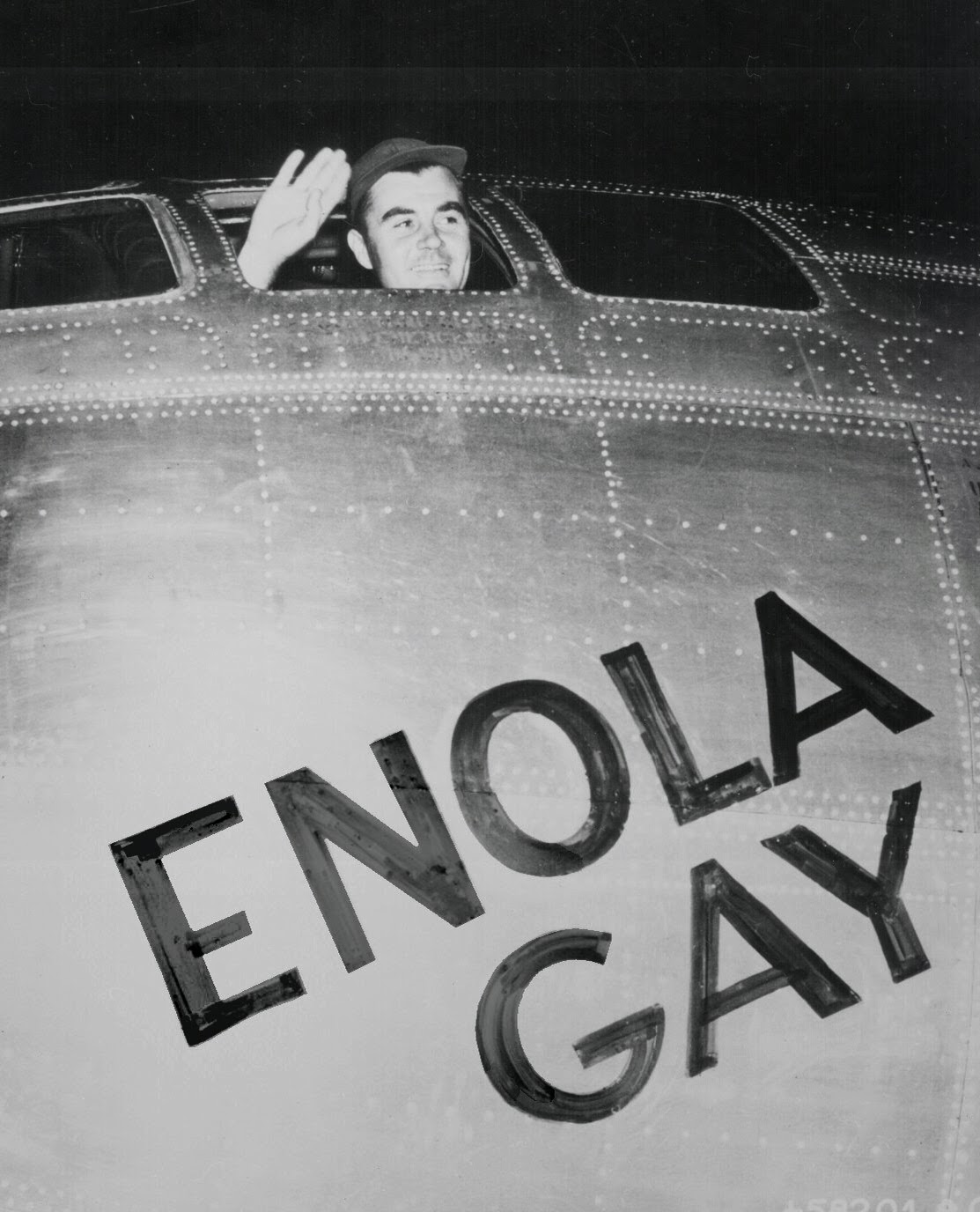
Think of it as the true end of the beginning. Last week, Theodore "Dutch" Van Kirk, the final member of the 12-man crew of the Enola Gay, the plane (named after its pilot’s supportive mother) that dropped the atomic bomb on Hiroshima, died at age 93.

Paul Tibbetts, Jr. in cockpit

When that first A-bomb left its bomb bay at 8:15 on the morning of August 6, 1945, and began its descent toward its target, the Aioli (“Live Together”) Bridge, it was inscribed with a series of American messages, some obscene, including “Greetings to the Emperor from the men of the Indianapolis.” (That ship had delivered to the Pacific island of Tinian parts of the very bomb that would turn Hiroshima into an inferno of smoke and fire -- “that awful cloud,” Paul Tibbetts, Jr., theEnola Gay's pilot, would call it -- and afterward was torpedoed by a Japanese submarine with the loss of hundreds of sailors.)

The bomb, dubbed Little Boy, that had gestated in the belly of the Enola Gay represented not only the near endpoint of a bitter global war of almost unimaginable destruction, but the birthing of something new. The way for its use had been paved by an evolution in warfare: the increasing targeting of civilian populations from the air (something that can be seen again today in the carnage of Gaza). The history of that grim development extends from German airship bombings of London (1915) by way of Guernica (1937), Shanghai (1937), and Coventry (1940), to the fire bombings of Dresden (1945) and Tokyo (1945) in the last year of World War II. It even had an evolutionary history in the human imagination, where for decades writers (among others) had dreamed of the unparalleled release of previously unknown forms of energy for military purposes.

On August 7, 1945, a previous age was ending and a new one was dawning. In the nuclear era, city-busting weapons would be a dime a dozen and would spread from the superpowers to many other countries, including Great Britain, China, India, Pakistan, North Korea, and Israel. Targeted by the planet’s major nuclear arsenals would be the civilian inhabitants not just of single cities but of scores and scores of cities, even of the planet itself. On August 6th, 70 years ago, the possibility of the apocalypse passed out of the hands of God or the gods and into human hands, which meant a new kind of history had begun whose endpoint is unknowable, though we do know that even a “modest” exchange of nuclear weapons between India and Pakistan would not only devastate South Asia, but thanks to the phenomenon of nuclear winter also cause widespread famine on a planetary scale.

In other words, 70 years later, the apocalypse is us. Yet in the United States, the only nuclear bomb you're likely to read about is Iran’s (even though that country possesses no such weapon). For a serious discussion of the U.S. nuclear arsenal, those more than 4,800 increasingly ill-kept weapons that could incinerate several Earth-sized planets, you need to look not to the country’s major newspapers or news programs but to comic John Oliver -- or TomDispatch regular Noam Chomsky. Tom

How Many Minutes to Midnight?
Hiroshima Day 2014

If some extraterrestrial species were compiling a history of Homo sapiens, they might well break their calendar into two eras: BNW (before nuclear weapons) and NWE (the nuclear weapons era). The latter era, of course, opened on August 6, 1945, the first day of the countdown to what may be the inglorious end of this strange species, which attained the intelligence to discover the effective means to destroy itself, but -- so the evidence suggests -- not the moral and intellectual capacity to control its worst instincts.

Day one of the NWE was marked by the “success” of Little Boy, a simple atomic bomb. On day four, Nagasaki experienced the technological triumph of Fat Man, a more sophisticated design. Five days later came what the official Air Force history calls the “grand finale,” a 1,000-plane raid -- no mean logistical achievement -- attacking Japan’s cities and killing many thousands of people, with leaflets falling among the bombs reading “Japan has surrendered.” Truman announced that surrender before the last B-29 returned to its base.

Those were the auspicious opening days of the NWE. As we now enter its 70th year, we should be contemplating with wonder that we have survived. We can only guess how many years remain.

Some reflections on these grim prospects were offered by General Lee Butler, former head of the U.S. Strategic Command (STRATCOM), which controls nuclear weapons and strategy. Twenty years ago, he wrote that we had so far survived the NWE “by some combination of skill, luck, and divine intervention, and I suspect the latter in greatest proportion.”

Reflecting on his long career in developing nuclear weapons strategies and organizing the forces to implement them efficiently, he described himself ruefully as having been “among the most avid of these keepers of the faith in nuclear weapons.” But, he continued, he had come to realize that it was now his “burden to declare with all of the conviction I can muster that in my judgment they served us extremely ill.” And he asked, “By what authority do succeeding generations of leaders in the nuclear-weapons states usurp the power to dictate the odds of continued life on our planet? Most urgently, why does such breathtaking audacity persist at a moment when we should stand trembling in the face of our folly and united in our commitment to abolish its most deadly manifestations?”

He termed the U.S. strategic plan of 1960 that called for an automated all-out strike on the Communist world “the single most absurd and irresponsible document I have ever reviewed in my life.” Its Soviet counterpart was probably even more insane. But it is important to bear in mind that there are competitors, not least among them the easy acceptance of extraordinary threats to survival.

Survival in the Early Cold War Years

According to received doctrine in scholarship and general intellectual discourse, the prime goal of state policy is “national security.” There is ample evidence, however, that the doctrine of national security does not encompass the security of the population. The record reveals that, for instance, the threat of instant destruction by nuclear weapons has not ranked high among the concerns of planners. That much was demonstrated early on, and remains true to the present moment.

In the early days of the NWE, the U.S. was overwhelmingly powerful and enjoyed remarkable security: it controlled the hemisphere, the Atlantic and Pacific oceans, and the opposite sides of those oceans as well. Long before World War II, it had already become by far the richest country in the world, with incomparable advantages. Its economy boomed during the war, while other industrial societies were devastated or severely weakened. By the opening of the new era, the U.S. possessed about half of total world wealth and an even greater percentage of its manufacturing capacity.

There was, however, a potential threat: intercontinental ballistic missiles with nuclear warheads. That threat was discussed in the standard scholarly study of nuclear policies, carried out with access to high-level sources -- Danger and Survival: Choices About the Bomb in the First Fifty Years by McGeorge Bundy, national security adviser during the Kennedy and Johnson presidencies.

Bundy wrote that “the timely development of ballistic missiles during the Eisenhower administration is one of the best achievements of those eight years. Yet it is well to begin with a recognition that both the United States and the Soviet Union might be in much less nuclear danger today if [those] missiles had never been developed.” He then added an instructive comment: “I am aware of no serious contemporary proposal, in or out of either government, that ballistic missiles should somehow be banned by agreement.” In short, there was apparently no thought of trying to prevent the sole serious threat to the U.S., the threat of utter destruction in a nuclear war with the Soviet Union.

Could that threat have been taken off the table? We cannot, of course, be sure, but it was hardly inconceivable. The Russians, far behind in industrial development and technological sophistication, were in a far more threatening environment. Hence, they were significantly more vulnerable to such weapons systems than the U.S. There might have been opportunities to explore these possibilities, but in the extraordinary hysteria of the day they could hardly have even been perceived. And that hysteria was indeed extraordinary. An examination of the rhetoric of central official documents of that moment like National Security Council Paper NSC-68 remains quite shocking, even discounting Secretary of State Dean Acheson’s injunction that it is necessary to be “clearer than truth.” Read More


Monday, April 28, 2014

Japan's 25-year plan to have space solar power

Solar energy experts have long known that the best place to collect the sun's rays is in space. A solar farm in orbit could collect energy all the time, whereas ground-based arrays sit idle during the night.

And huge chunks of real estate are easier to come by in space, where solar collectors can be as enormous as they need to be. But the problems with turning solar energy in space into useable energy on Earth have kept space solar stuck in the land of science fiction since the 1960s.

Yet Japan's version of NASA, the Japan Aerospace Exploration Agency, is optimistic. JAXA recently unveiled a technology roadmap that says it can make solar arrays in orbit a reality by the 2030s, and that plant could supply 1 gigawatt of energy, the equivalent of one of the country's nuclear plants. Susumu Sasaki reports for IEEE Spectrum.

Microwaves are key to JAXA's plans. Some space solar concepts have proposed using lasers to beam the energy in orbit down to collectors on the surface, but the water molecules in the clouds can scatter laser light. That means you'd lose some of the energy on anything less than a perfectly clear day. Microwaves don't have that problem. So JAXA has designed multiple concepts in which the DC (direct current) power generated in orbit would be transformed into microwaves and then beamed to Earth's surface, where a farm of antennas would collect the microwaves and transform them back into DC electricity. JAXA says it can now perform these transformations with at least 80 percent efficiency on each end.

Another major hurdle for space solar is keeping the collectors pointed at the sun at all times so they can collect energy continuously. JAXA released one design that features a square panel measuring 2 kilometers (1.2 miles) on each side. But the panel's orientation is fixed, meaning the amount of energy it can produce varies. Another JAXA design solves this problem by incorporating two enormous mirrors that reflect sunlight onto photovoltaic panels positioned between them.

More hurdles: If a space solar array had to burn fuel to adjust its position, for example, that would add millions of dollars to the cost. So Japan is trying to design its components in such a way that they naturally counterbalance Earth's gravity and stay in position without adjustment. In the case of the two-mirror design, all those pieces would need to fly in careful, precise formation, something that has not been tried on so grand a scale.

In the transmission phase, more than a billion tiny antennas affixed to moveable panels would be required to receive the microwave energy coming from space. Those panels must constantly adjust their orientation to maximize how much energy they receive. JAXA plans to help them by sending a pilot signal from the ground to the satellite that would tell the satellite how to adjust the beam.

Despite these and more challenges, JAXA has rolled out an ambitious timeline: It plans to unveil a ground-based demonstration this year, then reveal progressively larger experimental satellites in 2017, 2021, and 2024. The major goal would come to fruition in the following decade: A 1-GW power station in 2031, and then one power station launched per year by the late 2030s.

Within a quarter-century, then, perhaps Japan's energy will come not from nuclear plants -- which are vulnerable to earthquakes, tsunamis, and planetary outbursts -- but from solar arrays that aren't even on the planet. More


Tuesday, March 11, 2014

Onagawa: The Japanese nuclear power plant that didn’t melt down on 3/11

Three years ago, the biggest recorded earthquake in Japanese history hit Tohoku prefecture, leaving more than 20,000 people dead or missing. On the heels of the destructive magnitude 9.0 earthquake came a tsunami that reached a run-up height of 30 meters in some areas, sweeping entire towns away in seconds.


Within the affected area were three nuclear power plants: the Fukushima Daiichi and Daini nuclear power plants operated by the Tokyo Electric Power Company (Tepco), and the Onagawa Nuclear Power Station operated by the Tohoku Electric Power Company. While the three power stations shared similar disaster conditions, nuclear reactor types, dates of operation, and an identical regulatory regime, their fates were very different. The Fukushima Daiichi plant experienced fatal meltdowns and radiation releases. Fukushima Daini was damaged by the earthquake and tsunami, but the heroic efforts and improvisations of its operators resulted in the cold shutdown of all four operating reactors. Onagawa managed to remain generally intact, despite its proximity to the epicenter of the enormous earthquake.

The earthquake and tsunami of March 11, 2011, were natural disasters of a magnitude that shocked the entire world. Although triggered by these cataclysmic events, the subsequent accident at the Fukushima Daiichi Nuclear Power Plant cannot be regarded as a natural disaster. It was a profoundly manmade disaster—that could and should have been foreseen and prevented.” - Kiyoshi Kurokawa, “Message from the Chairman,” The Official Report of The Fukushima Nuclear Accident Independent Investigation Commission


Everyone knows the name Fukushima, but few people, even in Japan, are familiar with the Onagawa power station. Fewer still know how Onagawa managed to avoid disaster. According to a report by the International Atomic Energy Agency mission that visited Onagawa and evaluated its performance, “the plant experienced very high levels of ground motion—the strongest shaking that any nuclear plant has ever experienced from an earthquake,” but it “shut down safely” and was “remarkably undamaged.”


Most people believe that Fukushima Daiichi’s meltdowns were predominantly due to the earthquake and tsunami. The survival of Onagawa, however, suggests otherwise. Onagawa was only 123 kilometers away from the epicenter—60 kilometers closer than Fukushima Daiichi—and the difference in seismic intensity at the two plants was negligible. Furthermore, the tsunami was bigger at Onagawa, reaching a height of 14.3 meters, compared with 13.1 meters at Fukushima Daiichi. The difference in outcomes at the two plants reveals the root cause of Fukushima Daiichi’s failures: the utility’s corporate “safety culture.”


Higher ground. While the Fukushima Daiichi and Onagawa plants are similar in many ways, the most obvious difference is that Tohoku Electric constructed Onagawa’s reactor buildings at a higher elevation than Tepco’s Fukushima reactor buildings. Before beginning construction, Tohoku Electric conducted surveys and simulations aimed at predicting tsunami levels. The initial predictions showed that tsunamis in the region historically had an average height of about 3 meters. Based on that, the company constructed its plant at 14.7 meters above sea level, almost five times that height. As more research was done, the estimated tsunami levels climbed higher, and Tohoku Electric conducted periodic checkups based on the new estimates.


Tepco, on the other hand, to make it easier to transport equipment and to save construction costs, in 1967 removed 25 meters from the 35-meter natural seawall of the Daiichi plant site and built the reactor buildings at a much lower elevation of 10 meters. According to the National Diet of Japan’s Fukushima Nuclear Accident Independent Investigation Commission (NAIIC), the initial construction was based on existing seismological information, but later research showed that tsunami levels had been underestimated. While Tohoku Electric learned from past earthquakes and tsunamis—including one in Chile on February 28, 2010—and continuously improved its countermeasures, Tepco overlooked these warnings. According to the NAIIC report, Tepco “resorted to delaying tactics, such as presenting alternative scientific studies and lobbying.”


Tepco’s tsunami risk characterization and assessment was, in the judgment of one the world’s renowned tsunami experts, Costas Synolakis, director of the Tsunami Research Center at the University of Southern California, a “cascade of stupid errors that led to the disaster.”


Emergency response. Tohoku Electric also took a different approach to emergency response—one that was more organized, collaborative, and controlled than Tepco’s. Tohoku Electric established an emergency response center at the Onagawa plant, as well as at company headquarters, immediately after the earthquake. Throughout the disaster, headquarters supported the plant operators minute by minute. Supervisors and chief engineers were dispatched to the main control rooms of the damaged reactors to make decisions, and information was sent in a timely manner to all levels of the response team.


Why did the Tohoku Electric team remain more poised and unified than their counterparts at Tepco? According to the Nippon Telegraph and Telephone Facilities Research Institute, Yanosuke Hirai, vice president of Tohoku Electric from 1960 to 1975—a time period that preceded the 1980 groundbreaking at Onagawa—was adamant about safety protocols and became a member of the Coastal Institution Research Association in 1963 because of his concern about the importance of protecting against natural disasters. With a senior employee in upper management advocating forcefully for safety, a strong safety culture formed within the company. Representatives of Tohoku Electric participated in seminars and panel discussions about earthquake and tsunami disaster prevention held by the Japan Nuclear Energy Safety Organization. The company implemented strict protocols for disaster response, and all workers were familiar with the steps to be taken when a tsunami was approaching.


These initiatives were not part of Tepco’s culture. The company had a mindset that its domination in the electricity industry was an indication of flawlessness. After the disaster, Hasuike Tooru, the former president of Tepco, described how management decided to lengthen the expected lifetime of power plants, even if there were severe safety consequences.


Safety culture. Government investigations of the Fukushima accident, as well as a statement by US Nuclear Regulatory Commission (NRC) chairwoman Allison MacFarlane, have explicitly acknowledged the vital role of safety culture, which the NRC has defined as “the core values and behaviors resulting from a collective commitment by leaders and individuals to emphasize safety over competing goals to ensure protection of people and the environment.”


The NAIIC report described the Fukushima accident as “made in Japan,” because Japan’s nuclear industry failed to absorb the lessons learned from Three Mile Island and Chernobyl. In the words of NAIIC chairman Kiyoshi Kurokawa, “It was this mindset that led to the disaster.” Safety culture has also been implicated as a primary root cause of the Chernobyl accident.


The Fukushima Daiichi Nuclear Power Station’s meltdowns were not due to the natural disaster, but rather to a series of decisions by Tepco not to be proactive with safety, dating back to when the reactors were being constructed. With most other factors being similar, it was Tokohu Electric’s overall organizational practices and safety culture that saved the day for Onagawa. If safety and disaster response had been properly recognized, addressed, and implemented at Fukushima Daiichi—as they were within Tohoku Electric’s corporate safety culture—perhaps the disastrous meltdowns would have been prevented.


Editor's note: This article is adapted from a research paper based on material available in the public domain in Japan and the United States; the full version of the paper can be found here.


Thursday, July 11, 2013

Short Term WHO Consultancy Available

Short Term WHO Consultancy Available - in Media and Health Inter-Sectoral Action.


TOR is as follows:

2. Description of tasks

Working closely with the Urban Health team, the contract holder will develop a policy brief on Impact Assessment for Multisectoral Action on Health.

Specifically, s/he will be tasked to:

Review relevant background literature and internal documents on Impact Assessment (including Health and other Impact Assessments) and Multisectoral Action on Health

Develop a policy brief on the topic, tailored to clarifying the concepts and importance of the use of impact assessment for media professionals.

3. Payment terms

The payment rate is US$ 200 per working day. The total expected number of working days is 30. The total amount is: US$ 200 x 30 days = US$ 6,000.

The consultant does not need to be at our office in Kobe, Japan.


For more information see: http://www.who.int/kobe_centre/en/


Tuesday, April 30, 2013

Take Action at Fukushima: An Open Letter to Secretary General Ban Ki-moon

Dear Secretary General Ban Ki-moon:

You no doubt observed the Fukushima disaster on March 11, 2011, with terror and worry: what would another nuclear disaster mean for state relations, especially in your home region of East Asia? Fortunately, it seemed, the effects were largely kept to Japan’s islands and were less than many experts anticipated. Within weeks the stories dissipated if not disappeared from the major media outlets, only to be resurrected with personal interest stories of a hero or an especially tragic case of a lost loved one.

But the crisis is not over. Today, Martin Fackler reported in the New York Times that radioactively polluted water is leaking out of the plants and that the site is in a new state of emergency. Mitsuhei Murata, Japan’s former ambassador to Switzerland, wrote a letter last year that brought international attention to the thousands of radioactive spent fuel rods at the site and the danger their vulnerability presents; he has testified to this several times before Japan’s parliament. International experts, independent and of the International Atomic Energy Agency, have commented that the Tokyo Electric Power Company’s plans for the removal of the rods from the site and their storage in a safer, if still temporary, location are optimistic if not unrealistic.

The news media has done an adequate if meager job of reporting the many issues the fuel rods present. The radioactive fuel must be continuously cooled in order to stay safe; the improvised electric system that maintains this cooling has failed several times, once for more than 24 hours, both on its own and because of hungry rats. The mechanism that stands between safety and a fire at the Fukushima Daiichi plant is, to say the least, precarious. (And, as has been clear to many since the beginning, TEPCO hope to shirk its responsibility: first, in its safety and maintenance of the site; second, in paying its costs to Japan.)

One can only speculate to the extent of the consequences of a spent fuel fire, but, unarguably, once a fire ignites (from lack of cooling water or from an earthquake-caused spill), even the best case scenario would be an unprecedented global disaster. Possible consequences are the evacuation of Tokyo’s 35 million people, permanent disuse of Japan’s land, and poisoned food crops in the United States. These are not fantastic projections, but reasonable, if not conservative, expectations.

Yet, unimaginably but all too familiarly, the situation is still relegated to the back pages of our papers, and thus to the back of our leaders’ minds. This reminds me of our international approach to solving climate change, which I have partaken in for decades, first in the United Nations and then as the Secretary General of the Parliamentary Earth Summit in Rio de Janeiro: we have a latent but very serious issue that we can likely fix but lack the resolve and political will to do so. As you well know, a successful climate change agreement has eluded us.

In comparison with climate change, however, the radioactive fuel rod issue at Fukushima is both easier to solve and more urgent. Any Japanese can tell you another serious earthquake will hit Japan well inside the next decade. That is to say, this situation must be resolved quickly.

Still, even if possible to solve, the issue needs constant attention and competent and well funded actors. So who might take charge? The International Atomic Energy Agency said last week that it will take TEPCO 40 years to secure the radioactive fuel rods in more appropriate storage containers. TEPCO is already refusing to pay Japan billions of Yen in cleanup costs, and does not have the technology or wherewithal to perform the task competently and expediently. Yet, so far the Japanese government has only looked to TEPCO.

The next obvious choice outside Japan is the United States, for their technological superiority, money, and leadership. Early after the accident, the U.S. Department of Defense offered assistance to Japan, but the Japanese denied their help. It remains to be seen whether that door has permanently closed. This would not be a benevolent action: the U.S. sits in harm’s way in the case of a fuel pool fire; residents of California, Oregon, and Washington have already received much radiation. U.S.-led action, except perhaps by Oregon Senator Ron Wyden, is unlikely: U.S. senators and representatives continues to demonstrate their impotence at home or abroad.

I have long been advocating for an international team of independent experts to investigate the situation. The United Nations is one appropriate body to assemble and deliver such a team. The IAEA, however, should not take on the responsibility.

The IAEA’s mission is to promote the peaceful use of nuclear energy. Concerns of proliferation are not applicable here, and the disaster itself has certainly called into question (again) what the peaceful use of nuclear energy means and whether it should be promoted. While the agency has recently urged safety improvements at Fukushima, the official line of thinking is still, incorrectly and impossibly, to use TEPCO to carry out the process.

We are not only waiting for a bigger disaster. One is already unfolding before us. The health consequences of the released radiation are large: despite what major news outlets are reporting, we will see a significant jump in thyroid and other cancers in Japan in four to five years. Congenital malformations will likely begin to appear. The premature reporting of some UN agencies and the press at large has been irresponsible: do we have no notion of what “precaution” means? These latent effects will cripple much of Japan’s young population within the decade.
Our myopia, in Japan and internationally, is tragic. One bright spot was the UN Special Rapporteur Anand Grover’s fact-finding mission in Japan last year; I hope you back his findings and circulate them widely.

We have already waited too long, as we did for climate change, to take international action on Fukushima. But now it is clear that we cannot allow Japan to take care of an issue that could affect all of us.

Secretary General Ban Ki-moon, I urge you to use your unique position as the head of the United Nations to galvanize political will and organize an independent assessment team of international scientists and engineers to solve the Fukushima radioactive spent fuel rod issue before we are forced to reckon with the fallout of another disaster. Japan and the world should not have to suffer more because we choose to wait.

Yours truly,

Akio Matsumura

-Former Special Advisor to the United Nations Development Program
-Founder and Secretary General of the Global Forum of Spiritual and Parliamentary Leaders for Human Survival
-Secretary General of the 1992 Parliamentary Earth Summit Conference in Rio de Janeiro More


Monday, March 11, 2013

Fukushima disaster: Long road to nuclear clean-up

It would be reassuring to think that the world's worst nuclear disaster since Chernobyl is contained, and the Fukushima Daiichi nuclear power plant is in stable shut-down.

Unfortunately a look inside the Fukushima plant suggests otherwise.

I was part of a group taken in to the Fukushima plant last week, only the second time foreign TV journalists have been allowed in since the disaster two year ago. Very little that we saw in our brief two-hour tour was reassuring.

Our first stop was reactor building number four. This place was potentially the most worrying.

Inside the shattered building, more than 1,500 spent fuel rods were still sitting inside a cooling pool. They were still highly radioactive and the pool was outside the reactor's steel and concrete containment vessel, perched high on the third floor.

But that operation will not start until the end of this year, and will then take two more years to complete. If another large earthquake strikes during that time there is real concern the building could collapse.A race is now on to get the fuel rods out. A huge steel structure is being erected around building four that will be used to raise the spent fuel out.

Tepco, the company that runs the plant, told us the building was now strong enough to withstand another quake. But contractors who have worked inside building four have reported that the structure is still extremely fragile.

Waste water

Reactor number four was only the tip of a radioactive iceberg. Two hundred meters away I could clearly see the twisted and rusting steel of reactor building number three.

Two years after the disaster it was still virtually untouched. The reason was simple. The radiation at reactor three was so high workers could not safely go near it.

Like reactor four, reactor three had spent fuel rods sitting inside a cooling pool beneath the twisted steel and rubble. Remotely-operated cranes are being used to try and pull away the debris, but it is a painfully slow process.Our bus rushed past without stopping. The Geiger counter reading was over 1,000 micro sieverts an hour. That is roughly the same as ten chest X-rays every hour, or a full CT scan every ten hours.

Tepco's other huge problem is contaminated water, tens of thousands of tonnes of it.

This work will take 30 to 40 years” Takeshi Takahashi

The 9.0 earthquake that struck two years ago appears to have severely damaged the foundations of the plant - creating large cracks in the underground walls that are supposed to keep the plant water tight.

Ground and seawater is now leaking through the cracks in to the basements around the reactors.

The water rapidly becomes highly contaminated and cannot be pumped out into the sea. Instead Tepco is building huge 1,000 tonne water tanks to store the contaminated water.

The Fukushima sight is now dotted with hundreds of them. But the water leakage is so severe that they are having to add a new tank every two to three days. Within two years they will have run out of room. More


Monday, October 22, 2012

Earthquake-Causing Fracking to Be Allowed within 500 Feet of Nuclear Plants

Nuclear Plants Vulnerable to Earthquakes

The American government has officially stated that fracking can cause earthquakes. Some fracking companies now admit this fact The scientific community agrees. See this, this, this, this and this.

Earthquakes can – of course – damage nuclear power plants. For example, even the operator of Fukushima and the Japanese government now admit that the nuclear cores might have started melting down before the tsuanmi ever hit. More here.

Indeed, the fuel pools and rods at Fukushima appear to have “boiled”, caught fire and/or exploded soon after the earthquake knocked out power systems. See this, this, this, this and this. And fuel pools in the United States store an average of ten times more radioactive fuel than stored at Fukushima, have virtually no safety features, and are vulnerable to accidents and terrorist attacks. And see this.

Indeed, American reactors may be even more vulnerable to earthquakes than Fukushima.

But American nuclear “regulators” have allowed numerous nuclear power plants to be built in earthquake zones:

And they have cover up the risks from earthquakes for years … just like theJapanese regulators did. For example:

  • The NRC won’t even begin conducting its earthquake study for Indian Point nuclear power plant in New York until after relicensing is complete in 2013, because the NRC doesn’t consider a big earthquake “a serious risk”
  • Congressman Markey has said there is a cover up. Specifically, Markey alleges that the head of the NRC told everyone not to write down risks they find from an earthquake greater than 6.0 (the plant was only built to survive a 6.0 earthquake)
  • We have 4 reactors in California – 2 at San Onofre 2 at San Luis Obisbo – which are vulnerable to earthquakes and tsunamis

For example, Diablo Canyon is located on numerous earthquake faults, and a state legislator and seismic expert says it could turn into California’s Fukushima:

On July 26th 2011 the California Energy Commission held hearings concerning the state’s nuclear safety. During those hearings, the Chairman of the Commission asked governments experts whether or not they felt the facilities could withstand the maximum credible quake. The response was that they did not know.This is similar to what happened at Fukushima: seismologists dire warnings were ignored (and see this.)

Yet the Nuclear Regulatory Commission doesn’t even take earthquake risk into account when deciding whether or not to relicense plants like Diablo Canyon. More