Showing posts with label tsunami. Show all posts

Tuesday, March 11, 2014

Onagawa: The Japanese nuclear power plant that didn’t melt down on 3/11

Three years ago, the biggest recorded earthquake in Japanese history hit Tohoku prefecture, leaving more than 20,000 people dead or missing. On the heels of the destructive magnitude 9.0 earthquake came a tsunami that reached a run-up height of 30 meters in some areas, sweeping entire towns away in seconds.


Within the affected area were three nuclear power plants: the Fukushima Daiichi and Daini nuclear power plants operated by the Tokyo Electric Power Company (Tepco), and the Onagawa Nuclear Power Station operated by the Tohoku Electric Power Company. While the three power stations shared similar disaster conditions, nuclear reactor types, dates of operation, and an identical regulatory regime, their fates were very different. The Fukushima Daiichi plant experienced fatal meltdowns and radiation releases. Fukushima Daini was damaged by the earthquake and tsunami, but the heroic efforts and improvisations of its operators resulted in the cold shutdown of all four operating reactors. Onagawa managed to remain generally intact, despite its proximity to the epicenter of the enormous earthquake.

The earthquake and tsunami of March 11, 2011, were natural disasters of a magnitude that shocked the entire world. Although triggered by these cataclysmic events, the subsequent accident at the Fukushima Daiichi Nuclear Power Plant cannot be regarded as a natural disaster. It was a profoundly manmade disaster—that could and should have been foreseen and prevented.” - Kiyoshi Kurokawa, “Message from the Chairman,” The Official Report of The Fukushima Nuclear Accident Independent Investigation Commission


Everyone knows the name Fukushima, but few people, even in Japan, are familiar with the Onagawa power station. Fewer still know how Onagawa managed to avoid disaster. According to a report by the International Atomic Energy Agency mission that visited Onagawa and evaluated its performance, “the plant experienced very high levels of ground motion—the strongest shaking that any nuclear plant has ever experienced from an earthquake,” but it “shut down safely” and was “remarkably undamaged.”


Most people believe that Fukushima Daiichi’s meltdowns were predominantly due to the earthquake and tsunami. The survival of Onagawa, however, suggests otherwise. Onagawa was only 123 kilometers away from the epicenter—60 kilometers closer than Fukushima Daiichi—and the difference in seismic intensity at the two plants was negligible. Furthermore, the tsunami was bigger at Onagawa, reaching a height of 14.3 meters, compared with 13.1 meters at Fukushima Daiichi. The difference in outcomes at the two plants reveals the root cause of Fukushima Daiichi’s failures: the utility’s corporate “safety culture.”


Higher ground. While the Fukushima Daiichi and Onagawa plants are similar in many ways, the most obvious difference is that Tohoku Electric constructed Onagawa’s reactor buildings at a higher elevation than Tepco’s Fukushima reactor buildings. Before beginning construction, Tohoku Electric conducted surveys and simulations aimed at predicting tsunami levels. The initial predictions showed that tsunamis in the region historically had an average height of about 3 meters. Based on that, the company constructed its plant at 14.7 meters above sea level, almost five times that height. As more research was done, the estimated tsunami levels climbed higher, and Tohoku Electric conducted periodic checkups based on the new estimates.


Tepco, on the other hand, to make it easier to transport equipment and to save construction costs, in 1967 removed 25 meters from the 35-meter natural seawall of the Daiichi plant site and built the reactor buildings at a much lower elevation of 10 meters. According to the National Diet of Japan’s Fukushima Nuclear Accident Independent Investigation Commission (NAIIC), the initial construction was based on existing seismological information, but later research showed that tsunami levels had been underestimated. While Tohoku Electric learned from past earthquakes and tsunamis—including one in Chile on February 28, 2010—and continuously improved its countermeasures, Tepco overlooked these warnings. According to the NAIIC report, Tepco “resorted to delaying tactics, such as presenting alternative scientific studies and lobbying.”


Tepco’s tsunami risk characterization and assessment was, in the judgment of one the world’s renowned tsunami experts, Costas Synolakis, director of the Tsunami Research Center at the University of Southern California, a “cascade of stupid errors that led to the disaster.”


Emergency response. Tohoku Electric also took a different approach to emergency response—one that was more organized, collaborative, and controlled than Tepco’s. Tohoku Electric established an emergency response center at the Onagawa plant, as well as at company headquarters, immediately after the earthquake. Throughout the disaster, headquarters supported the plant operators minute by minute. Supervisors and chief engineers were dispatched to the main control rooms of the damaged reactors to make decisions, and information was sent in a timely manner to all levels of the response team.


Why did the Tohoku Electric team remain more poised and unified than their counterparts at Tepco? According to the Nippon Telegraph and Telephone Facilities Research Institute, Yanosuke Hirai, vice president of Tohoku Electric from 1960 to 1975—a time period that preceded the 1980 groundbreaking at Onagawa—was adamant about safety protocols and became a member of the Coastal Institution Research Association in 1963 because of his concern about the importance of protecting against natural disasters. With a senior employee in upper management advocating forcefully for safety, a strong safety culture formed within the company. Representatives of Tohoku Electric participated in seminars and panel discussions about earthquake and tsunami disaster prevention held by the Japan Nuclear Energy Safety Organization. The company implemented strict protocols for disaster response, and all workers were familiar with the steps to be taken when a tsunami was approaching.


These initiatives were not part of Tepco’s culture. The company had a mindset that its domination in the electricity industry was an indication of flawlessness. After the disaster, Hasuike Tooru, the former president of Tepco, described how management decided to lengthen the expected lifetime of power plants, even if there were severe safety consequences.


Safety culture. Government investigations of the Fukushima accident, as well as a statement by US Nuclear Regulatory Commission (NRC) chairwoman Allison MacFarlane, have explicitly acknowledged the vital role of safety culture, which the NRC has defined as “the core values and behaviors resulting from a collective commitment by leaders and individuals to emphasize safety over competing goals to ensure protection of people and the environment.”


The NAIIC report described the Fukushima accident as “made in Japan,” because Japan’s nuclear industry failed to absorb the lessons learned from Three Mile Island and Chernobyl. In the words of NAIIC chairman Kiyoshi Kurokawa, “It was this mindset that led to the disaster.” Safety culture has also been implicated as a primary root cause of the Chernobyl accident.


The Fukushima Daiichi Nuclear Power Station’s meltdowns were not due to the natural disaster, but rather to a series of decisions by Tepco not to be proactive with safety, dating back to when the reactors were being constructed. With most other factors being similar, it was Tokohu Electric’s overall organizational practices and safety culture that saved the day for Onagawa. If safety and disaster response had been properly recognized, addressed, and implemented at Fukushima Daiichi—as they were within Tohoku Electric’s corporate safety culture—perhaps the disastrous meltdowns would have been prevented.


Editor's note: This article is adapted from a research paper based on material available in the public domain in Japan and the United States; the full version of the paper can be found here.


Tuesday, August 20, 2013

Save the Date: World Conference on Disaster Risk Reduction 2015

Subject to an anticipated decision of the UN General Assembly later in 2013, the Third United Nations World Conference on Disaster Risk Reduction (WCDRR) is to take place in Sendai City, Miyagi Prefecture, Japan, from 14 to 18 March 2015 (five days inclusive).


Hosted by the Government of Japan in cooperation with the United Nations Office for Disaster Risk Reduction (UNISDR), as secretariat of the International Strategy for Disaster Reduction, the WCDRR will review the implementation of the Hyogo Framework for Action and is expected to adopt a successor framework for disaster risk reduction.

The post-2015 framework for disaster risk reduction will build on the knowledge and practice developed through the implementation of the International Framework for the International Decade for Natural Disaster Reduction of 1989, the Yokohama Strategy and Plan of Action of 1994, the International Strategy for Disaster Reduction of 1999 and the Hyogo Framework for Action 2005-2015: Building the Resilience of Nations and Communities to Disasters. Pursuant to General Assembly resolution 66/199, UNISDR will continue to ensure extensive and inclusive multi-stakeholder consultations for a post-2015 framework for disaster risk reduction.

Kind regards,
UNISDR


*******************
International Day for Disaster Reduction 2013
http://www.unisdr.org/2013/iddr

The United Nations Office for Disaster Risk Reduction (UNISDR)
Visit our website: http://www.unisdr.org
Follow us on Twitter: http://www.twitter.com/unisdr
Find us on Facebook: http://www.facebook.com/unisdr

Share your Disaster Risk Reduction content: http://www.preventionweb.net/submit


Tuesday, April 30, 2013

Take Action at Fukushima: An Open Letter to Secretary General Ban Ki-moon

Dear Secretary General Ban Ki-moon:

You no doubt observed the Fukushima disaster on March 11, 2011, with terror and worry: what would another nuclear disaster mean for state relations, especially in your home region of East Asia? Fortunately, it seemed, the effects were largely kept to Japan’s islands and were less than many experts anticipated. Within weeks the stories dissipated if not disappeared from the major media outlets, only to be resurrected with personal interest stories of a hero or an especially tragic case of a lost loved one.

But the crisis is not over. Today, Martin Fackler reported in the New York Times that radioactively polluted water is leaking out of the plants and that the site is in a new state of emergency. Mitsuhei Murata, Japan’s former ambassador to Switzerland, wrote a letter last year that brought international attention to the thousands of radioactive spent fuel rods at the site and the danger their vulnerability presents; he has testified to this several times before Japan’s parliament. International experts, independent and of the International Atomic Energy Agency, have commented that the Tokyo Electric Power Company’s plans for the removal of the rods from the site and their storage in a safer, if still temporary, location are optimistic if not unrealistic.

The news media has done an adequate if meager job of reporting the many issues the fuel rods present. The radioactive fuel must be continuously cooled in order to stay safe; the improvised electric system that maintains this cooling has failed several times, once for more than 24 hours, both on its own and because of hungry rats. The mechanism that stands between safety and a fire at the Fukushima Daiichi plant is, to say the least, precarious. (And, as has been clear to many since the beginning, TEPCO hope to shirk its responsibility: first, in its safety and maintenance of the site; second, in paying its costs to Japan.)

One can only speculate to the extent of the consequences of a spent fuel fire, but, unarguably, once a fire ignites (from lack of cooling water or from an earthquake-caused spill), even the best case scenario would be an unprecedented global disaster. Possible consequences are the evacuation of Tokyo’s 35 million people, permanent disuse of Japan’s land, and poisoned food crops in the United States. These are not fantastic projections, but reasonable, if not conservative, expectations.

Yet, unimaginably but all too familiarly, the situation is still relegated to the back pages of our papers, and thus to the back of our leaders’ minds. This reminds me of our international approach to solving climate change, which I have partaken in for decades, first in the United Nations and then as the Secretary General of the Parliamentary Earth Summit in Rio de Janeiro: we have a latent but very serious issue that we can likely fix but lack the resolve and political will to do so. As you well know, a successful climate change agreement has eluded us.

In comparison with climate change, however, the radioactive fuel rod issue at Fukushima is both easier to solve and more urgent. Any Japanese can tell you another serious earthquake will hit Japan well inside the next decade. That is to say, this situation must be resolved quickly.

Still, even if possible to solve, the issue needs constant attention and competent and well funded actors. So who might take charge? The International Atomic Energy Agency said last week that it will take TEPCO 40 years to secure the radioactive fuel rods in more appropriate storage containers. TEPCO is already refusing to pay Japan billions of Yen in cleanup costs, and does not have the technology or wherewithal to perform the task competently and expediently. Yet, so far the Japanese government has only looked to TEPCO.

The next obvious choice outside Japan is the United States, for their technological superiority, money, and leadership. Early after the accident, the U.S. Department of Defense offered assistance to Japan, but the Japanese denied their help. It remains to be seen whether that door has permanently closed. This would not be a benevolent action: the U.S. sits in harm’s way in the case of a fuel pool fire; residents of California, Oregon, and Washington have already received much radiation. U.S.-led action, except perhaps by Oregon Senator Ron Wyden, is unlikely: U.S. senators and representatives continues to demonstrate their impotence at home or abroad.

I have long been advocating for an international team of independent experts to investigate the situation. The United Nations is one appropriate body to assemble and deliver such a team. The IAEA, however, should not take on the responsibility.

The IAEA’s mission is to promote the peaceful use of nuclear energy. Concerns of proliferation are not applicable here, and the disaster itself has certainly called into question (again) what the peaceful use of nuclear energy means and whether it should be promoted. While the agency has recently urged safety improvements at Fukushima, the official line of thinking is still, incorrectly and impossibly, to use TEPCO to carry out the process.

We are not only waiting for a bigger disaster. One is already unfolding before us. The health consequences of the released radiation are large: despite what major news outlets are reporting, we will see a significant jump in thyroid and other cancers in Japan in four to five years. Congenital malformations will likely begin to appear. The premature reporting of some UN agencies and the press at large has been irresponsible: do we have no notion of what “precaution” means? These latent effects will cripple much of Japan’s young population within the decade.
Our myopia, in Japan and internationally, is tragic. One bright spot was the UN Special Rapporteur Anand Grover’s fact-finding mission in Japan last year; I hope you back his findings and circulate them widely.

We have already waited too long, as we did for climate change, to take international action on Fukushima. But now it is clear that we cannot allow Japan to take care of an issue that could affect all of us.

Secretary General Ban Ki-moon, I urge you to use your unique position as the head of the United Nations to galvanize political will and organize an independent assessment team of international scientists and engineers to solve the Fukushima radioactive spent fuel rod issue before we are forced to reckon with the fallout of another disaster. Japan and the world should not have to suffer more because we choose to wait.

Yours truly,

Akio Matsumura

-Former Special Advisor to the United Nations Development Program
-Founder and Secretary General of the Global Forum of Spiritual and Parliamentary Leaders for Human Survival
-Secretary General of the 1992 Parliamentary Earth Summit Conference in Rio de Janeiro More


Monday, March 11, 2013

Fukushima disaster: Long road to nuclear clean-up

It would be reassuring to think that the world's worst nuclear disaster since Chernobyl is contained, and the Fukushima Daiichi nuclear power plant is in stable shut-down.

Unfortunately a look inside the Fukushima plant suggests otherwise.

I was part of a group taken in to the Fukushima plant last week, only the second time foreign TV journalists have been allowed in since the disaster two year ago. Very little that we saw in our brief two-hour tour was reassuring.

Our first stop was reactor building number four. This place was potentially the most worrying.

Inside the shattered building, more than 1,500 spent fuel rods were still sitting inside a cooling pool. They were still highly radioactive and the pool was outside the reactor's steel and concrete containment vessel, perched high on the third floor.

But that operation will not start until the end of this year, and will then take two more years to complete. If another large earthquake strikes during that time there is real concern the building could collapse.A race is now on to get the fuel rods out. A huge steel structure is being erected around building four that will be used to raise the spent fuel out.

Tepco, the company that runs the plant, told us the building was now strong enough to withstand another quake. But contractors who have worked inside building four have reported that the structure is still extremely fragile.

Waste water

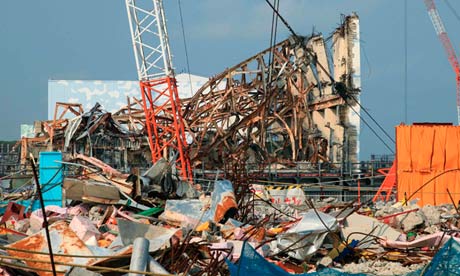
Reactor number four was only the tip of a radioactive iceberg. Two hundred meters away I could clearly see the twisted and rusting steel of reactor building number three.

Two years after the disaster it was still virtually untouched. The reason was simple. The radiation at reactor three was so high workers could not safely go near it.

Like reactor four, reactor three had spent fuel rods sitting inside a cooling pool beneath the twisted steel and rubble. Remotely-operated cranes are being used to try and pull away the debris, but it is a painfully slow process.Our bus rushed past without stopping. The Geiger counter reading was over 1,000 micro sieverts an hour. That is roughly the same as ten chest X-rays every hour, or a full CT scan every ten hours.

Tepco's other huge problem is contaminated water, tens of thousands of tonnes of it.

This work will take 30 to 40 years” Takeshi Takahashi

The 9.0 earthquake that struck two years ago appears to have severely damaged the foundations of the plant - creating large cracks in the underground walls that are supposed to keep the plant water tight.

Ground and seawater is now leaking through the cracks in to the basements around the reactors.

The water rapidly becomes highly contaminated and cannot be pumped out into the sea. Instead Tepco is building huge 1,000 tonne water tanks to store the contaminated water.

The Fukushima sight is now dotted with hundreds of them. But the water leakage is so severe that they are having to add a new tank every two to three days. Within two years they will have run out of room. More


Monday, October 15, 2012

Fukushima disaster could have been avoided, nuclear plant operator admits

Tepco, which previously insisted nothing could have protected plant, now says it failed to implement safety improvements


The company at the centre of Japan's worst-ever nuclear crisis has acknowledged for the first time it could have avoided the disaster that crippled the Fukushima Daiichi power plant last year.

In a dramatic reversal of its insistence that nothing could have protected the plant against the earthquake and tsunami that killed almost 20,000 people on 11 March 2011, Tokyo Electric Power (Tepco) said it had known safety improvements were needed before the disaster, but had failed to implement them.

"When looking back on the accident, the problem was that preparations were not made in advance," Tepco's internal reform taskforce, led by the firm's president, Naomi Hirose, said in a statement on Monday.

The company could have taken steps to prevent a catastrophic accident by adopting more extensive safety measures, the statement added.

Tepco's about-turn came after an independent panel of experts challenged the company's claim that it could not have foreseen the waves, which reached up to 14m high, that swept through the plant, knocking out its backup power supply and causing three of its six reactors to melt down.

In a damning report released in July, a parliament-appointed panel criticised years of "collusion" between Tepco, industry regulators and politicians, and described the disaster as "manmade". More


Monday, September 24, 2012

Twenty-Three Nuclear Power Plants Found to Be in Tsunami Risk Areas

ScienceDaily (Sep. 21, 2012) — Tsunamis are synonymous with the destruction of cities and homes and since the Japanese coast was devastated in March 2011 we now know that they cause nuclear disaster, endanger the safety of the population and pollute the environment. As such phenomena are still difficult to predict, a team of scientists has assessed "potentially dangerous" areas that are home to completed nuclear plants or those under construction.

In the study published in the journal Natural Hazards, the researchers drew a map of the world's geographic zones that are more at risk of large tsunamis. Based on this data, 23 nuclear power plants with 74 reactors have been identified in high risk areas. One of them includes Fukushima I. Out of them, 13 plants with 29 reactors are active; another four, that now have 20 reactors, are being expanded to house nine more; and there are seven new plants under construction with 16 reactors.

"We are dealing with the first vision of the global distribution of civil nuclear power plants situated on the coast and exposed to tsunamis," as explained by José Manuel Rodríguez-Llanes, coauthor of the study and researcher at the Centre for Research on the Epidemiology of Disasters (CRED) of the Catholic University of Leuven in Belgium. The authors used historical, archaeological, geological and instrumental records as a base for determining tsunami risk.

Despite the fact that the risk of these natural disasters threatens practically the entire western coast of the American continent, the Spanish/Portuguese Atlantic Coast and the coast of North Africa, the Eastern Mediterranean and areas of Oceania, especially in South and Southeast Asia are at greater risk due to the presence of atomic power stations.

For Debarati Guha-Sapir, another coauthor of the study and CRED researcher, "the impact of natural disaster is getting worse due to the growing interaction with technological installations."

China: a nuclear power in the making

Some 27 out of 64 nuclear reactors that are currently under construction in the world are found in China. This is an example of the massive nuclear investment of the Asian giant. "The most important fact is that 19 (two of which are in Taiwan) out of the 27 reactors are being built in areas identified as dangerous," state the authors of the study.

In the case of Japan, which in March 2011 suffered the consequences of the worse tsunami in its history, there are seven plants with 19 reactors at risk, one of which is currently under construction. South Korea is now expanding two plants at risk with five reactors. India (two reactors) and Pakistan (one reactor) could also feel the consequences of a tsunami in the plants.

The ghost of Fukushima

"The location of nuclear installations does not only have implications for their host countries but also for the areas which could be affected by radioactive leaks," as outlined by Joaquín Rodríguez-Vidal, lead author of the study and researcher at the Geodynamics and Paleontology Department of the University of Huelva. More


Thursday, September 20, 2012

New atomic regulator launches, vowing no more disasters

The government launched a new nuclear regulatory body Wednesday that vowed never to let a disaster like the Fukushima triple meltdown occur again.

News photo
Shunichi Tanaka
The new body — the Nuclear Regulation Authority — has been imbued with a high level of independence and authority. But it has a lot of work to do to win back the public's trust in nuclear power regulation after the crisis at the Fukushima No. 1 power plant.

"We are starting this new regulatory body under very difficult circumstances," Shunichi Tanaka, head of the five-member commission, said during its first meeting.

"Our mission is to protect people's lives and their properties. This means we will never, ever let an accident like Fukushima happen again," said Tanaka, a physicist and former vice chairman of the Japan Atomic Energy Commission, a policy-drafting body of the government.

The Nuclear and Industrial Safety Agency, the NRA's predecessor, was heavily criticized for its lack of expertise and independence in regulating the utilities because it was part of the Ministry of Economy Trade and Industry, which for decades had been tasked with promoting nuclear power.

One of the major criticisms of NISA was that it failed to get Tokyo Electric Power Co., the operator of the Fukushima No. 1 plant, to take the measures needed to reduce the risk of a large tsunami knocking out power at the plant, even though the risks had been raised before the major earthquake and ensuing tsunami crippled it on March 11, 2011.

The NRA, along with its secretariat consisting of about 480 employees, has been established as an outside agency under the environment ministry separate from METI. The NRA has also been given "article 3 commission" status, which gives the body a greater independence from politics to the extent that even the prime minister cannot easily change commission members.

The secretariat employees are mostly from NISA, while others are from the science ministry, land ministry and the Cabinet Office.

Under the previous regulatory system, nuclear-related matters were handled not only by NISA but also by other ministries, which resulted in sectionalism. Now, the NRA and its secretariat will handle all nuclear-related matters, including drafting safety standards for reactors, deciding whether to restart idled reactors and decommissioning the crippled Fukushima plant.

One of the most pressing tasks for the NRA will be to draw up new safety standards that will be applied in reactivating reactors and examining possible active faults underneath some plants. More

Friday, September 14, 2012

Flood Threat To Nuclear Plants Covered Up By Regulators, NRC Whistleblower Claims

In a letter submitted Friday afternoon to internal investigators at the Nuclear Regulatory Commission, a whistleblower engineer within the agency accused regulators of deliberately covering up information relating to the vulnerability of U.S. nuclear power facilities that sit downstream from large dams and reservoirs.

Fort Calhoun Nuclear Facility
The letter also accuses the agency of failing to act to correct these vulnerabilities despite being aware of the risks for years.

These charges were echoed in separate conversations with another risk engineer inside the agency who suggested that the vulnerability at one plant in particular -- the three-reactor Oconee Nuclear Station near Seneca, S.C. -- put it at risk of a flood and subsequent systems failure, should an upstream dam completely fail, that would be similar to the tsunami that hobbled the Fukushima Daiichi nuclear facility in Japan last year. That event caused multiple reactor meltdowns.

In the letter, a copy of which was obtained by The Huffington Post, Richard H. Perkins, a reliability and risk engineer with the agency's division of risk analysis, alleged that NRC officials falsely invoked security concerns in redacting large portions of a report detailing the agency's preliminary investigation into the potential for flooding at U.S. nuclear power plants due to upstream dam failure.

In addition to the Oconee facility, the report examined similar vulnerabilities at the Ft. Calhoun station in Nebraska, the Prairie Island facility in Minnesota and the Watts Bar plant in Tennessee, among others.

Perkins was the lead author of that report, which was completed in July of 2011 -- roughly four months after an earthquake and subsequent tsunami flooded the Fukushima Daiichi nuclear power plant in Japan, cut off electric power to the facility and disabled all of its backup power systems, eliminating the ability to keep the reactors cool and leading to a meltdown.

The report concluded, among other things, that the failure of one or more dams sitting upstream from several nuclear power plants "may result in flood levels at a site that render essential safety systems inoperable." High floodwaters could conceivably undermine all available power sources, the report found, including grid power, emergency diesel backup generators, and ultimately battery backups. The risk of these things happening, the report said, is higher than acceptable.

"The totality of information analyzed in this report suggests that external flooding due to upstream dam failure poses a larger than expected risk to plants and public safety," Perkins's report concluded, adding that the evidence warranted a more formal investigation.

In response to the report, the NRC launched an expanded investigation, which is ongoing. It also folded the dam failure issue into the slate of post-Fukushima improvements recommended by a special task force formed in the aftermath of that disaster. But in a press release dated March 6 of this year, the agency said the report "did not identify any immediate safety concerns."

The NRC made a heavily redacted copy of the report publicly available on the NRC website the same day.

"Nuclear power plant designs include protection against serious but very rare flooding events, including flooding from dam failure scenarios," the agency release noted. "Dam failures can occur as a consequence of earthquakes, overflow, and other mechanisms such as internal erosion and operational failures. A dam failure could potentially cause flooding at a nuclear power plant site depending on a number of factors including the location of the dam, reservoir volume, dam properties, flood routing, and site characteristics." More


Thursday, September 13, 2012

Nuclear reactor safety in the post-Fukushima world

Since the Fukushima-Daiichi nuclear power plant disaster in 2011, there have been calls for increasing safety levels in nuclear plants worldwide. The incident in Japan was the fourth significant accident in the 55-year history of nuclear reactor operation.

The first occurred in 1957 at the Windscale reactor in the UK. Two decades later, in 1979, a reactor at Three Mile Island in the USA was severely damaged, though radioactive material releases were slight. The third incident is well-known: the 1986 disaster at Chernobyl, Ukraine, where the destruction of a reactor by steam explosion, fire and core disruption had significant health and environmental consequences, mainly due to fission product release and dispersion, as well as a human death toll at the site itself.

But throughout the nuclear age, countries and international bodies have, of course, been developing a variety of approaches and systems to promote safety and minimize the risk of accidents. In the UK and US, for example, nuclear reactor safety has, since the latter part of the twentieth century, been based on a comprehensive risk assessment approach in which experts, at the design stage, identify what could go wrong—based on a detailed knowledge of the components, materials, energy flows and core neutronics.

The experts then identify the various paths that an accident might follow, taking into account the plant design and its safety features such as emergency shutdown control rods, emergency core cooling and pressure vessel strength. They also calculate probabilities for each scenario (how often in ten thousand years a given accident might happen). For each hypothetical accident, they calculate the likely release of radioactive materials and model what the consequences would be for human life, health and the environment. Once all the above is complete, the so-called ‘envelope of risks’ for the planned reactor can be examined. If any part of this represents a risk above that which is judged to be tolerable, improvements can be made.

A landmark event in the UK was the Public Enquiry into the construction of a pressurised water reactor at the existing nuclear site at Sizewell. This enquiry revealed that neither the operators nor the Nuclear Installations Inspectorate had a numerical basis for comparing the tolerability of risks from nuclear reactors to such things as deaths from earthquakes, aircraft crashes and lightning strikes. The Sizewell enquiry was adjourned until these things were developed and approved. The result was two seminal documents: ‘The Tolerability of Risk from Nuclear Power Stations HSE, London 1988 (revised 1992)’; and ‘Safety Assessment Principles for Nuclear Facilities (revised as 2006 Edition, Revision 1, HSE, Bootle, UK).

The US has also engaged in studying these issues. The latest document is the US Nuclear Regulatory Commission’s State-of-the-Art Reactor Consequence Analyses, which analyzed the potential consequences of severe accidents at the Surry Power Station, Virginia, and the Peach Bottom Atomic Power Station in Pennsylvania as real examples of nuclear reactors. The project combined up-to-date information about the plants’ layout and operations with local population data and emergency preparedness plans. This information was then analyzed using computer codes that incorporate decades of research into reactor accidents. More


Friday, August 31, 2012

International Experts' Meeting to Discuss Protecting Nuclear Power Plants from Natural Hazards

The importance of protecting nuclear power plants (NPPs) from extreme natural hazards remains a priority for the nuclear power industry. In this light, the International Experts' Meeting (IEM) on Protection Against Extreme Earthquakes and Tsunamis in the Light of the Accident at the Fukushima Daiichi Nuclear Power Plant is being convened by the IAEA under the framework of the IAEA Action Plan on Nuclear Safety.

This meeting will take place in Vienna, Austria from 4 to 7 September 2012. More than 120 experts and government officials from 37 countries, from regulatory bodies, utilities, technical support organizations, academic institutions, vendors and research and development organizations will participate in the meeting.

The IEM will discuss technical developments and research programmes in site evaluation and nuclear plant safety, particularly as they relate to extreme natural hazards such as earthquake and tsunamis.

The IEM will provide an opportunity to share lessons learned from recent extreme natural events, including the Great East Japan Earthquake and Tsunami of 11 March 2011. This earthquake and associated tsunami affected the Fukushima Daiichi, Fukushima Daini, Tokai and Onagawa NPPs in Japan and triggered the accident at TEPCO's Fukushima Daiichi Nuclear Power Station.

This was the first NPP accident to arise from the combined hazards of ground motion and flooding. It highlighted the importance of preparing not only for a single external hazard, but also the combined effect of multiple external hazards, in the safety assessment of NPPs, and the measures for defence in depth. More

I must admit I find it strange that it has taken this long to convene this meeting. I raised the issue at a panel discussion last March at the Carnegie Endowment in Washington. Granted the official Japanese report was only released eight weeks ago but.... Editor


Sunday, August 19, 2012

Fukushima Daiichi NPS Reactor 4 in July 2012

This aerial view shows the damaged No. 4 reactor building at Tokyo Electric Power Co.'s Fukushima Dai-ichi nuclear power plant in Okuma town, Fukushima prefecture, northeastern Japan, Wednesday, July 18, 2012. A giant crane removed two rods packed with nuclear fuel from the reactor building on Wednesday, the beginning of a delicate and long process to deal with a remaining risk of more radiation escaping from the disaster-struck plant. AP More


Wednesday, April 18, 2012

Fukushima: Probability theory is unsafe

A year has now passed since the complete core meltdowns of three boiling water reactors at Tokyo Electric Power Co.'s Fukushima No. 1 plant. Because of the limited and biased information issued by the Japanese government, the world does not know what really happened when the earthquake and the tsunami hit the six Fukushima nuclear reactors. There are many important lessons that must be learned to avoid a future disaster. These lessons can be applied to all the nuclear reactors globally. People around the world deserve the right to know what happened.


As a nuclear core designer and someone who earned a Ph.D. from the Massachusetts Institute of Technology in nuclear engineering, I volunteered to look into the situation at Fukushima No. 1 in June of 2011. Mr. Goushi Hosono, minister of nuclear power and environment, personally gave me access to the information and personnel who were directly involved in the containment operations of the postdisaster nuclear plants. After three months of investigation, I analyzed and wrote a long report detailing minute by minute how the nuclear reactors were actually disabled (pr.bbt757.com/eng/)


Here are the highlights of my findings:

1. Three of the six reactors of Fukushima No. 1 had a complete core meltdown a few days after the tsunami hit. The molten fuel penetrated not only through the bottom of the thick pressure vessel, but also poked holes at the bottom of the containment vessel, thus releasing fission materials into the environment. The meltdown itself started at 11p.m. on the day of the tsunami, March 11, 2011.

2. As expected, the meltdown caused the fuel cladding material, zircaloy (zirconium alloy), to react with vapor and to create large quantities of hydrogen and zirconium oxide, which caused the catastrophic hydrogen explosion that blew out three reactor buildings. The hydrogen explosion took place on March 12, 14 and 15. The Japanese Government did not admit to the meltdown until three months later, nor did they admit to the damage to the containment vessels until a half year later. Our government tried to hide this important information for some reason, though judging from the amount of fission material released and from the size of the hydrogen explosion, the meltdown of the entire core was undeniable for anyone who has studied reactor engineering.

3. The earthquake on March 11 damaged all of the five independent external power supply systems, and the 15-meter-high tsunami damaged all of the pumps and motors of the main and emergency cooling systems that were constructed along the shore line, thus disabling the cooling system that pumps in sea water.

4. The tsunami also sent massive amounts of water into the reactor buildings and the turbine housing, thus soaking the emergency diesel engines and batteries, which were stored in the basement of these buildings. This meant that all sources of emergency backup power stored in the basement of the reactors were totally destroyed.

5. There was an air-cooled diesel engine sitting atop a hill close to Reactor No. 6. Its airfins were too big to fit into the basement and was luckily placed outside, and as such, this engine started to generate electricity. With a pump brought in from outside, it started to cool not only Reactor No. 6, but had enough power to cool Reactor No. 5. Of the 13 emergency generators associated with the six plants, this was the only one of the three air-cooled backups, and hence not dependent on water as the heat sink. This air-cooled diesel engine was the only one not entirely submerged in water, but in fact at one point the water level did reach up to half its height. A few weeks later Reactors No. 5 and No. 6 were brought to a cold shutdown.

6. The buildings of reactors No. 1 and No. 3 were blown away by an explosion of hydrogen generated by the core meltdown. Reactor No. 4 eventually exploded, though its core had no fuel inside due to a periodic inspection that meant the fuel rods were stored elsewhere. It turned out that the Reactor No. 4's building filled with hydrogen that leaked from Reactor No. 3 through their common gas release ducts. Reactor No. 2 escaped from the massive explosion, although its core had completely melted. Its windows were blown away most likely by the explosions from neighboring reactors No. 1 and No. 3 and the hydrogen inside Reactor No. 2 escaped into the air. More