Showing posts with label power. Show all posts

Friday, October 9, 2015

Report finds many nuclear power plant systems “insecure by design”

A study of the information security measures at civilian nuclear energy facilities around the world found a wide range of problems at many facilities that could leave them vulnerable to attacks on industrial control systems—potentially causing interruptions in electrical power or even damage to the reactors themselves.

The study, undertaken by Caroline Baylon, David Livingstone, and Roger Brunt of the UK international affairs think tank Chatham House, found that many nuclear power plants’ systems were “insecure by design” and vulnerable to attacks that could have wide-ranging impacts in the physical world—including the disruption of the electrical power grid and the release of “significant quantities of ionizing radiation.” It would not require an attack with the sophistication of Stuxnet to do significant damage, the researchers suggested, based on the poor security present at many plants and the track record of incidents already caused by software.

The researchers found that many nuclear power plant systems were not “air gapped” from the Internet and that they had virtual private network access that operators were “sometimes unaware of.” And in facilities that did have physical partitioning from the Internet, those measures could be circumvented with a flash drive or other portable media introduced into their onsite network—something that would be entirely too simple given the security posture of many civilian nuclear operators. The use of personal devices on plant networks and other gaps in security could easily introduce malware into nuclear plants’ networks, the researchers warned.
The security strategies of many operators examined in the report were “reactive rather than proactive,” the Chatham House researchers noted, meaning that there was little in the way of monitoring of systems for anomalies that might warn of a cyber-attack on a facility. An attack could be well underway before it was detected. And because of poor training around information security, the people responsible for operating the plants would likely not know what to do.

That problem is heightened by what the researchers characterized as a “communication breakdown” between IT security professionals and the plant operations staff, and a simple lack of awareness among plant operations people about the potential dangers of cyber-attacks. Cultural differences between IT and nuclear engineering culture cause friction at some facilities, in fact—making it difficult for IT and security staff to get across the problem with the poor security practices in the plants.

Unfortunately, there’s no way to tell how bad the problem really is, because the nuclear industry doesn’t talk about breaches.

“The infrequency of cyber security incident disclosure at nuclear facilities makes it difficult to assess the true extent of the problem and may lead nuclear industry personnel to believe that there are few incidents,” the researchers wrote in their summary. ”Moreover, limited collaboration with other industries or information-sharing means that the nuclear industry tends not to learn from other industries that are more advanced in this field.”

These issues, combined with a lack of regulation, may lead to an underestimation of risk by nuclear operators and result in a lack of budgeting or planning for reducing the risk of attack. More


Friday, September 14, 2012

Flood Threat To Nuclear Plants Covered Up By Regulators, NRC Whistleblower Claims

In a letter submitted Friday afternoon to internal investigators at the Nuclear Regulatory Commission, a whistleblower engineer within the agency accused regulators of deliberately covering up information relating to the vulnerability of U.S. nuclear power facilities that sit downstream from large dams and reservoirs.

Fort Calhoun Nuclear Facility
The letter also accuses the agency of failing to act to correct these vulnerabilities despite being aware of the risks for years.

These charges were echoed in separate conversations with another risk engineer inside the agency who suggested that the vulnerability at one plant in particular -- the three-reactor Oconee Nuclear Station near Seneca, S.C. -- put it at risk of a flood and subsequent systems failure, should an upstream dam completely fail, that would be similar to the tsunami that hobbled the Fukushima Daiichi nuclear facility in Japan last year. That event caused multiple reactor meltdowns.

In the letter, a copy of which was obtained by The Huffington Post, Richard H. Perkins, a reliability and risk engineer with the agency's division of risk analysis, alleged that NRC officials falsely invoked security concerns in redacting large portions of a report detailing the agency's preliminary investigation into the potential for flooding at U.S. nuclear power plants due to upstream dam failure.

In addition to the Oconee facility, the report examined similar vulnerabilities at the Ft. Calhoun station in Nebraska, the Prairie Island facility in Minnesota and the Watts Bar plant in Tennessee, among others.

Perkins was the lead author of that report, which was completed in July of 2011 -- roughly four months after an earthquake and subsequent tsunami flooded the Fukushima Daiichi nuclear power plant in Japan, cut off electric power to the facility and disabled all of its backup power systems, eliminating the ability to keep the reactors cool and leading to a meltdown.

The report concluded, among other things, that the failure of one or more dams sitting upstream from several nuclear power plants "may result in flood levels at a site that render essential safety systems inoperable." High floodwaters could conceivably undermine all available power sources, the report found, including grid power, emergency diesel backup generators, and ultimately battery backups. The risk of these things happening, the report said, is higher than acceptable.

"The totality of information analyzed in this report suggests that external flooding due to upstream dam failure poses a larger than expected risk to plants and public safety," Perkins's report concluded, adding that the evidence warranted a more formal investigation.

In response to the report, the NRC launched an expanded investigation, which is ongoing. It also folded the dam failure issue into the slate of post-Fukushima improvements recommended by a special task force formed in the aftermath of that disaster. But in a press release dated March 6 of this year, the agency said the report "did not identify any immediate safety concerns."

The NRC made a heavily redacted copy of the report publicly available on the NRC website the same day.

"Nuclear power plant designs include protection against serious but very rare flooding events, including flooding from dam failure scenarios," the agency release noted. "Dam failures can occur as a consequence of earthquakes, overflow, and other mechanisms such as internal erosion and operational failures. A dam failure could potentially cause flooding at a nuclear power plant site depending on a number of factors including the location of the dam, reservoir volume, dam properties, flood routing, and site characteristics." More


Tuesday, September 11, 2012

Asia Risks Water Scarcity Amid Coal-Fired Power Embrace

Inner Mongolia’s rivers are feeding China’s coal industry, turning grasslands into desert. In India, thousands of farmers have protested diverting water to coal- fired power plants, some committing suicide.

The struggle to control the world’s water is intensifying around energy supply. China and India alone plan to build $720 billion of coal-burning plants in two decades, more than twice today’s total power capacity in the U.S., International Energy Agency data show. Water will be boiled away in the new steam turbines to make electricity and flush coal residue at utilities from China Shenhua Energy Co. (1088) to India’s Tata Power Co. (TPWR) that are favoring coal over nuclear because it’s cheaper.

With China set to vaporize water equal to what flows over Niagara Falls each year, and India’s industrial water demand growing at twice the pace of agricultural or municipal use,Asia’s most populous nations will have to reconsider energy projects to avoid conflict between cities, farmers and industry.

“You’re going to have a huge issue with the competition between water, energy and food,” said Vineet Mittal, managing director of Welspun Energy Ltd., the utility unit of Leon Black’s Apollo Global Management LLC-backedWelspun Group. “Water is something everyone should be probing every chief executive about,” he said in an interview.

Investors have driven up the 49-member S&P Global Water Index (SPGTAQD) about 96 percent from its low point after the 2008 financial crisis. That beat the 88 percent gain in the period by the 1,625-stock the MSCI World Index, a global benchmark, and trailed the Dow Jones Industrial Average’s 101 percent increase. More


Monday, August 13, 2012

Warm seawater forces Conn. nuclear plant shutdown

HARTFORD, Conn. (AP) — Connecticut's nuclear power plant shut down one of two units on Sunday because seawater used to cool down the plant is too warm.

Unit 2 of Millstone Power Station has occasionally shut for maintenance or other issues, but in its 37-year history it has never gone down due to excessively warm water, spokesman Ken Holt said on Monday.

Water from Long Island Sound is used to cool key components of the plant and is discharged back into the sound. The water may not be warmer than 75 degrees and following the hottest July on record has been averaging 1.7 degrees above the limit, the Nuclear Regulatory Commission said.

The federal agency issued an "emergency license amendment" last week, allowing Millstone, a subsidiary of Dominion Resources Inc., to use an average temperature of several readings.

"It wasn't enough to prevent us from shutting down," Holt said.

Richmond, Va.-based Dominion does not have an estimate of when the unit will restart, Holt said.

Millstone provides half of all power used in Connecticut and 12 percent in New England. Its two units produce 2,100 megawatts of electricity, which is reduced by 40 percent with Unit 2 down, Holt said.

Marcia Blomberg, a spokeswoman for regional grid operator ISO-New England, said the loss of electricity will not be a major problem. The Holyoke, Mass.-based agency generally operates with a margin of reserve and plans for the possibility of lost resources, she said. More


Thursday, July 5, 2012

New report blasts Japan’s preparation for, response to Fukushima disaster

TOKYO — Last year’s nuclear crisis at the Fukushima Daiichi plant was a “profoundly man-made disaster,” the result of poor earthquake-safety planning and faulty post-tsunami communication, a report from an independent parliamentary panel said Thursday.

Daiichi Nuclear Power Station
The sharp criticism of the Japanese government and the nuclear operator Tokyo Electric Power Co. (Tepco) provided an alternative narrative to an earlier investigation from Tepco itself, whose in-house panel concluded that the nuclear crisis was unforeseeable, spurred by a “giant tsunami beyond our imagination.

In contrast, the report released Thursday suggested that the 9.0-magnitude earthquake that triggered the tsunami may also have caused critical damage that led to the series of meltdowns. It argued that the nuclear power plants could and should have been made more quake-proof, and blamed lax safety measures on what it called the country’s powerful and “collusive” decision makers and on a conformist culture that allowed them to operate with little scrutiny.

The nuclear bloc, while reassuring the nation about its safe atomic plants, ignored safeguards that would have helped strengthen the Fukushima facility against a massive but foreseeable earthquake, the 641-page report said.

In a blistering assessment, authors described how regulators and nuclear operators went to painstaking lengths to either ignore safety risks at the plant or cover them up. It accused Tepco and government officials of slow and faulty communication after the disaster, which, the report said hampered the emergency response.

Both regulators and nuclear operators disregarded earlier warnings from outside watchdog groups that earthquakes posed a significant safety risk to the nuclear plants, an English summary of the report said. In the process, they “effectively betrayed the nation’s right to be safe from nuclear accidents.”

“What must be admitted — very painfully – is that this was a disaster ‘Made in Japan,’ ” investigation Chairman Kiyoshi Kurokawa wrote in the introduction to the report. “Its fundamental causes are to be found in the ingrained conventions of Japanese culture: our reflexive obedience; our reluctance to question authority; our devotion to ‘sticking with the program’; our groupism; and our insularity.” More


Monday, July 2, 2012

Danger Zone: Ageing Nuclear Reactors

Danger Zone: Ageing Nuclear Reactors

The US has more than 100 reactors similar to Japan's destroyed Fukushima plant. Some located in earthquake zones or close to major cities are now reaching the end of their working lives. People & Power sent Joe Rubin and Serene Fang to investigate. Al Jazeera English

In March 2011, a devastating earthquake and tsunami in Japan caused a meltdown at the Fukushima nuclear power plant.

As tens of thousands of people were evacuated from nearby towns and villages, the world waited anxiously to see whether the radioactive fallout would spread across the country, or even be carried overseas.

Unsurprisingly, in the wake of this incident, the nuclear operations of other countries have come under considerable scrutiny.

One such country is the US where more than 100 similar reactors - some of them in earthquake zones or close to major cities - are now reaching the end of their working lives.

Their owners want to keep them running, but others - from environmentalists to mainstream politicians - are deeply concerned.

In this investigation for People & Power, Joe Rubin and Serene Fang of the Center for Investigative Reporting examine whether important safety considerations are being taken into account as the US Nuclear Regulatory Commission (NRC) considers extending the licences of these plants.

The agency has recently come under fire for glossing over the potential dangers of ageing reactors, for becoming too cosy with the industry and for political infighting among the agency's senior executives, which critics in the US Senate and elsewhere say seriously hampers its ability to ensure safety.

The investigation focuses on the Pacific Gas & Electric nuclear facility at Diablo Canyon and two others, Vermont Yankee and Indian Point in New York.

These three sites represent the dangers posed to nuclear power plant safety by earthquakes, terrorism, mechanical breakdown and flooding.

Rubin and Fang discover that the NRC's oversight track record is far from perfect, and that unless urgent action is taken the US could be heading for a nuclear catastrophe of its own. More

As I keep repeating 'Any organization that is motivated solely by profit MUST be heavily regulated. Think Fukushima. Editor

Tuesday, March 27, 2012

Increased solar power use in Pakistan

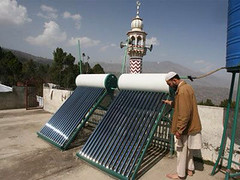
Pakistani teacher Kashif shows solar geysers on the roof of his seminary in Murree. From mosques, to homes to street lights, Pakistanis are increasingly seeing the light and realising that year-round sun may be a quick and cheap answer to an enormous energy crisis.


Pakistan needs to produce 16,000 megawatts of electricity to cater for daily demand, but falls short by providing only 13,000 megawatts, according to the state-owned Pakistan Electric Power Company. More

Pakistan would be very smart if the encouraged investment in Alternative Energy (AE) now for a number of reasons. The most obvious being the shortage of electricity and the second and perhpas more important being the fact that oil prices are going to keep escalating making it more difficult for Pakistani's to afford electricity in the future. Editor.


Tuesday, January 11, 2011

China Should Control Pace of Reactor Construction, Outlook Says


China must avoid building too many nuclear power reactors too quickly, the research unit of the State Council, or Cabinet, wrote in Outlook Weekly. 


The country should set a 2020 ceiling on reactors in operation at 70,000 megawatts to avoid a shortfall of fuel, equipment and qualified plant workers, the government-controlled unit said in a commentary in the weekly magazine published by the official Xinhua News Agency.

China is increasing the share of non-fossils fuels in its energy mix to reduce greenhouse gas emissions. The country had 9,080 megawatts of nuclear capacity in operation as of 2009 and 21,920 megawatts under construction, the China Electricity Council says.

To lower safety risks, China should focus on developing reactors based on the third-generation AP1000 design instead of older, second-generation technology, according to the commentary. The AP 1000 reactor is manufactured by Westinghouse Electric Co., a unit of Toshiba Corp. More >>>

Sunday, October 10, 2010

Fast Breeder Reactors essential for India's future energy security: Prithviraj Chavan


Fast Breeder Reactors are essential for the future energy security of the country, for which the large thorium reserves will have to be utilised, minister of state for science and technology Prithviraj Chavan said today. 
"For the future energy security of the country, we are depending on utilising our large thorium reserves. Successful demonstration of thorium utilisation will enable us win the confidence of the public and policy makers in large scale deployment of nuclear energy in future," he said.
Chavan said it would take time for India to attain the third phase of the nuclear programme as envisioned by Homi Bhaba as it was still relying on other nations for proven technology. "Once India reaches the third stage of thorium utilisation it will be key to India's energy security."
He said there are plans to set up a 1,000 MW Fast Breeder Reactor using metallic fuel. "The metallic fuel will be developed by 2022. It will comprise Uranium, plutonium and Zirconium," said Chavan.
Asked about importing nuclear reactors from one or two vendors at a cheaper rate by assuring volumes instead of from multiple vendors, he said four companies would supply them to India in the first phase.
"In the second round of imports we will look at other commercial considerations (localisation of components) and reactor systems which are more fuel economical and safer like the ones having multiple redundancies. All imported reactors should get approval of national regulatory authority,"he said.
He also said the Rs5,600 crore prototype fast breeder reactor (PFBR) built by Bharatiya Nabhikiya Vidyut Nigam Ltd (Bhavini) at Kalpakkam would be ready by 2011-2012.
Asked about delays in the Koodankulam project, he said these have been minimised now and it was just a matter of months before the unit goes on stream. "The project has to be completed as it is in interest of everybody, both suppliers as well as NPCL," he added. More >>>

Sunday, October 3, 2010


Sep 1, 2010 - Oil and gas brought many of them vast riches, but it is to nuclear power that Middle Eastern states are turning their attention in the 21st Century. 

A growing number of countries across the region want to develop civilian nuclear programmes to meet rising power demand and cut carbon emissions. Chris Webb looks at their progress so far.

This September will see the world’s nuclear industry elite converge on the Egyptian capital of Cairo, for the ‘Nuclear Power, Middle East and North Africa 2010’ event. It is a fitting venue, given Egypt’s avowed wish to press ahead at full speed with a nuclear power agenda aimed at supporting the country’s continuing economic development. Iran, Jordan and Turkey will be among others from the region discussing their future nuclear plans at the event.

The prospect of widespread development of nuclear power in the Middle East, with its political hotspots, is not to everyone’s liking. There is a palpable air of ambivalence in some quarters, fuelled on the one hand by a desire to sell nuclear technology to cash-rich nations and on the other by fears of sinister spin-offs, notably the proliferation of fissile materials for use in developing nuclear weapons. More >>>

Thursday, July 22, 2010

Saudi Arabia's Nuclear Ambitions

Saudi Arabia's Nuclear Ambitions

Mark HibbsQ&A, JULY 20, 2010
There is a growing number of countries across the Middle East seeking to establish civilian nuclear energy programs. Last week, three leading nuclear industry-related firms—two from the United States and one from Japan—announced a joint initiative to build and operate nuclear power plants in Saudi Arabia. More >>>

This also speaks volumes, as far as I am concerned, about Saudi Arabia’s petroleum reserves. Editor.

Wednesday, April 28, 2010

New Power Generation for Pakistan


Pakistan Deal Signals China's Growing Nuclear Assertiveness

Mark Hibbs Nuclear Energy Brief, April 27, 2010

Contrary to guidelines adopted in 1992 by nuclear equipment supplier states in the Nuclear Non-Proliferation Treaty (NPT), China is poised to export two power reactors to Pakistan. This transaction is about to happen at a time when China’s increasingly ambitious nuclear energy program is becoming more autonomous. Guidelines of the Nuclear Suppliers Group (NSG), representing 46 NPT states, call on parties to the NPT not to supply nuclear equipment to non–nuclear-weapon states without comprehensive IAEA safeguards, including Pakistan. China joined the NSG in 2004. More >>>

Saturday, January 23, 2010

Nuclear power plans in Africa, Middle East


Dec 29 (Reuters) - Many countries in Africa and the Middle East have said they want to develop civilian nuclear programmes to meet rising power demand.

Nuclear is seen by many as a long-term solution to high fuel costs and an effective way to cut carbon emissions from the electricity generation sector.
A fall in fossil fuel prices since summer 2008 has made nuclear power less attractive than it was when oil CLc1 was above $147 a barrel in July 2008. South Africa is the only country in the region with an operational nuclear power plant.
Below are the nuclear aspirations of countries across Africa and the Middle East. More >>>

Sunday, September 13, 2009

Jordan signs deal for first nuclear power plant


AMMAN, Jordan - Jordan signed a $12 million deal Saturday with a Belgium-based company as it pushes forward with a plan to build the first nuclear power plant for the oil-barren desert kingdom.

The head of Jordan's Atomic Energy Commission, Khaled Toukan, signed the deal in Amman with Georges Cornet, the head of Tractebel Engineering, a French-Belgian company.
Toukan said the company would first carry out a two-year environmental impact study to determine whether the planned location -- a desert area near the Saudi border about 15 miles (25 kilometers) south of the Red Sea port of Aqaba -- is in fact the best location for protecting "both public health and the environment."
In January 2007, the country's ruler, King Abdullah II, announced his intention to develop a peaceful nuclear program, a plan that has U.S. backing. More >>>

Tuesday, July 21, 2009


Monday, July 20, 2009 - Indian and U.S. officials are set tomorrow to discuss arrangements under which New Delhi could reprocess nuclear fuel purchased from the United States, the Indo-Asian News Service reported

India would use a facility within its borders to reprocess spent fuel, an effort that can generate nuclear-weapon material. The site would operate under monitoring by the International Atomic Energy Agency, under the terms of the U.S.-Indian nuclear trade deal.
New Delhi might also today identify locations today for two civilian nuclear facilities that the United States plans to build. Anticipated locations are in the states of Gujarat and Andhra Pradesh, sources indicated (Indo-Asian News Service I/Hindustan Times, July 19). More >>>