Showing posts with label agriculture. Show all posts

Thursday, November 30, 2017

Tackling water security: Who owns the right to groundwater?

Tariq said that to understand water security there is a need to understand water scarcity. He explained, “The global yardstick for water scarcity is that if you have 1,700 cubic metres per person, per year then you are in a very comfortable water regime.”

He added that the moment this amount reduces, you start getting into water stress situations, water shortages and water scarcity.

“Plant the water, as the best place to store water is underground”

“The surplus water available for Pakistan doesn’t last for more than 30 days.” He elaborated that for the rest of the 335 days, Pakistan is in a semi-drought or drought-like condition.

The PWP CEO said that for an arid country like Pakistan there is a need to have 40% surface water storage. However, he deplored that the country has only 7% storage to counter the problem. He added that this is also reducing due to sedimentation, which leaves a big question mark on the country’s water security. More

Friday, June 9, 2017

The Relentless March of Drought – That ‘Horseman of the Apocalypse’

ROME, Jun 7 2017 (IPS) - By 2025 –that’s in less than 8 years from today– 1.8 billion people will experience absolute water scarcity, and two thirds of the world will be living under water-stressed conditions. Now it is feared that advancing drought and deserts, growing water scarcity and decreasing food security may provoke a huge ‘tsunami” of climate refugees and migrants.
No wonder then that a major United Nations Convention calls drought ‘one of the four horsemen of the apocalypse.’ See what the United Nations Convention to Combat Desertification (UNCCD) says in this regard.

By 2050, the demand for water is expected to increase by 50 per cent. As populations increase, especially in dry-land areas, more and more people are becoming dependent on fresh water supplies in land that are becoming degraded, the Bonn-based Convention secretariat warns.

“The world’s drought-prone and water scarce regions are often the main sources of refugees.” Monique Barbut.
Water scarcity is one of the greatest challenges of the twenty-first century, it underlines, adding that drought and water scarcity are considered to be the most far-reaching of all natural disasters, causing short and long-term economic and ecological losses as well as significant secondary and tertiary impacts.

To mitigate these impacts, drought preparedness that responds to human needs, while preserving environmental quality and ecosystems, requires involvement of all stakeholders including water users and water providers to achieve solutions for drought, explains UNCCD.

“Drought, a complex and slowly encroaching natural hazard with significant and pervasive socio-economic and environmental impacts, is known to cause more deaths and displace more people than any other natural disaster.” More

Thursday, June 25, 2015

The World’s Most Hostile International Water Basins

At the launch of A New Climate for Peace, a new report on climate-fragility risks produced for the G7 by a consortium of international partners including the Wilson Center, USAID Deputy Assistant Administrator Christian Holmes called water a common denominator for climate risk.

“How you manage your water programs…has a huge amount to do with how you mitigate the prospect for increased fragility,” he said. “Sometimes it’s the obvious that’s so easy to miss, and I think that the obvious on water as it relates to economic development is, essentially, the question of sustainable water supply.”

One of the most striking infographics from A New Climate for Peace touches on that question of supply. Using data from Oregon State University’s Transboundary Freshwater Dispute Database and adapted from a graphic that originally appeared in Popular Sciencelast year, the map shows the world’s most active – and tension-filled – international water basins.

Water is a common denominator for climate risk

The Transboundary Freshwater Dispute Database measures not only the frequency of hostile events in a basin, but cooperative ones as well, each on a sliding scale. Hostile events range from declarations of war (zero recorded from 1990 to 2008, the period of time encompassed by the graphic) to leaders using “language of discord.” Cooperative events range from “mild verbal support” to “voluntary unification into a single country.”

The total number of events is indicated by shades of blue – the darker the blue, the more transboundary events, both positive and negative. This is essentially the “hot list” of international water basins – which regions have the most official and unofficial chatter over water.

Circles superimposed on the basins represent the total number of hostile events. As the description text points out, however, “circle size does not automatically translate into conflict danger.” In some places, transboundary institutions and diplomatic frameworks allow different actors to work through their differences. Cooperative hostility, if you will. In the Danube River Basin, for example, the high number of “hostile” events is mitigated by strong cooperative incentives associated with European integration. Likewise in North America, where Canada, the United States, and Mexico share several basins with a high number of hostile events, there is little chance of violent conflict.

Water basins in South Asia, the Middle East, and East Africa are major hotspots with a high number of hostile events and weaker institutional frameworks to mitigate them. The Indus, Ganges-Brahmaputra-Meghna, Salween, Tigris-Euphrates, and Jordan basins witness a very high number of interactions, suggesting at least that continued dialogue could be a way forward to mitigate the risk of violent conflict or fragility. The Nile Basin has less activity reflecting the stalled negotiations between the basin’s 10 member states to replace colonial-era water agreements. The Mekong Basin, where the largest member, China, does not participate as a full member of the Mekong River Commission, shows less activity as well.

The map does a great job illustrating why it can be difficult to answer the question, where is the highest risk of water-related violence? Tensions between states and other freshwater basin actors isn’t necessarily a sign of impending violence if there’s a framework to resolve them. Likewise, lack of communication over a major natural resource can be a bad sign for cooperation when the resource in question is the Nile. More

More infographics from ‘A New Climate for Peace: Taking Action on Climate and Fragility Risks’ are available on NewClimateforPeace.org.


Monday, May 25, 2015

Deciphering clues to prehistoric climate changes locked in cave deposits

It turns out that the steady dripping of water deep underground can reveal a surprising amount of information about the constantly changing cycles of heat and cold, precipitation and drought in the turbulent atmosphere above. The analysis of a stalagmite from a cave in north east India can detect the link between El Nino conditions in the Pacific Ocean and the Indian monsoon, a new study has found.

When the conversation turns to the weather and the climate, most people’s thoughts naturally drift upward toward the clouds, but Jessica Oster’s sink down into the subterranean world of stalactites and stalagmites.

That is because the assistant professor of earth and environmental sciences at Vanderbilt University is a member of a small group of earth scientists who are pioneering in the use of mineral cave deposits, collectively known as speleothems, as proxies for the prehistoric climate.

It turns out that the steady dripping of water deep underground can reveal a surprising amount of information about the constantly changing cycles of heat and cold, precipitation and drought in the turbulent atmosphere above.

As water seeps down through the ground it picks up minerals, most commonly calcium carbonate. When this mineral-rich water drips into caves, it leaves mineral deposits behind that form layers which grow during wet periods and form dusty skins when the water dries up.

Today, scientists can date these layers with extreme precision based on the radioactive decay of uranium into its daughter product thorium. Variations in the thickness of the layers is determined by a combination of the amount of water seeping into the cave and the concentration of carbon dioxide in the cave’s atmosphere so, when conditions are right, they can provide a measure of how the amount of precipitation above the cave varies over time. By analyzing the ratios of heavy to light isotopes of oxygen present in the layers, the researchers can track changes in the temperature at which the water originally condensed into droplets in the atmosphere changes and whether the rainfall’s point of origin was local or if traveled a long way before falling to the ground.

The value of this information is illustrated by the results of a study published May 19 in the journal Geophysical Research Letters by Oster’s group, working with colleagues from the Berkeley Geochronology Center, the Smithsonian Institution National Museum of Natural History and the University of Cambridge titled “Northeast Indian stalagmite records Pacific decadal climate change: Implications for moisture transport and drought in India.”

In the study, Oster and her team made a detailed record of the last 50 years of growth of a stalagmite that formed in Mawmluh Cave in the East Khasi Hills district in the northeastern Indian state of Meghalaya, an area credited as the rainiest place on Earth.

Studies of historical records in India suggest that reduced monsoon rainfall in central India has occurred when the sea surface temperatures in specific regions of the Pacific Ocean were warmer than normal. These naturally recurring sea surface temperature “anomalies” are known as the El Niño Modoki, which occurs in the central Pacific, and the Pacific Decadal Oscillation, which takes place in the northern Pacific. (By contrast, the historical record indicates that the traditional El Niño, which occurs in the eastern Pacific, has little effect on rainfall levels in the subcontinent.)

When the researchers analyzed the Mawmluh stalagmite record, the results were consistent with the historical record. Specifically, they found that during El Niño Modoki events, when drought was occurring in central India, the mineral chemistry suggested more localized storm events occurred above the cave, while during the non-El Niño periods, the water that seeped into the cave had traveled much farther before it fell, which is the typical monsoon pattern.

“Now that we have shown that the Mawmluh cave record agrees with the instrumental record for the last 50 years, we hope to use it to investigate relationships between the Indian monsoon and El Niño during prehistoric times such as the Holocene,” said Oster.

The Holocene Climate Optimum was a period of global climate warming that occurred between six to nine thousand years ago. At that time, the global average temperatures were somewhere between four to six degrees Celsius higher than they are today. That is the range of warming that climatologists are predicting due to the build-up of greenhouse gases in the atmosphere from human activity. So information about the behavior of the monsoon during the Holocene could provide clues to how it is likely to behave in the future. This knowledge could be very important for the 600 million people living on the Indian subcontinent who rely on the monsoon, which provides the area with 75 percent of its annual rainfall.

“The study actually grew out of an accidental discovery,” said Oster. Vanderbilt graduate student Chris Myers visited the cave, which co-author Sebastian Breitenbach from Cambridge has been studying for several years, to see if it contained enough broken speleothems so they could use them to date major prehistoric earthquakes in the area.

Myers found a number of columns that appear to have broken off in the magnitude 8.6 earthquake that hit Assam, Tibet in 1950. But he also discovered a number of new stalagmites that had begun growing on the broken bases. When he examined these in detail he found that they had very thick layers and high concentrates of uranium, which made them perfect for analysis.

Because of the large amount of water running into the cave, the stalagmite they choose to analyze had grown about 2.5 centimeters in 50 years. (If that seems slow, compare it with growth rates of a few millimeters in a thousand years found in caves in arid regions like the Sierra Nevada.) As a result, the annual layers averaged about 0.4 millimeters thick — wide enough for the researchers to get seven to eight samples per layer, which is slightly better than one measurement every two months. The amount of information about the climate that scientists can extract from the stalagmites and stalactites in a cave is amazing. But the value of this approach increases substantially as the number of caves that can act as climate proxies increases.

It is not a simple task. Because each cave is unique, the scientists have to study it for several years before they understand it well enough to use it as a proxy. For example, they must establish how long it takes water to move from the surface down to the cave, a factor that can vary from days to months.

Efforts to use the mineral deposits in caves as climate proxies began in the 1990’s. Currently, there are only a few dozen scientists who are pursuing this line of research and they have analyzed the mineral deposits from 100 to 200 caves in this fashion.

Story Source:

The above story is based on materials provided by Vanderbilt University. The original article was written by David Salisbury. Note: Materials may be edited for content and length.

Journal Reference:

  1. Christopher G. Myers, Jessica L. Oster, Warren D. Sharp, Ralf Bennartz, Neil P. Kelley, Aaron K. Covey, Sebastian F.M. Breitenbach. Northeast Indian stalagmite records Pacific decadal climate change: Implications for moisture transport and drought in India. Geophysical Research Letters, 2015; DOI: 10.1002/2015GL063826


Tuesday, March 3, 2015

Climate change key in Syrian conflict – and it will trigger more war in future

Climate change was a key driver of the Syrian uprising, according to research which warns that global warming is likely to unleash more wars in the coming decades, with Eastern Mediterranean countries such as Jordan and Lebanon particularly at risk.

Experts have long predicted that climate change will be a major source of conflict as drought and rising temperatures hurt agriculture, putting a further strain on resources in already unstable regimes.

But the Syria conflict is the first war that scientists have explicitly linked to climate change. Researchers say that global warming intensified the region’s worst-ever drought, pushing the country into civil war by destroying agriculture and forcing an exodus to cities already straining from poverty, an influx of refugees from war-torn Iraq next door and poor government, the report finds.

“Added to all the other stressors, climate change helped kick things over the threshold into open conflict,” said report co-author Richard Seager, of Columbia University in New York.

“I think this is scary and it’s only just beginning. It’s going to continue through the current century as part of the general drying of the Eastern Mediterranean – I don’t see how things are going to survive there,” Professor Seager added.

Turkey, Lebananon, Israel, Jordan, Iraq and Afghanistan are among those most at risk from drought because of the intensity of the drying and the history of conflict in the region, he says. Israel is much better equipped to withstand climate change than its neighbours because it is wealthy, politically stable and imports much of its food. Drought-ravaged East African countries such as Somalia and Sudan are also vulnerable along with parts of Central America – especially Mexico, which is afflicted by crime, is politically unstable, short of water and reliant on agriculture, Prof Seager said.

The conflict in Syria began in spring 2011 and has evolved into a complex multinational war that has killed at least 200,000 people and displaced millions more, according to the Columbia study, which appears in the journal Proceedings of the National Academy of Sciences. It was preceded by a record drought that ravaged Syria between 2006 and 2010.The paper says the timing is unlikely to be a coincidence, citing a recent interview with a 38-year old farmer in Mohasen, an agricultural village in the north east of Syria.

Asked if the conflict was about the drought, Faten – a female farmer who did not want to give her last name – said: “Of course. The drought and unemployment were important in pushing people towards revolution. When the drought happened, we could handle it for two years, and then we said, ‘It’s enough’,” the report said.

The study combined climate, social and economic data relating to the so-called Fertile Crescent, spanning parts of Turkey and much of Syria and Iraq, where agriculture and herding are thought to have started 12,000 years ago and continue to be crucial.

The region has warmed by between 1 and 1.2C since 1900, reducing rainfall in the wet season by an average of 10 per cent. In addition to the warming – which has found to be caused by human greenhouse gas emissions – Syria has had to contend with rapid population growth, from 4 million in the 1950s to 22 million now.

The ruling al-Assad family encouraged water-intensive export crops such as cotton, while illegal drilling of irrigation wells dramatically depleted groundwater that might have provided valuable reserves, the report said. The drought’s effects were immediate. Agriculture production, which typically makes up a quarter of Syria’s economy, plummeted by a third.

In the hard-hit northeast, livestock herds were practically obliterated, cereal prices doubled and nutrition-related diseases among children increased dramatically. As many as 1.5m people fled from the country to the city.

“Whether it was a primary or substantial factor is impossible to know, but drought can lead to devastating consequences when coupled with pre-existing acute vulnerability,” said lead author Colin Kelley, who did the work at Columbia but is now the University of California, Santa Barbara.

The pressure exerted by climate change is even more dangerous because it comes against a backdrop of rising populations and growing scarcity of resources, experts say.

With demand for basic commodities such as wheat and copper set to soar over the next two decades, relatively small shocks to supply risk causing sudden price rises and triggering “overreactions or even militarised responses”, the Chatham House think-tank has warned.

Furthermore, while the effects of rising population and global warming may be felt hardest among the poorer countries most affected by climate change, the impact will be felt worldwide.

Global trade is so interconnected that no importer of resources is insulated from the problems of key exporters – a fact of concern to the UK, which imports 40 per cent of its food and a high proportion of fossil fuels and metals, the think-tank warns. More


Thursday, February 26, 2015

A Thirsty, Violent World

They say you learn something new everyday. For me, this day qualifies. Michael Specter writes at the New Yorker on the increasingly dire prospects for water -- of the clean, unpolluted kind -- for a clamoring humankind and of the water wars that are surely on the horizon.

And he has this, on the origins of the word "rivals": "After all, the word 'rivals' has its roots in battles over water—coming from the Latin, rivalis, for 'one taking from the same stream as another.'” Who knew? Not me. Specter's prognostication on our looming water disasters is a grim but important read and not just for Pakistanis or Nigerians, but for us in a country in which California is parched for water in a prolonged drought and researchers are predicting humongous droughts coming later in the century for our breadbasket, the Midwest! TomDispatch


A Thirsty, Violent World

Angry protesters filled the streets of Karachi last week, clogging traffic lanes and public squares until police and paratroopers were forced to intervene. That’s not rare in Pakistan, which is often a site of political and religious violence.

But last week’s protests had nothing to do with freedom of expression, drone wars, or Americans. They were about access to water. When Khawaja Muhammad Asif, the Minister of Defense, Power, and Water (yes, that is one ministry), warned that the country’s chronic water shortages could soon become uncontrollable, he was looking on the bright side. The meagre allotment of water available to each Pakistani is a third of what it was in 1950. As the country’s population rises, that amount is falling fast.

Dozens of other countries face similar situations—not someday, or soon, but now. Rapid climate change, population growth, and a growing demand for meat (and, thus, for the water required to grow feed for livestock) have propelled them into a state of emergency. Millions of words have been written, and scores of urgent meetings have been held, since I last wrote about this issue for the magazine, nearly a decade ago; in that time, things have only grown worse.

The various physical calamities that confront the world are hard to separate, but growing hunger and the struggle to find clean water for billions of people are clearly connected. Each problem fuels others, particularly in the developing world—where the harshest impact of natural catastrophes has always been felt. Yet the water crisis challenges even the richest among us.

California is now in its fourth year of drought, staggering through its worst dry spell in twelve hundred years; farmers have sold their herds, and some have abandoned crops. Cities have begun rationing water. According to the London-based organization Wateraid, water shortages are responsible for more deaths in Nigeria than Boko Haram; there are places in India where hospitals have trouble finding the water required to sterilize surgical tools.

Nowhere, however, is the situation more acute than in Brazil, particularly for the twenty million residents of São Paulo. “You have all the elements for a perfect storm, except that we don’t have water,” a former environmental minister told Lizzie O’Leary, in a recent interview for the syndicated radio show “Marketplace.” The country is bracing for riots. “There is a real risk of social convulsion,” José Galizia Tundisi, a hydrologist with the Brazilian Academy of Sciences, warned in a press conference last week. He said that officials have failed to act with appropriate urgency. “Authorities need to act immediately to avoid the worst.” But people rarely act until the crisis is directly affecting them, and at that point it will be too late.

It is not that we are actually running out of water, because water never technically disappears. When it leaves one place, it goes somewhere else, and the amount of freshwater on earth has not changed significantly for millions of years. But the number of people on the planet has grown exponentially; in just the past century, the population has tripled, and water use has grown sixfold. More than that, we have polluted much of what remains readily available—and climate change has made it significantly more difficult to plan for floods and droughts.

Success is part of the problem, just as it is with the pollution caused by our industrial growth. The standard of living has improved for hundreds of millions of people, and the pace of improvement will quicken. As populations grow more prosperous, vegetarian life styles often yield to a Western diet, with all the disasters that implies. The new middle classes, particularly in India and China, eat more protein than they once did, and that, again, requires more water use. (On average, hundreds of gallons of water are required to produce a single hamburger.)

Feeding a planet with nine billion residents will require at least fifty per cent more water in 2050 than we use today. It is hard to see where that water will come from. Half of the planet already lives in urban areas, and that number will increase along with the pressure to supply clean water.

“Unfortunately, the world has not really woken up to the reality of what we are going to face, in terms of the crises, as far as water is concerned,” Rajendra Pachauri, the chairman of the International Panel on Climate Change, said at a conference on water security earlier this month. “If you look at agricultural products, if you look at animal protein, the demand for which is growing—that’s highly water intensive. At the same time, on the supply side, there are going to be several constraints. Firstly because there are going to be profound changes in the water cycle due to climate change.”

Floods will become more common, and so will droughts, according to most assessments of the warming earth. “The twenty-first-century projections make the [previous] mega-droughts seem like quaint walks through the garden of Eden,” Jason Smerdon, a climate scientist at Columbia University’s Lamont-Doherty Earth Observatory, said recently. At the same time, demands for economic growth in India and other developing nations will necessarily increase pollution of rivers and lakes. That will force people to dig deeper than ever before into the earth for water.

There are ways to replace oil, gas, and coal, though we won’t do that unless economic necessity demands it. But there isn’t a tidy and synthetic invention to replace water. Conservation would help immensely, as would a more rational use of agricultural land—irrigation today consumes seventy per cent of all freshwater.

The result of continued inaction is clear. Development experts, who rarely agree on much, all agree that water wars are on the horizon. That would be nothing new for humanity. After all, the word “rivals” has its roots in battles over water—coming from the Latin, rivalis, for “one taking from the same stream as another.” It would be nice to think that, with our complete knowledge of the physical world, we have moved beyond the limitations our ancestors faced two thousand years ago. But the truth is otherwise; rivals we remain, and the evidence suggests that, until we start dying of thirst, we will stay that way. More


Friday, November 7, 2014

The Man Who Creates Artificial Glaciers To Meet The Water Needs Of Ladakh

Ladakh’s beautiful mountains might be a paradise for tourists, but ask the locals who have to struggle to meet their basic water needs every year. Chewang Norphel put his engineering skills to a better use and created artificial glaciers to provide water in this cold and dry mountainous region. Know more about his remarkably innovative technology and how it works.

Chewang Norphel, a 79-year old retired civil engineer, has always been a solution provider. The story goes back to 1966 when he was posted in Zanskar, one of the most backward and remote areas in Ladakh, as Sub Divisional Officer. He, along with his team, had to construct school buildings, bridges, canals, roads etc. in that area. The task was very difficult to execute due to lack of skilled labour.

So he started doing the masonry work himself and trained a few villagers to help him. After some years, when he went back to that village, he found out that the villagers he had trained had become perfect mistry and were earning handsome salaries.

Today, he is called the “Ice Man of India” and has created 10 artificial glaciers in Ladakh to help people deal with water scarcity in this cold, mountainous region.

Ladakh, a beautiful location with magnificent scenery around and exquisite beauty, takes everyone’s breath away. But, it is not the same with the people of Ladakh as the cold, dry and infertile land makes their lives harder than we could imagine.

Fortunately, the situation is slowly changing as Ladakh now has artificial glaciers to meet their needs and people have Norphel to thank for his amazing contribution.

Born in 1936, Norphel comes from a farming background and has served in the government service for more than 36 years before he had to take an early retirement due to his bad health. Being at home was not something Norphel enjoyed doing, and at the same time, the poor living conditions in Ladakh constantly troubled him. He thought of putting his engineering skills to a better use.

“Almost all the villages in Ladakh have roads, culverts, bridges, buildings or irrigation systems made by me,”says Norphel. But his biggest contribution came in the form of artificial glaciers.

Being a cold mountain desert, Ladakh sees a low average rainfall of 50 mm annually making people dependent upon glaciers as their primary water source.

80 percent of the population depends on farming, and their main source of irrigation water is the water that comes from the melting of snow and glaciers. Because of global warming, the glaciers are receding quickly and as a result, farmers face a lot of difficulty in getting adequate water. On the other hand, a lot of water gets wasted during the winter months as, due to the severe cold climate, farmers cannot grow any crops in that season.

“So I thought that if we could conserve this water in the form of ice, it can be of help to farmers to some extent during the irrigation period, particularly during the sowing season. The artificial glaciers, being quite close to the villages, melt earlier than the natural glaciers. Also, getting water during the sowing period is the most crucial concern of the farmers because the natural glaciers start melting in the month of June and sowing starts in April and May,” he says.

The idea first came to him when he saw water dripping from a tap which was kept open so as to avoid the water from freezing in winter and bursting the tap. The water gradually froze into the shape of an ice sheet as it came in touch with the ground and made a pool.

It struck him that the water that melts from natural glaciers due to high temperatures in summer goes to waste as it flows into the river. Instead, if this water can be stored in summer and autumn so that it can form a glacier in winter, then this artificial glacier would melt in spring and provide water to the villagers at the right time.

It was now time for action, and he put all his engineering knowledge, field experience and passion to work. He started his first experiment in Phutse village. He made canals to divert the water from the main stream to small catchment areas located four kms away from the village. He also created a shaded area to keep the water frozen in winters.

And, as these glaciers are located at a lower altitude of 13,000 feet as compared to the original glaciers which are located at 18,000 feet, they start melting earlier than the mainstream ones and provide water to the villagers when they need it the most in April.

“The main technique used to create artificial glaciers is to control the velocity of water as much as possible. The region is a hilly area and that is why the gradient of streams is very steep. As a result, in the main streams the water usually does not freeze. So what we have done is we have diverted the water to a shadow area by constructing a diversion channel with a mild grade. When it reaches the site, the water is released downward of the hill, distributing it in a small quantity so that the velocity can be minimized, and side by side we have constructed ice retaining walls in series to store the frozen water. This is the entire methodology of the artificial glacier,” he explains.

Retaining walls for artificial glacier

His first project cost him Rs.90,000. The width of the glacier ranges generally from 50 to 200 feet and the depth from 2 to 7 feet. This low cost model used only locally sourced material and help from the local community. Norphel has successfully built 10 glaciers so far. The smallest one is 500 feet long in Umla and the largest is 2 km long in Phutse.

His efforts have increased the agricultural production, thereby increasing the income of the locals. This has also reduced the migration to cities. His simple technique has brought water closer to the villages, and most importantly, made it available when the villagers need it the most.

In the future, he wants to continue making the glaciers and plans to build in other areas like Lahol, Spiti, Zangskar, etc. The only thing that comes as a challenge is lack of adequate funds.

“As you sow, so you reap. There is no doubt that if one has strong determination and dedication, there is nothing impossible in the world. That is what I believe,” Norphel says.

His simple idea has received acclaim across the globe and he has proved that if man is the one responsible for disturbing nature, he also has the capacity to save it. You just need the right intention to do so. More


Wednesday, October 22, 2014

Mismanaging Climate Change

Pakistan’s extreme vulnerability to climate change is not a scientific secret but is, in fact, a logical certainty owing to its geographic location, inclined elevation, as well as demographics.

Former Minister Malik Amin Aslam Khan

The issue directly impacts upon the country’s already volatile water dynamics driven by the northern glaciers and the seasonal monsoon rains and, if not managed properly, could burden our economy to the tune of $6-14 billion per year (United Nations Framework Convention on Climate Change NEEDS study 2010). In response to this challenge, Pakistan’s National Climate Change Policy has laid out a comprehensive ‘to do’ list for the government, which was approved by the government but, unfortunately, has not been acted upon by the authorities. Oblivious to this apathy and inaction, Pakistan continues to face a mammoth challenge to not only climate-proof its future development path, but also take steps to cope with an issue, which is here to stay. These steps include establishing early warning systems, effective flood plain management, improving weather forecasting with cross-border data exchange and enhancing the disaster preparedness, as well as emergency response capabilities to deal with predicted climate-induced natural disasters.

To their credit, previous governments did begin to take concrete institutional building measures, such as establishing a very high-level Prime Minister’s Cabinet Committee on Climate Change, setting up a dedicated Ministry of Climate Change built on the debris of a misguidedly devolved Environment Ministry and creating a focused climate research centre i.e., the Global Change Impact Studies Centre. However, in one stroke of convenient denial, the present government has undone and dismantled all those measures by downgrading the ministry to a division level, drastically cutting the funds for the division, leaving it headless without an appointed minister and also drying up all finances for the climate research centre. It is, thus, not surprising, that the country received a rude wake-up call when, during the recent floods, the forces of nature once again caught it totally off guard and institutionally ill-prepared to deal with a situation, which had been predicted and forewarned time and again by climate experts.

The 2014 flood came in two surges. The first surge occurred due to exceptionally high rainfall in the rivers Jhelum, Chenab, Ravi and their catchments. It is a recorded fact that the Pakistan meteorological office gave clear warnings about this enhanced rainfall activity, which were not heeded to in a timely manner. The result of this negligence was that the Mangla Dam remained filled to the brim, while storm waters gathered upstream and, subsequently, the floodgates were forced open at the worst possible time when water levels were already dangerously peaking downstream. Had the water been incrementally released, as advised, the massive flood surge that eventually occurred could have been effectively prevented. Dams remain a double-edged sword — if used intelligently, they can be the best tool for controlling and regulating floods, but if used improperly, as they were on this occasion, they can quickly convert floods into mega human disasters.

This first human-induced deluge was followed by the second flood surge that occurred due to the unpredictably high ‘cloud-burst’ in Indian-held Kashmir. The information about this second surge was also received hours in advance as the water roared down River Chenab. Again, our own meteorological office issued a timely flood peak warning, but again, the reaction time and response measures of our government were found severely lacking.

The floods were triggered by climate-induced cloud-bursts and monsoonal shifts, but the human tragedy and destruction got multiplied due to poor government planning, human negligence and a criminal mixture of absence and apathy of relevant institutional response mechanisms.

Climate related calamities, including more flooding and an enhanced frequency of freak natural events are, unequivocally, predicted for Pakistan and it is time to take these warnings seriously, and for the government to heed to them by planning to deal with the consequences, limiting the damage and adapting to this shifting scenario. The recent floods, which are surely not the last one, have also rudely exposed the human, economic and environmental costs to be paid for our politically motivated aversion to building large dams, as well as the suicidal trend of encroaching upon flood plains and continuing to challenge the flood water boundaries.

Pakistan lies at the geographic crossroads of melting glaciers, shifting monsoons and enhanced disaster activity. This locational risk cannot be changed, but how we deal with this looming catastrophe can certainly be changed. What it requires is better responsive measures and heeding to technical advice and scientifically based warnings with timely decisions.

The political optics of wading through floodwaters and post disaster bear hugs with destitute and frustrated victims is beginning to lose its vote-gathering lustre. As we haplessly subject millions to avoidable disasters, it is time to face up to reality. Climate-proofing of infrastructure, conserving the yearly deluge of water that is callously flushed into the Arabian Sea and effectively enforced flood plains management needs to get the priority it deserves. The politics of underpasses and overpasses has to give way to the politics of common sense, based on what Pakistan’s real challenges are and what it is predicted to face up to in the near future. Governing with confused priorities and institutional mismanagement will continue to worsen the responses forced upon us as we face up to the unpredictability of climate change. More

Published in The Express Tribune, October 19th, 2014.


Friday, August 22, 2014

Global Climate Inaction Will Mean Economic Turmoil for South Asia, Warns Bank

The first comprehensive study ever issued on the economic costs that uncontrolled climate change would inflict on South Asia predicts a staggering burden that would hit the region's poorest the hardest.

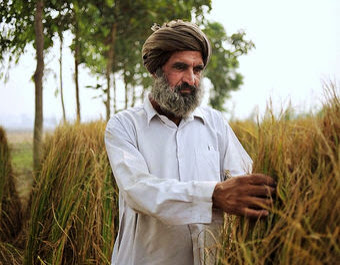
Rice Farmer in Punjab, India

"The impacts of climate change are likely to result in huge economic, social and environmental damage to South Asian countries, compromising their growth potential and poverty reduction efforts," said the study, published by the Asian Development Bank.

The cuts in regional GDP are so deep that they might ripple around the world, as six developing countries with 1.4 billion people—a third of them living in poverty—pay the price of the world's continuing reliance on fossil fuels.

Projections like this feed into the urgency for action as world leaders prepare to meet at the United Nations next month to discuss the climate crisis. Recent warnings show that the steps nations seem willing to take will fall well short of what is needed.

Action now, the study shows, would pay immediate and lasting dividends to the countries it examined: Bangladesh, Bhutan, India, the Maldives, Nepal and Sri Lanka.

The study, published as a new 160-page book, says that if the world cuts fossil fuel consumption enough to keep warming within 2 degrees Celsius—the goal of UN negotiations—the costs to South Asian countries of adapting to rising seas and temperatures in the decades ahead might be cut almost in half.

But if business-as-usual continues, leading to a world that is 4 or 5 degrees warmer by 2100 than at the start of the industrial age, the outlook looks grim.

"Climate change will slash up to 9 percent off the South Asian economy every year by the end of this century if the world continues on its current fossil-fuel intensive path," the bank said. "The human and financial toll could be even higher if the damage from floods, droughts, and other extreme weather events is included."

Because this kind of estimate is inherently imprecise, the bank warned that the real damage could be much worse than expected. Under business-as-usual trends, there is a one in 20 chance that South Asia will lose 24 percent of its annual GDP by the end of the century, the study found.

Paying to stave off those damages will cost these nations dearly, the study said.

To avoid the damage that is expected if the world takes no action on climate change, South Asia would have to spend nearly $40 billion per year by 2050 on adaptation measures, or nearly half a percentage point of average annual GDP. By 2100, the costs would have to increase to $73 billion per year, or roughly nine-tenths of a point of GDP.

If the world were to achieve the 2-degree warming goal established by UN negotiators at climate treaty talks in Copenhagen in 2009—a goal also at the heart of culminating talks set for Paris in 2015—annual adaptation costs for South Asia would be considerably less: $31 billion a year at mid-century, and $41 billion at century's end.

And instead of losing nearly 9 percent of annual GDP by the end of the century, the study found, South Asia would lose about 2.5 percent by 2100 if the world lives up to the goals of Copenhagen. More


Saturday, July 5, 2014

Famke Janssen addresses the World Youth Parliament for Water

gcint.org

March 14
Dear friends and distinguished members of the World Youth Parliament for Water.

The efforts of youth from all around the world to offer solutions and to work together to tackle the global water crisis both humble and inspire me. You are truly making a difference.

President Gorbachev, who spoke at the opening of the World Water Forum just two days ago, believes in the power of all people, particularly the youth, to make change aimed at protecting the environment. Young people – who will be tomorrow’s leaders -- have a vital role to play to ensure all people can live free of poverty and insecurity, and enjoy a world that conserves – not exploits – its many natural wonders.

I come from the Netherlands, a country that has a lot of experience in "coping" with water. My country is one that is vulnerable to global warming and rising oceans. Fortunately, we have a long history of finding ways to stop the ocean from flooding much of a country that rests largely below sea level. Water is a central part of Dutch life, from our many canals and dikes to the water-powered windmills that are dotted all over the country. Many historians argue that our social organization was built on the need for communities to organize democratically in order to pull together to stop an invading ocean or a broken dike – a recognition that water crises do not discriminate whether they come in the form of floods or drought and, most importantly, that water crises can unite people and not only separate them.

The Netherlands, however, is not a country associated with scarcity of water, a curse for many populations today that will grow much worse. For our world is already buckling under the weight of our 7-billion strong population, and in less than 20 years from now, we will have grown to 8.3 billion . As you know, this will only increase the demand for water. Consequently, by 2025 experts estimate that two-thirds of the world's population could be living under water stressed conditions.

Water scarcity is the problem that our future generations will have to face. Responsibility for solving this global challenge, some might say, lies unfairly in the hands of you and young people around the world. You did not cause the crisis, but it will be up to today’s youth to be prepared for steering our world toward a more sustainable future, a path that will ensure we respond to the water crisis, fairly share our available water resources, promote conservation and end waste, and help millions upon millions of people realize their basic Human Right to have access to safe Water and Sanitation.

Lack of adequate drinking water and poor or non-existent sanitation target the youth unfairly. For example, 443 million school days are missed every year due to sickness caused by water-related diseases, such as diarrhoea, dysentery and cholera. Lack of access to safe drinking water and sanitation is one of the main obstacles to education today. This is bad, but what is absolutely intolerable is that diarrhoea is the world’s second biggest killer of children and accounts for 1.5 million young lives every year. Moreover, in the absence of functioning drainage systems, water forms stagnant puddles that are soon infested with malaria-carrying mosquitoes: 3600 people die of malaria each day and 3200 of them are children. These grim statistics do not even take into account the ravages imposed on children as a result of water scarcity, which affects the availability of food and increases the risk of malnutrition among children.

Young girls are especially vulnerable to today’s water problems. For in many communities, young girls fetch water – often walking many miles to do so – placing their health, safety, education and development at grave risk. If a girl’s town or village has no safe source of water, it is often her job to collect it for her family, meaning she cannot attend school. This is a double tragedy that must be overcome.

Another factor against girls is the lack of sanitation facilities in schools, which can force many to stop attending classes when they reach puberty. Without education, futures of children and young women are being lost.

Without access to safe water and education, many young people will find it even harder – if not impossible – to rise out of poverty. As a result, when they become parents themselves, their own children will be trapped by the same problems.

But there are things we can all do today.

You are an extremely powerful voice of change. The more noise you make the more power you have. You have the right to demand a better world, as you are the ones who will inherit the problems we have caused. There are concrete actions that you can take that will result in meaningful change.

Green Crosses’ Green Lane Environmental Diary, which some of you may have participated in, shows ways to reduce our water footprints, from taking shorter showers, to avoiding use of plastic bottles. These basic tips, when practiced by an entire community can result in massive changes in the management of water resources. These are guidelines for individuals but collectively they can have profound impacts.

On a policy level you can demand that countries that have not ratified the United Nations Watercourses Convention do so. Some of you live in places that have not ratified the Convention and just 11 more signatures are needed from governments to validate it. It is the only global set of regulations and measures drafted for governing the more than 270 rivers in the world that are shared by multiple countries. 145 countries share these rivers and the groundwater linked to them. Their basins are home to 40% of the planet’s human population. But only 40% of these rivers are covered by official agreements on how to share and manage them, many of which are unsatisfactory. These weaknesses must be addressed if we are to tackle global challenges such as climate change and growing water demands.

Since you are here you have already developed the taste for politics. As potential future parliamentarians you will demand that the Right to Water and Sanitation is enshrined in your country’s constitutions and laws. It is imperative that you do all in your power to ensure your fellow countrymen and women can realize this fundamental, life-preserving right.

After meeting many of you and seeing what you have done here in Marseille, I have great confidence in your abilities to make a difference when it comes to ensuring all people have access to safe water.

I know you wont forget the experiences you have had here at the World Youth Parliament for Water. But I urge you to apply what you have absorbed, and put it into action, first and foremost in your own communities, and hopefully further afield.

Eleanor Roosevelt said, "the future belongs to those who believe in the beauty of their dreams". I encourage you to start believing. Thank you for the honor to speak with you and good luck. More


Thursday, June 26, 2014

Is the UN turning its back on the human right to water?

One of the biggest threats to economic and social development is that the world's freshwater supplies are rapidly becoming scarce and polluted. A new set of actors are now engaging in the global development arena to define and write the rules ofaccess to water to ensure people's needs are protected.

It is alarming to see that the human right to water and sanitation continues to be marginalised in UN policy discussions. The exclusion of this right to water in the most recent draft of the sustainable development goals reveals policy more conducive to promoting water security for economic growth than ensuring the preservation of watersheds and the equitable distribution of scarce water supplies.

When the UN general assembly passed a resolution in 2010 affirming water and sanitation as a human right, it was celebrated as a victory for communities dealing with the health impacts of polluted water, the indignity of not having access to clean drinking water and sanitation or the inability to produce food owing to water shortages. Social movements saw the human right to water and sanitation as a tool in the fight against a global water crisis produced by inequality, social exclusion and abuse of the water commons.

The global water crisis is also a big concern for industries seeking secure access to water supplies to sustain and expand operations in a never-ending quest for economic growth. The extractive industries, large drinks companies, big banks investing in water stocks, and companies involved in providing water and sanitation services have positioned themselves as stakeholders within global water policy discussions and as being able to provide solutions to the crisis.

The latest trend in global and national water policy is for corporations to participate in decision-making bodies and promote corporate-driven solutions through public-private partnerships. Over the past decade or so, the efforts of corporations such as Nestlé and Unilever to engage in global water policy discussions has shifted the debate from one of injustice and inequality to a depoliticised discussion of scarcity solved by technological fixes. These are offered by multinational corporations and market mechanisms that further deregulate water resource allocation.

When global policymakers – including the working group on sustainable development goals (SDGs) – focus simply on improving "water efficiency" for these ever-expanding industries without anchoring discussions of access to water as a right, they are ignoring communities that are challenging the very presence of the industries that are destroying watersheds.

The human right to water and sanitation holds promise for these communities. It has been invoked in Plachimada, in south India, to challenge Coca Cola's accessto aquifers; by anti-mining activists throughout Latin America; and, more recently, by the Kalahari Bushmen in a struggle to access traditional water sources on land coveted by industries such as tourism, diamond mining and fracking.

It has also been used to democratise water and sanitation services. In Uruguay, recognition of the human right to water led to the ban of private water services. When a recent ruling by a top Greek court blocked the privatisation of the country's largest water utility, in Athens, it was a victory for activists across Europe who had condemned forced privatisation through loan conditions in bailout packages for Greece, Portugal and Italy.

So it is deeply troubling that the human right to water continues to be contested at the UN. For those living without access to adequate drinking water and sanitation, the SDG on water focuses on universal access. As special rapporteur on the human right to safe drinking water and sanitation, Catarina de Albuquerque arguesthat an emphasis on universality alone fails to eliminate inequality.

At the very minimum, the human right to water calls for the elimination of discrimination and the adoption of special measures for marginalised communities. Social movements pursuing public control over water supplies, and democratic and participatory governance models, are also drawn to the elements of public participation in decision-making, accountability and access to justice underscored by the human right to water.

While this right is hardly the silver bullet for all global water woes, it goes a long way towards balancing unequal power relationships. More


Saturday, May 31, 2014

Monsoon Disrupted By El Nino + Climate Change as India Suffers Deaths, Crop Losses from Extreme Heat.

May is the month when the massive rainstorm that is the Asian Monsoon begins to gather and advance. This year, as in many other years, the monsoon gradually formed along the coast of Myanmar early in the month. It sprang forward with gusto reaching the Bay of Bengal by last week.

And there it has stalled ever since.

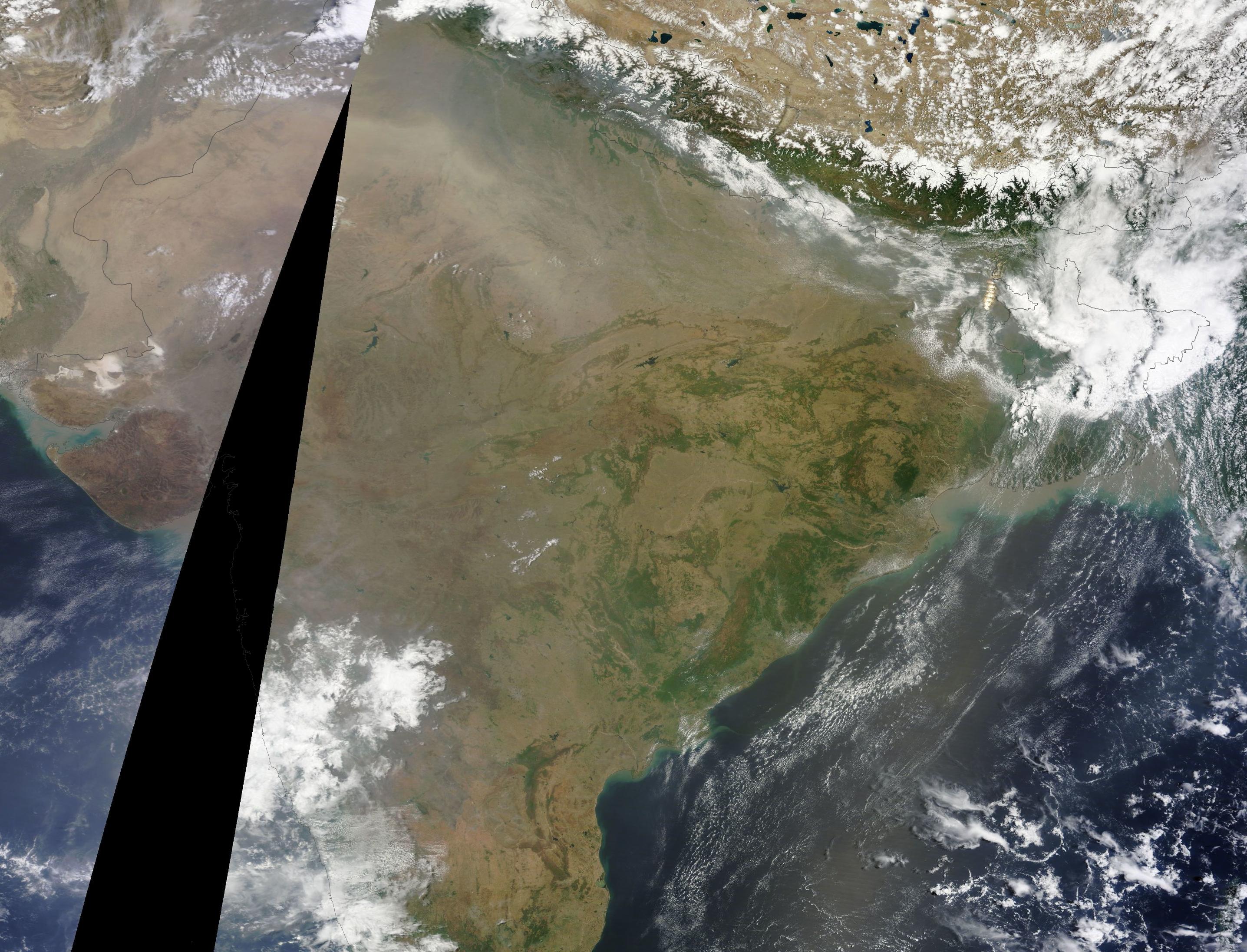
On May 25-27, an outburst of moisture from this stalled monsoonal flow splashed over the coasts of India. But by the 29th and 30th, these coastal storms and even the ones gathering over the Bengali waters had all been snuffed out. The most prominent feature in the MODIS shot of India today isn’t the rainfall that should be now arriving along the southeast coast, but the thick and steely-gray pallor of coal-ash smog trapped under a persistent and oppressive dome of intense heat.

(MODIS shot of India on May 30th. See the open stretch of blue water in the lower right frame? That’s the Bay of Bengal which borders coastal India. During a normal year at this time, that entire ocean zone should be filled with the storm clouds of a building monsoon that is already encroaching on coastal India. Today, there is nothing but a smattering of small and dispersed cloud through a mostly clear sky. Image source: LANCE-MODIS.)

Monsoon Described as Feeble

Official forecasts had already announced as of May 27th that the annual monsoon was likely to be delayed by at least a week for southeast regions of India. Meanwhile, expected monsoonal rainfall for western and northern sections of India for 2014 fell increasingly into doubt.

From The Times of India:

The monsoon is likely to be delayed by 10 days, according to scientists at the Indian Institute of Tropical Meteorology (IITM) here. The IITM’s third experimental real-time forecast says that a feeble monsoon will reach central India after June 20 as against the usual June 15. Last year, the monsoon had covered the entire country by June 15.

The annual monsoon is key to India’s agriculture. The substantial rains nurture crops even as they tamp down a powerful heating that typically builds throughout the sub-continent into early summer. Without these rains, both heat and drought tend to run rampant, bringing down crop yields and resulting in severe human losses due to excessive heat.

But, this year, heat and drought are already at extreme levels.

Major Heatwave Already Results in Loss of Life for 2014

As early as late March, the heatwave began to build over the Indian subcontinent. The heat surged throughout the state, setting off fires, resulting in a growing list of heat casualties, shutting down the power grid and spurring unrest. Meanwhile, impacts to India’s agriculture were already growing as the Lychee fruit crop was reported to have suffered a 40% loss.

By late May, temperatures across a broad region had surged above 105 degrees shattering records as the oppressive and deadly heat continued to tighten its grip.

In a country surrounded on three sides by oceans, it is a combination of heat, humidity and persistently high night-time temperatures that can be a killer. Wet bulb temperatures surge into a high-risk range for human mortality during the day even as night-time provides little respite for already stressed human bodies. Such extreme and long-duration heat doesn’t come without a sad toll. As of today, early reports indicated a loss of more than 56 lives due to heat stroke (In 2012 and 2013, total Indian heat deaths were near 1,000 each year). That said, final figures on heat losses are still pending awaiting complete reports from all of India’s provinces.

"Climatologically, we know that heatwaves are increasing in frequency and the number of days exceeding 45ºC temperatures is increasing. The frequency will increase further with global warming, hence this is a good example of a situation where science and disaster management can come together and avert damage," a spokesman for India’s National Disaster Management Authority noted on Friday.

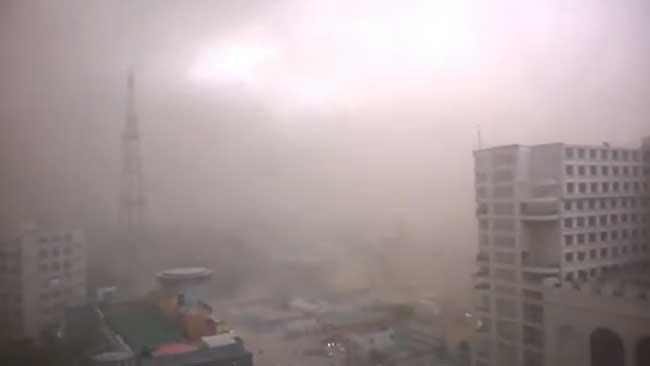
(Hot Dust. A dust storm rolls through New Delhi on Friday amidst furnace-like 113 degree heat snarling traffic and resulting in the tragic loss of 9 more lives. Image source: Gaurav Karoliwal/YouTube Screenshot.)

Today the heatwave continued to gain ground, with Kota and Rajasthan reaching an all-time record of 116 degree F (46.5 C) as New Delhi’s mercury hit 113 degrees F in the midst of a drought-induced dust storm. Dust shrouding the city spurred traffic chaos and in the heat, darkness, and confusion nine more souls were lost.

After two months of growing disruption due to heat and drought, the lands and peoples of India cry out for a Monsoon that is running later and later with each new weather report.

Climate Change + El Nino: Adding Heat and Beating Back the Monsoon

As systems approach tipping points, they are more likely to tilt toward the extremes.

For India this year, its seasonally warmest period from April to May found severe heat amplification from a number of global factors. First, climate change seeded the ground for the current Indian heatwave by adding general heat and evaporation to already hot conditions. With global average heating of +0.8 C above 1880s levels amplifying in the hot zones, early moisture loss due to higher-than-normal temperatures produces a kind of snowball effect for still more warming. Essentially, the cooling effect of water evaporation is baked out early allowing for heat to hit harder just as typical seasonal maximums are reached. More

Originally published by robertscribbler.wordpress.com/