Showing posts with label drinking. Show all posts

Sunday, November 2, 2014

The Future Corporation - Paul Polak

TEDxMileh-ligh - Paul Polak - The Future Corporation

Uploaded on May 26, 201 1 • What is the future of the corporation? Paul Polak's vision will likely transform your view of what's possible through capitalism and may change the way current organizations view their business models. His talk details the tremendous shared value that lies within product and system designs for the bottom 90% of the income pyramid.

In the spirit of "ideas worth spreading," TED has created TEDx. TEDx is a program of local, self-organized events that bring people together to share a TED-like experience. Our event is called TEDxMileHigh, where x = independently organized TED event. At a TEDx event, TEDTalks video and live speakers combine to spark deep discussion and connection in a small group. These local, self-organized events are branded TEDx, where x=independently organized

TED event. The TED Conference provides general guidance for the TEDx program, but individual TEDx events, including ours, are self-organized.

Thursday, September 4, 2014

ADB Spotlights Pakistan’s Water Assessment and Management Plan


News: ADB Spotlights Pakistan’s Water Assessment and Management Plan

ADBSeptember 2014: The Asian Development Bank (ADB) has published a report titled ‘Water Balance: Achieving Sustainable Development through a Water Assessment and Management Plan – The Case of Federally Administered Tribal Areas (FATA), Pakistan.' The report presents the case of the development of the FATA Water Assessment and Management Plan, outlining elements necessary in such assessment, and emphasizing that inefficient and unsustainable management of development initiatives result from lack of information about water availability and cause watershed degradation.


Integrated water resources management (IWRM) was used as a core approach in the development of possible activities to promote the sustainable use of water resources in the FATA region. While noting much of the data used is historical, the report emphasizes that climate change is likely to alter current water availability patterns, and calls for integrating hydrological forecasting and climate change models into the assessment.


The report includes sections on: background; project area; assessing surface water availability; assessing groundwater; assessing water consumption; water balance model; water management plan; and conclusions. [Publication: Water Balance: Achieving Sustainable Development through a Water Assessment and Management Plan – The Case of Federally Administered Tribal Areas (FATA), Pakistan]


Read more: http://water-l.iisd.org/news/adb-spotlights-pakistans-water-assessment-and-management-plan/


Saturday, May 31, 2014

Monsoon Disrupted By El Nino + Climate Change as India Suffers Deaths, Crop Losses from Extreme Heat.

May is the month when the massive rainstorm that is the Asian Monsoon begins to gather and advance. This year, as in many other years, the monsoon gradually formed along the coast of Myanmar early in the month. It sprang forward with gusto reaching the Bay of Bengal by last week.

And there it has stalled ever since.

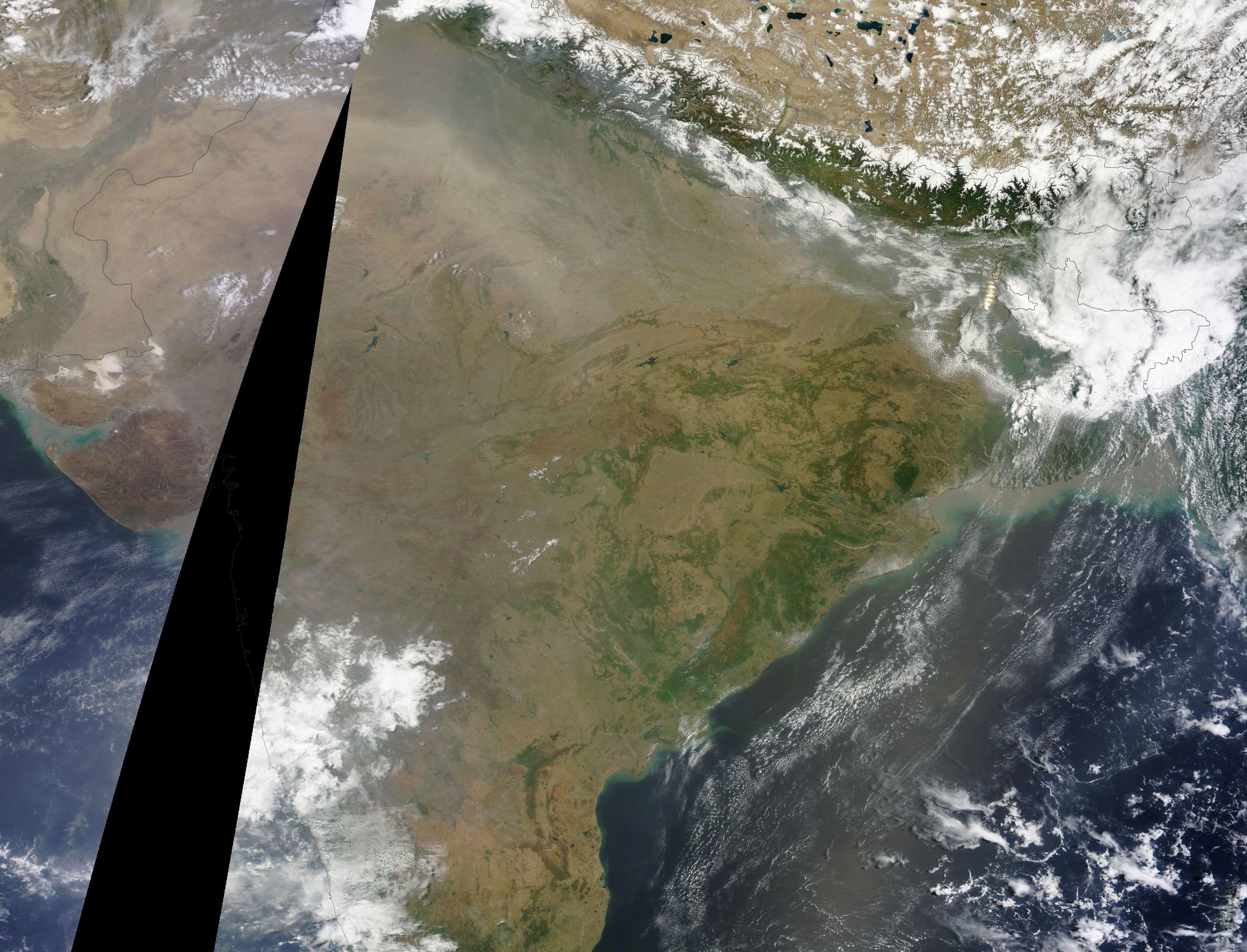
On May 25-27, an outburst of moisture from this stalled monsoonal flow splashed over the coasts of India. But by the 29th and 30th, these coastal storms and even the ones gathering over the Bengali waters had all been snuffed out. The most prominent feature in the MODIS shot of India today isn’t the rainfall that should be now arriving along the southeast coast, but the thick and steely-gray pallor of coal-ash smog trapped under a persistent and oppressive dome of intense heat.

(MODIS shot of India on May 30th. See the open stretch of blue water in the lower right frame? That’s the Bay of Bengal which borders coastal India. During a normal year at this time, that entire ocean zone should be filled with the storm clouds of a building monsoon that is already encroaching on coastal India. Today, there is nothing but a smattering of small and dispersed cloud through a mostly clear sky. Image source: LANCE-MODIS.)

Monsoon Described as Feeble

Official forecasts had already announced as of May 27th that the annual monsoon was likely to be delayed by at least a week for southeast regions of India. Meanwhile, expected monsoonal rainfall for western and northern sections of India for 2014 fell increasingly into doubt.

From The Times of India:

The monsoon is likely to be delayed by 10 days, according to scientists at the Indian Institute of Tropical Meteorology (IITM) here. The IITM’s third experimental real-time forecast says that a feeble monsoon will reach central India after June 20 as against the usual June 15. Last year, the monsoon had covered the entire country by June 15.

The annual monsoon is key to India’s agriculture. The substantial rains nurture crops even as they tamp down a powerful heating that typically builds throughout the sub-continent into early summer. Without these rains, both heat and drought tend to run rampant, bringing down crop yields and resulting in severe human losses due to excessive heat.

But, this year, heat and drought are already at extreme levels.

Major Heatwave Already Results in Loss of Life for 2014

As early as late March, the heatwave began to build over the Indian subcontinent. The heat surged throughout the state, setting off fires, resulting in a growing list of heat casualties, shutting down the power grid and spurring unrest. Meanwhile, impacts to India’s agriculture were already growing as the Lychee fruit crop was reported to have suffered a 40% loss.

By late May, temperatures across a broad region had surged above 105 degrees shattering records as the oppressive and deadly heat continued to tighten its grip.

In a country surrounded on three sides by oceans, it is a combination of heat, humidity and persistently high night-time temperatures that can be a killer. Wet bulb temperatures surge into a high-risk range for human mortality during the day even as night-time provides little respite for already stressed human bodies. Such extreme and long-duration heat doesn’t come without a sad toll. As of today, early reports indicated a loss of more than 56 lives due to heat stroke (In 2012 and 2013, total Indian heat deaths were near 1,000 each year). That said, final figures on heat losses are still pending awaiting complete reports from all of India’s provinces.

"Climatologically, we know that heatwaves are increasing in frequency and the number of days exceeding 45ºC temperatures is increasing. The frequency will increase further with global warming, hence this is a good example of a situation where science and disaster management can come together and avert damage," a spokesman for India’s National Disaster Management Authority noted on Friday.

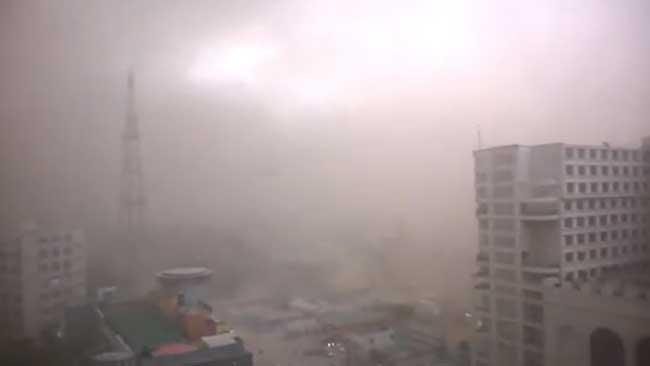
(Hot Dust. A dust storm rolls through New Delhi on Friday amidst furnace-like 113 degree heat snarling traffic and resulting in the tragic loss of 9 more lives. Image source: Gaurav Karoliwal/YouTube Screenshot.)

Today the heatwave continued to gain ground, with Kota and Rajasthan reaching an all-time record of 116 degree F (46.5 C) as New Delhi’s mercury hit 113 degrees F in the midst of a drought-induced dust storm. Dust shrouding the city spurred traffic chaos and in the heat, darkness, and confusion nine more souls were lost.

After two months of growing disruption due to heat and drought, the lands and peoples of India cry out for a Monsoon that is running later and later with each new weather report.

Climate Change + El Nino: Adding Heat and Beating Back the Monsoon

As systems approach tipping points, they are more likely to tilt toward the extremes.

For India this year, its seasonally warmest period from April to May found severe heat amplification from a number of global factors. First, climate change seeded the ground for the current Indian heatwave by adding general heat and evaporation to already hot conditions. With global average heating of +0.8 C above 1880s levels amplifying in the hot zones, early moisture loss due to higher-than-normal temperatures produces a kind of snowball effect for still more warming. Essentially, the cooling effect of water evaporation is baked out early allowing for heat to hit harder just as typical seasonal maximums are reached. More

Originally published by robertscribbler.wordpress.com/


Wednesday, April 16, 2014

The Future Is Evaporating: Climate Change Could Dry Out 30 Percent of the Earth

Scientists expect the changing climate to bring on more drought; there's going to be less rainfall in the already arid regions.

That alone would be bad news for denizens of the planet's dry zones—in some places in North Africa, the American Southwest, India, and the Middle East, water shortages could well become an existential threat to societies built there. But new research shows that in addition to less rain, the rate of evaporation is likely to rise, too. Combined, the two forces could dry out up to a third of the planet.

The study, published in the journal Climate Dynamics last month, estimates that climate change will cause reduced rainfall alone to dry out 12 percent of the Earth's land by 2100. But if evaporation is factored in, the study's authors say that it will "increase the percentage of global land area projected to experience at least moderate drying by the end of the 21st century from 12 to 30 percent."

“We know from basic physics that warmer temperatures will help to dry things out,” the study’s lead author, Benjamin Cook, a climate scientist with Columbia University and NASA's Goddard Institute for Space Studies, said in a statement. “Even if precipitation changes in the future are uncertain, there are good reasons to be concerned about water resources.”

Writing in a 2011 literature review in the science journal Nature, the physicist Joe Romm elaborates on how increased heat and evaporation can lead to a vicious cycle: "Precipitation patterns are expected to shift, expanding the dry subtropics. What precipitation there is will probably come in extreme deluges, resulting in runoff rather than drought alleviation. Warming causes greater evaporation and, once the ground is dry, the Sun’s energy goes into baking the soil, leading to a further increase in air temperature."

Disappearing soil moisture is likely to be a greater problem than previously thought, and the occasional downpour won't sate year-round crops. As Columbia University notes, "An increase in evaporative drying means that even regions expected to get more rain, including important wheat, corn, and rice belts in the western United States and southeastern China, will be at risk of drought."

If it becomes too dry to cultivate crops on one-third of the planet's surface, there's little doubt that crisis will follow. For millions of people who depend on food grown in vulnerable regions, the future is literally evaporating. More


Friday, April 11, 2014

Water Crisis: 2020 Statement by Mikhail Gorbachev on 20th Anniversary of Green Cross

Water crisis – clear and present danger

We live in urgent times. The sum of the concurrent crises that have been engulfing everything from climate to energy, to the economy, is creating a spiral of need for change. But the water crisis sticks out of this list in terms of being an explicitly clear and present danger with deadly implications.

Mikhail Gorbachev

The mounting water crisis and its geography make it clear that without resolute counteraction, it will overstretch many societies’ adaptive capacities within the coming decades. This could result in massive migration, severe socio-economic stress, destabilization and violence, jeopardizing national and international security to a new degree.

By 2025, a predicted 1.8 billion people will live in regions suffering from absolute water scarcity. Two-thirds of the world population could be under hydric stress conditions. Demand for water will rise: water withdrawals in developing countries will increase by 50%, and 18% in developed countries by 2025.

Despite these demands, what state is the world’s water in? Despite the fact that we use slightly more than half the world’s (54%) accessible water, more than 50% of the 3.5 billion people living in urban circumstances around the world already do not have access to adequate water and sanitation.

But the really bad news is that the water use is growing even faster than the population: the 20th century water consumption grew twice as fast as the world population. As a result, a third of the world's population lives in water-stressed countries now. By 2025, this is expected to rise to two-thirds.

In addition to unsustainable water use we are polluting our lakes, rivers and streams to death. Most wastewater (about 80%) from residential and industrial sources enters the environment untreated.

The growing human need for water, to sustain life and wellbeing, plus the pressures on the resource itself, from mismanagement, pollution and a general lack of foresight, make for the most telling case for improved global water conservation and consumption.

But too little is being done on these fronts. We have been waiting since 1997 for just 35 countries to sign the UN Watercourses Convention, to promote the management and sharing of the world’s 276 cross-border rivers and connected underground water sources, and we are still a handful short.

The lack of a global framework to manage water sources that cross national borders endangers the world in many ways, not least of all in terms of the risk of conflict between countries over who controls the same river that runs through their respective frontiers.

Then there is the Right to Water and Sanitation, which Green Cross was a loud advocate of before it finally came into being in 2010. While this recognition itself, that access to safe drinking water and sanitation are basic human rights, is a success, what must be happening at breakneck speed now is the realization of this right. This means creation of national legislation enshrining the right (alongside education, health and others) and investing in the infrastructure needed to make safe water and sanitation services available to all.

Despite UN adoption of this vital principle, the deficit of fresh water is becoming increasingly severe and large-scale – whereas, unlike other resources, there is no substitute for water.

While the Millennium Development Goal for access to drinking water and sanitation was announced met in 2012, almost 800 million people still have no access to safe water today, and three times that number lack adequate sanitation. Thousands of children die daily in the developing world due to related waterborne diseases.

The scale and global nature of the water crisis demand stronger statesmanship, vision and international action. To master the water crisis, we must address its effects and causes. The economic, social, water and environmental aspects must be properly coordinated in any response.

A comprehensive “water goal” must be injected into the post-2015 development agenda, linking development and environment in analyses and in governance policies. Such a goal would address the three interdependent dimensions of water: water, sanitation and hygiene; water management; and wastewater management and water quality.

This goal must be based on principles of equity, solidarity, recognition of limits of planet and rights approach, coupled with effective means to check and demand the accountability of all stakeholders.

We live in volatile and transformative times, faced with the awe-inspiring global challenge of climate change, the devastation of civil wars, and the hope-crushing scourge of extreme poverty. But one thing is constant: our need for water. Whole regions are languishing in poverty and conflict, effectively held hostage by their hydrology: we must break this cycle and give people a chance for their future. Benjamin Franklin said that "when the well's dry, we know the worth of water." The alarm clock has been ringing on deaf ears for far too long, it is time to wake-up before it is too late, before the wells of the world have run dry. More


Wednesday, August 14, 2013

Peak Water: What Happens When the Wells Go Dry?

Peak oil has generated headlines in recent years, but the real threat to our future is peak water. There are substitutes for oil, but not for water. We can produce food without oil, but not without water.

We drink on average four liters of water per day, in one form or another, but the food we eat each day requires 2,000 liters of water to produce, or 500 times as much. Getting enough water to drink is relatively easy, but finding enough to produce the ever-growing quantities of grain the world consumes is another matter.

Grain consumed directly supplies nearly half of our calories. That consumed indirectly as meat, milk, and eggs supplies a large part of the remainder. Today roughly 40 percent of the world grain harvest comes from irrigated land. It thus comes as no surprise that irrigation expansion has played a central role in tripling the world grain harvest over the last six decades.

During the last half of the twentieth century, the world’s irrigated area expanded from close to 250 million acres (100 million hectares) in 1950 to roughly 700 million in 2000. This near tripling of world irrigation within 50 years was historically unique. But since then the growth in irrigation has come to a near standstill, expanding only 10 percent between 2000 and 2010.

In looking at water and our future, we face many questions and few answers. Could the world be facing peak water? Or has it already peaked?

Farmers get their irrigation water either from rivers or from underground aquifers. Historically, beginning with the Sumerians some 6,000 years ago, irrigation water came from building dams across rivers, creating reservoirs that then enabled them to divert the water onto the land through a network of gravity-fed canals. This method of irrigation prevailed until the second half of the twentieth century, where with few sites remaining for building dams, the prospects for expanding surface irrigation faded. Farmers then turned to drilling wells to tap underground water resources.

In doing so, they learned that there are two types of aquifers: those that are replenishable through rainfall, which are in the majority, and those that consist of water laid down eons ago, and thus do not recharge. The latter, known as fossil aquifers, include two strategically important ones, the deep aquifer under the North China Plain and the Ogallala aquifer under the U.S. Great Plains.

Tapping underground water resources helped expand world food production, but as the demand for grain continued climbing, so too did the amount of water pumped. Eventually the extraction of water began to exceed the recharge of aquifers from precipitation, and water tables began to fall. And then wells begin to go dry. In effect, overpumping creates a water-based food bubble, one that will burst when the aquifer is depleted and the rate of pumping is necessarily reduced to the rate of recharge.

Today some 18 countries, containing half the world’s people, are overpumping their aquifers. Among these are the big three grain producers—China, India, and the United States—and several other populous countries, including Iran, Pakistan and Mexico.

During the last couple of decades, several of these countries have overpumped to the point that aquifers are being depleted and wells are going dry. They have passed not only peak water, but also peak grain production. Among the countries whose use of water has peaked and begun to decline are Saudi Arabia, Syria, Iraq, and Yemen. In these countries peak grain has followed peak water.

Nowhere are falling water tables and the shrinkage of irrigated agriculture more dramatic than in Saudi Arabia, a country as water-poor as it is oil-rich. After the Arab oil export embargo in 1973, the Saudis realized they were vulnerable to a counter-embargo on grain. To become self-sufficient in wheat, they developed a heavily subsidized irrigated agriculture based heavily on pumping water from fossil aquifers.

After being self-sufficient in wheat for over 20 years, the Saudis announced in early 2008 that, with their aquifers largely depleted, they would reduce wheat planting by one eighth each year until 2016, when production would end. By then Saudi Arabia projects it will be importing some 15 million tons of wheat, rice, corn, and barley to feed its 30 million people. It is the first country to publicly project how aquifer depletion will shrink its grain harvest.

Syria, a country of 22 million people riddled by civil war, is also overpumping its underground water. Its grain production peaked in 2001 and during the years since has dropped 32 percent. It, too, is becoming heavily dependent on imported grain.

In neighboring Iraq, grain production has plateaued over the last decade. In 2012 it was dependent on the world market for two thirds of its consumption. In addition to aquifer depletion, both Syria and Iraq are also suffering from a reduced flow in the Tigris and Euphrates rivers as upstream Turkey claims more water for its own use.

In Yemen, a nation of 24 million people that shares a long border with Saudi Arabia, the water table is falling by roughly 6 feet a year as water use outstrips aquifer recharge. With one of the world’s fastest-growing populations and with water tables falling throughout the country, Yemen is fast becoming a hydrological basket case. Grain production has fallen by nearly half over the last 40 years. By 2015, irrigated fields will be a rarity and the country will be importing virtually all of its grain. Living on borrowed water and borrowed time, Yemen could disintegrate into a group of tribal fiefdoms warring over water.

Thus in the Arab Middle East the world is seeing the collision between population growth and water supply at the regional level. For the first time in history, grain production is dropping in a geographic region with nothing in sight to arrest the decline. Because of the failure of governments in the region to mesh population and water policies, each day now brings 9,000 more people to feed and less irrigation water with which to feed them.

Other countries with much larger populations are also near or beyond peak water. In Iran, a country with 77 million people, grain production dropped 10 percent between 2007 and 2012 as irrigation wells started to go dry. One quarter of its current grain harvest is based on overpumping. With its population growing by a million people per year, it, too, faces a day of reckoning.

Pakistan, with a population of 182 million that is growing by 3 million per year, is also mining its underground water. Most of its irrigation water comes from the Indus river system, but in the Pakistani part of the fertile Punjab plain, the drop in water tables appears to be similar to the better-known fall that is occurring in India.

Observation wells near the twin cities of Islamabad and Rawalpindi showed a fall in the water table between 1982 and 2000 that ranged from 3 to 6 feet a year. In the Pakistani province of Balochistan, which borders Afghanistan, water tables around the capital, Quetta, are falling by 3.5 meters (11.5 feet) per year—pointing to the day when the city will run out of water. Sardar Riaz A. Khan, former director of Pakistan’s Arid Zone Research Institute in Quetta, reports that six of Balochistan’s seven basins have exhausted their groundwater supplies, leaving their irrigated lands barren.

In a World Bank study, water expert John Briscoe says: “Pakistan is already one of the most water-stressed countries in the world, a situation which is going to degrade into outright water scarcity due to high population growth.” He then notes that “the survival of a modern and growing Pakistan is threatened by water.”

In Mexico—home to a population of 122 million that is projected to reach 156 million by 2050—the demand for water is outstripping supply. Mexico City’s water problems are well known. Rural areas are also suffering. In the agricultural state of Guanajuato, the water table is falling by 6 feet or more a year. In the northwestern wheat-growing state of Sonora, farmers once pumped water from the Hermosillo aquifer at a depth of 40 feet. Today they pump from over 400 feet. Mexico may be near peak water use. Peak grain may be imminent.

In addition to these small and midsize countries, aquifer depletion now also threatens harvests in the big three grain producers—China, India, and the United States—that together produce half of the world’s grain. The question is not whether water shortages will affect future harvests in these countries, but rather when they will do so.

Among the big three, dependence on irrigation varies widely. Some four fifths of China’s grain harvest comes from irrigated land, most of it drawing on surface water, principally the Yellow and Yangtze rivers. For India, three fifths of its grain is irrigated, mostly with groundwater. For the United States, only one fifth of the harvest is from irrigated land. The bulk of the grain crop is rain-fed, produced in the highly productive Midwestern Corn Belt where there is little or no irrigation.

Falling water tables are already adversely affecting harvest prospects in China, which rivals the United States as the world’s largest grain producer. A groundwater survey released in Beijing in 2001 indicated that the water table under the North China Plain, an area that produces half of the country’s wheat and a third of its corn, was falling fast. Overpumping has largely depleted the shallow aquifer, forcing well-drillers to turn to the region’s deep aquifer, which is not replenishable.

The survey reported that under Hebei Province in the heart of the North China Plain, the average level of the deep aquifer was dropping nearly 10 feet per year. Around some cities in the province, it was falling twice as fast. He Qingcheng, head of the groundwater monitoring team, notes that as the deep aquifer is depleted, the region is losing its last water reserve—its only safety cushion.

In 2010, He Qingcheng reported that Beijing was drilling down 1,000 feet to reach an aquifer, five times deeper than 20 years ago. His concerns are mirrored in the unusually strong language of a World Bank report on China’s water situation that foresees “catastrophic consequences for future generations” unless water use and supply can quickly be brought back into balance.

As serious as water shortages are in China, they are even more alarming in India, where the margin between food consumption and survival is so precarious. In India, whose population is growing by 15 million per year, irrigation depends heavily on underground water. And since there are no restrictions on well drilling, farmers have drilled more than 27 million irrigation wells and are pumping vast amounts of underground water.

In this global epicenter of well drilling, pumps powered by heavily subsidized electricity are dropping water tables at an alarming rate. Among the states most affected are Punjab, Haryana, Rajasthan, and Gujarat in the north and Tamil Nadu in the south. In North Gujarat the water table is falling by 20 feet per year. In Tamil Nadu, a state of 72 million people, water tables are falling everywhere. Kuppannan Palanisami of Tamil Nadu Agricultural University noted in 2004 that 95 percent of the wells owned by small farmers have dried up, reducing the irrigated area in the state by half over the preceding decade.

India’s grain harvest has been expanding rapidly in recent years, but in part for the wrong reason, namely massive overpumping. A World Bank study estimates that 15 percent of India’s food supply is produced by mining groundwater. Stated otherwise, 175 million Indians are now fed with grain produced with the unsustainable use of water. As early as 2004, Fred Pearce reported in New Scientist that “half of India’s traditional hand-dug wells and millions of shallower tube wells have already dried up, bringing a spate of suicides among those who rely on them. Electricity blackouts are reaching epidemic proportions in states where half of the electricity is used to pump water from depths of up to a kilometer.”

As India’s water tables fall, larger farmers are using modified oil-drilling technology to reach water, going as deep as 1,000 feet in some locations. In communities where underground water sources have dried up entirely, all agriculture is now rain-fed and drinking water must be trucked in. Tushaar Shah of the International Water Management Institute says of India’s water situation: “When the balloon bursts, untold anarchy will be the lot of rural India.”

In the United States, farmers are over-pumping in the Great Plains, including in several leading grain-producing states such as Texas, Oklahoma, Kansas, and Nebraska. In these states, irrigation has not only raised wheat yields but it has also enabled a shift from wheat to corn, a much higher-yielding crop. Kansas, for example, long known as the leading wheat state, now produces more corn than wheat.

Irrigated agriculture has thrived in these states, but the water is drawn from the Ogallala aquifer, a huge underground water body that stretches from Nebraska southwards to the Texas Panhandle. It is, unfortunately, a fossil aquifer, one that does not recharge. Once it is depleted, the wells go dry and farmers either go back to dryland farming or abandon farming altogether, depending on local conditions.

In Texas, a large grain and cattle state, whose northern part overlies the shallow end of the Ogallala, irrigated grain area peaked in 1975. Since then it has shrunk by two thirds, with the most precipitous drop in recent years. In Kansas the peak came in 1982 and irrigated grain area has since fallen 41 percent. Nebraska, now also a leading corn-producing state, saw its irrigated area peak most recently, in 2007. Even though aquifer depletion is reducing grain output in several key states, it is not yet sufficient to reduce the overall U.S. grain harvest, the bulk of which is produced in the rain-fed Midwestern Corn Belt.

At the international level, water conflicts, such as the one in the Nile river basin between Egypt and the upstream countries, make the news. But within countries it is the competition for water between cities and farms that preoccupies political leaders. Indeed, in many countries farmers now face not only a shrinking water supply as aquifers are pumped dry, but also a shrinking share of that shrinking supply.

In large areas of the United States, such as the southern Great Plains and the Southwest, virtually all water is now spoken for. The growing water needs of major cities and thousands of small towns often can be satisfied only by taking water from agriculture. As the value of water rises, more farmers are selling their irrigation rights to cities, letting their land dry up. Hardly a day goes by without the announcement of a new sale. Half or more of all sales are by individual farmers or their irrigation districts to cities and municipalities.

In the largest farm-to-city water transfer in U.S. history, farmers in California’s highly productive Imperial Valley agreed in 2003 to send San Diego County enough water to meet the household needs of close to one million people each year. The agreement spans 45 years. This could reduce food production in the Imperial Valley, a huge vegetable garden not only for California, but for countless other markets as well. Writing from the area in the New York Times, Felicity Barringer notes that many fear that “a century after Colorado River water allowed this land to be a cornucopia, unfettered urban water transfers could turn it back into a desert.”

Colorado, with a fast-growing population, has one of the world’s most active water markets. Cities and towns of all sizes are buying irrigation water rights from farmers and ranchers. In the Arkansas river basin, which occupies the southeastern quarter of the state, Colorado Springs and Aurora (a suburb of Denver) have already bought water rights to one third of the basin’s farmland. Aurora has purchased rights to water that was once used to irrigate 19,000 acres of cropland in the Arkansas valley. The U.S. Geological Survey estimates that 400,000 acres of farmland dried up statewide between 2000 and 2005.

Colorado is not alone in losing irrigation water. Farmers in rural India are also losing their irrigation water to cities. This is strikingly evident in Chennai (formerly Madras), a city of 9 million on the east coast. As a result of the city government’s inability to supply water to many of its people, a thriving tank-truck industry has emerged that buys water from nearby farmers and hauls it to the city’s thirsty residents.

For farmers near cities, the market price of water typically far exceeds the value of the crops they can produce with it. Unfortunately the 13,000 privately owned tank trucks hauling water to Chennai are mining the region’s underground water resources. As water tables fall, eventually even the deeper wells will go dry, depriving rural communities of both their food supply and their livelihood.

In the competition for water between farmers on the one hand and cities and industries on the other, farmers always lose. The economics do not favor agriculture. In countries such as China, where industrial development and the jobs associated with it are an overriding national economic goal, agriculture is becoming the residual claimant on the water supply.

Where virtually all water has been claimed, cities can typically get more water only by taking it from irrigation. Countries then import grain to offset the loss of irrigated grain production. Since it takes 1,000 tons of water to produce one ton of grain, importing grain is the most efficient way to import water. Thus trading in grain futures is, in a sense, trading in water futures. To the extent that there is a world water market, it is embodied in the world grain market.

We can now see how overpumping, whether in the Middle East or the U.S. Great Plains, can lead to aquifer depletion and shrinking grain harvests. In short, peak water can lead to peak grain. For some countries this is no longer merely a theoretical possibility. It is a reality.

Thus far, aquifer depletion has translated into shrinking harvests only in smaller countries in the Middle East. When we look at middle-sized countries such as Iran, Mexico, and Pakistan, with tightening water supplies, we see that Iran is already in deep trouble. It is feeling the effects of shrinking water supplies from overpumping. Pakistan may also have reached peak water. If so, peak grain may not be far behind. In Mexico, the water supply may have already peaked. With less water for irrigation, Mexico may be on the verge of a downturn in its grain harvest.

In summarizing prospects for the three big grain producers—the United States, China, and India—we see sharp contrasts. In the United States, the irrigated grainland is starting to shrink largely as a result of depletion of the Ogallala aquifer, making it more difficult to rapidly increase overall grain production.

China, with four fifths of its grain harvest coming from irrigated land, relies heavily on irrigation, but it is largely river water. A notable exception to this is the all-important North China Plain which relies heavily on underground water. With tight water supplies in northern China and with cities claiming more irrigation water, the shrinking water supply will likely reduce the harvest in some local situations. And before long it could more than offset production gains, leading to an absolute decline in China’s grain harvest.

Of the big three countries, the one most vulnerable to overpumping is India. Three fifths of its grain harvest comes from irrigated land. And since only a minor share of its irrigation water comes from rivers, India is overwhelmingly dependent on underground water. Its millions of wells, each powered with a diesel engine or electric motor, are dropping water tables at an alarming rate. Accurate data are hard to come by, but India may have already passed peak water. The question is, will peak water be followed by peak grain or is there enough unrealized technological potential remaining to raise yields enough to offset any imminent losses from wells going dry?

The world has quietly transitioned into a situation where water, not land, has emerged as the principal constraint on expanding food supplies. There is a large area of land that could produce food if water were available.

Water scarcity is not our only challenge. Just as harvests are shrinking in some countries because of aquifer depletion, they are shrinking in other countries because of soil erosion. Among the more dramatic examples are Mongolia and Lesotho, which have each seen their grain area shrink as a result of soil erosion. And as a result of overplowing and overgrazing, two huge new dust bowls are forming in the world today, one in northwest China and the other in the Sahelian region of Africa. These giant dust bowls dwarf the U.S. Dust Bowl of the 1930s.

The bottom line is that water constraints—augmented by soil erosion, the loss of cropland to nonfarm uses, a plateauing of yields in major producing areas, and climate change—are making it more difficult to expand world food production. The question raised is this: Is it conceivable that the negative influences on future food production could one day offset the positive ones, leading to a cessation in the world grain harvest? More

Adapted from ‘The real threat to our future is peak water’ by Lester R. Brown, published in the Observer on July 6, 2013.

Lester R. Brown is president of the Earth Policy Institute and author of Full Planet, Empty Plates: The New Geopolitics of Food Scarcity (W.W. Norton, 2012).


Saturday, August 3, 2013

Could Sri Lanka get irrigation boost from ancient reservoirs?

COLOMBO, 1 August 2013 (IRIN) - One way Sri Lanka can better manage its water resources in the face of changing monsoon patterns is through centuries-old water reservoirs, experts say.

Inland fishermen working in the
Kala Weva lake (tank)

Experts at the Colombo-based International Water Management Institute (IWMI) say one way to ease fluctuating rice harvests (due to increasingly erratic monsoon seasons) is to use thousands of ancient small irrigation reservoirs spread out in the Northern, North Central, Eastern, North Western and Southern provinces.

“Tanks [reservoirs] can store water and so are buffers against irregular rainfall supplies,” said Herath Manthrithilake, the head of the institute’s Sri Lanka Development Initiative.

The reservoirs were built between 300 and 400 BC to provide nearby villages with water for agriculture and other needs. They became less important with the introduction of rain-fed cash crops by European colonizers in the 1500s and have been largely untouched since the 1970s with the development of large irrigation and hydropower schemes.

The tanks were constructed by excavating earth and building a large wall around the hole. Most tanks have filled up with sediment, others are hidden by overgrown shrubs or belong to dilapidated networks connecting them to the fields. There is no current estimate, but in 2004 the then government estimated that it would cost some US$20 million at the 2004 exchange rate ($15 million now) to make the tanks functional.

For Werrakoddi Archchilage Premadasa, a 33-year-old farmer from Tanamalvila town in southeastern Uva Province, the tank near his farm is the main source of water for cultivation. “Now the problem is half of the tank is overgrown and it’s also filled with sand… If we can get it to store to its maximum capacity, I don’t think we will have issues with water for cultivation.”

IWMI research has shown that reservoirs can also divert flood waters to the old tanks built on low-lying land, helping to minimize flood damage.

Manthrithilake said a major renovation of thousands of such reservoirs (estimated by researchers to number some 12,000) should be launched if they are to be used effectively. Some 1,000 tanks were repaired in 2004, with no additional repairs planned since then.

“Managing the water resources will be crucial. The monsoon, our main source of water, is changing, forcing us to change the way we use our water resources,” Waduwatte Lekamlage Sumapthipala, formerly the head of the Climate Change Unit at the Ministry of Environment and currently a government adviser, told IRIN.

Weather predictions

A recent World Bank report warned the island’s dry regions are likely to experience less rain while wet zones are at risk of even more deluges.

“The seasonal distribution of precipitation is expected to become amplified, with a decrease of up to 30 percent during the dry season and a 30 percent increase during the wet season,” the report predicted.

Late 2012 and early 2013 floods affected more than one million people nationwide, while a 2012 drought hit an estimated 1.3 million residents.

A survey of flood-affected communities conducted by the Sri Lanka government and the World Food Programme in January this year found 75 percent of the 557,000 people surveyed were either severely food insecure or borderline food insecure.

Of those surveyed, some 33 percent said their main income was through agriculture.

Fluctuating rice production

Rice production has been at the mercy of increasingly unpredictable monsoons in the past three years. In 2011, large harvest losses, around 20 percent of the main harvest, were recorded due to floods.

But the harvest recovered to an extent in mid-2011 when rain-fed irrigation helped to produce a higher-than-average secondary harvest (the country has two harvests annually).

During 2012’s drought the second annual rice harvest fell by up to 10 percent.

However according to the latest country assessments by the UN Food and Agriculture Organization, the rice harvest is expected to recover this year, and is likely to be above four million tons for the first time since 2009.

“The problem is the prices keep going up and down when the harvest falls and picks up. When we don’t have means to keep prices steady, we should look at keeping the harvest steady,” said Liyana Pathirana Rupasena, the deputy director of research at the governmental Hector Kobbekaduwa Agrarian Training and Research Institute (HARTI).

His concern is that poorer communities will cut back on calories or go for rice varieties that are cheaper but less nutritious during price hikes.

Rupasena said despite predicted harvest increases, rice prices are still higher than in 2011 and 2012.

Hydropower problems

In addition to destabilizing rice production, water management problems have hit the country’s energy supply. Sri Lanka typically generates around 40 percent of its electricity using hydro generation.

During August 2012 when the drought was at its worst, hydro-generation barely reached 15 percent; the remaining power was generated through costly thermal sources, which forced the country to spend heavily on oil imports, according to the state.

The 2012 oil import bill for thermal power was around US$2 billion, around a tenth of what Colombo spent on imports for the entire year. More


Saturday, March 23, 2013

Ancient aqueducts [karez] give Iraq a trickle of hope

A millennia-old labyrinth of underground canals may help solve the Middle East's water crisis, say experts.

The ancient karez in Kunaflusa

In the windswept plateaus of northern Iraq, unseen aqueducts which have channelled water to arid settlements for centuries are running dry. Experts say the wide-scale demise of these ancient water systems is an ominous sign of how scarce water in the region will soon become, and the humanitarian disasters that could follow.

For villagers here, tragic consequences have already arrived.

Farez Abdulrahman Ali strides across a muddy field and sweeps a burly arm towards the mountains that loom over Shekh Mamudian village in the wilds of Iraq’s semi-autonomous Kurdistan region. This is the rugged terrain of thepeshmerga, the Kurdish military whose name means "those who face death".

Ali explains that a subterranean canal - known in Iraq as a karez - once brought water to the village, where it gushed from a rock-lined tunnel into a pool just below the entrance to the local mosque. From there, it was channelled to nearby fields of okra, eggplant, onion and tobacco.

"Farmers would use the water," said Ali. "On hot days, children would play in the water. In the evenings, people would gather at the karez to talk about village things."

"The karez dates back to the time when karez were dug," he added, matter-of-factly. "Nobody in the village knows when it was dug. Even my grandfather doesn't know. It is probably 800 or 900 or 1,000 years old."

"There is now not enough water for farming. If the karez runs dry,

we will be forced to leave the village." - Fadel Salah, Kunaflusa villager

Dry county

In autumn 2011, for the first time in the village's collective memory, the karez in Shekh Mamudian went dry. As the village chief, or mukhtar, Ali sees the loss of the karez as catastrophic for the livestock and crops the village depends on for its hard won self-sufficiency. Unless it is restored, he fears for the end of a community that withstood assaults by Saddam Hussein’s army in the 1980s, and survived as a bloody no-man's land in the Kurdish civil war of the mid-1990s.

"The karez was the source of life," Ali said. "The village now feels like a family that has lost its father."

Echoes of Ali’s lament are being heard throughout the arid mountains and plains of Kurdistan, where the widespread demise of karez is becoming a humanitarian nightmare.

Last year, an inventory of karez systems in Kurdistan - believed to be the first such compiled in modern times - found that decades of war and years of grinding drought, combined with neglect and over-pumping from nearby mechanised wells, had brought these vital water lifelines to the edge of extinction.

According to a UNESCO report, just 116 of the 683 karez networks located in northern Iraq were still supplying water as of August 2009. As many as 40 per cent of the region's karez have dried up in the past four years alone.

Since 2005, more than 100,000 people have been forced to abandon their homes because their karez stopped flowing, and a further 36,000 are at immediate risk of evacuating their villages, according to the UN agency.

Parched land

In Kunaflusa, a rocky 90-minute drive north of Erbil, the village karez was last year producing only a trickle. Village mukhtar Fadel Abdullah Salah said families were allotted one-hour time slots to fill up enough water jugs to last a week.

"There is not enough water now for farming," said Salah. "If the karez runs dry, we will be forced to leave the village."

Water brought in tanker trucks by the Kurdistan Regional Government has helped the people of Kunaflusa. But experts say quick fixes such as hauling in water or drilling new, gas-fuelled wells are expensive band-aids that will ultimately prove unsustainable.

Salah said the village had some 200 houses in 1984, but today only 13 remain occupied. The UN report found that, on average, 70 per cent of residents moved away from their villages after the local karez went dry. More


Wednesday, March 13, 2013

India, Bangladesh very short of water, among Asia's worst - report

NEW DELHI (AlertNet) - Three out of four countries in Asia and the Pacific are facing a serious lack of water, and some are in danger of a crisis unless steps are taken to improve water management, a report by the Asian Development Bank and the Asia-Pacific Water Forum has said.

A private vehicle crosses a bridge as excavators work at the dam site of Kishanganga power project in Gurez, 160 km north of Srinagar, Indian-administered Kashmir. Picture June 21, 2012, REUTERS/Fayaz Kabli

The Asian Water Development Outlook 2013 , the first study of the degree of water security of every country in the region, found that 37 out of 49 nations do not have enough water, the worst being India, Afghanistan, Bangladesh, Pakistan, Cambodia, Kiribati, Nauru and Tuvalu.

"South Asia and parts of Central and West Asia are faring the worst with rivers under immense strain, while many Pacific islands suffer from a lack of access to safe piped water and decent sanitation and are highly vulnerable to increasingly severe water disasters," said an ADB statement.

"By contrast East Asia, which has the highest frequency of hazards in the region, is relatively better off due to higher levels of investment in disaster defences, but urban water security remains poor in many cities and towns."

Water security has become an increasing concern across the world in recent years.

More frequent floods and droughts caused by climate change, pollution of rivers and lakes, urbanisation, over-extraction of ground water and expanding populations mean that many Asia-Pacific nations face serious water shortages.

In addition, the demand for more power by countries like India to fuel their economic growth has resulted in a need to harness more water for hydropower dams.

The study examined water security in countries at five different levels, including access to clean drinking water and sanitation, water availability for industry and agriculture, and water supply systems in urban areas.

"Much progress has been made in terms of providing drinking water, but when we look at the number of households that have piped water, it is much less," said Wouter T. Lincklaen, lead water resources specialist at the ADB.

Only 35 percent of the region's population have a secure water supply. Even worse, only 23 percent of South Asians and 21 percent of those living in the Pacific have piped water, he said.

ADB experts cited China as a good example of improved water management, in which the government not only promised to double annual investment in the water sector to $608 billion by 2020, but also set performance targets for industry, irrigation and water quality. More


Tuesday, March 12, 2013

Rains or Not, India Is Falling Short on Drinkable Water

CHERRAPUNJI, India — Almost no place on Earth gets more rain than this small hill town. Nearly 40 feet falls every year — more than 12 times what Seattle gets. Storms often drop more than a foot a day. The monsoon is epic.

But during the dry season from November through March, many in this corner of India struggle to find water. Some are forced to walk long distances to fill jugs in springs or streams. Taps in Shillong, the capital of Meghalaya State, spout water for just a few hours a day. And when it arrives, the water is often not drinkable.

That people in one of the rainiest places on the planet struggle to get potable water is emblematic of the profound water challenges that India faces. Every year, about 600,000 Indian children die because of diarrhea or pneumonia, often caused by toxic water and poor hygiene, according to Unicef.

Half of the water supply in rural areas, where 70 percent of India’s population lives, is routinely contaminated with toxic bacteria. Employment in manufacturing in India has declined in recent years, and a prime reason may be the difficulty companies face getting water.

And India’s water problems are likely to worsen. A report that McKinsey & Company helped to write predicted that India would need to double its water-generation capacity by the year 2030 to meet the demands of its surging population.

A separate analysis concluded that groundwater supplies in many of India’s cities — including Delhi, Mumbai, Hyderabad and Chennai — are declining at such a rapid rate that they may run dry within a few years.

The water situation in Gurgaon, the new mega-city south of Delhi, became so acute last year that a judge ordered a halt to new construction until projects could prove they were using recycled water instead of groundwater.

On Feb. 28, India’s finance minister, Palaniappan Chidambaram, proposed providing $2.8 billion to the Ministry of Drinking Water and Sanitation in the coming fiscal year, a 17 percent increase.

But water experts describe this as very little in a country where more than 100 million people scrounge for water from unimproved sources.

Some water problems stem from India’s difficult geography. Vast parts of the country are arid, and India has just 4 percent of the world’s fresh water shared among 16 percent of its people.

But the country’s struggle to provide water security to the 2.6 million residents of Meghalaya, blessed with more rain than almost any place, shows that the problems are not all environmental.

Arphisha lives in Sohrarim, a village in Meghalaya, and she must walk a mile during the dry season to the local spring, a trip she makes four to five times a day. Sometimes her husband fetches water in the morning, but mostly the task is left to her. Indeed, fetching water is mostly women’s work in India.

On a recent day, Arphisha, who has only one name, took the family laundry to the spring, which is a pipe set in a cement abutment. While her 2-year-old son, Kevinson, played nearby, Arphisha beat clothes on a cement and stone platform in front of the spring. Her home has electricity several hours a day and heat from a coal stove. But there is no running water. When it rains, she uses a barrel to capture runoff from her roof.

“It’s nice having the sunshine now, but my life is much easier during the monsoon,” she said.

Kevinson interrupted her work by bringing her an empty plastic bottle. “Water,” he said. Arphisha bent down, filled the bottle and gave it back to him. “Say, ‘Thank you,’ ” she said. “Say, ‘Thank you.’ ” When he silently drank, turned and went back to playing, Arphisha laughed and shrugged her shoulders. More


Tuesday, February 26, 2013

Climate change and water mismanagement parch Egypt

Climate change, a fast growing population, ill-designed infrastructure, high levels of pollution and lack of law enforcement have made Egypt a country thirsty for water — both in terms of quantity and quality.

The River Nile, which is considered poor by many experts and hydrologists, lies at lower altitude than the rest of the country. Massive electric pumps extract the water from the river’s bed and canals and direct it to industry, agriculture and for individual water use.

A significant portion of the water contained in Lake Nasser’s 5,000 square kilometer basin is lost to evaporation, while old networks of leaking pipes also deprive the country of satisfactory access to its most important resource: water.

In order to debate water scarcity in Egypt, its causes, and how climate change makes the issue more pressing than ever, as well as looking to solutions, a panel of experts were invited to participate in the 13th Cairo Climate Talk last week entitled “Growing Thirst: Sustainable Water Solutions for Egypt.”

Tarek Kotb, the First Assistant Minister in the Ministry of Water Resources and Irrigation, and a member of the panel discussion, talked about the dwindling water share per capita with a sense of urgency. “Every year, the Egyptian population grows by 1.8 million, while the annual quota of Nile water allocated to Egypt, 55 billion cubic meters, has remained unchanged since the 1959 Nile Water Agreement,” he says.

While Egyptians in the 1960s could enjoy a water share per capita of 2800 cubic meters for all purposes, the current share has dropped to 660 cubic meters today—below the international standard defining water poverty of 1000 cubic meters.

Kotb estimates that Egypt is gradually going to leave the stage of water scarcity and enter a phase of drastic water stress in the next 40 years, if no sustainable water management is put in place.

“By 2050, there will be about 160 million Egyptians and only 370 cubic meters of water per capita,” he says. While Egypt has other options for its water needs, such as tapping into groundwater basins and desalinating sea-water, the bulk of water is still extracted from the Nile, leading to longstanding tensions with the other Nile basin countries.

The treaty signed under colonial rule in 1959 granted Egypt and Sudan most of the Nile water share, while upstream countries were given access to a very small allocation of water. Lama al-Hatow, a hydrologist and one of the founders of the Water Institute for the Nile (WIN) condemns Egypt’s historical and ongoing hydro hegemony, by which the country claims its entitlement to benefit from most of the Nile water.

“A lot of science has been published on how not to lose water if the Ethiopian Millennium Dam is built, but it is not given much attention by the politicians,” Hatow says. “The upstream countries have the right to develop,” she says, “and there are ways to make it happen without Egypt losing water.”

She adds that preventing water evaporation in Lake Nasser could even increase Egypt’s water share.

Kotb responding to her remarks, saying that Egypt is investing millions of dollars in Sudan, South Sudan and Ethiopia to overcome losses due to evaporation in marshes and basins. “We don’t deny these countries’ right to development; actually, we help them,” he said.

Claudia Bürkin, the Water Sector Coordinator for the German Development Cooperation and Senior Programme Manager at KfW Development Bank, explains that Egypt’s water resources face two main challenges: water loss and bad quality.

“Egypt loses about 50% of its freshwater through poor maintenance of supplies and distribution problems, and the water is polluted,” she says, stressing that a significant number of diseases are water borne. Polluted water also affects the ecosystems’ balance, the soil quality, and seeps into the aquifers. “Egypt needs to set up strong standards for water quality and control the drainage nutrients, pesticides and waste found in the water.”

Kotb admits that while most of the issues and potential solutions have been identified by the government, much needs to be done in terms of implementation of existing laws and stronger cooperation between ministries.

“Water management is not the mandate of the Ministry of Water Resources and Irrigation exclusively, which makes the implementation process so much harder,” he says.

A National Water Resource Plan was established a few years ago, Kotb says, to curb the amount of pollution in the Nile emanating from cruise boats, factories, industries and villagers deprived of a waste management system. As part of this, he explains, factories located close to the Nile or the canals have been moved further away from the water streams, and new industries will be prevented from setting up a plant within 20km from the water.

“Law 48 on pollution has been reviewed and the penalties will be tougher,” he says. Meanwhile, Hatow argues that enforcing stronger penalties is not the solution to prevent farmers from polluting.

“Instead of punishing them, we should give farmers incentives to make better use of water, and provide them with premium crops,” she says.

The conversation then shifted to the effects of climate change, which can already be felt in the Northern part of the Delta and in the Mediterranean coastal cities of Damietta and Rosetta. The gradual rise in sea levels taking place turns fields into barren land unfit for agriculture, and the sea water that infiltrates the Nile is reaching further and further away from the coast.

“In order to keep a good yield and maintain agricultural production,” says Kotb, “we need to use more fresh water to combat rising temperatures.”

Lama’s take on how to combat climate change is quite different from this. “We need to study community based resilience techniques to figure out how local and indigenous knowledge can provide answers and climate resilience.”

- See more at: http://www.egyptindependent.com/news/climate-change-and-water-mismanagement-parch-egypt#sthash.NavKkkxR.dpuf