Showing posts with label monsoon. Show all posts

Tuesday, September 2, 2014

Ned Breslin: thinking big about water supply

Jordan Levy on Ned Breslin

Ned Breslin believes that too many organisations who are providing clean water and sanitation are chasing numbers. He wants to see them be bold enough to operate towards a long-term vision for clean water for everyone. This may seem simple, but he says this is not the way most in the sector operate. He believes these short-term achievements do not always contribute towards solving the systematic issues. I am inspired by Ned and his organisation because they don’t rely on short-term outputs to build legitimacy regardless of outside pressure to do so. They are not afraid to say that real solutions take time.

Ned Breslin on Water for People

The problem is clear. Three decades of support for water projects from NGOs, governments and large and small donors alike have not transformed people’s lives and country’s economic trajectories as such massive investments should.

Few celebrate the report from the World Health Organisation and Unicef (pdf) that shows progress on water supply worldwide – as contradictory evidence paints a much more unfortunate story. The European Union’s scathing audit of water aid investments and the Dutch government’s brave evaluation of their own work (pdf) offer sobering insight into water-sector history and challenges moving forward.

The impact of such failure is also sadly clear. Girls continue to fetch polluted water from muddy puddles and rivers, walking past broken hand-pumps and schools they would be attending if they had the time. To break this cycle, Water For People, the IRC, Water and Sanitation for the Urban Poor, One Drop, and some members of the Millennium Water Alliance are partnering with governments and the local private sector to change the water sector narrative.

We are testing this initiative – called Everyone Forever (EF) – across Africa, Asia and Latin America. The concept is that districts maintain water services for everyone without the need for further philanthropic aid or support.

EF takes a page from polio and smallpox eradication efforts that saturated entire districts, consisting of millions of people and hundreds and thousands of villages. “Everyone” is only achieved when every family, school and clinic in a target district has access to water services, that includes the hardest to reach, the poorest, the disabled, the politically marginalised and the socially ostracised. The poorest in those areas are receiving water services because other residents are covering their tariffs. “Forever” is only achieved when districts show they can sustain these investments over time as populations grow, water resources are threatened, economies change and infrastructure ages.

EF works with governments and insists that their financial support is essential for success. We have seen a 39% increase in government investments towards EF in the past year, with examples like the district of Rulindo in Rwanda now spending over $1m a year on water infrastructure.

Two districts – Chinda, Honduras and Cuchumuela, Bolivia – have reached full coverage verified by the national government. Another five areas are close, including an island in the Ganges in India where half a million pilgrims use the local sanitation system every year (pdf).

One mayor in Bolivia now brags about his district achieving “everyone” status. As a result, other mayors across the country are replicating EF, channeling their investments towards full district coverage. Similar spread is happening in India, Rwanda, Ghana, Uganda and Honduras.

Momentum is now building scaled work that excludes nobody, transcends individual communities and is focused on sustainability. Everyone Forever offers a model that is hard to argue against by politicians and development agencies. The alternative – more projects and hollow slogans of coverage delinked from investments – is simply not good enough anymore. More

Ned Breslin is the CEO of Water for the People. Follow @NedBreslin on Twitter.


Saturday, May 31, 2014

Monsoon Disrupted By El Nino + Climate Change as India Suffers Deaths, Crop Losses from Extreme Heat.

May is the month when the massive rainstorm that is the Asian Monsoon begins to gather and advance. This year, as in many other years, the monsoon gradually formed along the coast of Myanmar early in the month. It sprang forward with gusto reaching the Bay of Bengal by last week.

And there it has stalled ever since.

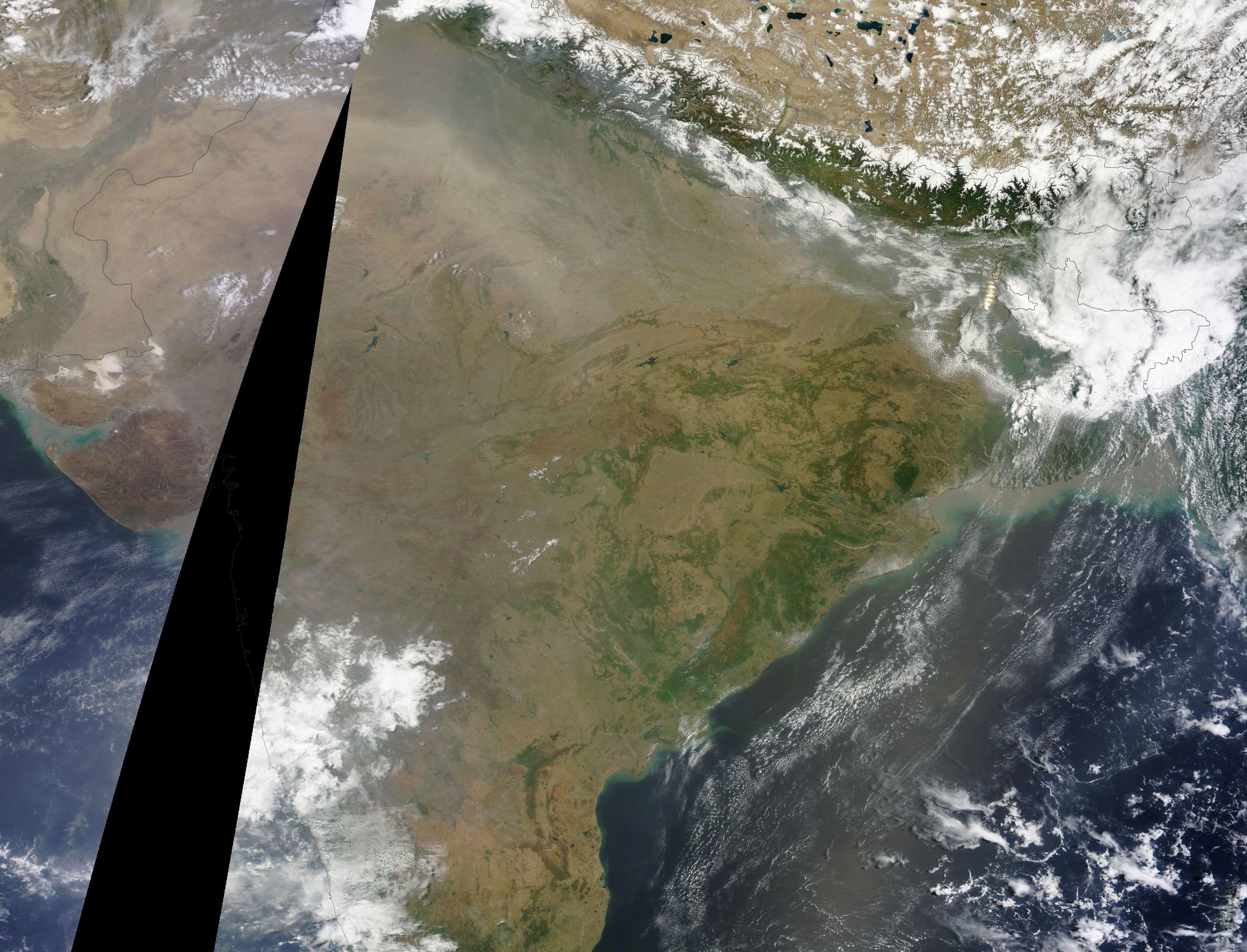
On May 25-27, an outburst of moisture from this stalled monsoonal flow splashed over the coasts of India. But by the 29th and 30th, these coastal storms and even the ones gathering over the Bengali waters had all been snuffed out. The most prominent feature in the MODIS shot of India today isn’t the rainfall that should be now arriving along the southeast coast, but the thick and steely-gray pallor of coal-ash smog trapped under a persistent and oppressive dome of intense heat.

(MODIS shot of India on May 30th. See the open stretch of blue water in the lower right frame? That’s the Bay of Bengal which borders coastal India. During a normal year at this time, that entire ocean zone should be filled with the storm clouds of a building monsoon that is already encroaching on coastal India. Today, there is nothing but a smattering of small and dispersed cloud through a mostly clear sky. Image source: LANCE-MODIS.)

Monsoon Described as Feeble

Official forecasts had already announced as of May 27th that the annual monsoon was likely to be delayed by at least a week for southeast regions of India. Meanwhile, expected monsoonal rainfall for western and northern sections of India for 2014 fell increasingly into doubt.

From The Times of India:

The monsoon is likely to be delayed by 10 days, according to scientists at the Indian Institute of Tropical Meteorology (IITM) here. The IITM’s third experimental real-time forecast says that a feeble monsoon will reach central India after June 20 as against the usual June 15. Last year, the monsoon had covered the entire country by June 15.

The annual monsoon is key to India’s agriculture. The substantial rains nurture crops even as they tamp down a powerful heating that typically builds throughout the sub-continent into early summer. Without these rains, both heat and drought tend to run rampant, bringing down crop yields and resulting in severe human losses due to excessive heat.

But, this year, heat and drought are already at extreme levels.

Major Heatwave Already Results in Loss of Life for 2014

As early as late March, the heatwave began to build over the Indian subcontinent. The heat surged throughout the state, setting off fires, resulting in a growing list of heat casualties, shutting down the power grid and spurring unrest. Meanwhile, impacts to India’s agriculture were already growing as the Lychee fruit crop was reported to have suffered a 40% loss.

By late May, temperatures across a broad region had surged above 105 degrees shattering records as the oppressive and deadly heat continued to tighten its grip.

In a country surrounded on three sides by oceans, it is a combination of heat, humidity and persistently high night-time temperatures that can be a killer. Wet bulb temperatures surge into a high-risk range for human mortality during the day even as night-time provides little respite for already stressed human bodies. Such extreme and long-duration heat doesn’t come without a sad toll. As of today, early reports indicated a loss of more than 56 lives due to heat stroke (In 2012 and 2013, total Indian heat deaths were near 1,000 each year). That said, final figures on heat losses are still pending awaiting complete reports from all of India’s provinces.

"Climatologically, we know that heatwaves are increasing in frequency and the number of days exceeding 45ºC temperatures is increasing. The frequency will increase further with global warming, hence this is a good example of a situation where science and disaster management can come together and avert damage," a spokesman for India’s National Disaster Management Authority noted on Friday.

(Hot Dust. A dust storm rolls through New Delhi on Friday amidst furnace-like 113 degree heat snarling traffic and resulting in the tragic loss of 9 more lives. Image source: Gaurav Karoliwal/YouTube Screenshot.)

Today the heatwave continued to gain ground, with Kota and Rajasthan reaching an all-time record of 116 degree F (46.5 C) as New Delhi’s mercury hit 113 degrees F in the midst of a drought-induced dust storm. Dust shrouding the city spurred traffic chaos and in the heat, darkness, and confusion nine more souls were lost.

After two months of growing disruption due to heat and drought, the lands and peoples of India cry out for a Monsoon that is running later and later with each new weather report.

Climate Change + El Nino: Adding Heat and Beating Back the Monsoon

As systems approach tipping points, they are more likely to tilt toward the extremes.

For India this year, its seasonally warmest period from April to May found severe heat amplification from a number of global factors. First, climate change seeded the ground for the current Indian heatwave by adding general heat and evaporation to already hot conditions. With global average heating of +0.8 C above 1880s levels amplifying in the hot zones, early moisture loss due to higher-than-normal temperatures produces a kind of snowball effect for still more warming. Essentially, the cooling effect of water evaporation is baked out early allowing for heat to hit harder just as typical seasonal maximums are reached. More

Originally published by robertscribbler.wordpress.com/


Sunday, May 25, 2014

Nepal Glaciers Shrink By Quarter In 30 Years

Climate crisis has caused Nepal 's Himalayan glaciers to shrink by nearly a quarter in just over 30 years, said a scientist.

The glacier loss raises the risk of natural disasters in the ecologically fragile region.

A new study by the Kathmandu-based International Centre for Integrated Mountain Development (ICIMOD) shows that the area covered by glaciers has decreased by 24 per cent between 1977 and 2010.

Samjwal Ratna Bajracharya, lead author of the report, said “the shrinking of glaciers in Nepal is definitely connected to climate change; glacial melt is a huge indicator of rising temperatures.”

Under the three-year study led by ICIMOD scientists mapped satellite imagery from several decades to find the extent of ice loss in the region.

The fastest decline occurred between 1980 and 1990, said Bajracharya. Prior to the late 1970s, satellite imagery reflected little change in Nepal 's glacial area.

He said the glacial melting is creating huge, expanding lakes that threaten to burst and devastate mountain communities living downstream.

The accelerated glacial loss raises concerns over future access to water resources, particularly in regions where groundwater is limited and monsoon rains are erratic.

“If the trend continues, the immediate impact will be felt by those living in high-altitude regions, which are dependent on freshwater reserves from glaciers,” said Bajracharya.

The findings also sound alarm bells for Nepal 's push to develop hydropower projects.

“ Nepal cannot use its water resources to develop the country without assessing the state of our glaciers and river basins,” he said.

A government report in India recently blamed hydropower projects for devastating floods last year that killed thousands in India and Nepal .

The government panel said the build up of sediment in rivers, due to the dumping of soil that was dug up during construction of hydropower projects, exacerbated flooding when record-high rainfall hit the region last June.

It should be mentioned that the Himalayan region abounds in glaciers. Most of the big glaciers lie in the eastern Himalayas .

As the western Himalayas receive only a small amount of rainfall, barring the formation of vast snowfields, the source of some of the big rivers of Nepal are in fact glaciers.

Nepal 's largest glacier lies in the Mahalangur and the Kumbhakarna ranges. Khumbu is the biggest glacier and Langtang the longest. Kanchenjunga , Yalung, Nupchu and Langtang are some other glaciers belonging to the eastern Himalayas . Tukche and Hidden valley glaciers belong to the central Himalayas but these are comparatively small.

The Khumbu glacier is situated between Mount Everest and the Lhotse-Nuptse Ridge. It is seen flowing down between the two mountains and swerving right through the Khumbu valley. The terrain is gray and rocky. More


Monday, April 28, 2014

India’s rain woes grow bigger, scientists worried

Forecasting the June-to-September rains, which account for three-quarters of India’s annual rainfall, is becoming tougher. Last year, six states had to declare droughts despite predictions of a normal monsoon.

Although India is scaling up its prediction techniques, including joint Indo-American forecasting under a bilateral agreement, too little is understood about how pollution and rising temperatures are impacting the monsoon. But new research shows that they are surely having an impact on the climate.

“Our studies show the Indian Ocean has significantly warmed in 50 years. By about 0.6 degrees. Monsoon has been declining in the Western Ghats, and interior areas, such as Jharkhand and Chhattisgarh, by about 6-7%,” R Krishnan, a climatologist at the Indian Institute of Tropical Meteorology, Pune, told HT.

Krishnan also said that a weakening monsoon circulation has quickened the “warming of the equatorial India Ocean” and this, in turn, has contributed to a “further weakening of the monsoon”.

The new findings portend problems India isn’t currently prepared to address. Two-thirds of Indians rely on rain-fed farm income. The monsoon also replenishes 81 nationally monitored water reservoirs critical for drinking, power and irrigation. A changing monsoon could hurt millions of farmers.

Yet another published study, by Dr Veerabhadran Ramanathan of the University of California, San Diego, notes that climate change has “evidently already negatively affected India’s hundreds of millions of rice producers and consumers. More


Wednesday, April 16, 2014

The Future Is Evaporating: Climate Change Could Dry Out 30 Percent of the Earth

Scientists expect the changing climate to bring on more drought; there's going to be less rainfall in the already arid regions.

That alone would be bad news for denizens of the planet's dry zones—in some places in North Africa, the American Southwest, India, and the Middle East, water shortages could well become an existential threat to societies built there. But new research shows that in addition to less rain, the rate of evaporation is likely to rise, too. Combined, the two forces could dry out up to a third of the planet.

The study, published in the journal Climate Dynamics last month, estimates that climate change will cause reduced rainfall alone to dry out 12 percent of the Earth's land by 2100. But if evaporation is factored in, the study's authors say that it will "increase the percentage of global land area projected to experience at least moderate drying by the end of the 21st century from 12 to 30 percent."

“We know from basic physics that warmer temperatures will help to dry things out,” the study’s lead author, Benjamin Cook, a climate scientist with Columbia University and NASA's Goddard Institute for Space Studies, said in a statement. “Even if precipitation changes in the future are uncertain, there are good reasons to be concerned about water resources.”

Writing in a 2011 literature review in the science journal Nature, the physicist Joe Romm elaborates on how increased heat and evaporation can lead to a vicious cycle: "Precipitation patterns are expected to shift, expanding the dry subtropics. What precipitation there is will probably come in extreme deluges, resulting in runoff rather than drought alleviation. Warming causes greater evaporation and, once the ground is dry, the Sun’s energy goes into baking the soil, leading to a further increase in air temperature."

Disappearing soil moisture is likely to be a greater problem than previously thought, and the occasional downpour won't sate year-round crops. As Columbia University notes, "An increase in evaporative drying means that even regions expected to get more rain, including important wheat, corn, and rice belts in the western United States and southeastern China, will be at risk of drought."

If it becomes too dry to cultivate crops on one-third of the planet's surface, there's little doubt that crisis will follow. For millions of people who depend on food grown in vulnerable regions, the future is literally evaporating. More


Wednesday, April 9, 2014

Pakistan has only 30 days of water reserves - researchers

ISLAMABAD, Pakistan (Thomson Reuters Foundation) – Inadequate planning is exposing Pakistan to water-related threats from climate change and putting the country’s agriculture, industry and hydropower at risk, water experts say.

Speaking at a water summit in Pakistan recently, they said the country desperately needs more reservoirs to increase its water storage capacity, and they called for conservation awareness campaigns, the introduction of drought-tolerant crop varieties and more economical irrigation.

“The country is gravely vulnerable to water-related (effects) of the changing weather patterns,” said Pakistan’s minister for planning, development and reform, Ahsan Iqbal, in a keynote address at the summit in the nation’s capital.

In December, the World Resources Institute ranked Pakistan among the 36 most water-stressed countries in the world.

Iqbal said that Pakistan needs a minimum storage capacity of 40 percent of the around 115 million acre-feet of water available in the Indus river system throughout the year. But the country’s storage capacity is only 7 percent and is decreasing due to sediment build-up in reservoirs.

This gives Pakistan a stored water supply, adequate to meet its needs, of just 30 days. By contrast, “carryover capacity” in other countries ranges from 200 days in India to 1,000 days in Egypt, he said.

“In Pakistan, planners and policy makers across different sectors, including agriculture and industry, energy and health now have ... a daunting challenge before them of increasing the country’s water storage capacity,” Iqbal said.

The minister urged the finance ministry to explore funding avenues for new water storage projects to boost storage capacity. Many of these are hydroelectric dams, which would also produce power.

THREATS TO HYDROPOWER, AGRICULTURE

But Pakistan Water Partnership’s country director, Pervaiz Amir, warned that if climate change leads to lower water flows in the northwest of the country, it would cut the amount of hydroelectricity that can be produced.

More variable rainfall and glacier melt in the face of climate change also means that agriculture, which he said accounts for over 96 percent of the country’s water consumption, will be affected, Amir said.

Without more facilities to divert and store water, heavy rainfall and flooding in some parts of the country will continue to damage crops, increase soil erosion and delay planting and harvesting, he said.

Pakistan ranks ninth among countries most affected by floods, according to UN-Water’s World Water Development Report.

Arun Shrestha, a senior climate change specialist at the International Centre for Integrated Mountain Development (ICIMOD), said that many South Asian countries lack preparedness for water-related hazards, including flood, droughts and glacial lake outburst floods, and instead focus mainly on post-disaster relief.

What is “more appalling,” he said, is that climate change is dealt with as a separate problem rather than integrated into planning for water-related areas of the government and economy including agriculture, industry, health and energy.

Shrestha urged South Asian countries to include disasters attributable to climate change in their respective water-related planning and policies.

He called for them to analyse their vulnerabilities to increasingly frequent flooding, droughts and glacial lake outburst floods, and to share the findings with each other to develop a regional action plan for dealing with climate-related disasters.

Shrestha underlined the need for regional coordination between government agencies so that river basins can be managed more efficiently, for example by sharing data about river flows.

Stephen Davies, a senior research fellow at the International Food Policy Research Institute, said that water, food and energy are closely interconnected, yet energy models do not properly address water constraints in South Asia and other regions.

Industrial growth and accelerating urbanisation are creating greater demand for energy, he said, but efforts to expand hydropower generation are being hampered by the shrinking availability of water.

Limitations on water availability also are impacting food production to meet the country’s galloping population growth, he added.

Chief executive of LEAD Pakistan and climate policy expert Tauqeer Ali Sheikh urged policymakers to incorporate the interdependence of water, food and energy into their planning.

In South Asia, “energy planning is often made without taking into account possible changes in water availability due to climate change or other water competing uses,” he pointed out. More

Saleem Shaikh and Sughra Tunio are climate change and development reporters based in Islamabad, Pakistan.


Tuesday, September 24, 2013

Pakistan tackles water crisis with rainwater harvesting

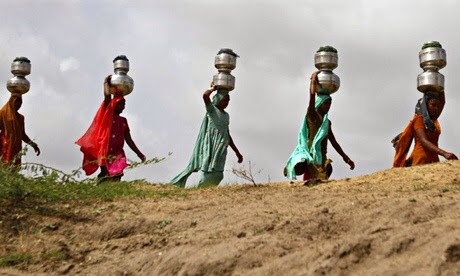
MORRY-JE-WANDH, Pakistan (AlertNet) – Wearing colourful traditional dresses with silver jewellery and bangles on their arms, the women of Tharparkar district look festive. But the empty earthen pots they carry tell a different story.

Women of Tharparkar district

“Walking for three miles and (hoisting) a ... bucket filled with water through a wooden pulley from a 130-feet-deep well twice a day is toilsome work,” says Marvi Bheel, who lives in isolated Morry-je-Wandh village in this arid district of Sindh province, some 450 km (280 miles) south-east of Karachi.

Increasing temperatures and lower rainfalls, believed to be associated with climate change, are creating intense water shortages in much of Pakistan, a situation which is likely to worsen if the country’s 170 million population doubles as projected in the next 25 years.

In response, non-governmental organizations are trying to improve water harvesting in rural areas. A pilot project in Morry-je-Wandh has seen the construction of a large covered pond with the capacity to supply the domestic and drinking water needs of 20 families (135 villagers) for more than eight months.

“The new rainwater harvesting facilities have transformed the lives of people, as we have now a safe source of clean water,” said Sobho Bheel, a farmer unrelated to Marvi Bheel.

The effects of having a good supply of drinking water at hand are far-reaching, he added: diseases have diminished, children can go to school and women have more time to spend on other economic activities.

IMPROVING LIFE FOR WOMEN

Women in Tharparker district, as in many places around the world, are charged with the task of gathering water. But as water becomes scarcer, travelling long distances to collect it can be arduous.

“Women fall unconscious on their way to these dug wells, while others develop pregnancy related complications due to being malnourished,” Marvi Bheel said. On summer days temperatures hover around 48 to 50 degrees Celsius (118 to 122 degrees Fahrenheit), and the falling water table means that water sometimes has to be hauled from a depth of 200 to 250 feet (62 to 77 metres).

Dug wells are the major source of water for over 90 percent of the approximately 1.4 million people living in Tharparkar, Pakistan’s largest arid district, which spreads over nearly 20,000 square kilometres (7,600 square miles) and comprises some 2,350 villages.

Water is taken from the wells for domestic, agriculture and livestock needs. But because of the inadequate number of wells in the district and demand for water exceeding supply, wells often produce too little water or dry up within several months of being recharged by rain.

Bharumal Armani of Chelhar village recalls that during August 2010, rains in the Thar Desert recharged parched shallow wells, raised the water table in deep wells and filled household cisterns.

But after four months, local people were without sufficient water even for drinking. Many villagers had to walk miles to fetch supplies, while herdsmen were forced to take their livestock to reservoirs to water them.

According to a study by the Pakistan Council for Research on Water Resources (PCRWR), a government body, the entire Thar Desert receives between 260 and 280 mm (1.0-1.1 inches) of rainfall annually. The scanty precipitation, however, could suffice to meet the domestic water needs of the locals and their livestock for three years, according to the PCRWR.

95 PERCENT OF RAINFALL LOST

But because of inadequate storage and rainwater harvesting facilities, more than 95 percent of the water is lost under sand dunes or evaporates in the summer heat.

“Hardly 0.06 percent of the total annual rainwater is harvested by the locals in their household cisterns or in other indigenous ways,” said A.D. Khan, director for groundwater management at the water council. Khan believes the water shortage problem can be addressed by scaling up rainwater harvesting to at least 0.25 percent of the annual rainfall.

In Morry-je-Wandh, a water storage pond with a cover to curb evaporation is part of that effort. The pond, constructed by the Sukkar Foundation, a non-governmental organisation, cost Rs. 125,000 (about $1,400) and relied on financial and technical support from WaterAid-UK’s Pakistan chapter.

“We lay a geo-membrane sheet under the floor of these (ponds) to check seepage, and cover them with roofs that help check evaporation of stored rainwater during the sizzling summer days,” said Abdul Hafeez, WaterAid’s national programme manager.

Using hand pumps connected to the storage ponds through pipes, women can fill their pitchers with water without any difficulty.

According to Qamar uz Zaman Chaudhry, Pakistan’s advisor on climate change affairs, the country is one of the world’s most arid. Most areas have little or no access to surface water. By international standards, Pakistan was already considered a water-scarce country in 1992 with an annual per capita availability of 1,700 cubic metres. This has now declined to fewer than 1,100 cubic metres, according to the government.

“The situation will grow tenser as rains are becoming more erratic and scarce due to climate change,” said Chaudhry, who is author of Pakistan’s national climate change policy.

Climate change and overuse of limited water is expected to create severe problems for the country in coming years, according to Simi Kamal, chairperson of the Hisar Foundation for Water, Food and Livelihood Security, promotes water conservation and management practices in Pakistan.

Annual per capita availability of water may fall to half its current level by 2020 if the depletion of water resources goes unchecked, she said. She believes much of the solution to growing water stress lies in planning and implementing workable rainwater harvesting programmes at medium and small levels.

Chaudhry agrees.

“More than adequate water can be made available for domestic, agriculture, industrial, livestock and other miscellaneous needs, provided that viable strategic plans are drawn up and implemented for rainwater harvesting at all levels,” he said. More

Saleem Shaikh and Sughra Tunio are development reporters based in Karachi, Pakistan.


Thursday, August 1, 2013

Northeast Pakistan hit by 'surprise' floods, as monsoon rains intensify

SIALKOT, Pakistan (Thomson Reuters Foundation) - “We kept quivering with fear the whole night and could not sleep even a wink,” recalled Salma Zehra, a mother of five teenage children. The family trembled to think that the roof of their mud house could cave in at any time, as the rain lashed down in a huge thunderstorm.

Mehtabpur, District Sialkot, Pakistan

By early morning on July 22, the house in Mehtabpur village in northeast Pakistan’s Sialkot district was waist-deep in water. The torrential downpour had left Zehra’s two buffaloes dead, the 45-year-old said in a shaky voice.

Another bout of heavy rain followed later that night. The Dek tributary of the Chenab River in Sialkot, 192 km (122 miles) from Islamabad, burst its banks, submerging more than 72 villages in the district.

Besides Sialkot, other districts in Punjab province have also suffered massive damage to crops across 1,000 hectares of land, as well as to properties. According to the district disaster management authorities of Sialkot, Gujranwala and Narowal, an estimated 400 villages have been flooded.

Officials have declined to give final figures for the losses, but say dozens have died and thousands of people remain stranded in the affected parts of the three districts. Some are starting to return home, but many houses have collapsed and must be rebuilt, they report.

Sialkot District Coordination Officer Iftikhar Ali Sahu told Thomson Reuters Foundation thousands of people had been trapped on the roofs of their houses during the worst of the flooding. “Mortality among cattle is high - the number of dead animals continued to rise as the floodwaters began to recede on July 26,” he added.

The situation in adjoining districts is just as bad. In Narowal alone, around 2,000 people were marooned on their rooftops in some seven villages a week ago.

Less than 30 percent of the floodwater has yet to recede, according to Mujahid Sherdil, director-general of the Punjab Provincial Disaster Management Authority.

Machines have been brought in to help drain water out of the flood-affected areas, and he hopes the task will be accomplished in the next two to three days, he told Thomson Reuters Foundation from Lahore.

Sherdil said the torrential rainfall had caused breaches of irrigation canals, streams and natural dams, and the floods had washed away crops, livestock, roads, bridges, buildings and even entire villages.

Farmers say surviving cattle in flood-hit areas are now at risk.

“Besides paddy, maize and vegetable crops, fodder fields are also underwater. This has created an acute shortage of fodder, and it is barely possible to save our cattle from the looming threat of hunger and disease,” said Zehra’s husband, Ghulam Abbas.

METEOROLOGISTS ‘STARTLED’

The above-normal monsoon rains in Punjab’s northeastern districts have taken weather experts by surprise.

“Last month, we predicted that this year monsoon rains across the country would remain normal with no possibility of flooding. But unexpected heavy rains in the northeastern districts are startling for us,” said Ghulam Rasul, a senior weather scientist at the Pakistan Meteorological Department (PMD) in Islamabad. “This shows how monsoon rains have become erratic and unpredictable in timing, volume and intensity.”

Sherdil, head of the Punjab disaster management agency, said the heavy rains and flooding had caught them unprepared.

“We were closely following the weekly and monthly forecasts of PMD that never predicted heavy rains of unprecedented significance for July in northeastern parts, which have been nearly 40 percent above normal for the month,” he said.

It has been difficult to get aid into the affected areas due to damaged and flooded roads and bridges, he said. “Nevertheless, we left no stone unturned to get the emergency relief items including food, medicines, to the flood victims on boats – although (they arrived) a bit late,” he added.

MONSOON SHIFTS

In June 2012, scientists argued in the Nature Climate Change journal that global warming would make understanding changes in the South Asian monsoon more difficult.

They said the impacts of short- and long-term monsoon shifts would affect the lives of over a billion people in the region, who rely on rainfall for agriculture, hydropower generation, economic growth and basic human needs.

Understanding how the South Asian monsoon will alter due to climate change is necessary to cope with the effects, reduce the risk of disasters and safeguard people’s livelihoods, they underlined.

“Addressing the uncertainties in projected changes of the monsoon variability in coming years will remain a daunting challenge for climate scientists,” said Arshad Abbasi, a water and energy expert at the Sustainable Development Policy Institute in Islamabad.

Arshad Khan, the executive director of the Global Change Impact Study Centre (GCISC), the research arm of Pakistan’s Federal Climate Change Division, said the country is in the grip of unpredictable weather patterns.

Intense monsoon rains will be a common phenomenon, particularly on the country’s southern plains which lack water reservoirs and are highly vulnerable to floods, he warned.

And a spurt in the speed of glacial melt, due to rising global temperatures and above-normal monsoon rains, is likely to cause rivers to overflow and burst their banks across the country, he added.

GOVERNMENT EFFORTS

Officials at the Climate Change Division, which operates under the oversight of the prime minister, said efforts are underway to tackle the vagaries of climate change across different sectors of the economy, particularly agriculture and water.

“Consultations are being made with national and provincial disaster management authorities, and officials of federal and provincial environment, agriculture, irrigation departments to implement national climate change policy to mitigate the impacts of changing weather patterns and erratic monsoon rains,” said a senior official, who coordinates policy at federal and provincial levels.

The Climate Change Division is developing climate adaptation plans for the agriculture, water and irrigation sectors, which will be implemented in Pakistan’s four provinces in collaboration with international NGOs and provincial government offices.

It is also working on programmes to ensure that climate change is considered in other sectors such as health and education, to make them more climate-resilient.

Abbasi of the Sustainable Development Policy Institute said the best ways to avert the growing threat of floods in Pakistan include efficient watershed management, reforestation in northern mountain areas and the revival of riverine forests.

Saleem Shaikh and Sughra Tunio are Islamabad-based journalists specialising in climate change and development issues. More

Tuesday, June 4, 2013

Rising energy prices will challenge western way of life – MoD report

A little-known Ministry of Defence (MoD) report published earlier this year warns that converging global trends will dramatically affect UK economic prosperity through to 2040.

The report says that depletion of cheap conventional "easy oil", along with shortages of food and water due to climate change and population growth, will sustain rocketing energy prices. Long-term price spikes are likely to lead to a long recession in Western economies, fuelling internal unrest and the rise of nationalist movements.

The report departs significantly from the conservative and relatively optimistic scenarios officially adopted by the British government, as exemplified in the coalition's new Energy Security Strategy published in November last year by the Department of Energy and Climate Change (Decc).

Peak "easy oil"

The report predicts that "the imminent passing of the point of peak 'easy oil' will mean that hydrocarbon-based energy prices will rise significantly out to 2040." Other factors affecting energy prices include "increasing demand for fossil fuels" due to South Asia's "industrial rise" and greater "volatility in supply" in the Middle East.

Contradicting the British government's official position on peak oil - which accepts the International Energy Agency's (IEA) latest estimate that oil prices will reach "$125/barrel in real terms (over $215/barrel in nominal terms)" - the MoD report projects an exponential escalation in prices, such that "the increasing price of oil... is likely to reach $500 a barrel by 2040" - almost double conventional projections.

This price rise will, however, "drive the development of alternative fuel sources" including tar sands, shale gas, coal, nuclear and renewables.

Rising demand for "resources and energy" from China and India will spur a "'scramble' for commodities and resources" as less developed countries' "resource requirements may go unfulfilled." There will also be a greater chance of clashes over access to "Middle East resources", the South China Sea and the Indian Ocean.

Climate crisis

Climates change will significantly compound these challenges, including a wide range of impacts such as "rising sea levels... increased incidents of seasonal floods, heat-waves, storms, and unpredictable farm yields."

If sea levels rise quicker than anticipated, "millions of people across South Asia (principally in Sri Lanka, Bangladesh and the Maldives) will be displaced, with no opportunity to return to their homes."

Irregularities in the pattern of monsoon rains are likely to undermine South Asia's "agricultural and domestic water needs", while higher temperatures will "increase the range of vector-borne diseases such as malaria", such that it becomes "prevalent all-year-round."

Water stress

Water may become a "destabilising factor", with water stress and scarcity affecting some "2.5 billion people", and acting as a limiter to economic growth in some South Asian economies, including China by 2030.

Water will be a "defence and security issue" through to 2040, and increasing water demand is also likely to "heighten tensions over shared resources such as the Brahma-Putra Himalayan region and the River Indus", between China, India, Pakistan and Bangladesh.

Food shortages

The sustainability of food production in such conditions "will also be a key issue for the region, with much of the population dependent on rice crops as a staple." The report warns that a "rapid loss of some arable land is likely to promote local, then national migration", which may contribute to unrest.

As agriculture is the single largest contributor to GDP and employment in the region, the report observes that the decline in agricultural output driven by higher temperatures, erratic weather, lower yields, soil erosion and increased pests and weeds, will primarily affect nearly all those who are "close to, or below, the poverty line."

Demographic time bomb?

Although China and India will incorporate "some measures of sustainable development", those measures will be limited by the fact that "economic growth will remain the imperative throughout the period."

Despite their confidence in being able to meet these emerging climate and energy challenges, the sheer scale of the latter - "especially with regard to food and water availability and the sensitivity of the monsoon cycle, may challenge such confidence."

Under present trends, South Asia will contain "nearly 40% of the world's population" within the next 30 years. China and India will therefore face "increasing demands" from their "burgeoning populations" requiring "strong levels of sustained economic growth over the period to maintain internal stability."

Inadequate "social and educational policies" and persistent "inequality and corruption" could turn this demographic dividend into "a 'demographic time bomb.'"

In fact, the report predicts that due to "rising inequality", ethnic tensions, strict controls on freedom of speech, and increased access to global communications, "China is likely to experience increased incidents internal of unrest."

End of growth due to resource price spikes?

But the West faces other parallel challenges:

"The growth of South Asian economies will impact on most western nations, where the way of life for the majority of the populaces may be challenged by rising energy and resource prices, coupled with a relative decline in the value of their national economies...

The economic and industrial rise of China and India will increase the cost and reduce the availability of UK energy supplies. As a resource-importing nation, and with relatively modest fossil fuel reserves, the UK will be affected by increased resource and commodity costs. The UK will increasingly need to compete with China and India in order to secure enduring access to energy."

Consequently, the report argues that the "western 'way of life'" - associated with "a wide variety of consumer choice and relatively cheap energy" - will be "increasingly challenged as lifestyles follow GDP levels and 'normalise' across the globe."

Within the US and UK, the bulk of the populations will be affected by:

"... rising energy and resource prices, and the declining availability of finance to sustain discretionary spending. In such a context, this could lead to periods of sustained recession in the West, causing increasingly protectionist policies to be adopted."

"Internal unrest"

This could occur even as growth continues in South Asia, with global GDP per capita overall levelling off to "equilibrate", culminating in "the stalling and subsequent decline of many western economies." This will result in:

"long periods of recession and rising disaffection within the UK population... This could subsequently lead to increased incidents of internal unrest, a rise of nationalistic groups and a demand for protectionist economic and defence policies."


Corporate stakeholders

This could occur even as growth continues in South Asia, with global GDP per capita overall levelling off to "equilibrate", culminating in "the stalling and subsequent decline of many western economies." This will result in:

"long periods of recession and rising disaffection within the UK population... This could subsequently lead to increased incidents of internal unrest, a rise of nationalistic groups and a demand for protectionist economic and defence policies."

The report, titled Regional Survey: South Asia out to 2040, was published by the MoD's Development, Concepts and Doctrine Centre (DCDC) as part of its Strategic Trends Programme in January. The DCDC is an MoD think tank within the Defence Academy site at Shrivenham.

The report utilised the input of a range of government agencies and departments, including the MoD's Strategy Unit, the Defence Science and Technology Laboratory, the Cabinet Office, and the Foreign Office - as well as two private institutions, Standard Chartered Bank and Now & Next. Decc is notably missing from the list of contributors.

Standard Chartered has a chequered history replete with scandals and "ethical lapses". Two years ago, an Ecologist investigation alleged that a coal power plant project in India financed by Standard Chartered among others, had "displaced poor communities and will lead to the destruction of forests."

The project was slated to receive carbon credits under the UN's controversial Clean Development Mechanism. Standard Chartered is now heavily invested in South Asia.

Now and Next is the website of a future trend analysis publication, What's Next, which includes among its clients General Electric, KPMG, McDonalds, and Shell.

Privatisation of power

Although the document sets out reasons to believe the UK is well-positioned to "adapt" to these converging trends, and perhaps even benefit from them, the overall vision heralds the recognition that of a rapidly shifting global landscape.

The report concedes that the "'relative' decline of the West is likely to lead to a new power framework where alliances are constantly reassessed and negotiated." This will also see "the declining influence of existing international institutions such as NATO and the UN Security Council."

In this context, the report predicts an accelerating coalescence between nation states and global capital, noting that:

"The line between government, and private industry protection of intellectual property of key technologies for security and wealth creation, may become increasingly blurred... [as] blueprints, patents and formulas will be increasingly seen as the foundations of wealth generation." More


MOD Report
 

Sunday, March 3, 2013

Atmospheric Warming Altering Ocean Salinity And The Water Cycle

A clear change in salinity has been detected in the world’s oceans, signaling shifts and acceleration in the global rainfall and evaporation cycle tied directly to climate change.

In a paper published … in the journal Science, Australian scientists from the Commonwealth Scientific and Industrial Research Organisation (CSIRO) and Lawrence Livermore National Laboratory reported changing patterns of salinity in the global ocean during the past 50 years, marking a clear symptom of climate change.

Lead author Paul Durack said that by looking at observed ocean salinity changes and the relationship between salinity, rainfall and evaporation in climate models, they determined the water cycle has become 4 percent stronger from 1950-2000. This is twice the response projected by current generation global climate models.

“These changes suggest that arid regions have become drier and high rainfall regions have become wetter in response to observed global warming,” said Durack, a post-doctoral fellow at Lawrence Livermore National Laboratory.

Scientists monitor salinity changes in the world’s oceans to determine where rainfall has increased or decreased. “It provides us with a gauge — a method of monitoring how large-scale patterns of rainfall and evaporation (the climate variables we care most about) are changing,” Durack said.

With a projected temperature rise of 3 degrees Celsius by the end of the century, the researchers estimate a 24 percent acceleration of the water cycle is possible.

[JR: Actually the projected warming by century's end is closer to 5°C -- see review of literature here -- which would yield a stunning 40% acceleration of the water cycle.]

Scientists have struggled to determine coherent estimates of water cycle changes from land-based data because surface observations of rainfall and evaporation are sparse. According to the team, global oceans provide a much clearer picture.

“The ocean matters to climate — it stores 97 percent of the world’s water; receives 80 percent of all surface rainfall, and it has absorbed 90 percent of the Earth’s energy increase associated with past atmospheric warming,” said co-author, Richard Matear of CSIRO’s Wealth from Oceans Flagship.

“Warming of the Earth’s surface and lower atmosphere is expected to strengthen the water cycle largely driven by the ability of warmer air to hold and redistribute more moisture.”

He said the intensification is an enhancement in the patterns of exchange between evaporation and rainfall, and with oceans accounting for 71 percent of the global surface area, the change is clearly represented in ocean surface salinity patterns.

In the study, the scientists combined 50-year observed global surface salinity changes with changes from global climate models and found “robust evidence of an intensified global water cycle at a rate of about 8 percent per degree of surface warming,” Durack said.

Durack said the patterns are not uniform, with regional variations agreeing with the ‘rich get richer’ mechanism, where wet regions get wetter and dry regions drier.

He said a change in freshwater availability in response to climate change poses a more significant risk to human societies and ecosystems than warming alone.

“Changes to the global water cycle and the corresponding redistribution of rainfall will affect food availability, stability, access and utilization,” Durack said.

Susan Wijffels, co-chair of the global Argo project and a co-author on the study, said maintenance of the present fleet of around 3,500 profilers is critical to observing continuing changes to salinity in the upper oceans. More

This piece of research was originally published at the Lawrence Livermore National Laboratory.