Showing posts with label extreme temperatures. Show all posts

Sunday, August 24, 2014

Karachi thirsts for a water supply

KARACHI: On the outskirts of the slums of Pakistan’s biggest city, protesters burning tires and throwing stones have what sounds like a simple demand: They want water at least once a week.

In Karachi people go days without getting water from city trucks, sometimes forcing them to use groundwater contaminated with salt. A recent drought has only made the problem worse. And as the city of roughly 18 million people rapidly grows, the water shortages are only expected to get worse.

“During the last three months they haven’t supplied a single drop of water in my neighbourhood,” protester Yasmeen Islam said. “It doesn’t make us happy to come on the roads to protest but we have no choice anymore.”

Karachi gets most of its water from the Indus River — about 550 million gallons per day — and another 100 million gallons from the Hub Dam that is supplied by water from neighbouring Balochistan province. But in recent years, drought has hurt the city’s supply.

Misbah Fareed, a senior official with the Karachi Water and Sewerage Board that runs the city’s water supplies, said that only meets about half the city’s needs — 1.2 billion gallons a day.

Karachi’s water distribution network has exacerbated the problem by forcing much of the city to get its water through tankers instead of directly from pipes. The Karachi Water and Sewerage Board operates 12 water hydrants around the city where tankers fill up and then distribute. Even people in the richest areas of the city get their water through tankers that come a few times a week to fill up underground cisterns.

But criminals have illegally tapped into the city’s water pipes and set up their own distribution points where they siphon off water and sell it.

“I personally know some people previously associated with drug mafias who now switched to the water tanker business,” Fareed said. “Just imagine how lucrative the business is.”

Other areas of Pakistan pump massive amounts of groundwater. But in the coastal city of Karachi, the underground water is too salty to drink. Many people have pumps but they use the water for things such as showering or washing clothes.

The water shortage is exacerbated by Karachi’s massive population. Pakistani military operations and American drone strikes in the northern tribal regions, as well as natural disasters such as flooding and earthquakes, have pushed people toward a city long seen as the economic heart of Pakistan.

The city is trying to increase the amount of water it gets from the Indus River by building another canal — dubbed the K4 project. But even if they were to get political approval from the capital to take more water from the river, it would take a minimum of four years to build.

But analysts say supply isn’t the only problem. Farhan Anwar, who runs an organisation called Sustainable Initiatives in Karachi, said the Karachi Water and Sewerage Board is horribly overstaffed and many of those are political appointees. The cost for water is also very low and the agency doesn’t collect all that it’s due, Anwar said. That’s made it difficult to upgrade the ageing pipes the system does have, meaning contamination and leakages are common.

Meanwhile, Karachi residents have to spend more money or walk further and further to get water. One elderly resident Aisha Saleem said in recent months even the little water they get from the water board is salty.

“Women and kids have to go miles by foot and carry drinking water every day,” she said More


Saturday, May 31, 2014

Monsoon Disrupted By El Nino + Climate Change as India Suffers Deaths, Crop Losses from Extreme Heat.

May is the month when the massive rainstorm that is the Asian Monsoon begins to gather and advance. This year, as in many other years, the monsoon gradually formed along the coast of Myanmar early in the month. It sprang forward with gusto reaching the Bay of Bengal by last week.

And there it has stalled ever since.

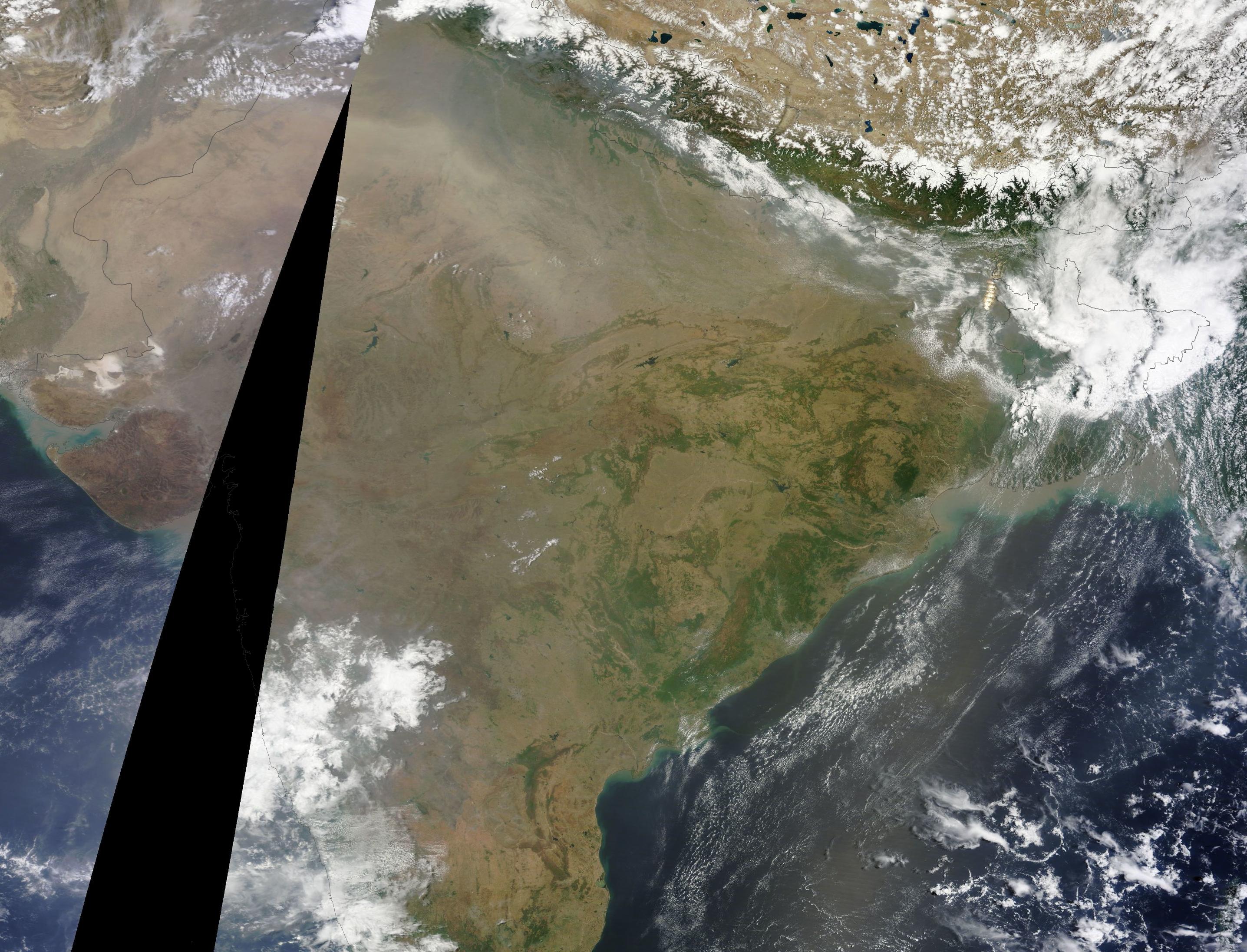
On May 25-27, an outburst of moisture from this stalled monsoonal flow splashed over the coasts of India. But by the 29th and 30th, these coastal storms and even the ones gathering over the Bengali waters had all been snuffed out. The most prominent feature in the MODIS shot of India today isn’t the rainfall that should be now arriving along the southeast coast, but the thick and steely-gray pallor of coal-ash smog trapped under a persistent and oppressive dome of intense heat.

(MODIS shot of India on May 30th. See the open stretch of blue water in the lower right frame? That’s the Bay of Bengal which borders coastal India. During a normal year at this time, that entire ocean zone should be filled with the storm clouds of a building monsoon that is already encroaching on coastal India. Today, there is nothing but a smattering of small and dispersed cloud through a mostly clear sky. Image source: LANCE-MODIS.)

Monsoon Described as Feeble

Official forecasts had already announced as of May 27th that the annual monsoon was likely to be delayed by at least a week for southeast regions of India. Meanwhile, expected monsoonal rainfall for western and northern sections of India for 2014 fell increasingly into doubt.

From The Times of India:

The monsoon is likely to be delayed by 10 days, according to scientists at the Indian Institute of Tropical Meteorology (IITM) here. The IITM’s third experimental real-time forecast says that a feeble monsoon will reach central India after June 20 as against the usual June 15. Last year, the monsoon had covered the entire country by June 15.

The annual monsoon is key to India’s agriculture. The substantial rains nurture crops even as they tamp down a powerful heating that typically builds throughout the sub-continent into early summer. Without these rains, both heat and drought tend to run rampant, bringing down crop yields and resulting in severe human losses due to excessive heat.

But, this year, heat and drought are already at extreme levels.

Major Heatwave Already Results in Loss of Life for 2014

As early as late March, the heatwave began to build over the Indian subcontinent. The heat surged throughout the state, setting off fires, resulting in a growing list of heat casualties, shutting down the power grid and spurring unrest. Meanwhile, impacts to India’s agriculture were already growing as the Lychee fruit crop was reported to have suffered a 40% loss.

By late May, temperatures across a broad region had surged above 105 degrees shattering records as the oppressive and deadly heat continued to tighten its grip.

In a country surrounded on three sides by oceans, it is a combination of heat, humidity and persistently high night-time temperatures that can be a killer. Wet bulb temperatures surge into a high-risk range for human mortality during the day even as night-time provides little respite for already stressed human bodies. Such extreme and long-duration heat doesn’t come without a sad toll. As of today, early reports indicated a loss of more than 56 lives due to heat stroke (In 2012 and 2013, total Indian heat deaths were near 1,000 each year). That said, final figures on heat losses are still pending awaiting complete reports from all of India’s provinces.

"Climatologically, we know that heatwaves are increasing in frequency and the number of days exceeding 45ºC temperatures is increasing. The frequency will increase further with global warming, hence this is a good example of a situation where science and disaster management can come together and avert damage," a spokesman for India’s National Disaster Management Authority noted on Friday.

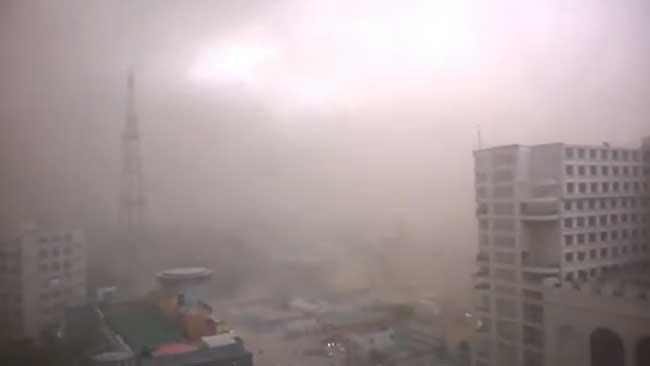
(Hot Dust. A dust storm rolls through New Delhi on Friday amidst furnace-like 113 degree heat snarling traffic and resulting in the tragic loss of 9 more lives. Image source: Gaurav Karoliwal/YouTube Screenshot.)

Today the heatwave continued to gain ground, with Kota and Rajasthan reaching an all-time record of 116 degree F (46.5 C) as New Delhi’s mercury hit 113 degrees F in the midst of a drought-induced dust storm. Dust shrouding the city spurred traffic chaos and in the heat, darkness, and confusion nine more souls were lost.

After two months of growing disruption due to heat and drought, the lands and peoples of India cry out for a Monsoon that is running later and later with each new weather report.

Climate Change + El Nino: Adding Heat and Beating Back the Monsoon

As systems approach tipping points, they are more likely to tilt toward the extremes.

For India this year, its seasonally warmest period from April to May found severe heat amplification from a number of global factors. First, climate change seeded the ground for the current Indian heatwave by adding general heat and evaporation to already hot conditions. With global average heating of +0.8 C above 1880s levels amplifying in the hot zones, early moisture loss due to higher-than-normal temperatures produces a kind of snowball effect for still more warming. Essentially, the cooling effect of water evaporation is baked out early allowing for heat to hit harder just as typical seasonal maximums are reached. More

Originally published by robertscribbler.wordpress.com/


Thursday, April 17, 2014

Food shortages could be most critical world issue by mid-century

The world is less than 40 years away from a food shortage that will have serious implications for people and governments, according to a top scientist at the U.S. Agency for International Development.

Dr. Fred Davies

"For the first time in , food production will be limited on a global scale by the availability of land, water and energy," said Dr. Fred Davies, senior science advisor for the agency's bureau of food security. "Food issues could become as politically destabilizing by 2050 as are today."

Davies, who also is a Texas A&M AgriLife Regents Professor of Horticultural Sciences, addressed the North American Agricultural Journalists meeting in Washington, D.C. on the "monumental challenge of feeding the world."

He said the world population will increase 30 percent to 9 billion people by mid-century. That would call for a 70 percent increase in food to meet demand.

"But resource limitations will constrain global food systems," Davies added. "The increases currently projected for crop production from biotechnology, genetics, agronomics and horticulture will not be sufficient to meet food demand." Davies said the ability to discover ways to keep pace with food demand have been curtailed by cutbacks in spending on research.

"The U.S. agricultural productivity has averaged less than 1.2 percent per year between 1990 and 2007," he said. "More efficient technologies and crops will need to be developed—and equally important, better ways for applying these technologies locally for farmers—to address this challenge." Davies said when new technologies are developed, they often do not reach the small-scale farmer worldwide.

"A greater emphasis is needed in high-value horticultural crops," he said. "Those create jobs and economic opportunities for rural communities and enable more profitable, intense farming." Horticultural crops, Davies noted, are 50 percent of the farm-gate value of all crops produced in the U.S.

He also made the connection between the consumption of fruits and vegetables and chronic disease prevention and pointed to research centers in the U.S. that are making links between farmers, biologists and chemists, grocers, health care practitioners and consumers. That connection, he suggested, also will be vital in the push to grow enough food to feed people in coming years.

"Agricultural productivity, , safety, the environment, health, nutrition and obesity—they are all interconnected," Davies said. One in eight people worldwide, he added, already suffers from chronic undernourishment, and 75 percent of the world's chronically poor are in the mid-income nations such as China, India, Brazil and the Philippines.

"The perfect storm for horticulture and agriculture is also an opportunity," Davies said. "Consumer trends such as views on quality, nutrition, production origin and safety impact what foods we consume. Also, urban agriculture favors horticulture." For example, he said, the fastest growing segment of new farmers in California, are female, non-Anglos who are "intensively growing horticultural crops on small acreages," he said. More


Wednesday, April 2, 2014

Geoff Lawton's Permaculture Design Course (Online)

For Those Who May Be Interested
If you are interested in growing your own food and if you have a farm this course is excellent.

Last year saw the launch Geoff Lawton's first online Permaculture Design Certificate (PDC) course, with the hope of exponentially increasing our educational reach. It was a 'scary' undertaking, in that, being the first course, we were not sure what to expect.


But we are proud to share that the course brought an overwhelmingly positive response. I've been looking around the inner 'halls' of the course system and reading comment after positive comment, and I've seen many of the amazing designs the students submitted at the end of their training. The best news is that this course is reaching people who would otherwise never get to take a PDC course, due to remote locations, family and work commitments, health constraints, cost, etc. Doctors, lawyers, housewives, politicians, activists, nurses, rural farmers, urbanites, pilots, industrialists, even experienced Permaculture teachers - the list goes on - all are coming together in the same system to learn, share, network and cause ripples of influence we may never be able to measure.


This last weekend Geoff's second online PDC was opened for registrations - for the new and even more expansive 2014 course (we keep adding material!). This course is run only once per year, and the door for registrations closes this Sunday, April 6th, 2014. If you want to get onto this course, or if you know someone who should, there's only three days left before the door shuts until next year, and the course begins. More


If you're unsure of the value of this life-altering course, please take a few minutes to scan the many comments below this post: http://permaculturenews.org/2013/10/28/geoff-lawtons-online-permaculture-design-course-worth/


Wednesday, March 19, 2014

Future heat waves pose threat to global food supply, study says

Heat waves could significantly reduce crop yields and threaten global food supply if climate change is not tackled and reversed.

This is according to a new study led by researchers at the University of East Anglia and published today, 20 March, in IOP Publishing's journal Environmental Research Letters, which has, for the first time, estimated the global effects of extreme temperatures and elevated levels of carbon dioxide (CO2) on the production of maize, wheat and soybean.

Earlier studies have found that climate change is projected to reduce globally by the end of the century under a "business as usual" scenario for future emissions of greenhouse gases; however, this new study shows that the inclusion of the effects of , which have not been accounted for in previous modelling calculations, could double the losses of the crop.

Lead author of the study Delphine Deryng, from the Tyndall Centre for Climate Change Research at the University of East Anglia, said: "Instances of extreme temperatures, brought about by a large increase in global mean temperature, can be detrimental to crops at any stage of their development, but in particular around anthesis—the flowering period of the plant.

"At this stage, extreme temperatures can lead to reduced pollen sterility and reduced seed set, greatly reducing the crop yield."

The impacts on wheat and soybean are likely to be less profound, primarily because of the fertilisation effects that elevated levels of CO2 can have on these crops.

In plants, CO2 is central to the process of photosynthesis—the mechanism by which they create food from sunlight, CO2 and water. When there is more CO2 in the atmosphere, the leaves of plants can capture more of it, resulting in an overall increase in the biomass of the plant.

In addition, plants are able to manage their water use much more efficiently in these conditions, resulting in better tolerance to drought episodes. However, it is not clear whether these CO2 fertilisation effects will actually occur in the field owing to interactions with other factors.

If the CO2 fertilisation effects do occur, the researchers found that the yields of wheat and soybean are expected to increase throughout the 21st century under a "business-as-usual" scenario; however, the increases are projected to be significantly offset by the effects of heat waves, as these plants are still vulnerable to the effects of .

The positive impacts on soybean yield will be offset by 25 per cent and the positive impacts on wheat will be offset by 52 per cent.

The researchers, from the Tyndall Centre for Climate Change Research (University of East Anglia, Norwich), Grantham Research Institute on Climate Change and the Environment (London School of Economics and Political Science, London), and Global Environmental and Climate Change Centre (McGill University, Montreal), arrived at their results using the global crop model PEGASUS to simulate crop yield responses to 72 spanning the 21st century.

The study also identified particular areas where heat waves are expected to have the largest negative effects on . Some of the largest affected areas are key for crop production, for example the North American corn belt for maize. When the CO2 fertilisation effects are not taken into account, the researchers found a net decrease in yields in all three crops, intensified by extreme , for the top-five producing countries of each crop.

"Our results show that maize yields are expected to be negatively affected by , while the impacts on wheat and soybean are generally positive, unless CO2 fertilisation effects have been overestimated," continued Deryng.

"However, stress reinforced by 'business-as-usual' reduces the beneficial effects considerably in these two crops. Climate mitigation policy would help reduce risks of serious negative impacts on maize worldwide and reduce risks of extreme heat stress that threaten global crop production."

Explore further: Climate change will reduce crop yields sooner than we thought

More information: 'Global crop yield response to extreme heat stress under multiple climate change futures' Delphine Deryng, Declan Conway, Navin Ramankutty, Jeff Price and Rachel Warren 2014 Environ. Res. Lett. 9 034011. iopscience.iop.org/1748-9326/9/3/034011/article