Showing posts with label temperature. Show all posts

Sunday, March 1, 2015

The Guardian view on food security: if the dreamers lose, we face a nightmare

By the time nations once again get round a table in Paris in December to discuss climate change, hunger should be on the menu. Researchers have just warned that a new and aggressive strain of yellow rust fungus is now a threat to Britain’s wheat harvest.

Another team has calculated that average yields of wheat per field, which only two decades ago were rising rapidly, are now down 2.5%, and barley by 3.8%. In each case, the scientists identify climate change as a contributing factor. Global warming has barely begun but climate scientists have been warning about the consequences for food security for 30 years.

The two latest bits of research into wheat yields are not isolated indicators of tomorrow’s troubles. The big heat has yet to arrive. It will be catastrophic. Another group has studied the consequences for harvests of extremes of heat and calculated that for each 1C notch in the thermometer, global wheat yields could fall by 6%. Some latitudes will benefit, but overall, world harvests could fall. This is very bad news: wheat is one of the world’s staples, and the world’s largest source of vegetable protein. There are other factors at play in the fields. Within a decade, 2.9 billion people in 48 nations will experience chronic water scarcity, another research team warns.

Agriculture consumes 70% of the world water supplies and action is needed “to pre-empt looming conflicts born of desperation”. Separately, US geologists have used historical analyses to work out what modern agriculture does to topsoil. When European settlers took the plough to the American heartlands, erosion accelerated one hundred-fold. At peak, an inch of soil was lost every 25 years. Before the Europeans, wind and water erosion took 2,500 years to remove the same thin layer. Because of erosion, overgrazing and drought, the planet’s farmland is being degraded at a catastrophic rate. An estimated 10m hectares are now abandoned each year; something the size of a family farm every minute. And as the food supply is threatened, demand will accelerate. There will be many more hungry people at the table.

In the last year, researchers re-examined UN population projections and decided that the global numbers may not peak at 9 billion. By 2100, the world could be home to 12 billion and still rising. By 2100, according to business-as-usual climate projections, temperatures will have risen by 4C and sea levels by a metre or so. So land that is ever less productive will be expected to deliver vastly more food at ever greater cost in fossil fuel energy to feed increasingly conflict-torn nation states.

Solutions exist but none are easy. All will require a generous adjustment between the haves and the have-nots and sustained global cooperation. That sounds like a dream, but the alternative is a nightmare. The enduring lesson of history is that drought and famine feed conflict, and conflict breeds more privation, and despair. Come December, each aspect of the climate challenge will have become more pressing, and more complex. Everything should be on the table in Paris except perhaps, symbolically, lunch. More


Saturday, May 31, 2014

Monsoon Disrupted By El Nino + Climate Change as India Suffers Deaths, Crop Losses from Extreme Heat.

May is the month when the massive rainstorm that is the Asian Monsoon begins to gather and advance. This year, as in many other years, the monsoon gradually formed along the coast of Myanmar early in the month. It sprang forward with gusto reaching the Bay of Bengal by last week.

And there it has stalled ever since.

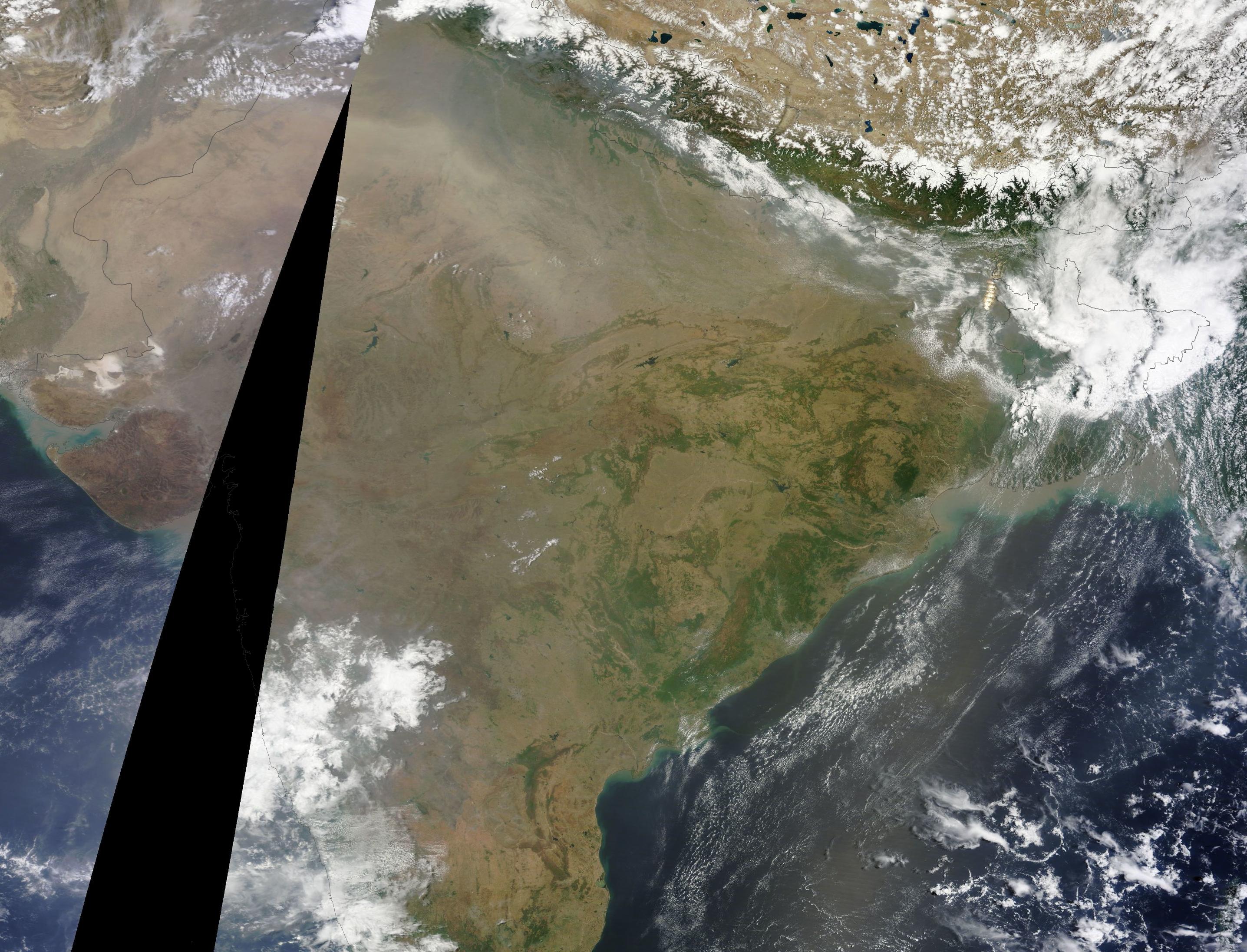
On May 25-27, an outburst of moisture from this stalled monsoonal flow splashed over the coasts of India. But by the 29th and 30th, these coastal storms and even the ones gathering over the Bengali waters had all been snuffed out. The most prominent feature in the MODIS shot of India today isn’t the rainfall that should be now arriving along the southeast coast, but the thick and steely-gray pallor of coal-ash smog trapped under a persistent and oppressive dome of intense heat.

(MODIS shot of India on May 30th. See the open stretch of blue water in the lower right frame? That’s the Bay of Bengal which borders coastal India. During a normal year at this time, that entire ocean zone should be filled with the storm clouds of a building monsoon that is already encroaching on coastal India. Today, there is nothing but a smattering of small and dispersed cloud through a mostly clear sky. Image source: LANCE-MODIS.)

Monsoon Described as Feeble

Official forecasts had already announced as of May 27th that the annual monsoon was likely to be delayed by at least a week for southeast regions of India. Meanwhile, expected monsoonal rainfall for western and northern sections of India for 2014 fell increasingly into doubt.

From The Times of India:

The monsoon is likely to be delayed by 10 days, according to scientists at the Indian Institute of Tropical Meteorology (IITM) here. The IITM’s third experimental real-time forecast says that a feeble monsoon will reach central India after June 20 as against the usual June 15. Last year, the monsoon had covered the entire country by June 15.

The annual monsoon is key to India’s agriculture. The substantial rains nurture crops even as they tamp down a powerful heating that typically builds throughout the sub-continent into early summer. Without these rains, both heat and drought tend to run rampant, bringing down crop yields and resulting in severe human losses due to excessive heat.

But, this year, heat and drought are already at extreme levels.

Major Heatwave Already Results in Loss of Life for 2014

As early as late March, the heatwave began to build over the Indian subcontinent. The heat surged throughout the state, setting off fires, resulting in a growing list of heat casualties, shutting down the power grid and spurring unrest. Meanwhile, impacts to India’s agriculture were already growing as the Lychee fruit crop was reported to have suffered a 40% loss.

By late May, temperatures across a broad region had surged above 105 degrees shattering records as the oppressive and deadly heat continued to tighten its grip.

In a country surrounded on three sides by oceans, it is a combination of heat, humidity and persistently high night-time temperatures that can be a killer. Wet bulb temperatures surge into a high-risk range for human mortality during the day even as night-time provides little respite for already stressed human bodies. Such extreme and long-duration heat doesn’t come without a sad toll. As of today, early reports indicated a loss of more than 56 lives due to heat stroke (In 2012 and 2013, total Indian heat deaths were near 1,000 each year). That said, final figures on heat losses are still pending awaiting complete reports from all of India’s provinces.

"Climatologically, we know that heatwaves are increasing in frequency and the number of days exceeding 45ºC temperatures is increasing. The frequency will increase further with global warming, hence this is a good example of a situation where science and disaster management can come together and avert damage," a spokesman for India’s National Disaster Management Authority noted on Friday.

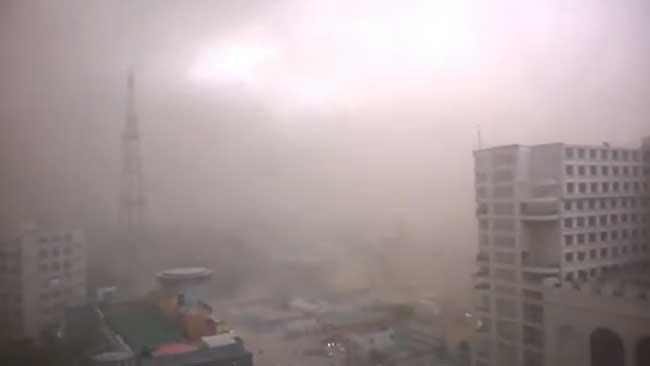
(Hot Dust. A dust storm rolls through New Delhi on Friday amidst furnace-like 113 degree heat snarling traffic and resulting in the tragic loss of 9 more lives. Image source: Gaurav Karoliwal/YouTube Screenshot.)

Today the heatwave continued to gain ground, with Kota and Rajasthan reaching an all-time record of 116 degree F (46.5 C) as New Delhi’s mercury hit 113 degrees F in the midst of a drought-induced dust storm. Dust shrouding the city spurred traffic chaos and in the heat, darkness, and confusion nine more souls were lost.

After two months of growing disruption due to heat and drought, the lands and peoples of India cry out for a Monsoon that is running later and later with each new weather report.

Climate Change + El Nino: Adding Heat and Beating Back the Monsoon

As systems approach tipping points, they are more likely to tilt toward the extremes.

For India this year, its seasonally warmest period from April to May found severe heat amplification from a number of global factors. First, climate change seeded the ground for the current Indian heatwave by adding general heat and evaporation to already hot conditions. With global average heating of +0.8 C above 1880s levels amplifying in the hot zones, early moisture loss due to higher-than-normal temperatures produces a kind of snowball effect for still more warming. Essentially, the cooling effect of water evaporation is baked out early allowing for heat to hit harder just as typical seasonal maximums are reached. More

Originally published by robertscribbler.wordpress.com/


Monday, May 5, 2014

Noam Chomsky: The Anthropocene Period and its Challenges


(2014) "Noam Chomsky": The Anthropocene Period and its Challenges

Uploaded on 29 Apr 2014©2014 Leigha Cohen Video Production http://www.leighacohenvideo.com/

For Noam Chomsky the edge is literal and deadly as he looks into the present and predicted future consequences of how humans in industrial society "Anthropocene Period" are impacting our environment and ecosystems which is increasingly having more extensive and rapid effects to our world. We as always have a choice, as a commons to let this continue or we can we can be the forces of change.

Noam Chomsky who was on of several speakers who spoke at the 10th. Annual Pen World of Voices Festival held April 28, 2014 http://worldvoices.pen.org/event/2014/03/11/opening-night-edge.
Filmed in The Great Hall, The Cooper Union 7 East 7th Street, New York, NY 10003 on April 28, 2014 at the 2014 PEN World Voices Festival. Some of the globe's most prominent thinkers each, in turn, brought their enthusiasm for societal improvement to the stage for a short oration http://worldvoices.pen.org/event/2014/03/11/opening-night-edge

Unless otherwise indicated, all materials on in this video are copyrighted to Leigha Cohen Video, All rights reserved. No part of this video may be used for any purpose other than educational use and any monetary gain from this video is prohibited without prior permission from me. Therefore, reproduction, modification, storage in a retrieval system is prohibited. Standard linking of this video is allowed and encouraged.


Monday, March 31, 2014

Planet at Risk

Human interference with the climate system is occurring, and climate change poses risks for human and natural systems . The assessment of impacts, adaptation, and vulnerability in the Working Group II contribution to the IPCC's Fifth Assessment Report (WGII AR5) evaluates how patterns of risks and potential benefits are shifting due to climate change. It considers how impacts and risks related to climate change can be reduced and managed through adaptation and mitigation. The report assesses needs, options, opportunities, constraints, resilience, limits, and other aspects associated with adaptation.

Climate change involves complex interactions and changing likelihoods of diverse impacts. A focus on risk, which is new in this report, supports decision-making in the context of climate change, and complements other elements of the report. People and societies may perceive or rank risks and potential benefits differently, given diverse values and goals.

Compared to past WGII reports, the WGII AR5 assesses a substantially larger knowledge base of relevant scientific, technical, and socioeconomic literature. Increased literature has facilitated comprehensive assessment across a broader set of topics and sectors, with expanded coverage of human systems, adaptation, and the ocean. More


IPCC AR5 Working Group II Video Overview

AR5 Working Group II


Published on Mar 30, 2014 • IPCC Fifth Assessment Report - Working Group II - Climate Change 2014: Impacts,

Adaptation, and Vulnerability

Sunday, March 16, 2014

A Fork in the Road by Dr. James Hansen

We stand at a fork in the road. Conventional oil and gas supplies are limited. We can move down the path of dirtier more carbon-intensive unconventional fossil-fuels, digging up the dirtiest tar sands and tar shales, hydrofracking for gas, continued mountain-top removal and mechanized destructive long-wall coal mining. Or we can choose the alternative path of clean energies and energy efficiency.

The climate science is crystal clear. We cannot go down the path of the dirty fuels without guaranteeing that the climate system passes tipping points, leaving our children and grandchildren a situation out of their control, a situation of our making. Unstable ice sheets will lead to continually rising seas and devastation of coastal cities worldwide. A large fraction of Earth's species will be driven to extinction by the combination of shifting climate zones and other stresses. Summer heat waves, scorching droughts, and intense wildfires will become more frequent and extreme. At other times and places, the warmer water bodies and increased evaporation will power stronger storms, heavier rains, greater floods.

The economics is crystal clear. We are all better off if fossil fuels are made to pay their honest costs to society. We must collect a gradually rising fee from fossil fuel companies at the source, the domestic mine or port of entry, distributing the funds to the public on a per capita basis. This approach will provide the business community and entrepreneurs the incentives to develop clean energy and energy-efficient products, and the public will have the resources to make changes.

This approach is transparent, built on conservative principles. Not one dime to the government.

The alternative is to slake fossil fuel addiction, forcing the public to continue to subsidize fossil fuels. And hammer the public with more pollution. The public must pay the medical costs for all pollution effects. The public will pay costs caused by climate change. Fossil fuel moguls get richer, we get poorer. Our children are screwed. Our well-oiled coal-fired government pretends to not understand.

Joe Nocera is polite, but he does not understand basic economics. If a rising price is placed on carbon, the tar sands will be left in the ground where they belong. And the remarkable life and landscape of the original North American people will be preserved.

Joe Nocera quoted a private comment from a note explaining that I could not promise I would be back in New York to meet him. But he did not mention the contents of the e-mail that I sent him with information about the subject we were to discuss. The entire e-mail is copied below.

Jim Hansen


_______

Joe,

Here are some relevant words from the draft of a paper that I am working on:

Transition to a post-fossil fuel world of clean energies will not occur as long as fossil fuels are the cheapest energy. Fossil fuels are cheap only because they are subsidized and do not pay their costs to society. Air and water pollution from fossil fuel extraction and use have high costs in human health, food production, and natural ecosystems, with costs borne by the public. Costs of climate change and ocean acidification also are borne by the public, especially young people and future generations.

Thus the essential underlying policy, albeit not sufficient, is for emissions of CO2 to come with a price that allows these costs to be internalized within the economics of energy use. Because so much energy is used through expensive capital stock, the price should rise in a predictable way to enable people and businesses to efficiently adjust lifestyles and investments to minimize costs.

An economic analysis indicates that a tax beginning at $15/tCO2 and rising $10/tCO2 each year would reduce emissions in the U.S. by 30% within 10 years. Such a reduction is more than 10 times as great as the carbon content of tar sands oil carried by the proposed Keystone XL pipeline (830,000 barrels/day). Reduced oil demand would be nearly six times the pipeline capacity, thus rendering it superfluous

A rising carbon price is the sine qua non for fossil fuel phase out, but it is not sufficient. Investment is needed in energy RD&D (research, development and demonstration) in new technologies such as low-loss smart electric grids, electrical vehicles interacting effectively with the power grid, and energy storage for intermittent renewable energy. Nuclear power has made major contributions to climate change mitigation and mortality prevention, and advanced nuclear reactor designs can address safety, nuclear waste, and weapons proliferation issues that have limited prior use of nuclear power, but governments need to provide a regulatory environment that supports timely construction of approved designs to limit costs. etc.

Jim Hansen


Wednesday, October 2, 2013

Monsoon to get longer in India [sub-continent]: IPCC

NEW DELHI: North India is likely to heat up more than the southern parts of the country while the entire Indian subcontinent may see longer rainy seasons in second half of the century, the UN's climate body has predicted in its latest comprehensive document on climate change.


The conclusion, showing variation in temperature and rainfall in South Asia, is part of the lengthy technical details of the United Nation's Intergovernmental Panel on Climate Change (IPCC) which made its comprehensive report — Climate Change 2013, The Physical Science Basis — public in Stockholm on Monday.

The findings of the report show that the northern part of the continent is likely to witness winter temperatures rise of up to 0.4 to 0.8 degree Celsius during 2016-35 as compared to the 1986-2005 average, 2 to 3 degree Celsius during 2046-65 and up to 3 to 5 degree Celsius by the end of the century (2081-2100), under different scenarios of action to limit greenhouse gas emissions.

Though the UN body's report on region-wise "impact, adaptation and vulnerability" will come out in March next year, the technical details comprising 14 chapters and Atlas of Global and Regional Climate Projections in its annexure carry indications of these changes in South Asia.

Krishna Kumar Kanikicharla, climate scientist at Pune's Indian Institute of Tropical Meteorology and one of the drafting authors of the IPCC report, told TOI there was "growing evidence" of the impact of the climate change on monsoons in South Asia and the tropical cyclone system in the Bay of Bengal.

Kanikicharla, responsible for drafting the chapter comprising details of monsoon systems, said: "There is strong hint that the duration of the rainy season would increase due to early onset of monsoon. The quantum of rainfall will also increase during the later part of this century."

He said though the Indian summer monsoon circulation will weaken, rainfall will increase due to higher atmospheric moisture resulting from a rise in temperatures.

In its projection for South Asia, the technical summary of the report clearly points at "enhanced summer monsoon precipitation and increased rainfall extremes of landfall cyclones on the coasts of the Bay of Bengal and Arabian Sea".

What is the confidence level of these predictions? Prashant Goswami, one of the lead authors of the IPCC report, admitted that these conclusions were based on climatic projections that were not as firm as those made at a global level.

"These uncertainties increase as you go to smaller scale (from global to regional or from regional to sub-regional levels). But one has to have an element of faith in these conclusions which are based on well defined scientific methodology," Goswami, chief scientist at Bangalore's CSIR Centre for Mathematical Modelling and Computer Simulation, told TOI.

The impact of temperature rise and rainfall variations on the region's agriculture that's highly dependent on monsoon, will be considered in the report on impact, adaptation and vulnerability, to be released next year as part of the IPCC's fifth assessment report (AR5). More


Thursday, August 22, 2013

Heat Wave In China

For the entire month of July and the first half of August, eastern China baked in a record-breaking heat wave. Nineteen provinces endured above-normal temperatures.

Shanghai broke its all-time record high three times in as many weeks. The current record—40.8 degrees Celsius (105.4°F)—was set on August 7, 2013. At least 40 people have died during the heat wave, including ten in Shanghai, according to the Xinhua news service.

During a heat wave, ground temperatures soar, particularly in urban areas where there are fewer plants to cool the ground with shade and evapotranspiration. Paved or metallic surfaces can become warm enough to cook food. These images show land surface temperatures as measured by two different satellites.

The image above shows temperature anomalies across China between August 5 and August 12, 2013, as observed by the Moderate Resolution Imaging Spectroradiometer (MODIS) on NASA’s Terra satellite. Red areas are warmer than the long-term average for the week, while cooler-than-average temperatures are blue. While much of China was warm during this period, the worst of the heat wave was concentrated near the coast and in Tibet. This weather pattern is tied to a subtropical high-pressure system parked over southern China, according to the China Meteorological Administration.

Though miserable everywhere, the heat wave was likely worst in China’s cities, where manmade surfaces absorb heat during the day and cool slowly at night. As a result, cities are warmer during the day and slower to cool at night, making an extended heat wave more uncomfortable, and more deadly, in a city. The image below shows this “urban heat island” effect in Shanghai.

The image was made with measurements taken on August 13, 2013 by the Thermal Infrared Sensor on the Landsat 8 satellite. The warmest surfaces are yellow, while cooler surfaces are pink. The image shows pockets of very warm areas, particularly downtown, surrounded by cooler suburban areas. The dark purple dots are cold clouds.

Chinese officials have declared a weather emergency, warning residents to limit time outdoors. It is the first time the country has issued a weather warning for heat. China’s National Meteorological Center expected the heat to break sometime after August 15.


Wednesday, March 27, 2013

HSBC: World is hurtling towards Peak Planet

Global investment bank HSBC says the world is hurtling towards a “Peak Planet” scenario where the global carbon budget from 2000 to 2050 is consumed well before 2030.

To address this, a peak in greenhouse emissions will need to be achieved as a matter or urgency, and by 2020 at the latest. “This is a tough task – but not impossible in our view,” it writes. “There is a growing recognition of the severity of the situation … and we believe that ambition is about to pick up again.”

In an analysis on climate change politics and the business case for action, HSBC economists say the focus is now on five key economies to break that nexus between economic growth and emissions – in fact to double the rate of decoupling.

This so-called Carbon 5 comprises China, Russia, India, the EU and the US, and HSBC says these countries need to cut the carbon emitted per unit of GDP by between 3 and 5 per cent per annum by 2020, beyond existing efforts.

It points to five reasons why this might be achievable, despite the apparent stalemate in international talks.

First, it notes that awareness of the severity of climate impacts is rising, and public opinion is shifting, particularly in the US. It says improving economic confidence and falling clean tech costs will assist the process, and it expects an increase in policy activism in the next three years after the recent plateau.

“Ultimately, climate change is like a chronic disease, where the problem accumulates over time. If we are to avoid unmanageable disruptions to the global economy, governments have agreed that we need to keep the rise in global temperatures below 2°C,” HSBC says.

“What they haven’t agreed, however, is the likelihood of hitting this target. This will be a core part of the negotiations that are now underway for an international climate agreement by the end of 2015.”

HSBC says there are different views of carbon budgets for the global economy, depending on differing views of risk, and where investors can generate returns.

The most commonly cited assessment is Malte Meinshausen’s 2009 evaluation that to have an 80 per cent chance staying below 2°C, the global carbon budget is around 886 gigatonnes of CO2 equivalent from 2000-2050. A riskier 50:50 scenario increases the budget substantially to 1440Gt (see chart above). But by the end of 2011, 420Gt had already been consumed.

HSBC says that with annual emissions from energy alone running at over 31Gt, the budget for the 80% scenario would de depleted by 2026, and by 2039 for the 50/50 chance.

This means that without large-scale deployment of carbon capture and storage, between two-thirds and four-fifths of current reserves cannot be commercialised in a 2°C world, and global emissions need to peak before 2020. The International Energy Agency, it notes, says global CO2 emissions from energy need to peak by 2017. “The contradiction between global carbon budgets and fossil fuel reserves is gaining increasing attention,” it says.

Is this target impossible? Nearly, but not quite, says HSBC. It says major European economies – France, Germany and the UK – peaked their emissions of greenhouse gases in the 1970s, and have each cut their emissions by more than 30 per cent as a result of oil price shocks and a structural shift away from coal for economic and environmental reasons. (see chart below) More


Friday, March 1, 2013

Killer Heat Waves and Floods Linked to Climate Change

UXBRIDGE, Canada, Feb 27 2013 (IPS) - Killer heat waves, floods and storms are increasingly caused by climate change, new research reveals.

Scientists in Germany say they have found how greenhouse gases from burning fossil fuels are helping to trap the jet stream, resulting in extraordinary weather such as the 2010 Pakistan flood and the 2011 heat wave in the United States.

Human-driven climate change repeatedly disturbs the flow of atmospheric waves around the globe’s Northern hemisphere, said lead author Vladimir Petoukhov of the Potsdam Institute for Climate Impact Research (PIK) in Germany.

Giant atmospheric waves called Rossby waves are meanders in the strong, high-altitude winds known as jet streams and have a major influence on weather. These wave movements are caused by the difference in temperatures between the cold air from the Arctic and hot air from the tropics.

When the waves shift north, they suck warm air from the tropics to Europe, Russia, or the U.S., and when they swing down, they do the same thing with cold air from the Arctic, said Petoukhov.

“During several recent extreme weather events, these planetary waves almost freeze in their tracks for weeks,” he said. “So instead of bringing in cool air after having brought warm air in before, the heat just stays.”

This unnatural pattern is due to human heating of the climate through emissions of greenhouse gases that result from burning fossil fuels, according to the study published this week in Proceedings of the National Academy of Sciences.

However, this heating of the atmosphere is wildly uneven. The Arctic is warming two to three times faster than the global temperature rise of 0.8C and that affects the Rossby waves and is slowing the jet stream.

“(Our research) complements previous research that already linked such phenomena to climate change,” said Hans Joachim Schellnhuber, a co-author of the study.

IPS previously reported research showing the dramatic loss of Arctic sea ice and rapid warming of the region was affecting weather patterns in the northern hemisphere.

The unprecedented expanse of ice-free Arctic Ocean has been absorbing the 24-hour sun over the short polar summer. The heat in the water must be released into the atmosphere if the ice is to re-form in the autumn.

“This is like a new energy source for the atmosphere,” Jennifer Francis, a researcher at Rutgers University, told the Guardian.

Major declines of Arctic summer sea ice as in 2011 and 2007 have been linked to colder winters in the UK and northern Europe, Francis said. The record ice loss in 2012 has been followed by a cold and stormy winter over much of Europe.

“The jet stream is clearly weaker,” said Francis. That means weather systems, be it rain or dry conditions, are slow to move on and last longer. Ultimately, this can result in “blocking” events, such as the conditions that produced the terrible heatwave in western Russia during the summer of 2010 and floods in Pakistan, she said.

Last summer, Greenland experienced a similar blocking anti-cyclone, resulting in a record surface melting of its ice sheet. “Blocks act like a traffic jam, slowing down weather patterns elsewhere,” Francis said.

Scientists are surprised by how extreme these changes have been with a relatively small amount of warming. That has prompted some to speak out politically to urge emission reductions. On Monday, a group of Canadian and U.S. scientists pleaded with the Canadian government to stop the expansion of the Alberta tar sands oil projects and take real steps to reduce carbon emissions. More


Wednesday, February 13, 2013

Global Temperature by Janet Larsen Earth Policy Institute

Warmest Decade on Record Brings Record Temperatures and Weather Extremes

In recent years weather events have whiplashed between the extremes of heat and cold, flooding and drought. Carbon dioxide and other greenhouse gases—largely from the burning of coal, oil, and natural gas—have loaded up in the atmosphere, heating the planet and pushing humanity onto a climatic seesaw of weather irregularities. High-temperature records in many places are already being broken with startling frequency, and hotter temperatures are in store. Without a dramatic reduction in fossil fuel use, we will veer even further away from the “normal” temperatures and weather patterns that civilization is adapted to.

The world has warmed by 1.4 degrees Fahrenheit (0.8 degrees Celsius) since the Industrial Revolution, with most of the rise in temperature coming since the 1970s. Such rapid warming is unprecedented over at least 20,000 years. The average global temperature in 2012 was 58.2 degrees Fahrenheit (14.56 degrees Celsius). This sets it among the 10 warmest years on record—all of which, according to NASA data dating back to 1880, have occurred in the last 14 years. (See data.)

The two headline-dominating weather events of 2012 both occurred in the United States: the intense summertime drought and heat that baked the country’s midsection and Superstorm Sandy, which clobbered the East Coast in late October. Overall, 2012 was the hottest year in U.S. history, topping the twentieth-century average by more than 3 degrees Fahrenheit.

After a winter that never seemed to take hold over much of the United States&‐with snow coverage across the lower 48 states the third lowest on record—summer-like weather arrived in March. Close to 15,000 new high-temperature records were set. Thus began the warmest spring in U.S. history, setting the stage for further high temperatures and an epic drought. July 2012 was the hottest month ever in the continental United States, according to the National Climatic Data Center. A third of the U.S. population witnessed summer temperatures of 100 degrees Fahrenheit or higher for 10 or more days. At its peak, drought covered nearly two thirds of the country. Power plants shut down because of the lack of cooling water. Low water levels disrupted Mississippi River barge traffic. Crops withered; corn yields in key producing areas were cut by a fifth or more. Purdue University economist Chris Hurt estimates the cost of the drought could exceed $75 billion. And with drought lingering into the new year, particularly in the Great Plains, the odds of a second year of harvest shortfalls are increasing.

The other most expensive weather event of 2012 was the opposite precipitation extreme: Superstorm Sandy. Sandy was number 18 of 19 named Atlantic storms in a season that began even before its official start, with two storms forming in May. After bringing heavy rain to the Caribbean and killing 72 people, Sandy merged with a winter storm, transforming into a meteorological chimera. Rather than travelling a more typical pathway out to sea, Sandy made an abrupt left-hand turn to make landfall on the U.S. East Coast. Fueled by high sea-surface temperatures and loaded with extra moisture due to warmer air temperatures, Sandy brought more than a foot of rainfall to parts of the mid-Atlantic region. Coasts from Maryland to Massachusetts were hit by a tremendous storm surge that in Lower Manhattan reached more than 9 feet above the normal high-tide level. In New York and New Jersey close to 100 people died, and more than a half-million homes were damaged or destroyed. Blizzards blanketed parts of Appalachia with the most snow ever recorded for a U.S. storm in October. Costs are still being tallied, but state governments report damages of $62 billion.

Some scientists propose that Sandy was pushed onto its unusual trajectory because of changes in atmospheric circulation caused by the loss of sea ice in the rapidly warming Arctic. As the Arctic’s reflective ice cover shrinks, more heat is absorbed, resulting in a smaller temperature differential between the North Pole and higher latitudes. This can cause the jet stream to slow down or become more wavy, stalling typical weather patterns and leading to prolonged extreme events. The regional warming is also accelerating ice melt on Greenland, which contains enough water to raise global sea level by 23 feet (7 meters). In late May 2012, southern Greenland reached a balmy 76.6 degrees Fahrenheit. In mid-July, 97 percent of its surface area showed signs of melting.

The year was exceptionally warm in Canada, where summer 2012 was the warmest on record. For Russia it was the second warmest, just behind summer 2010, when Moscow was smothered by heat and choked with smoke from rampant wildfires. In both years crops suffered, contributing to a jump in food prices. In France, an unusually late and sudden heat wave toward the end of August broke the high-temperature records set during the 2003 heat wave that killed nearly 15,000 people nationwide. More


Sunday, November 4, 2012

Recalibrating Food Production in the Developing World: Global Warming Will Change More Than Just the Climate

Recalibrating Food Production in the Developing World: Global Warming Will Change More Than Just the Climate - Author: Thornton, P

Abstract: An analysis of the effects of climate change on 22 critical agricultural commodities and three important natural resources in the developing world reveals a number of cross-cutting themes: The world’s agricultural systems face an uphill struggle in feeding a projected nine to ten billion people by 2050. Climate change introduces a significant hurdle in this struggle.

- Securing and maintaining necessary levels of calories, protein and nutrients for populations around the world will be an exceptional challenge.

- Recalibrating agriculture in the face of climate change is more than planting crops that can tolerate warmer weather. Some commodities, for example, can grow in warm weather but cannot resist the insects and diseases whose prevalence will increase. Others can tolerate

a lack of water but not the sporadic flooding that occurs with more common weather extremes.

- Even as global deforestation continues, trees continue to be valued as a provider of agricultural commodities like nuts and fruit; as a mitigating resource that removes carbon dioxide from the atmosphere; and also as a staple of adaptation—trees help stabilize soil erosion, better regulate water, as well as provide shade, firewood and fodder.

- Production of the most common commodity staples—wheat, maize and rice—will be challenged by new weather patterns. Adjustments in production, replacement with commodities that can tolerate the new conditions in different regions, and innovations in technology are key elements of adaptation.

- Raising livestock and catching fish and other aquatic products—two of the more common sources of protein—will also be challenged by a new climate. In some areas, different plants, breeds and species can provide substitutions, but in others, adaptation is critical.

- This recalibration of agriculture will eventually extend beyond what is grown and raised. The world’s many cultures must adapt to the changing dinner menu forced upon them due to climate change.

Download Report Here


Wednesday, August 8, 2012

The hunger wars in our future: Heat, drought, rising food costs, and global unrest

The mass unrest of the Arab Spring was triggered in part by rising food prices. In Algeria (above), the government slashed food prices in response to protests.

Photo by Magharebia
The Great Drought of 2012 has yet to come to an end, but we already know that its consequences will be severe. With more than one-half of America’s counties designated as drought disaster areas, the 2012 harvest of corn, soybeans, and other food staples is guaranteed to fall far short of predictions. This, in turn, will boost food prices domestically and abroad, causing increased misery for farmers and low-income Americans and far greater hardship for poor people in countries that rely on imported U.S. grains.

This, however, is just the beginning of the likely consequences: If history is any guide, rising food prices of this sort will also lead to widespread social unrest and violent conflict.

Food — affordable food — is essential to human survival and well-being. Take that away, and people become anxious, desperate, and angry. In the United States, food represents only about 13 percent of the average household budget, a relatively small share, so a boost in food prices in 2013 will probably not prove overly taxing for most middle- and upper-income families. It could, however, produce considerable hardship for poor and unemployed Americans with limited resources. “You are talking about a real bite out of family budgets,” commented Ernie Gross, an agricultural economist at Omaha’s Creighton University. This could add to the discontent already evident in depressed and high-unemployment areas, perhaps prompting an intensified backlash against incumbent politicians and other forms of dissent and unrest.

It is in the international arena, however, that the Great Drought is likely to have its most devastating effects. Because so many nations depend on grain imports from the U.S. to supplement their own harvests, and because intense drought and floods are damaging crops elsewhere as well, food supplies are expected to shrink and prices to rise across the planet. “What happens to the U.S. supply has immense impact around the world,” says Robert Thompson, a food expert at the Chicago Council on Global Affairs. As the crops most affected by the drought, corn and soybeans, disappear from world markets, he noted, the price of all grains, including wheat, is likely to soar, causing immense hardship to those who already have trouble affording enough food to feed their families.

The Hunger Games, 2007-2011

What happens next is, of course, impossible to predict, but if the recent past is any guide, it could turn ugly. In 2007 to 2008, when rice, corn, and wheat experienced prices hikes of 100 percent or more, sharply higher prices — especially for bread — sparked “food riots” in more than two dozen countries, including Bangladesh, Cameroon, Egypt, Haiti, Indonesia, Senegal, and Yemen. In Haiti, the rioting became so violent and public confidence in the government’s ability to address the problem dropped so precipitously that the Haitian Senate voted to oust the country’s prime minister, Jacques-Édouard Alexis. In other countries, angry protestors clashed with army and police forces, leaving scores dead.

Those price increases of 2007 to 2008 were largely attributed to the soaring cost of oil, which made food production more expensive. (Oil’s use is widespread in farming operations, irrigation, food delivery, and pesticide manufacture.) At the same time, increasing amounts of cropland worldwide were being diverted from food crops to the cultivation of plants used in making biofuels.

The next price spike, in 2010 to 2011, was, however, closely associated with climate change. An intense drought gripped much of eastern Russia during the summer of 2010, reducing the wheat harvest in that breadbasket region by one-fifth and prompting Moscow to ban all wheat exports. Drought also hurt China’s grain harvest, while intense flooding destroyed much of Australia’s wheat crop. Together with other extreme-weather-related effects, these disasters sent wheat prices soaring by more than 50 percent and the price of most food staples by 32 percent. More

Given the devestating flooding that has affected Pakistan in the last two years, with the associated destruction of crops, how will rising prices and potential shortages affect the country? Editor.

The Economic Cost of Increased Temperatures: Warming Episodes Hurt Poor Countries and Limit Long-Term Growth

ScienceDaily (Aug. 7, 2012) — Even temporary rises in local temperatures significantly damage long-term economic growth in the world's developing nations, according to a new study co-authored by an MIT economist.

Looking at weather data over the last half-century, the study finds that every 1-degree-Celsius increase in a poor country, over the course of a given year, reduces its economic growth by about 1.3 percentage points. However, this only applies to the world's developing nations; wealthier countries do not appear to be affected by the variations in temperature.

"Higher temperatures lead to substantially lower economic growth in poor countries," says Ben Olken, a professor of economics at MIT, who helped conduct the research. And while it's relatively straightforward to see how droughts and hot weather might hurt agriculture, the study indicates that hot spells have much wider economic effects.

"What we're suggesting is that it's much broader than [agriculture]," Olken adds. "It affects investment, political stability and industrial output."

Varied effects on economies

The paper, "Temperature Shocks and Economic Growth: Evidence from the Last Half Century," was published this summer in the American Economic Journal: Macroeconomics. Along with Olken, the authors are Melissa Dell PhD '12, of Harvard University, who was a PhD candidate in MIT's Department of Economics when the paper was produced, and Ben Jones PhD '03, an economist at Northwestern University.

The study first gained public attention as a working paper in 2008. It collects temperature and economic-output data for each country in the world, in every year from 1950 through 2003, and analyzes the relationship between them. "We couldn't believe no one had done it before, but we weren't really sure we'd find anything at all," Olken says.

By looking at economic data by type of activity, not just aggregate output, the researchers concluded there are a variety of "channels" through which weather shocks hurt economic production -- by slowing down workers, commerce, and perhaps even capital investment.

"If you think about people working in factories on a 105-degree day with no air conditioning, you can see how it makes a difference," Olken says.

One consequence of this, borne out in the data, is that the higher temperatures in a given year affect not only a country's economic activity at the time, but its growth prospects far into the future; by the numbers, growth lagged following hot years. More


Tuesday, July 24, 2012

The world is closer to a food crisis than most people realise

Unless we move quickly to adopt new population, energy, and water policies, the goal of eradicating hunger will remain just that.

Food riots in Algeria in 2008. Photograph: Fayez Nureldine/AFP/Getty Images
In the early spring this year, US farmers were on their way to planting some 96m acres in corn, the most in 75 years. A warm early spring got the crop off to a great start. Analysts were predicting the largest corn harvest on record.

The United States is the leading producer and exporter of corn, the world's feedgrain. At home, corn accounts for four-fifths of the US grain harvest. Internationally, the US corn crop exceeds China's rice and wheat harvests combined. Among the big three grains – corn, wheat, and rice – corn is now the leader, with production well above that of wheat and nearly double that of rice.

The corn plant is as sensitive as it is productive. Thirsty and fast-growing, it is vulnerable to both extreme heat and drought. At elevated temperatures, the corn plant, which is normally so productive, goes into thermal shock.

Time is running out. The world may be much closer to an unmanageable food shortage – replete with soaring food prices, spreading food unrest, and ultimately political instability– than most people realise.

As spring turned into summer, the thermometer began to rise across the corn belt. In St Louis, Missouri, in the southern corn belt, the temperature in late June and early July climbed to 100F or higher 10 days in a row. For the past several weeks, the corn belt has been blanketed with dehydrating heat.

Weekly drought maps published by the University of Nebraska show the drought-stricken area spreading across more and more of the country until, by mid-July, it engulfed virtually the entire corn belt. Soil moisture readings in the corn belt are now among the lowest ever recorded.

While temperature, rainfall, and drought serve as indirect indicators of crop growing conditions, each week the US Department of Agriculture releases a report on the actual state of the corn crop. This year the early reports were promising. On 21 May, 77% of the US corn crop was rated as good to excellent. The following week the share of the crop in this category dropped to 72%. Over the next eight weeks, it dropped to 26%, one of the lowest ratings on record. The other 74% is rated very poor to fair. And the crop is still deteriorating.

Over a span of weeks, we have seen how the more extreme weather events that come with climate change can affect food security. Since the beginning of June, corn prices have increased by nearly one half, reaching an all-time high on 19 July. More