Showing posts with label climate. Show all posts

Sunday, September 16, 2018

For Whom the Climate Bell Tolls

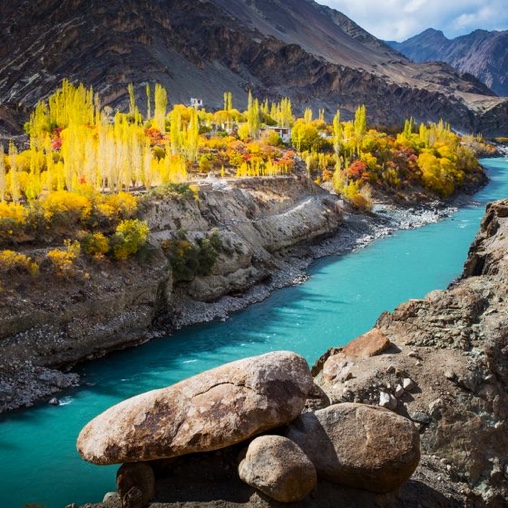
Indus River


...the problems associated with climate change will be neither mere inconveniences, nor as far off as we would like to think. There are currently two billion near-subsistence farmers living in the six great river valleys of Asia, from the Yellow all the way around to the Indus. These farmers have limited means and few non-agricultural skills. It would not be easy for them to pick up and relocate, let alone earn their livelihood doing something else.
Asia’s six great river valleys have supported most of human civilization for the past 5,000 years. During that time, the snow melt from the region’s high plateaus has always arrived at precisely the right moment, and in precisely the right volume, to support the crops upon which the region’s people rely. Read More

Sunday, August 23, 2015

Islamic Declaration Blasts Short-Sighted Capitalism, Demands Action on Climate

Just as scientists announced July was the hottest month in recorded history, and ahead of a major climate summit in Paris later this year, an international group of Islamic leaders on Tuesday released a public declaration calling on the religion's 1.6 billion followers to engage on the issue of global warming and take bold action to stem its worst impacts.

"What will future generations say of us, who leave them a degraded planet as our legacy? How will we face our Lord and Creator?" —Islamic Declaration on Global Climate Change

Released during an international symposium taking place in Istanbul, the Islamic Declaration on Global Climate Change is signed by 60 Muslim scholars and leaders of the faith who acknowledge that—despite the short-term economic benefits of oil, coal, and gas—humanity's use of fossil fuels is the main cause of global warming which increasingly threatens "a functioning climate, healthy air to breathe, regular seasons, and living oceans."

The declaration states there is deep irony that humanity's "unwise and short-sighted use of these resources is now resulting in the destruction of the very conditions that have made our life on earth possible."

"Our attitude to these gifts has been short-sighted, and we have abused them," it continues. "What will future generations say of us, who leave them a degraded planet as our legacy? How will we face our Lord and Creator?"

The declaration by the Muslim leaders follows the widely lauded encyclical released by Pope Francis, leader of the Roman Catholic Church, earlier this summer in which he called for a drastic transformation of the world's economies and energy systems in order to stave off the worst impacts of an increasingly hotter planet. Additionally, hundreds of Jewish Rabbis also released a Rabbinic Letter on the Climate Crisis and dozens of other denominations and churches have joined the global movement to divest their financial holdings from the fossil fuel industry.

Fazlun Khalid, founder of the Islamic Foundation for Ecology and Environmental Sciences and a signatory to the declaration, said the unified statement "is the work of world renowned Islamic environmentalists" and that its goal is to trigger richer dialogue and further action. Khalid said he would be happy if other people adopt or improve upon the ideas contained within the document.

"Civil society is delighted by this powerful Climate Declaration coming from the Islamic community as it challenges all world leaders, and especially oil producing nations, to phase out their carbon emissions and supports the just transition to 100% renewable energy as a necessity to tackle climate change, reduce poverty and deliver sustainable development around the world." —Wael Hmaidan, Climate Action Network

As with the papal encyclical, the Muslim scholars take special note of how global capitalism—namely the "relentless pursuit of economic growth and consumption"—has fostered an energy paradigm that now threatens the sustainability of living systems and human society.

With a focus on the upcoming Conference of Parties (COP21) talks in Paris, the declaration urges leaders to forge an "equitable and binding" agreement and called on all nations to:

  • Aim to phase out greenhouse gas emissions as soon as possible in order to stabilize greenhouse gas concentrations in the atmosphere;
  • Commit themselves to 100 % renewable energy and/or a zero emissions strategy as early as possible, to mitigate the environmental impact of their activities;
  • Invest in decentralized renewable energy, which is the best way to reduce poverty and achieve sustainable development;
  • Realize that to chase after unlimited economic growth in a planet that is finite and already overloaded is not viable. Growth must be pursued wisely and in moderation; placing a priority on increasing the resilience of all, and especially the most vulnerable, to the climate change impacts already underway and expected to continue for many years to come.
  • Set in motion a fresh model of wellbeing, based on an alternative to the current financial model which depletes resources, degrades the environment, and deepens inequality.
  • Prioritise adaptation efforts with appropriate support to the vulnerable countries with the least capacity to adapt. And to vulnerable groups, including indigenous peoples, women and children.

When it comes to wealthier nations and the oil-rich states of the world, the declaration called on them to specifically:

  • Lead the way in phasing out their greenhouse gas emissions as early as possible and no later than the middle of the century;
  • Provide generous financial and technical support to the less well-off to achieve a phase-out of greenhouse gases as early as possible;
  • Recognize the moral obligation to reduce consumption so that the poor may benefit from what is left of the earth’s non-renewable resources;
  • Stay within the ‘2 degree’ limit, or, preferably, within the ‘1.5 degree’ limit, bearing in mind that two-thirds of the earth’s proven fossil fuel reserves remain in the ground;
  • Re-focus their concerns from unethical profit from the environment, to that of preserving it and elevating the condition of the world’s poor.
  • Invest in the creation of a green economy.

Additionally, focusing on the corporate sector and business interests who profit most from exploitative activities and the current burning of fossil fuels, the declaration argues those institutions to:

  • Shoulder the consequences of their profit-making activities, and take a visibly more active role in reducing their carbon footprint and other forms of impact upon the natural environment;
  • In order to mitigate the environmental impact of their activities, commit themselves to 100 % renewable energy and/or a zero emissions strategy as early as possible and shift investments into renewable energy;
  • Change from the current business model which is based on an unsustainable escalating economy, and to adopt a circular economy that is wholly sustainable;
  • Pay more heed to social and ecological responsibilities, particularly to the extent that they extract and utilize scarce resources;
  • Assist in the divestment from the fossil fuel driven economy and the scaling up of renewable energy and other ecological alternatives.

Such a rounded and full-throated declaration was met with applause by climate campaigners, anti-poverty advocates, and social justice voices from around the world.

"Muslim leaders single out wealthy nations and oil producing states to lead on a fossil fuel phase out and provide support to those less well off to curb emissions and adapt to a changing climate. They also call on big business to stop their relentless pursuit of growth, change their extractive models and provide greater benefits for people and the climate."
—Lies Craeynest, Oxfam International

"Today’s declaration is an unprecedented call by Muslim leaders to end the destruction of Earth’s resources," stated Lies Craeynest, the food and climate justice director for Oxfam International. "Muslim leaders single out wealthy nations and oil producing states to lead on a fossil fuel phase out and provide support to those less well off to curb emissions and adapt to a changing climate. They also call on big business to stop their relentless pursuit of growth, change their extractive models and provide greater benefits for people and the climate."

Referring to Pope Francis' earlier declaration, Craeynest acknowledged the vital importance of religious leaders taking such bold and powerful stances. "As leaders of the two largest global faiths express grave concern about our fragile climate, there is no justifiable way political leaders can put the interests of the fossil fuel industry above of the needs of people, particularly the poorest, and of our planet."

Wael Hmaidan, international director of the Climate Action Network, called the declaration a potential game changer and said, "Civil society is delighted by this powerful Climate Declaration coming from the Islamic community as it challenges all world leaders, and especially oil producing nations, to phase out their carbon emissions and supports the just transition to 100% renewable energy as a necessity to tackle climate change, reduce poverty and deliver sustainable development around the world."

Celebrating the growing call among faith communities and religious scholars for bold climate action, Hoda Baraka, the global communications director for the climate action group 350.org, said the Islamic declaration reveals the important ways in which international consensus is solidifying across cultures. "With the end of the fossil fuel era approaching," declared Baraka, "we have a moral responsibility to expedite the transition to clean energy protecting those most impacted from the climate crisis. The declaration’s call for divestment reinforces the moral impetus behind the fast-growing movement to divest from fossil fuels and helps expand its reach in faith communities around the world."

Speaking for the UN climate body, UNFCCC Executive Secretary Christiana Figueres also welcomed the declaration.

"A clean energy, sustainable future for everyone ultimately rests on a fundamental shift in the understanding of how we value the environment and each other," Figueres said. "Islam’s teachings, which emphasize the duty of humans as stewards of the Earth and the teacher’s role as an appointed guide to correct behavior, provide guidance to take the right action on climate change." More


Thursday, August 20, 2015

Islamic Climate Change Declaration Calls for Zero Emissions Strategy


18 August 2015: Islamic leaders, during an International Islamic Climate Change Symposium, called on the world's 1.6 billion Muslims to take an active role in combating climate change and urged governments to agree to a new climate change agreement in Paris.


The Symposium convened to discuss proposed messages from the Islamic community and to mobilize stakeholders in advance of the Paris Climate Change Conference in December 2015. It also aimed to seek consensus on an ‘Islamic Declaration on Climate Change,' which was drafted and circulated for comments prior to the symposium.


Approximately 60 participants, including international development policymakers, faith group leaders, academics and other experts, attended the Symposium, which met from 17-18 August 2015, in Istanbul, Turkey. The event provided the opportunity for: networking with leaders from other faiths and secular organizations; promoting inter-faith and cross-movement cooperation around joint messages; focusing on the role and contribution of Muslims to the climate movement; and securing high-level representation from participating stakeholder groups. The Symposium reaffirmed that the Islamic faith community represents a significant section of the global population and, thus, can be influential in the climate change discourse.


The 'Islamic Declaration on Climate Change,' agreed to by participants, presents the moral case, based on Islamic teachings, for Muslims and people of all faiths to act on climate change. It was drafted by international Islamic scholars from around the world and is “in harmony” with the Papal Encyclical.


The Declaration urges: setting clear targets and monitoring systems; phasing out greenhouse gas emissions; committing to 100% renewable energy and/or a zero emissions strategy; and richer countries and oil-producing states to lead the way in phasing out their emissions by 2050. The Declaration also calls for, inter alia: the provision of financial and technical support to poorer countries to phase out greenhouse gases; limiting temperature rise to below 2°C, and preferably below 1.5°C; investing in a green economy; and prioritizing adaptation efforts with support to more vulnerable countries.


In addition, the Declaration urges corporations, finance and the business sector to, inter alia: reduce their carbon footprint; commit to 100% renewable energy and/or a zero emissions strategy; adopt a “circular economy that is wholly sustainable”; consider social and ecological responsibilities; and help in divesting from the fossil fuel driven economy.


Welcoming the Declaration, UNFCCC Executive Secretary Christiana Secretary Christiana Figueres said that Islam's teachings, which emphasize the “duty of humans as stewards of the Earth and the teacher's role as an appointed guide to correct behavior,” provides guidance to take action on climate change.


The Pew Research Center data estimates that 84% of the world's population is religiously affiliated, which points to the importance of support by faith groups for climate action. Many other faiths and denominations have also called for governments to act on climate change, including through the Papal Encyclical, a forthcoming Buddhist Declaration on climate change and a Rabbinic Letter on the Climate Crisis. [Symposium Website] [Islamic Declaration on Climate Change] [UNFCCC Press Release] [Climate Action Network Press Release] More


Wednesday, July 15, 2015

Pakistan, Bangladesh face ‘state failure’ as globe heats up

Study compiled by experts from US, UK, China and India underlines migration potential from warming world

India will face a huge influx of refugees from Afghanistan, Pakistan and Bangladesh should high degrees of climate change develop, according to one of the country’s senior military officials.

Drought and flooding linked to sea level rise would place the governments of those countries under "severe stress" and lead to large-scale migration, said Vice Admiral Pradeep Chauhan, head of the Indian Naval Academy.

"In India, this would combine with an internal population shift from rural to urban areas, further increasing demographic pressure in cities," he wrote in a climate risk study backed by the UK Foreign Office.

A significant influx of migrants could further destabilise what is known as India’s "Red Corridor", a belt of land running through east India where Marxist rebels are fighting the state.

"The temptation to solve this problem through military intervention could become overwhelming," he added.

Current greenhouse gas emissions will "likely as not" mean temperature increases of 4C above pre-industrial levels by 2150 said the study, with severe implications for human health and crop yields.

A N M Muniruzzaman, a retired Bangladeshi major general, said millions of people in his country could be displaced as a result of sea level rise.

"Flooding is projected to increase in many regions, but it could be a particular problem in South Asia due to the contribution of melting glaciers," he said.

Planning battle

Chauhan’s and Muniruzzaman’s comments were based on a war gaming exercise held in Delhi in March, hosted by the Council on Energy, Environment and Water.

Former military officials from India, China, the US, the UK, Bangladesh, Germany, the Netherlands, and Finland took part, along with scientists and diplomats.

"In the game, it was notable that increasing numbers of refugees contributed to several large countries becoming more isolationist in their foreign policies," says the study.

"Participants in our exercise considered it extremely likely that climate change would exacerbate humanitarian crises over the coming decades."

Long term water stress in South Asia could become so severe previous agreements over resource sharing between India, Pakistan, China and Bangladesh "could be broken", the study warns.

"At the high degrees of climate change possible in the long-term future, participants in our scenarios exercise considered that there could even be risks to the political integrity of states that are currently considered developed and stable."

Alex Randall from the UK-based Climate Change and Migration Coalition said the document presented a "one sided view of migration" seeing it only as a security threat.

"While there is growing evidence linking climate change to changing patterns of migration, there is little evidence suggesting that migrants and refugee present the kind of security threat suggested in the report," he said.

"There is also strong evidence indicating that migration could become a key way for some people to adapt to climate change." More


Monday, May 25, 2015

Deciphering clues to prehistoric climate changes locked in cave deposits

It turns out that the steady dripping of water deep underground can reveal a surprising amount of information about the constantly changing cycles of heat and cold, precipitation and drought in the turbulent atmosphere above. The analysis of a stalagmite from a cave in north east India can detect the link between El Nino conditions in the Pacific Ocean and the Indian monsoon, a new study has found.

When the conversation turns to the weather and the climate, most people’s thoughts naturally drift upward toward the clouds, but Jessica Oster’s sink down into the subterranean world of stalactites and stalagmites.

That is because the assistant professor of earth and environmental sciences at Vanderbilt University is a member of a small group of earth scientists who are pioneering in the use of mineral cave deposits, collectively known as speleothems, as proxies for the prehistoric climate.

It turns out that the steady dripping of water deep underground can reveal a surprising amount of information about the constantly changing cycles of heat and cold, precipitation and drought in the turbulent atmosphere above.

As water seeps down through the ground it picks up minerals, most commonly calcium carbonate. When this mineral-rich water drips into caves, it leaves mineral deposits behind that form layers which grow during wet periods and form dusty skins when the water dries up.

Today, scientists can date these layers with extreme precision based on the radioactive decay of uranium into its daughter product thorium. Variations in the thickness of the layers is determined by a combination of the amount of water seeping into the cave and the concentration of carbon dioxide in the cave’s atmosphere so, when conditions are right, they can provide a measure of how the amount of precipitation above the cave varies over time. By analyzing the ratios of heavy to light isotopes of oxygen present in the layers, the researchers can track changes in the temperature at which the water originally condensed into droplets in the atmosphere changes and whether the rainfall’s point of origin was local or if traveled a long way before falling to the ground.

The value of this information is illustrated by the results of a study published May 19 in the journal Geophysical Research Letters by Oster’s group, working with colleagues from the Berkeley Geochronology Center, the Smithsonian Institution National Museum of Natural History and the University of Cambridge titled “Northeast Indian stalagmite records Pacific decadal climate change: Implications for moisture transport and drought in India.”

In the study, Oster and her team made a detailed record of the last 50 years of growth of a stalagmite that formed in Mawmluh Cave in the East Khasi Hills district in the northeastern Indian state of Meghalaya, an area credited as the rainiest place on Earth.

Studies of historical records in India suggest that reduced monsoon rainfall in central India has occurred when the sea surface temperatures in specific regions of the Pacific Ocean were warmer than normal. These naturally recurring sea surface temperature “anomalies” are known as the El Niño Modoki, which occurs in the central Pacific, and the Pacific Decadal Oscillation, which takes place in the northern Pacific. (By contrast, the historical record indicates that the traditional El Niño, which occurs in the eastern Pacific, has little effect on rainfall levels in the subcontinent.)

When the researchers analyzed the Mawmluh stalagmite record, the results were consistent with the historical record. Specifically, they found that during El Niño Modoki events, when drought was occurring in central India, the mineral chemistry suggested more localized storm events occurred above the cave, while during the non-El Niño periods, the water that seeped into the cave had traveled much farther before it fell, which is the typical monsoon pattern.

“Now that we have shown that the Mawmluh cave record agrees with the instrumental record for the last 50 years, we hope to use it to investigate relationships between the Indian monsoon and El Niño during prehistoric times such as the Holocene,” said Oster.

The Holocene Climate Optimum was a period of global climate warming that occurred between six to nine thousand years ago. At that time, the global average temperatures were somewhere between four to six degrees Celsius higher than they are today. That is the range of warming that climatologists are predicting due to the build-up of greenhouse gases in the atmosphere from human activity. So information about the behavior of the monsoon during the Holocene could provide clues to how it is likely to behave in the future. This knowledge could be very important for the 600 million people living on the Indian subcontinent who rely on the monsoon, which provides the area with 75 percent of its annual rainfall.

“The study actually grew out of an accidental discovery,” said Oster. Vanderbilt graduate student Chris Myers visited the cave, which co-author Sebastian Breitenbach from Cambridge has been studying for several years, to see if it contained enough broken speleothems so they could use them to date major prehistoric earthquakes in the area.

Myers found a number of columns that appear to have broken off in the magnitude 8.6 earthquake that hit Assam, Tibet in 1950. But he also discovered a number of new stalagmites that had begun growing on the broken bases. When he examined these in detail he found that they had very thick layers and high concentrates of uranium, which made them perfect for analysis.

Because of the large amount of water running into the cave, the stalagmite they choose to analyze had grown about 2.5 centimeters in 50 years. (If that seems slow, compare it with growth rates of a few millimeters in a thousand years found in caves in arid regions like the Sierra Nevada.) As a result, the annual layers averaged about 0.4 millimeters thick — wide enough for the researchers to get seven to eight samples per layer, which is slightly better than one measurement every two months. The amount of information about the climate that scientists can extract from the stalagmites and stalactites in a cave is amazing. But the value of this approach increases substantially as the number of caves that can act as climate proxies increases.

It is not a simple task. Because each cave is unique, the scientists have to study it for several years before they understand it well enough to use it as a proxy. For example, they must establish how long it takes water to move from the surface down to the cave, a factor that can vary from days to months.

Efforts to use the mineral deposits in caves as climate proxies began in the 1990’s. Currently, there are only a few dozen scientists who are pursuing this line of research and they have analyzed the mineral deposits from 100 to 200 caves in this fashion.

Story Source:

The above story is based on materials provided by Vanderbilt University. The original article was written by David Salisbury. Note: Materials may be edited for content and length.

Journal Reference:

  1. Christopher G. Myers, Jessica L. Oster, Warren D. Sharp, Ralf Bennartz, Neil P. Kelley, Aaron K. Covey, Sebastian F.M. Breitenbach. Northeast Indian stalagmite records Pacific decadal climate change: Implications for moisture transport and drought in India. Geophysical Research Letters, 2015; DOI: 10.1002/2015GL063826


Sunday, May 3, 2015

Building Climate Resilience in Conflict-Affected States: A Neglected Agenda

Climate change adaptation and mitigation efforts face many obstacles in fragile and conflict-affected societies. Instead of writing off these situations, however, International Alert’s Janani Vivekananda, Janpeter Schilling, and Dan Smith suggest approaching aid and development differently to proactively build resilience and simultaneously advance climate, development, and peacebuilding goals.

The interlinked challenges of climate change, poverty, and conflict legacies are recognized by academic and practitioner communities. But too often the focus has been limited to unpacking causal connections between climate change and the outbreak of violent conflict. While this emphasis garners significant attention (and much academic infighting), it largely fails to engage on the practical questions of how to respond effectively to climate change and poverty in conflict-affected states.

The concept of resilience, Vivekananda et al. write, is critically important in this context, as it connects disparate government and development efforts in service of society as a whole. Understanding the “intermediate” factors that already make a society vulnerable to conflict – poor governance, geopolitics, poverty, inequality – is vital to creating positive development, adaptation, and peacebuilding policies.

Context Is Everything

Understanding the local variation of societies, the “contextual complexities,” should be the first step for any resilience-building operation, the authors write. Local and national-level dynamics need to be considered in tandem to understand how changes in one place might affect elsewhere.

Experience in Nepal provides useful lessons. Nepal is one of the most vulnerable states to climate change and environmental risks in the world. An International Alert case study explores how aid designed to combat food insecurity there ended up undermining adaptive capacity. Rice paddies were created in communities that previously relied on other forms of agriculture, consequently creating a dependency and expectation for more due to the positive social implications that come with having rice in the diet. The shift to rice farming also increased the demand for water.

The study highlights how this change combined with climate-induced changes to rainfall has resulted in water shortages. The reduction of a specific resource in a setting already undergoing environmental change affected community resilience in a negative way. Greater contextual awareness of the implications of such a fundamental change to agriculture might have enabled the government and local communities to avoid such a “backdraft” effect.

Cross-Discipline Analysis

Climate change brings with it a new degree of uncertainty and unpredictability. Informal or formal institutions that embrace the complexities and flux will help societies do the same.

To adjust, Vivekananda and colleagues suggest better collaboration to break down existing institutional barriers and stovepipes between institutions. Multidisciplinary and integrated development efforts increase the likelihood of coherent climate and conflict-sensitive approaches to development, peacebuilding, and humanitarian actions. In turn, collaborative efforts are more likely to build long-term resilience, as communities rarely face a single risk in isolation, as highlighted in the Nepal case.

Academic fields, they suggest, should work towards common risk analyses. This integration entails the identification of possible negative outcomes, such as conflict; the determination of origins of said negative outcomes, such as political instability or environmental change; and shared evaluation amongst disciplines about how to fix the problem.

Vivekananda et al. work through the negative cycle that can emerge when climate change leads to conflict. Existing fragility can increase vulnerability and human insecurity, potentially leading to conflict. Identifying what makes a society fragile in the first place will provide more transparency regarding what will improve resilience.

For example, they cite a report produced by the humanitarian NGO Mercy Corps on conflict and severe drought in Ethiopia. Southern Ethiopia is home to some of the most vulnerable people to climate change: pastoralists. The report found that access to resources was one of these groups’ fundamental challenges. “Improving social cohesion and local institutions for conflict mitigation enhances access to natural resources,” they wrote, and “pastoralist groups with greater access recover more quickly from drought.”

The importance of integrated responses was also highlighted in A New Climate for Peace, a new report produced on behalf of the G7 by adelphi, the European Union Institute for Security Studies, International Alert, and the Wilson Center. The report says that by integrating efforts to address climate change, the international community will be better equipped to mitigate its interconnected risks while realizing important co-benefits. Recommendations include making climate change a foreign policy priority for all G7 members and using their clout to create a global resilience agenda.

Redundancy and Lack of Action

The literature on climate change mitigation, adaptation, and resilience frequently places great importance on the need to bridge the gap between academic disciplines and research communities, but relatively little action has been taken. Vivekananda et al. suggest this shortcoming could be because of the heavy focus on quantitative literature in examining the implications of climate change for conflict. Calling for more collaboration and increased multidisciplinary research is easier than doing it in practice with sufficient funds and willing partners.

So how do we incentivize more cross-sectoral work? Finding answers should be a priority. As more at-risk countries consider resilience programs, the potential for negative unintended consequences increases. Ambiguity surrounding important factors such as incentives can discourage local communities and governments from even attempting multisectoral approaches.

Vivekananda et al. suggest that incentives could be derived from better resourcing, political support, and increased transparency and clarity around what the concept of resilience building actually means. The G7 report and 2014 5th Assessment of the Intergovernmental Panel on Climate Change largely agree. The IPCC’s Working Group II dedicates an entire section to “trade-offs, synergies, and integration” in its assessment. And the G7 report says integration may become more enticing as different parties realize the benefits that it can bring.

These discussions about climate change in fragile and conflict-affected areas are important resources for policymakers. Government, the academy, and non-government organizations should act in earnest on their main message: dissolve ambiguity around key concepts, integrate responses, and build up the capacity of fragile states to make simultaneous progress on climate change, development, and peacebuilding goals. More

Monday, March 23, 2015

Climate change blamed as erratic downpours hit Pakistan’s harvests

Late rains were unusually heavy this year, say local farmers, affecting winter crops of wheat, oilseed and potato.

Anxious farmers in Pakistan waited for weeks for the rains to arrive – but when the skies finally opened, the downpour was so intense it destroyed crops and put the harvest in jeopardy.

"We weather scientists are really in shock, and so are farmers, who have suffered economic losses due to crop damage," says Muzammil Hussain, a weather forecasting scientist at the Pakistan Meteorological Department (PMD).

"The wind from the southeast has carried moisture from the Arabian Sea. Normally, the northeast wind brings rain during winter, and the southeast wind brings monsoon rains in summer. But the pattern has changed this year because of what is believed to be global warming."

Farmers across much of Pakistan plant winter crops of wheat, oilseed and potato late in the year and wait for rains to water the land.

This year, the rains arrived more than three weeks late and were unusually heavy, accompanied by violent hailstorms. Along with the rains, temperatures also dropped.

Ibrahim Mughal, chairman of the Pakistan Agri Forum, says excessive moisture due to heavy bouts of late rain is likely to lead to outbreaks of fungus on crops, and production could be halved.

"If the rains come a month ahead of the harvesting time [April to mid-May], it is always disastrous," he says. "It can hit production for a crop such as wheat by between 20% and 30%, and if the rain is accompanied by hailstorms and winds then the losses can escalate to more than 50%."

Arif Mahmood, a former director general at PMD, says the onset of winter across much of Pakistan is being delayed by two to three days every year, and there is an urgent need for farmers to adapt to such changes.

"Over recent years, winter has been delayed by 25 to 30 days, and also the intensity of the cold has increased, which has affected almost every field of life − from agriculture to urban life."

This year has also been marked by abrupt changes in temperature. Ghulam Rasul, a senior scientist at PMD, says big swings in temperature are likely to add to the problems being faced by millions of farmers in Pakistan.

"The average temperature during the first two weeks [of March] was between 11 and 13 degrees Celsius, but now it’s on a continuous upward trend and has reached 26˚C over the space of two days," he reports.

"The winter rains in the north and central area of Pakistan, and the sudden rise and fall in temperature, are related to climate change."

Serious damage

Similar storms and late winter rains have also caused serious damage across large areas of northern India.

The states of Uttar Pradesh and Maharashtra – the two most populous states in the country – have been particularly badly hit.

In Maharashtra, snow and landslides have blocked roads and cut off towns and villages.

In Uttar Pradesh, there are fears that more than 50% of the wheat crop has been lost in the eastern part of the state. More

This article was produced by the Climate News Network

For the Pakistan Metorlogical Department to claim be shocked by this event says to me that they have obviously not been following the global climate change discussion. Farming methods and water control and harvesting will have to change to mitigate the changing climate. Permaculture farming methods would be a good place to start. See http://permaculturenews.org/about-permaculture-and-the-pri/ Editor


Tuesday, March 3, 2015

Climate change key in Syrian conflict – and it will trigger more war in future

Climate change was a key driver of the Syrian uprising, according to research which warns that global warming is likely to unleash more wars in the coming decades, with Eastern Mediterranean countries such as Jordan and Lebanon particularly at risk.

Experts have long predicted that climate change will be a major source of conflict as drought and rising temperatures hurt agriculture, putting a further strain on resources in already unstable regimes.

But the Syria conflict is the first war that scientists have explicitly linked to climate change. Researchers say that global warming intensified the region’s worst-ever drought, pushing the country into civil war by destroying agriculture and forcing an exodus to cities already straining from poverty, an influx of refugees from war-torn Iraq next door and poor government, the report finds.

“Added to all the other stressors, climate change helped kick things over the threshold into open conflict,” said report co-author Richard Seager, of Columbia University in New York.

“I think this is scary and it’s only just beginning. It’s going to continue through the current century as part of the general drying of the Eastern Mediterranean – I don’t see how things are going to survive there,” Professor Seager added.

Turkey, Lebananon, Israel, Jordan, Iraq and Afghanistan are among those most at risk from drought because of the intensity of the drying and the history of conflict in the region, he says. Israel is much better equipped to withstand climate change than its neighbours because it is wealthy, politically stable and imports much of its food. Drought-ravaged East African countries such as Somalia and Sudan are also vulnerable along with parts of Central America – especially Mexico, which is afflicted by crime, is politically unstable, short of water and reliant on agriculture, Prof Seager said.

The conflict in Syria began in spring 2011 and has evolved into a complex multinational war that has killed at least 200,000 people and displaced millions more, according to the Columbia study, which appears in the journal Proceedings of the National Academy of Sciences. It was preceded by a record drought that ravaged Syria between 2006 and 2010.The paper says the timing is unlikely to be a coincidence, citing a recent interview with a 38-year old farmer in Mohasen, an agricultural village in the north east of Syria.

Asked if the conflict was about the drought, Faten – a female farmer who did not want to give her last name – said: “Of course. The drought and unemployment were important in pushing people towards revolution. When the drought happened, we could handle it for two years, and then we said, ‘It’s enough’,” the report said.

The study combined climate, social and economic data relating to the so-called Fertile Crescent, spanning parts of Turkey and much of Syria and Iraq, where agriculture and herding are thought to have started 12,000 years ago and continue to be crucial.

The region has warmed by between 1 and 1.2C since 1900, reducing rainfall in the wet season by an average of 10 per cent. In addition to the warming – which has found to be caused by human greenhouse gas emissions – Syria has had to contend with rapid population growth, from 4 million in the 1950s to 22 million now.

The ruling al-Assad family encouraged water-intensive export crops such as cotton, while illegal drilling of irrigation wells dramatically depleted groundwater that might have provided valuable reserves, the report said. The drought’s effects were immediate. Agriculture production, which typically makes up a quarter of Syria’s economy, plummeted by a third.

In the hard-hit northeast, livestock herds were practically obliterated, cereal prices doubled and nutrition-related diseases among children increased dramatically. As many as 1.5m people fled from the country to the city.

“Whether it was a primary or substantial factor is impossible to know, but drought can lead to devastating consequences when coupled with pre-existing acute vulnerability,” said lead author Colin Kelley, who did the work at Columbia but is now the University of California, Santa Barbara.

The pressure exerted by climate change is even more dangerous because it comes against a backdrop of rising populations and growing scarcity of resources, experts say.

With demand for basic commodities such as wheat and copper set to soar over the next two decades, relatively small shocks to supply risk causing sudden price rises and triggering “overreactions or even militarised responses”, the Chatham House think-tank has warned.

Furthermore, while the effects of rising population and global warming may be felt hardest among the poorer countries most affected by climate change, the impact will be felt worldwide.

Global trade is so interconnected that no importer of resources is insulated from the problems of key exporters – a fact of concern to the UK, which imports 40 per cent of its food and a high proportion of fossil fuels and metals, the think-tank warns. More


Sunday, December 7, 2014

Announcing “Disastersand Ecosystems: Resilience in a Changing Climate”

Announcing “Disastersand Ecosystems: Resilience in a Changing Climate”, a new Massive Open OnlineCourse (MOOC) to be launched on 12 January, 2015

What we all know is that disasters are increasing worldwide. Population growth,environmental degradation and climate change will likely exacerbate disasterimpacts in many regions of the world. What role do ecosystems play in reducingdisaster risks and adapting to climate change? This is the topic of an exciting new Massive Open Online Course thatwill go live in January 2015. It was developedjointly by the United Nations Environment Programme (UNEP), the Center for NaturalResources and Development (CNRD) and the Cologne University of Applied Sciences(CUAS), Germany. This is UNEP’s first MOOC, developed through its engagement with universities worldwide including the Global Universities Partnership on Environment for Sustainability (GUPES).

The MOOC covers a broad range of topics from disastermanagement, climate change, ecosystem management and community resilience. Howthese issues are linked and how well-managed ecosystems enhance resilience to naturaldisasters and climate change impacts are the core theme of the course.
The MOOC is designed at two levels: the leadership track, with the first 6 units providing generalintroduction to the fundamental concepts, which is suitable for people from allbackgrounds who wish to have a basic undertaking of the topic. The second level, or expert track comprises 15 units with more in depth learning on thevarious tools of ecosystem-based disaster risk reduction and climate changeadaptation.
The course is delivered by both scientists and practitioners.In addition there are guest lectures from global leaders and experts, such as Achim Steiner, the Executive Director of the United Nations Environment Programme, Julia Marton-Lefèvre, former Director General of the International Union for the Conservationof Nature (IUCN), Rajendra Pachauri of Teri University and Margareta Wahlströmof the UN International Strategy on Disaster Reduction (UNISDR).

Students will have the opportunity to enhance their knowledgethrough quizzes, real life and fictitious problem-solving exercises, additionalreading materials, videos and a discussion forum. An Expert-of-the-Week will be available torespond to questions and interact with students. Students will receive weeklynewsletters with up-to-date news on ecosystem-based disaster risk reduction andadaptation.
The course is invaluable for universities around the world,where faculty members can use it to update their curriculum and use thelectures and teaching materials for blended learning for their own courses. Atthe same time, the MOOC format also allows those currently outside theuniversity system to learn about the new developments in the area of disastersand climate change, without having to enroll in a university or pay for anonline course. Those who successfully complete the course will be provided witha course certificate.

Visit: www.themooc.net<http://www.themooc.net/>, or enroll directly at:
https://iversity.org/en/courses/disasters-and-ecosystems-resilience-in-a-changing-climate


Thursday, November 20, 2014

Wells Dry, Fertile Plains Turn to Dust

HASKELL COUNTY, Kan. — Forty-nine years ago, Ashley Yost’s grandfather sank a well deep into a half-mile square of rich Kansas farmland. He struck an artery of water so prodigious that he could pump 1,600 gallons to the surface every minute.

Last year, Mr. Yost was coaxing just 300 gallons from the earth, and pumping up sand in order to do it. By harvest time, the grit had robbed him of $20,000 worth of pumps and any hope of returning to the bumper harvests of years past.

“That’s prime land,” he said not long ago, gesturing from his pickup at the stubby remains of last year’s crop. “I’ve raised 294 bushels of corn an acre there before, with water and the Lord’s help.” Now, he said, “it’s over.”

The land, known as Section 35, sits atop the High Plains Aquifer, a waterlogged jumble of sand, clay and gravel that begins beneath Wyoming and South Dakota and stretches clear to the Texas Panhandle. The aquifer’s northern reaches still hold enough water in many places to last hundreds of years. But as one heads south, it is increasingly tapped out, drained by ever more intensive farming and, lately, by drought.

Vast stretches of Texas farmland lying over the aquifer no longer support irrigation. In west-central Kansas, up to a fifth of the irrigated farmland along a 100-mile swath of the aquifer has already gone dry. In many other places, there no longer is enough water to supply farmers’ peak needs during Kansas’ scorching summers.

And when the groundwater runs out, it is gone for good. Refilling the aquifer would require hundreds, if not thousands, of years of rains.

This is in many ways a slow-motion crisis — decades in the making, imminent for some, years or decades away for others, hitting one farm but leaving an adjacent one untouched. But across the rolling plains and tarmac-flat farmland near the Kansas-Colorado border, the effects of depletion are evident everywhere. Highway bridges span arid stream beds. Most of the creeks and rivers that once veined the land have dried up as 60 years of pumping have pulled groundwater levels down by scores and even hundreds of feet.

On some farms, big center-pivot irrigators — the spindly rigs that create the emerald circles of cropland familiar to anyone flying over the region — now are watering only a half-circle. On others, they sit idle altogether.

Two years of extreme drought, during which farmers relied almost completely on groundwater, have brought the seriousness of the problem home. In 2011 and 2012, the Kansas Geological Survey reports, the average water level in the state’s portion of the aquifer dropped 4.25 feet — nearly a third of the total decline since 1996.

And that is merely the average. “I know my staff went out and re-measured a couple of wells because they couldn’t believe it,” said Lane Letourneau, a manager at the State Agriculture Department’s water resources division. “There was a 30-foot decline.”

Kansas agriculture will survive the slow draining of the aquifer — even now, less than a fifth of the state’s farmland is irrigated in any given year — but the economic impact nevertheless will be outsized. In the last federal agriculture census of Kansas, in 2007, an average acre of irrigated land produced nearly twice as many bushels of corn, two-thirds more soybeans and three-fifths more wheat than did dry land.

Farmers will take a hit as well. Raising crops without irrigation is far cheaper, but yields are far lower. Drought is a constant threat: the last two dry-land harvests were all but wiped out by poor rains.

In the end, most farmers will adapt to farming without water, said Bill Golden, an agriculture economist at Kansas State University. “The revenue losses are there,” he said. “But they’re not as tremendously significant as one might think.”

Some already are. A few miles west of Mr. Yost’s farm, Nathan Kells cut back on irrigation when his wells began faltering in the last decade, and shifted his focus to raising dairy heifers — 9,000 on that farm, and thousands more elsewhere. At about 12 gallons a day for a single cow, Mr. Kells can sustain his herd with less water than it takes to grow a single circle of corn.

“The water’s going to flow to where it’s most valuable, whether it be industry or cities or feed yards,” he said. “We said, ‘What’s the higher use of the water?’ and decided that it was the heifer operation.”

The problem, others say, is that when irrigation ends, so do the jobs and added income that sustain rural communities.

“Looking at areas of Texas where the groundwater has really dropped, those towns are just a shell of what they once were,” said Jim Butler, a hydrogeologist and senior scientist at the Kansas Geological Survey.

The villain in this story is in fact the farmers’ savior: the center-pivot irrigator, a quarter- or half-mile of pipe that traces a watery circle around a point in the middle of a field. The center pivots helped start a revolution that raised farming from hardscrabble work to a profitable business.

Since the pivots’ debut some six decades ago, the amount of irrigated cropland in Kansas has grown to nearly three million acres, from a mere 250,000 in 1950. But the pivot irrigators’ thirst for water — hundreds and sometimes thousands of gallons a minute — has sent much of the aquifer on a relentless decline. And while the big pivots have become much more efficient, a University of California study earlier this year concluded that Kansas farmers were using some of their water savings to expand irrigation or grow thirstier crops, not to reduce consumption.

A shift to growing corn, a much thirstier crop than most, has only worsened matters. Driven by demand, speculation and a government mandate to produce biofuels, the price of corn has tripled since 2002, and Kansas farmers have responded by increasing the acreage of irrigated cornfields by nearly a fifth.

At an average 14 inches per acre in a growing season, a corn crop soaks up groundwater like a sponge — in 2010, the State Agriculture Department said, enough to fill a space a mile square and nearly 2,100 feet high.

Sorghum, or milo, gets by on a third less water, Kansas State University researchers say — and it, too, is in demand by biofuel makers. As Kansas’ wells peter out, more farmers are switching to growing milo on dry land or with a comparative sprinkle of irrigation water.

But as long as there is enough water, most farmers will favor corn. “The issue that often drives this is economics,” said David W. Hyndman, who heads Michigan State University’s geological sciences department. “And as long as you’ve got corn that’s $7, then a lot of choices get made on that.”

Of the 800 acres that Ashley Yost farmed last year in Haskell County, about 70 percent was planted in corn, including roughly 125 acres in Section 35. Haskell County’s feedlots — the county is home to 415,000 head of cattle — and ethanol plants in nearby Liberal and Garden City have driven up the price of corn handsomely, he said.

But this year he will grow milo in that section, and hope that by ratcheting down the speed of his pump, he will draw less sand, even if that means less water, too. The economics of irrigation, he said, almost dictate it.

“You’ve got $20,000 of underground pipe,” he said. “You’ve got a $10,000 gas line. You’ve got a $10,000 irrigation motor. You’ve got an $89,000 pivot. And you’re going to let it sit there and rot?

“If you can pump 150 gallons, that’s 150 gallons Mother Nature is not giving us. And if you can keep a milo crop alive, you’re going to do it.”

Mr. Yost’s neighbors have met the prospect of dwindling water in starkly different ways. A brother is farming on pivot half-circles. A brother-in-law moved most of his operations to Iowa. Another farmer is suing his neighbors, accusing them of poaching water from his slice of the aquifer.

A fourth grows corn with an underground irrigation system that does not match the yields of water-wasting center-pivot rigs, but is far thriftier in terms of water use and operating costs.

For his part, Mr. Yost continues to pump. But he also allowed that the day may come when sustaining what is left of the aquifer is preferable to pumping as much as possible.

Sitting in his Ford pickup next to Section 35, he unfolded a sheet of white paper that tracked the decline of his grandfather’s well: from 1,600 gallons a minute in 1964, to 1,200 in 1975, to 750 in 1976.

When the well slumped to 500 gallons in 1991, the Yosts capped it and drilled another nearby. Its output sank, too, from 1,352 gallons to 300 today.

This year, Mr. Yost spent more than $15,000 to drill four test wells in Section 35. The best of them produced 195 gallons a minute — a warning, he said, that looking further for an isolated pocket of water would be costly and probably futile.

“We’re on the last kick,” he said. “The bulk water is gone.” More