Showing posts with label river. Show all posts

Sunday, September 16, 2018

For Whom the Climate Bell Tolls

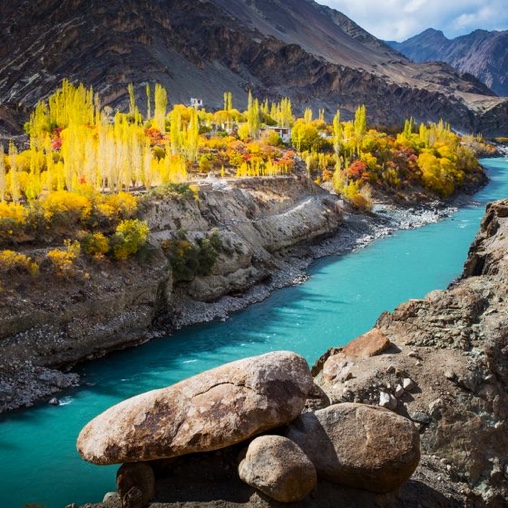
Indus River


...the problems associated with climate change will be neither mere inconveniences, nor as far off as we would like to think. There are currently two billion near-subsistence farmers living in the six great river valleys of Asia, from the Yellow all the way around to the Indus. These farmers have limited means and few non-agricultural skills. It would not be easy for them to pick up and relocate, let alone earn their livelihood doing something else.
Asia’s six great river valleys have supported most of human civilization for the past 5,000 years. During that time, the snow melt from the region’s high plateaus has always arrived at precisely the right moment, and in precisely the right volume, to support the crops upon which the region’s people rely. Read More

Tuesday, November 18, 2014

Water Resource Management- New Publication 2014

Department of Organic Food Quality and Food Culture, University of Kassel and Department of Archaeology and Heritage Management, Rajarata University, Sri Lanka are pleased to announce about the publication of their new research paper, titled "Water Resource Management in Dry Zonal Paddy Cultivation in Mahaweli River Basin, Sri Lanka: An Analysis of Spatial and Temporal Climate Change Impacts and Traditional Knowledge" in the Special Issue "Changes in precipitation and impacts on regional water resources", Climate Journal International.

The paper may be accessed at http://www.mdpi.com/2225-1154/2/4/329

Abstract: Lack of attention to spatial and temporal cross-scale dynamics and effects could be understood as one of the lacunas in scholarship on river basin management. Within the water-climate-food-energy nexus, an integrated and inclusive approach that recognizes traditional knowledge about and experiences of climate change and water resource management can provide crucial assistance in confronting problems in megaprojects and multipurpose river basin management projects.

The Mahaweli Development Program (MDP), a megaproject and multipurpose river basin management project, is demonstrating substantial failures with regards to the spatial and temporal impacts of climate change and socioeconomic demands for water allocation and distribution for paddy cultivation in the dry zone area, which was one of the driving goals of the project at the initial stage. This interdisciplinary study explores how spatial and temporal climatic changes and uncertainty n weather conditions impact paddy cultivation in dry zonal areas with competing stakeholders' interest in the Mahaweli River Basin.

In the framework of embedded design in the mixed methods research approach, qualitative data is the primary source while quantitative analyses are used as supportive data. The key findings from the research analysis are as follows: close and in-depth consideration of spatial and temporal changes in climate systems and paddy farmers' socioeconomic demands altered by seasonal changes are important factors. These factors should be considered in the future modification of water allocation, application of distribution technologies, and decision-making with regards to water resource management in the dry zonal paddy cultivation of Sri Lanka. More


Monday, July 14, 2014

The Unity of Water

MOSCOW – In May, Vietnam became the 35th and decisive signatory of the 1997 United Nations Convention on the Law of the Non-Navigational Uses of International Watercourses. As a result, 90 days later, on August 17, the convention will enter into force.

The fact that it took almost 50 years to draft and finally achieve the necessary ratification threshold demonstrates that something is very wrong with the modern system of multilateralism. Regardless of longstanding disagreements over how cross-border freshwater resources should be allocated and managed, and understandable preferences by governments and water professionals to rely on basin agreements rather than on international legal instruments, that half-century wait can be explained only by a lack of political leadership. So, though the world may celebrate the convention’s long-awaited adoption, we cannot rest on our laurels.

Roughly 60% of all freshwater runs within cross-border basins; only an estimated 40% of those basins, however, are governed by some sort of basin agreement. In an increasingly water-stressed world, shared water resources are becoming an instrument of power, fostering competition within and between countries. The struggle for water is heightening political tensions and exacerbating impacts on ecosystems.

But the really bad news is that water consumption is growing faster than population – indeed, in the twentieth century it grew at twice the rate. As a result, several UN agencies forecast that, by 2025, 1.8 billion people will be living in regions stricken with absolute water scarcity, implying a lack of access to adequate quantities for human and environmental uses. Moreover, two-thirds of the world’s population will face water-stress conditions, meaning a scarcity of renewable freshwater.

Without resolute counter-measures, demand for water will overstretch many societies’ adaptive capacities. This could result in massive migration, economic stagnation, destabilization, and violence, posing a new threat to national and international security.

The UN Watercourses Convention must not become just another ignored international agreement, filed away in a drawer. The stakes are too high. In today’s context of climate change, rising demand, population growth, increasing pollution, and overexploited resources, everything must be done to consolidate the legal framework for managing the world’s watersheds. Our environmental security, economic development, and political stability directly depend on it.

The convention will soon apply to all of the cross-border rivers of its signatories’ territories, not just the biggest basins. It will complement the gaps and shortcomings of existing agreements and provide legal coverage to the numerous cross-border rivers that are under increasing pressure.

Worldwide, there are 276 cross-border freshwater basins and about as many cross-border aquifers. Backed by adequate financing, political will, and the engagement of stakeholders, the convention can help address the water challenges that we are all facing. But will it?

An ambitious agenda should be adopted now, at a time when the international community is negotiating the contents of the Sustainable Development Goals (SDGs), the successor to the UN Millennium Development Goals, which will expire in 2015. We at Green Cross hope that the new goals, which are to be achieved by 2030, will include a stand-alone target that addresses water-resources management.

Moreover, the international community will soon have to agree on a climate-change framework to replace the Kyoto Protocol. Climate change directly affects the hydrological cycle, which means that all of the efforts that are undertaken to contain greenhouse-gas emissions will help to stabilize rainfall patterns and mitigate the extreme water events that so many regions are already experiencing.

But the UN Watercourses Convention’s entry into force raises as many new questions as existed in the period before its ratification. What will its implementation mean in practice? How will countries apply its mandates within their borders and in relation to riparian neighbors? How will the American and Asian countries that have largely ignored ratification respond?

Furthermore, how will the convention relate to the Convention on the Protection and Use of Transboundary Watercourses and International Lakes, which is already in force in most European and Central Asian countries and, since February 2013, has aimed to open its membership to the rest of the world? Similarly, how will the convention’s implementation affect existing regional and local cross-border freshwater agreements?

The countries that ratified the UN Watercourses Convention are expected to engage in its implementation and to go further in their efforts to protect and sustainably use their cross-border waters. What instruments, including financial, will the convention provide to them?

Several legal instruments can be implemented jointly and synergistically: the Ramsar Convention on Wetlands, the UN Convention to Combat Desertification, and the UN Framework Convention on Climate Change, to name just a few. The UN Watercourses Convention’s long-delayed enactment should be viewed as an opportunity for signatory states to encourage those that are not yet party to cooperative agreements to work seriously on these issues.

Clearly, politicians and diplomats alone cannot respond effectively to the challenges that the world faces. What the world needs is the engagement of political, business, and civil-society leaders; effective implementation of the UN Watercourses Convention is impossible without it.

This is too often overlooked, but it constitutes the key to the long-term success of cooperation that generates benefits for all. Inclusive participation by stakeholders (including the affected communities), and the development of the capacity to identify, value, and share the benefits of cross-border water resources, should be an integral part of any strategy to achieve effective multilateral collaboration. More


Thursday, June 26, 2014

Is the UN turning its back on the human right to water?

One of the biggest threats to economic and social development is that the world's freshwater supplies are rapidly becoming scarce and polluted. A new set of actors are now engaging in the global development arena to define and write the rules ofaccess to water to ensure people's needs are protected.

It is alarming to see that the human right to water and sanitation continues to be marginalised in UN policy discussions. The exclusion of this right to water in the most recent draft of the sustainable development goals reveals policy more conducive to promoting water security for economic growth than ensuring the preservation of watersheds and the equitable distribution of scarce water supplies.

When the UN general assembly passed a resolution in 2010 affirming water and sanitation as a human right, it was celebrated as a victory for communities dealing with the health impacts of polluted water, the indignity of not having access to clean drinking water and sanitation or the inability to produce food owing to water shortages. Social movements saw the human right to water and sanitation as a tool in the fight against a global water crisis produced by inequality, social exclusion and abuse of the water commons.

The global water crisis is also a big concern for industries seeking secure access to water supplies to sustain and expand operations in a never-ending quest for economic growth. The extractive industries, large drinks companies, big banks investing in water stocks, and companies involved in providing water and sanitation services have positioned themselves as stakeholders within global water policy discussions and as being able to provide solutions to the crisis.

The latest trend in global and national water policy is for corporations to participate in decision-making bodies and promote corporate-driven solutions through public-private partnerships. Over the past decade or so, the efforts of corporations such as Nestlé and Unilever to engage in global water policy discussions has shifted the debate from one of injustice and inequality to a depoliticised discussion of scarcity solved by technological fixes. These are offered by multinational corporations and market mechanisms that further deregulate water resource allocation.

When global policymakers – including the working group on sustainable development goals (SDGs) – focus simply on improving "water efficiency" for these ever-expanding industries without anchoring discussions of access to water as a right, they are ignoring communities that are challenging the very presence of the industries that are destroying watersheds.

The human right to water and sanitation holds promise for these communities. It has been invoked in Plachimada, in south India, to challenge Coca Cola's accessto aquifers; by anti-mining activists throughout Latin America; and, more recently, by the Kalahari Bushmen in a struggle to access traditional water sources on land coveted by industries such as tourism, diamond mining and fracking.

It has also been used to democratise water and sanitation services. In Uruguay, recognition of the human right to water led to the ban of private water services. When a recent ruling by a top Greek court blocked the privatisation of the country's largest water utility, in Athens, it was a victory for activists across Europe who had condemned forced privatisation through loan conditions in bailout packages for Greece, Portugal and Italy.

So it is deeply troubling that the human right to water continues to be contested at the UN. For those living without access to adequate drinking water and sanitation, the SDG on water focuses on universal access. As special rapporteur on the human right to safe drinking water and sanitation, Catarina de Albuquerque arguesthat an emphasis on universality alone fails to eliminate inequality.

At the very minimum, the human right to water calls for the elimination of discrimination and the adoption of special measures for marginalised communities. Social movements pursuing public control over water supplies, and democratic and participatory governance models, are also drawn to the elements of public participation in decision-making, accountability and access to justice underscored by the human right to water.

While this right is hardly the silver bullet for all global water woes, it goes a long way towards balancing unequal power relationships. More


Friday, July 19, 2013

South Asia disunity 'hampers flood warnings'

A lack of co-operation between South Asian countries is preventing timely flood warnings that could save lives and property during the Monsoon season.

Erratic and extreme rainfall is causing catastrophic flooding, most recently in northwest India and Nepal following heavy rainfall in June.

But the sharing of hydrological data can be a sensitive issue because of disputes over water use.

Officials say a network is required to share data across borders.

Experts and officials told the BBC that countries in the region are doing very little to help each other forecast floods.

Referring to the event last month, Chiranjibi Adhikary, chief district officer of Darchula district in western Nepal, which shares a border with India's flood-hit Uttarakhand state, said: "We received no warning from the Indian side about that devastating flood."

The flooding in the Mahakali river that criss-crosses India and Nepal claimed more than 30 lives on the Nepalese side and swept away many buildings at the district headquarters Khalanga.

Nearly 1,000 people have been confirmed dead because of the floods in the Indian side while thousands are still missing.

"We are still trying to contact them [the Indian authorities] to know what was the reason behind the floods, but there has been no telephone contact yet," Mr Adhikary told the BBC.

In western South Asia, the Kabul river that straddles Afghanistan and Pakistan was a major contributor to the massive floods in the Pakistani territory in 2010.

But, officials say, there was no communication on flood-forecasting between the two countries then, nor is there any now.

"The Kabul river is of course a flood threat to us even today but still we have no hydrological and rainfall data exchange with Afghanistan," said Mohammad Riyaj, Pakistan's chief meteorologist.

"It is something we need to do with urgency but this can be done only at the policy-making level."

One of the worst flood-hit countries in the region, Bangladesh, receives relatively little hydrological data from upstream Nepal.

Officials at Nepal's Department of Hydrology and Meteorology said they used to send the information to Dhaka by fax before but now staffing constraints have become a problem.

Pakistan does have a mechanism to receive limited hydrological data from India but officials say it is quite inadequate for meaningful flood forecasting.

"For instance, the Indian side informs the Indus Water Commission (a body under an agreement between New Delhi and Islamabad on the sharing of Indus river water) only when the water level in the Chenab river crosses 75,000 cusecs," says Mr Riyaj.

"That gives us much less time for evacuation and preparation for floods."

The Chenab is a major tributary of the Indus river that originates in Tibet and flows through India into Pakistan.

India and Pakistan have deep running disagreements on the sharing of Indus waters and have been involved in litigation.

Mr Riyaj said hydrological information on tributaries of the Chenab, including the Jhelum, Ravi and Sutlej rivers, that flow in from India would also be of great help for timely flood forecasting.

Officials in Bangladesh, however, said there had been some progress on hydrological data sharing with India as they were now getting information from three reading stations for the Ganges and four for the Bramhaputra in the Indian side.

The chief of Bangladesh's flood warning office, Amirul Hossain, said his country was also getting Bramhaputra's hydrological data from Chinese authorities in Tibet, where the river originates.

"But since our people are demanding that they should get flood warnings at least a week in advance, we would like to get the hydrological data from a bit further off areas in India so that we get more lead time for a forecast," Mr Hossain said.

Officials say the data Bangladesh gets from India at present are from nearby border areas.

Hydrological data is quite a sensitive issue in India, especially between states that have been at loggerheads over the sharing of water resources for quite some time.

The recent order by India's water resources ministry to its authorities regarding the constitution of the "classified data release committee" read: "The committee shall consider requests for release of classified data after due verification by the concerned chief engineer of the Central Water Commission and [the] receipt of [a] secrecy undertaking."

Rajendra Sharma, who heads Nepal's flood forecasting division at the country's meteorological office, said: "For genuine regional flood forecasting, all countries including India and China will have to actively participate in the exchange of hydrological and meteorological data."

Indian officials said they recognised the importance of cross border cooperation for effective flood forecasting.

Though he was optimistic that things could improve in future, M Shashidhar Reddy, vice chairman of India's National Disaster Management Authority, said: "Things which are on paper sometimes do not get translated into action." More
 

Tuesday, June 4, 2013

Call for Applications: 15-21 September | Climate Change and the Energy Challenge: Towards an Energy-efficient and Renewalbe-based System

Climate Change and the Energy Challenge: Towards an Energy Efficient and Renewable-based System-

An interdisciplinary approach to today’s great energy questions - 10th annual Summer Academy 'Energy and the Environment' | September 15-21 | BrusselsOrganised by IKEM and the University of GreifswaldThe Summer Academy is looking for academics and professionals working in the field of climate change and sustainable energy, to join and together address the state, technology, economics, efficiency, RES, policy and legal aspects of a transition to a sustainable system during one week of lectures, seminars and workshops. Exceptionally held in Brussels from 15-21 September, after local summer holidays, the 10th annual Summer Academy ‘Energy and the Environment’ will revisit the major climate and energy questions of our generation, questions that have driven the event since its very first edition in 2004. Paying special attention to the demand and supply-side potential and challenges of energy efficiency, the 10th anniversary of the Summer Academy ‘Energy and the Environment’ looks back on the major topics addressed over the past decade, to evaluate what progress has been made and to weave new issues and recent (technological) developments into the discussion.

Topic Climate Change and the Energy Challenge: Towards an Energy Efficient and Renewable-based System As climate change is forcing us to redesign our energy system and consumption patterns, energy efficiency and renewable energy feature high on the agenda of policy-makers and businesses alike. Energy efficiency measures are rapidly integrated across the economy, and fossil fuel is making way for renewables. But are current efforts enough to mitigate climate change? The Academy will kick off with an in-depth study on the state of climate change, climate policy and the continuing dominance of conventional fuels (including new sources like shale gas and tar sand) in today’s energy infrastructure and matrix (Monday and Tuesday). This diagnosis is the foundation on which the program will develop a comprehensive, interdisciplinary analysis of energy efficiency and renewable energy sources, the building blocks of decarbonization strategies worldwide (Wednesday-Friday).

Benefits The event is a strong international networking platform for legal experts and young professionals working in the field of (sustainable) energy and climate policy. Delegates will benefit from insights into the energy market’s latest developments and gain access to a strong network of professional contacts through the teaching faculty and fellow participants. The challenges addressed by climate policy and energy law are the result of complex interactions and developments of economics, the legal, environmental and sociological field. These must continuously feed-into and inform new legal and policy initiatives. Based on this principle, the Academy offers a diverse agenda and matching teaching faculty, including representatives from the academic world, think-tanks, energy business and of course the legal field. Past faculty and participants include representatives from the German Federal Environment Agency, the Department for Energy and Climate change, businesses like TenneT, Siemens, DONG energy and First Solar, DECC, (UK), legal practitioners from Germany’s leading energy law firm Becker Büttner Held, think-tanks like Ecologic, Juwi R&D, and Ecofys and academia from all over the world, including the University of Oxford, Amsterdam, Sejong and Berkeley (for a more extensive overview, please see ikemsummeracademy.de/faculty). The Academy has weaved a comprehensive network of contacts that have proven to be a valuable source of information long after the event, indeed, most participants still use their network today!

The location 2013 is a special year for the Summer Academy: It marks the 10-year anniversary of this international event! At this occasion, the Academy will be hosted in Brussels, at the Representation of the Bundesland Mecklenburg Vorpommern to Brussels from Monday to Thursday. On Friday, the final conference will be hosted by the Academy’s long-time partner, German energy law firm Becker Büttner Held, at their Brussels office.

Participants The Academy is looking for participants who work or study in the field of energy and the environment, who like to actively participate in discussion and possibly present their work during the Academy. All participants may submit an article for publication on their particular work or focus in the field, which will be published by the Berlin-based legal publisher Lexxion.

Join! We would love to hear from you if you are interested in participating in the Summer Academy. You can download an application form at ikemsummeracademy.de/applications and send it to summeracademy2013@ikem-online.de by the 20th of June. To find out more about the event, its history, past publications and events you can check out our website at: ikemsummeracademy.deWe look forward to hearing from you!Kind regards,

Prof. Michael Rodi University of Greifswald Director of IKEM

Anika Nicolaas Ponder Events and publications | Organisation of the IKEM Summer AcademySummeracademy2013@ikem-online.de Magazinstraße 15-16 | D-10179 | Berlin | GermanyTel. + 49 (0) 30 408 187 015Fax + 49 (0) 30 408 187 029 www.ikem-online.de

More


Monday, April 22, 2013

Corruption in the water sector

Corruption in the water sector is all-pervasive, affecting everything from water resources management to drinking water services, irrigation and hydropower. It occurs in all phases—from design through construction to operation and maintenance of water systems.

Corruption represents lack of integrity in people and organizations. It is enabled by lack of governance, transparency and accountability— deficiencies that can be addressed by tools that help access information, demand accountability and build partnerships. Binayak Das from the Water Integrity Network will discuss this in detail, in a webinar organized by TheWaterChannelon April 25, 2013 between 1300-1400 GMT. (Check your local timing)

Attending the webinar is free and easy. Just click here, chose ‘Enter as Guest,’ listen to Binayak and put your comments/questions to him through the chat window. If you have any prior suggestions/questions for the speaker, send them to info@thewaterchannel.tv

For more information, go to www.TheWaterChannel.tv/webinar

With Regards,

Abraham Abhishek

MetaMeta

www.metameta.nl / www.thewaterchannel.tv


Subscribe to all other IISD Reporting Services' free newsletters and lists for environment and sustainable development policy professionals athttp://www.iisd.ca/email/subscribe.htm


Tuesday, March 19, 2013

World Water Day 2012 official video

World Water Day 2012 official video, focusing on the theme of the campaign "Water and Food Security".

Produced by kf@kantfish.com and featuring a soundtrack by DDG Project. Animations by antiestatico.com
Download your animation on: http://www.unwater.org/worldwaterday

Saturday, February 2, 2013

5 Sobering Realities About Global Water Security

Some people say that water is the oil of the 21st Century. If only water were that simple.

Water is very complicated. It’s affected by large-scale issues like climate change and globalization. International commerce moves virtual water (the water it takes to grow or produce a product) from farms in Brazil to grocery stores in China and Egypt.

But water is also inherently local, impacted by site-specific weather, geography, and other environmental and land use conditions. Managing and using water, then, requires understanding it in its full geographic context.

Today, WRI is launching its new Aqueduct mapping tool to do just that. Aqueduct provides businesses, governments, and other decision makers with the highest-resolution, most up-to-date data on water risk across the globe. Armed with this information, these decision-makers can better understand how water risk impacts them—and hopefully, take actions to improve water security.

5 Findings about Water

So, what are these global maps telling us? Here are five immediate conclusions:

  • Water risk has many dimensions. WRI’s Aqueduct tool offers a new way of combining and mapping multiple indicators of water stress. Factors like inter-annual variability, floods, droughts, and groundwater depletion are added to baseline water stress, revealing a richer picture of water stress across the globe. Other important factors related to water quality and reputational risk are also included to help companies and governments understand the full breadth of water risks associated with a particular region or water basin. Not only do these layers enrich the overall picture, they can help inform strategies for improving water security.

  • Water stress is growing worldwide. Our new global Aqueduct maps use the most recent 2010 data (previous maps used data from 2000). The picture that emerges shows that water stress is both more prevalent and more severe than estimated in 2000. The new maps reveal areas of higher water stress on every continent, particularlyin China, South and Central Asia, and Africa.

  • Water stress isn’t just in arid regions anymore. One of the striking things about Aqueduct’s new maps is that many parts of Europe and the U.S. East Coast and upper Midwest now show medium to high levels of water risk. These regions are not arid, yet they still face significant water stress as demand increases and supply is affected by climate change and other factors.

  • High competition and annual variability make for a bad combination. In some areas with elevated water stress—including the U.S. West, Australia, northern China, northwest India, and parts of Pakistan—there is also high variability in available water supply from year to year. In places where demand for water is high relative to the available supply, a greater likelihood of low-water years makes the situation even riskier.

  • Increasing risks to food security. Most of the world’s water is used for agriculture, which accounts for approximately 70 percent of all freshwater withdrawals. Overlaying the world’s major irrigated crop regions on Aqueduct maps reveals that many of these areas already face significant water stress. The situation may become more severe in the future—water stress is likely to grow due to climate change and increased demand for food and water. More


Friday, October 26, 2012

Tibet and the Future of Asia: Strategic Issues for the U.S., Pakistan, India, and the World

Tibet and the Future of Asia: Strategic Issues for the U.S., India, and the World

Published onMay 7, 2012byForeignPolicyI

3,337 views


33 likes, 1 dislikes
As the Obama administration pursues its "Asia pivot," Tibet is taking on increased strategic significance due to its importance as a source of water and minerals, the militarization of the Tibetan plateau and the Sino-Indian border, Chinese influence in Nepal, and Beijing's insistence on deference to its control of Tibet as a "core interest." The series of self-immolations by Tibetans over the past year demonstrates that 60 years of Communist Chinese occupation has not succeeded in destroying Tibetans' identity and desire for freedom. This still unfolding unrest and the democratization of the Tibetan government-in-exile make imperative a review of international policies.

Moving forward, what role will Tibet play in the region's peace and security? Do the U.S. and India have the right policies in place for Tibet? What policies is China pursuing in response to recent events and in anticipation of the future? What are the prospects for achieving the autonomy the Dalai Lama seeks? Can Tibetan Buddhism and democracy provide a bridge between Tibetans and Chinese?

Discussing these vital questions will be Brahma Chellaney of the Centre for Policy Research; Michael J. Green of the Center for Strategic and International Studies; Lodi G. Gyari, special envoy of His Holiness the Dalai Lama; and Ambassador Lalit Mansingh, former Indian Foreign Secretary. FPI Director of Democracy and Human Rights Ellen Bork will moderate the discussion.

Sunday, August 19, 2012

Troubled Waters: Can a Bridge Be Built over the Indus?

Whereas once the Indus Waters Treaty could correctly be described as a beacon of light in an otherwise gloomy relationship between India and Pakistan, this is no longer so.

The odds now are that the crumbling IWT will be a cause for further tension and conflict between India and Pakistan. It is also true that with far-sighted political leadership, especially in India but also in Pakistan, a bridge could be built over these troubled waters and the Indus could, again, become a catalyst for cooperation.

Preamble

t has been one of the great privileges of my life to work for almost 40 years on the challenges of water management in the south Asian subcontinent. Starting with a Harvard University/Government of India collaborative programme on planning of the Ganga and Narmada rivers in the early 1970s. I lived in Bangladesh (in the 1970s) and Delhi (from 2002 to 2005 when I was senior water advisor at the World Bank). In 2006 I published, with Indian colleagues a book titled India’s Water Economy: Facing a Turbulent Future and with Pakistani col- leagues, one titled Pakistan’s Water Economy: Running Dry.

Writing on a subject as fraught with mis- trust as the Indus requires a level of “personal declaration” that is not necessary in most other contexts. So whose views do I represent? America? No, I am not American but South African. The World Bank? No, but this requires a bit more explanation. I worked for 20 years for the World Bank, the last 10 as Senior Water Advisor and then as the country director for Brazil until the end of 2008 when I accepted a faculty position at Harvard University.

Institutions like the World Bank necessarily have to craft institutional positions on complex issues. Healthy institutions ensure that there is space for the expression of a wide variety of views in coming to decisions. As is described in detail in Chapter 13 of Sebastian Mallaby’s (2005) landmark history of the World Bank, my views were frequently different from the views of management of the Bank. Furthermore, I have not been involved in any internal discussion in the World Bank on Indian and Pakistan water issues since 2005. The interpretations in this article do not depend on any confidential information but are based entirely on my own reading of documents and reports that are in the public domain. So this paper represents the personal views of a mere university professor, who speaks in the name of no one else or no other institution. Over these 40 years I have acquired a deep affection for the people of both India and Pakistan, and am dismayed by what I see as a looming trainwreck on the Indus, with potentially disastrous consequences for both countries. Whereas once the Indus Waters Treaty (IWT) could correctly be described as a beacon of light in an other- wise gloomy relationship, the situation has changed: because of the growing invest- ment in hydropower in Indian-held Kashmir; because of the declining water availability in Pakistan; because the Baglihar verdict of the Neutral Expert has gutted the IWT of its essential balance, because the World Bank has withdrawn from its once-heroic en- gagement with the Indus and because of the appropriation of the water dialogue by extremists on both sides. The purpose of this article is to delve into some of these questions, and to suggest how to find a way out before it is too late.

The Indus Waters Treaty

In the 19th century, the British constructed most of what is today the world’s largest contiguous irrigation system in the Indus Basin. However, the boundaries between the two states drawn in 1947 paid no attention to hydrology. Eighty per cent of the irrigated area was in Pakistan, but after Partition a large portion of the headwaters for the rivers which serviced most of this immense area were in Indian-held Kashmir.

Seeing that India and Pakistan were un- able to resolve this issue, the World Bank offered its help. After 10 years of intense negotiation, in 1960 the IWT was signed by then Indian Prime Minister Jawaharlal Nehru, Pakistani President Ayub Khan and the World Bank.

There are four essential elements to the treaty. The first relates to the division of the waters. The waters of the three western rivers (the Indus, the Jhelum and the Chenab) were allocated to Pakistan, and the waters of the three eastern rivers (the Ravi, the Beas and the Sutlej) were allocated to India. More