Showing posts with label Bangladesh. Show all posts

Wednesday, July 15, 2015

Pakistan, Bangladesh face ‘state failure’ as globe heats up

Study compiled by experts from US, UK, China and India underlines migration potential from warming world

India will face a huge influx of refugees from Afghanistan, Pakistan and Bangladesh should high degrees of climate change develop, according to one of the country’s senior military officials.

Drought and flooding linked to sea level rise would place the governments of those countries under "severe stress" and lead to large-scale migration, said Vice Admiral Pradeep Chauhan, head of the Indian Naval Academy.

"In India, this would combine with an internal population shift from rural to urban areas, further increasing demographic pressure in cities," he wrote in a climate risk study backed by the UK Foreign Office.

A significant influx of migrants could further destabilise what is known as India’s "Red Corridor", a belt of land running through east India where Marxist rebels are fighting the state.

"The temptation to solve this problem through military intervention could become overwhelming," he added.

Current greenhouse gas emissions will "likely as not" mean temperature increases of 4C above pre-industrial levels by 2150 said the study, with severe implications for human health and crop yields.

A N M Muniruzzaman, a retired Bangladeshi major general, said millions of people in his country could be displaced as a result of sea level rise.

"Flooding is projected to increase in many regions, but it could be a particular problem in South Asia due to the contribution of melting glaciers," he said.

Planning battle

Chauhan’s and Muniruzzaman’s comments were based on a war gaming exercise held in Delhi in March, hosted by the Council on Energy, Environment and Water.

Former military officials from India, China, the US, the UK, Bangladesh, Germany, the Netherlands, and Finland took part, along with scientists and diplomats.

"In the game, it was notable that increasing numbers of refugees contributed to several large countries becoming more isolationist in their foreign policies," says the study.

"Participants in our exercise considered it extremely likely that climate change would exacerbate humanitarian crises over the coming decades."

Long term water stress in South Asia could become so severe previous agreements over resource sharing between India, Pakistan, China and Bangladesh "could be broken", the study warns.

"At the high degrees of climate change possible in the long-term future, participants in our scenarios exercise considered that there could even be risks to the political integrity of states that are currently considered developed and stable."

Alex Randall from the UK-based Climate Change and Migration Coalition said the document presented a "one sided view of migration" seeing it only as a security threat.

"While there is growing evidence linking climate change to changing patterns of migration, there is little evidence suggesting that migrants and refugee present the kind of security threat suggested in the report," he said.

"There is also strong evidence indicating that migration could become a key way for some people to adapt to climate change." More


Friday, August 22, 2014

Global Climate Inaction Will Mean Economic Turmoil for South Asia, Warns Bank

The first comprehensive study ever issued on the economic costs that uncontrolled climate change would inflict on South Asia predicts a staggering burden that would hit the region's poorest the hardest.

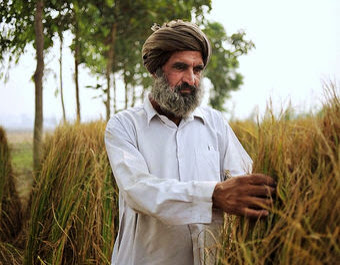
Rice Farmer in Punjab, India

"The impacts of climate change are likely to result in huge economic, social and environmental damage to South Asian countries, compromising their growth potential and poverty reduction efforts," said the study, published by the Asian Development Bank.

The cuts in regional GDP are so deep that they might ripple around the world, as six developing countries with 1.4 billion people—a third of them living in poverty—pay the price of the world's continuing reliance on fossil fuels.

Projections like this feed into the urgency for action as world leaders prepare to meet at the United Nations next month to discuss the climate crisis. Recent warnings show that the steps nations seem willing to take will fall well short of what is needed.

Action now, the study shows, would pay immediate and lasting dividends to the countries it examined: Bangladesh, Bhutan, India, the Maldives, Nepal and Sri Lanka.

The study, published as a new 160-page book, says that if the world cuts fossil fuel consumption enough to keep warming within 2 degrees Celsius—the goal of UN negotiations—the costs to South Asian countries of adapting to rising seas and temperatures in the decades ahead might be cut almost in half.

But if business-as-usual continues, leading to a world that is 4 or 5 degrees warmer by 2100 than at the start of the industrial age, the outlook looks grim.

"Climate change will slash up to 9 percent off the South Asian economy every year by the end of this century if the world continues on its current fossil-fuel intensive path," the bank said. "The human and financial toll could be even higher if the damage from floods, droughts, and other extreme weather events is included."

Because this kind of estimate is inherently imprecise, the bank warned that the real damage could be much worse than expected. Under business-as-usual trends, there is a one in 20 chance that South Asia will lose 24 percent of its annual GDP by the end of the century, the study found.

Paying to stave off those damages will cost these nations dearly, the study said.

To avoid the damage that is expected if the world takes no action on climate change, South Asia would have to spend nearly $40 billion per year by 2050 on adaptation measures, or nearly half a percentage point of average annual GDP. By 2100, the costs would have to increase to $73 billion per year, or roughly nine-tenths of a point of GDP.

If the world were to achieve the 2-degree warming goal established by UN negotiators at climate treaty talks in Copenhagen in 2009—a goal also at the heart of culminating talks set for Paris in 2015—annual adaptation costs for South Asia would be considerably less: $31 billion a year at mid-century, and $41 billion at century's end.

And instead of losing nearly 9 percent of annual GDP by the end of the century, the study found, South Asia would lose about 2.5 percent by 2100 if the world lives up to the goals of Copenhagen. More


Sunday, June 29, 2014

Himalayan Water Security: The Challenges for South and Southeast Asia

The scramble for control of natural resources to support economic and population growth, combined with the uncertain effects of climate change on the Tibetan Plateau, is raising tensions in Asia over Himalayan water resources.

Ten of the region’s largest and longest rivers (the Amu Darya, Brahmaputra, Ganges, Indus, Irrawaddy, Mekong, Salween, Tarim, Yangtze, and Yellow) originate in the Himalayas. These rivers help provide water, food, and energy for nearly 4 billion people in China and across South and Southeast Asia—nearly half of the world’s population. However, depletion and diversion of these transborder resources to meet growing industrial, agricultural, and urban demands have the potential to trigger far-reaching economic, social, and environmental challenges.

The lack of comprehensive and effective regional frameworks for cooperation hinders sustainable management of these waterways. China, which controls the headwaters of these rivers, has an enormous need for Himalayan water to satisfy economic and energy demands but has little incentive to participate in formal water-sharing and water-management agreements with its neighbors. China’s dam-building and water-diversion projects are a source of major concern to the countries downstream, which often complain about Beijing’s lack of transparency and reluctance to share information. Although managing water-sharing relations with China might be the most prominent challenge, cooperation is not much easier at the middle and lower reaches of the rivers. Collaboration in South and Southeast Asia is frequently frustrated by competing national interests, economic priorities, political disputes, and weak regional organizations. In addition to the environmental impacts of man-made diversion projects and unsustainable freshwater usage, there is also inadequate cooperation on scientific research to understand and prepare for the effects of climate change on the region’s water supplies.

This Asia Policy roundtable contains seven essays that discuss the challenges and implications of water security in Asia and recommend steps that both upstream and downstream countries could take to better manage the region’s shared water resources.

Asia’s Unstable Water Tower: The Politics, Economics, and Ecology of Himalayan Water Projects
Kenneth Pomeranz

China’s Upstream Advantage in the Great Himalayan Watershed
Jennifer L. Turner, Susan Chan Shifflett, and Robert Batten

Melting the Geopolitical Ice in South Asia
Robert G. Wirsing

Himalayan Water Security: A South Asian Perspective
Tushaar Shah and Mark Giordano

Hydropower Dams on the Mekong: Old Dreams, New Dangers
Richard P. Cronin

Climate Change and Water Security in the Himalayan Region
Richard Matthew

Securing the Himalayas as the Water Tower of Asia: An Environmental Perspective
Jayanta Bandyopadhyay

Download PDF


As I have been arguing for a number of years South Asia needs to re-negotiate the Indus Water Treaty to encompass Afghainstan, Bangladesh, Bhutan, China, India, Nepal and Pakistan before the region starts to suffer from water insecurity and the effects of climate change. Editor


Friday, July 19, 2013

South Asia disunity 'hampers flood warnings'

A lack of co-operation between South Asian countries is preventing timely flood warnings that could save lives and property during the Monsoon season.

Erratic and extreme rainfall is causing catastrophic flooding, most recently in northwest India and Nepal following heavy rainfall in June.

But the sharing of hydrological data can be a sensitive issue because of disputes over water use.

Officials say a network is required to share data across borders.

Experts and officials told the BBC that countries in the region are doing very little to help each other forecast floods.

Referring to the event last month, Chiranjibi Adhikary, chief district officer of Darchula district in western Nepal, which shares a border with India's flood-hit Uttarakhand state, said: "We received no warning from the Indian side about that devastating flood."

The flooding in the Mahakali river that criss-crosses India and Nepal claimed more than 30 lives on the Nepalese side and swept away many buildings at the district headquarters Khalanga.

Nearly 1,000 people have been confirmed dead because of the floods in the Indian side while thousands are still missing.

"We are still trying to contact them [the Indian authorities] to know what was the reason behind the floods, but there has been no telephone contact yet," Mr Adhikary told the BBC.

In western South Asia, the Kabul river that straddles Afghanistan and Pakistan was a major contributor to the massive floods in the Pakistani territory in 2010.

But, officials say, there was no communication on flood-forecasting between the two countries then, nor is there any now.

"The Kabul river is of course a flood threat to us even today but still we have no hydrological and rainfall data exchange with Afghanistan," said Mohammad Riyaj, Pakistan's chief meteorologist.

"It is something we need to do with urgency but this can be done only at the policy-making level."

One of the worst flood-hit countries in the region, Bangladesh, receives relatively little hydrological data from upstream Nepal.

Officials at Nepal's Department of Hydrology and Meteorology said they used to send the information to Dhaka by fax before but now staffing constraints have become a problem.

Pakistan does have a mechanism to receive limited hydrological data from India but officials say it is quite inadequate for meaningful flood forecasting.

"For instance, the Indian side informs the Indus Water Commission (a body under an agreement between New Delhi and Islamabad on the sharing of Indus river water) only when the water level in the Chenab river crosses 75,000 cusecs," says Mr Riyaj.

"That gives us much less time for evacuation and preparation for floods."

The Chenab is a major tributary of the Indus river that originates in Tibet and flows through India into Pakistan.

India and Pakistan have deep running disagreements on the sharing of Indus waters and have been involved in litigation.

Mr Riyaj said hydrological information on tributaries of the Chenab, including the Jhelum, Ravi and Sutlej rivers, that flow in from India would also be of great help for timely flood forecasting.

Officials in Bangladesh, however, said there had been some progress on hydrological data sharing with India as they were now getting information from three reading stations for the Ganges and four for the Bramhaputra in the Indian side.

The chief of Bangladesh's flood warning office, Amirul Hossain, said his country was also getting Bramhaputra's hydrological data from Chinese authorities in Tibet, where the river originates.

"But since our people are demanding that they should get flood warnings at least a week in advance, we would like to get the hydrological data from a bit further off areas in India so that we get more lead time for a forecast," Mr Hossain said.

Officials say the data Bangladesh gets from India at present are from nearby border areas.

Hydrological data is quite a sensitive issue in India, especially between states that have been at loggerheads over the sharing of water resources for quite some time.

The recent order by India's water resources ministry to its authorities regarding the constitution of the "classified data release committee" read: "The committee shall consider requests for release of classified data after due verification by the concerned chief engineer of the Central Water Commission and [the] receipt of [a] secrecy undertaking."

Rajendra Sharma, who heads Nepal's flood forecasting division at the country's meteorological office, said: "For genuine regional flood forecasting, all countries including India and China will have to actively participate in the exchange of hydrological and meteorological data."

Indian officials said they recognised the importance of cross border cooperation for effective flood forecasting.

Though he was optimistic that things could improve in future, M Shashidhar Reddy, vice chairman of India's National Disaster Management Authority, said: "Things which are on paper sometimes do not get translated into action." More


Saturday, June 1, 2013

Water Wars in Asia?

The battles of yesterday were fought over land. Those of today are over energy. And the battles of tomorrow may be over water.

Nowhere is the danger greater than in Asia. Drought, urbanization, pollution, and inadequate infrastructure have made Asia the world’s most water-scarce continent on a per-capita basis. Many of its water sources cross national boundaries, creating the potential for international conflict as supplies dwindle. Now global warming is raising the stakes further, causing rising sea levels, more severe floods and droughts, and the melting of the glaciers in the Tibetan plateau.

The water security challenges facing China and India in particular have consequences not just for the two rising powers, but for Asia as a whole. They threaten to reduce economic growth across the region, exacerbate ongoing territorial disputes, and impose further hardships on Asia’s poor. Asia Society Northern California is pleased to host national security expertBrahma Chellaney, water expert Peter Gleick, and futurist Peter Schwartz to discuss what is becoming Asia’s defining crisis of the 21st century.

Brahma Chellaney is Professor of Strategic Studies at the Center for Policy Research in New Dehli. He has written six books on international relations and geopolitics, including Water: Asia’s New Battleground, which won the Asia Society’s Bernard Schwartz Book Award in 2012. His newest book, Water, Peace, and War: Confronting the Global Crisis, has just been released.

Peter Gleick is Co-founder and President of the Pacific Institute. Dr. Gleick is the author of many scientific papers and nine books on water, including The World’s Water and Bottled and Sold: The Story Behind Our Obsession with Bottled Water. He is the recipient of the MacArthur “genius” Fellowship, among other awards.

Peter Schwartz (moderator), a renowned futurist, is Senior Vice President for Global Government Relations and Strategic Planning at Salesforce.com. He was Co-founder and Chairman of Global Business Network (GBN).

Copies of Water: Asia's New Battleground and Water, Peace, and War: Confronting the Global Water Crisis will be available for purchase and signing!

Promotional co-sponsors: The Asia Foundation, East Meets West, Institute of East Asian Studies, UC Berkeley, Japan Policy Research Institute, Pacific Institute, Sierra Club, US China Green Energy Council, World Affairs Council


Program Agenda:

5:30-6:00 pm: Registration
6:00-7:30 pm: Discussion and Audience Q&A
7:30-8:00 pm: Reception and Book Signing


EVENT DETAILS

5 June 2013

6:00pm - 7:30pm

Asia Society
Bechtel Conference Room
500 Washington St.
San Francisco

Click for Directions

$10 Asia Society/Co-sponsor members/students; $15 non-members

BUY TICKETS »


Monday, November 5, 2012

Indian monsoons may fail more often due to climate change - study

(Reuters) - The Indian monsoon is likely to fail more often in the next 200 years threatening food supplies, unless governments agree how to limit climate change, a study showed on Tuesday.

The monsoon rains could collapse about every fifth year between 2150 and 2200 with continued global warming, blamed mainly on human burning of fossil fuels, and related shifts in tropical air flows, it said.

“Monsoon failure becomes much more frequent” as temperatures rise, Anders Levermann, a professor of dynamics of the climate system and one of the authors at the Potsdam Institute for Climate Impact Research, told Reuters.

India’s monsoon, which lasts from June to September, is vital for India’s 1.2 billion people to grow crops such as rice, wheat and corn. India last faced a severe widespread drought in 2009 and had to import sugar, pushing global prices to 30-year highs.

The researchers defined monsoon “failure” as a fall in rainfall of between 40 and 70 percent below normal levels. Such a drastic decline has not happened any year in records dating back to 1870 by the India Meteorological Department, they said.

CATASTROPHE

“In the past century the Indian monsoon has been very stable. It is already a catastrophe with 10 percent less rain than the average,” Levermann told Reuters.

The study, in the journal Environmental Research Letters, projected a temperature rise of 4.6 degrees C (8.3 F) over pre-industrial times by 2200. U.N. scenarios indicate a gain of between 1.1 and 6.4 degrees C (2.9-11.5F) by 2100. More


Friday, October 26, 2012

Tibet and the Future of Asia: Strategic Issues for the U.S., Pakistan, India, and the World

Tibet and the Future of Asia: Strategic Issues for the U.S., India, and the World

Published onMay 7, 2012byForeignPolicyI

3,337 views


33 likes, 1 dislikes
As the Obama administration pursues its "Asia pivot," Tibet is taking on increased strategic significance due to its importance as a source of water and minerals, the militarization of the Tibetan plateau and the Sino-Indian border, Chinese influence in Nepal, and Beijing's insistence on deference to its control of Tibet as a "core interest." The series of self-immolations by Tibetans over the past year demonstrates that 60 years of Communist Chinese occupation has not succeeded in destroying Tibetans' identity and desire for freedom. This still unfolding unrest and the democratization of the Tibetan government-in-exile make imperative a review of international policies.

Moving forward, what role will Tibet play in the region's peace and security? Do the U.S. and India have the right policies in place for Tibet? What policies is China pursuing in response to recent events and in anticipation of the future? What are the prospects for achieving the autonomy the Dalai Lama seeks? Can Tibetan Buddhism and democracy provide a bridge between Tibetans and Chinese?

Discussing these vital questions will be Brahma Chellaney of the Centre for Policy Research; Michael J. Green of the Center for Strategic and International Studies; Lodi G. Gyari, special envoy of His Holiness the Dalai Lama; and Ambassador Lalit Mansingh, former Indian Foreign Secretary. FPI Director of Democracy and Human Rights Ellen Bork will moderate the discussion.

Wednesday, September 5, 2012

Crops in India Wilt in a Weak Monsoon Season

MURUMA, India — Vilas Dinkar Mukane lives halfway around the world from the corn farmers of Iowa, but the Indian sharecropper is at risk of losing his livelihood for the same reason: not enough rain.

With the nourishing downpours of the annual monsoon season down an average of 12 percent across India and much more in some regions, farmers in this village about 250 miles east of Mumbai are on the brink of disaster. “If this situation continues, I’ll lose everything,” said Mr. Mukane, whose soybean, sugarcane and cotton crops were visibly stunted and wilting in his fields recently. “Nothing can happen without water.”

Drought has devastated crops around the world this year, including corn and soybeans in the United States, wheat in Russia and Australia and soybeans in Brazil and Argentina. This has contributed to a 6 percent rise in global food prices from June to July, according to United Nations data.

India is experiencing its fourth drought in a dozen years, raising concerns about the reliability of the country’s primary source of fresh water, the monsoon rains that typically fall from June to October.

Some scientists warn that such calamities are part of a trend that is likely to intensify in the coming decades because of climate changes caused by the human release of greenhouse gases.

A paper published last month blamed global warming for a large increase in the percentage of the planet affected by extreme summer heat in the last several decades. And the World Meteorological Organization, a division of the United Nations, recently warnedthat climate change was “projected to increase the frequency, intensity and duration of droughts, with impacts on many sectors, in particular food, water and energy.”

Scientists say that in addition to increasing temperatures, climate change appears to be making India and its neighbors Pakistan, Sri Lanka and Bangladesh more vulnerable to erratic monsoons. More


Wednesday, August 29, 2012

World Water Week - Earth Policy Institute

Every August, scientists gather in Stockholm to participate in World Water Week and discuss the various issues related to water.

Water is as necessary to life as breath. This year in the United States, the lack of rain has resulted in drought conditions throughout the Corn Belt that, combined with excessive heat, will drastically reduce the U.S. corn harvest. According to Lester Brown, the drop could be roughly 100 million tons or 30 percent of the expected harvest.

In some parts of the Midwest, homeowners are turning on their taps and getting nothing but air as the water tables have so precipitously dropped. More intense droughts and heat waves are likely as the Earth’s temperature rises.

With regard to agricultural water use, Lester Brown has long been talking about the need for a major push to raise the level of water productivity. Two decades ago, he said that a shortage of water was the most underreported threat to civilization.

Here is some of what he writes on the subject (from Chapter 2 of World on the Edge)

The global water deficit is a product of the tripling of water demand over the last half-century coupled with the worldwide spread of powerful diesel and electrically driven pumps. Only since the advent of these pumps have farmers had the pumping capacity to pull water out of aquifers faster than it is replaced by precipitation.

As the world demand for food has soared, millions of farmers have drilled irrigation wells to expand their harvests. In the absence of government controls, far too many wells have been drilled. As a result, water tables are falling and wells are going dry in some 20 countries, including China, India, and the United States—the three countries that together produce half the world’s grain.

The overpumping of aquifers for irrigation temporarily inflates food production, creating a food production bubble, one that bursts when the aquifer is depleted. Since 40 percent of the world grain harvest comes from irrigated land, the potential shrinkage of the supply of irrigation water is of great concern. Among the big three grain producers, roughly a fifth of the U.S. grain harvest comes from irrigated land. For India, the figure is three fifths and for China, roughly four fifths. … More


Sunday, August 26, 2012

Risk of water wars rises with scarcity

The author Mark Twain once remarked that "whisky is for drinking; water is for fighting over" and a series of reports from intelligence agencies and research groups indicate the prospect of a water war is becoming increasingly likely.

In March, a report from the office of the US Director of National Intelligence said the risk of conflict would grow as water demand is set to outstrip sustainable current supplies by 40 per cent by 2030.

"These threats are real and they do raise serious national security concerns," Hillary Clinton, the US secretary of state, said after the report's release.

Internationally, 780 million people lack access to safe drinking water, according to the United Nations. By 2030, 47 per cent of the world’s population will be living in areas of high water stress, according to the Organisation for Economic Co-operation and Development's Environmental Outlook to 2030 report.

Some analysts worry that wars of the future will be fought over blue gold, as thirsty people, opportunistic politicians and powerful corporations battle for dwindling resources.

Dangerous warnings

Governments and military planners around the world are aware of the impending problem; with the US senate issuing reports with names like Avoiding Water Wars: Water Scarcity and Central Asia’s growing Importance for Stability in Afghanistan and Pakistan.

With rapid population growth, and increased industrial demand, water withdrawls have tripled over the last 50 years, according to UN figures.


"Water scarcity is an issue exacerbated by demographic pressures, climate change and pollution," said Ignacio Saiz, director of Centre for Economic and Social Rights, a social justice group. "The world's water supplies should guarantee every member of the population to cover their personal and domestic needs."

"Fundamentally, these are issues of poverty and inequality, man-made problems," he told Al Jazeera.

Of all the water on earth, 97 per cent is salt water and the remaining three per cent is fresh, with less than one per cent of the planet's drinkable water readily accessible for direct human uses. Scarcity is defined as each person in an area having access to less than 1,000 cubic meters of water a year.

The areas where water scarcity is the biggest problem are some of the same places where political conflicts are rife, leading to potentially explosive situations.

Some experts believe the only documented case of a "water war" happened about 4,500 years ago, when the city-states of Lagash and Umma went to war in the Tigris-Euphrates basin.

But Adel Darwish, a journalist and co-author of Water Wars: Coming Conflicts in the Middle East, says modern history has already seen at least two water wars.

"I have [former Israeli prime minister] Ariel Sharon speaking on record saying the reason for going to war [against Arab armies] in 1967 was for water," Darwish told Al Jazeera.

Some analysts believe Israel continues to occupy the Golan heights, seized from Syria in 1967, due to issues of water control, while others think the occupation is about maintaining high ground in case of future conflicts.

Senegal and Mauritania also fought a war starting in 1989 over grazing rights on the River Senegal. And Syria and Iraq have fought minor skirmishes over the Euphrates River.

Middle East hit hard

UN studies project that 30 nations will be water scarce in 2025, up from 20 in 1990. Eighteen of them are in the Middle East and North Africa, including Egypt, Israel, Somalia, Libya and Yemen.

"Water too often is treated as a commodity, as an instrument with which one population group can suppress another" -Ignacio Saiz, Centre for Economic and Social Rights

Darwish bets that a battle between south and north Yemen will probably be the scene of the next water conflict, with other countries in the region following suit if the situation is not improved.

Water shortages could cost the unstable country 750,000 jobs, slashing incomes in the poorest Arab country by as much as 25 per cent over the next decade, according to a report from the consulting firm McKinsey and Company produced for the Yemeni government in 2010. More


Monday, July 30, 2012

Thirsty South Asia's river rifts threaten "water wars"

KANZALWAN, India-Pakistan Line of Control (AlertNet) - As the silver waters of the Kishanganga rush through this north Kashmir valley, Indian labourers are hard at work on a hydropower project that will dam the river just before it flows across one of the world's most militarised borders into Pakistan.

The loud hum of excavators echoes through the pine-covered valley, clearing masses of soil and boulders.

The 330-MW dam shows India's growing focus on hydropower but also highlights how water is a growing source of tension with downstream Pakistan, which depends on the snow-fed Himalayan rivers for everything from drinking water to agriculture.

Islamabad has complained to an international court that the dam in the Gurez valley, one of dozens planned by India, will affect river flows and is illegal. The court has halted any permanent work on the river for the moment, although India can still continue tunneling and other associated projects.

In the years since their partition from British India in 1947, land disputes have led the two nuclear-armed neighbours to two of their three wars. The next flashpoint could well be water.

"There is definitely potential for conflict based on water, particularly if we are looking to the year 2050, when there could be considerable water scarcity in India and Pakistan," says Michael Kugelman, South Asia Associate at the Woodrow Wilson International Center for Scholars in Washington.

"Populations will continue to grow. There will be more pressure on supply. Factor in climate change and faster glacial melt ... That means much more will be at stake. So you could have a perfect storm which conceivably could be some sort of trigger." More


Sunday, July 15, 2012

UNFCCC Executive Secretary Christiana Figueres statement at of International Conference of Mountain Countries on Climate Change

UNFCCC Executive Secretary Christiana Figueres delivers recorded video statement on occasion of the International Conference of Mountain Countries on Climate Change in Kathmandu on 5-6 April 2012


Tuesday, April 17, 2012

Water scarcity to drive conflict, hit food and energy –experts

OXFORD, United Kingdom (AlertNet) – Water is increasingly becoming a scarce resource and shortages could drive conflict, hit food and energy production and threaten growth in renewable energy technology, experts warned at a water security conference on Monday.

And climate change – which appears to be bringing more extreme weather events such as droughts and floods – is likely to make the situation even more difficult, they said.

“Climate change will hit more people through water than in any other way,” said David Grey, a University of Oxford water expert, pointing to record floods in Thailand, Pakistan and Australia and record droughts in Somalia, Russia and the U.S. state of Texas in just the past two years.

But cutting waste in water use, particularly in irrigation, as well as making good use of mobile phone technology, gathering better data and putting in place better water use policies all could help stem conflict, improve safety and ensure better water security, particularly for the world’s poorest people, the experts said.

“The scale of the challenge, and therefore the scale of the opportunity it presents, is unprecedented,” said Ian Walmsley, pro-vice chancellor for research at the University of Oxford.

Worldwide, farming accounts for 70 percent of the world’s freshwater use each year. But in agricultural breadbaskets like central India, the northern China plains, and the central western region of the United States, much of the water is drawn not just from rain but from deep aquifers that are quickly being depleted.

Peter Gleick, a leading water expert and head of the U.S.-based Pacific Institute for Studies in Development, Environment and Security, likened the issue to drawing down a bank account. The situation could present huge problems in the future as the world tries to increase food production by at least 70 percent by 2050 to meet growing demand, experts said.

“A substantial amount of our food production worldwide comes from non-renewable groundwater resources, and in the long run that is not sustainable,” Gleick said.

Renewable energy production also is threatened by water shortages, he said. Huge solar energy arrays are planned in the western United States, but many of the best places to locate them also suffer severe shortages of the water needed to cool them.

Conflicts over access to water are as old as recorded history, Gleick said – his institute has created a map of 225 water conflicts dating back 5,000 years – but today “the risks of water-related conflicts are growing,” as shortages loom in many parts of the world. More