Showing posts with label drought. Show all posts

Thursday, May 17, 2018

Water shortages to be key environmental challenge of the century, Nasa warns


Water shortages to be key environmental challenge of the century, Nasa warns | Environment | The Guardian

Water shortages are likely to be the key environmental challenge of this century, scientists from Nasa have warned, as new data has revealed a drying-out of swaths of the globe between the tropics and the high latitudes, with 19 hotspots where water depletion has been dramatic.

Areas in northern and eastern India, the Middle East, California and Australia are among the hotspots where overuse of water resources has caused a serious decline in the availability of freshwater that is already causing problems. Without strong action by governments to preserve water the situation in these areas is likely to worsen


(https://www.theguardian.com/environment/2018/may/16/water-shortages-to-be-key-environmental-challenge-of-the-century-nasa-warns

Friday, June 9, 2017

The Relentless March of Drought – That ‘Horseman of the Apocalypse’

ROME, Jun 7 2017 (IPS) - By 2025 –that’s in less than 8 years from today– 1.8 billion people will experience absolute water scarcity, and two thirds of the world will be living under water-stressed conditions. Now it is feared that advancing drought and deserts, growing water scarcity and decreasing food security may provoke a huge ‘tsunami” of climate refugees and migrants.
No wonder then that a major United Nations Convention calls drought ‘one of the four horsemen of the apocalypse.’ See what the United Nations Convention to Combat Desertification (UNCCD) says in this regard.

By 2050, the demand for water is expected to increase by 50 per cent. As populations increase, especially in dry-land areas, more and more people are becoming dependent on fresh water supplies in land that are becoming degraded, the Bonn-based Convention secretariat warns.

“The world’s drought-prone and water scarce regions are often the main sources of refugees.” Monique Barbut.
Water scarcity is one of the greatest challenges of the twenty-first century, it underlines, adding that drought and water scarcity are considered to be the most far-reaching of all natural disasters, causing short and long-term economic and ecological losses as well as significant secondary and tertiary impacts.

To mitigate these impacts, drought preparedness that responds to human needs, while preserving environmental quality and ecosystems, requires involvement of all stakeholders including water users and water providers to achieve solutions for drought, explains UNCCD.

“Drought, a complex and slowly encroaching natural hazard with significant and pervasive socio-economic and environmental impacts, is known to cause more deaths and displace more people than any other natural disaster.” More

Thursday, September 4, 2014

ADB Spotlights Pakistan’s Water Assessment and Management Plan


News: ADB Spotlights Pakistan’s Water Assessment and Management Plan

ADBSeptember 2014: The Asian Development Bank (ADB) has published a report titled ‘Water Balance: Achieving Sustainable Development through a Water Assessment and Management Plan – The Case of Federally Administered Tribal Areas (FATA), Pakistan.' The report presents the case of the development of the FATA Water Assessment and Management Plan, outlining elements necessary in such assessment, and emphasizing that inefficient and unsustainable management of development initiatives result from lack of information about water availability and cause watershed degradation.


Integrated water resources management (IWRM) was used as a core approach in the development of possible activities to promote the sustainable use of water resources in the FATA region. While noting much of the data used is historical, the report emphasizes that climate change is likely to alter current water availability patterns, and calls for integrating hydrological forecasting and climate change models into the assessment.


The report includes sections on: background; project area; assessing surface water availability; assessing groundwater; assessing water consumption; water balance model; water management plan; and conclusions. [Publication: Water Balance: Achieving Sustainable Development through a Water Assessment and Management Plan – The Case of Federally Administered Tribal Areas (FATA), Pakistan]


Read more: http://water-l.iisd.org/news/adb-spotlights-pakistans-water-assessment-and-management-plan/


Sunday, August 24, 2014

Karachi thirsts for a water supply

KARACHI: On the outskirts of the slums of Pakistan’s biggest city, protesters burning tires and throwing stones have what sounds like a simple demand: They want water at least once a week.

In Karachi people go days without getting water from city trucks, sometimes forcing them to use groundwater contaminated with salt. A recent drought has only made the problem worse. And as the city of roughly 18 million people rapidly grows, the water shortages are only expected to get worse.

“During the last three months they haven’t supplied a single drop of water in my neighbourhood,” protester Yasmeen Islam said. “It doesn’t make us happy to come on the roads to protest but we have no choice anymore.”

Karachi gets most of its water from the Indus River — about 550 million gallons per day — and another 100 million gallons from the Hub Dam that is supplied by water from neighbouring Balochistan province. But in recent years, drought has hurt the city’s supply.

Misbah Fareed, a senior official with the Karachi Water and Sewerage Board that runs the city’s water supplies, said that only meets about half the city’s needs — 1.2 billion gallons a day.

Karachi’s water distribution network has exacerbated the problem by forcing much of the city to get its water through tankers instead of directly from pipes. The Karachi Water and Sewerage Board operates 12 water hydrants around the city where tankers fill up and then distribute. Even people in the richest areas of the city get their water through tankers that come a few times a week to fill up underground cisterns.

But criminals have illegally tapped into the city’s water pipes and set up their own distribution points where they siphon off water and sell it.

“I personally know some people previously associated with drug mafias who now switched to the water tanker business,” Fareed said. “Just imagine how lucrative the business is.”

Other areas of Pakistan pump massive amounts of groundwater. But in the coastal city of Karachi, the underground water is too salty to drink. Many people have pumps but they use the water for things such as showering or washing clothes.

The water shortage is exacerbated by Karachi’s massive population. Pakistani military operations and American drone strikes in the northern tribal regions, as well as natural disasters such as flooding and earthquakes, have pushed people toward a city long seen as the economic heart of Pakistan.

The city is trying to increase the amount of water it gets from the Indus River by building another canal — dubbed the K4 project. But even if they were to get political approval from the capital to take more water from the river, it would take a minimum of four years to build.

But analysts say supply isn’t the only problem. Farhan Anwar, who runs an organisation called Sustainable Initiatives in Karachi, said the Karachi Water and Sewerage Board is horribly overstaffed and many of those are political appointees. The cost for water is also very low and the agency doesn’t collect all that it’s due, Anwar said. That’s made it difficult to upgrade the ageing pipes the system does have, meaning contamination and leakages are common.

Meanwhile, Karachi residents have to spend more money or walk further and further to get water. One elderly resident Aisha Saleem said in recent months even the little water they get from the water board is salty.

“Women and kids have to go miles by foot and carry drinking water every day,” she said More


Thursday, April 17, 2014

Food shortages could be most critical world issue by mid-century

The world is less than 40 years away from a food shortage that will have serious implications for people and governments, according to a top scientist at the U.S. Agency for International Development.

Dr. Fred Davies

"For the first time in , food production will be limited on a global scale by the availability of land, water and energy," said Dr. Fred Davies, senior science advisor for the agency's bureau of food security. "Food issues could become as politically destabilizing by 2050 as are today."

Davies, who also is a Texas A&M AgriLife Regents Professor of Horticultural Sciences, addressed the North American Agricultural Journalists meeting in Washington, D.C. on the "monumental challenge of feeding the world."

He said the world population will increase 30 percent to 9 billion people by mid-century. That would call for a 70 percent increase in food to meet demand.

"But resource limitations will constrain global food systems," Davies added. "The increases currently projected for crop production from biotechnology, genetics, agronomics and horticulture will not be sufficient to meet food demand." Davies said the ability to discover ways to keep pace with food demand have been curtailed by cutbacks in spending on research.

"The U.S. agricultural productivity has averaged less than 1.2 percent per year between 1990 and 2007," he said. "More efficient technologies and crops will need to be developed—and equally important, better ways for applying these technologies locally for farmers—to address this challenge." Davies said when new technologies are developed, they often do not reach the small-scale farmer worldwide.

"A greater emphasis is needed in high-value horticultural crops," he said. "Those create jobs and economic opportunities for rural communities and enable more profitable, intense farming." Horticultural crops, Davies noted, are 50 percent of the farm-gate value of all crops produced in the U.S.

He also made the connection between the consumption of fruits and vegetables and chronic disease prevention and pointed to research centers in the U.S. that are making links between farmers, biologists and chemists, grocers, health care practitioners and consumers. That connection, he suggested, also will be vital in the push to grow enough food to feed people in coming years.

"Agricultural productivity, , safety, the environment, health, nutrition and obesity—they are all interconnected," Davies said. One in eight people worldwide, he added, already suffers from chronic undernourishment, and 75 percent of the world's chronically poor are in the mid-income nations such as China, India, Brazil and the Philippines.

"The perfect storm for horticulture and agriculture is also an opportunity," Davies said. "Consumer trends such as views on quality, nutrition, production origin and safety impact what foods we consume. Also, urban agriculture favors horticulture." For example, he said, the fastest growing segment of new farmers in California, are female, non-Anglos who are "intensively growing horticultural crops on small acreages," he said. More


Wednesday, April 16, 2014

The Future Is Evaporating: Climate Change Could Dry Out 30 Percent of the Earth

Scientists expect the changing climate to bring on more drought; there's going to be less rainfall in the already arid regions.

That alone would be bad news for denizens of the planet's dry zones—in some places in North Africa, the American Southwest, India, and the Middle East, water shortages could well become an existential threat to societies built there. But new research shows that in addition to less rain, the rate of evaporation is likely to rise, too. Combined, the two forces could dry out up to a third of the planet.

The study, published in the journal Climate Dynamics last month, estimates that climate change will cause reduced rainfall alone to dry out 12 percent of the Earth's land by 2100. But if evaporation is factored in, the study's authors say that it will "increase the percentage of global land area projected to experience at least moderate drying by the end of the 21st century from 12 to 30 percent."

“We know from basic physics that warmer temperatures will help to dry things out,” the study’s lead author, Benjamin Cook, a climate scientist with Columbia University and NASA's Goddard Institute for Space Studies, said in a statement. “Even if precipitation changes in the future are uncertain, there are good reasons to be concerned about water resources.”

Writing in a 2011 literature review in the science journal Nature, the physicist Joe Romm elaborates on how increased heat and evaporation can lead to a vicious cycle: "Precipitation patterns are expected to shift, expanding the dry subtropics. What precipitation there is will probably come in extreme deluges, resulting in runoff rather than drought alleviation. Warming causes greater evaporation and, once the ground is dry, the Sun’s energy goes into baking the soil, leading to a further increase in air temperature."

Disappearing soil moisture is likely to be a greater problem than previously thought, and the occasional downpour won't sate year-round crops. As Columbia University notes, "An increase in evaporative drying means that even regions expected to get more rain, including important wheat, corn, and rice belts in the western United States and southeastern China, will be at risk of drought."

If it becomes too dry to cultivate crops on one-third of the planet's surface, there's little doubt that crisis will follow. For millions of people who depend on food grown in vulnerable regions, the future is literally evaporating. More


Monday, April 14, 2014

Quenching Kenya: Can New Water Discoveries Save East Africa?

Water scarcity is becoming the defining international crisis of the twenty-first century. Water conflicts rage across the world as communities struggle to secure a clean, reliable supply.

One of the world’s most water-stressed regions is East Africa. Overexploitation of water resources there has been compounded by declining snowpacks on Mount Kilimanjaro and Mount Kenya, which have shrunk since the late 1980s due to global warming. Meanwhile, Lake Turkana -- the world’s largest perennial desert lake -- has largely disappeared from Ethiopian territory, retreating south into Kenya.

In this light, the discovery of two significant aquifers in mostly arid Kenya by a Japanese-financed UNESCO project has been hailed as a potential game changer. The first, the Lotikipi Basin Aquifer, is situated just west of Lake Turkana. The second, the smaller Lodwar Basin Aquifer, is near Lodwar, the capital of Turkana county. The aquifers were discovered by a French firm, Radar Technologies International (RTI), using a space-based exploration technology called WATEX that was originally designed to reveal mineral deposits. The company blended satellite and radar imagery with geographical surveys and seismic data to detect moisture. Subsequent drilling by UNESCO confirmed the presence of aquifers. Three other suspected aquifers in the region have yet to be verified through drilling.

For parched and economically backward Turkana, more than one-third of whose residents are malnourished, the discovery of major groundwater reserves is a godsend. Not only will the reserves provide lifesaving water, they will also spur the development of agricultural and hydrocarbon sectors and improve the lives of the impoverished residents in this conflict-ridden region, which extends from Kenya into the borderlands of Ethiopia and South Sudan. More [Subscription]


Friday, April 11, 2014

Water Crisis: 2020 Statement by Mikhail Gorbachev on 20th Anniversary of Green Cross

Water crisis – clear and present danger

We live in urgent times. The sum of the concurrent crises that have been engulfing everything from climate to energy, to the economy, is creating a spiral of need for change. But the water crisis sticks out of this list in terms of being an explicitly clear and present danger with deadly implications.

Mikhail Gorbachev

The mounting water crisis and its geography make it clear that without resolute counteraction, it will overstretch many societies’ adaptive capacities within the coming decades. This could result in massive migration, severe socio-economic stress, destabilization and violence, jeopardizing national and international security to a new degree.

By 2025, a predicted 1.8 billion people will live in regions suffering from absolute water scarcity. Two-thirds of the world population could be under hydric stress conditions. Demand for water will rise: water withdrawals in developing countries will increase by 50%, and 18% in developed countries by 2025.

Despite these demands, what state is the world’s water in? Despite the fact that we use slightly more than half the world’s (54%) accessible water, more than 50% of the 3.5 billion people living in urban circumstances around the world already do not have access to adequate water and sanitation.

But the really bad news is that the water use is growing even faster than the population: the 20th century water consumption grew twice as fast as the world population. As a result, a third of the world's population lives in water-stressed countries now. By 2025, this is expected to rise to two-thirds.

In addition to unsustainable water use we are polluting our lakes, rivers and streams to death. Most wastewater (about 80%) from residential and industrial sources enters the environment untreated.

The growing human need for water, to sustain life and wellbeing, plus the pressures on the resource itself, from mismanagement, pollution and a general lack of foresight, make for the most telling case for improved global water conservation and consumption.

But too little is being done on these fronts. We have been waiting since 1997 for just 35 countries to sign the UN Watercourses Convention, to promote the management and sharing of the world’s 276 cross-border rivers and connected underground water sources, and we are still a handful short.

The lack of a global framework to manage water sources that cross national borders endangers the world in many ways, not least of all in terms of the risk of conflict between countries over who controls the same river that runs through their respective frontiers.

Then there is the Right to Water and Sanitation, which Green Cross was a loud advocate of before it finally came into being in 2010. While this recognition itself, that access to safe drinking water and sanitation are basic human rights, is a success, what must be happening at breakneck speed now is the realization of this right. This means creation of national legislation enshrining the right (alongside education, health and others) and investing in the infrastructure needed to make safe water and sanitation services available to all.

Despite UN adoption of this vital principle, the deficit of fresh water is becoming increasingly severe and large-scale – whereas, unlike other resources, there is no substitute for water.

While the Millennium Development Goal for access to drinking water and sanitation was announced met in 2012, almost 800 million people still have no access to safe water today, and three times that number lack adequate sanitation. Thousands of children die daily in the developing world due to related waterborne diseases.

The scale and global nature of the water crisis demand stronger statesmanship, vision and international action. To master the water crisis, we must address its effects and causes. The economic, social, water and environmental aspects must be properly coordinated in any response.

A comprehensive “water goal” must be injected into the post-2015 development agenda, linking development and environment in analyses and in governance policies. Such a goal would address the three interdependent dimensions of water: water, sanitation and hygiene; water management; and wastewater management and water quality.

This goal must be based on principles of equity, solidarity, recognition of limits of planet and rights approach, coupled with effective means to check and demand the accountability of all stakeholders.

We live in volatile and transformative times, faced with the awe-inspiring global challenge of climate change, the devastation of civil wars, and the hope-crushing scourge of extreme poverty. But one thing is constant: our need for water. Whole regions are languishing in poverty and conflict, effectively held hostage by their hydrology: we must break this cycle and give people a chance for their future. Benjamin Franklin said that "when the well's dry, we know the worth of water." The alarm clock has been ringing on deaf ears for far too long, it is time to wake-up before it is too late, before the wells of the world have run dry. More


Friday, March 14, 2014

Pakistan’s Impending Famine

Thar, Sindh, Pakistan

It’s hard to catch a break in Pakistan.

Extremist violence is widespread, earthquakes and flooding are routine, and polio remains endemic. No nation has a higher infant mortality rate, and only a few have more cases of tuberculosis. Nearly half the country’s 180 million people lack access to safe water, and many Pakistanis have experienced power outages of up to 20 hours per day. Given such stresses, it’s not surprising that up to 16 percent of the country suffers from mental illness.

And now comes the latest scourge: Famine.

In recent days, media reports have revealed that dozens of people—many of them children—have died from malnutrition over the last three months in the bone-dry desert region of Thar, in the southern province of Sindh. And yet things could soon get much worse. A recent UNICEF report, noting that drought has “devastated” crops and livestock and that “hundreds of thousands” of people have fled, warns of a possible “massive humanitarian crisis” in Thar. Ominously, almost 3 million people “risk starvation” across Pakistan.

Many Pakistani press accounts—and numerous Pakistani politicians—depict the Thar tragedy as a catastrophic case of negligence by Sindh’s provincial government. They fault local officials for taking too long to get food assistance to those in need late last year when drought conditions first began to set in. And they single out authorities for failing to transfer sick children in remote areas to better hospitals.

Yet the Thar famine also reflects another type of failure: that of democracy.

In recent years, Pakistan—a country ruled by the military for about half its existence— has made remarkable democratic progress. With successive free elections, civilian rule is firmly in place. Pakistan’s mighty military has mellowed. Constitutional amendments have decentralized power. The Supreme Court is increasingly targeting powerful people and institutions. And private media outlets have rapidly proliferated.

However, there are limits to this progress.

The most commonly cited obstacles to deeper democratization are the military, which continues to exert heavy influence over politics; a lack of pluralism and tolerance, which contributes to the deplorable plight of religious minorities; and the country’s abysmal law enforcement, which enables militants to operate with impunity.

Yet the tragedy in Thar underscores a more insidious and underreported threat to democracy: Astounding manifestations of land inequality.

In Sindh, a paltry 0.05 percent of households hold more than five acres of land (the figure is similar in Punjab, Pakistan’s most populous province). In the nation as a whole, 2 percent of households own nearly 50 percent of land, while 5 percent of agricultural households own nearly two thirds of Pakistan’s farmland.

This means that the majority of the population holds little to no land. Without land, it’s difficult to access food and water (and it’s also difficult to earn a livelihood; landless Pakistanis make up 70 percent of the country’s rural poor). Most Pakistanis must depend on a tiny, wealthy landowning minority for access to these natural resources.

These resources, and the land that holds them, are becoming increasingly precious. According to one alarming estimate, Pakistan loses three acres of good agricultural land every 20 minutes. In Thar, land and natural resources are further imperiled by Islamabad’s plan to tap into the region’s vast coalfields to ease the country’s severe energy crisis. Officials insist there will be no deleterious impacts on local communities, but there’s good reason to fear that such exploitation could cause environmental distress and displacement, and deprive an impoverished region of a critical natural resource. These are very real problems in equally dry and poor Baluchistan, a province long subjected to intensive natural resource extractions by Islamabad and large corporations. Such conditions have helped fuel a long-running separatist insurgency.

In effect, millions of Pakistanis have neither the land to grow food nor the money to buy it. And yet little is done to help them. Landed rural elites—the essence of vested interests in Pakistan—seemingly spend more time blocking critical agricultural reforms (including those that would increase the tax base) than addressing the plight of the landless. They have also been accused of siphoning off irrigation water flows from poor farmers, and of diverting floodwaters away from their crops and into more vulnerable communities. What’s particularly troubling about all this is that these wealthy landowners are often politically connected, or politicians themselves (Sindh’s landed rural elite is a strong base of support for the Pakistan People’s Party, or PPP, which runs the Sindh government).

Consider the strikingly blasé reactions of local officials to current conditions in Thar. Apparently unmoved by (or oblivious to) UNICEF’s warnings of a massive crisis, PPP leaders have described events of recent days as “normal” and “nothing new.” Sindh’s advocate general, speaking Monday at a hearing convened by Pakistan’s Supreme Court, expressed regret, but also appeared to lay the blame on parents for not taking their kids to the hospital.

Perhaps most egregious of all, after federal officials toured affected areas this week, Sindh’s government hosted a lavish buffet lunch featuring fried fish and biryani —“an act of such monumental stupidity and insensitivity,” according to one Pakistani editorial, “that it beggars belief.”

Call this heartlessness, or call it apathy. Many Pakistanis call it feudalism—the embodiment of a system in which imperious landed elites lord over their hapless subjects. One thing you can’t call it, however, is democracy. Yes, it’s an imperfect institution—but surely it doesn’t sanction such vast disparities in land ownership, or the type of leadership that seems unmoved by the humanitarian crises spawned by those disparities.

The takeaway here is that in Thar, people are dying because of deeply entrenched inequalities that make them profoundly food insecure and hyper-vulnerable to calamities—like drought and disease—that more fortunate people elsewhere can withstand and survive.

Ultimately, the dead and dying of Thar—just like slaughtered Shia Muslims, the military’s large political footprint, and state sponsorship of militancy—underscore the fact that despite considerable achievements in recent years, democracy in Pakistan remains a work in progress.

Michael Kugelman is the senior program associate for South Asia at the Woodrow Wilson International Center for Scholars in Washington, DC. He can be reached at michael.kugelman[@]wilsoncenter.org or on Twitter @michaelkugelman.


Thursday, August 22, 2013

Littlest continent had biggest role in sea level drop [and rainfall]

A unique and complex set of circumstances came together over Australia from 2010 to 2011 to cause Earth's smallest continent to be the biggest contributor to the observed drop in global sea level rise during that time, finds a new study co-authored and co-funded by NASA.


In 2011, scientists at NASA's Jet Propulsion Laboratory in Pasadena, Calif., and the University of Colorado at Boulder reported that between early 2010 and summer 2011, global sea level fell sharply, by about a quarter of an inch, or half a centimeter. Using data from the NASA/German Aerospace Center's Gravity Recovery and Climate Experiment (GRACE) spacecraft, they showed that the drop was caused by the very strong La Nina that began in late 2010. That La Nina changed rainfall patterns all over our planet, moving huge amounts of Earth's water from the ocean to the continents. The phenomenon was short-lived, however.

By mid-2012, global mean sea level had resumed its long-term mean annual rise of 0.13 inches (3.2 millimeters) per year (see http://www.jpl.nasa.gov/news/news.php?release=2012-362).

But analyses of the historical record showed that past La Nina events only rarely accompanied such a pronounced drop in sea level. So what made this particular La Nina unique?

To better understand this phenomenon, scientists at the National Center for Atmospheric Research (NCAR) in Boulder, Colo.; JPL; and the University of Colorado at Boulder combined GRACE data with data from the Argo global array of 3,000 free-drifting floats and satellite altimeters (Jason-1, Jason-2 and Topex/Poseidon).

They found that three atmospheric patterns converged over the Indian and Pacific Oceans in 2010 and 2011 to drive excessive precipitation over Australia. On average, the continent received almost one foot (300 millimeters) of rain more than normal. The result was widespread flooding. The flooding was in large part prevented from running back into the ocean by Australia's dry soils and the mountain-ringed topography of the country's vast interior, called the Outback, leading to the measurable drop in the world's ocean levels.

"No other continent has this combination of atmospheric set-up and topography," said NCAR scientist John Fasullo, lead author of the study. "Only in Australia could the atmosphere carry such heavy tropical rains to such a large area, only to have those rains fail to make their way to the ocean."

Now that the atmospheric patterns have snapped back and more rain is falling over tropical oceans, the seas are rising again. In fact, with Australia in a major drought, they are rising faster than before. Since 2011, when the atmospheric patterns shifted out of their unusual combination, sea levels have been rising at a faster pace of about 0.4 inches (10 millimeters) per year.

The study, co-funded by NASA and the National Science Foundation, will be published next month in the journal Geophysical Research Letters.


Heat Wave In China

For the entire month of July and the first half of August, eastern China baked in a record-breaking heat wave. Nineteen provinces endured above-normal temperatures.

Shanghai broke its all-time record high three times in as many weeks. The current record—40.8 degrees Celsius (105.4°F)—was set on August 7, 2013. At least 40 people have died during the heat wave, including ten in Shanghai, according to the Xinhua news service.

During a heat wave, ground temperatures soar, particularly in urban areas where there are fewer plants to cool the ground with shade and evapotranspiration. Paved or metallic surfaces can become warm enough to cook food. These images show land surface temperatures as measured by two different satellites.

The image above shows temperature anomalies across China between August 5 and August 12, 2013, as observed by the Moderate Resolution Imaging Spectroradiometer (MODIS) on NASA’s Terra satellite. Red areas are warmer than the long-term average for the week, while cooler-than-average temperatures are blue. While much of China was warm during this period, the worst of the heat wave was concentrated near the coast and in Tibet. This weather pattern is tied to a subtropical high-pressure system parked over southern China, according to the China Meteorological Administration.

Though miserable everywhere, the heat wave was likely worst in China’s cities, where manmade surfaces absorb heat during the day and cool slowly at night. As a result, cities are warmer during the day and slower to cool at night, making an extended heat wave more uncomfortable, and more deadly, in a city. The image below shows this “urban heat island” effect in Shanghai.

The image was made with measurements taken on August 13, 2013 by the Thermal Infrared Sensor on the Landsat 8 satellite. The warmest surfaces are yellow, while cooler surfaces are pink. The image shows pockets of very warm areas, particularly downtown, surrounded by cooler suburban areas. The dark purple dots are cold clouds.

Chinese officials have declared a weather emergency, warning residents to limit time outdoors. It is the first time the country has issued a weather warning for heat. China’s National Meteorological Center expected the heat to break sometime after August 15.


Wednesday, August 14, 2013

Peak Water: What Happens When the Wells Go Dry?

Peak oil has generated headlines in recent years, but the real threat to our future is peak water. There are substitutes for oil, but not for water. We can produce food without oil, but not without water.

We drink on average four liters of water per day, in one form or another, but the food we eat each day requires 2,000 liters of water to produce, or 500 times as much. Getting enough water to drink is relatively easy, but finding enough to produce the ever-growing quantities of grain the world consumes is another matter.

Grain consumed directly supplies nearly half of our calories. That consumed indirectly as meat, milk, and eggs supplies a large part of the remainder. Today roughly 40 percent of the world grain harvest comes from irrigated land. It thus comes as no surprise that irrigation expansion has played a central role in tripling the world grain harvest over the last six decades.

During the last half of the twentieth century, the world’s irrigated area expanded from close to 250 million acres (100 million hectares) in 1950 to roughly 700 million in 2000. This near tripling of world irrigation within 50 years was historically unique. But since then the growth in irrigation has come to a near standstill, expanding only 10 percent between 2000 and 2010.

In looking at water and our future, we face many questions and few answers. Could the world be facing peak water? Or has it already peaked?

Farmers get their irrigation water either from rivers or from underground aquifers. Historically, beginning with the Sumerians some 6,000 years ago, irrigation water came from building dams across rivers, creating reservoirs that then enabled them to divert the water onto the land through a network of gravity-fed canals. This method of irrigation prevailed until the second half of the twentieth century, where with few sites remaining for building dams, the prospects for expanding surface irrigation faded. Farmers then turned to drilling wells to tap underground water resources.

In doing so, they learned that there are two types of aquifers: those that are replenishable through rainfall, which are in the majority, and those that consist of water laid down eons ago, and thus do not recharge. The latter, known as fossil aquifers, include two strategically important ones, the deep aquifer under the North China Plain and the Ogallala aquifer under the U.S. Great Plains.

Tapping underground water resources helped expand world food production, but as the demand for grain continued climbing, so too did the amount of water pumped. Eventually the extraction of water began to exceed the recharge of aquifers from precipitation, and water tables began to fall. And then wells begin to go dry. In effect, overpumping creates a water-based food bubble, one that will burst when the aquifer is depleted and the rate of pumping is necessarily reduced to the rate of recharge.

Today some 18 countries, containing half the world’s people, are overpumping their aquifers. Among these are the big three grain producers—China, India, and the United States—and several other populous countries, including Iran, Pakistan and Mexico.

During the last couple of decades, several of these countries have overpumped to the point that aquifers are being depleted and wells are going dry. They have passed not only peak water, but also peak grain production. Among the countries whose use of water has peaked and begun to decline are Saudi Arabia, Syria, Iraq, and Yemen. In these countries peak grain has followed peak water.

Nowhere are falling water tables and the shrinkage of irrigated agriculture more dramatic than in Saudi Arabia, a country as water-poor as it is oil-rich. After the Arab oil export embargo in 1973, the Saudis realized they were vulnerable to a counter-embargo on grain. To become self-sufficient in wheat, they developed a heavily subsidized irrigated agriculture based heavily on pumping water from fossil aquifers.

After being self-sufficient in wheat for over 20 years, the Saudis announced in early 2008 that, with their aquifers largely depleted, they would reduce wheat planting by one eighth each year until 2016, when production would end. By then Saudi Arabia projects it will be importing some 15 million tons of wheat, rice, corn, and barley to feed its 30 million people. It is the first country to publicly project how aquifer depletion will shrink its grain harvest.

Syria, a country of 22 million people riddled by civil war, is also overpumping its underground water. Its grain production peaked in 2001 and during the years since has dropped 32 percent. It, too, is becoming heavily dependent on imported grain.

In neighboring Iraq, grain production has plateaued over the last decade. In 2012 it was dependent on the world market for two thirds of its consumption. In addition to aquifer depletion, both Syria and Iraq are also suffering from a reduced flow in the Tigris and Euphrates rivers as upstream Turkey claims more water for its own use.

In Yemen, a nation of 24 million people that shares a long border with Saudi Arabia, the water table is falling by roughly 6 feet a year as water use outstrips aquifer recharge. With one of the world’s fastest-growing populations and with water tables falling throughout the country, Yemen is fast becoming a hydrological basket case. Grain production has fallen by nearly half over the last 40 years. By 2015, irrigated fields will be a rarity and the country will be importing virtually all of its grain. Living on borrowed water and borrowed time, Yemen could disintegrate into a group of tribal fiefdoms warring over water.

Thus in the Arab Middle East the world is seeing the collision between population growth and water supply at the regional level. For the first time in history, grain production is dropping in a geographic region with nothing in sight to arrest the decline. Because of the failure of governments in the region to mesh population and water policies, each day now brings 9,000 more people to feed and less irrigation water with which to feed them.

Other countries with much larger populations are also near or beyond peak water. In Iran, a country with 77 million people, grain production dropped 10 percent between 2007 and 2012 as irrigation wells started to go dry. One quarter of its current grain harvest is based on overpumping. With its population growing by a million people per year, it, too, faces a day of reckoning.

Pakistan, with a population of 182 million that is growing by 3 million per year, is also mining its underground water. Most of its irrigation water comes from the Indus river system, but in the Pakistani part of the fertile Punjab plain, the drop in water tables appears to be similar to the better-known fall that is occurring in India.

Observation wells near the twin cities of Islamabad and Rawalpindi showed a fall in the water table between 1982 and 2000 that ranged from 3 to 6 feet a year. In the Pakistani province of Balochistan, which borders Afghanistan, water tables around the capital, Quetta, are falling by 3.5 meters (11.5 feet) per year—pointing to the day when the city will run out of water. Sardar Riaz A. Khan, former director of Pakistan’s Arid Zone Research Institute in Quetta, reports that six of Balochistan’s seven basins have exhausted their groundwater supplies, leaving their irrigated lands barren.

In a World Bank study, water expert John Briscoe says: “Pakistan is already one of the most water-stressed countries in the world, a situation which is going to degrade into outright water scarcity due to high population growth.” He then notes that “the survival of a modern and growing Pakistan is threatened by water.”

In Mexico—home to a population of 122 million that is projected to reach 156 million by 2050—the demand for water is outstripping supply. Mexico City’s water problems are well known. Rural areas are also suffering. In the agricultural state of Guanajuato, the water table is falling by 6 feet or more a year. In the northwestern wheat-growing state of Sonora, farmers once pumped water from the Hermosillo aquifer at a depth of 40 feet. Today they pump from over 400 feet. Mexico may be near peak water use. Peak grain may be imminent.

In addition to these small and midsize countries, aquifer depletion now also threatens harvests in the big three grain producers—China, India, and the United States—that together produce half of the world’s grain. The question is not whether water shortages will affect future harvests in these countries, but rather when they will do so.

Among the big three, dependence on irrigation varies widely. Some four fifths of China’s grain harvest comes from irrigated land, most of it drawing on surface water, principally the Yellow and Yangtze rivers. For India, three fifths of its grain is irrigated, mostly with groundwater. For the United States, only one fifth of the harvest is from irrigated land. The bulk of the grain crop is rain-fed, produced in the highly productive Midwestern Corn Belt where there is little or no irrigation.

Falling water tables are already adversely affecting harvest prospects in China, which rivals the United States as the world’s largest grain producer. A groundwater survey released in Beijing in 2001 indicated that the water table under the North China Plain, an area that produces half of the country’s wheat and a third of its corn, was falling fast. Overpumping has largely depleted the shallow aquifer, forcing well-drillers to turn to the region’s deep aquifer, which is not replenishable.

The survey reported that under Hebei Province in the heart of the North China Plain, the average level of the deep aquifer was dropping nearly 10 feet per year. Around some cities in the province, it was falling twice as fast. He Qingcheng, head of the groundwater monitoring team, notes that as the deep aquifer is depleted, the region is losing its last water reserve—its only safety cushion.

In 2010, He Qingcheng reported that Beijing was drilling down 1,000 feet to reach an aquifer, five times deeper than 20 years ago. His concerns are mirrored in the unusually strong language of a World Bank report on China’s water situation that foresees “catastrophic consequences for future generations” unless water use and supply can quickly be brought back into balance.

As serious as water shortages are in China, they are even more alarming in India, where the margin between food consumption and survival is so precarious. In India, whose population is growing by 15 million per year, irrigation depends heavily on underground water. And since there are no restrictions on well drilling, farmers have drilled more than 27 million irrigation wells and are pumping vast amounts of underground water.

In this global epicenter of well drilling, pumps powered by heavily subsidized electricity are dropping water tables at an alarming rate. Among the states most affected are Punjab, Haryana, Rajasthan, and Gujarat in the north and Tamil Nadu in the south. In North Gujarat the water table is falling by 20 feet per year. In Tamil Nadu, a state of 72 million people, water tables are falling everywhere. Kuppannan Palanisami of Tamil Nadu Agricultural University noted in 2004 that 95 percent of the wells owned by small farmers have dried up, reducing the irrigated area in the state by half over the preceding decade.

India’s grain harvest has been expanding rapidly in recent years, but in part for the wrong reason, namely massive overpumping. A World Bank study estimates that 15 percent of India’s food supply is produced by mining groundwater. Stated otherwise, 175 million Indians are now fed with grain produced with the unsustainable use of water. As early as 2004, Fred Pearce reported in New Scientist that “half of India’s traditional hand-dug wells and millions of shallower tube wells have already dried up, bringing a spate of suicides among those who rely on them. Electricity blackouts are reaching epidemic proportions in states where half of the electricity is used to pump water from depths of up to a kilometer.”

As India’s water tables fall, larger farmers are using modified oil-drilling technology to reach water, going as deep as 1,000 feet in some locations. In communities where underground water sources have dried up entirely, all agriculture is now rain-fed and drinking water must be trucked in. Tushaar Shah of the International Water Management Institute says of India’s water situation: “When the balloon bursts, untold anarchy will be the lot of rural India.”

In the United States, farmers are over-pumping in the Great Plains, including in several leading grain-producing states such as Texas, Oklahoma, Kansas, and Nebraska. In these states, irrigation has not only raised wheat yields but it has also enabled a shift from wheat to corn, a much higher-yielding crop. Kansas, for example, long known as the leading wheat state, now produces more corn than wheat.

Irrigated agriculture has thrived in these states, but the water is drawn from the Ogallala aquifer, a huge underground water body that stretches from Nebraska southwards to the Texas Panhandle. It is, unfortunately, a fossil aquifer, one that does not recharge. Once it is depleted, the wells go dry and farmers either go back to dryland farming or abandon farming altogether, depending on local conditions.

In Texas, a large grain and cattle state, whose northern part overlies the shallow end of the Ogallala, irrigated grain area peaked in 1975. Since then it has shrunk by two thirds, with the most precipitous drop in recent years. In Kansas the peak came in 1982 and irrigated grain area has since fallen 41 percent. Nebraska, now also a leading corn-producing state, saw its irrigated area peak most recently, in 2007. Even though aquifer depletion is reducing grain output in several key states, it is not yet sufficient to reduce the overall U.S. grain harvest, the bulk of which is produced in the rain-fed Midwestern Corn Belt.

At the international level, water conflicts, such as the one in the Nile river basin between Egypt and the upstream countries, make the news. But within countries it is the competition for water between cities and farms that preoccupies political leaders. Indeed, in many countries farmers now face not only a shrinking water supply as aquifers are pumped dry, but also a shrinking share of that shrinking supply.

In large areas of the United States, such as the southern Great Plains and the Southwest, virtually all water is now spoken for. The growing water needs of major cities and thousands of small towns often can be satisfied only by taking water from agriculture. As the value of water rises, more farmers are selling their irrigation rights to cities, letting their land dry up. Hardly a day goes by without the announcement of a new sale. Half or more of all sales are by individual farmers or their irrigation districts to cities and municipalities.

In the largest farm-to-city water transfer in U.S. history, farmers in California’s highly productive Imperial Valley agreed in 2003 to send San Diego County enough water to meet the household needs of close to one million people each year. The agreement spans 45 years. This could reduce food production in the Imperial Valley, a huge vegetable garden not only for California, but for countless other markets as well. Writing from the area in the New York Times, Felicity Barringer notes that many fear that “a century after Colorado River water allowed this land to be a cornucopia, unfettered urban water transfers could turn it back into a desert.”

Colorado, with a fast-growing population, has one of the world’s most active water markets. Cities and towns of all sizes are buying irrigation water rights from farmers and ranchers. In the Arkansas river basin, which occupies the southeastern quarter of the state, Colorado Springs and Aurora (a suburb of Denver) have already bought water rights to one third of the basin’s farmland. Aurora has purchased rights to water that was once used to irrigate 19,000 acres of cropland in the Arkansas valley. The U.S. Geological Survey estimates that 400,000 acres of farmland dried up statewide between 2000 and 2005.

Colorado is not alone in losing irrigation water. Farmers in rural India are also losing their irrigation water to cities. This is strikingly evident in Chennai (formerly Madras), a city of 9 million on the east coast. As a result of the city government’s inability to supply water to many of its people, a thriving tank-truck industry has emerged that buys water from nearby farmers and hauls it to the city’s thirsty residents.

For farmers near cities, the market price of water typically far exceeds the value of the crops they can produce with it. Unfortunately the 13,000 privately owned tank trucks hauling water to Chennai are mining the region’s underground water resources. As water tables fall, eventually even the deeper wells will go dry, depriving rural communities of both their food supply and their livelihood.

In the competition for water between farmers on the one hand and cities and industries on the other, farmers always lose. The economics do not favor agriculture. In countries such as China, where industrial development and the jobs associated with it are an overriding national economic goal, agriculture is becoming the residual claimant on the water supply.

Where virtually all water has been claimed, cities can typically get more water only by taking it from irrigation. Countries then import grain to offset the loss of irrigated grain production. Since it takes 1,000 tons of water to produce one ton of grain, importing grain is the most efficient way to import water. Thus trading in grain futures is, in a sense, trading in water futures. To the extent that there is a world water market, it is embodied in the world grain market.

We can now see how overpumping, whether in the Middle East or the U.S. Great Plains, can lead to aquifer depletion and shrinking grain harvests. In short, peak water can lead to peak grain. For some countries this is no longer merely a theoretical possibility. It is a reality.

Thus far, aquifer depletion has translated into shrinking harvests only in smaller countries in the Middle East. When we look at middle-sized countries such as Iran, Mexico, and Pakistan, with tightening water supplies, we see that Iran is already in deep trouble. It is feeling the effects of shrinking water supplies from overpumping. Pakistan may also have reached peak water. If so, peak grain may not be far behind. In Mexico, the water supply may have already peaked. With less water for irrigation, Mexico may be on the verge of a downturn in its grain harvest.

In summarizing prospects for the three big grain producers—the United States, China, and India—we see sharp contrasts. In the United States, the irrigated grainland is starting to shrink largely as a result of depletion of the Ogallala aquifer, making it more difficult to rapidly increase overall grain production.

China, with four fifths of its grain harvest coming from irrigated land, relies heavily on irrigation, but it is largely river water. A notable exception to this is the all-important North China Plain which relies heavily on underground water. With tight water supplies in northern China and with cities claiming more irrigation water, the shrinking water supply will likely reduce the harvest in some local situations. And before long it could more than offset production gains, leading to an absolute decline in China’s grain harvest.

Of the big three countries, the one most vulnerable to overpumping is India. Three fifths of its grain harvest comes from irrigated land. And since only a minor share of its irrigation water comes from rivers, India is overwhelmingly dependent on underground water. Its millions of wells, each powered with a diesel engine or electric motor, are dropping water tables at an alarming rate. Accurate data are hard to come by, but India may have already passed peak water. The question is, will peak water be followed by peak grain or is there enough unrealized technological potential remaining to raise yields enough to offset any imminent losses from wells going dry?

The world has quietly transitioned into a situation where water, not land, has emerged as the principal constraint on expanding food supplies. There is a large area of land that could produce food if water were available.

Water scarcity is not our only challenge. Just as harvests are shrinking in some countries because of aquifer depletion, they are shrinking in other countries because of soil erosion. Among the more dramatic examples are Mongolia and Lesotho, which have each seen their grain area shrink as a result of soil erosion. And as a result of overplowing and overgrazing, two huge new dust bowls are forming in the world today, one in northwest China and the other in the Sahelian region of Africa. These giant dust bowls dwarf the U.S. Dust Bowl of the 1930s.

The bottom line is that water constraints—augmented by soil erosion, the loss of cropland to nonfarm uses, a plateauing of yields in major producing areas, and climate change—are making it more difficult to expand world food production. The question raised is this: Is it conceivable that the negative influences on future food production could one day offset the positive ones, leading to a cessation in the world grain harvest? More

Adapted from ‘The real threat to our future is peak water’ by Lester R. Brown, published in the Observer on July 6, 2013.

Lester R. Brown is president of the Earth Policy Institute and author of Full Planet, Empty Plates: The New Geopolitics of Food Scarcity (W.W. Norton, 2012).


Sunday, August 11, 2013

China and India 'water grab' dams put ecology of Himalayas in danger

The future of the world's most famous mountain range could be endangered by a vast dam-building project, as a risky regional race for water resources takes place in Asia.

Ranganadi hydroelectric project in Arunachal Pradesh

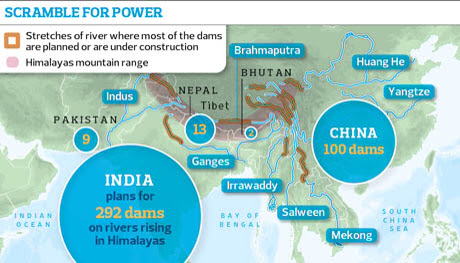
New academic research shows that India, Nepal, Bhutan and Pakistan are engaged in a huge "water grab" in the Himalayas, as they seek new sources of electricity to power their economies. Taken together, the countries have plans for more than 400 hydro dams which, if built, could together provide more than 160,000MW of electricity – three times more than the UK uses.

In addition, China has plans for around 100 dams to generate a similar amount of power from major rivers rising in Tibet. A further 60 or more dams are being planned for the Mekong river which also rises in Tibet and flows south through south-east Asia.

Most of the Himalayan rivers have been relatively untouched by dams near their sources. Now the two great Asian powers, India and China, are rushing to harness them as they cut through some of the world's deepest valleys. Many of the proposed dams would be among the tallest in the world, able to generate more than 4,000MW, as much as the Hoover dam on the Colorado river in the US.

The result, over the next 20 years, "could be that the Himalayas become the most dammed region in the world", said Ed Grumbine, visiting international scientist with the Chinese Academy of Sciences in Kunming. "India aims to construct 292 dams … doubling current hydropower capacity and contributing 6% to projected national energy needs. If all dams are constructed as proposed, in 28 of 32 major river valleys, the Indian Himalayas would have one of the highest average dam densities in the world, with one dam for every 32km of river channel. Every neighbour of India with undeveloped hydropower sites is building or planning to build multiple dams, totalling at minimum 129 projects," said Grumbine, author of a paper in Science.

China, which is building multiple dams on all the major rivers running off the Tibetan plateau, is likely to emerge as the ultimate controller of water for nearly 40% of the world's population. "The plateau is the source of the single largest collection of international rivers in the world, including the Mekong, the Brahmaputra, the Yangtse and the Yellow rivers. It is the headwater of rivers on which nearly half the world depends. The net effect of the dam building could be disastrous. We just don't know the consequences," said Tashi Tseri, a water resource researcher at the University of British Columbia in Canada.

"China is engaged in the greatest water grab in history. Not only is it damming the rivers on the plateau, it is financing and building mega-dams in Pakistan, Laos, Burma and elsewhere and making agreements to take the power," said Indian geopolitical analyst Brahma Chellaney. "China-India disputes have shifted from land to water. Water is the new divide and is going centre stage in politics. Only China has the capacity to build these mega-dams and the power to crush resistance. This is effectively war without a shot being fired."

According to Chellaney, India is in the weakest position because half its water comes directly from China; however, Bangladesh is fearful of India's plans for water diversions and hydropower. Bangladeshi government scientists say that even a 10% reduction in the water flow by India could dry out great areas of farmland for much of the year. More than 80% of Bangladesh's 50 million small farmers depend on water that flows through India.

Engineers and environmentalists say that little work has been done on the human or ecological impact of the dams, which they fear could increase floods and be vulnerable to earthquakes. "We do not have credible environmental and social impact assessments, we have no environmental compliance system, no cumulative impact assessment and no carrying capacity studies. The Indian ministry of environment and forests, developers and consultants are responsible for this mess," said Himanshu Thakkar, co-ordinator of South Asia Network on Dams, Rivers and People.

China and India have both displaced tens of millions of people with giant dams such as the Narmada and Three Gorges over the last 30 years, but governments have not published estimates of how many people would have to be relocated or how much land would be drowned by the new dams. "This is being totally ignored. No one knows, either, about the impact of climate change on the rivers. The dams are all being built in rivers that are fed by glaciers and snowfields which are melting at a fast rate," said Tsering.

Climate models suggest that major rivers running off the Himalayas, after increasing flows as glaciers melt, could lose 10-20% of their flow by 2050. This would not only reduce the rivers' capacity to produce electricity, but would exacerbate regional political tensions.

The dams have already led to protest movements in Uttarakhand, Himachal Pradesh, Sikkim, Assam and other northern states of India and in Tibet. Protests in Uttarakhand, which was devastated by floods last month, were led by Indian professor GD Agarwal, who was taken to hospital after a 50-day fast but who was released this week.

"There is no other way but to continue because the state government is not keen to review the dam policy," said Mallika Bhanot, a member of Ganga Avahan, a group opposing proposals for a series of dams on the Ganges.

Governments have tried to calm people by saying that many of the dams will not require large reservoirs, but will be "run of the river" constructions which channel water through tunnels to massive turbines. But critics say the damage done can be just as great. "[These] will complete shift the path of the river flow," said Shripad Dharmadhikary, a leading opponent of the Narmada dams and author of a report into Himalayan dams. "Everyone will be affected because the rivers will dry up between points. The whole hydrology of the rivers will be changed. It is likely to aggravate floods.

"A dam may only need 500 people to move because of submergence, but because the dams stop the river flow it could impact on 20,000 people. They also disrupt the groundwater flows so many people will end up with water running dry. There will be devastation of livelihoods along all the rivers." More