Showing posts with label atmospheric rivers. Show all posts

Monday, September 29, 2014

Explaining Extreme Events of 2013

A report released today investigates the causes of a wide variety of extreme weather and climate events from around the world in 2013. Published by the Bulletin of the American Meteorological Society, "Explaining Extreme Events of 2013 from a Climate Perspective (link is external)" addresses the causes of 16 individual extreme events that occurred on four continents in 2013. NOAA scientists served as three of the four lead editors on the report.

Of the five heat waves studied in the report, human-caused climate change was found to have clearly increased the severity and likelihood of those events. On the other hand, for other events examined like droughts, heavy rain events, and storms, fingerprinting the influence of human activity was more challenging. Human influence on these kinds of events—primarily through the burning of fossil fuels—was sometimes evident, but often less clear, suggesting natural factors played a far more dominant role.

"This annual report contributes to a growing field of science which helps communities, businesses and nations alike understand the impacts of natural and human-caused climate change," said Thomas R. Karl, L.H.D., director of NOAA’s National Climatic Data Center. "The science remains challenging, but the environmental intelligence it yields to decision makers is invaluable and the demand is ever-growing."

Confidence in the role of climate change about any one event is increased when multiple groups using independent methods come to similar conclusions. For example, in this report, five independent research teams looked at specific factors related to the record heat in Australia in 2013. Each consistently found that human-caused climate change increased the likelihood and severity of that event. However, for the California drought, which was investigated by three teams from the United States, human factors were found not to have influenced the lack of rainfall. One team found evidence that atmospheric pressure patterns increased due to human causes, but the influence on the California drought remains uncertain.

When human influence for an event cannot be conclusively identified with the scientific tools available today, this means that if there is a human contribution, it cannot be distinguished from natural climate variability.

"There is great scientific value in having multiple studies analyze the same extreme event to determine the underlying factors that may have influenced it," said Stephanie C. Herring, PhD, lead editor for the report at NOAA’s National Climatic Data Center. "Results from this report not only add to our body of knowledge about what drives extreme events, but what the odds are of these events happening again—and to what severity."

The report was edited by Herring, along with Martin P. Hoerling, NOAA’s Earth System Research Laboratory; Thomas Peterson, NOAA’s National Climatic Data Center, and Peter A. Stott, UK Met Office Hadley Centre and written by 92 scientists from 14 countries. View the full report online (link is external).

Also, view the slides for the media briefing on the "Explaining Extreme Events of 2013 from a Climate Perspective" report. More


Friday, August 22, 2014

Global Climate Inaction Will Mean Economic Turmoil for South Asia, Warns Bank

The first comprehensive study ever issued on the economic costs that uncontrolled climate change would inflict on South Asia predicts a staggering burden that would hit the region's poorest the hardest.

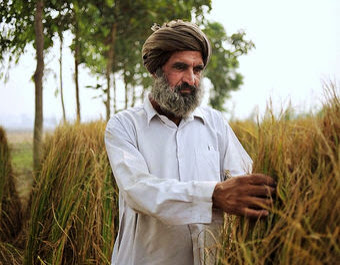
Rice Farmer in Punjab, India

"The impacts of climate change are likely to result in huge economic, social and environmental damage to South Asian countries, compromising their growth potential and poverty reduction efforts," said the study, published by the Asian Development Bank.

The cuts in regional GDP are so deep that they might ripple around the world, as six developing countries with 1.4 billion people—a third of them living in poverty—pay the price of the world's continuing reliance on fossil fuels.

Projections like this feed into the urgency for action as world leaders prepare to meet at the United Nations next month to discuss the climate crisis. Recent warnings show that the steps nations seem willing to take will fall well short of what is needed.

Action now, the study shows, would pay immediate and lasting dividends to the countries it examined: Bangladesh, Bhutan, India, the Maldives, Nepal and Sri Lanka.

The study, published as a new 160-page book, says that if the world cuts fossil fuel consumption enough to keep warming within 2 degrees Celsius—the goal of UN negotiations—the costs to South Asian countries of adapting to rising seas and temperatures in the decades ahead might be cut almost in half.

But if business-as-usual continues, leading to a world that is 4 or 5 degrees warmer by 2100 than at the start of the industrial age, the outlook looks grim.

"Climate change will slash up to 9 percent off the South Asian economy every year by the end of this century if the world continues on its current fossil-fuel intensive path," the bank said. "The human and financial toll could be even higher if the damage from floods, droughts, and other extreme weather events is included."

Because this kind of estimate is inherently imprecise, the bank warned that the real damage could be much worse than expected. Under business-as-usual trends, there is a one in 20 chance that South Asia will lose 24 percent of its annual GDP by the end of the century, the study found.

Paying to stave off those damages will cost these nations dearly, the study said.

To avoid the damage that is expected if the world takes no action on climate change, South Asia would have to spend nearly $40 billion per year by 2050 on adaptation measures, or nearly half a percentage point of average annual GDP. By 2100, the costs would have to increase to $73 billion per year, or roughly nine-tenths of a point of GDP.

If the world were to achieve the 2-degree warming goal established by UN negotiators at climate treaty talks in Copenhagen in 2009—a goal also at the heart of culminating talks set for Paris in 2015—annual adaptation costs for South Asia would be considerably less: $31 billion a year at mid-century, and $41 billion at century's end.

And instead of losing nearly 9 percent of annual GDP by the end of the century, the study found, South Asia would lose about 2.5 percent by 2100 if the world lives up to the goals of Copenhagen. More


Thursday, May 29, 2014

Putting Climate Polluters in the Dock

Can Caribbean governments take legal action against other countries that they believe are warming the planet with devastating consequences?

A former regional diplomat argues the answer is yes. Ronald Sanders, who is also a senior research fellow at London University, says such legal action would require all Small Island Developing States (SIDS) acting together.

He believes the Hague-based International Court of Justice (ICJ) would be amenable to hearing their arguments, although the court’s requirement that all parties to a dispute agree to its jurisdiction would be a major stumbling block.

“It is most unlikely that the countries that are warming the planet, which incidentally now include India and China, not just the United States, Canada and the European Union…[that] they would agree to jurisdiction,” Sanders told IPS.

“The alternative, if countries wanted to press the issue of compensation for the destruction caused by climate change, is that they would have to go to the United Nations General Assembly.”

Sanders said that the Caribbean Community (CARICOM) countries could “as a group put forward a resolution stating the case that they do believe, and there is evidence to support it, that climate change and global warming is having a material effect… on the integrity of their countries.

“We’re seeing coastal areas vanishing and we know that if sea level rise continues large parts of existing islands will disappear and some of them may even be submerged, so the evidence is there.”

Sanders pointed to the damaging effects of flooding and landslides in St. Vincent and the Grenadines, St. Lucia, and Dominica as 2013 came to an end.

The prime minister of St. Vincent and the Grenadines, Dr. Ralph Gonsalves, described the flooding and landslides as “unprecedented” and gave a preliminary estimate of damage in his country alone to be in excess of 60 million dollars.

“People who live in the Caribbean know from their own experience that climate change is real,” Sanders said.

“They know it from days and nights that are hotter than in the past, from more frequent and more intense hurricanes or freak years like the last one when there were none, from long periods of dry weather followed by unseasonal heavy rainfall and flooding, and from the recognisable erosion of coastal areas and reefs.”

At the U.N. climate talks in Warsaw last November, developing countries fought hard for the creation of a third pillar of a new climate treaty to be finalised in 2015. After two weeks and 36 straight hours of negotiations, they finally won the International Mechanism for Loss and Damage (IMLD), to go with the mitigation (emissions reduction) and adaptation pillars.

The details of that mechanism will be hammered out at climate talks in Bonn this June, and finally in Paris the following year. As chair of the Alliance of Small Island States (AOSIS), Nauru will be present at a meeting in New Delhi next week of the BASIC group (Brazil, South Africa, India and China) to try and build a common platform for the international talks.

“It isn’t just the Caribbean, of course,” Sanders said. “A number of other countries in the world – the Pacific countries – are facing an even more pressing danger than we are at the moment. There are countries in Africa that are facing this problem, and countries in Asia,” he told IPS.

“Now if they all join together, there is a moral case to be raised at the United Nations and maybe that is the place at which we would more effectively press it if we acted together. It would require great leadership, great courage and great unity,” he added.

Pointing to the OECD countries, Sir Ronald said they act together, consult with each other and come up with a programme which they then say is what the international standard must be and the developing countries must accept it.

“Why do the developing countries not understand that we could reverse that process? We can stand up together and say look, this is what we are demanding and the developed countries would then have to listen to what the developing countries are saying,” Sir Ronald said.

Following their recent 25th inter-sessional meeting in St. Vincent, Jamaican Prime Minister Portia Simpson Miller praised the increased focus that CARICOM leaders have placed on the issue of climate change, especially in light of the freak storm last year that devastated St. Lucia, Dominica and St. Vincent and the Grenadines.

At that meeting, heads of government agreed on the establishment of a task force on climate change and SIDS to provide guidance to Caribbean climate change negotiators, their ministers and political leaders in order to ensure the strategic positioning of the region in the negotiations.

In Antigua, where drought has persisted for months, water catchments are quickly drying up. The water manager at the state-owned Antigua Public utilities Authority (APUA), Ivan Rodrigues, blames climate change.

“We know that the climate is changing and what we need to do is to cater for it and deal with it,” he told IPS.

But he is not sold on the idea of international legal action against the large industrialised countries.

“I think what will cause [a reversal of their practices] is consumer activism,” he said. “The argument may not be strong enough for a court of law to actually penalise a government.”

But Sanders firmly believes an opinion from the International Court of Justice would make a huge difference.

“We could get an opinion. If the United Nations General Assembly were to accept a resolution that, say, we want an opinion from the International Court of Jurists on this matter, I think we could get an opinion that would be favourable to a case for the Caribbean and other countries that are affected by climate change,” he told IPS.

“If there was a case where countries, governments and large companies knew that if they continue these harmful practices, action would be taken against them, of course they would change their position because at the end of the day they want to be profitable and successful. They don’t want to be having to fight court cases and losing them and then having to pay compensation,” he added. More


Sunday, February 16, 2014

Study: Climate change linked to extreme rain

John Fogerty once crooned "Who'll stop the rain?" Not humanity, apparently, as new research shows that human-caused climate change has significantly increased the chances of extreme rain- and snowfall around the world, along with the deadly floods that follow.

Pakistan floods 2011

This is according to two new studies published Wednesday in the British journal Nature.

While other studies have suggested that global warming may be partly responsible for an increase in heavy precipitation, what's new in this study is the formal finding that human influence has "likely made intense precipitation stronger, on average, over the second half of the 20th century," says study co-author Francis Zwiers of the University of Victoria in British Columbia.

"The observed change cannot be explained by natural fluctuations of the climate system alone," he says.

One of the studies reported that that the most significant rain and snow events were 7 percent wetter in the 1990s than they had been in the 1950s.

Scientists based their findings on rainfall data from 1951 to 1999 in Northern Hemisphere land areas, including North America, Eurasia and India.

The scientists took all the information that showed an increase in extreme rain and snow events from the 1950s through the 1990s, and ran dozens of computer models numerous times. They put in the effects of greenhouse gases -- which come from the burning of fossil fuels -- and then ran numerous models without those factors.

Only when the greenhouse gases are factored in did the models show a similar increase to what actually happened. Essentially, the computer runs show climate change is the only way to explain what's happening.

The other study dealt with the floods that swamped the U.K. in fall 2000 and determined that climate change made them over twice as likely to occur.

Why would global warming lead to more precipitation? According to study co-author Myles Allen of the University of Oxford in England, warmer air holds more water.

Senior scientist Kevin Trenberth of the National Center for Atmospheric Research in Boulder, who was not part of either study, expands on this: "The water holding capacity of the atmosphere goes up with higher temperatures (and higher sea-surface temperatures), and so there is simply more moisture lurking around waiting to be caught up in any storm."

The effects of greenhouse gases on precipitation appear to be global: "Extreme precipitation is expected to increase almost everywhere in a warmer world, even though we expect reductions in mean precipitation in some locations and increases in others," reports Zwiers.

Overall, according to Zwiers, computer models suggest that the northern high latitudes will see the largest percentage increases in mean annual precipitation, and that the tropics will see the largest percentage increases in extreme precipitation.

"Damaging weather events have always happened since well before humans had any substantial influence on climate," says Allen. "This research allows us to quantify how rising greenhouse gas levels may be loading the dice in favor of certain events, such as the U.K. floods of 2000, and against other events."

However, climate scientist Jerry North of Texas A&M University, while praising the work, said he worried that the studies were making too firm a connection based on weather data that could be poor in some locations. More


Wednesday, October 2, 2013

Monsoon to get longer in India [sub-continent]: IPCC

NEW DELHI: North India is likely to heat up more than the southern parts of the country while the entire Indian subcontinent may see longer rainy seasons in second half of the century, the UN's climate body has predicted in its latest comprehensive document on climate change.


The conclusion, showing variation in temperature and rainfall in South Asia, is part of the lengthy technical details of the United Nation's Intergovernmental Panel on Climate Change (IPCC) which made its comprehensive report — Climate Change 2013, The Physical Science Basis — public in Stockholm on Monday.

The findings of the report show that the northern part of the continent is likely to witness winter temperatures rise of up to 0.4 to 0.8 degree Celsius during 2016-35 as compared to the 1986-2005 average, 2 to 3 degree Celsius during 2046-65 and up to 3 to 5 degree Celsius by the end of the century (2081-2100), under different scenarios of action to limit greenhouse gas emissions.

Though the UN body's report on region-wise "impact, adaptation and vulnerability" will come out in March next year, the technical details comprising 14 chapters and Atlas of Global and Regional Climate Projections in its annexure carry indications of these changes in South Asia.

Krishna Kumar Kanikicharla, climate scientist at Pune's Indian Institute of Tropical Meteorology and one of the drafting authors of the IPCC report, told TOI there was "growing evidence" of the impact of the climate change on monsoons in South Asia and the tropical cyclone system in the Bay of Bengal.

Kanikicharla, responsible for drafting the chapter comprising details of monsoon systems, said: "There is strong hint that the duration of the rainy season would increase due to early onset of monsoon. The quantum of rainfall will also increase during the later part of this century."

He said though the Indian summer monsoon circulation will weaken, rainfall will increase due to higher atmospheric moisture resulting from a rise in temperatures.

In its projection for South Asia, the technical summary of the report clearly points at "enhanced summer monsoon precipitation and increased rainfall extremes of landfall cyclones on the coasts of the Bay of Bengal and Arabian Sea".

What is the confidence level of these predictions? Prashant Goswami, one of the lead authors of the IPCC report, admitted that these conclusions were based on climatic projections that were not as firm as those made at a global level.

"These uncertainties increase as you go to smaller scale (from global to regional or from regional to sub-regional levels). But one has to have an element of faith in these conclusions which are based on well defined scientific methodology," Goswami, chief scientist at Bangalore's CSIR Centre for Mathematical Modelling and Computer Simulation, told TOI.

The impact of temperature rise and rainfall variations on the region's agriculture that's highly dependent on monsoon, will be considered in the report on impact, adaptation and vulnerability, to be released next year as part of the IPCC's fifth assessment report (AR5). More


Thursday, August 22, 2013

Littlest continent had biggest role in sea level drop [and rainfall]

A unique and complex set of circumstances came together over Australia from 2010 to 2011 to cause Earth's smallest continent to be the biggest contributor to the observed drop in global sea level rise during that time, finds a new study co-authored and co-funded by NASA.


In 2011, scientists at NASA's Jet Propulsion Laboratory in Pasadena, Calif., and the University of Colorado at Boulder reported that between early 2010 and summer 2011, global sea level fell sharply, by about a quarter of an inch, or half a centimeter. Using data from the NASA/German Aerospace Center's Gravity Recovery and Climate Experiment (GRACE) spacecraft, they showed that the drop was caused by the very strong La Nina that began in late 2010. That La Nina changed rainfall patterns all over our planet, moving huge amounts of Earth's water from the ocean to the continents. The phenomenon was short-lived, however.

By mid-2012, global mean sea level had resumed its long-term mean annual rise of 0.13 inches (3.2 millimeters) per year (see http://www.jpl.nasa.gov/news/news.php?release=2012-362).

But analyses of the historical record showed that past La Nina events only rarely accompanied such a pronounced drop in sea level. So what made this particular La Nina unique?

To better understand this phenomenon, scientists at the National Center for Atmospheric Research (NCAR) in Boulder, Colo.; JPL; and the University of Colorado at Boulder combined GRACE data with data from the Argo global array of 3,000 free-drifting floats and satellite altimeters (Jason-1, Jason-2 and Topex/Poseidon).

They found that three atmospheric patterns converged over the Indian and Pacific Oceans in 2010 and 2011 to drive excessive precipitation over Australia. On average, the continent received almost one foot (300 millimeters) of rain more than normal. The result was widespread flooding. The flooding was in large part prevented from running back into the ocean by Australia's dry soils and the mountain-ringed topography of the country's vast interior, called the Outback, leading to the measurable drop in the world's ocean levels.

"No other continent has this combination of atmospheric set-up and topography," said NCAR scientist John Fasullo, lead author of the study. "Only in Australia could the atmosphere carry such heavy tropical rains to such a large area, only to have those rains fail to make their way to the ocean."

Now that the atmospheric patterns have snapped back and more rain is falling over tropical oceans, the seas are rising again. In fact, with Australia in a major drought, they are rising faster than before. Since 2011, when the atmospheric patterns shifted out of their unusual combination, sea levels have been rising at a faster pace of about 0.4 inches (10 millimeters) per year.

The study, co-funded by NASA and the National Science Foundation, will be published next month in the journal Geophysical Research Letters.


Sunday, July 28, 2013

Rivers' in air could boost flooding

Winter floods could intensify in Britain, [and countries globally] according to new research into powerful weather systems called "atmospheric rivers".

Only identified about 20 years ago, atmospheric rivers are intense bands of moisture that flow through the air.

Known to be responsible for heavy rainfall, they have been blamed for severe flooding in California and the UK.

The new study suggests that warmer conditions could create more rivers - and make them more severe.

The paper is published by the Institute of Physics in Environmental Research Letters.

Atmospheric rivers are up to 300km wide and can stretch in length for over 1,000-2,000km. They flow invisibly between 1-2.5km above the surface of the ocean.

One atmospheric river is believed to have been behind the violent flooding that hit Cockermouth in Cumbria on 19 November 2009.

The flooding claimed the life of a policeman, PC Bill Barker, who died after a bridge collapsed.

The researchers, led by Dr David Lavers of the University of Iowa, have estimated the staggering volume of moisture carried by this particular atmospheric river.

They calculate that at its peak it was transporting almost 300,000 tonnes of moisture every second.

By comparison, the River Thames carries about 65 tonnes of water through London over the same period.

Remain on course

If the rivers make landfall and encounter a steep rise in terrain, the air is forced upwards where it cools and releases the moisture in the form of rain.

On top of that, if the river remains on the same course for 24 hours - as it did over Cumbria in 2009 - it will deliver a continuous flow of heavy rain over the same area.

The most closely-studied atmospheric river, which flows towards the California coast, has been dubbed the "Pineapple Express" because it usually originates from the region of Hawaii.

It has been linked to a number of extremely damaging storms along the US West Coast.

Over the last 30 years, there has been an average of 9-11 of the strongest atmospheric river events hitting Britain every year.

In this latest study, the researchers examined five different modelling scenarios to simulate possible conditions this century and found that a warming climate - which allows the atmosphere to hold more moisture - made the rivers more likely.

Dr Lavers said: "All five models suggest that there could be a doubling of atmospheric river events in the period 2074-99 and most of those could be expected to make landfall in the UK.

"One of the big things is that these are the most relevant feature of winter flooding in Britain and the work is certainly suggesting an increase in strength and frequency."

Computer modelling

Among the uncertainties about the research are the reliability of the models used to generate the future scenarios and possible shifts in the patterns of the winds - a change of course away from the UK would reduce the risk.

It was research in the 1970s that first identified "conveyor belts" of moisture travelling through the atmosphere, with later studies in the early 1990s detecting much narrower bands of intense vapour that became known as atmospheric rivers.

Dr Richard Allan of Reading University, also an author of the paper, said: "What this shows is that the dominating factor is the increase in water vapour which means that if you've got more moisture - and the winds don't change -then you've got a much bigger potential for flooding.

"These are really massive flows of invisible water which can feed clouds and cause rainfall if forced up over mountains."

The researchers say the study could help guide forecasters trying to give warning of future flood risks. More