Showing posts with label IPCC. Show all posts

Wednesday, October 2, 2013

Monsoon to get longer in India [sub-continent]: IPCC

NEW DELHI: North India is likely to heat up more than the southern parts of the country while the entire Indian subcontinent may see longer rainy seasons in second half of the century, the UN's climate body has predicted in its latest comprehensive document on climate change.


The conclusion, showing variation in temperature and rainfall in South Asia, is part of the lengthy technical details of the United Nation's Intergovernmental Panel on Climate Change (IPCC) which made its comprehensive report — Climate Change 2013, The Physical Science Basis — public in Stockholm on Monday.

The findings of the report show that the northern part of the continent is likely to witness winter temperatures rise of up to 0.4 to 0.8 degree Celsius during 2016-35 as compared to the 1986-2005 average, 2 to 3 degree Celsius during 2046-65 and up to 3 to 5 degree Celsius by the end of the century (2081-2100), under different scenarios of action to limit greenhouse gas emissions.

Though the UN body's report on region-wise "impact, adaptation and vulnerability" will come out in March next year, the technical details comprising 14 chapters and Atlas of Global and Regional Climate Projections in its annexure carry indications of these changes in South Asia.

Krishna Kumar Kanikicharla, climate scientist at Pune's Indian Institute of Tropical Meteorology and one of the drafting authors of the IPCC report, told TOI there was "growing evidence" of the impact of the climate change on monsoons in South Asia and the tropical cyclone system in the Bay of Bengal.

Kanikicharla, responsible for drafting the chapter comprising details of monsoon systems, said: "There is strong hint that the duration of the rainy season would increase due to early onset of monsoon. The quantum of rainfall will also increase during the later part of this century."

He said though the Indian summer monsoon circulation will weaken, rainfall will increase due to higher atmospheric moisture resulting from a rise in temperatures.

In its projection for South Asia, the technical summary of the report clearly points at "enhanced summer monsoon precipitation and increased rainfall extremes of landfall cyclones on the coasts of the Bay of Bengal and Arabian Sea".

What is the confidence level of these predictions? Prashant Goswami, one of the lead authors of the IPCC report, admitted that these conclusions were based on climatic projections that were not as firm as those made at a global level.

"These uncertainties increase as you go to smaller scale (from global to regional or from regional to sub-regional levels). But one has to have an element of faith in these conclusions which are based on well defined scientific methodology," Goswami, chief scientist at Bangalore's CSIR Centre for Mathematical Modelling and Computer Simulation, told TOI.

The impact of temperature rise and rainfall variations on the region's agriculture that's highly dependent on monsoon, will be considered in the report on impact, adaptation and vulnerability, to be released next year as part of the IPCC's fifth assessment report (AR5). More


Sunday, July 29, 2012

IPCC Scholarship Program 2012

IPCC Scholarship Program is to build capacity in the understanding and management of climate change in developing countries through providing opportunities for young scientists from developing countries to undertake studies that would not be possible without the intervention of the Fund.

Applications from students from Least Developed Countries (LDCs) and Small Island Developing States (SIDS) researching topics with the fields of study chosen for the call for applications are given priority.

Scholarship Details: A scholarship award will be for a maximum amount of USD 20,000 per year.

Eligibility Criteria: The Call for Applications is open to candidates fulfilling the following requirements:

* Post-Graduate students at PhD level, accepted at a recognized educational institution to start studies in 2013, or currently enrolled on continuing PhD courses

* Applicants must be younger than 30 years of age at the time of application

* Applicants must be nationals of developing countries

How to Apply: Register to upload your completed application and requested supporting documents via the following link: https://www.ipcc.ch/apps/scholarship/applicant/

Deadline: 30 September 2012

Click here for more details and information: http://www.ipcc.ch/ipcc-scholarship-programme/ipcc_scholarshipprogramme.shtml#.UBIRDdmN6Sq


Thursday, July 12, 2012

IPCC announces call for applications for second round of awards under the IPCC Scholarship Programme

IPCC announces call for applications for second round of awards under the IPCC Scholarship Programme

The Intergovernmental Panel on Climate Chance (IPCC) has opened a call for applications for the second round of awards under the IPCC Scholarship Programme.

The IPCC Scholarship Programme aims to build capacity in the understanding and management of climate change in developing countries by providing opportunities for young scientists from developing countries to undertake studies that would not be possible without funding under the programme.

Applicants must be post-graduate students under the age of 30 studying at PhD level. They must have already been accepted at a recognized educational institution to start studies in 2013, or be currently enrolled on continuing PhD courses. Research proposals should focus on one of the following fields of study:

* Socio-economic modelling related to climate change

* Underlying science of climate change

* Climate change and water

Applicants must be nationals of developing countries and priority will be given to students from Least Developed Countries (LDCs) and Small Island Developing States (SIDS).

With a value of up to USD 20,000 per year, each award will be given for a period of one year and is renewable once, subject to satisfactory progress during the period of study and term reports signed by the research supervisor.

Applications will undergo a two-level selection process. IPCC scientific experts will first assess the applications in an initial review and the IPCC Science Board will then review the applications and make a final selection. The candidates selected for an award will be notified individually during the second quarter of 2013.

The IPCC Scholarship Programme was established with the funds received from the 2007 Nobel Peace Prize. The IPCC Scholarship Programme benefits from the support of the Prince Albert II of Monaco Foundation.

Students interested in applying for an IPCC scholarship can download application forms at:

http://www.ipcc.ch/ipcc-scholarship-programme/ipcc_scholarshipprogramme.shtml

Completed application forms and supporting documents should be uploaded by 30 September 2012 at:

https://www.ipcc.ch/apps/scholarship/applicant/


Saturday, January 30, 2010

World's glaciers continue to melt at historic rates


Latest figures show the world's glaciers are continuing to melt so fast that many will disappear by the middle of this century.

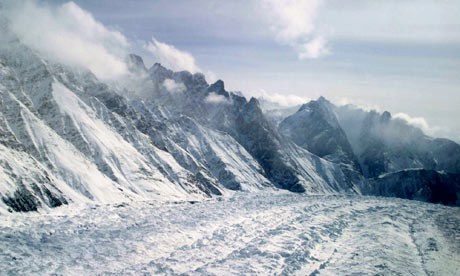
[Above: An aerial view of the Siachen glacier]

Glaciers across the globe are continuing to melt so fast that many will disappear by the middle of this century, the World Glacier Monitoring Service (WGMS) said today.

The announcement of the latest annual results from monitoring in nine mountain ranges on four continents comes as doubts have been cast on how much climate scientists have exaggerated the problem of glacier melt, which is seen as a leading indicator of how much the planet is heating up.

Last week the head of the Intergovernmental Panel on Climate Change (IPCC) apologised for "a paragraph" in its four-volume 2007 report which warned there was a "very high" risk that the Himalayan glaciers, on which at least half a billion of the world's poorest people depend for water, would disappear by 2035.

However the director of the WGMS, Professor Wilfried Haeberli, said the latest global results indicated most glaciers were continuing to melt at historically high rates. More >>>