Showing posts with label extreme weather. Show all posts

Wednesday, October 22, 2014

Mismanaging Climate Change

Pakistan’s extreme vulnerability to climate change is not a scientific secret but is, in fact, a logical certainty owing to its geographic location, inclined elevation, as well as demographics.

Former Minister Malik Amin Aslam Khan

The issue directly impacts upon the country’s already volatile water dynamics driven by the northern glaciers and the seasonal monsoon rains and, if not managed properly, could burden our economy to the tune of $6-14 billion per year (United Nations Framework Convention on Climate Change NEEDS study 2010). In response to this challenge, Pakistan’s National Climate Change Policy has laid out a comprehensive ‘to do’ list for the government, which was approved by the government but, unfortunately, has not been acted upon by the authorities. Oblivious to this apathy and inaction, Pakistan continues to face a mammoth challenge to not only climate-proof its future development path, but also take steps to cope with an issue, which is here to stay. These steps include establishing early warning systems, effective flood plain management, improving weather forecasting with cross-border data exchange and enhancing the disaster preparedness, as well as emergency response capabilities to deal with predicted climate-induced natural disasters.

To their credit, previous governments did begin to take concrete institutional building measures, such as establishing a very high-level Prime Minister’s Cabinet Committee on Climate Change, setting up a dedicated Ministry of Climate Change built on the debris of a misguidedly devolved Environment Ministry and creating a focused climate research centre i.e., the Global Change Impact Studies Centre. However, in one stroke of convenient denial, the present government has undone and dismantled all those measures by downgrading the ministry to a division level, drastically cutting the funds for the division, leaving it headless without an appointed minister and also drying up all finances for the climate research centre. It is, thus, not surprising, that the country received a rude wake-up call when, during the recent floods, the forces of nature once again caught it totally off guard and institutionally ill-prepared to deal with a situation, which had been predicted and forewarned time and again by climate experts.

The 2014 flood came in two surges. The first surge occurred due to exceptionally high rainfall in the rivers Jhelum, Chenab, Ravi and their catchments. It is a recorded fact that the Pakistan meteorological office gave clear warnings about this enhanced rainfall activity, which were not heeded to in a timely manner. The result of this negligence was that the Mangla Dam remained filled to the brim, while storm waters gathered upstream and, subsequently, the floodgates were forced open at the worst possible time when water levels were already dangerously peaking downstream. Had the water been incrementally released, as advised, the massive flood surge that eventually occurred could have been effectively prevented. Dams remain a double-edged sword — if used intelligently, they can be the best tool for controlling and regulating floods, but if used improperly, as they were on this occasion, they can quickly convert floods into mega human disasters.

This first human-induced deluge was followed by the second flood surge that occurred due to the unpredictably high ‘cloud-burst’ in Indian-held Kashmir. The information about this second surge was also received hours in advance as the water roared down River Chenab. Again, our own meteorological office issued a timely flood peak warning, but again, the reaction time and response measures of our government were found severely lacking.

The floods were triggered by climate-induced cloud-bursts and monsoonal shifts, but the human tragedy and destruction got multiplied due to poor government planning, human negligence and a criminal mixture of absence and apathy of relevant institutional response mechanisms.

Climate related calamities, including more flooding and an enhanced frequency of freak natural events are, unequivocally, predicted for Pakistan and it is time to take these warnings seriously, and for the government to heed to them by planning to deal with the consequences, limiting the damage and adapting to this shifting scenario. The recent floods, which are surely not the last one, have also rudely exposed the human, economic and environmental costs to be paid for our politically motivated aversion to building large dams, as well as the suicidal trend of encroaching upon flood plains and continuing to challenge the flood water boundaries.

Pakistan lies at the geographic crossroads of melting glaciers, shifting monsoons and enhanced disaster activity. This locational risk cannot be changed, but how we deal with this looming catastrophe can certainly be changed. What it requires is better responsive measures and heeding to technical advice and scientifically based warnings with timely decisions.

The political optics of wading through floodwaters and post disaster bear hugs with destitute and frustrated victims is beginning to lose its vote-gathering lustre. As we haplessly subject millions to avoidable disasters, it is time to face up to reality. Climate-proofing of infrastructure, conserving the yearly deluge of water that is callously flushed into the Arabian Sea and effectively enforced flood plains management needs to get the priority it deserves. The politics of underpasses and overpasses has to give way to the politics of common sense, based on what Pakistan’s real challenges are and what it is predicted to face up to in the near future. Governing with confused priorities and institutional mismanagement will continue to worsen the responses forced upon us as we face up to the unpredictability of climate change. More

Published in The Express Tribune, October 19th, 2014.


Saturday, July 19, 2014

Sifting through the wreckage of MH17, searching for sense amid the horror

Any journalist should hesitate before saying this, but news can be bad for you. You don’t have to agree with the analyst who reckons “news is to the mind what sugar is to the body” to see that reading of horror and foreboding hour by hour, day after day, can sap the soul.

This week ended with a double dose, administered within the space of a few hours: Israel’s ground incursion into Gaza and, more shocking because entirely unexpected, the downing of Malaysia Airlines flight MH17 over Ukraine, killing all 298 on board.

So in Gaza we look at the wildly lopsided death tolls – nearly 300 Palestinians and two Israelis killed these past nine days.

The different responses these events stir in those of us who are distant, and the strategies we devise to cope with them, say much about our behaviour as consumers of news. But they also go some way to determining our reaction as citizens, as constituent members of the amorphous body we call public, or even world, opinion.

As I write, 18 of the 20 most-read articles on the Guardian website are about MH17. The entry into Gaza by Israeli forces stands at number 21. It’s not hard to fathom why the Malaysian jet strikes the louder chord. As the preacher might put it, “There but for the grace of God go I.” Stated baldly, most of us will never live in Gaza, but we know it could have been us boarding that plane in Amsterdam.

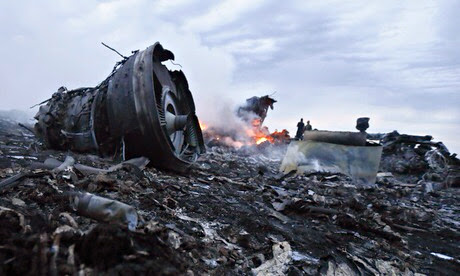
Which is why there is a morbid fascination with tales of the passenger who changed flights at the last minute, thereby cheating death, or with the crew member who made the opposite move, hastily switching to MH17 at the final moment, taking a decision that would have seemed so trivial at the time but which cost him his life. When we read about the debris – the holiday guidebooks strewn over the Ukrainian countryside, the man found next to an iPhone, the boy with his seatbelt still on – our imaginations put us on that flight. Of course we have sympathy for the victims and their families. But our fear is for ourselves.

It’s quite true that if the US truly decided that Israel’s 47-year occupation of Palestinian territory was no longer acceptable, that would bring change.

The reports from Gaza stir a different feeling. When we read the Guardian’s Peter Beaumont describe the sights he saw driving around the strip on Friday morningthree Palestinian siblings killed by an Israeli artillery shell that crashed into their bedroom, a father putting the remains of his two-year-old son into a plastic shopping bag – we are shaken by a different kind of horror. It is compassion for another human being, someone in a situation utterly different to ours. We don’t worry that this might happen to us, as we now might when we contemplate an international flight over a war zone. Our reaction is directed not inward, but outward. More

There is an interesting article by Chris Hedges entitled It's NOT going to be OK on the current economic disparity which, he believes could lead to a drastic decline in democracy as states respond to social protests. The question I ask is what can be done to slow or erradicate this process? Editor


Saturday, May 31, 2014

Monsoon Disrupted By El Nino + Climate Change as India Suffers Deaths, Crop Losses from Extreme Heat.

May is the month when the massive rainstorm that is the Asian Monsoon begins to gather and advance. This year, as in many other years, the monsoon gradually formed along the coast of Myanmar early in the month. It sprang forward with gusto reaching the Bay of Bengal by last week.

And there it has stalled ever since.

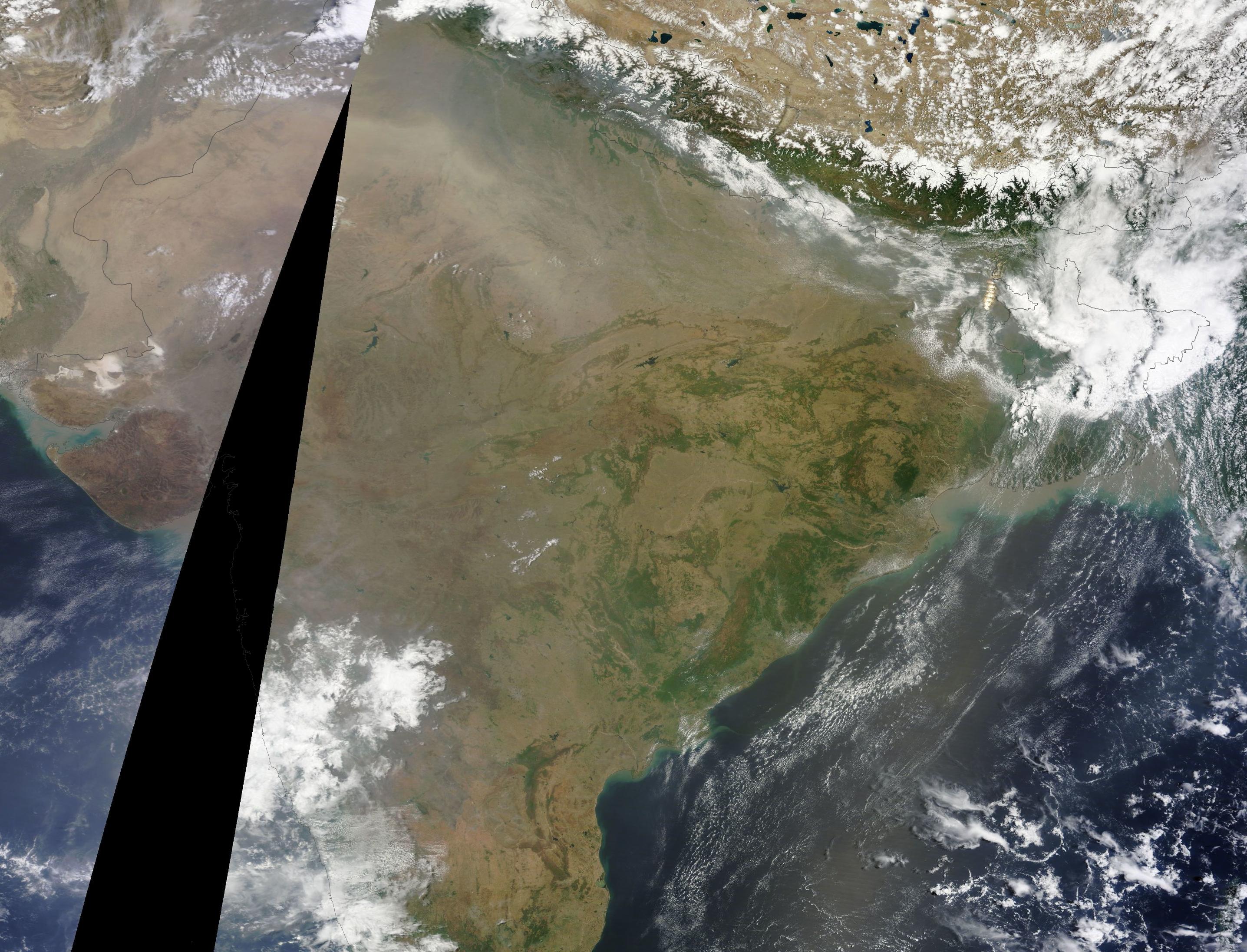
On May 25-27, an outburst of moisture from this stalled monsoonal flow splashed over the coasts of India. But by the 29th and 30th, these coastal storms and even the ones gathering over the Bengali waters had all been snuffed out. The most prominent feature in the MODIS shot of India today isn’t the rainfall that should be now arriving along the southeast coast, but the thick and steely-gray pallor of coal-ash smog trapped under a persistent and oppressive dome of intense heat.

(MODIS shot of India on May 30th. See the open stretch of blue water in the lower right frame? That’s the Bay of Bengal which borders coastal India. During a normal year at this time, that entire ocean zone should be filled with the storm clouds of a building monsoon that is already encroaching on coastal India. Today, there is nothing but a smattering of small and dispersed cloud through a mostly clear sky. Image source: LANCE-MODIS.)

Monsoon Described as Feeble

Official forecasts had already announced as of May 27th that the annual monsoon was likely to be delayed by at least a week for southeast regions of India. Meanwhile, expected monsoonal rainfall for western and northern sections of India for 2014 fell increasingly into doubt.

From The Times of India:

The monsoon is likely to be delayed by 10 days, according to scientists at the Indian Institute of Tropical Meteorology (IITM) here. The IITM’s third experimental real-time forecast says that a feeble monsoon will reach central India after June 20 as against the usual June 15. Last year, the monsoon had covered the entire country by June 15.

The annual monsoon is key to India’s agriculture. The substantial rains nurture crops even as they tamp down a powerful heating that typically builds throughout the sub-continent into early summer. Without these rains, both heat and drought tend to run rampant, bringing down crop yields and resulting in severe human losses due to excessive heat.

But, this year, heat and drought are already at extreme levels.

Major Heatwave Already Results in Loss of Life for 2014

As early as late March, the heatwave began to build over the Indian subcontinent. The heat surged throughout the state, setting off fires, resulting in a growing list of heat casualties, shutting down the power grid and spurring unrest. Meanwhile, impacts to India’s agriculture were already growing as the Lychee fruit crop was reported to have suffered a 40% loss.

By late May, temperatures across a broad region had surged above 105 degrees shattering records as the oppressive and deadly heat continued to tighten its grip.

In a country surrounded on three sides by oceans, it is a combination of heat, humidity and persistently high night-time temperatures that can be a killer. Wet bulb temperatures surge into a high-risk range for human mortality during the day even as night-time provides little respite for already stressed human bodies. Such extreme and long-duration heat doesn’t come without a sad toll. As of today, early reports indicated a loss of more than 56 lives due to heat stroke (In 2012 and 2013, total Indian heat deaths were near 1,000 each year). That said, final figures on heat losses are still pending awaiting complete reports from all of India’s provinces.

"Climatologically, we know that heatwaves are increasing in frequency and the number of days exceeding 45ºC temperatures is increasing. The frequency will increase further with global warming, hence this is a good example of a situation where science and disaster management can come together and avert damage," a spokesman for India’s National Disaster Management Authority noted on Friday.

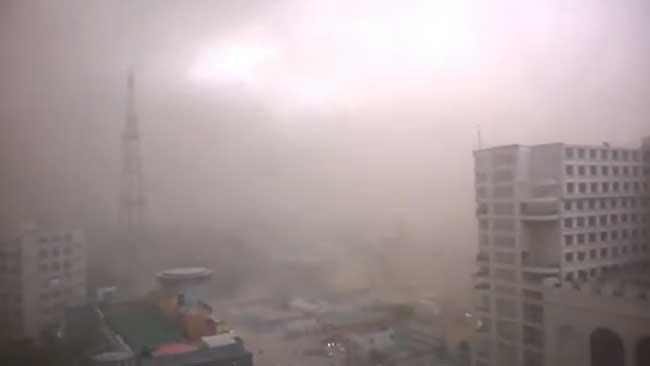
(Hot Dust. A dust storm rolls through New Delhi on Friday amidst furnace-like 113 degree heat snarling traffic and resulting in the tragic loss of 9 more lives. Image source: Gaurav Karoliwal/YouTube Screenshot.)

Today the heatwave continued to gain ground, with Kota and Rajasthan reaching an all-time record of 116 degree F (46.5 C) as New Delhi’s mercury hit 113 degrees F in the midst of a drought-induced dust storm. Dust shrouding the city spurred traffic chaos and in the heat, darkness, and confusion nine more souls were lost.

After two months of growing disruption due to heat and drought, the lands and peoples of India cry out for a Monsoon that is running later and later with each new weather report.

Climate Change + El Nino: Adding Heat and Beating Back the Monsoon

As systems approach tipping points, they are more likely to tilt toward the extremes.

For India this year, its seasonally warmest period from April to May found severe heat amplification from a number of global factors. First, climate change seeded the ground for the current Indian heatwave by adding general heat and evaporation to already hot conditions. With global average heating of +0.8 C above 1880s levels amplifying in the hot zones, early moisture loss due to higher-than-normal temperatures produces a kind of snowball effect for still more warming. Essentially, the cooling effect of water evaporation is baked out early allowing for heat to hit harder just as typical seasonal maximums are reached. More

Originally published by robertscribbler.wordpress.com/


Sunday, May 25, 2014

Nepal Glaciers Shrink By Quarter In 30 Years

Climate crisis has caused Nepal 's Himalayan glaciers to shrink by nearly a quarter in just over 30 years, said a scientist.

The glacier loss raises the risk of natural disasters in the ecologically fragile region.

A new study by the Kathmandu-based International Centre for Integrated Mountain Development (ICIMOD) shows that the area covered by glaciers has decreased by 24 per cent between 1977 and 2010.

Samjwal Ratna Bajracharya, lead author of the report, said “the shrinking of glaciers in Nepal is definitely connected to climate change; glacial melt is a huge indicator of rising temperatures.”

Under the three-year study led by ICIMOD scientists mapped satellite imagery from several decades to find the extent of ice loss in the region.

The fastest decline occurred between 1980 and 1990, said Bajracharya. Prior to the late 1970s, satellite imagery reflected little change in Nepal 's glacial area.

He said the glacial melting is creating huge, expanding lakes that threaten to burst and devastate mountain communities living downstream.

The accelerated glacial loss raises concerns over future access to water resources, particularly in regions where groundwater is limited and monsoon rains are erratic.

“If the trend continues, the immediate impact will be felt by those living in high-altitude regions, which are dependent on freshwater reserves from glaciers,” said Bajracharya.

The findings also sound alarm bells for Nepal 's push to develop hydropower projects.

“ Nepal cannot use its water resources to develop the country without assessing the state of our glaciers and river basins,” he said.

A government report in India recently blamed hydropower projects for devastating floods last year that killed thousands in India and Nepal .

The government panel said the build up of sediment in rivers, due to the dumping of soil that was dug up during construction of hydropower projects, exacerbated flooding when record-high rainfall hit the region last June.

It should be mentioned that the Himalayan region abounds in glaciers. Most of the big glaciers lie in the eastern Himalayas .

As the western Himalayas receive only a small amount of rainfall, barring the formation of vast snowfields, the source of some of the big rivers of Nepal are in fact glaciers.

Nepal 's largest glacier lies in the Mahalangur and the Kumbhakarna ranges. Khumbu is the biggest glacier and Langtang the longest. Kanchenjunga , Yalung, Nupchu and Langtang are some other glaciers belonging to the eastern Himalayas . Tukche and Hidden valley glaciers belong to the central Himalayas but these are comparatively small.

The Khumbu glacier is situated between Mount Everest and the Lhotse-Nuptse Ridge. It is seen flowing down between the two mountains and swerving right through the Khumbu valley. The terrain is gray and rocky. More


Thursday, May 22, 2014

Challenge in Sao Paulo: Overcoming Water Scarcity in South America’s Largest City

Last March, one of Brazil’s most important newspapers, O Estado de S. Paulo, published a version of the article below, which summarizes the Conservancy’s efforts to help secure Sao Paulo’s water supply. It is translated and reprinted here with permission.

By João Campari and Samuel Barrêto, The Nature Conservancy

The inhabitants of Sao Paulo have been dealing with discouraging images of cracked riverbeds where they used to see flowing water, making this temperate part of Brazil look more like the country’s semi-arid region. Unfortunately, these stark images show the worsening struggles of the Cantareira system, one of the greatest water supply systems in the world.

Right now, the Cantareira’s reservoirs — responsible for providing water for more than 12 million inhabitants of the Sao Paulo Metropolitan Region (RMSP) and Campinas — are operating at less than 15% capacity*, the lowest level recorded since the Cantareira’s creation in the early 1970s.

The images, the symbol of the current crisis, show that water doesn’t really come from the taps in our houses. It comes from nature, and in Sao Paulo much of that nature is the Atlantic Forest. While water rationing gets peoples’ attention and is one of the necessary responses to water scarcity, rationing alone is not enough to solve the long-term problem of securing lasting access to fresh water.

We must look beyond the tap and work to take care of our water supplies at their sources. We need a systemic response for the management of watersheds to restore the sources of our water that have been degraded, polluted and deforested. Forests are very important for healthy fresh water supplies. Unfortunately, the Cantareira system alone has lost 70% of its original forest cover, aggravating the sedimentation of rivers and dams, and decreasing their ability to supply water.The degradation of native vegetation also worsens the effects of erosion and drought.

The interaction of all these factors — deforestation, sedimentation, erosion and drought — leads to a situation of extreme risk and represents an environmental, social and economic threat not just to Sao Paulo, but to the entire country of Brazil. The Sao Paulo Metropolitan Region and Campinas together are responsible for more then 22% of the country’s GDP. Therefore, it is a priority to create a strong and strategic response to the increasing and urgent problems of water quantity, quality, access and supply for urban centers.

Protecting Water Supplies at their Sources

We must go beyond conventional interventions, such as engineering works — more dams or aqueducts are not the answer. Wider, systemic responses are necessary, and the responsibility to act is not limited to the government. We all need water and it is the shared responsibility of businesses, communities and civil society as a whole to search for solutions together. The government’s role is to foster and implement multiple solutions that reach multiple stakeholders at once.

The Conservancy’s work shows that one of the highest priorities for securing Sao Paulo’s water supplies is strengthening the Cantareira system’s “green infrastructure” by restoring the degraded forests of the Atlantic Forest, as well as conserving existing forest remnants. Such initiatives ensure the health of a watershed. This type of solution, when well managed, minimizes the risk of extreme events and reduces the vulnerability of populations to floods and prolonged droughts. Healthy forests also store water and reduce erosion and provide environmental services of water regulation and security to the population.

New York City illustrates this equation quite clearly. Decades ago, the city’s administration compared the costs of both natural and built infrastructure for protecting and providing water. Preserving the forests that were source of the city’s drinking water cost US $1 to 1.5 billion over 10 years. That amount was seven times lessthan the estimated US $6 to 8 billion needed to build a traditional, engineered water treatment and distribution network. (That amount doesn’t include the additional and ongoing operational and maintenance costs of $300 to $500 million a year that would have been necessary.) Obviously, nature was the better buy for the people of New York.

It is something for Sao Paulo to consider. A recent study by the Conservancy showed that restoring about 35,000 acres of deforested areas and preventing erosion on 5000 acres within the basins of the Piracicaba, Capivari, Jundiaí and Alto Tietê rivers would decrease the level of sediments that clog the rivers by 50%. Reducing erosion would increase the capacity of water reservoirs and simultaneously decrease the cost of treatment for the removal of sediments.

What the Conservancy is doing in Sao Paulo

To help accomplish restoration goals in the lands around Sao Paulo’s Cantareira system, the Conservancy-led Water Producers Project provides payments to farmers and ranchers who conserve forests on properties that are part of the watershed that feeds the Cantareira reservoirs. This payment-for-environmental-services program recognizes and compensates landowners for the water-producing value their lands provide.

The Conservancy also leads the Water for Sao Paulo Movement. This initiative fosters conversation and working relationships between different stakeholders and focuses on the importance of both water conservation and nature-based solutions for securing the water supply of the region. Because healthy forests are so important for healthy rivers and water supplies, Water for Sao Paulo seeks to restore degraded forests near the urban area.

Finally, Sao Paulo must strengthen the existing Watersheds Committees. Created by the Brazilian Legislature, Watersheds Committees discuss and make decisions about the use of water from specific river basins and are some of the most important collaborations for achieving a balance between water supply and demand.Committees include representatives of local governments, water supply companies and civil society, who are responsible for tasks such as approving water management plans, defining actions for conservation of biodiversity and mediating conflicts about the use of water resources. There are more than 200 of these groups in Brazil.

The current crisis in the Cantareira system is both a challenge and an opportunity to learn from the past and make better decisions for the future. If we have the discernment to act in a systemic way and the political and institutional capacity for change, we will be able to reduce the risks of a permanent cycle of water shortage. In addition to this, we have the opportunity to show how healthy watersheds contribute to water security, which is indispensable for Sao Paulo’s social and economic stability into the future.

To learn more about how the Conservancy is helping to secure Brazil’s water supplies, please visit Where Does Your Water Come From?

*Since this article was published in March, the need for concerted action in Sao Paulo has become even more urgent. The level of water in the Cantareira system has now dropped – to about 8% of its overall capacity. As an emergency stopgap to provide water to the city, the government of Sao Paulo spent US$36 million on emergency constructions to allow access to water stored below the level of the pumps. Known to water managers as “dead volume,” this water was never intended to be part of the water supply, and the reservoirs are now, essentially, operating at a deficit. More


Thursday, May 8, 2014

Third National Climate Assessment: Climate Change Impacts in the United States

Please see the message below announcing the release of the new U.S. National Climate Assessment and the associated websites where it is available.

We are so pleased to announce today’s release of the Third National Climate Assessment: Climate Change Impacts in the United States. The Third National Climate Assessment (NCA), which delivers on USGCRP’s legal mandate and the President’s Climate Action Plan, is the most comprehensive, authoritative, transparent scientific report ever generated on U.S. climate impacts, both as currently observed and as projected for the future. The Third NCA documents climate change-related impacts and responses across key sectors and all regions of the U.S. with the goal of better informing public and private decision-making at all levels.

WHERE CAN YOU FIND THE ASSESSMENT?

The Third NCA is available to download and also can be explored in a novel interactive format through USGCRP’s newly redeployed web presence at http://globalchange.gov. An important feature of this interactivity is the traceability of the data and other information in the report, giving users the means to refer back to these data for their analyses and decision support. The site is mobile-compatible and every piece of the report—from highlights to chapters to key messages to graphics—has its own unique URL for social network sharing. Please find below links that will help you navigate the Third NCA:

· Full Report: http://nca2014.globalchange.gov/

· Highlights: http://nca2014.globalchange.gov/highlights

Beyond the Third NCA, the new globalchange.gov features accessible and dynamic information on a wide range of climate-related topics.

Any White House materials about the release of the Third NCA will be available from: http://www.whitehouse.gov/climate-change. At 2:00 pm EDT, the White House is hosting a stakeholder event that will feature speakers from the Administration, NCA authors, and users of the report. For those who won't be at the event in person, you can tune into the live webcast:http://www.whitehouse.gov/live.

WHAT CAN BE FOUND IN THIS LATEST ASSESSMENT?

The data and information in the Third NCA can be of great value to the adaptation planning and implementation efforts of U.S. Federal Agencies and their partners and stakeholders. Some examples include:

· The latest science on observed trends and projected future conditions of changes in the climate across the 8 NCA regions and contiguous U.S. as well as 13 sectors and cross-sectors.

· Examples throughout of on-the-ground impacts across the U.S., many of which are already directly affecting substantial numbers of Americans.

· For the first time in a U.S. national assessment, explicit chapters on Decision Support, Mitigation, and Adaptation, with specific information on those topics as they are practiced now in addition to identifying research needs associated with these topics for improving future implementation of climate resilience measures. Specifically related to adaptation, the following information is captured in the Adaptation chapter:

o Adaptation key terms defined

o An overview of adaptation activities at multiple levels including the Federal government, states, tribes, local and regional governments, non-governmental organizations, and the private sector

o Example barriers to adaptation

o Several illustrative case studies of adaptation in action

· A useful and informative section that answers some frequently asked questions about climate change. The questions addressed range from those purely related to the science of climate change to those that extend to some of the issues being faced in consideration of mitigation and adaptation measures.

· Data and metadata behind content and images used in the assessment are accessible and traceable.


Thursday, April 17, 2014

Food shortages could be most critical world issue by mid-century

The world is less than 40 years away from a food shortage that will have serious implications for people and governments, according to a top scientist at the U.S. Agency for International Development.

Dr. Fred Davies

"For the first time in , food production will be limited on a global scale by the availability of land, water and energy," said Dr. Fred Davies, senior science advisor for the agency's bureau of food security. "Food issues could become as politically destabilizing by 2050 as are today."

Davies, who also is a Texas A&M AgriLife Regents Professor of Horticultural Sciences, addressed the North American Agricultural Journalists meeting in Washington, D.C. on the "monumental challenge of feeding the world."

He said the world population will increase 30 percent to 9 billion people by mid-century. That would call for a 70 percent increase in food to meet demand.

"But resource limitations will constrain global food systems," Davies added. "The increases currently projected for crop production from biotechnology, genetics, agronomics and horticulture will not be sufficient to meet food demand." Davies said the ability to discover ways to keep pace with food demand have been curtailed by cutbacks in spending on research.

"The U.S. agricultural productivity has averaged less than 1.2 percent per year between 1990 and 2007," he said. "More efficient technologies and crops will need to be developed—and equally important, better ways for applying these technologies locally for farmers—to address this challenge." Davies said when new technologies are developed, they often do not reach the small-scale farmer worldwide.

"A greater emphasis is needed in high-value horticultural crops," he said. "Those create jobs and economic opportunities for rural communities and enable more profitable, intense farming." Horticultural crops, Davies noted, are 50 percent of the farm-gate value of all crops produced in the U.S.

He also made the connection between the consumption of fruits and vegetables and chronic disease prevention and pointed to research centers in the U.S. that are making links between farmers, biologists and chemists, grocers, health care practitioners and consumers. That connection, he suggested, also will be vital in the push to grow enough food to feed people in coming years.

"Agricultural productivity, , safety, the environment, health, nutrition and obesity—they are all interconnected," Davies said. One in eight people worldwide, he added, already suffers from chronic undernourishment, and 75 percent of the world's chronically poor are in the mid-income nations such as China, India, Brazil and the Philippines.

"The perfect storm for horticulture and agriculture is also an opportunity," Davies said. "Consumer trends such as views on quality, nutrition, production origin and safety impact what foods we consume. Also, urban agriculture favors horticulture." For example, he said, the fastest growing segment of new farmers in California, are female, non-Anglos who are "intensively growing horticultural crops on small acreages," he said. More


Monday, April 14, 2014

Quenching Kenya: Can New Water Discoveries Save East Africa?

Water scarcity is becoming the defining international crisis of the twenty-first century. Water conflicts rage across the world as communities struggle to secure a clean, reliable supply.

One of the world’s most water-stressed regions is East Africa. Overexploitation of water resources there has been compounded by declining snowpacks on Mount Kilimanjaro and Mount Kenya, which have shrunk since the late 1980s due to global warming. Meanwhile, Lake Turkana -- the world’s largest perennial desert lake -- has largely disappeared from Ethiopian territory, retreating south into Kenya.

In this light, the discovery of two significant aquifers in mostly arid Kenya by a Japanese-financed UNESCO project has been hailed as a potential game changer. The first, the Lotikipi Basin Aquifer, is situated just west of Lake Turkana. The second, the smaller Lodwar Basin Aquifer, is near Lodwar, the capital of Turkana county. The aquifers were discovered by a French firm, Radar Technologies International (RTI), using a space-based exploration technology called WATEX that was originally designed to reveal mineral deposits. The company blended satellite and radar imagery with geographical surveys and seismic data to detect moisture. Subsequent drilling by UNESCO confirmed the presence of aquifers. Three other suspected aquifers in the region have yet to be verified through drilling.

For parched and economically backward Turkana, more than one-third of whose residents are malnourished, the discovery of major groundwater reserves is a godsend. Not only will the reserves provide lifesaving water, they will also spur the development of agricultural and hydrocarbon sectors and improve the lives of the impoverished residents in this conflict-ridden region, which extends from Kenya into the borderlands of Ethiopia and South Sudan. More [Subscription]


Friday, April 11, 2014

Water Crisis: 2020 Statement by Mikhail Gorbachev on 20th Anniversary of Green Cross

Water crisis – clear and present danger

We live in urgent times. The sum of the concurrent crises that have been engulfing everything from climate to energy, to the economy, is creating a spiral of need for change. But the water crisis sticks out of this list in terms of being an explicitly clear and present danger with deadly implications.

Mikhail Gorbachev

The mounting water crisis and its geography make it clear that without resolute counteraction, it will overstretch many societies’ adaptive capacities within the coming decades. This could result in massive migration, severe socio-economic stress, destabilization and violence, jeopardizing national and international security to a new degree.

By 2025, a predicted 1.8 billion people will live in regions suffering from absolute water scarcity. Two-thirds of the world population could be under hydric stress conditions. Demand for water will rise: water withdrawals in developing countries will increase by 50%, and 18% in developed countries by 2025.

Despite these demands, what state is the world’s water in? Despite the fact that we use slightly more than half the world’s (54%) accessible water, more than 50% of the 3.5 billion people living in urban circumstances around the world already do not have access to adequate water and sanitation.

But the really bad news is that the water use is growing even faster than the population: the 20th century water consumption grew twice as fast as the world population. As a result, a third of the world's population lives in water-stressed countries now. By 2025, this is expected to rise to two-thirds.

In addition to unsustainable water use we are polluting our lakes, rivers and streams to death. Most wastewater (about 80%) from residential and industrial sources enters the environment untreated.

The growing human need for water, to sustain life and wellbeing, plus the pressures on the resource itself, from mismanagement, pollution and a general lack of foresight, make for the most telling case for improved global water conservation and consumption.

But too little is being done on these fronts. We have been waiting since 1997 for just 35 countries to sign the UN Watercourses Convention, to promote the management and sharing of the world’s 276 cross-border rivers and connected underground water sources, and we are still a handful short.

The lack of a global framework to manage water sources that cross national borders endangers the world in many ways, not least of all in terms of the risk of conflict between countries over who controls the same river that runs through their respective frontiers.

Then there is the Right to Water and Sanitation, which Green Cross was a loud advocate of before it finally came into being in 2010. While this recognition itself, that access to safe drinking water and sanitation are basic human rights, is a success, what must be happening at breakneck speed now is the realization of this right. This means creation of national legislation enshrining the right (alongside education, health and others) and investing in the infrastructure needed to make safe water and sanitation services available to all.

Despite UN adoption of this vital principle, the deficit of fresh water is becoming increasingly severe and large-scale – whereas, unlike other resources, there is no substitute for water.

While the Millennium Development Goal for access to drinking water and sanitation was announced met in 2012, almost 800 million people still have no access to safe water today, and three times that number lack adequate sanitation. Thousands of children die daily in the developing world due to related waterborne diseases.

The scale and global nature of the water crisis demand stronger statesmanship, vision and international action. To master the water crisis, we must address its effects and causes. The economic, social, water and environmental aspects must be properly coordinated in any response.

A comprehensive “water goal” must be injected into the post-2015 development agenda, linking development and environment in analyses and in governance policies. Such a goal would address the three interdependent dimensions of water: water, sanitation and hygiene; water management; and wastewater management and water quality.

This goal must be based on principles of equity, solidarity, recognition of limits of planet and rights approach, coupled with effective means to check and demand the accountability of all stakeholders.

We live in volatile and transformative times, faced with the awe-inspiring global challenge of climate change, the devastation of civil wars, and the hope-crushing scourge of extreme poverty. But one thing is constant: our need for water. Whole regions are languishing in poverty and conflict, effectively held hostage by their hydrology: we must break this cycle and give people a chance for their future. Benjamin Franklin said that "when the well's dry, we know the worth of water." The alarm clock has been ringing on deaf ears for far too long, it is time to wake-up before it is too late, before the wells of the world have run dry. More


Wednesday, April 9, 2014

Pakistan has only 30 days of water reserves - researchers

ISLAMABAD, Pakistan (Thomson Reuters Foundation) – Inadequate planning is exposing Pakistan to water-related threats from climate change and putting the country’s agriculture, industry and hydropower at risk, water experts say.

Speaking at a water summit in Pakistan recently, they said the country desperately needs more reservoirs to increase its water storage capacity, and they called for conservation awareness campaigns, the introduction of drought-tolerant crop varieties and more economical irrigation.

“The country is gravely vulnerable to water-related (effects) of the changing weather patterns,” said Pakistan’s minister for planning, development and reform, Ahsan Iqbal, in a keynote address at the summit in the nation’s capital.

In December, the World Resources Institute ranked Pakistan among the 36 most water-stressed countries in the world.

Iqbal said that Pakistan needs a minimum storage capacity of 40 percent of the around 115 million acre-feet of water available in the Indus river system throughout the year. But the country’s storage capacity is only 7 percent and is decreasing due to sediment build-up in reservoirs.

This gives Pakistan a stored water supply, adequate to meet its needs, of just 30 days. By contrast, “carryover capacity” in other countries ranges from 200 days in India to 1,000 days in Egypt, he said.

“In Pakistan, planners and policy makers across different sectors, including agriculture and industry, energy and health now have ... a daunting challenge before them of increasing the country’s water storage capacity,” Iqbal said.

The minister urged the finance ministry to explore funding avenues for new water storage projects to boost storage capacity. Many of these are hydroelectric dams, which would also produce power.

THREATS TO HYDROPOWER, AGRICULTURE

But Pakistan Water Partnership’s country director, Pervaiz Amir, warned that if climate change leads to lower water flows in the northwest of the country, it would cut the amount of hydroelectricity that can be produced.

More variable rainfall and glacier melt in the face of climate change also means that agriculture, which he said accounts for over 96 percent of the country’s water consumption, will be affected, Amir said.

Without more facilities to divert and store water, heavy rainfall and flooding in some parts of the country will continue to damage crops, increase soil erosion and delay planting and harvesting, he said.

Pakistan ranks ninth among countries most affected by floods, according to UN-Water’s World Water Development Report.

Arun Shrestha, a senior climate change specialist at the International Centre for Integrated Mountain Development (ICIMOD), said that many South Asian countries lack preparedness for water-related hazards, including flood, droughts and glacial lake outburst floods, and instead focus mainly on post-disaster relief.

What is “more appalling,” he said, is that climate change is dealt with as a separate problem rather than integrated into planning for water-related areas of the government and economy including agriculture, industry, health and energy.

Shrestha urged South Asian countries to include disasters attributable to climate change in their respective water-related planning and policies.

He called for them to analyse their vulnerabilities to increasingly frequent flooding, droughts and glacial lake outburst floods, and to share the findings with each other to develop a regional action plan for dealing with climate-related disasters.

Shrestha underlined the need for regional coordination between government agencies so that river basins can be managed more efficiently, for example by sharing data about river flows.

Stephen Davies, a senior research fellow at the International Food Policy Research Institute, said that water, food and energy are closely interconnected, yet energy models do not properly address water constraints in South Asia and other regions.

Industrial growth and accelerating urbanisation are creating greater demand for energy, he said, but efforts to expand hydropower generation are being hampered by the shrinking availability of water.

Limitations on water availability also are impacting food production to meet the country’s galloping population growth, he added.

Chief executive of LEAD Pakistan and climate policy expert Tauqeer Ali Sheikh urged policymakers to incorporate the interdependence of water, food and energy into their planning.

In South Asia, “energy planning is often made without taking into account possible changes in water availability due to climate change or other water competing uses,” he pointed out. More

Saleem Shaikh and Sughra Tunio are climate change and development reporters based in Islamabad, Pakistan.


Wednesday, April 2, 2014

Geoff Lawton's Permaculture Design Course (Online)

For Those Who May Be Interested
If you are interested in growing your own food and if you have a farm this course is excellent.

Last year saw the launch Geoff Lawton's first online Permaculture Design Certificate (PDC) course, with the hope of exponentially increasing our educational reach. It was a 'scary' undertaking, in that, being the first course, we were not sure what to expect.


But we are proud to share that the course brought an overwhelmingly positive response. I've been looking around the inner 'halls' of the course system and reading comment after positive comment, and I've seen many of the amazing designs the students submitted at the end of their training. The best news is that this course is reaching people who would otherwise never get to take a PDC course, due to remote locations, family and work commitments, health constraints, cost, etc. Doctors, lawyers, housewives, politicians, activists, nurses, rural farmers, urbanites, pilots, industrialists, even experienced Permaculture teachers - the list goes on - all are coming together in the same system to learn, share, network and cause ripples of influence we may never be able to measure.


This last weekend Geoff's second online PDC was opened for registrations - for the new and even more expansive 2014 course (we keep adding material!). This course is run only once per year, and the door for registrations closes this Sunday, April 6th, 2014. If you want to get onto this course, or if you know someone who should, there's only three days left before the door shuts until next year, and the course begins. More


If you're unsure of the value of this life-altering course, please take a few minutes to scan the many comments below this post: http://permaculturenews.org/2013/10/28/geoff-lawtons-online-permaculture-design-course-worth/


Monday, March 31, 2014

Planet at Risk

Human interference with the climate system is occurring, and climate change poses risks for human and natural systems . The assessment of impacts, adaptation, and vulnerability in the Working Group II contribution to the IPCC's Fifth Assessment Report (WGII AR5) evaluates how patterns of risks and potential benefits are shifting due to climate change. It considers how impacts and risks related to climate change can be reduced and managed through adaptation and mitigation. The report assesses needs, options, opportunities, constraints, resilience, limits, and other aspects associated with adaptation.

Climate change involves complex interactions and changing likelihoods of diverse impacts. A focus on risk, which is new in this report, supports decision-making in the context of climate change, and complements other elements of the report. People and societies may perceive or rank risks and potential benefits differently, given diverse values and goals.

Compared to past WGII reports, the WGII AR5 assesses a substantially larger knowledge base of relevant scientific, technical, and socioeconomic literature. Increased literature has facilitated comprehensive assessment across a broader set of topics and sectors, with expanded coverage of human systems, adaptation, and the ocean. More