Showing posts with label social. Show all posts

Saturday, July 19, 2014

Sifting through the wreckage of MH17, searching for sense amid the horror

Any journalist should hesitate before saying this, but news can be bad for you. You don’t have to agree with the analyst who reckons “news is to the mind what sugar is to the body” to see that reading of horror and foreboding hour by hour, day after day, can sap the soul.
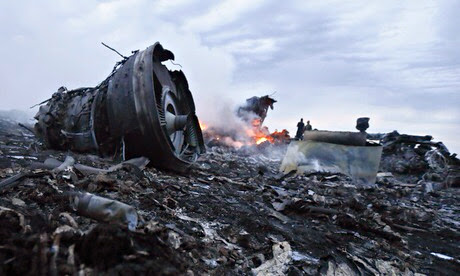
This week ended with a double dose, administered within the space of a few hours: Israel’s ground incursion into Gaza and, more shocking because entirely unexpected, the downing of Malaysia Airlines flight MH17 over Ukraine, killing all 298 on board.

So in Gaza we look at the wildly lopsided death tolls – nearly 300 Palestinians and two Israelis killed these past nine days.

The different responses these events stir in those of us who are distant, and the strategies we devise to cope with them, say much about our behaviour as consumers of news. But they also go some way to determining our reaction as citizens, as constituent members of the amorphous body we call public, or even world, opinion.

As I write, 18 of the 20 most-read articles on the Guardian website are about MH17. The entry into Gaza by Israeli forces stands at number 21. It’s not hard to fathom why the Malaysian jet strikes the louder chord. As the preacher might put it, “There but for the grace of God go I.” Stated baldly, most of us will never live in Gaza, but we know it could have been us boarding that plane in Amsterdam.

Which is why there is a morbid fascination with tales of the passenger who changed flights at the last minute, thereby cheating death, or with the crew member who made the opposite move, hastily switching to MH17 at the final moment, taking a decision that would have seemed so trivial at the time but which cost him his life. When we read about the debris – the holiday guidebooks strewn over the Ukrainian countryside, the man found next to an iPhone, the boy with his seatbelt still on – our imaginations put us on that flight. Of course we have sympathy for the victims and their families. But our fear is for ourselves.

It’s quite true that if the US truly decided that Israel’s 47-year occupation of Palestinian territory was no longer acceptable, that would bring change.

The reports from Gaza stir a different feeling. When we read the Guardian’s Peter Beaumont describe the sights he saw driving around the strip on Friday morningthree Palestinian siblings killed by an Israeli artillery shell that crashed into their bedroom, a father putting the remains of his two-year-old son into a plastic shopping bag – we are shaken by a different kind of horror. It is compassion for another human being, someone in a situation utterly different to ours. We don’t worry that this might happen to us, as we now might when we contemplate an international flight over a war zone. Our reaction is directed not inward, but outward. More

There is an interesting article by Chris Hedges entitled It's NOT going to be OK on the current economic disparity which, he believes could lead to a drastic decline in democracy as states respond to social protests. The question I ask is what can be done to slow or erradicate this process? Editor


Saturday, August 31, 2013

Introduction to a Green Economy: Concepts and Applications

Introduction to a Green Economy:


Concepts and Applications

E-Learning Course, 4th Edition

21 October – 13 December 2013

In order to provide interested stakeholders from government, business, civil society and academia with an introduction to the green economy concept UNITAR in partnership with UNEP, ILO and UNIDO is delivering the e-learning course“Introduction to a Green Economy: Concepts and Applications”, 21 October - 13 December 2013. Participants will learn about different concepts and facets of the green economy, including its contribution to addressing climate change. Special attention is given to global, national and sector-specific challenges and opportunities to advance sustainable, low-carbon and socially inclusive development. Additionally, participants will begin to acquire basic skills for applying the green economy concept in an economic, policy-making and personal context.

The ability of national actors to act on the green economy is key for effective policy making and achieving tangible results. To address this challenge UNITAR is working closely with UNEP, ILO and UNIDO in a new Partnership for Action on Green Economy (PAGE), focusing on national capacity development.

Comprehensive information and registration details are availablehttps://www.unitar.org/event/introduction-green-economy-concepts-and-applications-4th-edition.

Registration is open until 13 October 2013.

Please feel free to disseminate information about this course through your networks, and don’t hesitate to contact us (envgov@unitar.org) should you need any further information.

Yours,

The UNITAR Environmental Governance Programme Team

-----------------------------------------------

BACKGROUND

The concept of a green economy is receiving increasing international attention, as countries explore new patterns of development that take into account economic, social and environmental sustainability considerations. The ability of national actors to act on the green economy is key for effective policy making and achieving tangible results. To address this challenge, United Nations Institute for Training and Research (UNITAR) is working closely with UNEP, ILO and UNIDO in a new Partnership for Action on Green Economy (PAGE), with a focus on national capacity development.

In order to provide interested stakeholders from government, business, civil society and academia with an introduction to the green economy concept UNITAR, together with PAGE partners, is delivering an interactive e-learning course from 21 October to 13 December 2013.

TARGET GROUPS

The course targets groups and individuals that are interested in obtaining a general understanding about the green economy concept and latest developments. They include:

• Civil servants in national Ministries, provincial departments and local authorities

• Diplomats from Permanent Missions and Ministries of Foreign Affairs

• Environmental managers in private sector and civil society organizations

• Faculty, researchers and students

• Interested citizens

LEARNING OBJECTIVES

Participants will learn about different concepts and facets of the green economy, as well as global, national and sector-specific challenges and opportunities to advance low-carbon, resource efficient and socially inclusive development. Additionally, participants will begin to develop basic skills for applying the green economy concept in a real world economic, policy and/or personal context.

After completing the course, participants will be able to:

  • Define the concept of a green economy and explain its value
  • Identify enabling conditions for greening national economies
  • Identify principal challenges and opportunities for greening key economic sectors
  • Describe national planning processes in support of a green transformation
  • Recognize international and regional initiatives and support services to foster green development
  • Apply the green economy concept to a real world economic, policy and/or personal context

METHODOLOGY

The course pedagogy is adapted to professionals in full-time work. Participants are provided with the opportunity to learn through various experiences: absorb (read); do (activity); interact (socialize); and reflect (relate to one’s own reality). The total number of learning hours is 40 over an 8 week period. During weeks 1-5 the reading of an e-book is complemented by a range of learning activities and experiences that include interactive exercises, discussion forums, and an applied case study. Weeks 6-8 are reserved for wrap-up and completing course assignments.

cid:image001.png@01CEA415.9B144B30

COURSE FEE AND REGISTRATION

The course participation fee is 600 USD.

A number of full/partial fellowships are available for participants from developing countries working in the public sector, academia or non-profit organizations. Priority for fellowships will be given to applicants from Least Developed Countries (LDCs). For details please contact the UNITAR Environmental Governance Programme atenvgov@unitar.org

Register at:

https://www.unitar.org/event/introduction-green-economy-concepts-and-applications-4th-edition

Registration deadline: 13 October 2013.

The UNITAR e-Learning Team

Geneva, Switzerland

Website: www.unitar.org

UNITAR-logo for email3

-----------------------------------------------

pc30 video30 facebook30 twitter-green30

UNITAR is making concrete contributions to developing

the capacities of tens of thousands of people, and institutions

around the world. Check out UNITAR’s online catalogue.