Showing posts with label global governance. Show all posts

Tuesday, October 14, 2014

Ebola and Climate Change: ‘We Are Running Out of Time,’ says World Bank President

Not acting on climate change could have the same results as the inaction on Ebola with significant human and economic impact, warned World Bank Group president Jim Yong Kim in a speech Friday to the International Monetary Fund/World Bank Group annual meeting. He said that addressing both would further the World Bank’s goal of ending extreme poverty by 2030.

Jim Yong Kim President World Bank

“In a world where natural disasters, conflict, financial shocks and epidemics are becoming more frequent and destructive, we at the World Bank Group must do everything we can to become even more relevant,” he said. “Indeed, we’ve been fully engaged lately in fighting two of these global threats: the Ebola epidemic and climate change.”

“Ebola and climate change have a few things in common,” he said. “Most importantly, we are running out of time to find solutions to both. Also, until very recently, the plans to fight them were either nonexistent or inadequate. And inaction is literally killing people–one because of the rapid spread of a deadly virus, the other from the poisoning of the atmosphere and the oceans. And finally, perhaps most critically from our point of view, resolving these problems is essential to development, whether from the perspective of human suffering, economic growth or public health.”

Kim, an infectious disease physician, called the initial global response to Ebola “inadequate and slow” but said “Once engaged, we’ve moved with creativity, speed and purpose.” He said that the World Bank’s world on climate change over the last two years provided a blueprint for its response to Ebola.

“Soon after I started at the World Bank [July 2012], I asked my team a simple question: What’s the plan to fight climate change?” he said. “The responses received from our staff and even from leaders in the climate change community were mostly tactical: new technologies here, some efficiencies there. While important, they were not equal to the challenge of keeping a global increase in temperature below 2 degrees Celsius. So, working with others, we developed our own strategy that we hoped could take us a long way toward achieving this objective.”

That five-part plan including carbon pricing, eliminating fossil fuel subsidies, building cleaner cities, encouraging climate-friendly agriculture, and investing in renewable energy sources. He described in detail the World Bank’s campaign on carbon pricing: building a coalition of cooperating governments and businesses.

“At the start of the campaign, we counted 22 countries that would support this goal,” said Kim. “With lobbying, the number kept climbing. Less than a week before the deadline, China, the world’s largest emitter of carbon dioxide, agreed to support carbon pricing. It became the 54th country to endorse the statement. In the four days before the [UN Climate] summit, 20 more countries signed on. At the time of the announcement, 74 governments and more than 1,000 companies and investors had agreed to put a price on carbon. Together, the countries account for up to 54 percent of the world’s carbon emissions, 52 percent of the world’s GDP and nearly 50 percent of the world’s population.”

“Later today, ministers, CEOs and the World Bank Climate Group will join me to turn this pledge into action,” he said.

“We must maintain this commitment because increasing global fragility and volatility will challenge us more and more every day,” he concluded. “In our march to end extreme poverty, conflict, typhoons, floods, droughts, financial shocks and epidemics may at times slow us. But they will not stop us. The Bank will be aggressive and creative and apply large-scale solutions to help states manage, prepare for, recover from and conquer these risks, so they can grow and flourish.” More


Monday, September 29, 2014

Explaining Extreme Events of 2013

A report released today investigates the causes of a wide variety of extreme weather and climate events from around the world in 2013. Published by the Bulletin of the American Meteorological Society, "Explaining Extreme Events of 2013 from a Climate Perspective (link is external)" addresses the causes of 16 individual extreme events that occurred on four continents in 2013. NOAA scientists served as three of the four lead editors on the report.

Of the five heat waves studied in the report, human-caused climate change was found to have clearly increased the severity and likelihood of those events. On the other hand, for other events examined like droughts, heavy rain events, and storms, fingerprinting the influence of human activity was more challenging. Human influence on these kinds of events—primarily through the burning of fossil fuels—was sometimes evident, but often less clear, suggesting natural factors played a far more dominant role.

"This annual report contributes to a growing field of science which helps communities, businesses and nations alike understand the impacts of natural and human-caused climate change," said Thomas R. Karl, L.H.D., director of NOAA’s National Climatic Data Center. "The science remains challenging, but the environmental intelligence it yields to decision makers is invaluable and the demand is ever-growing."

Confidence in the role of climate change about any one event is increased when multiple groups using independent methods come to similar conclusions. For example, in this report, five independent research teams looked at specific factors related to the record heat in Australia in 2013. Each consistently found that human-caused climate change increased the likelihood and severity of that event. However, for the California drought, which was investigated by three teams from the United States, human factors were found not to have influenced the lack of rainfall. One team found evidence that atmospheric pressure patterns increased due to human causes, but the influence on the California drought remains uncertain.

When human influence for an event cannot be conclusively identified with the scientific tools available today, this means that if there is a human contribution, it cannot be distinguished from natural climate variability.

"There is great scientific value in having multiple studies analyze the same extreme event to determine the underlying factors that may have influenced it," said Stephanie C. Herring, PhD, lead editor for the report at NOAA’s National Climatic Data Center. "Results from this report not only add to our body of knowledge about what drives extreme events, but what the odds are of these events happening again—and to what severity."

The report was edited by Herring, along with Martin P. Hoerling, NOAA’s Earth System Research Laboratory; Thomas Peterson, NOAA’s National Climatic Data Center, and Peter A. Stott, UK Met Office Hadley Centre and written by 92 scientists from 14 countries. View the full report online (link is external).

Also, view the slides for the media briefing on the "Explaining Extreme Events of 2013 from a Climate Perspective" report. More


Saturday, July 19, 2014

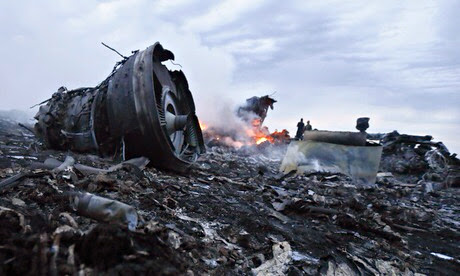
Sifting through the wreckage of MH17, searching for sense amid the horror

Any journalist should hesitate before saying this, but news can be bad for you. You don’t have to agree with the analyst who reckons “news is to the mind what sugar is to the body” to see that reading of horror and foreboding hour by hour, day after day, can sap the soul.

This week ended with a double dose, administered within the space of a few hours: Israel’s ground incursion into Gaza and, more shocking because entirely unexpected, the downing of Malaysia Airlines flight MH17 over Ukraine, killing all 298 on board.

So in Gaza we look at the wildly lopsided death tolls – nearly 300 Palestinians and two Israelis killed these past nine days.

The different responses these events stir in those of us who are distant, and the strategies we devise to cope with them, say much about our behaviour as consumers of news. But they also go some way to determining our reaction as citizens, as constituent members of the amorphous body we call public, or even world, opinion.

As I write, 18 of the 20 most-read articles on the Guardian website are about MH17. The entry into Gaza by Israeli forces stands at number 21. It’s not hard to fathom why the Malaysian jet strikes the louder chord. As the preacher might put it, “There but for the grace of God go I.” Stated baldly, most of us will never live in Gaza, but we know it could have been us boarding that plane in Amsterdam.

Which is why there is a morbid fascination with tales of the passenger who changed flights at the last minute, thereby cheating death, or with the crew member who made the opposite move, hastily switching to MH17 at the final moment, taking a decision that would have seemed so trivial at the time but which cost him his life. When we read about the debris – the holiday guidebooks strewn over the Ukrainian countryside, the man found next to an iPhone, the boy with his seatbelt still on – our imaginations put us on that flight. Of course we have sympathy for the victims and their families. But our fear is for ourselves.

It’s quite true that if the US truly decided that Israel’s 47-year occupation of Palestinian territory was no longer acceptable, that would bring change.

The reports from Gaza stir a different feeling. When we read the Guardian’s Peter Beaumont describe the sights he saw driving around the strip on Friday morning – three Palestinian siblings killed by an Israeli artillery shell that crashed into their bedroom, a father putting the remains of his two-year-old son into a plastic shopping bag – we are shaken by a different kind of horror. It is compassion for another human being, someone in a situation utterly different to ours. We don’t worry that this might happen to us, as we now might when we contemplate an international flight over a war zone. Our reaction is directed not inward, but outward. More

There is an interesting article by Chris Hedges entitled It's NOT going to be OK on the current economic disparity which, he believes could lead to a drastic decline in democracy as states respond to social protests. The question I ask is what can be done to slow or erradicate this process? Editor


Tuesday, June 10, 2014

Years of Living Dangerously - Premiere Full Episode

Years of Living Dangerously Premiere Full Episode


Published on Apr 6, 2014 • Hollywood celebrities and respected journalists span the globe to explore the issues of climate change and cover intimate stories of human triumph and tragedy. Watch new episodes Mondays at 8PM ET/ PT, only on SHOWTIME.

Subscribe to the Years of Living Dangerously channel for more: http://s.sho.com/YearsYouTube

Official site: http://www.sho.com/yearsoflivingdangerously

The Years Project: http://yearsoflivingdangerously.com/

Follow: https://twitter.com/YEARSofLIVING

Like: https://www.facebook.com/YearsOfLiving

Watch on Showtime Anytime: http://s.sho.com/1 hoirn4

Don't Have Showtime? Order Now: http://s.sho.com/PODCVU

It's the biggest story of our time. Hollywood's brightest stars and today's most respected journalists explore the issues of climate change and bring you intimate accounts of triumph and tragedy. YEARS OF LIVING DANGEROUSLY takes you directly to the heart of the matter in this awe-inspiring and cinematic documentary series event from Executive

Producers James Cameron, Jerry Weintraub and Arnold Schwarzenegger.

Thursday, May 29, 2014

Putting Climate Polluters in the Dock

Can Caribbean governments take legal action against other countries that they believe are warming the planet with devastating consequences?

A former regional diplomat argues the answer is yes. Ronald Sanders, who is also a senior research fellow at London University, says such legal action would require all Small Island Developing States (SIDS) acting together.

He believes the Hague-based International Court of Justice (ICJ) would be amenable to hearing their arguments, although the court’s requirement that all parties to a dispute agree to its jurisdiction would be a major stumbling block.

“It is most unlikely that the countries that are warming the planet, which incidentally now include India and China, not just the United States, Canada and the European Union…[that] they would agree to jurisdiction,” Sanders told IPS.

“The alternative, if countries wanted to press the issue of compensation for the destruction caused by climate change, is that they would have to go to the United Nations General Assembly.”

Sanders said that the Caribbean Community (CARICOM) countries could “as a group put forward a resolution stating the case that they do believe, and there is evidence to support it, that climate change and global warming is having a material effect… on the integrity of their countries.

“We’re seeing coastal areas vanishing and we know that if sea level rise continues large parts of existing islands will disappear and some of them may even be submerged, so the evidence is there.”

Sanders pointed to the damaging effects of flooding and landslides in St. Vincent and the Grenadines, St. Lucia, and Dominica as 2013 came to an end.

The prime minister of St. Vincent and the Grenadines, Dr. Ralph Gonsalves, described the flooding and landslides as “unprecedented” and gave a preliminary estimate of damage in his country alone to be in excess of 60 million dollars.

“People who live in the Caribbean know from their own experience that climate change is real,” Sanders said.

“They know it from days and nights that are hotter than in the past, from more frequent and more intense hurricanes or freak years like the last one when there were none, from long periods of dry weather followed by unseasonal heavy rainfall and flooding, and from the recognisable erosion of coastal areas and reefs.”

At the U.N. climate talks in Warsaw last November, developing countries fought hard for the creation of a third pillar of a new climate treaty to be finalised in 2015. After two weeks and 36 straight hours of negotiations, they finally won the International Mechanism for Loss and Damage (IMLD), to go with the mitigation (emissions reduction) and adaptation pillars.

The details of that mechanism will be hammered out at climate talks in Bonn this June, and finally in Paris the following year. As chair of the Alliance of Small Island States (AOSIS), Nauru will be present at a meeting in New Delhi next week of the BASIC group (Brazil, South Africa, India and China) to try and build a common platform for the international talks.

“It isn’t just the Caribbean, of course,” Sanders said. “A number of other countries in the world – the Pacific countries – are facing an even more pressing danger than we are at the moment. There are countries in Africa that are facing this problem, and countries in Asia,” he told IPS.

“Now if they all join together, there is a moral case to be raised at the United Nations and maybe that is the place at which we would more effectively press it if we acted together. It would require great leadership, great courage and great unity,” he added.

Pointing to the OECD countries, Sir Ronald said they act together, consult with each other and come up with a programme which they then say is what the international standard must be and the developing countries must accept it.

“Why do the developing countries not understand that we could reverse that process? We can stand up together and say look, this is what we are demanding and the developed countries would then have to listen to what the developing countries are saying,” Sir Ronald said.

Following their recent 25th inter-sessional meeting in St. Vincent, Jamaican Prime Minister Portia Simpson Miller praised the increased focus that CARICOM leaders have placed on the issue of climate change, especially in light of the freak storm last year that devastated St. Lucia, Dominica and St. Vincent and the Grenadines.

At that meeting, heads of government agreed on the establishment of a task force on climate change and SIDS to provide guidance to Caribbean climate change negotiators, their ministers and political leaders in order to ensure the strategic positioning of the region in the negotiations.

In Antigua, where drought has persisted for months, water catchments are quickly drying up. The water manager at the state-owned Antigua Public utilities Authority (APUA), Ivan Rodrigues, blames climate change.

“We know that the climate is changing and what we need to do is to cater for it and deal with it,” he told IPS.

But he is not sold on the idea of international legal action against the large industrialised countries.

“I think what will cause [a reversal of their practices] is consumer activism,” he said. “The argument may not be strong enough for a court of law to actually penalise a government.”

But Sanders firmly believes an opinion from the International Court of Justice would make a huge difference.

“We could get an opinion. If the United Nations General Assembly were to accept a resolution that, say, we want an opinion from the International Court of Jurists on this matter, I think we could get an opinion that would be favourable to a case for the Caribbean and other countries that are affected by climate change,” he told IPS.

“If there was a case where countries, governments and large companies knew that if they continue these harmful practices, action would be taken against them, of course they would change their position because at the end of the day they want to be profitable and successful. They don’t want to be having to fight court cases and losing them and then having to pay compensation,” he added. More


Thursday, May 8, 2014

Third National Climate Assessment: Climate Change Impacts in the United States

Please see the message below announcing the release of the new U.S. National Climate Assessment and the associated websites where it is available.

We are so pleased to announce today’s release of the Third National Climate Assessment: Climate Change Impacts in the United States. The Third National Climate Assessment (NCA), which delivers on USGCRP’s legal mandate and the President’s Climate Action Plan, is the most comprehensive, authoritative, transparent scientific report ever generated on U.S. climate impacts, both as currently observed and as projected for the future. The Third NCA documents climate change-related impacts and responses across key sectors and all regions of the U.S. with the goal of better informing public and private decision-making at all levels.

WHERE CAN YOU FIND THE ASSESSMENT?

The Third NCA is available to download and also can be explored in a novel interactive format through USGCRP’s newly redeployed web presence at http://globalchange.gov. An important feature of this interactivity is the traceability of the data and other information in the report, giving users the means to refer back to these data for their analyses and decision support. The site is mobile-compatible and every piece of the report—from highlights to chapters to key messages to graphics—has its own unique URL for social network sharing. Please find below links that will help you navigate the Third NCA:

· Full Report: http://nca2014.globalchange.gov/

· Highlights: http://nca2014.globalchange.gov/highlights

Beyond the Third NCA, the new globalchange.gov features accessible and dynamic information on a wide range of climate-related topics.

Any White House materials about the release of the Third NCA will be available from: http://www.whitehouse.gov/climate-change. At 2:00 pm EDT, the White House is hosting a stakeholder event that will feature speakers from the Administration, NCA authors, and users of the report. For those who won't be at the event in person, you can tune into the live webcast:http://www.whitehouse.gov/live.

WHAT CAN BE FOUND IN THIS LATEST ASSESSMENT?

The data and information in the Third NCA can be of great value to the adaptation planning and implementation efforts of U.S. Federal Agencies and their partners and stakeholders. Some examples include:

· The latest science on observed trends and projected future conditions of changes in the climate across the 8 NCA regions and contiguous U.S. as well as 13 sectors and cross-sectors.

· Examples throughout of on-the-ground impacts across the U.S., many of which are already directly affecting substantial numbers of Americans.

· For the first time in a U.S. national assessment, explicit chapters on Decision Support, Mitigation, and Adaptation, with specific information on those topics as they are practiced now in addition to identifying research needs associated with these topics for improving future implementation of climate resilience measures. Specifically related to adaptation, the following information is captured in the Adaptation chapter:

o Adaptation key terms defined

o An overview of adaptation activities at multiple levels including the Federal government, states, tribes, local and regional governments, non-governmental organizations, and the private sector

o Example barriers to adaptation

o Several illustrative case studies of adaptation in action

· A useful and informative section that answers some frequently asked questions about climate change. The questions addressed range from those purely related to the science of climate change to those that extend to some of the issues being faced in consideration of mitigation and adaptation measures.

· Data and metadata behind content and images used in the assessment are accessible and traceable.


Saturday, August 31, 2013

Syria: U.S. War Making at the Expense of Democracy by Richard Falk

The U.S. Government rains drone missiles on civilian human targets anywhere in the world, continues to operate Guantanamo in the face of universal condemnation, whitewashed Abu Ghraib, Bagram, and the torture memos, committed aggression against Iraq and Afghanistan, and invests billions to sustain its unlawful global surveillance capabilities.

Richard Falk

Still, it has the audacity to lecture the world about ‘norm enforcement’ in the wake of the chemical weapons attack in the Ghouta suburb of Damascus. Someone should remind President Barack Obama and Secretary of State John Kerry that credibility with respect to international law begins at home and ends at the United Nations. Sadly, the American government loses out at both ends of this normative spectrum, and the days of Washington being able to deliver pious messages on the importance of international law are over. No one is listening, and that’s a relief, although it does provide material for those teams of writers working up material for the likes of Jon Stewart, Stephen Colbert, and the many standups at Comedy Central. Yet, of course, this geopolitical TV series is no laughing matter for the long ordeal of the Syrian people.

There is yet another disturbing dimension of this pre-war pseudo debate about recourse to force in retaliation for an alleged use of chemical weapons by Assad against his own people: should a democracy empower its elected leaders to commit the country to war without at least securing specific legislative authorization? The contrast between the approach of the British and American approach to this issue is illuminating. David Cameron, as Prime Minister, along with his Foreign Secretary, strongly favored joining with the United States in launching a punitive attack against Syria, but arranged a prior Parliamentary debate and vote, and clearly indicated his immediate acceptance of the surprising refusal to win backing for such a policy, a show of Parliamentary independence that had not occurred in the country since the late 18th century. Of course, given polls showing only 11% of British citizens supporting an attack on Syria, Cameron may be privately breathing a deep sigh of relief that the vote came out as it did! Obama should be so lucky! If only his powers as Commander-in-Chief included a tool with which to erase imprudent ‘red lines’!

Compare now the Obama approach: speeches informing the country about why it is important to punish the Assad regime so as to uphold American national security interests and to engender respect for international law and several consultations with Congressional leaders. What is absent from the Obama discourse is the word ‘authorization’ or ‘a decent respect for the opinions’ of humanity, as expressed at home and in the world. In my view, this continuing claim of presidential authority to wage war unilaterally, and absent a UN mandate, is creating a deep crisis of legitimacy not only for the U.S., but for all governments that purport to be democracies but commit to war on the decision of the chief executive, as France and Turkey appear to be doing. It is time to face up to this crisis.

Above all, the foundational idea of American republicanism was to demonstrate that the power to declare and wage war was subject to ‘checks and balances’ and ‘separation of powers,’ and in this crucial respect, was unlike the monarchical powers of English kings in war/peace contexts. This makes the Parliamentary rebuff to Cameron not only a revitalizing move for British democracy, but an ironic commentary on the degree to which American ‘democracy’ has perversely moved in an absolutist direction.

It is true that government lawyers as hired hands can always find legal justifications for desired lines of policy. We can count on White House lawyers do just this at the present time: working into the night at Office of the Legal Counsel to prepare breifing material on the broad scope of the powers of the president as Commander-in-Chief, reinforced by patterns of practice over the course of the last several decades, and rounded out with an interpretation of the War Powers Act that supposedly gives the president 60 days of discretionary war making before any obligation exists to seek approval from Congress. Lawyers might quibble, but democracy will be the loser if procedures for accountability and authorization are not restored with full solemnity. In this respect the law should follow, not lead, and what is at stake is whether the republican ideals of limited government would be better served by the original ideas of making it unconstitutional for a president to commit the country to war without a formal and transparent process of public deliberation in the Congress, which is that part of government charged with reflecting the interests and values of the citizenry. Let the lawyers be damned if they side with the warrior politicians, however ‘war weary’ they claim to be.

It is worth also noticing that the common arguments for presidential authority do not pertain. The United States is not responding to an attack or acting in the face of an imminent threat. There is no time urgency. Beyond this the American public, as is the case with the publics of all other Western democracies, oppose by large majorities acts of war against Syria. What makes this situation worse, still, is the refusal to test diplomacy. By international law norms, reinforced by the UN Charter, a use of force to resolve an international conflict is legally a matter of ‘last resort’ after diplomatic remedies have been exhausted. But here they are not even being tried in good faith, which would involve bringing Iran into the process as a major engaged player, and enlisting Russia's support rather than exhibiting post-Snowden pique. Obama claims that no one is more war weary than he is, but his behavior toward Syria, Iran, Egypt, and Russia convey the opposite message.

And finally, some urge what be called ‘a humanitarian right of exception,’ namely, that this crime against humanity committed against the Syrian people requires a proportionate response from the perspective of international morality, regardless of the constraints associated with international law. Disregarding ‘the slippery slope’ of moral assessments, this particular response is being presented as directed against the Assad regime, but not motivated by any commitment to end the civil war or to assassinate Assad. There are reasons for viewing Washington’s moralizing reaction to the horrifying chemical attacks of August 21, especially the rush to judgment with respect to attributing responsibility to the Assad regime without awaiting the results of the UN inspection team and the odd timing of a such a major attack just as the inspectors were arriving in Damascus. It is not only habitual skeptics that recall Colin Powell’s presentation of conclusive evidence of Iraq’s possession of WMD to the UN Security Council in the lead up to the unlawful Iraq War. We should by now understand that when a foreign policy imperative exists for the occupant of the White House, factoids replace facts, and moral/legal assessments become matters of bureaucratic and media duty.


Richard Falk | August 31, 2013 at 2:26 am | Categories: America, Commentary, Global Governance, International & Global Law, Syria | URL: http://wp.me/p19Wt7-lq