Showing posts with label global. Show all posts

Thursday, May 8, 2014

Third National Climate Assessment: Climate Change Impacts in the United States

Please see the message below announcing the release of the new U.S. National Climate Assessment and the associated websites where it is available.

We are so pleased to announce today’s release of the Third National Climate Assessment: Climate Change Impacts in the United States. The Third National Climate Assessment (NCA), which delivers on USGCRP’s legal mandate and the President’s Climate Action Plan, is the most comprehensive, authoritative, transparent scientific report ever generated on U.S. climate impacts, both as currently observed and as projected for the future. The Third NCA documents climate change-related impacts and responses across key sectors and all regions of the U.S. with the goal of better informing public and private decision-making at all levels.

WHERE CAN YOU FIND THE ASSESSMENT?

The Third NCA is available to download and also can be explored in a novel interactive format through USGCRP’s newly redeployed web presence at http://globalchange.gov. An important feature of this interactivity is the traceability of the data and other information in the report, giving users the means to refer back to these data for their analyses and decision support. The site is mobile-compatible and every piece of the report—from highlights to chapters to key messages to graphics—has its own unique URL for social network sharing. Please find below links that will help you navigate the Third NCA:

· Full Report: http://nca2014.globalchange.gov/

· Highlights: http://nca2014.globalchange.gov/highlights

Beyond the Third NCA, the new globalchange.gov features accessible and dynamic information on a wide range of climate-related topics.

Any White House materials about the release of the Third NCA will be available from: http://www.whitehouse.gov/climate-change. At 2:00 pm EDT, the White House is hosting a stakeholder event that will feature speakers from the Administration, NCA authors, and users of the report. For those who won't be at the event in person, you can tune into the live webcast:http://www.whitehouse.gov/live.

WHAT CAN BE FOUND IN THIS LATEST ASSESSMENT?

The data and information in the Third NCA can be of great value to the adaptation planning and implementation efforts of U.S. Federal Agencies and their partners and stakeholders. Some examples include:

· The latest science on observed trends and projected future conditions of changes in the climate across the 8 NCA regions and contiguous U.S. as well as 13 sectors and cross-sectors.

· Examples throughout of on-the-ground impacts across the U.S., many of which are already directly affecting substantial numbers of Americans.

· For the first time in a U.S. national assessment, explicit chapters on Decision Support, Mitigation, and Adaptation, with specific information on those topics as they are practiced now in addition to identifying research needs associated with these topics for improving future implementation of climate resilience measures. Specifically related to adaptation, the following information is captured in the Adaptation chapter:

o Adaptation key terms defined

o An overview of adaptation activities at multiple levels including the Federal government, states, tribes, local and regional governments, non-governmental organizations, and the private sector

o Example barriers to adaptation

o Several illustrative case studies of adaptation in action

· A useful and informative section that answers some frequently asked questions about climate change. The questions addressed range from those purely related to the science of climate change to those that extend to some of the issues being faced in consideration of mitigation and adaptation measures.

· Data and metadata behind content and images used in the assessment are accessible and traceable.


Saturday, August 31, 2013

Syria: U.S. War Making at the Expense of Democracy by Richard Falk

The U.S. Government rains drone missiles on civilian human targets anywhere in the world, continues to operate Guantanamo in the face of universal condemnation, whitewashed Abu Ghraib, Bagram, and the torture memos, committed aggression against Iraq and Afghanistan, and invests billions to sustain its unlawful global surveillance capabilities.

Richard Falk

Still, it has the audacity to lecture the world about ‘norm enforcement’ in the wake of the chemical weapons attack in the Ghouta suburb of Damascus. Someone should remind President Barack Obama and Secretary of State John Kerry that credibility with respect to international law begins at home and ends at the United Nations. Sadly, the American government loses out at both ends of this normative spectrum, and the days of Washington being able to deliver pious messages on the importance of international law are over. No one is listening, and that’s a relief, although it does provide material for those teams of writers working up material for the likes of Jon Stewart, Stephen Colbert, and the many standups at Comedy Central. Yet, of course, this geopolitical TV series is no laughing matter for the long ordeal of the Syrian people.

There is yet another disturbing dimension of this pre-war pseudo debate about recourse to force in retaliation for an alleged use of chemical weapons by Assad against his own people: should a democracy empower its elected leaders to commit the country to war without at least securing specific legislative authorization? The contrast between the approach of the British and American approach to this issue is illuminating. David Cameron, as Prime Minister, along with his Foreign Secretary, strongly favored joining with the United States in launching a punitive attack against Syria, but arranged a prior Parliamentary debate and vote, and clearly indicated his immediate acceptance of the surprising refusal to win backing for such a policy, a show of Parliamentary independence that had not occurred in the country since the late 18th century. Of course, given polls showing only 11% of British citizens supporting an attack on Syria, Cameron may be privately breathing a deep sigh of relief that the vote came out as it did! Obama should be so lucky! If only his powers as Commander-in-Chief included a tool with which to erase imprudent ‘red lines’!

Compare now the Obama approach: speeches informing the country about why it is important to punish the Assad regime so as to uphold American national security interests and to engender respect for international law and several consultations with Congressional leaders. What is absent from the Obama discourse is the word ‘authorization’ or ‘a decent respect for the opinions’ of humanity, as expressed at home and in the world. In my view, this continuing claim of presidential authority to wage war unilaterally, and absent a UN mandate, is creating a deep crisis of legitimacy not only for the U.S., but for all governments that purport to be democracies but commit to war on the decision of the chief executive, as France and Turkey appear to be doing. It is time to face up to this crisis.

Above all, the foundational idea of American republicanism was to demonstrate that the power to declare and wage war was subject to ‘checks and balances’ and ‘separation of powers,’ and in this crucial respect, was unlike the monarchical powers of English kings in war/peace contexts. This makes the Parliamentary rebuff to Cameron not only a revitalizing move for British democracy, but an ironic commentary on the degree to which American ‘democracy’ has perversely moved in an absolutist direction.

It is true that government lawyers as hired hands can always find legal justifications for desired lines of policy. We can count on White House lawyers do just this at the present time: working into the night at Office of the Legal Counsel to prepare breifing material on the broad scope of the powers of the president as Commander-in-Chief, reinforced by patterns of practice over the course of the last several decades, and rounded out with an interpretation of the War Powers Act that supposedly gives the president 60 days of discretionary war making before any obligation exists to seek approval from Congress. Lawyers might quibble, but democracy will be the loser if procedures for accountability and authorization are not restored with full solemnity. In this respect the law should follow, not lead, and what is at stake is whether the republican ideals of limited government would be better served by the original ideas of making it unconstitutional for a president to commit the country to war without a formal and transparent process of public deliberation in the Congress, which is that part of government charged with reflecting the interests and values of the citizenry. Let the lawyers be damned if they side with the warrior politicians, however ‘war weary’ they claim to be.

It is worth also noticing that the common arguments for presidential authority do not pertain. The United States is not responding to an attack or acting in the face of an imminent threat. There is no time urgency. Beyond this the American public, as is the case with the publics of all other Western democracies, oppose by large majorities acts of war against Syria. What makes this situation worse, still, is the refusal to test diplomacy. By international law norms, reinforced by the UN Charter, a use of force to resolve an international conflict is legally a matter of ‘last resort’ after diplomatic remedies have been exhausted. But here they are not even being tried in good faith, which would involve bringing Iran into the process as a major engaged player, and enlisting Russia's support rather than exhibiting post-Snowden pique. Obama claims that no one is more war weary than he is, but his behavior toward Syria, Iran, Egypt, and Russia convey the opposite message.

And finally, some urge what be called ‘a humanitarian right of exception,’ namely, that this crime against humanity committed against the Syrian people requires a proportionate response from the perspective of international morality, regardless of the constraints associated with international law. Disregarding ‘the slippery slope’ of moral assessments, this particular response is being presented as directed against the Assad regime, but not motivated by any commitment to end the civil war or to assassinate Assad. There are reasons for viewing Washington’s moralizing reaction to the horrifying chemical attacks of August 21, especially the rush to judgment with respect to attributing responsibility to the Assad regime without awaiting the results of the UN inspection team and the odd timing of a such a major attack just as the inspectors were arriving in Damascus. It is not only habitual skeptics that recall Colin Powell’s presentation of conclusive evidence of Iraq’s possession of WMD to the UN Security Council in the lead up to the unlawful Iraq War. We should by now understand that when a foreign policy imperative exists for the occupant of the White House, factoids replace facts, and moral/legal assessments become matters of bureaucratic and media duty.


Richard Falk | August 31, 2013 at 2:26 am | Categories: America, Commentary, Global Governance, International & Global Law, Syria | URL: http://wp.me/p19Wt7-lq


Tuesday, April 9, 2013

NASA: New study: A warming world will further intensify extreme precipitation events

April 4, 2013 According to a newly-published NOAA-led study in Geophysical Research Letters, as the globe warms from rising atmospheric concentrations of greenhouse gases, more moisture in a warmer atmosphere will make the most extreme precipitation events more intense.

The study, conducted by a team of researchers from the North Carolina State University’s Cooperative Institute for Climate and Satellites-North Carolina (CICS-NC), NOAA’s National Climatic Data Center (NCDC), the Desert Research Institute, University of Wisconsin-Madison, and ERT, Inc., reports that the extra moisture due to a warmer atmosphere dominates all other factors and leads to notable increases in the most intense precipitation rates.

The study also shows a 20-30 percent expected increase in the maximum precipitation possible over large portions of the Northern Hemisphere by the end of the 21st century if greenhouse gases continue to rise at a high emissions rate.

“We have high confidence that the most extreme rainfalls will become even more intense, as it is virtually certain that the atmosphere will provide more water to fuel these events,” said Kenneth Kunkel, Ph.D., senior research professor at CICS-NC and lead author of the paper.

The paper looked at three factors that go into the maximum precipitation value possible in any given location: moisture in the atmosphere, upward motion of air in the atmosphere, and horizontal winds. The team examined climate model data to understand how a continued course of high greenhouse gas emissions would influence the potential maximum precipitation. While greenhouse gas increases did not substantially change the maximum upward motion of the atmosphere or horizontal winds, the models did show a 20-30 percent increase in maximum moisture in the atmosphere, which led to a corresponding increase in the maximum precipitation value.

The findings of this report could inform “design values,” or precipitation amounts, used by water resource managers, insurance and building sectors in modeling the risk due to catastrophic precipitation amounts. Engineers use design values to determine the design of water impoundments and runoff control structures, such as dams, culverts, and detention ponds.

“Our next challenge is to translate this research into local and regional new design values that can be used for identifying risks and mitigating potential disasters. Findings of this study, and others like it, could lead to new information for engineers and developers that will save lives and major infrastructure investments,” said Thomas R. Karl, L.H.D., director of NOAA’s NCDC in Asheville, N.C., and co-author on the paper.

The study, Probable Maximum Precipitation (PMP) and Climate Change, can be viewed online. More


Friday, November 9, 2012

Climate change "new normal," lessons from Sandy: U.N. chief


(Reuters) - Extreme weather sparked by climate change is "the new normal" and Superstorm Sandy that ravaged the U.S. Northeast is a lesson the world must pursue more environmentally friendly policies, U.N. Secretary-General Ban Ki-moon said on Friday.

The United Nations headquarters closed for three days when former hurricane Sandy slammed the Northeast on October 29 as a rare hybrid superstorm, killing at least 121 people, swamping seaside towns and leaving millions without power.

"We all know the difficulties in attributing any single storm to climate change. But we also know this: extreme weather due to climate change is the new normal," Ban told the 193-member U.N. General Assembly.

"This may be an uncomfortable truth, but it is one we ignore at our peril. The world's best scientists have been sounding the alarm for many years," he said. "There can be no looking away, no persisting with business as usual ... This should be one of the main lessons of Hurricane Sandy."

New York City Mayor Michael Bloomberg endorsed President Barack Obama for a second term after Sandy struck, citing Obama's record on climate change and saying he believed the Democrat would adopt more policies to curb greenhouse gases in a second term. Obama won re-election on Tuesday.

The head of U.N. security, Gregory Starr, said last week that U.N. headquarters sustained severe damage when Sandy produced heavy flooding in basement levels of the world body's Manhattan complex along the East River. �� Flood damage forced the relocation of a U.N. Security Council meeting on Somalia last week from its normal chambers to a temporary building inside the U.N. campus.

U.N. delegations sharply criticized the United Nations' management on Monday for an almost "total breakdown in communications" with the world body's member states after superstorm Sandy struck.

"Our global services were provided without interruption," said Ban. "However, it is clear that in focusing so much on operations and infrastructure, we fell short when it came to communications." More


Wednesday, August 15, 2012

Extreme Weather

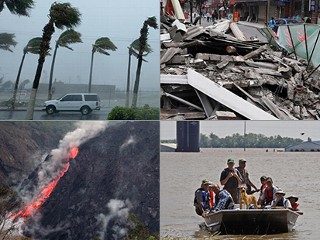
The weekend forecast for Nashville, Tennessee, called for two to four inches of rain. But by the afternoon of Saturday, May 1, 2010, parts of the city had seen more than six inches, and the rain was still coming down in sheets.


Mayor Karl Dean was in the city’s Emergency Communications Center monitoring the first reports of flash flooding when something on a TV screen caught his eye. It was a live shot of cars and trucks on Interstate 24 being swamped by a tributary of the Cumberland River southeast of the city. Floating past them in the slow lane was a 40-foot-long portable building from the Lighthouse Christian School.

“We’ve got a building running into cars,” the TV anchorman was saying.

Dean had been in the “war room” for hours. But when he saw the building floating down the highway, he says, “it became very clear to me what an extreme situation we had on our hands.” Soon 911 calls were coming in from every part of the city. Police, fire, and rescue teams were dispatched in boats. One crew in a skiff headed out to I-24 to pluck the driver of an 18-wheeler from the chest-high water. Other teams pulled families off rooftops and workers from flooded warehouses. Still, 11 people died in the city that weekend.

This was a new kind of storm for Nashville. “It came down harder than I’ve ever seen it rain here,” says Brad Paisley, the country singer, who owns a farm outside town. “You know how when you’re in a mall and it’s coming down in sheets, and you think, I’ll give it five minutes, and when it lets up I’ll run to my car? Well, imagine that it didn’t let up until the next day.”

Over at NewsChannel 5, the local CBS station, meteorologist Charlie Neese could see where the weather was coming from. The jet stream had gotten stuck over the city, and one thunderstorm after another was sucking up warm, humid air from the Gulf of Mexico, rumbling hundreds of miles northeast, and dumping the water on Nashville. While Neese and his colleagues were broadcasting from a second-floor studio, the first-floor newsroom was being swamped by backed-up sewers. “Water was shooting up through the toilets,” Neese says.

The Cumberland River, which winds through the heart of Nashville, started rising Saturday morning. At Ingram Barge Company, David Edgin, a former towboat captain, had more than seven boats and 70 barges out on the waterway. As the rain continued to pound down, he called the U.S. Army Corps of Engineers to get its forecast of how high the river would rise. “It’s blowing up our models,” the duty officer said. “We’ve never seen anything like this.” Edgin ordered all of Ingram’s boats to tie up at safe locations along the riverbank. It turned out to be a smart move.

By Saturday night the Cumberland had risen at least 15 feet, to 35 feet, and the corps was predicting it would crest at 42. But the rain didn’t stop Sunday, and the river didn’t crest until Monday—at 52 feet, 12 feet above flood stage. Spilling into downtown streets, the flood caused some two billion dollars in damage. More

When one starts to look at the bigger picture of extreme weather around the world you quickly realize that something is ot right. Climate change anyone? Editor


Thursday, July 5, 2012

Monday, May 7, 2012

Warming and the Water Cycle: More than Just a Faster Wetter Wet and Drier Dry

One of the most serious consequences of global warming is its predicted impact on the water cycle. A new study, described below, presents evidence that the global water cycle is changing even faster than predicted. A further concern is that future rainfall patterns may be extremely variable in both space and time.

Since the 1950s, parts of the world's ocean became saltier (red) and parts became fresher (blue) as the global water cycle intensified. The color scale refers to the observed change in salinity. The numbers on the scale correspond approximately to grams of salt per kilogram of seawater.

As the atmosphere warms, its capacity to hold water vapor increases. This is quantified by the Clausius-Clapeyron relationship, which explains that the atmosphere will hold about about 7% more moisture for every degree Celsius of warming. That means more evaporation in areas that are already dry and increased precipitation in regions that already receive high rainfall. Thus we can expect increasing droughts in dry areas and more floods in regions now prone to flooding.

In the 27 April 2012 issue of SCIENCE, Paul Durack of the Lawrence Livermore National Laboratory in California and coworkers explored a historical database of the saltiness of the surface ocean waters, or salinity, and found evidence that the global water cycle has intensified over the past half-century. The observed shifts in ocean salinity are consistent with the Clausius-Clapeyron relationship and with the observed warming of the surface ocean by about 0.5°C.

Noting difficulties in obtaining accurate estimates of rainfall over land, Durack and coworkers used ocean salinity as a natural rain gauge. Just as the long-term average evaporation and precipitation leave their imprint on land in terms of characteristic landscapes, they are recorded in the ocean by the saltiness of surface waters. The saltiest ocean waters are found in the subtropics, where the dry descending air of the Hadley cell causes evaporation to exceed precipitation. By contrast, surface waters at high latitudes tend to be less salty as precipitation is greater than evaporation. This pattern has existed for much of Earth’s history. More


Friday, September 25, 2009

Prominent nuclear disarmament organization welcomes UN nuclear-free call


WASHINGTON, Sept. 24 (Xinhua) -- Global Zero, a prominent organization for international nuclear disarmament, on Thursday hailed a new United Nations resolution that aims at nuclear-free world.

The UN resolution, endorsing calls by U.S. President Barack Obama and his Russian counterpart Dmitry Medvedev to eliminate all nuclear weapons, "indicates a global consensus for this goal has been achieved," Global Zero said in a press release.

Global Zero, a group of more than 200 political and military leaders from around the world, will hold a plenary session in February for strategy talks on the phased elimination of arsenals and launch of global public campaign, the release said. The UN Security Council on Thursday unanimously adopted a resolution to stop the proliferation of nuclear weapons in a bid to seek a safer world for all and to create the conditions for a world without nuclear weapons. More >>>

.

Thursday, September 17, 2009

Human-made Crises 'Outrunning Our Ability To Deal With Them,' Scientists Warn


ScienceDaily (Sep. 17, 2009) — The world faces a compounding series of crises driven by human activity, which existing governments and institutions are increasingly powerless to cope with, a group of eminent environmental scientists and economists has warned.
Writing in the journal Science, the researchers say that nations alone are unable to resolve the sorts of planet-wide challenges now arising.
Pointing to global action on ozone depletion (the Montreal Protocol), high seas fisheries and antibiotic drug resistance as examples, they call for a new order of cooperative international institutions capable of dealing with issues like climate change – and enforcing compliance where necessary. More >>>