Showing posts with label water cycle. Show all posts

Sunday, April 3, 2016

Climate Change & Biodiversity (A Pakistan case study): Impact of Climate Change on biodiversity of Butterflies in Northern coniferous forests of Punjab,Pakistan

Climate change is an established fact but the way and the intensity in which the climate has been changing since 1975 has created an alarming situation in Pakistan .

The last decade was the warmest since instrumental records have been kept in the nineteenth century. Climate change is a major threat to biodiversity by causing changes in plant phonologies and a poleward shifts in birds and butterflies. In terrestrial ecosystem 28,586 significant biological changes are related with climate change. With a relatively short life-cycle and host-plant reliance, butterfly communities show quick response to climate change. Punjab has few coniferous forests which are home to many exotic species. Twenty two years climate analysis shows reduction in precipitation and an increase in extreme weather events. In short span of just twenty years 14 butterfly species have disappeared from very rich forests of Murree. The species which are present are also on the verge of extinction as with climate change the number of invasive species is coming upwards.

by Hassaan Bin Saadat (Author)

http://www.amazon.com/Climate-Change-Biodiversity-Pakistan-study/dp/3659244716


Thursday, June 25, 2015

The World’s Most Hostile International Water Basins

At the launch of A New Climate for Peace, a new report on climate-fragility risks produced for the G7 by a consortium of international partners including the Wilson Center, USAID Deputy Assistant Administrator Christian Holmes called water a common denominator for climate risk.

“How you manage your water programs…has a huge amount to do with how you mitigate the prospect for increased fragility,” he said. “Sometimes it’s the obvious that’s so easy to miss, and I think that the obvious on water as it relates to economic development is, essentially, the question of sustainable water supply.”

One of the most striking infographics from A New Climate for Peace touches on that question of supply. Using data from Oregon State University’s Transboundary Freshwater Dispute Database and adapted from a graphic that originally appeared in Popular Sciencelast year, the map shows the world’s most active – and tension-filled – international water basins.

Water is a common denominator for climate risk

The Transboundary Freshwater Dispute Database measures not only the frequency of hostile events in a basin, but cooperative ones as well, each on a sliding scale. Hostile events range from declarations of war (zero recorded from 1990 to 2008, the period of time encompassed by the graphic) to leaders using “language of discord.” Cooperative events range from “mild verbal support” to “voluntary unification into a single country.”

The total number of events is indicated by shades of blue – the darker the blue, the more transboundary events, both positive and negative. This is essentially the “hot list” of international water basins – which regions have the most official and unofficial chatter over water.

Circles superimposed on the basins represent the total number of hostile events. As the description text points out, however, “circle size does not automatically translate into conflict danger.” In some places, transboundary institutions and diplomatic frameworks allow different actors to work through their differences. Cooperative hostility, if you will. In the Danube River Basin, for example, the high number of “hostile” events is mitigated by strong cooperative incentives associated with European integration. Likewise in North America, where Canada, the United States, and Mexico share several basins with a high number of hostile events, there is little chance of violent conflict.

Water basins in South Asia, the Middle East, and East Africa are major hotspots with a high number of hostile events and weaker institutional frameworks to mitigate them. The Indus, Ganges-Brahmaputra-Meghna, Salween, Tigris-Euphrates, and Jordan basins witness a very high number of interactions, suggesting at least that continued dialogue could be a way forward to mitigate the risk of violent conflict or fragility. The Nile Basin has less activity reflecting the stalled negotiations between the basin’s 10 member states to replace colonial-era water agreements. The Mekong Basin, where the largest member, China, does not participate as a full member of the Mekong River Commission, shows less activity as well.

The map does a great job illustrating why it can be difficult to answer the question, where is the highest risk of water-related violence? Tensions between states and other freshwater basin actors isn’t necessarily a sign of impending violence if there’s a framework to resolve them. Likewise, lack of communication over a major natural resource can be a bad sign for cooperation when the resource in question is the Nile. More

More infographics from ‘A New Climate for Peace: Taking Action on Climate and Fragility Risks’ are available on NewClimateforPeace.org.


Monday, May 25, 2015

Deciphering clues to prehistoric climate changes locked in cave deposits

It turns out that the steady dripping of water deep underground can reveal a surprising amount of information about the constantly changing cycles of heat and cold, precipitation and drought in the turbulent atmosphere above. The analysis of a stalagmite from a cave in north east India can detect the link between El Nino conditions in the Pacific Ocean and the Indian monsoon, a new study has found.

When the conversation turns to the weather and the climate, most people’s thoughts naturally drift upward toward the clouds, but Jessica Oster’s sink down into the subterranean world of stalactites and stalagmites.

That is because the assistant professor of earth and environmental sciences at Vanderbilt University is a member of a small group of earth scientists who are pioneering in the use of mineral cave deposits, collectively known as speleothems, as proxies for the prehistoric climate.

It turns out that the steady dripping of water deep underground can reveal a surprising amount of information about the constantly changing cycles of heat and cold, precipitation and drought in the turbulent atmosphere above.

As water seeps down through the ground it picks up minerals, most commonly calcium carbonate. When this mineral-rich water drips into caves, it leaves mineral deposits behind that form layers which grow during wet periods and form dusty skins when the water dries up.

Today, scientists can date these layers with extreme precision based on the radioactive decay of uranium into its daughter product thorium. Variations in the thickness of the layers is determined by a combination of the amount of water seeping into the cave and the concentration of carbon dioxide in the cave’s atmosphere so, when conditions are right, they can provide a measure of how the amount of precipitation above the cave varies over time. By analyzing the ratios of heavy to light isotopes of oxygen present in the layers, the researchers can track changes in the temperature at which the water originally condensed into droplets in the atmosphere changes and whether the rainfall’s point of origin was local or if traveled a long way before falling to the ground.

The value of this information is illustrated by the results of a study published May 19 in the journal Geophysical Research Letters by Oster’s group, working with colleagues from the Berkeley Geochronology Center, the Smithsonian Institution National Museum of Natural History and the University of Cambridge titled “Northeast Indian stalagmite records Pacific decadal climate change: Implications for moisture transport and drought in India.”

In the study, Oster and her team made a detailed record of the last 50 years of growth of a stalagmite that formed in Mawmluh Cave in the East Khasi Hills district in the northeastern Indian state of Meghalaya, an area credited as the rainiest place on Earth.

Studies of historical records in India suggest that reduced monsoon rainfall in central India has occurred when the sea surface temperatures in specific regions of the Pacific Ocean were warmer than normal. These naturally recurring sea surface temperature “anomalies” are known as the El Niño Modoki, which occurs in the central Pacific, and the Pacific Decadal Oscillation, which takes place in the northern Pacific. (By contrast, the historical record indicates that the traditional El Niño, which occurs in the eastern Pacific, has little effect on rainfall levels in the subcontinent.)

When the researchers analyzed the Mawmluh stalagmite record, the results were consistent with the historical record. Specifically, they found that during El Niño Modoki events, when drought was occurring in central India, the mineral chemistry suggested more localized storm events occurred above the cave, while during the non-El Niño periods, the water that seeped into the cave had traveled much farther before it fell, which is the typical monsoon pattern.

“Now that we have shown that the Mawmluh cave record agrees with the instrumental record for the last 50 years, we hope to use it to investigate relationships between the Indian monsoon and El Niño during prehistoric times such as the Holocene,” said Oster.

The Holocene Climate Optimum was a period of global climate warming that occurred between six to nine thousand years ago. At that time, the global average temperatures were somewhere between four to six degrees Celsius higher than they are today. That is the range of warming that climatologists are predicting due to the build-up of greenhouse gases in the atmosphere from human activity. So information about the behavior of the monsoon during the Holocene could provide clues to how it is likely to behave in the future. This knowledge could be very important for the 600 million people living on the Indian subcontinent who rely on the monsoon, which provides the area with 75 percent of its annual rainfall.

“The study actually grew out of an accidental discovery,” said Oster. Vanderbilt graduate student Chris Myers visited the cave, which co-author Sebastian Breitenbach from Cambridge has been studying for several years, to see if it contained enough broken speleothems so they could use them to date major prehistoric earthquakes in the area.

Myers found a number of columns that appear to have broken off in the magnitude 8.6 earthquake that hit Assam, Tibet in 1950. But he also discovered a number of new stalagmites that had begun growing on the broken bases. When he examined these in detail he found that they had very thick layers and high concentrates of uranium, which made them perfect for analysis.

Because of the large amount of water running into the cave, the stalagmite they choose to analyze had grown about 2.5 centimeters in 50 years. (If that seems slow, compare it with growth rates of a few millimeters in a thousand years found in caves in arid regions like the Sierra Nevada.) As a result, the annual layers averaged about 0.4 millimeters thick — wide enough for the researchers to get seven to eight samples per layer, which is slightly better than one measurement every two months. The amount of information about the climate that scientists can extract from the stalagmites and stalactites in a cave is amazing. But the value of this approach increases substantially as the number of caves that can act as climate proxies increases.

It is not a simple task. Because each cave is unique, the scientists have to study it for several years before they understand it well enough to use it as a proxy. For example, they must establish how long it takes water to move from the surface down to the cave, a factor that can vary from days to months.

Efforts to use the mineral deposits in caves as climate proxies began in the 1990’s. Currently, there are only a few dozen scientists who are pursuing this line of research and they have analyzed the mineral deposits from 100 to 200 caves in this fashion.

Story Source:

The above story is based on materials provided by Vanderbilt University. The original article was written by David Salisbury. Note: Materials may be edited for content and length.

Journal Reference:

  1. Christopher G. Myers, Jessica L. Oster, Warren D. Sharp, Ralf Bennartz, Neil P. Kelley, Aaron K. Covey, Sebastian F.M. Breitenbach. Northeast Indian stalagmite records Pacific decadal climate change: Implications for moisture transport and drought in India. Geophysical Research Letters, 2015; DOI: 10.1002/2015GL063826


Thursday, February 26, 2015

A Thirsty, Violent World

They say you learn something new everyday. For me, this day qualifies. Michael Specter writes at the New Yorker on the increasingly dire prospects for water -- of the clean, unpolluted kind -- for a clamoring humankind and of the water wars that are surely on the horizon.

And he has this, on the origins of the word "rivals": "After all, the word 'rivals' has its roots in battles over water—coming from the Latin, rivalis, for 'one taking from the same stream as another.'” Who knew? Not me. Specter's prognostication on our looming water disasters is a grim but important read and not just for Pakistanis or Nigerians, but for us in a country in which California is parched for water in a prolonged drought and researchers are predicting humongous droughts coming later in the century for our breadbasket, the Midwest! TomDispatch


A Thirsty, Violent World

Angry protesters filled the streets of Karachi last week, clogging traffic lanes and public squares until police and paratroopers were forced to intervene. That’s not rare in Pakistan, which is often a site of political and religious violence.

But last week’s protests had nothing to do with freedom of expression, drone wars, or Americans. They were about access to water. When Khawaja Muhammad Asif, the Minister of Defense, Power, and Water (yes, that is one ministry), warned that the country’s chronic water shortages could soon become uncontrollable, he was looking on the bright side. The meagre allotment of water available to each Pakistani is a third of what it was in 1950. As the country’s population rises, that amount is falling fast.

Dozens of other countries face similar situations—not someday, or soon, but now. Rapid climate change, population growth, and a growing demand for meat (and, thus, for the water required to grow feed for livestock) have propelled them into a state of emergency. Millions of words have been written, and scores of urgent meetings have been held, since I last wrote about this issue for the magazine, nearly a decade ago; in that time, things have only grown worse.

The various physical calamities that confront the world are hard to separate, but growing hunger and the struggle to find clean water for billions of people are clearly connected. Each problem fuels others, particularly in the developing world—where the harshest impact of natural catastrophes has always been felt. Yet the water crisis challenges even the richest among us.

California is now in its fourth year of drought, staggering through its worst dry spell in twelve hundred years; farmers have sold their herds, and some have abandoned crops. Cities have begun rationing water. According to the London-based organization Wateraid, water shortages are responsible for more deaths in Nigeria than Boko Haram; there are places in India where hospitals have trouble finding the water required to sterilize surgical tools.

Nowhere, however, is the situation more acute than in Brazil, particularly for the twenty million residents of São Paulo. “You have all the elements for a perfect storm, except that we don’t have water,” a former environmental minister told Lizzie O’Leary, in a recent interview for the syndicated radio show “Marketplace.” The country is bracing for riots. “There is a real risk of social convulsion,” José Galizia Tundisi, a hydrologist with the Brazilian Academy of Sciences, warned in a press conference last week. He said that officials have failed to act with appropriate urgency. “Authorities need to act immediately to avoid the worst.” But people rarely act until the crisis is directly affecting them, and at that point it will be too late.

It is not that we are actually running out of water, because water never technically disappears. When it leaves one place, it goes somewhere else, and the amount of freshwater on earth has not changed significantly for millions of years. But the number of people on the planet has grown exponentially; in just the past century, the population has tripled, and water use has grown sixfold. More than that, we have polluted much of what remains readily available—and climate change has made it significantly more difficult to plan for floods and droughts.

Success is part of the problem, just as it is with the pollution caused by our industrial growth. The standard of living has improved for hundreds of millions of people, and the pace of improvement will quicken. As populations grow more prosperous, vegetarian life styles often yield to a Western diet, with all the disasters that implies. The new middle classes, particularly in India and China, eat more protein than they once did, and that, again, requires more water use. (On average, hundreds of gallons of water are required to produce a single hamburger.)

Feeding a planet with nine billion residents will require at least fifty per cent more water in 2050 than we use today. It is hard to see where that water will come from. Half of the planet already lives in urban areas, and that number will increase along with the pressure to supply clean water.

“Unfortunately, the world has not really woken up to the reality of what we are going to face, in terms of the crises, as far as water is concerned,” Rajendra Pachauri, the chairman of the International Panel on Climate Change, said at a conference on water security earlier this month. “If you look at agricultural products, if you look at animal protein, the demand for which is growing—that’s highly water intensive. At the same time, on the supply side, there are going to be several constraints. Firstly because there are going to be profound changes in the water cycle due to climate change.”

Floods will become more common, and so will droughts, according to most assessments of the warming earth. “The twenty-first-century projections make the [previous] mega-droughts seem like quaint walks through the garden of Eden,” Jason Smerdon, a climate scientist at Columbia University’s Lamont-Doherty Earth Observatory, said recently. At the same time, demands for economic growth in India and other developing nations will necessarily increase pollution of rivers and lakes. That will force people to dig deeper than ever before into the earth for water.

There are ways to replace oil, gas, and coal, though we won’t do that unless economic necessity demands it. But there isn’t a tidy and synthetic invention to replace water. Conservation would help immensely, as would a more rational use of agricultural land—irrigation today consumes seventy per cent of all freshwater.

The result of continued inaction is clear. Development experts, who rarely agree on much, all agree that water wars are on the horizon. That would be nothing new for humanity. After all, the word “rivals” has its roots in battles over water—coming from the Latin, rivalis, for “one taking from the same stream as another.” It would be nice to think that, with our complete knowledge of the physical world, we have moved beyond the limitations our ancestors faced two thousand years ago. But the truth is otherwise; rivals we remain, and the evidence suggests that, until we start dying of thirst, we will stay that way. More


Sunday, January 4, 2015

Abu Dhabi summit to discuss water security challenges

More than 32,000 global leaders from 170 countries representing government, industry, investment and research to Abu Dhabi, will provide an upfront look at affordable technologies to enable sustainable water resource management to help meet the Middle East’s rising demand for water.

Hosted by Masdar, Abu Dhabi’s renewable energy company, ADSW is a yearly platform that addresses the interconnected challenges of energy and water security, climate risk and sustainable development.

Running from January 17 to 24, ADSW includes the World Future Energy Summit (WFES), the world’s foremost event dedicated to the advancement of renewable energy, energy efficiency and clean technology; and the International Water Summit (IWS), which provides a business approach to addressing water scarcity, sustainable growth and economic development in arid regions.

“The Mena region is in a truly unique position to solve the challenge of water security,” remarked Raed Bkayrat, vice president of development for Saudi Arabia at First Solar, which is participating in WFES.

“While the region is quite arid, it also has one of the highest solar irradiances of any region in the world, and much of the population has ready access to seawater. Accordingly, solar photovoltaic projects are proving to be sustainable means of powering water desalination in the region, ensuring that the supply of clean water will keep up with the region’s increasing demand for it,” he noted.

Masdar took a major step by launching a pilot project to test energy-efficient desalination technologies – such as reverse osmosis and forward osmosis – powered by renewable energy.

The company awarded contracts to Abengoa, Degremont, Sidem/Veolia and Trevi Systems to build the desalination plants, which are expected to enable the implementation of cost-competitive desalination plants powered by renewable energy in the UAE and abroad.

“Engaging different sectors of the industry is really crucial to bring forward innovative solutions, as well as pilot projects that demonstrate to governments the value of new integrated systems,” Bkayrat added.

Both WFES and IWS will offer numerous keynote addresses, panel discussions and workshops as well as exhibitors introducing affordable technologies to enable sustainable water resource management.

Along with WFES and IWS, ADSW will include the second EcoWaste and the seventh Zayed Future Energy Prize Award Ceremony; it also coincides with the Fifth General Assembly of the International Renewable Energy Agency.-TradeArabia News Service More


Thursday, September 4, 2014

ADB Spotlights Pakistan’s Water Assessment and Management Plan


News: ADB Spotlights Pakistan’s Water Assessment and Management Plan

ADBSeptember 2014: The Asian Development Bank (ADB) has published a report titled ‘Water Balance: Achieving Sustainable Development through a Water Assessment and Management Plan – The Case of Federally Administered Tribal Areas (FATA), Pakistan.' The report presents the case of the development of the FATA Water Assessment and Management Plan, outlining elements necessary in such assessment, and emphasizing that inefficient and unsustainable management of development initiatives result from lack of information about water availability and cause watershed degradation.


Integrated water resources management (IWRM) was used as a core approach in the development of possible activities to promote the sustainable use of water resources in the FATA region. While noting much of the data used is historical, the report emphasizes that climate change is likely to alter current water availability patterns, and calls for integrating hydrological forecasting and climate change models into the assessment.


The report includes sections on: background; project area; assessing surface water availability; assessing groundwater; assessing water consumption; water balance model; water management plan; and conclusions. [Publication: Water Balance: Achieving Sustainable Development through a Water Assessment and Management Plan – The Case of Federally Administered Tribal Areas (FATA), Pakistan]


Read more: http://water-l.iisd.org/news/adb-spotlights-pakistans-water-assessment-and-management-plan/


Tuesday, September 2, 2014

Ned Breslin: thinking big about water supply

Jordan Levy on Ned Breslin

Ned Breslin believes that too many organisations who are providing clean water and sanitation are chasing numbers. He wants to see them be bold enough to operate towards a long-term vision for clean water for everyone. This may seem simple, but he says this is not the way most in the sector operate. He believes these short-term achievements do not always contribute towards solving the systematic issues. I am inspired by Ned and his organisation because they don’t rely on short-term outputs to build legitimacy regardless of outside pressure to do so. They are not afraid to say that real solutions take time.

Ned Breslin on Water for People

The problem is clear. Three decades of support for water projects from NGOs, governments and large and small donors alike have not transformed people’s lives and country’s economic trajectories as such massive investments should.

Few celebrate the report from the World Health Organisation and Unicef (pdf) that shows progress on water supply worldwide – as contradictory evidence paints a much more unfortunate story. The European Union’s scathing audit of water aid investments and the Dutch government’s brave evaluation of their own work (pdf) offer sobering insight into water-sector history and challenges moving forward.

The impact of such failure is also sadly clear. Girls continue to fetch polluted water from muddy puddles and rivers, walking past broken hand-pumps and schools they would be attending if they had the time. To break this cycle, Water For People, the IRC, Water and Sanitation for the Urban Poor, One Drop, and some members of the Millennium Water Alliance are partnering with governments and the local private sector to change the water sector narrative.

We are testing this initiative – called Everyone Forever (EF) – across Africa, Asia and Latin America. The concept is that districts maintain water services for everyone without the need for further philanthropic aid or support.

EF takes a page from polio and smallpox eradication efforts that saturated entire districts, consisting of millions of people and hundreds and thousands of villages. “Everyone” is only achieved when every family, school and clinic in a target district has access to water services, that includes the hardest to reach, the poorest, the disabled, the politically marginalised and the socially ostracised. The poorest in those areas are receiving water services because other residents are covering their tariffs. “Forever” is only achieved when districts show they can sustain these investments over time as populations grow, water resources are threatened, economies change and infrastructure ages.

EF works with governments and insists that their financial support is essential for success. We have seen a 39% increase in government investments towards EF in the past year, with examples like the district of Rulindo in Rwanda now spending over $1m a year on water infrastructure.

Two districts – Chinda, Honduras and Cuchumuela, Bolivia – have reached full coverage verified by the national government. Another five areas are close, including an island in the Ganges in India where half a million pilgrims use the local sanitation system every year (pdf).

One mayor in Bolivia now brags about his district achieving “everyone” status. As a result, other mayors across the country are replicating EF, channeling their investments towards full district coverage. Similar spread is happening in India, Rwanda, Ghana, Uganda and Honduras.

Momentum is now building scaled work that excludes nobody, transcends individual communities and is focused on sustainability. Everyone Forever offers a model that is hard to argue against by politicians and development agencies. The alternative – more projects and hollow slogans of coverage delinked from investments – is simply not good enough anymore. More

Ned Breslin is the CEO of Water for the People. Follow @NedBreslin on Twitter.


Saturday, July 5, 2014

Famke Janssen addresses the World Youth Parliament for Water

gcint.org

March 14
Dear friends and distinguished members of the World Youth Parliament for Water.

The efforts of youth from all around the world to offer solutions and to work together to tackle the global water crisis both humble and inspire me. You are truly making a difference.

President Gorbachev, who spoke at the opening of the World Water Forum just two days ago, believes in the power of all people, particularly the youth, to make change aimed at protecting the environment. Young people – who will be tomorrow’s leaders -- have a vital role to play to ensure all people can live free of poverty and insecurity, and enjoy a world that conserves – not exploits – its many natural wonders.

I come from the Netherlands, a country that has a lot of experience in "coping" with water. My country is one that is vulnerable to global warming and rising oceans. Fortunately, we have a long history of finding ways to stop the ocean from flooding much of a country that rests largely below sea level. Water is a central part of Dutch life, from our many canals and dikes to the water-powered windmills that are dotted all over the country. Many historians argue that our social organization was built on the need for communities to organize democratically in order to pull together to stop an invading ocean or a broken dike – a recognition that water crises do not discriminate whether they come in the form of floods or drought and, most importantly, that water crises can unite people and not only separate them.

The Netherlands, however, is not a country associated with scarcity of water, a curse for many populations today that will grow much worse. For our world is already buckling under the weight of our 7-billion strong population, and in less than 20 years from now, we will have grown to 8.3 billion . As you know, this will only increase the demand for water. Consequently, by 2025 experts estimate that two-thirds of the world's population could be living under water stressed conditions.

Water scarcity is the problem that our future generations will have to face. Responsibility for solving this global challenge, some might say, lies unfairly in the hands of you and young people around the world. You did not cause the crisis, but it will be up to today’s youth to be prepared for steering our world toward a more sustainable future, a path that will ensure we respond to the water crisis, fairly share our available water resources, promote conservation and end waste, and help millions upon millions of people realize their basic Human Right to have access to safe Water and Sanitation.

Lack of adequate drinking water and poor or non-existent sanitation target the youth unfairly. For example, 443 million school days are missed every year due to sickness caused by water-related diseases, such as diarrhoea, dysentery and cholera. Lack of access to safe drinking water and sanitation is one of the main obstacles to education today. This is bad, but what is absolutely intolerable is that diarrhoea is the world’s second biggest killer of children and accounts for 1.5 million young lives every year. Moreover, in the absence of functioning drainage systems, water forms stagnant puddles that are soon infested with malaria-carrying mosquitoes: 3600 people die of malaria each day and 3200 of them are children. These grim statistics do not even take into account the ravages imposed on children as a result of water scarcity, which affects the availability of food and increases the risk of malnutrition among children.

Young girls are especially vulnerable to today’s water problems. For in many communities, young girls fetch water – often walking many miles to do so – placing their health, safety, education and development at grave risk. If a girl’s town or village has no safe source of water, it is often her job to collect it for her family, meaning she cannot attend school. This is a double tragedy that must be overcome.

Another factor against girls is the lack of sanitation facilities in schools, which can force many to stop attending classes when they reach puberty. Without education, futures of children and young women are being lost.

Without access to safe water and education, many young people will find it even harder – if not impossible – to rise out of poverty. As a result, when they become parents themselves, their own children will be trapped by the same problems.

But there are things we can all do today.

You are an extremely powerful voice of change. The more noise you make the more power you have. You have the right to demand a better world, as you are the ones who will inherit the problems we have caused. There are concrete actions that you can take that will result in meaningful change.

Green Crosses’ Green Lane Environmental Diary, which some of you may have participated in, shows ways to reduce our water footprints, from taking shorter showers, to avoiding use of plastic bottles. These basic tips, when practiced by an entire community can result in massive changes in the management of water resources. These are guidelines for individuals but collectively they can have profound impacts.

On a policy level you can demand that countries that have not ratified the United Nations Watercourses Convention do so. Some of you live in places that have not ratified the Convention and just 11 more signatures are needed from governments to validate it. It is the only global set of regulations and measures drafted for governing the more than 270 rivers in the world that are shared by multiple countries. 145 countries share these rivers and the groundwater linked to them. Their basins are home to 40% of the planet’s human population. But only 40% of these rivers are covered by official agreements on how to share and manage them, many of which are unsatisfactory. These weaknesses must be addressed if we are to tackle global challenges such as climate change and growing water demands.

Since you are here you have already developed the taste for politics. As potential future parliamentarians you will demand that the Right to Water and Sanitation is enshrined in your country’s constitutions and laws. It is imperative that you do all in your power to ensure your fellow countrymen and women can realize this fundamental, life-preserving right.

After meeting many of you and seeing what you have done here in Marseille, I have great confidence in your abilities to make a difference when it comes to ensuring all people have access to safe water.

I know you wont forget the experiences you have had here at the World Youth Parliament for Water. But I urge you to apply what you have absorbed, and put it into action, first and foremost in your own communities, and hopefully further afield.

Eleanor Roosevelt said, "the future belongs to those who believe in the beauty of their dreams". I encourage you to start believing. Thank you for the honor to speak with you and good luck. More


Thursday, June 26, 2014

Is the UN turning its back on the human right to water?

One of the biggest threats to economic and social development is that the world's freshwater supplies are rapidly becoming scarce and polluted. A new set of actors are now engaging in the global development arena to define and write the rules ofaccess to water to ensure people's needs are protected.

It is alarming to see that the human right to water and sanitation continues to be marginalised in UN policy discussions. The exclusion of this right to water in the most recent draft of the sustainable development goals reveals policy more conducive to promoting water security for economic growth than ensuring the preservation of watersheds and the equitable distribution of scarce water supplies.

When the UN general assembly passed a resolution in 2010 affirming water and sanitation as a human right, it was celebrated as a victory for communities dealing with the health impacts of polluted water, the indignity of not having access to clean drinking water and sanitation or the inability to produce food owing to water shortages. Social movements saw the human right to water and sanitation as a tool in the fight against a global water crisis produced by inequality, social exclusion and abuse of the water commons.

The global water crisis is also a big concern for industries seeking secure access to water supplies to sustain and expand operations in a never-ending quest for economic growth. The extractive industries, large drinks companies, big banks investing in water stocks, and companies involved in providing water and sanitation services have positioned themselves as stakeholders within global water policy discussions and as being able to provide solutions to the crisis.

The latest trend in global and national water policy is for corporations to participate in decision-making bodies and promote corporate-driven solutions through public-private partnerships. Over the past decade or so, the efforts of corporations such as Nestlé and Unilever to engage in global water policy discussions has shifted the debate from one of injustice and inequality to a depoliticised discussion of scarcity solved by technological fixes. These are offered by multinational corporations and market mechanisms that further deregulate water resource allocation.

When global policymakers – including the working group on sustainable development goals (SDGs) – focus simply on improving "water efficiency" for these ever-expanding industries without anchoring discussions of access to water as a right, they are ignoring communities that are challenging the very presence of the industries that are destroying watersheds.

The human right to water and sanitation holds promise for these communities. It has been invoked in Plachimada, in south India, to challenge Coca Cola's accessto aquifers; by anti-mining activists throughout Latin America; and, more recently, by the Kalahari Bushmen in a struggle to access traditional water sources on land coveted by industries such as tourism, diamond mining and fracking.

It has also been used to democratise water and sanitation services. In Uruguay, recognition of the human right to water led to the ban of private water services. When a recent ruling by a top Greek court blocked the privatisation of the country's largest water utility, in Athens, it was a victory for activists across Europe who had condemned forced privatisation through loan conditions in bailout packages for Greece, Portugal and Italy.

So it is deeply troubling that the human right to water continues to be contested at the UN. For those living without access to adequate drinking water and sanitation, the SDG on water focuses on universal access. As special rapporteur on the human right to safe drinking water and sanitation, Catarina de Albuquerque arguesthat an emphasis on universality alone fails to eliminate inequality.

At the very minimum, the human right to water calls for the elimination of discrimination and the adoption of special measures for marginalised communities. Social movements pursuing public control over water supplies, and democratic and participatory governance models, are also drawn to the elements of public participation in decision-making, accountability and access to justice underscored by the human right to water.

While this right is hardly the silver bullet for all global water woes, it goes a long way towards balancing unequal power relationships. More


Tuesday, June 10, 2014

Years of Living Dangerously - Premiere Full Episode

Years of Living Dangerously Premiere Full Episode


Published on Apr 6, 2014 • Hollywood celebrities and respected journalists span the globe to explore the issues of climate change and cover intimate stories of human triumph and tragedy. Watch new episodes Mondays at 8PM ET/ PT, only on SHOWTIME.

Subscribe to the Years of Living Dangerously channel for more: http://s.sho.com/YearsYouTube

Official site: http://www.sho.com/yearsoflivingdangerously

The Years Project: http://yearsoflivingdangerously.com/

Follow: https://twitter.com/YEARSofLIVING

Like: https://www.facebook.com/YearsOfLiving

Watch on Showtime Anytime: http://s.sho.com/1 hoirn4

Don't Have Showtime? Order Now: http://s.sho.com/PODCVU

It's the biggest story of our time. Hollywood's brightest stars and today's most respected journalists explore the issues of climate change and bring you intimate accounts of triumph and tragedy. YEARS OF LIVING DANGEROUSLY takes you directly to the heart of the matter in this awe-inspiring and cinematic documentary series event from Executive

Producers James Cameron, Jerry Weintraub and Arnold Schwarzenegger.

Saturday, May 31, 2014

Monsoon Disrupted By El Nino + Climate Change as India Suffers Deaths, Crop Losses from Extreme Heat.

May is the month when the massive rainstorm that is the Asian Monsoon begins to gather and advance. This year, as in many other years, the monsoon gradually formed along the coast of Myanmar early in the month. It sprang forward with gusto reaching the Bay of Bengal by last week.

And there it has stalled ever since.

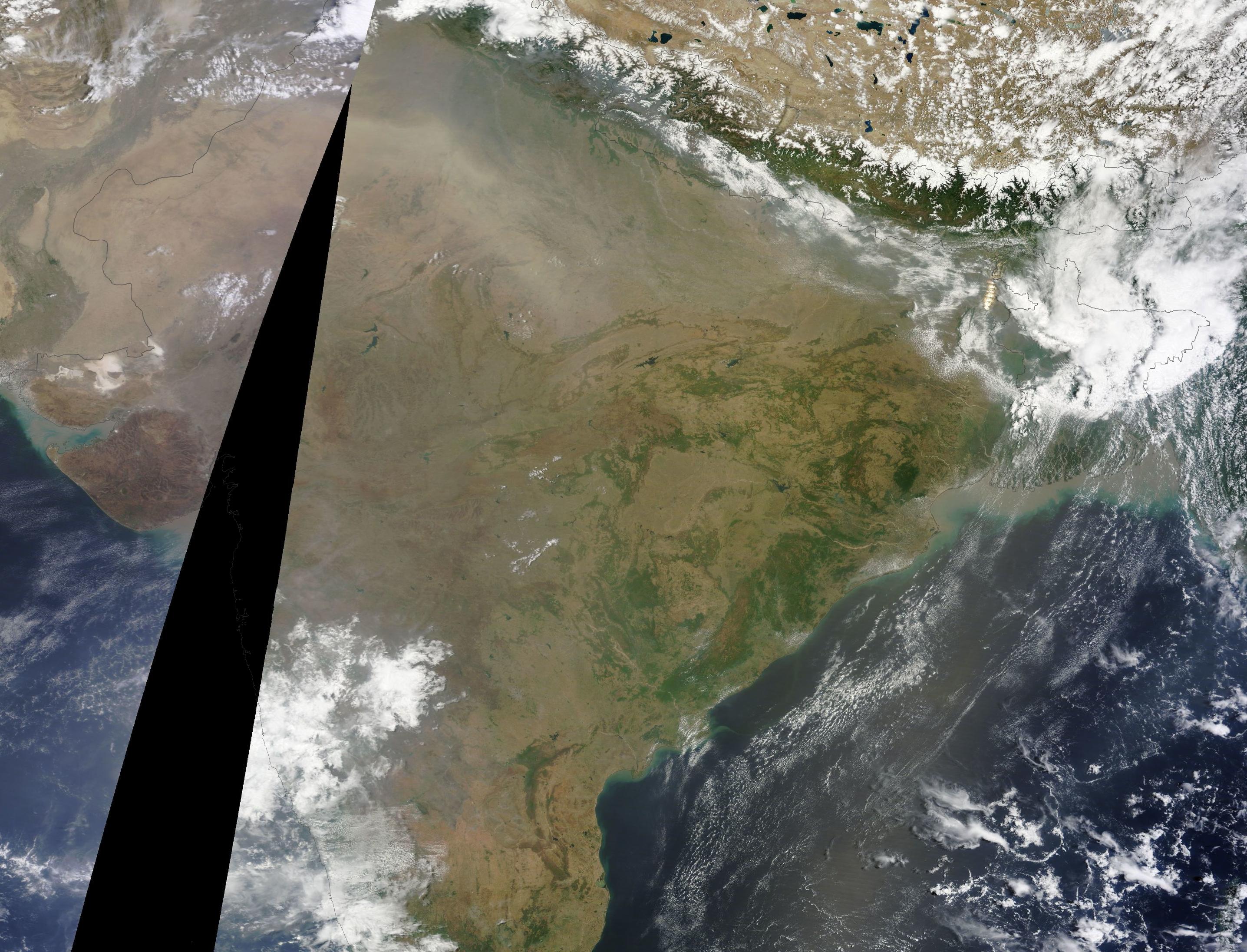
On May 25-27, an outburst of moisture from this stalled monsoonal flow splashed over the coasts of India. But by the 29th and 30th, these coastal storms and even the ones gathering over the Bengali waters had all been snuffed out. The most prominent feature in the MODIS shot of India today isn’t the rainfall that should be now arriving along the southeast coast, but the thick and steely-gray pallor of coal-ash smog trapped under a persistent and oppressive dome of intense heat.

(MODIS shot of India on May 30th. See the open stretch of blue water in the lower right frame? That’s the Bay of Bengal which borders coastal India. During a normal year at this time, that entire ocean zone should be filled with the storm clouds of a building monsoon that is already encroaching on coastal India. Today, there is nothing but a smattering of small and dispersed cloud through a mostly clear sky. Image source: LANCE-MODIS.)

Monsoon Described as Feeble

Official forecasts had already announced as of May 27th that the annual monsoon was likely to be delayed by at least a week for southeast regions of India. Meanwhile, expected monsoonal rainfall for western and northern sections of India for 2014 fell increasingly into doubt.

From The Times of India:

The monsoon is likely to be delayed by 10 days, according to scientists at the Indian Institute of Tropical Meteorology (IITM) here. The IITM’s third experimental real-time forecast says that a feeble monsoon will reach central India after June 20 as against the usual June 15. Last year, the monsoon had covered the entire country by June 15.

The annual monsoon is key to India’s agriculture. The substantial rains nurture crops even as they tamp down a powerful heating that typically builds throughout the sub-continent into early summer. Without these rains, both heat and drought tend to run rampant, bringing down crop yields and resulting in severe human losses due to excessive heat.

But, this year, heat and drought are already at extreme levels.

Major Heatwave Already Results in Loss of Life for 2014

As early as late March, the heatwave began to build over the Indian subcontinent. The heat surged throughout the state, setting off fires, resulting in a growing list of heat casualties, shutting down the power grid and spurring unrest. Meanwhile, impacts to India’s agriculture were already growing as the Lychee fruit crop was reported to have suffered a 40% loss.

By late May, temperatures across a broad region had surged above 105 degrees shattering records as the oppressive and deadly heat continued to tighten its grip.

In a country surrounded on three sides by oceans, it is a combination of heat, humidity and persistently high night-time temperatures that can be a killer. Wet bulb temperatures surge into a high-risk range for human mortality during the day even as night-time provides little respite for already stressed human bodies. Such extreme and long-duration heat doesn’t come without a sad toll. As of today, early reports indicated a loss of more than 56 lives due to heat stroke (In 2012 and 2013, total Indian heat deaths were near 1,000 each year). That said, final figures on heat losses are still pending awaiting complete reports from all of India’s provinces.

"Climatologically, we know that heatwaves are increasing in frequency and the number of days exceeding 45ºC temperatures is increasing. The frequency will increase further with global warming, hence this is a good example of a situation where science and disaster management can come together and avert damage," a spokesman for India’s National Disaster Management Authority noted on Friday.

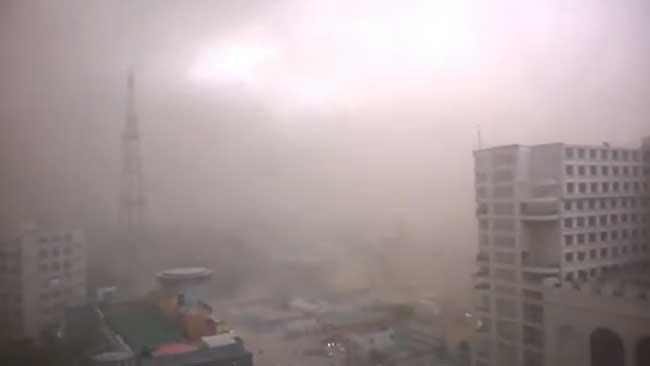
(Hot Dust. A dust storm rolls through New Delhi on Friday amidst furnace-like 113 degree heat snarling traffic and resulting in the tragic loss of 9 more lives. Image source: Gaurav Karoliwal/YouTube Screenshot.)

Today the heatwave continued to gain ground, with Kota and Rajasthan reaching an all-time record of 116 degree F (46.5 C) as New Delhi’s mercury hit 113 degrees F in the midst of a drought-induced dust storm. Dust shrouding the city spurred traffic chaos and in the heat, darkness, and confusion nine more souls were lost.

After two months of growing disruption due to heat and drought, the lands and peoples of India cry out for a Monsoon that is running later and later with each new weather report.

Climate Change + El Nino: Adding Heat and Beating Back the Monsoon

As systems approach tipping points, they are more likely to tilt toward the extremes.

For India this year, its seasonally warmest period from April to May found severe heat amplification from a number of global factors. First, climate change seeded the ground for the current Indian heatwave by adding general heat and evaporation to already hot conditions. With global average heating of +0.8 C above 1880s levels amplifying in the hot zones, early moisture loss due to higher-than-normal temperatures produces a kind of snowball effect for still more warming. Essentially, the cooling effect of water evaporation is baked out early allowing for heat to hit harder just as typical seasonal maximums are reached. More

Originally published by robertscribbler.wordpress.com/


Thursday, May 22, 2014

Challenge in Sao Paulo: Overcoming Water Scarcity in South America’s Largest City

Last March, one of Brazil’s most important newspapers, O Estado de S. Paulo, published a version of the article below, which summarizes the Conservancy’s efforts to help secure Sao Paulo’s water supply. It is translated and reprinted here with permission.

By João Campari and Samuel Barrêto, The Nature Conservancy

The inhabitants of Sao Paulo have been dealing with discouraging images of cracked riverbeds where they used to see flowing water, making this temperate part of Brazil look more like the country’s semi-arid region. Unfortunately, these stark images show the worsening struggles of the Cantareira system, one of the greatest water supply systems in the world.

Right now, the Cantareira’s reservoirs — responsible for providing water for more than 12 million inhabitants of the Sao Paulo Metropolitan Region (RMSP) and Campinas — are operating at less than 15% capacity*, the lowest level recorded since the Cantareira’s creation in the early 1970s.

The images, the symbol of the current crisis, show that water doesn’t really come from the taps in our houses. It comes from nature, and in Sao Paulo much of that nature is the Atlantic Forest. While water rationing gets peoples’ attention and is one of the necessary responses to water scarcity, rationing alone is not enough to solve the long-term problem of securing lasting access to fresh water.

We must look beyond the tap and work to take care of our water supplies at their sources. We need a systemic response for the management of watersheds to restore the sources of our water that have been degraded, polluted and deforested. Forests are very important for healthy fresh water supplies. Unfortunately, the Cantareira system alone has lost 70% of its original forest cover, aggravating the sedimentation of rivers and dams, and decreasing their ability to supply water.The degradation of native vegetation also worsens the effects of erosion and drought.

The interaction of all these factors — deforestation, sedimentation, erosion and drought — leads to a situation of extreme risk and represents an environmental, social and economic threat not just to Sao Paulo, but to the entire country of Brazil. The Sao Paulo Metropolitan Region and Campinas together are responsible for more then 22% of the country’s GDP. Therefore, it is a priority to create a strong and strategic response to the increasing and urgent problems of water quantity, quality, access and supply for urban centers.

Protecting Water Supplies at their Sources

We must go beyond conventional interventions, such as engineering works — more dams or aqueducts are not the answer. Wider, systemic responses are necessary, and the responsibility to act is not limited to the government. We all need water and it is the shared responsibility of businesses, communities and civil society as a whole to search for solutions together. The government’s role is to foster and implement multiple solutions that reach multiple stakeholders at once.

The Conservancy’s work shows that one of the highest priorities for securing Sao Paulo’s water supplies is strengthening the Cantareira system’s “green infrastructure” by restoring the degraded forests of the Atlantic Forest, as well as conserving existing forest remnants. Such initiatives ensure the health of a watershed. This type of solution, when well managed, minimizes the risk of extreme events and reduces the vulnerability of populations to floods and prolonged droughts. Healthy forests also store water and reduce erosion and provide environmental services of water regulation and security to the population.

New York City illustrates this equation quite clearly. Decades ago, the city’s administration compared the costs of both natural and built infrastructure for protecting and providing water. Preserving the forests that were source of the city’s drinking water cost US $1 to 1.5 billion over 10 years. That amount was seven times lessthan the estimated US $6 to 8 billion needed to build a traditional, engineered water treatment and distribution network. (That amount doesn’t include the additional and ongoing operational and maintenance costs of $300 to $500 million a year that would have been necessary.) Obviously, nature was the better buy for the people of New York.

It is something for Sao Paulo to consider. A recent study by the Conservancy showed that restoring about 35,000 acres of deforested areas and preventing erosion on 5000 acres within the basins of the Piracicaba, Capivari, Jundiaí and Alto Tietê rivers would decrease the level of sediments that clog the rivers by 50%. Reducing erosion would increase the capacity of water reservoirs and simultaneously decrease the cost of treatment for the removal of sediments.

What the Conservancy is doing in Sao Paulo

To help accomplish restoration goals in the lands around Sao Paulo’s Cantareira system, the Conservancy-led Water Producers Project provides payments to farmers and ranchers who conserve forests on properties that are part of the watershed that feeds the Cantareira reservoirs. This payment-for-environmental-services program recognizes and compensates landowners for the water-producing value their lands provide.

The Conservancy also leads the Water for Sao Paulo Movement. This initiative fosters conversation and working relationships between different stakeholders and focuses on the importance of both water conservation and nature-based solutions for securing the water supply of the region. Because healthy forests are so important for healthy rivers and water supplies, Water for Sao Paulo seeks to restore degraded forests near the urban area.

Finally, Sao Paulo must strengthen the existing Watersheds Committees. Created by the Brazilian Legislature, Watersheds Committees discuss and make decisions about the use of water from specific river basins and are some of the most important collaborations for achieving a balance between water supply and demand.Committees include representatives of local governments, water supply companies and civil society, who are responsible for tasks such as approving water management plans, defining actions for conservation of biodiversity and mediating conflicts about the use of water resources. There are more than 200 of these groups in Brazil.

The current crisis in the Cantareira system is both a challenge and an opportunity to learn from the past and make better decisions for the future. If we have the discernment to act in a systemic way and the political and institutional capacity for change, we will be able to reduce the risks of a permanent cycle of water shortage. In addition to this, we have the opportunity to show how healthy watersheds contribute to water security, which is indispensable for Sao Paulo’s social and economic stability into the future.

To learn more about how the Conservancy is helping to secure Brazil’s water supplies, please visit Where Does Your Water Come From?

*Since this article was published in March, the need for concerted action in Sao Paulo has become even more urgent. The level of water in the Cantareira system has now dropped – to about 8% of its overall capacity. As an emergency stopgap to provide water to the city, the government of Sao Paulo spent US$36 million on emergency constructions to allow access to water stored below the level of the pumps. Known to water managers as “dead volume,” this water was never intended to be part of the water supply, and the reservoirs are now, essentially, operating at a deficit. More