Showing posts with label glaciers. Show all posts

Thursday, November 30, 2017

Tackling water security: Who owns the right to groundwater?

Tariq said that to understand water security there is a need to understand water scarcity. He explained, “The global yardstick for water scarcity is that if you have 1,700 cubic metres per person, per year then you are in a very comfortable water regime.”

He added that the moment this amount reduces, you start getting into water stress situations, water shortages and water scarcity.

“Plant the water, as the best place to store water is underground”

“The surplus water available for Pakistan doesn’t last for more than 30 days.” He elaborated that for the rest of the 335 days, Pakistan is in a semi-drought or drought-like condition.

The PWP CEO said that for an arid country like Pakistan there is a need to have 40% surface water storage. However, he deplored that the country has only 7% storage to counter the problem. He added that this is also reducing due to sedimentation, which leaves a big question mark on the country’s water security. More

Friday, November 7, 2014

The Man Who Creates Artificial Glaciers To Meet The Water Needs Of Ladakh

Ladakh’s beautiful mountains might be a paradise for tourists, but ask the locals who have to struggle to meet their basic water needs every year. Chewang Norphel put his engineering skills to a better use and created artificial glaciers to provide water in this cold and dry mountainous region. Know more about his remarkably innovative technology and how it works.

Chewang Norphel, a 79-year old retired civil engineer, has always been a solution provider. The story goes back to 1966 when he was posted in Zanskar, one of the most backward and remote areas in Ladakh, as Sub Divisional Officer. He, along with his team, had to construct school buildings, bridges, canals, roads etc. in that area. The task was very difficult to execute due to lack of skilled labour.

So he started doing the masonry work himself and trained a few villagers to help him. After some years, when he went back to that village, he found out that the villagers he had trained had become perfect mistry and were earning handsome salaries.

Today, he is called the “Ice Man of India” and has created 10 artificial glaciers in Ladakh to help people deal with water scarcity in this cold, mountainous region.

Ladakh, a beautiful location with magnificent scenery around and exquisite beauty, takes everyone’s breath away. But, it is not the same with the people of Ladakh as the cold, dry and infertile land makes their lives harder than we could imagine.

Fortunately, the situation is slowly changing as Ladakh now has artificial glaciers to meet their needs and people have Norphel to thank for his amazing contribution.

Born in 1936, Norphel comes from a farming background and has served in the government service for more than 36 years before he had to take an early retirement due to his bad health. Being at home was not something Norphel enjoyed doing, and at the same time, the poor living conditions in Ladakh constantly troubled him. He thought of putting his engineering skills to a better use.

“Almost all the villages in Ladakh have roads, culverts, bridges, buildings or irrigation systems made by me,”says Norphel. But his biggest contribution came in the form of artificial glaciers.

Being a cold mountain desert, Ladakh sees a low average rainfall of 50 mm annually making people dependent upon glaciers as their primary water source.

80 percent of the population depends on farming, and their main source of irrigation water is the water that comes from the melting of snow and glaciers. Because of global warming, the glaciers are receding quickly and as a result, farmers face a lot of difficulty in getting adequate water. On the other hand, a lot of water gets wasted during the winter months as, due to the severe cold climate, farmers cannot grow any crops in that season.

“So I thought that if we could conserve this water in the form of ice, it can be of help to farmers to some extent during the irrigation period, particularly during the sowing season. The artificial glaciers, being quite close to the villages, melt earlier than the natural glaciers. Also, getting water during the sowing period is the most crucial concern of the farmers because the natural glaciers start melting in the month of June and sowing starts in April and May,” he says.

The idea first came to him when he saw water dripping from a tap which was kept open so as to avoid the water from freezing in winter and bursting the tap. The water gradually froze into the shape of an ice sheet as it came in touch with the ground and made a pool.

It struck him that the water that melts from natural glaciers due to high temperatures in summer goes to waste as it flows into the river. Instead, if this water can be stored in summer and autumn so that it can form a glacier in winter, then this artificial glacier would melt in spring and provide water to the villagers at the right time.

It was now time for action, and he put all his engineering knowledge, field experience and passion to work. He started his first experiment in Phutse village. He made canals to divert the water from the main stream to small catchment areas located four kms away from the village. He also created a shaded area to keep the water frozen in winters.

And, as these glaciers are located at a lower altitude of 13,000 feet as compared to the original glaciers which are located at 18,000 feet, they start melting earlier than the mainstream ones and provide water to the villagers when they need it the most in April.

“The main technique used to create artificial glaciers is to control the velocity of water as much as possible. The region is a hilly area and that is why the gradient of streams is very steep. As a result, in the main streams the water usually does not freeze. So what we have done is we have diverted the water to a shadow area by constructing a diversion channel with a mild grade. When it reaches the site, the water is released downward of the hill, distributing it in a small quantity so that the velocity can be minimized, and side by side we have constructed ice retaining walls in series to store the frozen water. This is the entire methodology of the artificial glacier,” he explains.

Retaining walls for artificial glacier

His first project cost him Rs.90,000. The width of the glacier ranges generally from 50 to 200 feet and the depth from 2 to 7 feet. This low cost model used only locally sourced material and help from the local community. Norphel has successfully built 10 glaciers so far. The smallest one is 500 feet long in Umla and the largest is 2 km long in Phutse.

His efforts have increased the agricultural production, thereby increasing the income of the locals. This has also reduced the migration to cities. His simple technique has brought water closer to the villages, and most importantly, made it available when the villagers need it the most.

In the future, he wants to continue making the glaciers and plans to build in other areas like Lahol, Spiti, Zangskar, etc. The only thing that comes as a challenge is lack of adequate funds.

“As you sow, so you reap. There is no doubt that if one has strong determination and dedication, there is nothing impossible in the world. That is what I believe,” Norphel says.

His simple idea has received acclaim across the globe and he has proved that if man is the one responsible for disturbing nature, he also has the capacity to save it. You just need the right intention to do so. More


Sunday, May 25, 2014

Nepal Glaciers Shrink By Quarter In 30 Years

Climate crisis has caused Nepal 's Himalayan glaciers to shrink by nearly a quarter in just over 30 years, said a scientist.

The glacier loss raises the risk of natural disasters in the ecologically fragile region.

A new study by the Kathmandu-based International Centre for Integrated Mountain Development (ICIMOD) shows that the area covered by glaciers has decreased by 24 per cent between 1977 and 2010.

Samjwal Ratna Bajracharya, lead author of the report, said “the shrinking of glaciers in Nepal is definitely connected to climate change; glacial melt is a huge indicator of rising temperatures.”

Under the three-year study led by ICIMOD scientists mapped satellite imagery from several decades to find the extent of ice loss in the region.

The fastest decline occurred between 1980 and 1990, said Bajracharya. Prior to the late 1970s, satellite imagery reflected little change in Nepal 's glacial area.

He said the glacial melting is creating huge, expanding lakes that threaten to burst and devastate mountain communities living downstream.

The accelerated glacial loss raises concerns over future access to water resources, particularly in regions where groundwater is limited and monsoon rains are erratic.

“If the trend continues, the immediate impact will be felt by those living in high-altitude regions, which are dependent on freshwater reserves from glaciers,” said Bajracharya.

The findings also sound alarm bells for Nepal 's push to develop hydropower projects.

“ Nepal cannot use its water resources to develop the country without assessing the state of our glaciers and river basins,” he said.

A government report in India recently blamed hydropower projects for devastating floods last year that killed thousands in India and Nepal .

The government panel said the build up of sediment in rivers, due to the dumping of soil that was dug up during construction of hydropower projects, exacerbated flooding when record-high rainfall hit the region last June.

It should be mentioned that the Himalayan region abounds in glaciers. Most of the big glaciers lie in the eastern Himalayas .

As the western Himalayas receive only a small amount of rainfall, barring the formation of vast snowfields, the source of some of the big rivers of Nepal are in fact glaciers.

Nepal 's largest glacier lies in the Mahalangur and the Kumbhakarna ranges. Khumbu is the biggest glacier and Langtang the longest. Kanchenjunga , Yalung, Nupchu and Langtang are some other glaciers belonging to the eastern Himalayas . Tukche and Hidden valley glaciers belong to the central Himalayas but these are comparatively small.

The Khumbu glacier is situated between Mount Everest and the Lhotse-Nuptse Ridge. It is seen flowing down between the two mountains and swerving right through the Khumbu valley. The terrain is gray and rocky. More


Thursday, May 22, 2014

Challenge in Sao Paulo: Overcoming Water Scarcity in South America’s Largest City

Last March, one of Brazil’s most important newspapers, O Estado de S. Paulo, published a version of the article below, which summarizes the Conservancy’s efforts to help secure Sao Paulo’s water supply. It is translated and reprinted here with permission.

By João Campari and Samuel Barrêto, The Nature Conservancy

The inhabitants of Sao Paulo have been dealing with discouraging images of cracked riverbeds where they used to see flowing water, making this temperate part of Brazil look more like the country’s semi-arid region. Unfortunately, these stark images show the worsening struggles of the Cantareira system, one of the greatest water supply systems in the world.

Right now, the Cantareira’s reservoirs — responsible for providing water for more than 12 million inhabitants of the Sao Paulo Metropolitan Region (RMSP) and Campinas — are operating at less than 15% capacity*, the lowest level recorded since the Cantareira’s creation in the early 1970s.

The images, the symbol of the current crisis, show that water doesn’t really come from the taps in our houses. It comes from nature, and in Sao Paulo much of that nature is the Atlantic Forest. While water rationing gets peoples’ attention and is one of the necessary responses to water scarcity, rationing alone is not enough to solve the long-term problem of securing lasting access to fresh water.

We must look beyond the tap and work to take care of our water supplies at their sources. We need a systemic response for the management of watersheds to restore the sources of our water that have been degraded, polluted and deforested. Forests are very important for healthy fresh water supplies. Unfortunately, the Cantareira system alone has lost 70% of its original forest cover, aggravating the sedimentation of rivers and dams, and decreasing their ability to supply water.The degradation of native vegetation also worsens the effects of erosion and drought.

The interaction of all these factors — deforestation, sedimentation, erosion and drought — leads to a situation of extreme risk and represents an environmental, social and economic threat not just to Sao Paulo, but to the entire country of Brazil. The Sao Paulo Metropolitan Region and Campinas together are responsible for more then 22% of the country’s GDP. Therefore, it is a priority to create a strong and strategic response to the increasing and urgent problems of water quantity, quality, access and supply for urban centers.

Protecting Water Supplies at their Sources

We must go beyond conventional interventions, such as engineering works — more dams or aqueducts are not the answer. Wider, systemic responses are necessary, and the responsibility to act is not limited to the government. We all need water and it is the shared responsibility of businesses, communities and civil society as a whole to search for solutions together. The government’s role is to foster and implement multiple solutions that reach multiple stakeholders at once.

The Conservancy’s work shows that one of the highest priorities for securing Sao Paulo’s water supplies is strengthening the Cantareira system’s “green infrastructure” by restoring the degraded forests of the Atlantic Forest, as well as conserving existing forest remnants. Such initiatives ensure the health of a watershed. This type of solution, when well managed, minimizes the risk of extreme events and reduces the vulnerability of populations to floods and prolonged droughts. Healthy forests also store water and reduce erosion and provide environmental services of water regulation and security to the population.

New York City illustrates this equation quite clearly. Decades ago, the city’s administration compared the costs of both natural and built infrastructure for protecting and providing water. Preserving the forests that were source of the city’s drinking water cost US $1 to 1.5 billion over 10 years. That amount was seven times lessthan the estimated US $6 to 8 billion needed to build a traditional, engineered water treatment and distribution network. (That amount doesn’t include the additional and ongoing operational and maintenance costs of $300 to $500 million a year that would have been necessary.) Obviously, nature was the better buy for the people of New York.

It is something for Sao Paulo to consider. A recent study by the Conservancy showed that restoring about 35,000 acres of deforested areas and preventing erosion on 5000 acres within the basins of the Piracicaba, Capivari, Jundiaí and Alto Tietê rivers would decrease the level of sediments that clog the rivers by 50%. Reducing erosion would increase the capacity of water reservoirs and simultaneously decrease the cost of treatment for the removal of sediments.

What the Conservancy is doing in Sao Paulo

To help accomplish restoration goals in the lands around Sao Paulo’s Cantareira system, the Conservancy-led Water Producers Project provides payments to farmers and ranchers who conserve forests on properties that are part of the watershed that feeds the Cantareira reservoirs. This payment-for-environmental-services program recognizes and compensates landowners for the water-producing value their lands provide.

The Conservancy also leads the Water for Sao Paulo Movement. This initiative fosters conversation and working relationships between different stakeholders and focuses on the importance of both water conservation and nature-based solutions for securing the water supply of the region. Because healthy forests are so important for healthy rivers and water supplies, Water for Sao Paulo seeks to restore degraded forests near the urban area.

Finally, Sao Paulo must strengthen the existing Watersheds Committees. Created by the Brazilian Legislature, Watersheds Committees discuss and make decisions about the use of water from specific river basins and are some of the most important collaborations for achieving a balance between water supply and demand.Committees include representatives of local governments, water supply companies and civil society, who are responsible for tasks such as approving water management plans, defining actions for conservation of biodiversity and mediating conflicts about the use of water resources. There are more than 200 of these groups in Brazil.

The current crisis in the Cantareira system is both a challenge and an opportunity to learn from the past and make better decisions for the future. If we have the discernment to act in a systemic way and the political and institutional capacity for change, we will be able to reduce the risks of a permanent cycle of water shortage. In addition to this, we have the opportunity to show how healthy watersheds contribute to water security, which is indispensable for Sao Paulo’s social and economic stability into the future.

To learn more about how the Conservancy is helping to secure Brazil’s water supplies, please visit Where Does Your Water Come From?

*Since this article was published in March, the need for concerted action in Sao Paulo has become even more urgent. The level of water in the Cantareira system has now dropped – to about 8% of its overall capacity. As an emergency stopgap to provide water to the city, the government of Sao Paulo spent US$36 million on emergency constructions to allow access to water stored below the level of the pumps. Known to water managers as “dead volume,” this water was never intended to be part of the water supply, and the reservoirs are now, essentially, operating at a deficit. More


Sunday, March 23, 2014

How NASA Can Save Us Billions of Gallons of Water

Here’s something to add to your doomsday list of natural resources that people need to survive but are threatened by climate change: snow.

It’s a key source of freshwater for more than 1 billion people across the globe, slaking thirst, irrigating croplands, and driving turbines that generate electricity. Conveniently, in much of the world, snow also acts as a natural reservoir, storing water during wet seasons, then rationing it out slowly during drier summer months. But today, growing populations, warming temperatures, and changing weather patterns are straining that supply like never before. “June is the new July,” says Auden Schendler, vice president of sustainability at Aspen Skiing Company in Colorado. “Snowmelt comes earlier than it used to, and it all happens in one big flood.”

Which means that knowing exactly how much snow is in the highlands—and when it’s coming down to lower elevations to feed rivers, aqueducts, and irrigation channels—is ever more important. But how do you measure something that’s spread over thousands of miles of steep, rugged, alpine terrain?

Tom Painter, a research scientist at NASA’s Jet Propulsion Laboratory, has an answer: by measuring snow from thousands of feet in the air. Using sophisticated, aircraft-borne sensors that gauge snow’s depth and the amount of light it reflects, Painter and his team are assembling the most accurate measurement ever made of just how much water the mountains hold.

This is welcome news in California, where the water content of accumulated snow is at historically low levels. Runoff from the Sierra Nevada mountains provides about a third of the entire state’s water, and up to 80 percent in some areas, supplying tens of millions of people and almost 1 million acres of farmland.

Painter can’t make it snow, but he can provide more and better data to water managers, who need to plan how to most efficiently fill their reservoirs; farmers deciding which crops to plant and when; and cities trying to figure out if they’ll have enough water to supply their residents—or will need to start rationing. “The demand for knowledge about water resources is at an all-time high,” says Painter, a gregarious, athletically built 46-year-old.

For decades, state water officials have estimated the snowpack’s water content by a straightforward method that will appeal to steampunk aficionados: They clamber into the mountains on snowshoes and stick aluminum tubes into the snow. The tubes indicate depth while collecting a sample revealing water volume. More recently, California has added a network of tabletop-size scales scattered through the mountains that electronically transmit the weight of snow that has fallen on them.

Both systems yield reliable measurements but only of the snow where the measurement is taken; extrapolating out from that to a whole basin, or a whole mountain range, is better than guesswork but less than precise. What’s more, both the scales and the human surveyors are concentrated at lower elevations, leaving scientists to wonder what lies farther uphill. “The old system worked OK historically because there was always enough water,” says Painter. “But now it’s all been allocated out, and demand is starting to exceed supply.” More


Monday, March 25, 2013

Tibetan Plateau glaciers shrinking

About 90 per cent of glaciers in the Third Pole region are shrinking, accelerated by black carbon being transferred from South Asia to the Tibetan Plateau, a top scientist has warned.

Change between 1968 and 2007

The Third Pole region, which is centred on the Tibetan Plateau and concerns the interests of the surrounding countries and regions, covers more than 5 million square kilometers and has an average altitude of more than 4,000 meters.

The area has the largest number of glaciers outside the polar regions and exerts a direct influence on the social and economic development of some of the most densely populated regions on earth, including China and India.

The glaciers are at the headwaters of many prominent Asian rivers.

Influenced by global warming, its alpine glaciers have seen drastic changes in recent years, such as thinning and shrinkage, which pose potential geological hazards to people both on and around the plateau.

Like Antarctica and the Arctic, the Third Pole is drawing increased attention from the international academic community, but the results of former international studies in this area are inconsistent, said Yao Tandong, director of the Chinese Academy of Sciences' Institute of Tibetan Plateau Research.

The scientist, a member of the Chinese People's Political Consultative Conference National Committee, said some people believe the glaciers will retreat and finally disappear by 2030, while others argue they will remain unchanged.

There are even people who argue that the glaciers have even moved forward, he said.

Researchers at Yao's institute say they can now draw a more comprehensive picture of the region, by showing data on the glaciers' status over the past 30 years. An investigation using topographic maps and satellite images revealed the retreat of 82 glaciers, area reduction by 7,090 glaciers and the mass-balance change of 15 glaciers.

"Systematic differences in glacier status are apparent from region to region, with the most pronounced shrinkage in the Himalayas, the southeastern part of the region.

Some of the glaciers there are very likely to disappear by 2030," Yao said. More


Monday, February 25, 2013

Satellite Tracking of Middle East Aquifers Points to the End of ‘Data Denial’

Jay Famiglietti, one of the authors of an important new study on the rapid depletion of aquifers under the Tigris and Euphrates river basins, has posted an excellent overview of the work and its context for policy, and noted that he and other authors are preparing for a two-week “water diplomacy” tour to discuss their findings in the affected region.

The project shows how improving systems for observing and analyzing environmental trends are brightening prospects for better management of resources and risks in struggling regions — even when governments might not want the information revealed. This is as true for forests as it is here for water supplies.

Here are some notable excerpts from Famiglietti’s post, which is particularly notable given President Obama’s planned visit to the Middle East this spring:

Worse to come:

Our team’s expectation is that the water situation in the Middle East will only degrade with time, primarily due to climate change. The best available science indicates that the arid and semi-arid regions of the world will become even more so: the dry areas of the world will become drier (while conversely, the wet areas will become wetter). Consequences for the Middle East include more prolonged drought, which means that the underground aquifers that store the region’s groundwater will not be replenished during our lifetimes, nor during those of future generations.


Management and transparency:

We cannot reverse climate change and its impact on water availability, but we can and must do a far better job with water management, including the modernization of national and international water policy. Our research and its implications point to the following critical needs, not only for the Middle East, but in all regions of the world where groundwater resources are in decline.

First, it’s high time for groundwater to be included under the water management umbrella. In most of the world, groundwater pumping is unmonitored and unregulated.

It is as true in much of the U. S. as it is in the Middle East. That’s no different than making withdrawals from a savings account without keeping track of the amount or the remaining balance: irresponsible without question, and a recipe for disaster when multiple account holders are acting independently.

Second, since nearly 80% of the world’s water resources are used to support agriculture, continued improvements in agricultural and irrigation conservation and efficiency should be an important focus for research, development, investment and cooperation. In the Middle East, some countries, notably Israel, are pioneers of efficiency, while others are less advanced. Much of the technology is in place. It just needs to be disseminated and embraced across the entire region.

Third, our report and others that have preceded it clearly demonstrate that satellite technology has advanced to the point where a reliable assessment of regional hydrology can be produced with little access to observations on the ground. Our 2009 study of groundwater depletion in India is yet another example of current capabilities. My point is that data denial policies amongst nations will ultimately be rendered obsolete. It will be far better to share key measurements now, to enhance and fully utilize the satellite picture for mutually beneficial water management in the long term.

For more on efficient water use in agriculture in dry regions, click back to my post on the pioneering work on drip irrigation by Daniel Hillel and read about how solar-powered pumping systems and drip irrigation are improving incomes and lives in sub-Saharan Africa.

Another relevant resource is this 2009 World Bank publication: “Water in the Arab World: Management Perspectives and Innovations.” More


Monday, February 18, 2013

China and Russia block UN Security Council climate change action

Russia and China blocked efforts last Friday to have climate change recognised as an international security threat by the UN Security Council (UNSC).

The council met in New York to discuss the potential effects of global warming, but according to Bloomberg the two permanent members objected to it being a ‘formal session’.

Despite the participation of UN Secretary-General Ban Ki-moon this meant the session – planned by Pakistan and the United Kingdom – had few political implications.

China, Russia, India and more than 100 developing countries oppose climate becoming a UNSC issue as the council does not operate under the principles of Common But Differentiated Responsibility, which underpins the UN climate talks.

They are concerned that securitizing the issue would place a greater burden on poorer nations with large greenhouse gas emissions to take action.

Small island states vulnerable to sea level rises have pushed for climate to be discussed at this level for over two decades.

Marshall Islands representative Tony deBrum expressed frustration with Russia and China’s stance, explaining that 35 years on from gaining independence from the USA the very existence of his country is now in question.

“Our roads are inundated every 14 days,” he said. “We have to ration water three times a week. People have emergency kits for water. We can no longer use well water because it’s inundated with salt.”

The meeting – the third in UNSC history – was convened by council President Pakistan and permanent member the United Kingdom, which despite domestic criticism over its low carbon strategy appears to be embarking on a new initiative to inject momentum into global efforts to cut emissions.

The UK’s new climate envoy Rear Admiral Neil Morisetti is pushing for climate change to be framed as a global security concern.

“The UK believes that the impacts of a changing climate pose a significant and emerging threat to a country’s national security and prosperity,” a Foreign Office spokesman told RTCC.

“The UK is engaging with our international partners and through international forums to better manage this risk.”

Risk multiplier

A 2009 report commissioned by the council identified climate change as a ‘threat multiplier’, stressing it would hit food supply lines and affect the territorial integrity of island states.

And in 2011 it discussed whether ‘green helmet’ climate peacekeepers could be required to prevent conflicts caused by resource scarcity.

Addressing the session, leading German scientist Joachim Schellnhuber explained that rises in global temperatures were likely to have catastrophic consequences.

“With unabated greenhouse-gas emissions, humankind would venture into an uncertain future that is much hotter than ever before in its history – so from a scientist’s perspective, climate change is a global risk multiplier,” he said.

The World Bank’s Rachel Kyte told delegates cities must take the lead in developing low carbon infrastructure, in terms of transport, urban planning and managing water resources.

In a statement Oxfam International’s Tim Gore urged the UNSC to debate the issue further, warning the global food system was already under severe stress as a result of droughts across the US, Africa and Asia.

“Droughts or floods can wipe out entire harvests, as we have seen in recent years in Pakistan, in the Horn of Africa and across the Sahel,” he said.

“And when extreme weather hits major world food producers – like last year’s droughts in the US and Russia – world food prices rocket. This presents a major risk to net food importing countries, such as Yemen, which ships in 90% of its wheat.

“The food riots and social unrest seen in the wake of the 2008 food price spikes were not a one-off phenomenon, but a sign of the risks we face through our failure to feed a warming world.” More


Thursday, September 13, 2012

Himalaya's Losing Ice

Himalayan Glaciers Retreating at Accelerated Rate in Some Regions: Consequences for Water Supply Remain Unclear.

Everest and Lhotse mountain peaks
ScienceDaily (Sep. 12, 2012) — Glaciers in the eastern and central regions of the Himalayas appear to be retreating at accelerating rates, similar to those in other areas of the world, while glaciers in the western Himalayas are more stable and could be growing, says a new report from the National Research Council.

The report examines how changes to glaciers in the Hindu Kush-Himalayan region, which covers eight countries across Asia, could affect the area's river systems, water supplies, and the South Asian population. The mountains in the region form the headwaters of several major river systems -- including the Ganges, Mekong, Yangtze, and Yellow rivers -- which serve as sources of drinking water and irrigation supplies for roughly 1.5 billion people.

The entire Himalayan climate is changing, but how climate change will impact specific places remains unclear, said the committee that wrote the report. The eastern Himalayas and Tibetan Plateau are warming, and the trend is more pronounced at higher elevations. Models suggest that desert dust and black carbon, a component of soot, could contribute to the rapid atmospheric warming, accelerated snowpack melting, and glacier retreat.

While glacier melt contributes water to the region's rivers and streams, retreating glaciers over the next several decades are unlikely to cause significant change in water availability at lower elevations, which depend primarily on monsoon precipitation and snowmelt, the committee said. Variations in water supplies in those areas are more likely to come from extensive extraction of groundwater resources, population growth, and shifts in water-use patterns. However, if the current rate of retreat continues, high elevation areas could have altered seasonal and temporal water flow in some river basins. The effects of glacier retreat would become evident during the dry season, particularly in the west where glacial melt is more important to the river systems. Nevertheless, shifts in the location, intensity, and variability of both rain and snow will likely have a greater impact on regional water supplies than glacier retreat will.

Melting of glacial ice could play an important role in maintaining water security during times of drought or similar climate extremes, the committee noted. During the 2003 European drought, glacial melt contributions to the Danube River in August were about three times greater than the 100-year average. Water stored as glacial ice could serve as the Himalayan region's hydrologic "insurance," adding to streams and rivers when it is most needed. Although retreating glaciers would provide more meltwater in the short term, the loss of glacier "insurance" could become problematic over the long term.

Water resources management and provision of clean water and sanitation are already a challenge in the region, and the changes in climate and water availability warrant small-scale adaptations with effective, flexible management that can adjust to the conditions, the committee concluded. Current efforts that focus on natural hazard and disaster reduction in the region could offer useful lessons when considering and addressing the potential for impacts resulting from glacial retreat and changes in snowmelt processes in the region. More


Thursday, May 17, 2012

Pakistan's climate change challenge

Last month, an avalanche on the Siachen glacier in Kashmir killed 124 Pakistani soldiers and 11 civilians. The tragedy has intensified debate about the logic of stationing Pakistani and Indian troops on such inhospitable terrain. And it has also brought attention to Pakistan's environmental insecurity.

Siachen is rife with glacial melt; one study concludes the icy peak has retreated nearly two kilometers in less than 20 years. It has also been described as "the world's highest waste dump." Much of this waste-generated from soldiers' food, fuel, and equipment-eventually finds its way to the Indus River Basin, Pakistan's chief water source.

Siachen, in fact, serves as a microcosm of Pakistan's environmental troubles. The nation experiences record-breaking temperatures, torrential rains (nearly 60 percent of Pakistan's annual rainfall comes from monsoons), drought, and glacial melt (Pakistan's United Nations representative, Hussain Haroon, contends that glacial recession on Pakistani mountains has increased by 23 percent over the past decade). Experts estimate that about a quarter of Pakistan's land area and half of its population are vulnerable to climate change-related disasters, and several weeks ago Sindh's environment minister said that millions of people across the province face "acute environmental threats."

Pakistan's environmental insecurity is not merely a matter of nasty weather. In three specific ways, it also threatens the country's fragile stability.

The last two years have provided ample proof of Pakistan's climate-change vulnerability. According to climatologists, the devastating floods of 2010-which submerged a fifth of the country and displaced millions-constituted "the worst natural disaster to date attributable to climate change" (a judgment rendered in 2010). They argued that a combination of high temperatures in the Atlantic Ocean and lower ones in the Pacific "created the perfect conditions" for the deluge.

The floods' destructiveness was exacerbated by Pakistan's rampant deforestation. UN data andPakistani media reports paint an alarming picture of this emissions-releasing scourge: Pakistan suffers from the highest annual rate of deforestation in Asia (the nation lost 33 percent of its forest cover between 1990 and 2010), with barely 2 percent of the country's total area remaining forested today. One of the prime perpetrators is the Pakistani Taliban, which has long recognized the revenue-generating potential of logging. During its rule over Swat in northern Pakistan, the Taliban's timber sales eliminated up to 15 percent of the picturesque region's forest cover. Separately, back in the 1990s, wealthy landowners in Sindh ordered laborers to clear forestland for crop cultivation; one small village alone lost 10,000 acres of forest. In both Swat and Sindh, the loss of forestland has facilitated riverbank erosion and deprived the country of a natural bulwark against raging floodwaters. More


Monday, January 16, 2012

Policy draft to mitigate climate effects

 PAKISTAN’S climate change policy whose draft took more than a year to be readied is now under print and may be presented to the federal cabinet for approval in a few weeks.

The draft will unveil an action plan to mitigate adverse effects of extreme weather events as witnessed in 2010 and again in 2011 and likely to face more such happenings in the years to come.

The subject is partially covered by Pakistan Environmental Protection Act 1997 and the National Environment Policy, 2005, but they have proved to be ineffective for lack of implementation of the suggested measures. A high-level committee appointed by the prime minister to coordinate actions on climate change has failed to meet even once in the past three years.

How far the climate change policy will succeed in motivating the bureaucracy to meet the challenge is difficult to foresee. But the magnitude of the challenge — rise in temperatures, frequency of heavy rains and floods, large-scale damages to property and infrastructure, rehabilitation of climate refugees and losses in agricultural output — is too enormous that it hardly provides any room for lethargy, inefficiency and corrupt practices on the part of relevant authorities.

The draft will address the issues of adaptation to the changes in climate and their impact on sectors such as irrigation, energy, crop patterns, clean water, transport, disaster management and capacity building of several departments. Besides, people in Pakistan will have to be prepared to learn to live and cope with most of the changes in climate in the future. More


Thursday, December 22, 2011

ICIMOD Reports Warn of Vulnerabilities of the HKH Region to Climate Change

6 December 2011: Three new reports released by the International Centre for Integrated Mountain Development (ICIMOD) warn that snow and glacier melt in Asia’s mountainous Hindu Kush-Himalayan (HKH) region threaten millions of mountain people and 1.3 billion people living downstream in Asia’s major river basins.

The report titled "The Status of Glaciers in the Hindu Kush-Himalayan Region" presents findings of a three-year research project funded by Sweden and led by ICIMOD, which through the use of remote sensing studies was able to tally the number of glaciers in the region—more than 54,000—and measure the area covered, 60,000 km. According to the report, glaciers appear to be shrinking in both the central and eastern Himalayas, with clean glaciers of the Tibetan plateau retreating at a faster rate than the glaciers of the rugged central Himalayas.

The second report, titled "Snow-Cover Mapping and Monitoring in the Hindu Kush-Himalayas," provides a comprehensive status report of snow cover in the region. According to the report, there was an indication of an overall decrease in snow cover over the decade in the central HKH region and overall, and a slight increase in the western and eastern parts of the region.

The third report, titled "Climate Change in the Hindu Kush-Himalayas: The State of Current Knowledge," reviews the research and data on climate and hydrology, biodiversity and ecosystems, and atmospheric changes and overall provides a snapshot on the changes that have occurred in the HKH region. [ICIMOD News] [Publication: The Status of Glaciers in the Hindu Kush-Himalayan Region] [Publication: Snow-Cover Mapping and Monitoring in the Hindu Kush-Himalayas] [Publication: "Climate Change in the Hindu Kush-Himalayas: The State of Current Knowledge] More


Sunday, December 12, 2010

Melting Glaciers Cause Droughts, Floods; Norway Helps Himalayas


The valley of Chitral has always looked to the 
glaciers of Tirich Mir for water.  (Photo by Amina Tariq)

CANCUN, Mexico, December 7, 2010 (ENS) - Climate change is causing mass loss of glaciers in high mountains worldwide. Within a few decades, melting glaciers could leave arid areas such as Central Asia and parts of the Andes even drier as the ice melts into water and flows downhill, causing disastrous floods in the lowlands, finds a new report by the UN Environment Programme presented today at the UN climate talks in Cancun.
Compiled by UNEP's Polar Research Centre GRID-Arendal and experts from research centers in Asia, Europe, Latin America and North America, the report says the larger glaciers may take centuries to disappear but many low-lying, smaller glaciers, which are often crucial water sources in dry lands, are melting much faster.

Glacial melt will change the lives of millions as over half of the
world's population lives in watersheds of major rivers originating in mountains with glaciers and snow.
Glaciers in Argentina and Chile, followed by those in Alaska and its coastal mountain ranges, have been losing mass faster and for longer than glaciers in other parts of the world, finds the report, "High Mountain Glaciers and Climate Change - Challenges to Human Livelihoods and Adaptation." More >>>

Saturday, January 30, 2010

World's glaciers continue to melt at historic rates


Latest figures show the world's glaciers are continuing to melt so fast that many will disappear by the middle of this century.

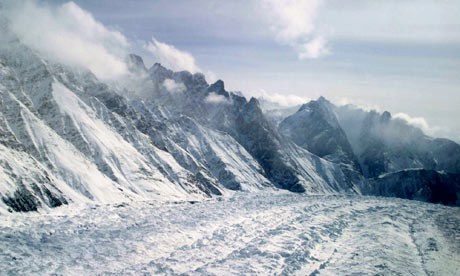
[Above: An aerial view of the Siachen glacier]

Glaciers across the globe are continuing to melt so fast that many will disappear by the middle of this century, the World Glacier Monitoring Service (WGMS) said today.

The announcement of the latest annual results from monitoring in nine mountain ranges on four continents comes as doubts have been cast on how much climate scientists have exaggerated the problem of glacier melt, which is seen as a leading indicator of how much the planet is heating up.

Last week the head of the Intergovernmental Panel on Climate Change (IPCC) apologised for "a paragraph" in its four-volume 2007 report which warned there was a "very high" risk that the Himalayan glaciers, on which at least half a billion of the world's poorest people depend for water, would disappear by 2035.

However the director of the WGMS, Professor Wilfried Haeberli, said the latest global results indicated most glaciers were continuing to melt at historically high rates. More >>>