Showing posts with label Hindu Kush. Show all posts

Sunday, February 19, 2012

The Winter War

In the frozen peaks of Afghanistan's Kunar province, a ferocious clash for supremacy rages amid the mountaintops.
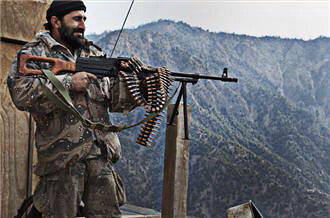
Barack Obama, the US president, has pledged to withdraw American forces from Afghanistan by 2014, with other NATO nations set to pull out their troops before that date and overall responsibility for security gradually being handed to the Afghan National Army and police.

Following the announcement last month from the Taliban that they are prepared to open a political office in Qatar - a step which may facilitate a move towards negotiations and a peaceful settlement - many people hope that the end of Afghanistan's long and brutal war may just be in sight.

But there is a long way to go yet and many ways in which any deal could be upset by events. General John Allen, the senior American commander on the ground, has publicly expressed doubts that a full military withdrawal by 2014 is feasible and, as many experts point out, fighting in parts of Afghanistan is just as fierce as it has always been.
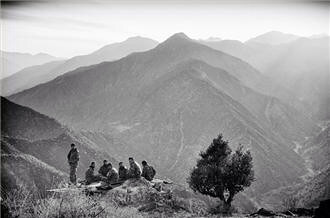
This is especially so in two strategically vital provinces, Kunar and Nuristan, which sit on Afghanistan's mountainous north-eastern border with Pakistan. Since US troops arrived in the country 11 years ago, the area has seen sustained and intense violence. In 2009, with casualties rising, the Americans withdrew entirely from Nuristan. The following year northern Kunar was also handed over to Afghan control. But within a few months, the Taliban had retaken the area, infiltrating through vital border crossings and completely undermining attempts by Afghan forces to maintain security across the region.

So now US forces have returned to the area, this time to the frozen peaks as well as the valleys, determined to re-establish their military dominance and win over the local population before they go. The Taliban are just as keen to see them defeated and the result is an intermittent but occasionally ferocious clash for supremacy amid the mountain tops. Both sides know that what happens here may yet decide the success or failure of NATO's war and indeed the future of Afghanistan itself. More


Tuesday, January 17, 2012

Three Pots of Tea

 Peace in Afghanistan Depends on Its Leaders, Neighbors, and Security Forces

There are three key ingredients for peace in Afghanistan. Afghan leaders must negotiate a peace. Afghan neighbors must respect the peace. And Afghan soldiers and police must keep the peace.

Only the Afghan parties should take part in the formal negotiations over their country’s future. But all of the major external stakeholders, including India, Iran, Pakistan, Russia, and the United States, should conduct parallel, less-formal discussions, with a view to exercising convergent influence on the Afghan parties. All potential parties to a peace treaty accept that the Taliban must be involved in negotiations and granted some role in the resulting government. 

Taliban fighters hand over their weapons in Herat, Afghanistan.

As for keeping the peace, there is likely no organization in the world other than the U.S. Army that can train security forces on the scale needed in places like Afghanistan. But current U.S. Army doctrine is insufficient for this task, and Western models for security forces may not work in Afghanistan. Developing and fielding 

host-nation forces that take the unique context of the country into account will be critical. So will be the army’s selection of advisers and preparation of leaders.

Pacifying Afghans and Their Neighbors

Agreement among the main Afghan parties is a necessary but not sufficient condition for peace. Unlike Iraq and Yugoslavia, which are strong states riven by even stronger ethnic antipathies, Afghanistan is a weak polity that has been torn apart by its near and more-distant neighbors, not unlike the hapless sheep that is pulled apart by mounted riders in buzkashi, the Central Asian version of polo. Until these neighboring countries sense that there is a credible endgame for an Afghan peace accord that protects their interests, they have every incentive to continue meddling destructively and to promote divisions among Afghans. To succeed, any peace process must include Afghanistan’s neighbors. More

Monday, January 16, 2012

Policy draft to mitigate climate effects

 PAKISTAN’S climate change policy whose draft took more than a year to be readied is now under print and may be presented to the federal cabinet for approval in a few weeks.

The draft will unveil an action plan to mitigate adverse effects of extreme weather events as witnessed in 2010 and again in 2011 and likely to face more such happenings in the years to come.

The subject is partially covered by Pakistan Environmental Protection Act 1997 and the National Environment Policy, 2005, but they have proved to be ineffective for lack of implementation of the suggested measures. A high-level committee appointed by the prime minister to coordinate actions on climate change has failed to meet even once in the past three years.

How far the climate change policy will succeed in motivating the bureaucracy to meet the challenge is difficult to foresee. But the magnitude of the challenge — rise in temperatures, frequency of heavy rains and floods, large-scale damages to property and infrastructure, rehabilitation of climate refugees and losses in agricultural output — is too enormous that it hardly provides any room for lethargy, inefficiency and corrupt practices on the part of relevant authorities.

The draft will address the issues of adaptation to the changes in climate and their impact on sectors such as irrigation, energy, crop patterns, clean water, transport, disaster management and capacity building of several departments. Besides, people in Pakistan will have to be prepared to learn to live and cope with most of the changes in climate in the future. More


Saturday, December 31, 2011

United States as a Global Power: New World Disorder

The US is struggling with a paradox: while its military power retains global reach, its role as world leader is gradually ending


The time has long since past when it became fashionable to talk about a new world order. The collapse of the Soviet Union provided an opportunity to fashion one. But instead of using that opportunity to create a new security architecture in Europe, Nato expanded eastwards as the military anchor for democracy promotion. Not content to have seen off one global military competitor in the Soviet Union, the western military industrial complex and the think-tanks they funded scurried around for a worthy replacement. When 11 September happened, they thought they were in business again. For a brief moment, al-Qaida seemed to fulfil some of the characteristics of communism: it could pop up anywhere in the world; it was an existential enemy, driven ideologically and uncontainable through negotiation; and it was potentially voluminous. Neither the doctrines of the pre-emptive strike, nor attacking a foreign country abroad to ensure security at home, were new. Swap the domino theory of the Vietnam era for the crescent of crisis of the Bush and Obama eras, and you had the same formula for a foe that hopscotched across the globe.

But here's the curious thing. Al-Qaida failed, not by being bombed out of the tribal areas of Pakistan or by losing its video-hugging leader. It failed as an ideological alternative, in its own terms and for its own people. It failed in Egypt, the country that mattered most to its chief thinker, the Egyptian-born doctor Ayman al-Zawahiri. When the opportunity arose for millions of Muslims to shed their brutal Arab yoke (this was supposed to be the fourth phase in the construction of the Caliphate, to be accompanied by physical attacks against oil suppliers and cyber ones on the US economy), nothing of the sort happened. Islam is indeed winning the day, but it is political rather than military. It seeks alliances with the apostate and says it is committed to democratic partnership and the rule of law. More

Friday, December 30, 2011

RE-IMAGINING THE INDUS: MAPPING MEDIA REPORTAGE IN INDIA AND PAKISTAN

Water shortage has become a subject of intense public debate in the present political narrative on resource management and riparian rights.
 

In an attempt to discern the divergence on core issues and mainstream media reporting, Re-imagining the Indus is a methodological study based on Media Content Analysis of the reporting on water issues related to the Indus, in the leading dailies of both India and Pakistan. This monograph seeks to capture the existing discourse and stimulate policy dialogue on the subject.
What is the general discourse on water scarcity and related crises in the Indian and Pakistani media? The study conducted by Samir Saran (ORF) and Hans Rasmussen Theting, scrutinised the media coverage on water on three specific themes – the political discourse, water governance and people, practice and environment.
Titled ‘Reimagining the INDUS: Mapping media reportage in India and Pakistan’, the study found that the Indus Water Treaty (IWT) does not dominate the reportage in Pakistan, indicating a low level of discontentment or critique. It also found that it is only in the months of winter, when the water flow is low, that inter-country dispute between India and Pakistan, and significant negative sentiment against India, gets attention in Pakistan. But in the Indian media, Pakistan only appears during spring months. More

The study, now published in the form of a book, found that agricultural concerns and inter-provincial disputes dominate media reportage in Pakistan while in India media lays greater emphasis on urban water concerns and interventions, including ground water and domestic consumption.

The study also showed that media reports in both the countries, Pakistan more than India, recognise the need for the two countries to cooperate on water issues. From the study, it was also clear that in both India and Pakistan, there is equal emphasis on the aspects of water governance and infrastructure. More


Thursday, December 22, 2011

ICIMOD Reports Warn of Vulnerabilities of the HKH Region to Climate Change

6 December 2011: Three new reports released by the International Centre for Integrated Mountain Development (ICIMOD) warn that snow and glacier melt in Asia’s mountainous Hindu Kush-Himalayan (HKH) region threaten millions of mountain people and 1.3 billion people living downstream in Asia’s major river basins.

The report titled "The Status of Glaciers in the Hindu Kush-Himalayan Region" presents findings of a three-year research project funded by Sweden and led by ICIMOD, which through the use of remote sensing studies was able to tally the number of glaciers in the region—more than 54,000—and measure the area covered, 60,000 km. According to the report, glaciers appear to be shrinking in both the central and eastern Himalayas, with clean glaciers of the Tibetan plateau retreating at a faster rate than the glaciers of the rugged central Himalayas.

The second report, titled "Snow-Cover Mapping and Monitoring in the Hindu Kush-Himalayas," provides a comprehensive status report of snow cover in the region. According to the report, there was an indication of an overall decrease in snow cover over the decade in the central HKH region and overall, and a slight increase in the western and eastern parts of the region.

The third report, titled "Climate Change in the Hindu Kush-Himalayas: The State of Current Knowledge," reviews the research and data on climate and hydrology, biodiversity and ecosystems, and atmospheric changes and overall provides a snapshot on the changes that have occurred in the HKH region. [ICIMOD News] [Publication: The Status of Glaciers in the Hindu Kush-Himalayan Region] [Publication: Snow-Cover Mapping and Monitoring in the Hindu Kush-Himalayas] [Publication: "Climate Change in the Hindu Kush-Himalayas: The State of Current Knowledge] More