I'd Dump the Israelis Tomorrow -Ex-CIA Michael Scheuer Tells Congress House Homeland Security Committee on October 9, 2013
Showing posts with label war on terror. Show all posts
Showing posts with label war on terror. Show all posts
Friday, September 5, 2014
 © 2014
Saturday, January 4, 2014
Biggest Threat to World Peace: The United States
Over 12 years into the so-called "Global War on Terror," the United States appears to be striking terror into the hearts of the rest of the world.
 |
| US Troops in Kandahar, Afghanistan |
In their annual End of Year survey, Win/Gallup International found that the United States is considered the number one "greatest threat to peace in the world today" by people across the globe.
The poll of 67,806 respondents from 65 countries found that the U.S. won this dubious distinction by a landslide, as revealed in the chart below.

The BBC explains that the U.S. was deemed a threat by geopolitical allies as well as foes, including a significant portion of U.S. society.
Predictable in some areas (the Middle East and North Africa) but less so in others. Eastern Europe's 32% figure may be heavily influenced by Russia and Ukraine, but across most of Western Europe there are also lots of figures in the high teens.
In the Americas themselves, decades of US meddling have left an awkward legacy. Its neighbours, Mexico (37%) and Canada (17%), clearly have issues. Even 13% of Americans see their own country as a danger. More


Thursday, October 3, 2013
Diary by Patrick Cockburn
The media that failed woefully in their coverage of Afghanistan, Iraq and Libya are the media that we are supposed now to believe are giving us the unvarnished truth in Syria.
He also makes some good points about how war's greater exposure in the modern media often changes the nature of the fighting for the worse. Jonathan Cook - Journalist

The four wars fought in Afghanistan, Iraq, Libya and Syria over the past 12 years have all involved overt or covert foreign intervention in deeply divided countries. In each case the involvement of the West exacerbated existing differences and pushed hostile parties towards civil war. In each country, all or part of the opposition have been hard-core jihadi fighters. Whatever the real issues at stake, the interventions have been presented as primarily humanitarian, in support of popular forces against dictators and police states. Despite apparent military successes, in none of these cases have the local opposition and their backers succeeded in consolidating power and establishing stable states.
More than most armed struggles, the conflicts have been propaganda wars in which newspaper, television and radio journalists played a central role. In all wars there is a difference between reported news and what really happened, but during these four campaigns the outside world has been left with misconceptions even about the identity of the victors and the defeated. In 2001 reports of the Afghan war gave the impression that the Taliban had been beaten decisively even though there had been very little fighting. In 2003 there was a belief in the West that Saddam Hussein’s forces had been crushed when in fact the Iraqi army, including the units of the elite Special Republican Guard, had simply disbanded and gone home. In Libya in 2011 the rebel militiamen, so often shown on television firing truck-mounted heavy machine-guns in the general direction of the enemy, had only a limited role in the overthrow of Muammar Gaddafi, which was mostly brought about by Nato air strikes. In Syria in 2011 and 2012 foreign leaders and journalists repeatedly and vainly predicted the imminent defeat of Bashar al-Assad.

These misperceptions explain why there have been so many surprises and unexpected reversals of fortune. The Taliban rose again in 2006 because it hadn’t been beaten as comprehensively as the rest of the world imagined. At the end of 2001 I was able to drive – nervously but safely – from Kabul to Kandahar, but when I tried to make the same journey in 2011 I could go no further south on the main road than the last police station on the outskirts of Kabul. In Tripoli two years ago hotels were filled to capacity with journalists covering Gaddafi’s fall and the triumph of the rebel militias. But state authority still hasn’t been restored. This summer Libya almost stopped exporting oil because the main ports on the Mediterranean had been seized by mutinying militiamen, and the prime minister, Ali Zeidan, threatened to bomb ‘from the air and the sea’ the oil tankers the militiamen were using to sell oil on the black market.
Libya’s descent into anarchy was scarcely covered by the international media since they had long since moved on to Syria, and more recently Egypt. Iraq, home a few years ago to so many foreign news bureaux, has also dropped off the media map although up to a thousand Iraqis are killed each month, mostly as a result of the bombing of civilian targets. When it rained for a few days in Baghdad in January the sewer system, supposedly restored at a cost of $7 billion, couldn’t cope: some streets were knee-deep in dirty water and sewage. In Syria, many opposition fighters who had fought to defend their communities turned into licensed bandits and racketeers when they took power in rebel-held enclaves.
It wasn’t that reporters were factually incorrect in their descriptions of what they had seen. But the very term ‘war reporter’, though not often used by journalists themselves, helps explain what went wrong. Leaving aside its macho overtones, it gives the misleading impression that war can be adequately described by focusing on military combat. But irregular or guerrilla wars are always intensely political, and none more so than the strange stop-go conflicts that followed from 9/11. This doesn’t mean that what happened on the battlefield was insignificant, but that it requires interpretation. In 2003 television showed columns of Iraqi tanks smashed and on fire after US air strikes on the main highway north of Baghdad. If it hadn’t been for the desert background, viewers could have been watching pictures of the defeated German army in Normandy in 1944. But I climbed into some of the tanks and could see that they had been abandoned long before they were hit. This mattered because it showed that the Iraqi army wasn’t prepared to fight and die for Saddam. It was a pointer too to the likely future of the allied occupation. Iraqi soldiers, who didn’t see themselves as having been defeated, expected to keep their jobs in post-Saddam Iraq, and were enraged when the Americans dissolved their army. Well-trained officers flooded into the resistance, with devastating consequences for the occupying forces: a year later the Americans controlled only islands of territory in Iraq.

War reporting is easier than other types of journalism in one respect because the melodrama of events drives the story and attracts an audience. It may be risky at times, but the correspondent talking to camera, with exploding shells and blazing military vehicles behind him, knows his report will feature high up in any newscast. ‘If it bleeds it leads,’ is an old American media adage. The drama of battle inevitably dominates the news, but oversimplifies it by disclosing only part of what is happening. These oversimplifications were more than usually gross and deceptive in Afghanistan and Iraq, when they dovetailed with political propaganda that demonised the Taliban and later Saddam as evil incarnate, casting the conflict – particularly easy in the US in the hysterical atmosphere after 9/11 – as a black and white struggle between good and evil. The crippling inadequacies of the opposition were ignored.
By 2011 the complexity of the conflicts in Iraq and Afghanistan was evident to journalists in Baghdad and Kabul if not necessarily to editors in London and New York. But by then the reporting of the wars in Libya and Syria was demonstrating a different though equally potent form of naivety. A version of the spirit of 1968 prevailed: antagonisms that predated the Arab Spring were suddenly said to be obsolete; a brave new world was being created at hectic speed. Commentators optimistically suggested that, in the age of satellite television and the internet, traditional forms of repression – censorship, imprisonment, torture, execution – could no longer secure a police state in power; they might even be counter-productive. State control of information and communication had been subverted by blogs, satellite phones and even the mobile phone; YouTube provided the means to expose in the most graphic and immediate way the crimes and violence of security forces. More
Tuesday, May 21, 2013
Pentagon to wage worldwide war on terror for decades to come
After the attacks of September 11, Congress handed over the power to the Executive Branch to declare war. The Authorization to Use Military Force Act empowers the president to fight the 'War on Terror' anywhere on the global and is set for repeal. On Thursday, the Senate held a hearing over the 12 year-old legislation, but will this legislation remain unchanged or will Congress regain the authority? To discuss, RT's Sam Sacks gives us his take on the AUMF.
Find RT America in your area:
Or watch us online:
Like us on Facebook
Follow us on Twitter
Saturday, April 28, 2012
Obama's Secret Drone War Explained
The Obama Administration has approved five times the number of covert drone strikes that his predecessor did. Thomson Reuters Digital Editor Chrystia Freeland sits down with Reuters' Pulitzer Prize-winning columnist David Rohde to discuss his special report detailing the quiet expansion of presidential power under Obama
Tuesday, February 28, 2012
Drums of war: The US media's 'Iranian threat'
On Listening Post this week: Beating the drum for war - the US media and 'The Iranian Threat'. Plus, the burgeoning media scene in post-revolutionary Libya.
Something sounds familiar. 'Long-range nuclear missiles', 'terrorist sleeper cells', 'WMDs': terms which quickly became part of the media's vocabulary in the run up to the 2003 US-led invasion of Iraq. Fast-forward to 2012 and they are featuring heavily once again, only now it is not about Iraq, but Iran. Last time, the media's saber-rattling followed the Bush administration's lead in selling the attack on Iraq. This time, the so-called 'Iranian Threat' is a narrative being constructed by the US media all by itself - with scant public support from the Obama administration. Our News Divide this week takes a close look at the coverage of Iran and a culture of journalism that seems to have forgotten the very real dangers of hypothesis and conjecture. More
One would think that paranoia was an infectious disease given the way is spreads in certain countries and among the media. However, given the level of greed in today's world that drives corporate motivation it should surprize no one. On the other hand no sector of the economy should be beating the drums of war. All corporations should be practicing Corporate Social Responsability. Editor.
Sunday, February 19, 2012
US Policy Towards The China-Pakistan-India Triangle – OpEd
The region of South Asia comprising of two nuclear states India and Pakistan – which also happen to be long time rivals - is the flashpoint of future conflicts.
These conflicts would most likely arise from the on and off imbalance of nuclear deterrence, trans-border terrorism, water disputes or the much clichéd Kashmir issue. But one must note here that these conflicts won’t come into play without the role of foreign involvement like the United States and China.

The United States is on the verge of losing balance in the region because of economic constraints, as a result of the failing War on Terror in Afghanistan. It is therefore, looking for a way out which seems to be not that easy. The expansion of its influence into Asia-Pacific for economic ties with partners like South Korea, Japan, Taiwan and India is gaining the required media hype. The recent visits of President Obama on the eve of Asian Economic Summits have proven that America can no longer sustain the decade long war and is now claiming its dominance as an Asia-Pacific power in the region. One wonders where that is going to lead the superpower.
China on the other hand, being a superpower in its own region has managed to match the American economy and has the potential to leave it behind in the near future. China is strong economically and militarily and is an apparent threat to the United States and India alike. Pakistan being an old ally of China, is taking every advantage of the “friendship” to improve its security, economic and energy problems. In other words, Pakistan provides a platform to China in the heart of South Asia which is a strategic gain for the latter. More
The Winter War
In the frozen peaks of Afghanistan's Kunar province, a ferocious clash for supremacy rages amid the mountaintops.
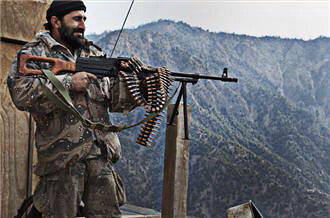
Barack Obama, the US president, has pledged to withdraw American forces from Afghanistan by 2014, with other NATO nations set to pull out their troops before that date and overall responsibility for security gradually being handed to the Afghan National Army and police.
Following the announcement last month from the Taliban that they are prepared to open a political office in Qatar - a step which may facilitate a move towards negotiations and a peaceful settlement - many people hope that the end of Afghanistan's long and brutal war may just be in sight.
But there is a long way to go yet and many ways in which any deal could be upset by events. General John Allen, the senior American commander on the ground, has publicly expressed doubts that a full military withdrawal by 2014 is feasible and, as many experts point out, fighting in parts of Afghanistan is just as fierce as it has always been.
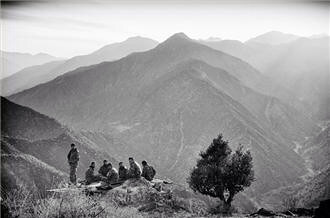
This is especially so in two strategically vital provinces, Kunar and Nuristan, which sit on Afghanistan's mountainous north-eastern border with Pakistan. Since US troops arrived in the country 11 years ago, the area has seen sustained and intense violence. In 2009, with casualties rising, the Americans withdrew entirely from Nuristan. The following year northern Kunar was also handed over to Afghan control. But within a few months, the Taliban had retaken the area, infiltrating through vital border crossings and completely undermining attempts by Afghan forces to maintain security across the region.
So now US forces have returned to the area, this time to the frozen peaks as well as the valleys, determined to re-establish their military dominance and win over the local population before they go. The Taliban are just as keen to see them defeated and the result is an intermittent but occasionally ferocious clash for supremacy amid the mountain tops. Both sides know that what happens here may yet decide the success or failure of NATO's war and indeed the future of Afghanistan itself. More
Monday, January 30, 2012
The Rohingya: Myanmar's outcasts
This article is the first in a series by Ambassador Akbar Ahmed, a former Pakistani high commissioner to the UK, exploring how a litany of volatile centre/periphery conflicts with deep historical roots were interpreted after 9/11 in the new global paradigm of anti-terrorism - with profound and often violent consequences. Incorporating in-depth case studies from Asia, Africa, and the Middle East, Ambassador Ahmed will ultimately argue that the inability for Muslim and non-Muslim states alike to either incorporate minority groups into a liberal and tolerant society or resolve the "centre vs periphery" conflict is emblematic of a systemic failure of the modern state - a breakdown which, more often than not, leads to widespread violence and destruction. The violence generated from these conflicts will become the focus, in the remainder of the 21st century, of all those dealing with issues of national integration, law and order, human rights and justice.

Washington, DC - The image of a smiling Daw Aung San Suu Kyi receiving flowers from her supporters is a powerful message of freedom and optimism in Myanmar, the symbol of democracy in a country which has known nothing but authoritarian oppression for decades.
Yet few ask one of the most pressing questions facing Daw Suu Kyi. How will she deal with the Rohingya?
"The Rohingya," you will ask. "Who are they?"
The Rohingya, whom the BBC calls "one of the world's most persecuted minority groups", are the little-publicised and largely forgotten Muslim people of the coastal Rakhine state of western Myanmar. Their historic lineage in Rakhine dates back centuries, as fishermen and farmers. Over the past three decades, the Rohingya have been systematically driven out of their homeland by Myanmar's military junta and subjected to widespread violence and the total negation of their rights and citizenship within Myanmar. They are a stateless Muslim minority.
The continued tragedy of the unrecognised Rohingya, both in Myanmar and as refugees abroad, casts a dark shadow over the bright hopes and prospects for democracy in a country plagued by violence and civil war. Suu Kyi is ideally placed to extend democratic reforms to all ethnic peoples, including the Rohingya, in a free Myanmar. More
Subscribe to:
Posts (Atom)