Showing posts with label CIA. Show all posts

Sunday, February 4, 2018

The Increasing Likelihood Of Nuclear War Should Straighten Out All Our Priorities


A Russian pilot has been killed by US-armed terrorists in Syria. The Ron Paul Institute‘s Daniel McAdams writes the following about this new development:

“The scenario where a US-backed, US-supplied jihadist group in Syria uses US weapons to shoot down a Russian plane and then murders the pilot on the ground should be seen as a near-nightmare escalation, drawing the US and Russia terrifyingly closer to direct conflict.”

McAdams is not fearmongering; he is stating a plainly obvious fact. The Trump administration has just announced that it is restructuring its nuclear weapons policy to take a more aggressive stance toward Russia than that which was held by the previous administration. This is coming after this administration’s decision to arm Ukraine against Russia, a move Obama refused to take for fear of escalating tensions with Moscow, as well as its decision to continue to occupy Syria in order to effect regime change, along with numerous other escalations. The Council on Foreign Relations, which is without exaggeration as close to the voice of the US establishment as you can possibly get, is now openly admitting that the “United States is currently in a second Cold War with Russia. Read More

Saturday, December 19, 2015

HOW ROGUE TECHIES ARMED THE PREDATOR, ALMOST STOPPED 9/11, AND ACCIDENTALLY INVENTED REMOTE WAR

ON THE AFTERNOON of October 7, 2001, the first day of the war in Afghanistan, an Air Force pilot named Scott Swanson made history while sitting in a captain’s chair designed for an RV. His contribution to posterity was to kill someone in a completely novel way.

In the moments leading up to the act, Swanson was nervous. He sat in a darkened trailer tucked behind a parking garage at CIA headquarters in Langley, Virginia, remotely piloting a Predator drone over Kandahar, 6,900 miles away. Nearly everything about his rig had been cobbled together and hastily assembled. The Predator itself, one of just a handful in existence, was flying about 250 pounds heavier than usual. And the satellite communications link that connected Swanson to the aircraft would periodically shut down due to a power issue, which software engineers in California were frantically trying to patch.

When the order came through to take the shot, Swanson pulled a trigger on his joystick. A little more than a second later, a Hellfire missile slid off an aluminum rail on the Predator’s wing and sailed into the Afghan night.

Swanson’s target was a pickup truck parked outside a compound thought to be hiding Mullah Omar, the supreme commander of the Taliban. The missile killed two unidentified men believed to have been his bodyguards. It was the first time a US drone had fired a weapon in combat. It was the first time a modern drone had ever killed a human being. More


Tuesday, July 28, 2015

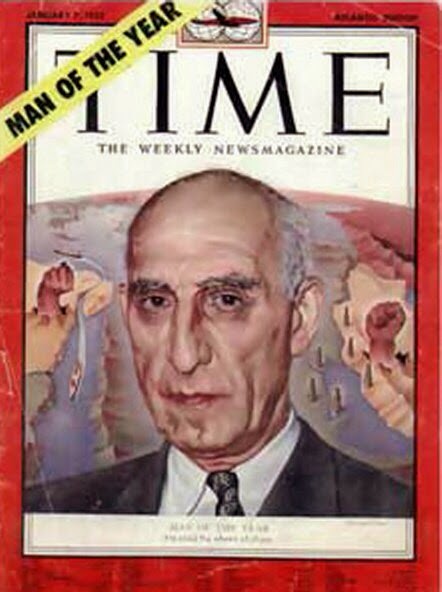
CIA Confirms Role in 1953 Iran Coup

The CIA has publicly admitted for the first time that it was behind the notorious 1953 coup against Iran’s democratically elected prime minister Mohammad Mosaddeq, in documents that also show how the British government tried to block the release of information about its own involvement in his overthrow.

On the 60th anniversary of an event often invoked by Iranians as evidence of western meddling, the US national security archive at George Washington University published a series of declassified CIA documents.

“The military coup that overthrew Mosaddeq and his National Front cabinet was carried out under CIA direction as an act of US foreign policy, conceived and approved at the highest levels of government,” reads a previously excised section of an internal CIA history titled The Battle for Iran.

The documents, published on the archive’s website under freedom of information laws, describe in detail how the US – with British help – engineered the coup, codenamed TPAJAX by the CIA and Operation Boot by Britain’s MI6.

Britain, and in particular Sir Anthony Eden, the foreign secretary, regarded Mosaddeq as a serious threat to its strategic and economic interests after the Iranian leader nationalised the British Anglo-Iranian Oil Company, latterly known as BP. But the UK needed US support. The Eisenhower administration in Washington was easily persuaded.

Mohammad Mosaddeq

British documents show how senior officials in the 1970s tried to stop Washington from releasing documents that would be “very embarrassing” to the UK.

Official papers in the UK remain secret, even though accounts of Britain’s role in the coup are widespread. In 2009 the former foreign secretary Jack Straw publicly referred to many British “interferences” in 20th-century Iranian affairs. On Monday the Foreign Office said it could neither confirm nor deny Britain’s involvement in the coup.

The previously classified US documents include telegrams from Kermit Roosevelt, the senior CIA officer on the ground in Iran during the coup. Others, including a draft in-house CIA history by Scott Kock titled Zendebad, Shah! (Viva, Shah!), say that according to Monty Woodhouse, MI6’s station chief in Tehran at the time, Britain needed US support for a coup. Eden agreed. “Woodhouse took his words as tantamount to permission to pursue the idea” with the US, Kock wrote.

Mosaddeq’s overthrow, still given as a reason for the Iranian mistrust of British and American politicians, consolidated the Shah’s rule for the next 26 years until the 1979 Islamic revolution. It was aimed at making sure the Iranian monarchy would safeguard the west’s oil interests in the country.

The archived CIA documents include a draft internal history of the coup titled “Campaign to install a pro-western government in Iran”, which defines the objective of the campaign as “through legal, or quasi-legal, methods to effect the fall of the Mosaddeq government; and to replace it with a pro-western government under the Shah’s leadership with Zahedi as its prime minister”.

Kermit Roosevelt

One document describes Mosaddeq as one of the “most mercurial, maddening, adroit and provocative leaders with whom they [the US and Britain] had ever dealt”. The document says Mosaddeq “found the British evil, not incomprehensible” and “he and millions of Iranians believed that for centuries Britain had manipulated their country for British ends”. Another document refers to conducting a “war of nerves” against Mossadeq.

The Iranian-Armenian historian Ervand Abrahamian, author of The Coup: 1953, the CIA and the Roots of Modern US-Iranian Relations, said in a recent interview that the coup was designed “to get rid of a nationalist figure who insisted that oil should be nationalised”.

Unlike other nationalist leaders, including Egypt’s Gamal Abdel Nasser, Mosaddeq epitomised a unique “anti-colonial” figure who was also committed to democratic values and human rights, Abrahamian argued.

Some analysts argue that Mosaddeq failed to compromise with the west and the coup took place against the backdrop of communism fears in Iran. “My study of the documents proves to me that there was never really a fair compromise offered to Mosaddeq, what they wanted Mosaddeq to do is to give up oil nationalisation and if he’d given that of course then the national movement would have been meaningless,” he told the Iranian online publication, Tableau magazine.

“My argument is that there was never really a realistic threat of communism … discourse and the way justifying any act was to talk about communist danger, so it was something used for the public, especially the American and the British public.”

Despite the latest releases, a significant number of documents about the coup remain secret. Malcolm Byrne, deputy director of the national security archive, has called on the US intelligence authorities to release the remaining records and documents.

“There is no longer good reason to keep secrets about such a critical episode in our recent past. The basic facts are widely known to every school child in Iran,” he said. “Suppressing the details only distorts the history, and feeds into myth-making on all sides.”

In recent years Iranian politicians have sought to compare the dispute over the country’s nuclear activities to that of the oil nationalisation under Mosaddeq: supporters of the former president Mahmoud Ahmadinejad often invoke the coup.

US officials have previously expressed regret about the coup but have fallen short of issuing an official apology. The British government has never acknowledged its role. More


Friday, September 5, 2014

I'd Dump the Israelis Tomorrow -Ex-CIA Michael Scheuer Tells Congress

I'd Dump the Israelis Tomorrow -Ex-CIA Michael Scheuer Tells Congress House Homeland Security Committee on October 9, 2013

Friday, July 18, 2014

CIA Station Chief Ordered out of Berlin

Berlin has ordered the CIA chief of station to leave Germany by the end of the week amid a growing espionage scandal, according to German newspapers.

The German Foreign Office did not verify a timeline for departure, but did reiterate the German government’s expectation that the intelligence representative leave “promptly.” Chancellor Angela Merkel demanded the station chief’s departure last week after a year-long spying dispute, triggered by revelations that the National Security Agency (NSA) monitored Merkel’s cell phone, culminated with reports that a German intelligence official was spying for the CIA.

Maj. James Weirick, the Marine Corps whistleblower who accused a senior general and his staff of wrongdoing during the trial of Marines implicated in a video depicting US personnel urinating on dead Afghani insurgents, has been transferred. Weirick, who previously served as a staff judge advocate at Quantico with Marine Corps Combat Development Command, filed an inspector general complaint in March of last year accusing Marine Commandant Gen. James F. Amos and some of his senior staff of exerting undue influence and seeking “to manipulate the military justice system to ensure tough punishments against the snipers shown in the video,” namely by removing the three-star general assigned to oversee the cases after learning that the general intended to impose administrative nonjudicial punishment rather than a more serious court-martial.

The Department of Justice declined to investigate the CIA’s allegations that Senate Intelligence Committee staff somehow hacked the agency’s computers while working on a report highly critical of the agency’s detention and interrogation program. The DOJ’s refusal to investigate the CIA allegations seems to affirm Senate Majority Leader Harry Reid’s (D-NV) earlier comments that accusations “that Senate committee staff who have no technical training somehow hacked into the CIA’s highly secure classified networks…appears on its face to be patently absurd.”

A Navy nurse at Guantanamo is refusing to continue force-feeding inmates on hunger strikes and has been reassigned to “alternative duties.” The Department of Defense recently admitted it has video recordings of force-feeding detainees at the same time detainees are accusing the US of manipulating data on inmates’ hunger strikes to keep strike numbers artificially low. A lawyer for one of the striking detainees, Abi Wa’el Dhiab, submitted court filings to preserve the force-feeding tapes. Dhiab is also one of the six-low level detainees being transferred to Uruguay, and the transfer would likely render his lawsuit moot.

House Democrats are asking the Department of Homeland Security’s inspector general to investigate McClatchy’s allegations that “Motorola’s contracting tactics have led state and local governments to squander millions of dollars on the company’s pricey two-way emergency radio systems.” Motorola’s public safety division, Motorola Solutions, has controlled an estimated 80 per cent or more of the market for emergency communications equipment for years, and its radios contain proprietary software that prevents Motorola equipment from interacting with other systems.

Russia will regain control of Lourdes Intelligence Center outside of Havana after giving it up in 2001 to satisfy a request from the US. Russia began negotiating with Cuba to regain control of the facility, which was the USSR’s largest electronic intelligence facility and controlled radio and telephone connections over a large territory of the “potential enemy,” several years ago. Russian President Vladimir Putin also signed a law writing off 90 per cent of Cuba’s $32 billion Soviet-era debt to Russia during his visit to Havana last week.

Newly declassified documents obtained by Ryan Shapiro show the FBI monitored Nelson Mandela during the 1990s over a perceived communist threat. The documents show the bureau monitored Mandela’s communications with the African National Congress “and kept a close eye on the anti-apartheid activities of the Communist Party USA.” Mandela remained on the US’ terror watch list, and the ANC remained designated as a US’ terrorist organization, until 2008. Shapiro has FOIA lawsuits against the NSA, FBI and the Defense Intelligence Agency for their records on any participation in Mandela’s 1962 capture, and a separate case against the CIA for records on Mandela’s arrest.

FOIA work from the folks at MuckRock revealed some interesting cafeteria complaints at the CIA, including suspicion that the Pepsi dispenser was in fact dispensing Diet Pepsi, anger with Russian-themed menu items (“Beef stroganoff is more American than Russian”), and frustration with the grumpy demeanor of fast food workers who have “attitude every day.” In other culinary news, the international food service company Sodexo is seeking a master chef for a secure US government facility in Northern Virginia who holds or can obtain a Top Secret security clearance. As Steve Aftergood points out, this is a prime example of the bloated security clearance system, which the Office of Management and Budget reportedearlier this year as being too large and needing to be reduced. As Aftergood notes, “Eliminating the TS/SCI clearance requirement for access to the kitchens and dining rooms of government facilities might be a sensible place to start.”

The KGB Archives of Soviet defector Vasiliy Mitrokhin’s are in the process of opening to the public for the first time. While not available online yet, the FBI called these documents, which Mitrokhin initially smuggled out of KGB facilities daily on small scraps of paper hidden in his shoes, “the most complete and extensive intelligence ever received from any source,” and are bound to be a boon to researchers when they become available.

Finally, this week’s #tbt document pick is a great reminder on the need for reformto the b(5) “deliberative process” exemption. The document is a May 18, 1994, State Department memo expressing doubts about the size of the Rwandan death toll and was cited in Samantha Power’s 2003 groundbreaking history A Problem from Hell, based largely on FOIA requests she and other Archive staff filed while at the National Security Archive. Apparently, the Department of State failed to realize in 2007 that the memo had been released years earlier in its entirety and cited in Power’s book, and chose to use the b(5) exemption to withhold the information in the memo from the public, citing the specious claim of the deliberative process. It’s worth noting that Power’s book also cites the intransigence of US agencies at the time, noting the need for “congressional inquiries with the power to subpoena documents and to summon US officials of all ranks in the executive and legislative branches,” as it was nearly impossible to obtain “meaningful disclosure” about the Rwandan genocide through the FOIA process. More


Friday, June 27, 2014

"The Battle for Iran," 1953: Re-Release of CIA Internal History Spotlights New Details about anti-Mosaddeq Coup

Mohammad Mossadegh

"The Battle for Iran," 1953: Re-Release of CIA Internal History Spotlights New Details about anti-Mosaddeq Coup

U.S. Ambassador Loy Henderson and Some CIA Officials Initially Disagreed with Certain Premises of Coup Planners

Declassified History Implies British Ties to the Operation, Criticizes London's Policies in Period Leading up to the OverthrowNational Security Archive Electronic Briefing Book No. 476Posted on June 27, 2014Edited by Malcolm ByrneFor more information contact:202 / 994-7043 or nsarchiv@gwu.eduWashington, D.C., June 27, 2014 --

During early planning for the 1953 Iran coup, U.S. Ambassador Loy Henderson warned not only that the Shah would not support the United States' chosen replacement for Prime Minister Mohammad Mosaddeq but that the Army would not play its hoped-for leading role without the Shah's active cooperation, according to a newly released version of an internal CIA history of the operation posted today by the National Security Archive.

The Archive, based at The George Washington University, obtained the latest release of this history -- "The Battle for Iran," written in the mid-1970s -- in response to a Mandatory Declassification Review request.

(Today's posting includes all previously released versions of the document as well, for purposes of comparison.)

The document goes on to say that members of the CIA's station in Tehran and certain officials at agency headquarters sided with Henderson against some of the assumptions of American coup planners, who were working under "closely held" conditions in Washington during Spring and Summer 1953.Mainly through interviews with coup participants, scholars have known generally that disagreements existed (and eventually Henderson went along with Mosaddeq's overthrow), but freshly declassified portions of the document posted today provide a few more specifics about the nature of the differences and who held to which views.The history also offers the most explicit declassified references to-date to British participation in the operation. London's role -- undoubtedly the worst-kept secret in Britain's relationship with Iran over the past 60 years -- has never been formally acknowledged by either British or U.S. authorities.

"The Battle for Iran" is one of three agency histories of the coup that are known to exist. All three have been posted at various times on the National Security Archive's Web site.Check out today's posting at the National Security Archive's website -http://www2.gwu.edu/~nsarchiv/NSAEBB/NSAEBB476/

Find us on Facebook - http://www.facebook.com/NSArchiveUnredacted, the Archive blog - http://nsarchive.wordpress.com/________________________________________________________

THE NATIONAL SECURITY ARCHIVE is an independent non-governmental research institute and library located at The George Washington University in Washington, D.C. The Archive collects and publishes declassified documents acquired through the Freedom of Information Act (FOIA). A tax-exempt public charity, the Archive receives no U.S. government funding; its budget is supported by publication royalties and donations from foundations and individuals.

_________________________________________________________


Tuesday, June 17, 2014

Secret state: Trevor Paglen documents the hidden world of governmental surveillance, from drone bases to "black sites"

Secret prisons, drone bases, surveillance stations, offices where extraordinary rendition is planned: Trevor Paglen takes pictures of the places that the American and British governments don’t want you to know even exist

As anyone who has worked there knows, Kabul is a tough place, redeemed by the charm of the people and the abundance of cheap taxis. But Trevor Paglen had trouble finding a taxi driver willing and able to take him where he wanted to go: north-east out of the city along an old back road reputed to be so dangerous – even by Afghan standards – that it had seen no regular traffic for more than 30 years.

Finally he succeeded in digging out an old man who had been driving a cab since before the Soviet invasion. "We started driving and we left the city behind and we're out in the sticks," he recalls, "and we end up in a traffic jam – not cars but goats. And we wait for the goats to go by and we see the shepherd, this very old man, traditional Afghan clothes, big beard, exactly what you'd picture in your head. But he's wearing a baseball hat.

"The shepherd finally turns to look at us in the car – and on that baseball cap are the letters KBR. It stands for Kellogg Brown and Root – a company that was a subsidiary of Halliburton, which Dick Cheney was on the board of. The local goatherd is wearing a Dick Cheney baseball cap!" It was the final clue he needed that this particular bad road was the right road. There in the distance, behind a high cream wall and coiled razor wire, was what Paglen was looking for: the nondescript structures of what he says he is "99.999 per cent sure" is the place they call the Salt Pit: a never-before-identified-or-photographed secret CIA prison. See photo above.

Trevor Paglen is an artist of a very particular kind. His principal tool is the camera, and most of his works are photographs, but the reason they are considered to be art – the reason, for example, that this bland photo, three feet wide by two feet high, showing the outer wall and the interior roof outline of the Salt Pit, with a dun-coloured Afghan hill behind it, sells for $20,000 – is because of the arduous, painstaking, sometimes dangerous path that culminated in pressing the shutter; and because it reveals something that the most powerful state in history has done everything in its power to keep secret.

Since he was a postgraduate geography student at UCLA 10 years ago, Paglen has dedicated himself to a very 21st-century challenge: seeing and recording what our political masters do everything in their power to render secret and invisible.

Above our heads more than 200 secret American surveillance satellites constantly orbit the Earth: with the help of fanatical amateur astronomers who track their courses, Paglen has photographed them. A secret air force base deep in the desert outside Las Vegas is the control centre for the US's huge fleet of drones: Paglen has photographed these tiny dots hurtling through the Nevada skies. To carry out the extraordinary rendition programme which was one of President George W Bush's answers to the 9/11 attacks, seizing suspects from the streets and spiriting them off to countries relaxed about torture, the CIA created numerous front companies: grinding through flight records and using the methods of a private detective, Paglen identified them, visiting and covertly photographing their offices and managers. The men and women who carried out the rendition programme were equipped with fake identities: Paglen has made a collection of these people's unconvincing and fluctuating signatures, "people," as he puts it, "who don't exist because they're in the business of disappearing other people".

It sounds like the work-in-progress of an extraordinarily determined investigative journalist. But while the dogged tracking of a Seymour Hersh will culminate in a 5,000-word piece for The New Yorker, blowing the lid off, say, alleged American plans to seize control of Pakistan's nuclear weapons or the origin of the sarin used in the Syrian civil war, Paglen is not interested in such narratives. Not that he is uninterested: he describes the extraordinary rendition programme, for example, as "incredibly evil", and has worked closely with human-rights activists. But rather than a charge sheet of the guilty men or calls for government action or popular insurrection, he presents us with a succession of enigmatic images: boring suburban offices, middle-aged men getting into American cars, shimmering lines in the sky, aircraft waiting to take off.

The new project that brings him to Britain is in line with this, though it is also prettier than most of his work. A photograph more than 60 metres wide which will stretch the entire length of the platform of Gloucester Road Underground station – home of the Art on the Underground programme – shows an idyllic expanse of rolling north York moors. And there, nestling among the folds of the hills are the massed giant golfballs of the vast RAF Fylingdales surveillance station, jointly operated with the US.

Given the existence of bitter and determined enemies, what's wrong with having secret facilities to keep a close eye on them?

"I think mass surveillance is a bad idea because a surveillance society is one in which people understand that they are constantly monitored," Paglen says, "and when people understand that they are constantly monitored they are more conformist, they are less willing to take up controversial positions, and that kind of mass conformity is incompatible with democracy.

"The second reason is that mass surveillance creates a dramatic power imbalance between citizens and government. In a democracy the citizens are supposed to have all the power and the government is supposed to be the means by which the citizens exercise that power. But when you have a surveillance state, the state has all the power and citizens have very little. In a democratic society you should have a state with maximum transparency and maximum civil liberties for citizens. But in a surveillance state the exact opposite is true." More


Sunday, May 25, 2014

The empire strikes back: How Brandeis foreshadowed Snowden and Greenwald

So-called liberals attack the whistle-blower duo -- and a brilliant Supreme Court justice saw it all coming

In the famous wiretapping case Olmstead v. United States, argued before the Supreme Court in 1928, Justice Louis Brandeis wrote one of the most influential dissenting opinions in the history of American jurisprudence. Those who are currently engaged in what might be called the Establishment counterattack againstGlenn Greenwald and Edward Snowden, including the eminent liberal journalists Michael Kinsley and George Packer, might benefit from giving it a close reading and a good, long think.

Brandeis’ understanding of the problems posed by a government that could spy on its own citizens without any practical limits was so far-sighted as to seem uncanny. (We’ll get to that.) But it was his conclusion that produced a flight of memorable rhetoric from one of the most eloquent stylists ever to sit on the federal bench. Government and its officers, Brandeis argued, must be held to the same rules and laws that command individual citizens. Once you start making special rules for the rulers and their police – for instance, the near-total impunity and thick scrim of secrecy behind which government espionage has operated for more than 60 years – you undermine the rule of law and the principles of democracy.

“Our Government is the potent, the omnipresent teacher,” Brandeis concluded. “For good or for ill, it teaches the whole people by its example. Crime is contagious. If the Government becomes a lawbreaker, it breeds contempt for law; it invites every man to become a law unto himself; it invites anarchy. To declare that in the administration of the criminal law the end justifies the means — to declare that the Government may commit crimes in order to secure the conviction of a private criminal — would bring terrible retribution.”

Kinsley’s anti-Greenwald screed in the New York Times Book Review, and Packer’slonger and subtler essay for the British magazine Prospect, deliberately ignore or finesse the question of what the government has taught us through its black budgets, its institutional paranoia, its super-secret and extra-constitutional spycraft. Those two articles, and others like them, amount to a sophisticated effort to change the subject on the Greenwald-Snowden affair now that its initial impact has faded, and also to reassure by way of bewilderment: In the face of all this confusion about who’s right and who’s wrong, the best policy is to keep calm, carry on and leave all this boring stuff to the experts. Instead of focusing on the larger issues of privacy, power and secrecy articulated by Brandeis or on the corroded nature of contemporary democracy, Kinsley and Packer urge us to deplore the perceived personality defects or political misjudgments of Greenwald and Snowden, and throw up a virtual smokescreen of invidious comparison. OK, maybe that whole NSA thing wasn’t super awesome – but you could be living in Communist Russia!

You know, I have some criticisms of Glenn Greenwald too, and I’d be happy to share them with you, or with him, on some other occasion. George Packer is no dolt, and he scores a few hits on both Greenwald and Snowden in his enormous and detailed article, which at least on the surface is much more evenhanded and thoughtful than Kinsley’s drive-by hackwork. But to observe that Greenwald can make infelicitous or inconsistent statements at times, or that his argument about the chilling cultural effect of mass surveillance is not well worked out, does not add up to “a pervasive absence of intellectual integrity.” For that I’m afraid that Packer – still in ideological rehab, it seems, for his “liberal interventionist” support of the Iraq War and the neoconservative foreign-policy agenda – had better look in the mirror.

When Greenwald derides mainstream journalists (in his response to Kinsley) as “jingoistic media courtiers” tasked with attacking “anyone who voices any fundamental critiques of American political culture,” he is not being polite or diplomatic, and is no doubt painting with too broad a brush. There are numerous exceptions, and as Greenwald surely knows, the newsrooms of the New York Times, the Washington Post and the Wall Street Journal have over the decades been the sites of vigorous internal debate about how best to cover issues of surveillance, espionage and national security. But as a general tendency, he’s more right than wrong, and in this instance Kinsley and Packer are fighting a vigorous rearguard action on behalf of the entrenched interests of the Beltway elite, the self-described serious grownups of the “permanent government” and their well-connected media allies.

Any pretense of a critical relationship toward power — which was once supposed to be the journalist’s role in a democratic society — has been abandoned altogether (in Kinsley’s case) or eaten away to nothing by reasonable-sounding nuance and dispassionate analysis, as with Packer. Kinsley’s review has already been subjected to widespread mockery, even by “mainstream” commentators like the Washington Post’s Erik Wemple, and no wonder; it reads as if it had been cranked out during a single Acela Express trip from New York to D.C. (and filed by the time he reached Wilmington). Kinsley appears to feel that the entire topic of Greenwald and Snowden is beneath him, and that it raises no questions to which the right-thinking people in his circle don’t already know the answers: Journalists have no special rights or privileges, David Gregory was being “perfectly reasonable” when he accused Greenwald on “Meet the Press” of being a criminal, and we simply can’t allow “newspapers and reporters to chase down and publish any national security leaks they can find.” Who gets to decide how, when and whether government secrets are released? Why, the government, of course! Isn’t it obvious? More

Dissenting opinion of Justice Louis D. Brandeis in Olmstead v. United States


Sunday, December 15, 2013

Syria: Whose Sarin?

In his nationally televised speech about Syria on 10 September, Obama laid the blame for the nerve gas attack on the rebel-held suburb of Eastern Ghouta firmly on Assad’s government, and made it clear he was prepared to back up his earlier public warnings that any use of chemical weapons would cross a ‘red line’: ‘Assad’s government gassed to death over a thousand people,’ he said. ‘We know the Assad regime was responsible … And that is why, after careful deliberation, I determined that it is in the national security interests of the United States to respond to the Assad regime’s use of chemical weapons through a targeted military strike.’ Obama was going to war to back up a public threat, but he was doing so without knowing for sure who did what in the early morning of 21 August.

He cited a list of what appeared to be hard-won evidence of Assad’s culpability: ‘In the days leading up to August 21st, we know that Assad’s chemical weapons personnel prepared for an attack near an area where they mix sarin gas. They distributed gas masks to their troops. Then they fired rockets from a regime-controlled area into 11 neighbourhoods that the regime has been trying to wipe clear of opposition forces.’ Obama’s certainty was echoed at the time by Denis McDonough, his chief of staff, who told the New York Times: ‘No one with whom I’ve spoken doubts the intelligence’ directly linking Assad and his regime to the sarin attacks.

But in recent interviews with intelligence and military officers and consultants past and present, I found intense concern, and on occasion anger, over what was repeatedly seen as the deliberate manipulation of intelligence. One high-level intelligence officer, in an email to a colleague, called the administration’s assurances of Assad’s responsibility a ‘ruse’. The attack ‘was not the result of the current regime’, he wrote. A former senior intelligence official told me that the Obama administration had altered the available information – in terms of its timing and sequence – to enable the president and his advisers to make intelligence retrieved days after the attack look as if it had been picked up and analysed in real time, as the attack was happening. The distortion, he said, reminded him of the 1964 Gulf of Tonkin incident, when the Johnson administration reversed the sequence of National Security Agency intercepts to justify one of the early bombings of North Vietnam. The same official said there was immense frustration inside the military and intelligence bureaucracy: ‘The guys are throwing their hands in the air and saying, “How can we help this guy” – Obama – “when he and his cronies in the White House make up the intelligence as they go along?”’

The complaints focus on what Washington did not have: any advance warning from the assumed source of the attack. The military intelligence community has for years produced a highly classified early morning intelligence summary, known as the Morning Report, for the secretary of defence and the chairman of the Joint Chiefs of Staff; a copy also goes to the national security adviser and the director of national intelligence. The Morning Report includes no political or economic information, but provides a summary of important military events around the world, with all available intelligence about them. A senior intelligence consultant told me that some time after the attack he reviewed the reports for 20 August through 23 August. For two days – 20 and 21 August – there was no mention of Syria. On 22 August the lead item in the Morning Report dealt with Egypt; a subsequent item discussed an internal change in the command structure of one of the rebel groups in Syria. Nothing was noted about the use of nerve gas in Damascus that day. It was not until 23 August that the use of sarin became a dominant issue, although hundreds of photographs and videos of the massacre had gone viral within hours on YouTube, Facebook and other social media sites. At this point, the administration knew no more than the public.

Obama left Washington early on 21 August for a hectic two-day speaking tour in New York and Pennsylvania; according to the White House press office, he was briefed later that day on the attack, and the growing public and media furore. The lack of any immediate inside intelligence was made clear on 22 August, when Jen Psaki, a spokesperson for the State Department, told reporters: ‘We are unable to conclusively determine [chemical weapons] use. But we are focused every minute of every day since these events happened … on doing everything possible within our power to nail down the facts.’ The administration’s tone had hardened by 27 August, when Jay Carney, Obama’s press secretary, told reporters – without providing any specific information – that any suggestions that the Syrian government was not responsible ‘are as preposterous as suggestions that the attack itself didn’t occur’.

The absence of immediate alarm inside the American intelligence community demonstrates that there was no intelligence about Syrian intentions in the days before the attack. And there are at least two ways the US could have known about it in advance: both were touched on in one of the top secret American intelligence documents that have been made public in recent months by Edward Snowden, the former NSA contractor.

On 29 August, the Washington Post, the Obama administration has never claimed to have specific information connecting Assad himself to the attack.) published excerpts from the annual budget for all national intelligence programmes, agency by agency, provided by Snowden. In consultation with the Obama administration, the newspaper chose to publish only a slim portion of the 178-page document, which has a classification higher than top secret, but it summarised and published a section dealing with problem areas. One problem area was the gap in coverage targeting Assad’s office. The document said that the NSA’s worldwide electronic eavesdropping facilities had been ‘able to monitor unencrypted communications among senior military officials at the outset of the civil war there’. But it was ‘a vulnerability that President Bashar al-Assad’s forces apparently later recognised’. In other words, the NSA no longer had access to the conversations of the top military leadership in Syria, which would have included crucial communications from Assad, such as orders for a nerve gas attack. (In its public statements since 21 August More


Saturday, September 28, 2013

Whistleblower Reveals U.S. State Dept. Ships Arms Directly to al-Qaeda...

William Robert “Tosh” Plumlee started his career as a CIA contract pilot in the late 1950s, delivering guns and ammunition on behalf of the agency to Fidel Castro.

Plumlee confirmed that such arm deals are still common today, with the State Dept. shipping arms to al-Qaeda via the CIA.

During an interview with Alex Jones, Plumlee pointed out that Pat Smith, the mother of an information management officer also killed during the Benghazi attack, received little information from the Obama administration about her son’s murder.

“I began to wonder ‘why won’t they tell her anything?’” He asked. “Then a contact of mine in the Middle East, a high-ranking NATO official, mentioned to me that he had reports that the ambassador [J. Christopher Stevens] had been complaining about the dispatches and cables that he had got from the State Department about the weapons being received and [Islamic] radicals armed, including Stinger missiles.”

According to Plumlee, Steven was ordered to stand down after he asked the State Department what he should do about the American arm shipments to al-Qaeda.

“The ambassador and his people had written a series of field reports and cable dispatches advising our State Department that the rebel factions had been armed with U.S. weapons,” he said. “Now my contention is this: if that is the case, why is that classified as a national security matter?”

Plumlee mentioned that Steven’s field notes have not been released by the State Department.

These revelations suggest that after Stevens told the State Dept. that he did not want al-Qaeda receiving heat seeking missiles, he was killed in the attack on the U.S. consulate in Benghazi which was designed to take out witnesses to the arms transfer and to suppress Stevens’s reports.

The Obama administration then blamed the attack entirely on Islamic protestors enraged by the filmInnocence of Muslims while refusing to answer why U.S. special forces were ordered not to aid Stevens and others during the assault.

The missiles in question, as well as the other weapons given to al-Qaeda, were transported to Libya by C-130s under the Direct Commercial Sales (DCS) program, which operates within the State Department.

As explained by New York Times best-selling author and former journalist Jim Marrs, the DCS program oversees the shipment of U.S. weapons and training to countries around the world.

Through its own internal investigations, the State Dept. admitted that firearms supplied by the DCS have ended up in the hands of foreign enemies.

Tying it all together, Plumlee stated that the weapons given to al-Qaeda were “U.S. made weapons that came from the DCS program, illegally transported by C-130s” into countries such as Turkey and Jordan and were “dispatched from CIA safe houses to the Syrian rebels.”

As we have documented in the past, the Syrian rebels are predominantly al-Qaeda fighters who want to overthrow President Bashar al-Assad in order to install an Islamic state in Syria. More


Thursday, September 19, 2013

Phone Companies Paid Millions to Cooperate with NSA

Senators Mark Udall (D-Colo.) and Ron Wyden (D-Ore.), members of the Senate Select Committee on Intelligence, issued a joint statement this week regarding admissions by senior intelligence officials that they did not fully understand the entirety of the NSA’s bulk collection programs.

NSA HQ

The Foreign Intelligence Surveillance (FISA) court released a previously classified opinion this week asserting the constitutionality of the National Security Agency’s (NSA) controversial bulk phone log collection program. The 29-page opinion, written by Judge Claire V. Eagan, is the most extensive explanation yet for the massive program, defending the practice on the grounds that it is sanctioned by a provision of the Patriot Act, and that it does not violate the Fourth Amendment since it does not eavesdrop on contents of phone calls. Judge Eagan, a 2001 George W. Bush appointee assigned to the FISA court this year by Chief Justice Roberts, wrote that “any decision about whether to keep it was a political question, not a legal one.” Jameel Jaffer, a senior attorney at the American Civil Liberties Union (ACLU), was unconvinced by the court’s opinion, saying the opinion “only confirms the folly of entrusting privacy rights to a court that hears argument only from the government.”

The ACLU isn’t the only one not reassured by Judge Eagan’s opinion on the program’s legality.Senators Mark Udall (D-Colo.) and Ron Wyden (D-Ore.), members of the Senate Select Committee on Intelligence, issued a joint statement this week regarding admissions by senior intelligence officials that they did not fully understand the entirety of the NSA’s bulk collection programs. After revelations that intelligence officials routinely mislead the FISA court and consistently violated the court’s orders, the Senators argue that, “[i]f the assertion that ineptitude and not malice was the cause of these ongoing violations is taken at face value, it is perfectly reasonable for Congress and the American people to question whether a program that no one fully understood was an effective defense of American security at all. The fact that this program was allowed to operate this way raises serious concerns about the potential for blind spots in the NSA’s surveillance programs. It also supports our position that bulk collection ought to be ended.”

Judge Eagan’s opinion also revealed that no telecommunications company has ever challenged the legality of an NSA surveillance request. While technology companies like Yahoo, Google, and Microsoft have all filed petitions with the FISA court to disclose records proving their objection to the programs, the NSA pays AT&T, Sprint, and Verizon hundreds of millions of dollars for their willing compliance. Matthew Aid argues this means that these private companies “now actually do much of NSA’s SIGINT collection work, for which NSA pays them tens of millions of dollars every year. And the irony is that we American taxpayers pay for this through a series of surcharges, fees and taxes tacked on to our AT&T, Verizon and Sprint long-distance telephone bills.” A Verizon executive went so far as to say tech companies were “grandstanding” in public about their aversion to cooperating with the NSA. However, despite the controversy surrounding the NSA’s surveillance practices, President Obama’s review panel created specifically to reform the NSA’s programs did not discuss making any substantive changes during the panel’s first meeting.

In non-NSA news, while the NSA has the budget to pay telecommunications companies $278 million for user data, the FBI is facing serious government spending cuts. The agency has long agonized over the anticipated budget cuts, and recently decided that the bureau will be forced to shut down their headquarters and nation-wide offices for 10 days over the course of the next year. “Besides the short-term effect on morale, response time and focus on the mission, this will degrade the capabilities of the bureau in the long term as well,” according to former FBI deputy director Tim Murphy. “I think the long-term impact is not being considered by those having this budget debate in Congress. Mistakes will be made down the road because of these cuts, and they will be able to be traced back to these cuts.”

The ACLU is challenging the CIA’s refusal to release any documents on its use of drones in targeted killings. Since the ACLU submitted a FOIA request to the CIA for use of drones for such practices, the CIA has continually refused to list or describe any documents in its possession –in direct opposition to a federal court’s orders. The CIA is not only ignoring the federal courts on the basis that releasing any information would endanger national security, it is continuing to engage in what an appeals courts calls a “pattern of strategic and selective leaks at very high levels of the Government,” prompting the ACLU to state in its brief, “[i]ndeed, the CIA’s response is so obviously deficient that one can only assume that the CIA’s goal is not to prevail on this motion but simply to delay as long as possible the day on which the agency will finally be required to explain what documents it is withholding and why.” More


Wednesday, September 18, 2013

Is Capitalism to Blame For the Syrian War Drive?

Obama’s push for war in Syria seemed so deeply irrational, so crazed, that many people naturally asked, “Why is this happening?” And “who” wants it to happen?

Few Americans actually believed that Nobel Peace Prizing winning Obama suddenly wanted to bomb Syria because “Assad gassed his own people” (especially when zero evidence was given to prove this).

Many commentators have correctly stated that geopolitics is a main motivation for Obama wanting to bomb Syria, acting as a gateway to Iran. Other commentators have also correctly discussed the specific economic (capitalistic) interests as a war motive. And others still have, again correctly, focused on the importance of Israel as a factor towards pushing for war in Syria and eventually Iran. All three answers are correct, and have an inter-dependence that is complicated and difficult to quantify, since much of the truth is hidden from public view.

Problems arise in analysis, however, when one of these issues is separated from the broader context, as was done in a recent article by Jean Bricmont and Diana Johnstone. Their article, “The People Against the 800 Pound Gorilla,” focuses on the importance of the U.S. Israeli lobby — “the 800 Pound Gorilla” — and its push for war, while minimizing or dismissing other crucial economic and political motives.

The article makes many excellent points, especially how the Israeli lobby in the U.S., American Israel Public Affairs Committee (AIPAC), is fanatically pushing for war against Syria. Congress is also trying to be politically immune from ANY discussion about AIPAC activities, lest accusations of “anti-Semite” are indiscriminately flung at them.

The problem with the article, however, is that the authors elevate the Israeli gorilla to a weight class it doesn’t belong in; and in so doing the authors are forced to minimize the size of several other giant gorillas, whose combined weight overshadows the Israeli chimp.

One of the giant gorillas that the authors seek to shrink is the U.S. capitalist class. The following passage summarizes the author’s main point:

“People who think that capitalists want wars to make profits should spend time observing the board of directors of any big corporation: capitalists need stability, not chaos, and the recent wars only bring more chaos.”

This is, of course, true for many if not most U.S. corporations. The authors are also correct when they argue that the average writer who uses a capitalist-centered analysis to explain war wrongly “…sees capitalism as a unified actor issuing orders to obedient politicians on the basis of careful calculations.” The authors are correct that this type of clunky analysis lacks nuance and should be rejected.

But the authors also fail to give capitalism the nuance it deserves; they construct a capitalistic strawman so arid it spontaneously combusts. For example, the authors limit the definition of capitalism to a sector-specific basis, mentioning specific types of capitalists that are blamed for pushing war and dismissing them as lesser gorillas than the Israeli lobby.

In naming corporate names the authors make some good points, but somehow skip over the 1,600 pound gorilla in the room — the big banks, the motor force of capitalism in the U.S. The authors might respond to this criticism by saying the banks were purposely omitted because they do not “directly benefit” from war and are, therefore, not at the forefront of advocating it.

This would be false. As the dominant corporate sector in U.S. capitalism, the banks are also the most internationalist in scope; the recent second quarter profits of U.S. banks were $42.2 billion (!), most of this money was made in overseas investing using cheap Federal Reserve printed dollars. More


Wednesday, September 4, 2013

Top-secret US intelligence files show new levels of distrust of Pakistan

THE $52.6 billion US intelligence arsenal is aimed mainly at unambiguous adversaries, including Al Qaeda, North Korea and Iran. But top-secret budget documents reveal an equally intense focus on one purported ally: Pakistan.

Pakistani security outside the U.S. consulate in Lahore


No other nation draws as much scrutiny across so many categories of national security concern.
A 178-page summary of the US intelligence community’s “black budget” shows that the United States has ramped up its surveillance of Pakistan’s nuclear arms, cites previously undisclosed concerns about biological and chemical sites there, and details efforts to assess the loyalties of counterterrorism sources recruited by the CIA.
Pakistan appears at the top of charts listing critical US intelligence gaps. It is named as a target of newly formed analytic cells. And fears about the security of its nuclear programme are so pervasive that a budget section on containing the spread of illicit weapons divides the world into two categories: Pakistan and everybody else.
The disclosures — based on documents provided to The Washington Post by former intelligence contractor Edward Snowden — expose broad new levels of US distrust in an already unsteady security partnership with Pakistan, a politically unstable country that faces rising Islamist militancy. They also reveal a more expansive effort to gather intelligence on Pakistan than US officials have disclosed.

The United States has delivered nearly $26 billion in aid to Pakistan over the past 12 years, aimed at stabilising the country and ensuring its cooperation in counterterrorism efforts. But with Osama bin Laden dead and Al Qaeda degraded, US spy agencies appear to be shifting their attention to dangers that have emerged beyond the patch of Pakistani territory patrolled by CIA drones.
“If the Americans are expanding their surveillance capabilities, it can only mean one thing,” said Husain Haqqani, who until 2011 served as Pakistan’s ambassador to the United States. “The mistrust now exceeds the trust.”


Beyond the budget files, other classified documents provided to The Post expose fresh allegations of systemic human rights abuses in Pakistan. US spy agencies reported that high-ranking Pakistani military and intelligence officials had been aware of — and possibly ordered — an extensive campaign of extrajudicial killings targeting militants and other adversaries.
Public disclosure of those reports, based on communications intercepts from 2010 to 2012 and other intelligence, could have forced the Obama administration to sever aid to the Pakistani armed forces because of a US law that prohibits military assistance to human rights abusers. But the documents indicate that administration officials decided not to press the issue, in order to preserve an already frayed relationship with the Pakistanis.
In a statement, a spokeswoman for the National Security Council said the United States is “committed to a long-term partnership with Pakistan, and we remain fully engaged in building a relationship that is based on mutual interests and mutual respect.”
“We have an ongoing strategic dialogue that addresses in a realistic fashion many of the key issues between us, from border management to counterterrorism, from nuclear security to promoting trade and investment,” said the spokeswoman, Caitlin Hayden. “The United States and Pakistan share a strategic interest in combating the challenging security issues in Pakistan, and we continue to work closely with Pakistan’s professional and dedicated security forces to do so.”
The Post agreed to withhold some details from the budget documents after consultations with US officials, who expressed concern about jeopardizing ongoing operations and sources.
A spokesman for the Pakistani Embassy in Washington did not respond to a request for comment.

Critical ‘intelligence gaps’

Stark assessments of Pakistan contained in the budget files seem at odds with the signals that US officials have conveyed in public, partly to avoid fanning Pakistani suspicions that the United States is laying contingency plans to swoop in and seize control of the country’s nuclear complex.
When Director of National Intelligence James R. Clapper Jr. was asked during congressional testimony last year whether Pakistan had appropriate safeguards for its nuclear programme, he replied, “I’m reasonably confident they do.” Facing a similar question this year, Clapper declined to discuss the matter in open session.
But the classified budget overview he signed and submitted for fiscal 2013 warned that “knowledge of the security of Pakistan’s nuclear weapons and associated material encompassed one of the most critical set of.
The budget documents do not break down expenditures by country or estimate how much the US government spends to spy on Pakistan. But the nation is at the centre of two categories — counter-terrorism and counter-proliferation — that dominate the black budget.
In their proposal for fiscal 2013, which ends Sept 30, US spy agencies sought $16.6 billion to fight Al Qaeda and other terrorist groups and asked for $6.86 billion to counter the spread of nuclear, biological and chemical weapons. Together, the two categories accounted for nearly half of the US intelligence community’s budget request for this year.

Detailed spreadsheets contain dozens of line items that correspond to operations in Pakistan. The CIA, for example, was scheduled to spend $2.6 billion on “covert action” programmes around the world. Among the most expensive, according to current and former US intelligence officials, is the armed drone campaign against Al Qaeda fighters and other militants in Pakistan’s tribal belt.
US intelligence analysts “produced hundreds of detailed and timely reports on shipments and pending deliveries of suspect cargoes” to Pakistan, Syria and Iran. Multiple US agencies exploited the massive American security presence in Afghanistan — including a string of CIA bases and National Security Agency listening posts along the border mainly focused on militants — for broader intelligence on Pakistan.Anxiety over nuclear programme
After years of diplomatic conflict, significant sources of tension between the United States and Pakistan have begun to subside.
The pace of CIA drone strikes has plunged, and two years have passed since US leaders infuriated Islamabad by ordering the secret raid inside Pakistani territory that killed bin Laden.
Although Pakistani anger has abated, Haqqani said the fallout from the raid had broader consequences than widely understood.

“The discovery of bin Laden (in Pakistan) made the Americans think that the Pakistani state’s ability to know what happens within the country is a lot less than had been assumed,” said Haqqani, who is an international-relations professor at Boston University. That realisation may have ratcheted up a long-standing source of concern: Pakistan’s ability to safeguard its nuclear materials and components.
US intelligence agencies are focused on two particularly worrisome scenarios: the possibility that Pakistan’s nuclear facilities might come under attack by Islamist militants, as its army headquarters in Rawalpindi did in 2009, and even greater concern that Islamist militants might have penetrated the ranks of Pakistan’s military or intelligence services, putting them in a position to launch an insider attack or smuggle out nuclear material.
Pakistan has dozens of laboratories and production and storage sites scattered across the country. After developing warheads with highly enriched uranium, it has more recently tried to do the same with more-powerful and compact plutonium. The country is estimated to have as many as 120 nuclear weapons, and the budget documents indicate that US intelligence agencies suspect that Pakistan is adding to that stockpile.
Little is known about how it moves materials among its facilities, an area that experts have cited as a potential vulnerability.
“Nobody knows how they truly do it,” said Feroz Khan, a retired Pakistani military officer and director of arms control who lectures at the US Naval Postgraduate School in Monterey, Calif. “Vehicles move in a stealthy manner and move with security. But it’s not clear whether the cores are moved to the warheads or the warheads are moved to the core locations.”
Concerns persist that extremists could seize components of the stockpile or trigger a war with neighbouring India. Pakistan also has a track record of exporting nuclear technology to countries that are on Washington’s blacklist.
Pakistan has accepted some security training from the CIA, but US export restrictions and Pakistani suspicions have prevented the two countries from sharing the most sophisticated technology for safeguarding nuclear components.
US anxiety over Pakistan’s nuclear programme appears to be driven more by uncertainty about how it is run than specific intelligence indicating that its systems are vulnerable, according to the budget documents.
A lengthy section on counter-proliferation starts with a single goal: “Make Quantitative and Qualitative Progress against Pakistan Nuclear Gaps.” A table indicates that US spy agencies have identified at least six areas in which their understanding of Pakistan’s weapons programmes is deficient.
US agencies reported gaining valuable information through “extensive efforts to increase understanding of the transfer and storage of the associated materials.”
The budget describes the creation of a Pakistan WMD Analysis Cell to track movements of nuclear materials. Agencies, including the CIA and the Defence Department, were able “to develop and deploy a new compartmented collection capability” that delivered a “more comprehensive understanding of strategic weapons security in Pakistan.”
Even so, “the number of gaps associated with Pakistani nuclear security remains the same,” the document said, and “the questions associated with this intractable target are more complex.” The budget documents indicate that US intelligence agencies are also focused on the security of the nuclear programme in India, Pakistan’s arch-rival.

Other fields under scrutiny

US surveillance of Pakistan extends far beyond its nuclear programme. There are several references in the black budget to expanding US scrutiny of chemical and biological laboratories. The country is not thought to be running a rogue chemical or biological weapons programme, but US intelligence officials fear that Islamists could seize materials from government-run laboratories.
Even American interdiction operations targeting other countries have stumbled into connections with Pakistan. In one case, a US effort to block an Iranian shipment through a Turkish port “proved to be even more successful when aluminum powder destined for Pakistan was also discovered and detained,” according to the documents. Aluminum powder can be used to increase the power of explosives.
The budget documents don’t disclose CIA payments to its Pakistani counterpart, the Inter-Services Intelligence directorate, or ISI, which former officials said has totalled tens of millions of dollars. The documents do show that the CIA has developed sophisticated means of assessing the loyalties of informants who have helped the agency find Al Qaeda leaders in Pakistan’s tribal region.
Those measures, which The Post has agreed not to disclose, have allowed the CIA to “gain confidence in each asset’s authenticity, reliability and freedom from hostile control.”

Extrajudicial killings

Other classified documents given to The Post by Snowden reveal that US spy agencies for years reported that senior Pakistani military and intelligence leaders were orchestrating a wave of extrajudicial killings of terrorism suspects and other militants.
In July 2011, an assessment of communications intercepts and other intelligence by the NSA concluded that the Pakistani military and intelligence services had continued over the preceding 16 months a pattern of lethally targeting perceived enemies without trial or due process. The killings, according to the NSA, occurred “with the knowledge, if not consent, of senior officers.”The NSA cited two senior Pakistani officials who “apparently ordered some of the killings or were at least aware of them,” read a summary of the top-secret NSA report, titled “Pakistan/Human Rights: Extrajudicial Killings Conducted With Consent of Senior Intelligence Officials.”
The report summary did not provide an estimate of how many people had been killed or their identities. But it generally described the targets as people whom the Pakistani security forces viewed as “undeniably linked to terrorist activity” or responsible for attacks on Pakistan’s armed forces.
The killings “seemed to serve the purpose of dispensing what the military considered swift justice,” the intelligence assessment stated. Pakistani authorities “were conscious of not arousing suspicions. The number of victims at a given time tended to be very small.
Furthermore, the military took care to make the deaths seem to occur in the course of counterinsurgency operations, from natural causes, or as the result of personal vendettas.”
Although Pakistan has been engaged for years in open warfare with Taliban factions and other domestic insurgents, the NSA placed the extrajudicial killings in a much darker category. Pakistani police forces “were reluctant to carry out the killings,” the report said.
The NSA compiled its report shortly after the public exposure of other alleged Pakistani atrocities.
In June 2010, the Human Rights Commission of Pakistan charged that Pakistani forces had carried out more than 280 summary executions during an offensive against Taliban fighters and other militants, mostly in the Swat Valley. Five months later, a video surfaced on the Internet showing Pakistani soldiers executing six blindfolded men with their hands tied behind their backs.
An international outcry over the latter incident prompted the Obama administration to withhold aid — but only to a handful of low-level Pakistani army units thought to have been involved in such incidents.
At the time, Pakistani officials dismissed the video and other reports of summary executions as Taliban propaganda, but they later reversed course and launched an internal investigation. Pakistan’s military leaders insisted publicly that they had zero tolerance for such incidents.

Human rights abuses

It was not the first time that US officials sought to keep evidence of Pakistani human rights abuses out of the public eye.
A classified diplomatic cable, sent from the US Embassy in Islamabad to officials in Washington in September 2009, also raised concern about the extrajudicial killings of militants by Pakistani army units. But the cable — originally released in 2010 by the anti-secrecy group WikiLeaks — advised against public disclosure of the incidents, saying it was more important to maintain support for the Pakistani armed forces.
US intelligence officials have kept quiet about other signs of human rights abuses by the Pakistani military, even though their classified reporting on the subject underscores persistent concerns.
In September 2011, the summary of a top-secret report from a Defense Intelligence Agency task force cited the “systemic practice” of unlawful killings by Pakistani security forces in the tribal regions of western Pakistan.

Pakistan had recently passed a law allowing the military to detain insurgents indefinitely and make it easier to convict them in civilian courts. But the DIA concluded that because extrajudicial killings were “condoned by senior officials” in Pakistan’s security establishment, the new law was unlikely to significantly reduce the number of deaths.
Other US intelligence documents indicate that Pakistani officials weren’t targeting just suspected insurgents Plot to kill Asma JahangirIn May 2012, US intelligence agencies discovered evidence of Pakistani officers plotting to “eliminate” a prominent human rights activist, Asma Jahangir, according to the summary of a top-secret DIA report. Jahangir had been a leading public critic of the ISI for years.
The DIA report did not identify which officers were plotting to kill Jahangir, but it said the plan “included either tasking militants to kill her in India or tasking militants or criminals to kill her in Pakistan.”
The US agency said it did not know whether the ISI had given approval for the plot to proceed. Although the report speculated that the ISI was motivated to kill Jahangir “to quiet public criticism of the military,” the DIA noted that such a plot “would result in international and domestic backlash as ISI is already under significant criticism for intimidation and extra-judicial killings.”
News of the alleged plot became public a few weeks later when Jahangir gave a round of interviews to journalists, revealing that she had learned that Pakistani intelligence officials had marked her for death. The plot was never carried out. More