Showing posts with label putin. Show all posts

Tuesday, January 19, 2016

What Happens If Russia Loses in Syria?

It's worth considering a subject that's seldom discussed here, though it should be. What if Russia's intervention in Syria -- its version of the American way of war (air power and more air power) -- proves to be somewhere between quagmirish and disastrous? Dominic Tierney at the Atlantic gives the subject some thought. Here's the end of the resulting piece. TomDispatch

President Putin

"In other words, Putin’s war may very well fail. But if it does, will he make concessions and abandon his ally? If the Russian president acts rationally, he should cut his losses. Putin, however, may not act rationally. When I researched my book on military disaster, The Right Way to Lose a War, I was struck by how poorly governments tend to handle battlefield reversals. From the United States in Vietnam to the Soviet Union in Afghanistan, leaders often respond to defeat with disastrous decisions that only worsen their plight. Rather than coolly looking for a way out of the predicament, they rage against the dying of the light."Part of the problem is what psychologists call “loss aversion.” Losing hurts twice as bad as winning feels good—whether in a tennis match or a war. The idea of accepting even a small loss can seem intolerable, and people are tempted to risk greater losses for a shot at the win. The gambler who drops 20 bucks in a casino doesn’t walk away; he doubles his bets. In a similar vein, the president who loses 1,000 soldiers in Vietnam doesn’t end the war; he sends half a million Americans into the mire.

Putin has repeatedly responded to the potential loss of client regimes with military force.

"It’s hard to imagine Putin accepting defeat. He has cultivated an image as the father of the Russian people, who is restoring the country as a world power. If Assad’s regime falls, Russia could lose its only military installation outside the former U.S.S.R.—the naval base in Tartus, Syria. Therefore, if the war effort collapses, Putin may want to salvage something from the wreckage, potentially moving the conflict into a dangerous new phase. He could intensify Russian air strikes or deploy “little green men”—as the Russian soldiers serving unofficially in eastern Ukraine were called. Once Russian troops start dying in Syria, all bets are off."Putin, moreover, has repeatedly responded to the potential loss of client regimes with military force. In 2008, the Russian military intervened in Georgia to punish pro-Western Georgian President Mikheil Saakashvili and protect the independence of the breakaway Georgian territories of Abkhazia and South Ossetia. Six years later, in 2014, Putin aided Ukrainian rebels and annexed Crimea following the toppling of pro-Russian Ukrainian President Viktor Yanukovych. In late 2015, with Assad’s forces reeling, Putin once again intervened to stabilize a client regime."And Putin has already raised the prospect of further military escalation, saying that Russia is using “far from everything we are capable of” in Syria and that “We also have other things as well and will use them if necessary.”

"What’s the solution? If Russia’s defeat could trigger hazardous escalation, this doesn’t mean a Russian victory is preferable. After all, if Assad somehow assumed a winning position, why would he negotiate a compromise peace that recognized the interests of all Syrian groups? Instead, the optimal opportunity for a peace deal may be a situation in which Putin believes a decisive triumph is not possible, but he can still save face by spinning the outcome as a success. In other words, he needs a story to tell the Russian people about the positive results of the mission. This narrative doesn’t need to be true, but it does need to havetruthiness, or a seeming plausibility. And so, to get Putin out of Syria, the United States might need to play along by avoiding boastful claims of a major Russian debacle. In 1989, after the Berlin Wall fell, U.S. President George H.W. Bush deliberately refused to declare the development a win—to avoid complicating the life of Soviet Premier Mikhail Gorbachev.

"Putin needs a victory speech. And Washington may have to help him write it." More


Monday, April 20, 2015

NATO: Guardian of peace or bellicose bully?

Former NATO Secretary-General Anders Fogh Rasmussen on whether the West's military alliance has reignited the Cold War.

"We are pretty close to a new Cold War because of Russia's illegal actions in Ukraine," says former Secretary-General of NATO Anders Fogh Rasmussen who led the alliance from 2009 to 2014.

In this episode of Head to Head, Mehdi Hasan challenges Anders Fogh Rasmussen, the former Danish prime minister and former NATO chief, on the West's military alliance's role in Eastern Europe and the so-called War on Terror.

We examine his record since assuming office in 2001, his role in the European support for the Iraq War and ask whether his NATO policies since 2009 have backfired.

Is it the West, or Putin who calls the shots in Ukraine? Has NATO reignited the Cold War? Did it create a bigger problem in Libya? And did it botch its mission in Afghanistan?

Joining this discussion are:

• Richard Sakwa, Russia and European politics professor and author of Frontline Ukraine: Crisis in the Borderlands, from the University of Kent

• Alexander Nekrassov, a political commentator and former adviser to the Kremlin

• Ian Bond, a former British diplomat and director of foreign policy at the Centre for European Reform

NATO: Guardian of peace or bellicose bully? with Anders Fogh Rasmussen will be broadcast on Al Jazeera English on April 17 at 2000GMT and will be repeated on April 18 at 1200GMT; April 19 at 0100GMT; and April 20 at 0600GMT.

Follow us on: https://www.facebook.com/AJHeadToHead and @AJheadtohead


Saturday, September 6, 2014

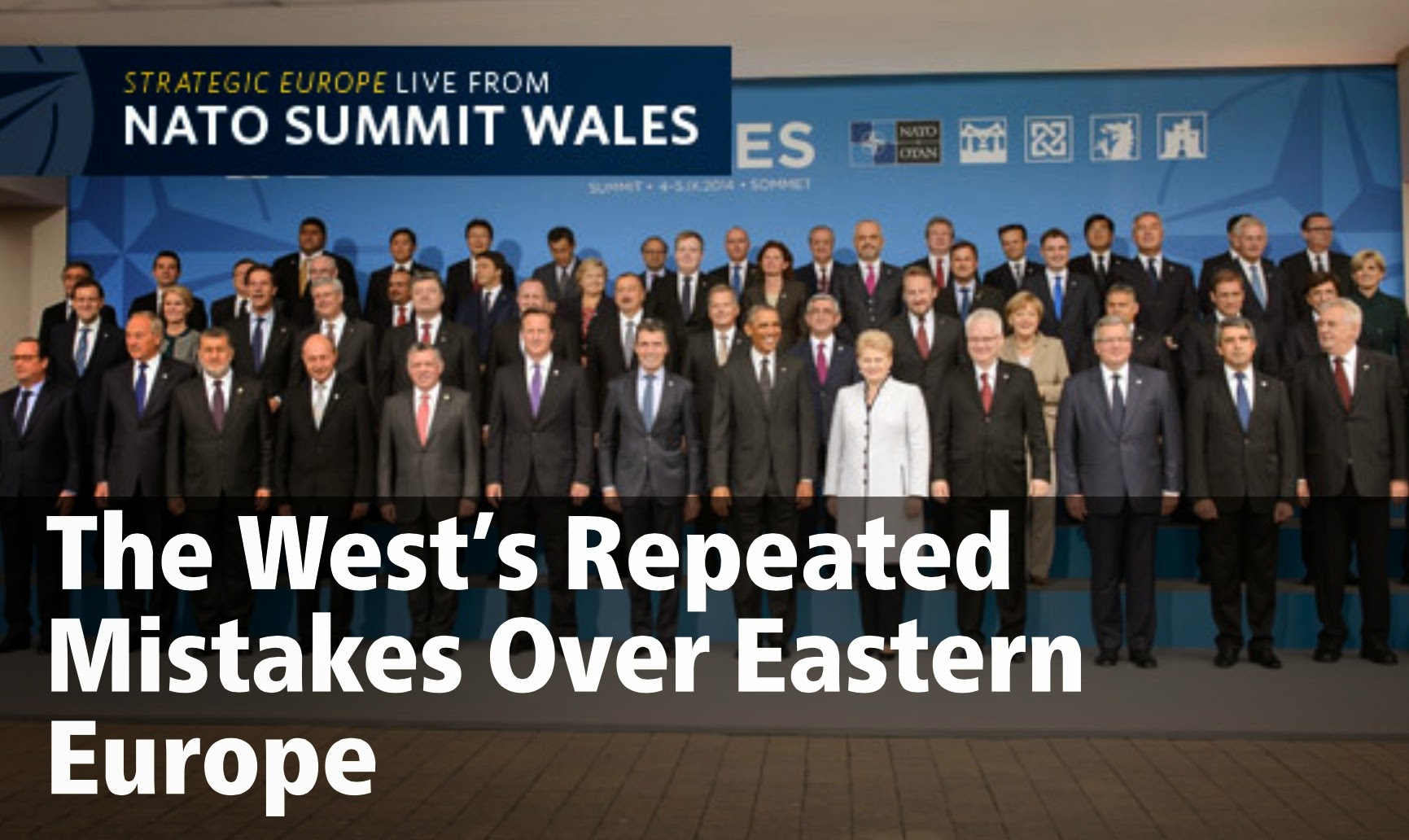
The West’s Repeated Mistakes Over Eastern Europe

Something very similar is happening now in the countries east of the European Union and west of Russia. As the people of Ukraine’s Euromaidan protest movement showed in January 2014 on Kiev’s Independence Square, they were not going to accept a post–Cold War status quo in which Russia sets the agenda. They wanted to choose their own political path.

It seems that history is repeating itself. This time round, NATO is not prepared to help the countries in Europe’s East, while the EU is divided and weak over how to deal with Russian President Vladimir Putin’s invasion of eastern Ukraine and illegal annexation of Crimea in March.

During a press conference with Ukrainian President Petro Poroshenko on September 4 at the NATO summit in Wales, the alliance’s Secretary General Anders Fogh Rasmussen tried to put the best spin on NATO help to Ukraine. Since NATO is not prepared even to consider the idea of Ukraine one day becoming a member of the organization, Rasmussen—and indeed Poroshenko—didn’t mention the “m-word.”

“It is for the Ukrainian people to decide . . . [their] future relationship with NATO,” the secretary general said—as if Putin will allow that to happen.

Rasmussen did say that NATO allies had pledged to provide support to help Ukraine improve its own security. “Our support is concrete and tangible. . . . Ukraine has stood by NATO. Now in these difficult times, NATO stands by Ukraine.”

Rasmussen explained how the allies had established “a comprehensive and tailored package of measures” to help Ukraine. The focus of NATO support would be on four areas: rehabilitation for injured troops, cyberdefense, logistics, and command and control and communications. “And allies will assist Ukraine with around €15 million [$19 million] through NATO,” Rasmussen added. NATO would not be supplying weapons. But that won’t stop individual countries from doing so.

Above all, the NATO chief insisted that an independent, sovereign, and stable Ukraine firmly committed to democracy and the rule of law was key to Euro-Atlantic security. “We stand united in our support of Ukraine’s sovereignty and territorial integrity,” he said.

Actually, the West is only rhetorically united over Ukraine’s sovereignty and territorial integrity. Western nations have no real intentions of matching that statement with deeds to allow Ukraine to regain territory in eastern Ukraine that has been taken over by rebels backed by Russian troops and tanks—let alone Crimea.

As for the EU, it is prepared to impose more sanctions on Russia—but with many misgivings and criticisms from several member states, especially Hungary, Slovakia, and the Czech Republic. That is despite the fact that until twenty-five years ago, these countries were under the Soviet yoke.

The measures undertaken by NATO and the EU are insufficient because they perpetuate the new rules of the game that Putin is writing across Eastern Europe. And because the West’s responses give him no reason to desist, at least for the moment, Western countries are repeating the mistakes they made when Eastern European civil society reared its head during the Communist era. The West is not prepared to stand up to Putin’s Russia.

Instead, willy-nilly, the West is allowing a new cordon sanitaire of countries to take hold between Russia and the EU. But if Putin and European leaders believe that this buffer zone is going to represent a new, stable “post-post–Cold War” status quo, they are seriously mistaken.

The reason is that civil society across these countries, from Belarus to Armenia, will not accept these new demarcation lines on a permanent basis. Just as Poles challenged their country’s Communist regime in 1980, the same will happen across the states in Europe’s East.

That has already happened in Ukraine. And despite the war in eastern Ukraine and the continuing influence of the country’s oligarchs, the supporters of the Euromaidan are not prepared to let this revolution fail. They are not naive enough to believe that the EU and NATO will come to their rescue. Instead, against all the odds, they will continue to struggle for their freedom to choose their own political path. More


Friday, March 28, 2014

Ukraine, Security Assurances and Nuclear Weapons

Since the events of February and March this year, in particular the annexation of Crimea, there have been pundits suggesting that perhaps Ukraine should have held onto Soviet nuclear weapons back in the early 1990s and thus deterred Russia’s intervention.

Patricia Lewis

In addition to the inaccuracy of such assertions – Ukraine did not have the command and control of the nuclear weapons on its territory – they are highly irresponsible in that they are likely to stimulate nuclear proliferation policies in other countries and stem from fantasy not reality.

Back in the early 1990s, at the point when the USSR fell apart, three newly independent states found themselves with a tricky nuclear weapons problem: Moscow had stationed these weapons on the territories of other members of the Soviet Union namely Belarus, Kazakhstan and Ukraine as part of its nuclear doctrine. The world feared that the USSR, a single nuclear weapons state would spawn four. Not quite the outcome hoped by the people of Europe and the US. Nor was it a comfortable position for Russia, unsure where the loyalties of the former USSR countries would lie. It was already clear that Warsaw Pact countries such as Poland and Hungary were distancing themselves from Russia as fast as they could, with the view to join NATO and the EU. Russia was not keen to be surrounded by three nuclear-armed states in addition to the US, UK, France and China.

For its part, the US and its allies were keen to move ahead on nuclear disarmament and nonproliferation efforts. The bilateral nuclear reduction negotiations had been going well, the problem of short-range tactical nuclear weapons in Europe was being addressed, the Conventional Armed Forces in Europe treaty negotiations had transformed the management of those forces, the Conference on Disarmament in Geneva was negotiating the Chemical Weapons Convention and there was great hope that a new relationship could be forged between West and East putting nuclear weapons firmly in the past.

Although Ukraine was never a fully-fledged nuclear weapon state, large numbers of strategic (approximately 1,900) and tactical (approximately 2,500) nuclear weapons were in place on its territory. Ukraine’s national capabilities at that time included a full civil fuel cycle expertise, and a missile and space-rocket design and manufacturing capability (the Southern Machine-building Factory ‘Yuzhmash’ was in the closed city of Dnipropetrovsk). The nuclear warheads however were not manufactured or tested in Ukraine and so, at that time, the country did not have the full complement of expertise it would have needed to become a true nuclear weapons possessor able to threaten to launch and detonate a nuclear warhead.

Ukraine could have developed such a capability and learned how to maintain nuclear warheads, found a way to change and adapt the launch codes, alter targeting programmes and guidance systems, and establish command and control procedures over the next 5-10 years. However, in 1990, Ukraine’s parliament adopted the Declaration of State Sovereignty of Ukraine in which Ukraine committed not to use, produce or stockpile nuclear weapons. So once Ukraine became an independent state in 1991, negotiations to relinquish the remaining stockpile to Russia began (along with similar efforts in Belarus and Kazakhstan).

In 1991, as part of the newly formed Commonwealth of Independent States, Ukraine pledged to join the NPT under the Alma-Ata Declaration on unified control of nuclear weapons and agreed to the withdrawal and dismantling of tactical nuclear weapons. Then Ukraine signed the Lisbon Protocol of the START I treaty in May 1992 and the Minsk Agreement on Strategic Forces at the end of the same year, committing to the full dismantlement of the nuclear forces by the end of 1994.

What followed next was hardly plain sailing however. Some in Ukraine’s political system wanted to hang on to the nuclear weapons, believing that they could be useful in providing a long-term counter to any future Russian aggression. Others wanted to hold on to them to secure a better bargain with Russia and the US, particularly in exchange for security, energy, financial and trade deals. The debates and negotiations stretched out for years with President Leonid Kravchuk promising one thing and the Rada demanding another. Numerous delays followed and the debates also signified a tussle for the centre of democratic power in Ukraine between the executive and legislative branches of governance.

Finally in 1994, a trilateral agreement between Ukraine, Russia and the US was agreed that enabled Ukraine’s accession as a non-nuclear weapons state to the NPT on 5 December 1994. The same day, the Budapest Memorandum was adopted by the United States, the Russian Federation, and the United Kingdom – the three depositaries of the NPT – that agreed to, among other things, respect the independence, sovereignty and existing borders of Ukraine, to refrain from the threat or use of force against the territorial integrity or political independence of Ukraine, to refrain from economic coercion of Ukraine and to seek immediate UN Security Council action to provide assistance if Ukraine should become a victim of an act of aggression.

The Budapest Memorandum has clearly been breached in the letter and spirit by one of its own members. Far from respecting the independence, sovereignty and existing borders of Ukraine and refrain from the threat or use of force against Ukraine, Russia has demonstrated that such assurances count for little in the real world. These assurances were part of the package that enabled Ukraine to join the NPT and Russia’s actions will send shivers down the spines of all 180+ non-nuclear weapons states that rely on such assurances. Russia’s actions could lead to a severe loss of trust in security assurances. At least the UK and US have fulfilled their commitments under the Budapest Memorandum and have taken the matter to the UN Security Council and continue to try to resolve the situation with Russia as promised. They at least have demonstrated their trustworthiness in terms of the assurances they have given. More

by Patricia Lewis, Research Director, International Security


Wednesday, September 18, 2013

Is Capitalism to Blame For the Syrian War Drive?

Obama’s push for war in Syria seemed so deeply irrational, so crazed, that many people naturally asked, “Why is this happening?” And “who” wants it to happen?

Few Americans actually believed that Nobel Peace Prizing winning Obama suddenly wanted to bomb Syria because “Assad gassed his own people” (especially when zero evidence was given to prove this).

Many commentators have correctly stated that geopolitics is a main motivation for Obama wanting to bomb Syria, acting as a gateway to Iran. Other commentators have also correctly discussed the specific economic (capitalistic) interests as a war motive. And others still have, again correctly, focused on the importance of Israel as a factor towards pushing for war in Syria and eventually Iran. All three answers are correct, and have an inter-dependence that is complicated and difficult to quantify, since much of the truth is hidden from public view.

Problems arise in analysis, however, when one of these issues is separated from the broader context, as was done in a recent article by Jean Bricmont and Diana Johnstone. Their article, “The People Against the 800 Pound Gorilla,” focuses on the importance of the U.S. Israeli lobby — “the 800 Pound Gorilla” — and its push for war, while minimizing or dismissing other crucial economic and political motives.

The article makes many excellent points, especially how the Israeli lobby in the U.S., American Israel Public Affairs Committee (AIPAC), is fanatically pushing for war against Syria. Congress is also trying to be politically immune from ANY discussion about AIPAC activities, lest accusations of “anti-Semite” are indiscriminately flung at them.

The problem with the article, however, is that the authors elevate the Israeli gorilla to a weight class it doesn’t belong in; and in so doing the authors are forced to minimize the size of several other giant gorillas, whose combined weight overshadows the Israeli chimp.

One of the giant gorillas that the authors seek to shrink is the U.S. capitalist class. The following passage summarizes the author’s main point:

“People who think that capitalists want wars to make profits should spend time observing the board of directors of any big corporation: capitalists need stability, not chaos, and the recent wars only bring more chaos.”

This is, of course, true for many if not most U.S. corporations. The authors are also correct when they argue that the average writer who uses a capitalist-centered analysis to explain war wrongly “…sees capitalism as a unified actor issuing orders to obedient politicians on the basis of careful calculations.” The authors are correct that this type of clunky analysis lacks nuance and should be rejected.

But the authors also fail to give capitalism the nuance it deserves; they construct a capitalistic strawman so arid it spontaneously combusts. For example, the authors limit the definition of capitalism to a sector-specific basis, mentioning specific types of capitalists that are blamed for pushing war and dismissing them as lesser gorillas than the Israeli lobby.

In naming corporate names the authors make some good points, but somehow skip over the 1,600 pound gorilla in the room — the big banks, the motor force of capitalism in the U.S. The authors might respond to this criticism by saying the banks were purposely omitted because they do not “directly benefit” from war and are, therefore, not at the forefront of advocating it.

This would be false. As the dominant corporate sector in U.S. capitalism, the banks are also the most internationalist in scope; the recent second quarter profits of U.S. banks were $42.2 billion (!), most of this money was made in overseas investing using cheap Federal Reserve printed dollars. More


Sunday, September 15, 2013

Resolving the Syrian Chemical Weapons Crisis: Sunlight and Shadows By Richard Falk

The Putin Moment: Not only did Vladimir Putin exhibit a new constructive role for Russia in 21st statecraft, spare Syria and the Middle East from another cycleof escalating violence, but he articulated this Kremlin initiative in the form of a direct appeal to the American people.

There were reasons to be particularly surprised by this display of Russian diplomacy: not since Nikita Khrushchev helped save the world from experiencing the catastrophe of nuclear war in the Cuban missile crisis of 1962 by backing down and agreeing to a face-saving formula for both superpowers, had Moscow distinguished itself in any positive way with respect to the conduct of international relations; for Putin to be so forthcoming, without being belligerent, was particularly impressive in view of Obama’s rather ill-considered cancellation only a few weeks ago of a bilateral meeting with the Russian leader because of Washington’s supposed anger at the refusal of the Russian government to turn the NSA whistleblower, Edward Snowden, over to the United States for criminal prosecution under American espionage laws; and finally, considering that Putin has much blood on his hands given past policies pursued in relation to Chechnya and in the autocratic treatment of domestic political opposition, it was hard to expect anything benevolent during his watch. And so Putin is emerging as a virtual ‘geopolitical black swan,’ making unanticipated moves of such a major character as to have the potential to transform the character of conflict management and resolution in the 21st century. It should be understood that Putin could have stayed on the sidelines, and benefitted from seeing Obama sink deeper and deeper into the Syrian quagmire, and instead he stepped in with a momentous move that seems to have served the regional and global interest.

Putin has explained in a coherent manner in his opinion piece that was published in the NY Times on September 11th attacks) that his approach to Russian foreign policy relies on two instruments: soft power and economic diplomacy. He acknowledged American leadership, but only if exercised within a framework of respect for international law and the UN Charter. And he appropriately took issue with Obama’s sentiments expressed a night earlier to the effect that America in its leadership role had a unique entitlement to use force to overcome injustice in situations other than self-defense and even without authorization by the UN Security Council. It was Putin, perhaps disingenuously, who claimed (quite correctly) that such a prerogative was “extremely dangerous.” He rejected Obama’s pretension that a unilateral discretion with respect to the use of force could be inferred from American exceptionalism. Whether disingenuous or not, the requirement of a Security Council authorization for non-defensive uses of force, while sometimes preventing a peacekeeping response by the UN to certain tragic situations of civil strife and humanitarian crisis overall contributed to finding diplomatically agreed upon solutions for conflict and enabled the UN (unlike the League of Nations) to persist despite severe tensions among its dominant members. Let hope that this Putin vituoso exhibition of creative diplomacy prompts his counterpart in the White House to explore more diligently soft power opportunities that will better protect American national interests, while simultaneously serving the global interest in war prevention and the rejection of militarism, and might also have the added benefit of reversing the steady decline of American credibility as a benevolent global leader ever since the end of the Cold War.(without invoking the symbolism of the twelfth anniversary of the 9/11

Constitutional Balance: Perhaps what might be of even greater importance than averting an ill-considered punitive attack on Syria, is the grounding of recourse to war on the major republican premise of Congressional authorization. There is little doubt that here the efficient cause and anti-hero was David Cameron, who turned to Parliament to support his wish to join with Obama in the attack coalition despite the anti-war mood in British public opinion. Cameron was politically spared by the vote of the House of Commons to withhold authorization. It is hard to believe that Obama’s decision to seek authorization from the U.S. Congress was not a belated realization that if Britain deferred to its Parliament as an expression of constitutional democracy, it would be unseemly for the United States to go to war without the formal backing of Congress. Of course, the Putin initiative saved Obama from the near certain embarrassment of being turned down by Congress, which would mean that either he would follow in Cameron’s and face savage criticism from his hawkish boosters or insist upon his authority as Commander in Chief to act on his own, a prerogative that seems constitutional dubious to support a bill of impeachment. Beyond this, theWar Powers Act that would seem to require some emergency justification for the presidential bypassing of Congress in the context of a proposed military action. Hopefully, we are witnessing, without an accompanying acknowledgement, the downfall of the ‘imperial presidency’ that got its start during the Vietnam War. The governmental pendulum in the United States may have started to swing back toward the separation of powers and checks and balances, and thus be more in keeping with the original republican hopes of limited executive authority, especially in relation to war making. This renewal of republican constitutionalism, combined with growing populist skepticism about military adventures abroad, might make this Syrian crisis of decision a welcome tipping point, reversing the unhealthy subordination of Congress in war/peace situations during the last half century and anti-democratic disregard of the views of the citizenry. More

Tuesday, November 13, 2012

Analysis: Obama faces bumps with Russia policy

WASHINGTON (AP) — President Barack Obama once assured Russian leaders that he'd have more flexibility to deal with missile defense during a second term in office. But now that he has been re-elected, there's little expectation of progress on that or other contentious issues that divide the two countries.

Tensions between the United States and Russia have been rising. The countries have been at odds over Syria's civil war, Iran's nuclear program and Russia's crackdown on domestic opposition. U.S. officials are uneasy about what they see as a more assertive foreign policy by Vladimir Putin, who returned to the Russian presidency in May.

Gone is the talk of a "reset" — Obama's policy of improving relations with Moscow after they deteriorated during George W. Bush's presidency. In the few areas where Obama is seeking closer ties, such as trade, he's running into opposition from a deeply divided Congress.

Moscow is undoubtedly pleased that Obama defeated Republican Mitt Romney, who had called Russia the No. 1 foe of the United States. A Russian official said Thursday that its government expected Obama to meet his commitment to be more flexible on missile defense.

But it's hard to imagine that happening now.

"Since Putin's return to the presidency, things have become more complicated," said Cliff Kupchan, a Russia analyst with the Eurasia group, who described the current state of relations as functional, but strained.

The reset undoubtedly improved cooperation between Washington and Moscow during the early years of the Obama administration and both sides saw dividends, such as the signing of a nuclear arms control treaty and the U.S. agreeing to Russia's entry into the World Trade Organization.

During that time, tensions over missile defense had receded following Obama's early move to replace a Bush administration plan for missile defense in eastern Europe. Moscow, which had angrily charged that the Bush era plan could undermine its ability to use long-range nuclear missiles to deter attacks initially, welcomed the change. But more recently, the Kremlin has ramped up its criticism, arguing that the later stages of the Obama plan could also threaten its missiles. More