Showing posts with label crisis. Show all posts

Friday, October 12, 2012

CUBAN MISSILE CRISIS REVELATIONS: KENNEDY'S SECRET APPROACH TO CASTRO

DECLASSIFIED RFK DOCUMENTS YIELD NEW INFORMATION ON BACK-CHANNEL TO FIDEL CASTRO TO AVOID NUCLEAR WAR

National Security Archive Electronic Briefing Book No. 395

Washington, DC, October 12, 2012 – On the 50thanniversary of the Cuban Missile Crisis, new documents from the Robert Kennedy papers declassified yesterdayand posted today by the National Security Archive reveal previously unknown details of the Kennedy administration's secret effort to find an accord with Cuba that would remove the Soviet missiles in return for a modus vivendi between Washington and Havana.

The 2700 pages of RFK papers opened yesterday include the first proposed letter to "Mr. F.C.," evaluated by the Executive Committee of advisors to Kennedy on October 17th--just one day after the president learned of the existence of the Soviet missiles in Cuba. The draft letter, available to historians for the first time, initiated a chain of events that led to a complicated back-channel diplomacy between Washington and Havana at the height of what Kennedy aide Arthur Schlesinger called "the most dangerous moment in human history."

The Archive's Cuba analyst, Peter Kornbluh, who was the first person to review the RFK papers at the Kennedy Library, noted that the documents "reinforce the key historical lesson of the missile crisis: the need and role for creative diplomacy to avoid the threat of nuclear Armageddon." Kornbluh noted that the State Department's own official historians, referring to the initial letter to Castro, had admitted that "none of these drafts have been found." The fact that the Robert Kennedy papers have yielded new information previously undiscovered by the government's own researchers, Kornbluh said, "underscores the historical importance of this declassification on the 50th anniversary of the crisis."

The Archive also posted two diagrams Robert Kennedy drew on his notepad during the crisis deliberations, including his initial tally of the "hawks" and the "doves" as Kennedy's advisors took positions on diplomacy vs. the use of force against Cuba.

The draft letter warned Castro that by deploying the ballistic missiles the Soviets had "raised grave issues for Cuba. To serve their interests they have justified the Western Hemisphere countries in making an attack on Cuba which would lead to the immediate overthrow of your regime." Moreover, according to this proposed communication, Nikita Khrushchev was quietly hinting that he would betray Cuba by trading concessions on Berlin for "Soviet abandonment of Cuba." Warning that failure to remove the missiles would lead to U.S. "measures of vital significance for the future of Cuba," the message offered an oblique carrot of negotiations for better relations once the Soviets and their weapons of mass destruction were gone.

During the early deliberations of how to respond to the missiles in Cuba Kennedy's top advisors pressed him to reject this message to Cuba because it would undermine the option of a surprise U.S. air attack on the island. After Kennedy decided on an interim option of a naval quarantine of Cuba to buy time for diplomacy to convince the Soviets to withdraw the missiles, he ordered the State Department to come up with diplomatic alternatives to attacking Cuba.

In an October 25 memorandum, titled "Political Path," the State Department submitted a series of creative options for resolving the crisis peacefully, including allowing the United Nations to take control of both the Soviet missile bases in Cuba and the U.S. missile bases in Turkey. The document also provided an outline for an "approach to Castro" through Brazil, with a message to Castro underscoring his options: "the overthrow of his regime, if not its physical destruction," or "assurances, regardless of whether we intended to carry them out, that we would not ourselves undertake to overthrow the regime" if he expelled both the missiles and the Russians. More


Tuesday, October 9, 2012

Belfer Center, Foreign Policy launch contest on Cuban Missile Crisis lessons

For the 50th anniversary of what historians agree was the most dangerous moment in human history, Harvard Kennedy School’s Belfer Center for Science and International Affairs and Foreign Policy magazine today launched a contest for scholars and citizens to reflect on the lessons of the Cuban Missile Crisis and its lessons for current challenges.

The contest is straightforward: In no more than 300 words, entrants must present the most persuasive, original lesson flowing from the confrontation that brought the world to the brink of nuclear war over 13 days in October 1962. The rules of the contest and additional details are available here. Prizes will be awarded to the winner in each of three categories: general public; foreign policy scholars/practitioners; and students in grades 6-12. Entries will be accepted through October 10. Winners will be announced October 15. The three winners will each receive an iPad.

The Belfer Center has created a Cuban Missile Crisis website to mark the 50th anniversary. The site offers original documents, video clips and an interactive timeline. In addition, the “lessons” section provides tools for teachers, including draft lesson plans, to help engage students in thinking about the modern-day implications of the nuclear showdown half a century ago.

Foreign Policy magazine also has innovative content on the crisis, including an “On the Brink” Twitter feed by author and historian Michael Dobbs that provides daily Tweets echoing events 50 years ago as the standoff developed. More


Tuesday, July 24, 2012

The world is closer to a food crisis than most people realise

Unless we move quickly to adopt new population, energy, and water policies, the goal of eradicating hunger will remain just that.

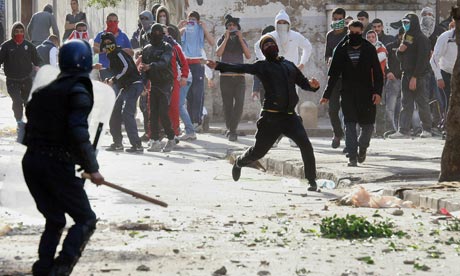
Food riots in Algeria in 2008. Photograph: Fayez Nureldine/AFP/Getty Images
In the early spring this year, US farmers were on their way to planting some 96m acres in corn, the most in 75 years. A warm early spring got the crop off to a great start. Analysts were predicting the largest corn harvest on record.

The United States is the leading producer and exporter of corn, the world's feedgrain. At home, corn accounts for four-fifths of the US grain harvest. Internationally, the US corn crop exceeds China's rice and wheat harvests combined. Among the big three grains – corn, wheat, and rice – corn is now the leader, with production well above that of wheat and nearly double that of rice.

The corn plant is as sensitive as it is productive. Thirsty and fast-growing, it is vulnerable to both extreme heat and drought. At elevated temperatures, the corn plant, which is normally so productive, goes into thermal shock.

Time is running out. The world may be much closer to an unmanageable food shortage – replete with soaring food prices, spreading food unrest, and ultimately political instability– than most people realise.

As spring turned into summer, the thermometer began to rise across the corn belt. In St Louis, Missouri, in the southern corn belt, the temperature in late June and early July climbed to 100F or higher 10 days in a row. For the past several weeks, the corn belt has been blanketed with dehydrating heat.

Weekly drought maps published by the University of Nebraska show the drought-stricken area spreading across more and more of the country until, by mid-July, it engulfed virtually the entire corn belt. Soil moisture readings in the corn belt are now among the lowest ever recorded.

While temperature, rainfall, and drought serve as indirect indicators of crop growing conditions, each week the US Department of Agriculture releases a report on the actual state of the corn crop. This year the early reports were promising. On 21 May, 77% of the US corn crop was rated as good to excellent. The following week the share of the crop in this category dropped to 72%. Over the next eight weeks, it dropped to 26%, one of the lowest ratings on record. The other 74% is rated very poor to fair. And the crop is still deteriorating.

Over a span of weeks, we have seen how the more extreme weather events that come with climate change can affect food security. Since the beginning of June, corn prices have increased by nearly one half, reaching an all-time high on 19 July. More