Showing posts with label chemical. Show all posts

Friday, March 7, 2014

7th Syrian chemical weapons destruction update

Here is the 7th Syrian chemical weapons destruction update here: http://www.gcint.org/green-cross-blog/syrian-chemical-weapons-destruction-update-7.


This update, and all previous updates, are stored on the CWCC site (CWCCoalition.org) under Documentation.

--

Charlotte Baskin-Gerwitz

Green Cross International

Global Green USA

Environmental Security and Sustainability


Tuesday, March 4, 2014

Report: Libya Intercepts Syria-Bound Mustard Agent

Libyan authorities allegedly intercepted a cache of mustard blister agent being smuggled to opposition forces in Syria, Arutz Sheva 7 reports.

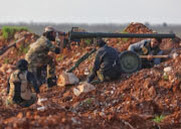
Syrian Rebel Fighters

A separate Israeli news report quotes a Libyan military officer asserting that his country's armed forces had stopped a group of Islamic militants in possession of a container holding the deadly chemical, the news station said on Sunday. The military personnel took custody of the caustic substance, Libyan Col. Mansour al-Mazini added in the report by Israel's Channel 2.

The press claim did not cite the timing of the alleged incident. Libya finished destroying its mustard agent stockpile with international assistance in January, but hundreds of tons of chemical-arms ingredients are still awaiting destruction in the North African country.

Syrian President Bashar Assad's regime agreed to surrender its arsenal of mustard agent and other warfare chemicals in the aftermath of an August nerve gas strike. The government blamed its opponents for the incident, and Moscow has joined its Damascus ally in holding rebel forces responsible for the attack on opposition-controlled territory.

The Syrian government also has placed blame on its opponents for slower-than-expected progress in the disarmament operation, which was to have removed the regime's entire chemical arsenal from the country by early last month.

Norway's military released footage of a transport vessel removing the first batch of Syrian chemical-warfare materials in January as part of the disarmament operation, the Washington Post reported on Friday. More


Tuesday, February 11, 2014

Updates on Syrian chemical weapon destruction process

As part of our push to maintain more regular contact with CWC Coalition members, we have started a weekly update on the Syrian chemical weapons destruction process. Please find links to updates from the first three weeks below:


http://www.gcint.org/green-cross-blog/syrian-chemical-weapons-destruction-first-stage

http://www.gcint.org/green-cross-blog/syrian-chemical-weapons-destruction-update-2

http://www.gcint.org/green-cross-blog/syrian-chemical-weapons-destruction-update-3


We are making every effort to stay as up to date as possible on this process. If you have additional information, or have found well informed articles, please share them with the group, as we all benefit from transparency in this situation. We are working on broadening the scope of the destruction to include further information for civil society and will keep you updated accordingly.


Monday, September 23, 2013

OPCW Course on Assistance and Protection Against Chemical Weapons Held in Finland

“Working together for a world free of chemical weapons”

OPCW News 51/2013

The Hague, 23 September 2013

Course on Assistance and Protection Against Chemical Weapons Held in Finland


The Government of Finland and the OPCW jointly organised a course on Assistance and Protection Against Chemical Weapons in Kuopio from 9 to 13 September 2013 for 18 participants from 16 States Parties.*

The course relates to Article X of the Chemical Weapons Convention and offered training in the use of protective equipment and in monitoring, detection, and decontamination techniques that are used in response to attacks with chemical warfare agents. Participants were also familiarised with chemical emergency responses by the CBRNE-2013 Exercise, organised by the South Savo Regional Rescue Department in Mikkeli.

The course facilitated exchange of information and experience regarding Article X implementation and provided a forum to discuss future cooperation among participating Member States.

*Armenia, Bangladesh, Belarus, Chile, India, Jordan, Libya, Pakistan, Peru, Philippines, Romania, Saudi Arabia, South Africa, Tanzania, Ukraine and Yemen.

Sunday, September 1, 2013

Syria: Obama’s Surprising (and Confusing) Latest Moves by Richard Falk

President Obama’s August 31st remarks from the White House Rose Garden will long be remembered for their strangeness, but the final interpretation of their significance will have to await months if not years.

Richard Falk

There are three dimensions, at least, that are worth pondering: (1) seeking Congressional authorization for a punitive military attack against Syria in support of the treaty prohibition on recourse to chemical weapons in an armed conflict; (2) reconciling any endorsement of an attack by Congress with United States obligations under international law and with respect to the United Nations and its Charter; (3) assessing the degree to which American war making prerogatives continue to operate within an unacceptable domain of American exceptionalism.

In framing the issues at stake Obama set forth the fundamental policy choices in a rather incoherent manner:

  • First of all, he asserted that on the basis of evidence available to the United States Government, that the Assad regime was without doubt responsible for the massive chemical weapons attack of August 21st directed at the Ghouta residential neighborhood on the outskirts of Damascus, and causing over 1,000 civilian deaths, including several hundred children. The Russian president, Vladimir Putin, clearly articulated the grounds for skepticism about this American construction of the Ghouta atrocity. He put forward a strongly worded request that the allegations be confirmed by the release of convincing evidence. This is a reasonable demand. Many around the world have questioned why Assad would launch such a provocative attack to coincide with the arrival of UN inspectors, and when the battlefield balance was tipping in favor of the Damascus regime. All along such important figures in the Obama administration, especially John Kerry and Joe Biden, have arrogantly dismissed the relevance of any information provided by the UN inspection team. In light of the gigantic deception relating to Saddam Hussein’s supposed weapons of mass destruction (WMD) arsenal, which was more politely described long after the event as an ‘intelligence failure,’ it would have been appropriate for Washington to admit that it has a credibility problem in winning governmental and popular support for an attack on Syria. Its refusal to acknowledge such an issue merely deepens suspicions.
  • Secondly, Obama informed listeners that “..after careful deliberation, I have decided that the United States should take military action against Syrian regime targets.” He added that he made this decision “as Commander-in-Chief on what I am convinced are our national security interests.” This conclusion was explained to rest on the importance of punishing such a crime against humanity and deterring future recourse to chemical weapons and other weapons of mass destruction by Syria, as well as sending a message to Iran and North Korea about America’s readiness to use force to uphold such norms of international law.
  • Thirdly, there was no effort in Obama’s remarks to show why, absent a UN mandate, the United States in coalition with a few other countries, had the legal authority to attack a sovereign state in a circumstance other than self-defense.
  • Fourthly, although the decision against involvement by the British Parliament was noted, there was no consideration as to whether such an outcome should bear on American policy. Nor was the German or Italian unwillingness to join in the attack noted, nor that of the Arab League. But the French support was duly appreciated, including a dig at the United Kingdom, by reminding his listeners around the world that it was France that was America’s “oldest ally.” (It is worth noting that the roles of these two European friends were directly reversed in the context of the Iraq War; then, it was the French more conservative led government that opposed participation, while now a socialist leader in Paris supports an attack against Syria).
  • Fifthly, and in the most dramatic passage in the speech, Obama announces that because the United States is a proud democracy he has made “a second decision: I will seek the authorization for the use of force from the American people’s representatives in Congress” by calling for a debate and vote. No mention is made of a time frame, nor how he would react in the event that authorization was not forthcoming. Such an eventuality would set up a potential tension between his duties to uphold national security and an obligation of deference to a decision by Congress on the vital matter of authority to wage war. Obama touched all the bases by saying, “Yet, while I believe I have the authority to carry out this military action without specific congressional authorization, I know that the country will be stronger if we take this course, and our actions will be even more effective.” In effect, there is no constitutional legal requirement to obtain Congressional authorization, but doing so will create a more effective response. But what if authorization is withheld? Or Congress is split with approval by the Senate, and disapproval by the House?
  • Sixthly, there is an implicit endorsement of American exceptionalism. After saying that the case for an attack will be made internationally, as well as domestically, Obama reaffirms a national prerogative of illegal unilateralism. He uses this phrase: “But we are the United States of America, and we cannot and must not turn a blind eye to what happened in Damascus.” That is no matter that others disagree, the United States alone has the duty to act as it sees fit. It is correctly presumed that such discretion is not vested in other sovereign states. Otherwise the world would be in flames. In effect, Syria, Iran, North Korea are bound by international law, as interpreted by the United States, while the United States and its closest allies are guided by assessments of their national security interests.

It is this double standard that is at the core of American exceptionalism, and also underpins the debate as to whether it is more instructive to view the United States as ‘global leader’ or ‘imperial power,’ or possibly some blend;

There is something rather sinister about announcing an intention to strike a vulnerable country with which the United States is not at war, coupled with the announcement that the needed military capabilities are in place, but will not be used until convenient; in effect, a lethal strike against Syria can take place at any point from now on until a time weeks or months from now, depending only on the workings of the internal American political process and the disposition of its Commander-in-Chief. If this is deemed to be in the interest of the Syrian people, I would like to know how.

Even if the controversy as to the facts is ignored, and the problems associated with double standards as to the relevance of international law to the use of force, there are some other reasons for concern about the approach adopted by President Obama:

  • It denies constitutional status to the request for Congressional authorization, making it a discretionary presidential judgment call that is not necessitated by the Constitution, but is an expression of Obama’s belief in democratic procedures. To not rest this request on the Constitution itself is a missed opportunity, and thus amounts to yet another reassertion of excessive authority by the Executive Branch of government;
  • It makes no effort to assess what would be of benefit to the people of Syria, and rather makes the case for a narrow strike as a combination of punishing (without intending to displace) the Assad regime and abstract American national security interests in its self-appointed role as preventing the use and spread of WMD;
  • It fails to advocate in a serious manner a diplomatic approach to ending the violence of the conflict by calling for a second Geneva conference with the full participation of Iran that would deal with regional peace and security issues, as well as the war in Syria;
  • It undermines the authority of the UN and international law by vesting in the U.S. Government the final word on when it is appropriate to use international force in non-defensive modes and fails to make war a matter of ‘last resort’;
  • It draws an overly sharp a distinction between this incident involving chemical weapons and other massacres that have occurred during the course of two years of strife in Syria; regardless of the weaponry deployed both forms of violence are crimes against humanity that deserve a serious and effective response, if available.

*******************************************************************

It is as yet possible that Congress will rescue Obama from having to respect a red line he ill-advisedly proclaimed a year ago. It would be ironic if this one time the anti-Obama Republicans saved him from the worse foreign policy excess of his presidency!

It is possible that Obama will be pushed by pro-interventionists to override a Congressional failure to give authorization. It is also possible that Congress will authorize, and public opinion strongly oppose. And we are left to wonder whether Congress can constitutionally authorize a use of force that violates international treaty law. Of course, we would be unlikely to find out given the passivity of the U.S. Supreme Court when it comes to challenges directed at legally dubious foreign policy and national security matters.

All of the above suggests that the revitalization of American republicanism requires, as a matter of urgency, a constitutional convention with an explicit mandate to restore the separation of powers and checks and balances in relations to war/peace issues. The U.S. Government has longed strayed from this vital pillar of republican democracy.

Nothing would do more to restore confidence in the United States as a global leader! Such a momentous event will not happen without massive grassroots pressure; it will never be decreed from on high.

A final word of blurred appreciation: CNN talking heads are very fond of referring to Obama as epitomizing ‘the reluctant warrior.’ And reluctant he is, but also warrior he has been, and continues to be, casting a rather dark shadow over the Nobel Peace Prize decision process. The reluctance is articulated over and over again in his words and sometimes reflected in his policies, and certainly seems sincere. And such reluctance may be credited, at least subconsciously, with this welcome move to broaden the domestic authorization process with respect to this non-defensive use of international force. Obama would deserve less ambiguous praise if he had recognized the role of Congress prior to the decision of the British Parliament. And prior the many demands from Congress for a greater role gathering political momentum. More

______________________

Editorial

I question how the international community can discipline a States Party to the United Nations for acting unilaterally? States that carry out drone strikes, committing extra-judicial killings, allegedly as part of their war on terror, a 'war' that the said state may be at least partially responsible for causing.

There has to be accountability, or as Richard Falk points out; Obama reaffirms a national prerogative of illegal unilateralism. He uses this phrase: “But we are the United States of America, and we cannot and must not turn a blind eye to what happened in Damascus.” That is no matter that others disagree, the United States alone has the duty to act as it sees fit.

The international community must uphold the Rule of Law, the United National and all International Organizations have an obligation to uphold the Rule of Law. The mandate of the Geneva Conventions must be upheld. I argue that it is a human right for all states to be held accountable and for there to consequences for illegal actions. Editor

Wednesday, June 19, 2013

Terry Long underwater munitions expert subject of European documentary

Terry Long known around the world for his expertise on sea-dumped munitions is now the focus of a documentary destined for a European audience.

Terry Long, second from left, works with a film crew

Terry Long of Leitches Creek, a retired military engineer trained in munitions disposal, is being filmed by the Deadly Depths production company regarding his drive to clean up underwater munitions around the world.

Long says the problem of sea-dumped munitions has been known to occur in every ocean, including sites on East Coast and West Coast of Canada. There are also unexploded munitions in waters off Cape Breton, such as the area commonly known as the Sydney Bight, located between Gabarus and Wreck Cove.

In the Sydney Bight fishing area 4VN, there are more than 80,000 tonnes of unexploded chemical munitions, said Long.

Most of these munitions started after the First World War and carried throughout the Second World War and the Cold War.

This practice continued up to the 1970s, when world governments began to understand the impact the dumps created on environment and marine ecosystems.

“The first major impact is being felt in the Baltic Sea from these munitions, and from the mustard gas we have a dead zone now from one end of the Baltic to the other,” said Long. “And in our fish studies we’ve been finding cancerous tumours, and these are the actually fish that people consume.”

As part of his work to remove munitions from world oceans, Long formed the International Dialogue on Underwater Munitions, a non-governmental organization that provides a platform for industry, politicians and stakeholders to explore the issue.

Film director Eric Nadler said filming wrapped in Cape Breton on Thursday.

“It’s an important topic and Terry is an extremely active guy — if not the most active guy on the planet on this issue — and thus he’s a great subject for a documentary.”

Nadler said the topic has become quite timely as studies have shown there are hazardous effects of allowing leaking munitions to seep into marine environments.

Long said the documentary, set to be released in early 2014, will be broadcast to 23 European States.

It is one of three documentaries Long has recently been asked to be a part of.


Tuesday, April 30, 2013

Syria access essential for credible chemical weapons inquiry: U.N.

UNITED NATIONS (Reuters) - U.N. chief Ban Ki-moon said on Monday that investigators have been gathering and analyzing available information on alleged chemical weapons attacks in Syria, but access to the war-torn country is essential for a "credible and comprehensive inquiry."

A U.N. push for unconditional access for its inspection team gained fresh momentum after the United States and Britain said last week they had limited evidence that Syrian President Bashar al-Assad's troops used the nerve agent sarin against rebels.

U.S. President Barack Obama has warned Syria that deployment of chemical weapons could trigger unspecified consequences, widely interpreted to include military action by Washington.

But Obama stressed the need for a comprehensive U.N. inquiry in Syria before any decisions on further steps could be taken. The U.N. team, led by Swedish scientist Ake Sellstrom, is investigating if chemical weapons were used, not who used them.

The Syrian government and the opposition blame each other for alleged chemical weapons attacks in Aleppo in March and Homs in December. Syria wants the U.N. team to probe only the Aleppo attack, but Ban wants the inquiry to cover both incidents.

Syria denies using chemical weapons in the two-year-old civil war in which more than 70,000 people have been killed.

"On-site activities are essential if the United Nations is to be able to establish the facts and clear all the doubts surrounding this issue," Ban told reporters before meeting with Sellstrom at the United Nations in New York.

"A credible and comprehensible inquiry requires full access to the site where chemical weapons are alleged to have been used," Ban said. "I again urge Syrian authorities to allow the investigation to proceed without delay and without conditions."

SYRIA BLOCKING ACCESS

Syria has blocked unfettered access by the U.N. mission, which was created by Ban nearly six weeks ago and has an advance team in Cyprus ready to deploy to Syria. Diplomats say it is unlikely it will gain access any time soon.

"There are clearly still differences in the understanding of what is required to carry out the investigation," Ban's spokesman Martin Nesirky told reporters. Syria and the United Nations have exchanged nearly a dozen letters on the issue.

Ban said that in the meantime, the U.N. investigators were gathering and analyzing available information on the alleged attacks, which included possible visits to countries that said they had evidence of chemical weapons use.

A Western diplomat said British officials had shown Sellstrom evidence on which London based its assertion that there was "limited but growing" evidence of chemical weapons use by Syrian troops. But Sellstrom found the evidence inconclusive, said the diplomat, speaking on the condition of anonymity.

The Organisation for the Prohibition of Chemical Weapons, which works on U.N. inquiries, has said assertions of chemical weapon use by Western and Israeli officials citing photos, sporadic shelling and traces of toxins do not meet the standard of proof needed for U.N. investigators. More

Organization for the Prevention of Chemical Weapons


Tuesday, April 16, 2013

Who would use chemical weapons?

The combatants in Syria are pointing fingers at each other. Syrian officials claim that the rebels used chemical weapons in a March 19th attack against Khan al-Assal, a town near Aleppo; the rebels say the Syrian government was the culprit.

Whichever is the case, at least 25 people died and many others were wounded in the assault. The UN has decided to investigate: Secretary-General Ban Ki-moon appointed Swedish scientist Ake Sellstrom, a former weapons monitor for the UN Special Commission on Iraq (UNSCOM), to lead the investigation.

The renewed specter of chemical weapons raises the question of why any leader would use them. This class of weapons not only kills and maims but can also cause birth defects, dooming subsequent generations to permanently disrupted lives. Strategically, these weapons produce lasting enemies and make the perpetrator a pariah, losing both domestic and international support. Chemical weapons are banned by an international treaty with 188 member nations. So why use them? Paranoia? Fanaticism? Desperation? And more practically, can we use our knowledge of a leader's mental health to assess his likelihood of using chemical weapons?

Leaders who have used chemical weapons in the post-World War II era have certain traits in common. Consider Saddam Hussein, former president of Iraq. Jerrold Post, a professor of psychiatry and director of the Political Psychology Program at George Washington University, told the New Yorker in 2002 that he found Hussein to be sane -- that is, in touch with reality -- but a psychopath, meaning he had a severe antisocial personality disorder causing a lack of empathy for others. Hussein's father and older brother died before he was born, causing his depressed mother to reject him and send him away to live with relatives for several years. She remarried; his new stepfather despised and abused him. With his self-esteem permanently damaged, Saddam Hussein compensated by developing "malignant narcissism," Post said, becoming prone to exaggerated retribution for perceived insults or slights. In addition, he was probably paranoid, as he displayed anobsession with conspiracies against his regime that may not have existed.

A leader who feels no empathy and is revenge-prone would theoretically be predisposed to using chemical weapons. And indeed, Hussein did so extensively. During the eight-year Iran-Iraq war in the 1980s, he used chemical weapons, including mustard gas and nerve agents, that caused an estimated 10,000 casualties. In March 1988, he attacked his own citizens with chemical weapons, killing and maiming thousands of civilians in the Kurdish town of Halabja. The town was in rebellion against his regime, fighting for an independent Kurdistan; Hussein's chemical weapons attack was his brutal retribution. In 2006, the Iraqi High Tribunal hung Saddam Hussein for crimes against humanity.

Other despots with caches of chemical weapons included late Libyan dictator Muammar Qaddafi and late North Korean leader Kim Jong-il. In 1987 Qaddafi used chemical weaponsin a war against neighboring Chad. Post characterized him on Public Radio International as having a "borderline personality disorder." People with borderline personality disorders typically have severely distorted self-images and are prone to anger, frequent mood swings, and impulsive behavior. Causes for this condition: genetic predisposition, childhood neglect, and abuse.

Unfortunately, not much is known about Qaddafi's early years except that his parents were nomads, and that he dropped out of Benghazi University to join the army. As leader he had many bizarre habits, including wearing flamboyant clothes and, while traveling abroad, sleeping in a Bedouin tent guarded by dozens of armed female virgins. He also kidnapped and raped teenagers, as French journalist Annick Cojean has documented.

North Korea's belligerent late leader Kim Jong-il had several thousand tons of chemical weapons, including mustard gas, sarin, and other nerve agents, at his disposal. Post categorized him as having malignant narcissism based on his grandiose self-image and his lack of empathy for others. His father, dictator Kim Il-sung, surrounded his son with luxury and privilege, but the boy may have been scarred for life after his mother died when he was seven and his younger brother drowned. Whatever the effects, these tragedies did not give him empathy for others' pain; he had no difficulty torturing his own people, and North Korean defectors have revealed that he gassed people in concentration camps. If current Korean leader Kim Jong-un inherited his father's malignant narcissism, then we should be concerned that he may use chemical weapons.

Bashar al-Assad has been President of Syria since 2000, when he inherited the position from his father, Hafez al-Assad. He wasn't supposed to have become leader of Syria. His extroverted and flashy older brother Bassel was the heir apparent but died in a car crash. Trained as an ophthalmologist, Bashar al-Assad is a shy and retiring introvert whose personality doesn't match those of the dictators previously discussed. When his brother died, Bashar was called to assume a role he neither wanted nor had prepared for.

Many Syrians had hoped that Bashar, who had briefly lived in London, would be an open-minded and liberal leader, but their hopes were unrealistic. Bashar had to prove to his father's inner circle that he was capable of leading. In addition, his aggressive younger brother, Maher, was put in charge of the Republican Guard, the powerful domestic security service. In an interview with Barbara Walters, Bashar insisted that he didn't "own" Syria's security forces, distancing himself from his brother's actions. As president, he said, he didn't own the country. Bashar al-Assad doesn't appear to have malignant narcissism or a borderline personality disorder. Instead, he appears to be a weak leader hiding behind his brother's back. More

 

Monday, April 8, 2013

OPCW Statement on Syria Investigation

Statement on Syria Investigation 21 March 2013

The Secretary General of the United Nations hasmade an announcement that he wishes the OPCW to be part of an investigation into an incident which according to Syrian authorities might have involved the use of a chemical munition.


The OPCW stands ready to extend its full support to the Secretary-General.

While allegations of this nature are not new to conflict situations, they are nonetheless serious, especially in the context of Syria which is not a State Party to the Chemical Weapons Convention. This remains a matter of serious concern.

As indicated by the Secretary-General, a mission of this nature, especially given the security situation inside Syria, requires careful planning. The OPCW will work closely with the United Nations in the establishment and conduct of this mission. More


Tuesday, March 19, 2013

Regime alleges Syrian rebels 'use chemical weapon'

Syrian state media say rebels fighting to topple President Bashar al-Assad have fired a chemical weapon in the north of the country.

"Terrorists launched a missile containing chemical products into the region of Khan al-Assal in the province of Aleppo, killing 15 people, mainly civilians," Sana news agency said.

The government routinely refers to rebels as "terrorists".

Rebels denied the report, accusing the government of using chemical agents.

"We were hearing reports from early this morning about a regime attack on Khan al-Assal, and we believe they fired a Scud with chemical agents," a senior rebel and spokesman for the Higher Military Council in Aleppo, Qassim Saadeddine, told Reuters news agency.

"Then suddenly we learned that the regime was turning these reports against us. The rebels were not behind this attack."

'Dangerous escalation'

The Aleppo Media Centre, which is affiliated to the rebels, said there had been cases of "suffocation and poison'' among civilians in Khan al-Assal after a surface-to-surface missile was fired at the area.

But it said this was "most likely" due to use of "poisonous gases" by government forces.

Syria's Information Minister Omran al-Zoabi said that as many as 86 people had been injured in Khan al-Assal, calling the incident a "dangerous escalation" and the "first act" of a newly announced rebel authority.

He also said that Turkey and Qatar, both of which support Syria's uprising, bore "legal, moral and political responsibility" for the attack, state TV reported.

An unnamed Turkish government official denied any links to the reported attack.

"This is a baseless accusation, the Syrian government has accused Turkey in the past as well," the official told Reuters news agency.

Russia, a close ally of Syrian President Bashar al-Assad, condemned the rebels for the alleged use of chemical weapons.

"We are very seriously concerned by the fact that weapons of mass destruction are falling into the hands of the rebels, which further worsens the situation in Syria and elevates the confrontation in the country to a new level," a foreign ministry statement said.

The Syrian government itself has a large stockpile of chemical weapons, and there has been widespread international concern about their security and the possibility that they might be used. More


Wednesday, August 8, 2012

Syria: international law and the use of chemical weapons

The ongoing unrest in Syria has continued to dominate the headlines as concerns have mounted about the country’s chemical weapons stockpiles. At the same time, these stockpiles raise interesting questions of international law.

The isolated state has long been understood to have a well-developed chemical weapons programme and large stockpiles of usable agents and warheads. Concerns about suspected chemical weapons, however, recently reached a fever pitch when a Foreign Ministry spokesman, Jihad Makdissi – in a move from Syria’s historical position of neither confirming nor denying a chemical, or biological, weapons programme – officially acknowledged their existence by announcing to the international community, on 23 July, that these weapons would not be used against civilians, but would be used in the event of ‘external aggression’. The regime subsequently qualified its statement, in an attempt to retain a perception of ambiguity over their actual existence. While there is uncertainty about whether Makdissi’s statement was meant as reassurance that the Assad government will maintain some restraint against its own civilians, or as a threat against the international community, Syria’s acknowledgment of its chemical weapons brings renewed focus to the status of chemical weapons use under international law.

The use of chemical weapons is very clearly prohibited in international law under a number of different legal instruments. Syria is not a party to the 1993 Chemical Weapons Convention (CWC), which unequivocally prohibits chemical weapons use (and other activities) under any circumstances. However, in 1968, Syria acceded to the 1925 Geneva Protocol, which prohibits the use in war of asphyxiating, poisonous or other gases, and of bacteriological methods of warfare. Russian President Vladimir Putin, who has continued to support the Assad regime, publicly reminded Syria of its obligations under the Geneva Protocol after their acknowledgement of chemical weapons stockpiles.

Syria’s adherence to the Geneva Protocol may have led the Assad regime to think twice about using chemical weapons against Syrian civilians – in what has now been declared a ‘non-international armed conflict’ by the International Committee of the Red Cross (ICRC) – even if the treaty was originally intended to cover international conflicts. The ICRC concluded in 2005 that customary international humanitarian law includes a ban on the use of chemical weapons in internal as well as international conflicts, and an appellate chamber in the International Criminal Tribunal for the former Yugoslavia (ICTY) noted in 1995, in Prosecutor v. Tadic, that ‘there had undisputedly emerged a general consensus in the international community on the principle that the use of chemical weapons is also prohibited in internal armed conflicts’.

Yet what are we to make of Syria’s threat to use chemical weapons in the event of ‘external aggression’? Again, as a state party to the Geneva Protocol, Syria is bound to refrain from any use of chemical weapons in international armed conflict. Their use in the event of ‘external aggression’ would therefore be a treaty violation and a violation of customary international humanitarian law. Such use could also trigger co-operation between the UN and the Organisation for the Prohibition of Chemical Weapons under the UN Secretary-General’s Mechanism for Investigation of Alleged Use of Chemical and Biological Weapons and Part XI, Paragraph 27 of the Verification Annex to the Chemical Weapons Convention. More