| ||||||||||||||||||||||||||||||||||||||||||||||||||||||
Showing posts with label sanctions. Show all posts
Showing posts with label sanctions. Show all posts
Monday, November 24, 2014
Iran Nuclear Negotiations: Looking Ahead


 © 2014


Sunday, August 24, 2014
Iran unveils new drones and long-range missiles
Iran on Sunday unveiled two new missiles and two new drones it said have been added to its arsenal, in a ceremony attended by President Hassan Rouhani.

The Ghadir (Mighty), with a range of 300 kilometres (185 miles), is a ground-to-sea and sea-to-sea missile, the official IRNA news agency said.
It is in the same family as the Ghader or Qader cruise missile, which has a range of 200 kilometres.
The other missile unveiled on Sunday, the Nasr-e Basir (Clear Victory), is equipped with a seeker homing head. Its range was not given.
The new Karar-4 (Striker) drone can track and monitor enemy aircraft, the agency said, while the Mohajer-4 (Migrant) drone is designed to perform photographic and mapping missions.
Iran has developed a major missile programme in addition to producing different types of Unmanned Aerial Vehicles (UAVs), including attack drones.
The United States, whose Fifth Fleet is based in Sunni-ruled Bahrain across the Gulf from the mainly Shiite Islamic republic, has repeatedly expressed concern about these two programmes.
Rouhani on Sunday sought to allay such fears.
“Iran has no intention to interfere in, dominate or attack other countries or plunder their resources,” he said in a speech broadcast on state television, adding that the country’s military doctrine was defensive.
“But at the same time we will stand up to any aggression,” he added.
In May, Iran said it had succeeded in copying an American RQ-170 Sentinel drone that it forced down and recovered nearly intact in December 2011.
Tehran is currently engaged in negotiations with the five permanent members of the UN Security Council plus Germany — known as P5+1 — on securing an agreement with world powers on its controversial nuclear programme.
Israel and Western powers suspect Iran’s civilian nuclear project to be a cover to develop an atomic weapon, an allegation Tehran denies, insisting its uranium enrichment drive is entirely peaceful.
["Iranian President Hassan Rouhani (centre) and Iran's Defence Minister Hossein Dehqan (2nd right) visit Iran's defence capabilities exhibition in Tehran on August 24, 2014" via AFP]
Friday, July 4, 2014
US may recognize Iran's right to produce fuel for nuclear power plants under certain conditions
However, until the Islamic Republic does not prove that its nuclear program is exclusively peaceful, enriching facilities should be cut, stated Washington, reports Itar-Tass.

Iran and the six world powers resumed talks on Thursday aimed at clinching a long-term deal later this month on the scope of Tehran's contested nuclear program. The cost of failure could be high. If diplomacy falls short, the risk of Israeli air strikes on Iranian nuclear sites could rise, and with it the threat of a wider Middle East conflict, Reuters reports.
After informal contacts on Wednesday, chief negotiators from Iran, the United States, France, Germany, China, Russia and Britain began a full plenary.
There are less than three weeks to try to agree on the future dimensions of Iran's uranium enrichment program and other issues if they are to meet a self-imposed July 20 deadline for a deal. Western officials privately acknowledge that additional talks might be needed.
Washington and some of its allies have imposed sanctions on Iran over suspicions that its nuclear program is designed to produce weapons - a charge denied by Iran, which says it is only interested in producing electricity and other peaceful projects.
US, Iran expected to continue P5+1 nuclear talks in Vienna
US Deputy Secretary of State Bill Burns is expected to attend talks between Iran and the six powers in Vienna this week that aim to strike a nuclear deal by July 20, Reuters reports. The new round of talks starts today and will continue until at least July 15. The presence of the American diplomat who led secret negotiations between Iran and the United States would open up the possibility of bilateral talks between the two diplomatic rivals.
Burns has met the Iranians two times during the last month, first in Geneva for bilateral talks and later in Vienna, where the wider nuclear talks are to be held.
During the latter talks, he broached the possibility of US and Iran's cooperation to stabilize Iraq against an onslaught by Sunni militants.
The primary disagreement between the United States and Iran is over the Iranian nuclear program, which Washington and some of its allies suspect is designed to produce atomic weapons. Iran denies this, saying the program is for peaceful purposes.
The United States along with Britain, China, France, Russia, Germany (the P5+1) and Iran reached an interim pact on Nov. 24 under which Iran won some relief from the economic sanctions in return for reducing some of its nuclear facilities.
Their target is to reach a comprehensive nuclear agreement that would lay to rest Western concerns about the Iranian program and comprehensively ease sanctions on Tehran by July 20, but outside analysts and diplomats are deeply skeptical they can achieve this.
Western officials have said very little progress has been made after five rounds of talks since February toward striking a deal that could end years of hostility and defuse the risk of a new war and a nuclear arms race in the Middle East.
Both sides have said their goal is to have a deal by July 20 and avoid a difficult extension of the interim accord which expires then. Privately, Western diplomats say they would be willing to consider extending the interim deal and continuing talks beyond July 20 only if an agreement was clearly in sight. More
Monday, March 11, 2013
Are sanctions against Iran legal? Or are they collective punishment?
Iran, Pakistan Begin Border Gas Pipe Amid Sanctions Threat
The presidents of Pakistan and Iran inaugurated work on the cross-border leg of a gas pipeline that the U.S. has warned may breach a sanctions regime aimed at curbing the Persian Gulf nation’s nuclear program.

Pakistan’s benchmark KSE 100 share index plunged 2.5 percent in Karachi, the biggest drop in almost two months, as the news sparked concerns the U.S. would impose penalties.
Asif Ali Zardari, on his second trip to Iran within a month, joined Iran’s Mahmoud Ahmadinejad and the country’s Oil Minister Rostam Qasemi in the southern port city of Chabahar for the ground-breaking ceremony, Pakistan state television showed. The leaders offered a prayer for the project’s success and uncovered a plaque at the construction site.
Once completed, the 1,931-kilometer (1,200-mile) natural gas pipeline would help alleviate the energy crisis in Pakistan, where 18-hour blackouts last summer forced factories to close and triggered street protests. Iran is under U.S. and European Union restrictions over its atomic activities, measures that have curbed oil exports and complicated the repatriation of cash from crude sales.
Pakistan’s decision to proceed with the $1.3 billion energy link comes amid a bid to repair relations with the U.S., the South Asian nation’s biggest aid donor, after damaging setbacks including the killing of Osama bin Laden by American commandos in Pakistan in 2011 and a cross-border U.S. airstrike that killed 24 Pakistani soldiers. The U.S. needs Islamabad’s support as it withdraws combat forces from Afghanistan.
Oil Refinery
Ahmadinejad attacked opponents of the pipeline in a speech at the ceremony, drawing parallels between Iran and Pakistan.
“Foreigners are seeking to create divisions between nations in the region in order to control them and rob them of their wealth,” he said. “The only way for regional nations to safeguard their independence, identity, culture and wealth is through cooperation and unity.”
Iran has completed 900 kilometers of the pipeline on its side of the border, according to the website of Pakistan’s Interstate Gas Systems Pvt. Ltd., which will oversee construction in Pakistan. Under an accord signed in June 2010, Iran will provide about 21.5 million cubic meters of gas a day to Pakistan for 25 years. The deal can be extended by five years and volumes may rise to 30 million cubic meters a day.
The two countries are also expected to sign an agreement today to build a $4 billion oil refinery in Pakistan’s Gwadar, the state-run Press TV news channel reported.
‘Serious Concerns’
Work on extending the pipeline into Pakistan has been delayed by difficulties in arranging funding. The ground- breaking ceremony comes just days before Pakistan’s government, headed by Zardari’s party, is to hand over power to a caretaker administration ahead of parliamentary elections in May. The president’s term expires in September.
The U.S., which has offered to help Pakistan secure gas via an alternate route from Central Asia, has recently reiterated its concerns over the pipeline.
“If this deal is finalized for a proposed Iran-Pakistan pipeline, it would raise serious concerns under our Iran Sanctions Act,” Victoria Nuland, U.S. State Department spokeswoman, told a weekly briefing in Washington March 7. The U.S. hopes Pakistani won’t “go in a direction that would cause sanctions to kick in,” Nuland said, according to a transcript posted on the State Department website.
While Pakistan is aware of concerns in Washington, “all our friends including the U.S.” should show greater understanding of the country’s energy needs, Pakistan Foreign Office spokesman Moazzam Ahmad Khan told reporters March 7. More
Fourth Geneva Convention, Part 111, Article 32- 33
Art. 32. The High Contracting Parties specifically agree that each of them is prohibited from taking any measure of such a character as to cause the physical suffering or extermination of protected persons in their hands. This prohibition applies not only to murder, torture, corporal punishments, mutilation and medical or scientific experiments not necessitated by the medical treatment of a protected person, but also to any other measures of brutality whether applied by civilian or military agents.
Art. 33. No protected person may be punished for an offence he or she has not personally committed. Collective penalties and likewise all measures of intimidation or of terrorism are prohibited.
Pillage is prohibited.
Reprisals against protected persons and their property are prohibited.
http://www.icrc.org/ihl.nsf/full/380
Under the 1949 Geneva Conventions collective punishments are a war crime. By collective punishment, the drafters of the Geneva Conventions had in mind the reprisal killings of World Wars I and World War II. In the First World War, Germans executed Belgian villagers in mass retribution for resistance activity. In World War II, the Nazis carried out a form of collective punishment to suppress resistance. Entire villages or towns or districts were held responsible for any resistance activity that occured in them. Additional concern also addressed the United States' atomic bombings of Hiroshima and Nagasaki at the war's end, which, in turn, caused death and disease to hundreds of thousands of Japanese civilians.[3] The conventions, to counter this, reiterated the principle of individual responsibility. The International Committee of the Red Cross (ICRC) Commentary to the conventions states that parties to a conflict often would resort to "intimidatory measures to terrorize the population" in hopes of preventing hostile acts, but such practices "strike at guilty and innocent alike. They are opposed to all principles based on humanity and justice."
It could therefore be argued that sanctions are a type of economic warfare, in which case the Geneva Conventions should apply. Therefore, the Fourth Geneva Convention, Part 111, Article 33 would apply, prohibiting any measure to cause physical suffering to Protected Persons. Editor
Friday, March 8, 2013
The Deepening Iran-Pakistan Petro-Relationship
The Iran-Pakistan branch of the Iran-Pakistan-India gas pipeline (IPI) seems to be coming online. Pakistani President Asif Ali Zardari has announced he will visit Iran for the groundbreaking of the Pakistan branch of a new gas pipeline on March 11. It will be his second visit to Iran in less than a month, part of a deepening petro-relationship that is worrying the United States.

The pipeline is controversial, to say the least, in the US. The State Department has threatened Pakistan with sanctions for dealing with the regime in Iran, offering a electrification projects to replace any sort of benefit Pakistan would get from the petro-deal.
The challenge facing Islamabad is that it is next door to Iran, while the U.S. is not. In the long-run, it is not in their interest to remain at loggerheads with Tehran even if the U.S. wants them to be. In his press statements, foreign ministry spokesman Moazzam Ahmad Khan has been open about this. “Yes, we know about their concerns but hope our friends, including the US, will understand our economic compulsions,” said Khan.
Iran has already proposed building a new oil refinery near the Pakistani port of Gwadar.
The Pakistan-Iran pipeline is separate from a larger regional project to link India with the natural gas fields of Turkmenistan through Afghanistan and Pakistan (the so-called TAPI pipeline, or Trans-Afghanistan pipeline) . It is a goal that has been lurking in the back rooms of the energy industry since the 1990s: how can one efficiently extract and export the vast energy wealth of the Caspian region without going through Russia or China?
Two decades ago Argentina-based Bridas and Texas-based Unocal were in bitter competition for who would get the Taliban’s permission to build a pipeline across Afghanistan. Bridas came close to signing a deal, but pulled out a year later. Unocal actually brought a Taliban delegation to visit the Texas homes of its executives. Unocal eventually pulled out when the Taliban made unreasonable demands.998, Unocal also pulled out when crashed oil prices combined with international opprobrium over the Taliban’s human rights record and terrorism made the deal too difficult to finalize.
The Asia Development Bank has been pushing TAPI for years, though the insecurity in Afghanistan remains a constant barrier to anything concrete coming to pass.
While TAPI languishes in development hell, Pakistan and Iran have pushed forward with their own pipeline.From Iran’s perspective, anything that gives them an economic connection with the region and is outside the regulatory reach of the U.S. government is a boon. From Pakistan’s perspective, too, the prospect of getting income and energy without U.S. strings attached is deeply attractive. More
Monday, December 17, 2012
Iran special analysis: Breaking the deadlock in the nuclear negotiations
Nicholas J. Wheeler, Josh Baker, and Scott Lucas of the University of Birmingham write:
 Following the recent re-election of President Obama, attention has turned yet again to the prospect of new negotiations between the P5+1 (United States, United Kingdom, France, Germany, Russia, and China) and Iran. Whilst there have been indications that Iran wished to restart talks since the previous round of discussions ended in June 2012, the Western powers, led by the United States, wanted to delay talks until after the US elections. Now that this hurdle has been cleared and President Obama has been returned for a second term, speculation has centred on whether the administration might come forward with a more imaginative set of proposals that could break the negotiating stalemate which characterised the first term. Secretary of State Hilary Clinton has recently put forward that possibility. Speaking on November 30th, she claimed that ‘we [the United States] continue to believe that there is still a window of opportunity to reach some kind of resolution over Iran's nuclear program…the fact that we finished our election…would be a good time to test the proposition that there can be some good-faith serious negotiations’.
In theory, Clinton might be right. As the historian John Lewis Gaddis has argued, ‘second terms in the White House open the way for second thoughts’ as they ‘lessen…the influence of domestic political considerations’. Second terms, then, might provide the necessary political space to make the moves it takes to transform deep-rooted conflicts. The most notable example being Ronald Reagan’s road to Damascus type conversion on the wisdom of negotiating with the Soviet Union. This was significantly influenced by his growing fears of nuclear war which came to a head with the Able Archer crisis of 1983. Reagan’s decision to enter into negotiations with Moscow bore fruit when he found in Mikhail Gorbachev, who became the leader of the Soviet Union in March 1985, an interlocutor whom he could trust, leading to aremarkable transformation of US-Soviet relations in the second half of the 1980s. A key factor facilitating this transformation was the sweeping mandate that Reagan secured through his overwhelming election victory. This example raises the question as to whether Obama’s victory - though not as sweeping as Reagan’s - might create a new-found political space within which to make moves which could similarly transform US-Iranian nuclear relations. However, there is an important dimension - and difference - to be noted in the past and present. In 1985, the initiative to end the Cold War came from Gorbachev with his game-changing proposals. Rather than trying to exploit Soviet gestures to weaken the Soviet Union, the Reagan Administration worked with Gorbachev to advance arms control agreements that promoted mutual security.
In December 2012, we are at a stage of negotiations where each side is looking to the other to make a decisive game-changing move. From Tehran's point of view, Iran has already made a number of significant gestures in recent months, most notably the offer to suspend enrichment of 20 per cent Uranium in return for equally calibrated reductions in sanctions. At the same time, it has arguably made a further concession by increasing the level of conversion of its existing stockpile of 20 per cent enriched uranium into fuel plates for its Tehran Research Reactor (TRR) to reassure Western concerns about its nuclear break-out capability. The Iranian leadership believes that the promised concession on the 20 per cent and the actual step of converting half of its stock has not been met with any equivalent reciprocation by the United States and its key allies.
In a classic example of each side failing to understand the other’s position, the United States, the United Kingdom, and France have not interpreted these Iranian moves as conciliatory ones. Consequently, the Western powers are looking to Tehran to make a significant first move in breaking the negotiating impasse when Tehran believes it has already done this. What the Western powers are seeking as an Iranian opening move is the so-called ‘stop, ship, and shut’ policy (freezing 20 per cent production, shipping the existing stockpile of 20 per cent out of the country, and closing the Fordoo plant). They have said that were this to happen, they would then consider reciprocation, including the distant possibility of limited sanctions relief. Such an opening gambit has been interpreted in Tehran as a demand for unilateral concessions dressed up in the garb of the language of reciprocity. Indeed, former Iranian nuclear negotiator, Hossein Mousavian, likened the Western strategy to one of‘peanuts for diamonds.’ More
Friday, October 12, 2012
Global powers launch new push to end Iran nuclear crisis
Revamped package will offer limited relief from sanctions and other incentives for Iran to limit enrichment of uranium
 Six global powers will launch a diplomatic drive after the US elections aimed at defusing the Iranian nuclear crisis in the next few months and avoiding the eruption of a new Middle East conflict next year.
A "reformulated" proposal will offer limited relief from existing sanctions and other incentives for Iran to limit the level of enrichment of its uranium stockpile. An attempt will be made to sequence the steps required to reach a deal to overcome the mutual distrust that helped sink previous rounds of negotiations, where each side appeared to wait for the other to make the first major concession.
"We recognise that the Iranians need something more with which they can sell a deal at home, and we will expect real change on the other side. It is about getting the sequencing right. That is what this next round will be about," a European official said.
"If Iran is prepared to do enough, sanctions will be on the table," another western diplomat said. "It shouldn't expect [the six-power group] to blink first – but if it's ready to take genuine steps we're ready to respond. This could include sanctions relief – but only for the right moves by Iran. Sanctions are biting in Tehran and we're not going to lift them without making solid progress on our concerns."
If the step-by-step approach fails there could be an attempt to "go big" with an ambitious, comprehensive settlement that would allow Iran to continue producing uranium at low levels (under 5%) of enrichment but under stricter international monitoring and controls.
"Currently we are stalled because Iran is asking too much and offering nothing in return. One way forward might be for Iran to offer much more and make an accordingly bigger demand at the same time," the western diplomat said. Officials involved in the nuclear talks believe there is a window of opportunity for diplomacy between the US elections on 6 November and next spring, with a resumption of high level talks between the group of six powers (the US, UK, France, Germany, Russia and China) with the Iranian chief negotiator, Saeed Jalili, in late November or December.
"Elections obviously mean there's a great deal of uncertainty, but there will be more clarity after November and clearly that's an opportunity," one western diplomat said. Britain will be represented at the talks by Mark Sedwill, formerly the UK's special envoy to Afghanistan and Pakistan, who has been named the new political director of the Foreign Office. More
Monday, October 8, 2012
Iran sanctions now causing food insecurity, mass suffering
Yet again, the US and its allies spread mass human misery though a policy that is as morally indefensible as it is counter-productive.
 The Economist this week describes the intensifying suffering of 75 million Iranian citizens as a result of the sanctions regime being imposed on them by the US and its allies [my emphasis]:
That sanctions on Muslim countries cause mass human suffering is not only inevitable but part of their design. In 2006, the senior Israeli official Dov Weisglass infamously described the purpose of his nation's blockade on Gaza with this candid admission: "'The idea is to put the Palestinians on a diet, but not to make them die of hunger." Democratic Rep. Brad Sherman justified the Iran sanctions regime this way: "Critics of sanctions argue that these measures will hurt the Iranian people. Quite frankly, we need to do just that."
Even more infamously, the beloved former Democratic Secretary of State Madeleine Albright - when asked in 1996 by 60 Minutes' Lesley Stahl about reports that 500,000 Iraqi children had died as a result of US-imposed sanctions on that country - stoically replied: "I think this is a very hard choice, but the price - we think the price is worth it." So extreme was the suffering caused by sanctions in Iraq that one former UN official, Denis Halliday, resigned in protest, saying that the sanctions policy met the formal definition of "genocide". More
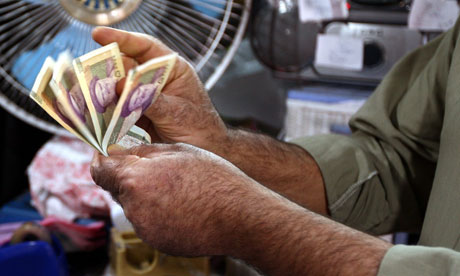
Pervasive unemployment, inflation, medicine shortages, and even food riots have been reported elsewhere."Six years ago, when America and Europe were putting in place the first raft of measures to press Iran to come clean over its nuclear ambitions, the talk was of "smart" sanctions. The West, it was stressed, had no quarrel with the Iranian people—only with a regime that seemed bent on getting a nuclear bomb, or at least the capacity for making one. Yet, as sanctions have become increasingly punitive in the face of Iran's intransigence, it is ordinary Iranians who are paying the price.
"On October 1st and 2nd Iran's rial lost more than 25% of its value against the dollar. Since the end of last year it has depreciated by over 80%, most of that in just the past month. Despite subsidies intended to help the poor, prices for staples, such as milk, bread, rice, yogurt and vegetables, have at least doubled since the beginning of the year. Chicken has become so scarce that when scant supplies become available they prompt riots. On October 3rd police in Tehran fired tear-gas at people demonstrating over the rial's collapse. The city's main bazaar closed because of the impossibility of quoting accurate prices. . . .
"Unemployment is thought to be around three times higher than the official rate of 12%, and millions of unskilled factory workers are on wages well below the official poverty line of 10m rials (about $300) a month."
That sanctions on Muslim countries cause mass human suffering is not only inevitable but part of their design. In 2006, the senior Israeli official Dov Weisglass infamously described the purpose of his nation's blockade on Gaza with this candid admission: "'The idea is to put the Palestinians on a diet, but not to make them die of hunger." Democratic Rep. Brad Sherman justified the Iran sanctions regime this way: "Critics of sanctions argue that these measures will hurt the Iranian people. Quite frankly, we need to do just that."
Even more infamously, the beloved former Democratic Secretary of State Madeleine Albright - when asked in 1996 by 60 Minutes' Lesley Stahl about reports that 500,000 Iraqi children had died as a result of US-imposed sanctions on that country - stoically replied: "I think this is a very hard choice, but the price - we think the price is worth it." So extreme was the suffering caused by sanctions in Iraq that one former UN official, Denis Halliday, resigned in protest, saying that the sanctions policy met the formal definition of "genocide". More
Tuesday, January 17, 2012
Iran, the U.S. and the Strait of Hormuz Crisis
The United States reportedly sent a letter to Iran via multiple intermediaries last week warning Tehran that any attempt to close the Strait of Hormuz constituted a red line for Washington.

The same week, a chemist associated with Iran's nuclear program was killed in Tehran. In Ankara, Iranian parliamentary speaker Ali Larijani met with Turkish officials and has been floating hints of flexibility in negotiations over Iran's nuclear program.
This week, a routine rotation of U.S. aircraft carriers is taking place in the Middle East, with the potential for three carrier strike groups to be on station in the U.S. Fifth Fleet's area of operations and a fourth carrier strike group based in Japan about a week's transit from the region. Next week, Gen. Michael Dempsey, chairman of the Joint Chiefs of Staff, will travel to Israel to meet with senior Israeli officials. And Iran is scheduling another set of war games in the Persian Gulf for February that will focus on the Islamic Revolutionary Guard Corps' irregular tactics for closing the Strait of Hormuz.
While tensions are escalating in the Persian Gulf, the financial crisis in Europe has continued, with downgrades in France's credit rating the latest blow. Meanwhile, China continued its struggle to maintain exports in the face of economic weakness among its major customers while inflation continued to increase the cost of Chinese exports. More
Wednesday, January 11, 2012
Another Iranian nuclear scientist killed: part of 'covert war'?
Tehran blamed the death of Iranian nuclear scientist Mostafa Ahmadi Roshan, a deputy director at the Natanz enrichment facility, on the US and Israel.
Iranian officials decried the assassination of a scientist involved in Iran's nuclear program in Tehran today, claiming that Israel was behind the latest strike as part of a broader covert war waged by the US, Israel, and the West to slow Iran's nuclear efforts. The attack – reported by witnesses to be carried out by two men on a motorcycle, who affixed a magnetic bomb to the target car in north Tehran – fits a pattern of previous killings of Iran's nuclear scientists. It comes as Washington is increasing pressure with sanctions targeting the Central Bank and Republican presidential candidates threatening military action against Iran.

The scientist killed, Mostafa Ahmadi Roshan, was a deputy director at Iran's Natanz uranium enrichment facility, a professor, and a chemistry graduate of Tehran's prestigious Sharif University of Technology. Iranian officials claimed the assassins were working for Israel and the US. “The terrorist action was carried out by the hirelings of the Zionist regime and those who claim to be fighting terrorism,” Iran’s First Vice President Mohammad Reza Rahimi told a cabinet meeting, according to the semi-official Fars News Agency. He condemned the killing as "evidence of [foreign] government-sponsored terrorism" and vowed that it would not stop "progress" of Iran's nuclear program. More
Friday, December 30, 2011
Ron Paul: Sanctions Against Iran Are an ‘Act of War’

Paul said that Iran would be justified in responding to sanctions by blocking the Straits of Hormuz, adding that the country blocking the strategically important strait is “so logical” since they have no other recourse.
He then compared the situation to China blocking off the Gulf of Mexico to trade.
“I think the solution is to do a lot less a lot sooner, and mind our own business, and we wouldn’t have this threat of another war,” Paul said.
Paul made the comments to a crowd of 100 people in Perry, Iowa, the first stop on his two-day campaign swing through the western part of the state.
The Texas congressman is not backing down from his view that a strike on Iran would cause economic hardship at home.
“If the Straits of Hormuz close, this whole financial thing could come down on our head. What would happen if oil doubled in price within a month or two?” Paul asked a crowd in Atlantic, Iowa.
Thursday was a tough day for Paul, beginning with a scathing editorial in the New Hampshire Union-Leader calling the Texas congressman a “dangerous man” who has been consistently spouting “nonsense,” adding, “it is about time New Hampshire voters showed him the door.” More
Keeping Iran From Saying Yes
Imagine that you are a senior adviser to the Iranian supreme leader Ayatollah Ali Khamenei and have decided that sanctions and other pressures on Iran have accomplished exactly what they ostensibly are designed to do (to the extent that any such presumed purpose of the pressure can be discerned from what is coming out of Washington [3]): to change minds among policy makers in Tehran about Iran's nuclear activities.
You, the adviser, have concluded that the pressures are sufficiently damaging to Iranian interests that Iran ought to make whatever policy changes are needed to get the pressure to stop. What, exactly, do you advise your boss to do?
As you contemplate that question, you realize there are several conditions that would have to be met in order for any advice you gave not to be rejected immediately and categorically, if not by the supreme leader himself then by others in the regime who have a say in shaping policy. Whatever step you recommend would have to be politically feasible, which also means being psychologically feasible for the leader, for other Iranian policy makers and for the Iranian public. There also would have to be some mechanism for reaching an understanding or agreement with the Americans, given that ending the U.S.-led pressure would be the whole purpose of changing policy. Closely related to that last requirement, you would also need to point to good reason to believe that if Tehran did change policy, the United States would indeed end the pressure.
After carefully reflecting on all this, you would have to decide that—as long as the policies and discourse you hear coming from the United States remain as they are—the requirements cannot be met. The United States has made it almost impossible for Iran to say yes to whatever it is the United States is supposedly demanding of Iran. You quietly drop the idea of recommending to the supreme leader any change of policy. More
Subscribe to:
Posts (Atom)