http://www.warcosts.com
Since 2004, up to 884 innocent civilians, including at least 176 children, have died from US drone strikes in the North Waziristan region of Pakistan. A new report from the Stanford and New York University law schools finds drone use has caused widespread post-tramatic stress disorder and an overall breakdown of functional society in North Waziristan. In addition, the report finds the use of a "double tap" procedure, in which a drone strikes once and strikes again not long after, has led to deaths of rescuers and medical professionals. Many interviewees told the researchers they didn't know what America was before drones. Now what they know of America is drones, death and terror. Follow the conversation @WarCosts #UnderDrones
Showing posts with label children. Show all posts
Showing posts with label children. Show all posts
Thursday, December 27, 2012
Monday, October 8, 2012
Iran sanctions now causing food insecurity, mass suffering
Yet again, the US and its allies spread mass human misery though a policy that is as morally indefensible as it is counter-productive.
 The Economist this week describes the intensifying suffering of 75 million Iranian citizens as a result of the sanctions regime being imposed on them by the US and its allies [my emphasis]:
That sanctions on Muslim countries cause mass human suffering is not only inevitable but part of their design. In 2006, the senior Israeli official Dov Weisglass infamously described the purpose of his nation's blockade on Gaza with this candid admission: "'The idea is to put the Palestinians on a diet, but not to make them die of hunger." Democratic Rep. Brad Sherman justified the Iran sanctions regime this way: "Critics of sanctions argue that these measures will hurt the Iranian people. Quite frankly, we need to do just that."
Even more infamously, the beloved former Democratic Secretary of State Madeleine Albright - when asked in 1996 by 60 Minutes' Lesley Stahl about reports that 500,000 Iraqi children had died as a result of US-imposed sanctions on that country - stoically replied: "I think this is a very hard choice, but the price - we think the price is worth it." So extreme was the suffering caused by sanctions in Iraq that one former UN official, Denis Halliday, resigned in protest, saying that the sanctions policy met the formal definition of "genocide". More
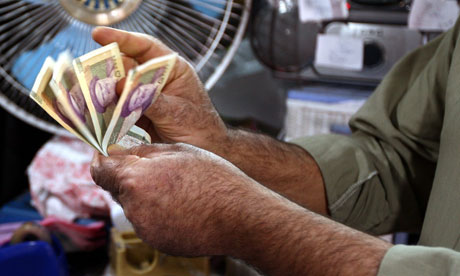
Pervasive unemployment, inflation, medicine shortages, and even food riots have been reported elsewhere."Six years ago, when America and Europe were putting in place the first raft of measures to press Iran to come clean over its nuclear ambitions, the talk was of "smart" sanctions. The West, it was stressed, had no quarrel with the Iranian people—only with a regime that seemed bent on getting a nuclear bomb, or at least the capacity for making one. Yet, as sanctions have become increasingly punitive in the face of Iran's intransigence, it is ordinary Iranians who are paying the price.
"On October 1st and 2nd Iran's rial lost more than 25% of its value against the dollar. Since the end of last year it has depreciated by over 80%, most of that in just the past month. Despite subsidies intended to help the poor, prices for staples, such as milk, bread, rice, yogurt and vegetables, have at least doubled since the beginning of the year. Chicken has become so scarce that when scant supplies become available they prompt riots. On October 3rd police in Tehran fired tear-gas at people demonstrating over the rial's collapse. The city's main bazaar closed because of the impossibility of quoting accurate prices. . . .
"Unemployment is thought to be around three times higher than the official rate of 12%, and millions of unskilled factory workers are on wages well below the official poverty line of 10m rials (about $300) a month."
That sanctions on Muslim countries cause mass human suffering is not only inevitable but part of their design. In 2006, the senior Israeli official Dov Weisglass infamously described the purpose of his nation's blockade on Gaza with this candid admission: "'The idea is to put the Palestinians on a diet, but not to make them die of hunger." Democratic Rep. Brad Sherman justified the Iran sanctions regime this way: "Critics of sanctions argue that these measures will hurt the Iranian people. Quite frankly, we need to do just that."
Even more infamously, the beloved former Democratic Secretary of State Madeleine Albright - when asked in 1996 by 60 Minutes' Lesley Stahl about reports that 500,000 Iraqi children had died as a result of US-imposed sanctions on that country - stoically replied: "I think this is a very hard choice, but the price - we think the price is worth it." So extreme was the suffering caused by sanctions in Iraq that one former UN official, Denis Halliday, resigned in protest, saying that the sanctions policy met the formal definition of "genocide". More


Thursday, August 11, 2011
Study reveals 168 child deaths in Pakistan drone war
US drone strikes in Pakistan have killed more civilians than previously reported, including 168 children, according to figures compiled by the Bureau of Investigative Journalism.

The airstrikes are largely focused on the mountainous areas of Waziristan near the border with Afghanistan. In December 2010, Channel 4 News spoke to witnesses on the ground who said that women and children had perished in the bombing raids, as well as rebel fighters.
Now a detailed study by the London-based Bureau of Investigative Journalism (TBIJ) has been published containing new figures on civilian casualties. Its findings suggest the number of ordinary people killed could be 40 per cent higher than previously reported and that as many as 168 children have died since the strikes began.
Commenting on the findings, Unicef said: "Even one child death from drone missiles or suicide bombings is one child death too many. "Children have no place in war, and all parties should do their utmost to protect children from violent attacks at all times." More >>>
The airstrikes are largely focused on the mountainous areas of Waziristan near the border with Afghanistan. In December 2010, Channel 4 News spoke to witnesses on the ground who said that women and children had perished in the bombing raids, as well as rebel fighters.
Now a detailed study by the London-based Bureau of Investigative Journalism (TBIJ) has been published containing new figures on civilian casualties. Its findings suggest the number of ordinary people killed could be 40 per cent higher than previously reported and that as many as 168 children have died since the strikes began.
Commenting on the findings, Unicef said: "Even one child death from drone missiles or suicide bombings is one child death too many. "Children have no place in war, and all parties should do their utmost to protect children from violent attacks at all times." More >>>
Location:Islamabad
Subscribe to:
Posts (Atom)