Showing posts with label nuclear weapons. Show all posts

Tuesday, June 5, 2012

Israel's Deployment of Nuclear Missiles on Subs from Germany

Many have wondered for years about the exact capabilities of the submarines Germany exports to Israel. Now, experts in Germany and Israel have confirmed that nuclear-tipped missiles have been deployed on the vessels. And the German government has long known about it.


The pride of the Israeli navy is rocking gently in the swells of the Mediterranean, with the silhouette of the Carmel mountain range reflected on the water's surface. To reach the Tekumah, you have to walk across a wooden jetty at the pier in the port of Haifa, and then climb into a tunnel shaft leading to the submarine's interior. The navy officer in charge of visitors, a brawny man in his 40s with his eyes hidden behind a pair of Ray-Ban sunglasses, bounces down the steps. When he reaches the lower deck, he turns around and says: "Welcome on board the Tekumah. Welcome to my toy."
He pushes back a bolt and opens the refrigerator, revealing zucchini, a pallet of yoghurt cups and a two-liter bottle of low-calorie cola. The Tekumah has just returned from a secret mission in the early morning hours.

The navy officer, whose name the military censorship office wants to keep secret, leads the visitors past a pair of bunks and along a steel frame. The air smells stale, not unlike the air in the living room of an apartment occupied solely by men. At the middle of the ship, the corridor widens and merges into a command center, with work stations grouped around a periscope. The officer stands still and points to a row of monitors, with signs bearing the names of German electronics giant Siemens and Atlas, a Bremen-based electronics company, screwed to the wall next to them.

The "Combat Information Center," as the Israelis call the command center, is the heart of the submarine, the place where all information comes together and all the operations are led. The ship is controlled from two leather chairs. It looks as if it could be in the cockpit of a small aircraft. A display lit up in red shows that the vessel's keel is currently located 7.15 meters (23.45 feet) below sea level.

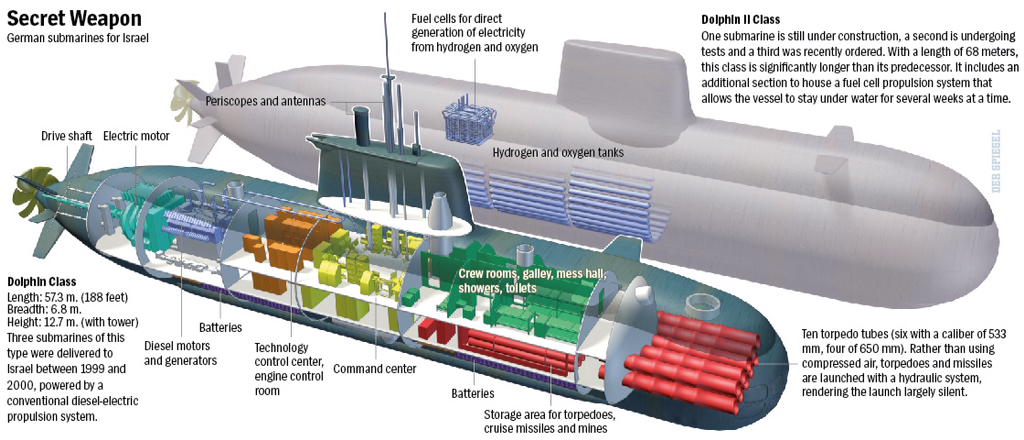
"This was all built in Germany, according to Israeli specifications," the navy officer says,"and so were the weapons systems." The Tekuma, 57 meters long and 7 meters wide, is a showpiece of precision engineering, painted in blue and made in Germany. To be more precise, it is a piece of precision engineering made in Germany that is suitable for equipping with nuclear weapons.

No Room for Doubt

Deep in their interiors, on decks 2 and 3, the submarines contain a secret that even in Israel is only known to a few insiders: nuclear warheads, small enough to be mounted on a cruise missile, but explosive enough to execute a nuclear strike that would cause devastating results. This secret is considered one of the best kept in modern military history. Anyone who speaks openly about it in Israel runs the risk of being sentenced to a lengthy prison term. More


Sunday, June 3, 2012

Israel Deploys Nuclear Weapons on German-Built Submarines

A German shipyard has already built three submarines for Israel, and three more are planned. Now SPIEGEL has learned that Israel is arming the submarines with nuclear-tipped cruise missiles. The German government has known about Israel's nuclear weapons program for decades, despite its official denials.

Germany is helping Israel to develop its military nuclear capabilities, SPIEGEL has learned. According to extensive research carried out by the magazine, Israel is equipping submarines that were built in the northern German city of Kiel and largely paid for by the German government with nuclear-tipped cruise missiles. The missiles can be launched using a previously secret hydraulic ejection system. Israeli Defence Minister Ehud Barak told SPIEGEL that Germans should be "proud" that they have secured the existence of the state of Israel "for many years."

In the past, the German government has always stuck to the position that it is unaware of nuclear weapons being deployed on the vessels. Now, however, former high-ranking officials from the German Defense Ministry, including former State Secretary Lothar Rühl and former chief of the planning staff Hans Rühle, have told SPIEGEL that they had always assumed that Israel would deploy nuclear weapons on the submarines. Rühl had even discussed the issue with the military in Tel Aviv.

Israel has a policy of not commenting officially on its nuclear weapons program. Documents from the archives of the German Foreign Ministry make it clear, however, that the German government has known about the program since 1961. The last discussion for which there is evidence took place in 1977, when then-Chancellor Helmut Schmidt spoke to then-Israeli Foreign Minister Moshe Dayan about the issue.

The submarines are built by the German shipyard HDW in Kiel. Three submarines have already been delivered to Israel, and three more will be delivered by 2017. In addition, Israel is considering ordering its seventh, eighth and ninth submarines from Germany.

The German government recently signed the contract for the delivery of the sixth vessel. According to information obtained by SPIEGEL, Chancellor Angela Merkel made substantial concessions to the Israelis. Not only is Berlin financing one-third of the cost of the submarine, around €135 million ($168 million), but it is also allowing Israel to defer its payment until 2015.

Merkel had tied the delivery of the sixth submarine to a number of conditions, including a demand that Israel stop its expansionist settlement policy and allow the completion of a sewage treatment plant in the Gaza Strip, which is partially financed with German money. So far, Israeli Prime Minister Benjamin Netanyahu has met none of the terms. More

Who is Israel planning to threaten with nuclear cruise missiles? What type of statement is this making? And what is Germany thinking in aiding and abetting this madness? Editor


Thursday, May 3, 2012

A tale of two treaties

Before the Nuclear Non-Proliferation Treaty (NPT) came into force in 1970, concerned scientists made dire predictions about the rate at which nuclear weapons would spread around the globe. Thanks in part to the treaty, the gloomiest scenarios have been avoided. But many in the developing world question whether their countries have been fairly compensated for their decisions to forego nuclear weapons -- whether the bargain at the heart of the treaty is being honored. Below, Naeem Ahmad Salik of Pakistan, Adel M. Ali of Egypt, and Sunday Jonah of Nigeria grapple with the question: "How can signatories to the NPT ensure that the treaty's provisions are fairly enforced?"

The basic aims of the Nuclear Non-Proliferation Treaty (NPT) are fairly straightforward: to prevent the spread of nuclear weapons; to provide assurances, through international safeguards, that peaceful nuclear activities will not lead to the production of nuclear weapons; to promote, to the maximum extent consistent with the treaty's other provisions, the peaceful uses of nuclear energy; and eventually to make progress toward nuclear disarmament.

But enforcement of the treaty's provisions has long been a major challenge -- in part because the International Atomic Energy Agency (IAEA), which is empowered to enforce the Safeguards Agreements that it establishes with individual nations, is not empowered to enforce the treaty as a whole. That is, the agency has no executive force. In any case, its role as an international promoter of "Atoms for Peace" is as important as its safeguards function.

Limits on the IAEA's authority, particularly in the field of nuclear security, amount to a set of serious deficiencies in the nonproliferation regime. For example, the agency cannot require states to establish systems for nuclear security. It has no authority to verify that nuclear materials within states are accorded appropriate physical protection. Even guidance on these issues is provided by the agency only on request, and though the IAEA regularly publishes recommendations PDF on these topics, following the recommendations is not mandatory. No nuclear security mandate requires that states adequately protect their nuclear materials. More


Friday, April 27, 2012

New Documents Spotlight Reagan-era Tensions over Pakistani Nuclear Program

Findings that General Zia Had "Lied" About Pakistani Nuclear Activities Conflicted with U.S. Afghanistan Priority

Previously General Vernon Walters Had Speculated that Zia Was "The Most Superb and Patriotic Liar I Have Ever Met"

Reagan Administration Supported Sale of F-16 with Advanced Radar Technology on Nonproliferation Grounds Despite CIA Warnings that Pakistan Would Share it with China

National Security Archive Electronic Briefing Book No. 377

Washington, D.C., April 27, 2012 – Preventing the spread of nuclear weapons has been a significant goal for U.S. presidents but there are instances when diplomatic and other interests have overridden concerns about nuclear proliferation. Israel since 1969 is one example and Pakistan during the 1980s is another. Concerned by new intelligence about the Pakistani nuclear program, in July 1982, the Reagan administration sent former CIA deputy director General Vernon Walters to meet secretly with Pakistani dictator General Muhammad Zia-ul-Haq. U.S. intelligence had detected an upswing of clandestine Pakistani efforts to procure nuclear weapons-related technology and unwanted publicity could jeopardize U.S. government economic and military aid to Pakistan, a key partner in the secret war against Soviet forces in Afghanistan.

According to documents published today for the first time by the National Security Archive and the Nuclear Proliferation International History Project, Walters told Zia that Washington had "incontrovertible intelligence" that Pakistani representatives had "transferred designs and specifications for nuclear weapons components to purchasing agents in several countries for the purpose of having these nuclear weapons components fabricated for Pakistan."

Confronted with the evidence, Zia acknowledged that the information "must be true," but then denied everything, leading Walters to conclude that either Zia "did not know the facts" or was the "most superb and patriotic liar I have ever met." While Zia restated earlier promises not to develop a nuclear weapon and made pledges to avoid specific nuclear "firebreaks," officials from Secretary of State George Shultz on down would conclude time and time again, that Zia was breaking his word.

In 1986, Arms Control and Disarmament Agency (ACDA) director Kenneth Adelman wrote in a memorandum to the White House that Zia "has lied to us again," and warned that failure to act would lead the General to conclude that he can "lie to us with impunity." While the Reagan administration was concerned about nuclear proliferation, it gave a greater priority to securing aid to Pakistan so it could support the Afghan anti-Soviet insurgency. The White House and the State Department leadership hoped that building a strong bilateral relationship would dissuade Pakistan from building nuclear weapons. More


Saturday, April 21, 2012

Tac Nukes in South Asia

Hans J. Morgenthau was a heavyweight whose books, including Politics Among Nations (1948) and In Defense of the National Interest (1951), packed a real wallop. Morgenthau also wrote with great clarity about nuclear weapons. Check out his essay, “The Four Paradoxes of Nuclear Strategy,” which appeared in the March 1964 issue of the American Political Science Review.

Here’s what Morgenthau had to say about tactical nuclear weapons and escalation control:

Both tactical nuclear war and graduated deterrence presuppose three capabilities on the part of belligerents: the rational ability to deduce the intentions of the enemy from his use of nuclear weapons, the rational ability to know exactly at every moment of the war what kind of nuclear weapon it is necessary and prudent to use, and the practical ability to impose the limitations so determined upon all nuclear command posts. Both tactical nuclear war and graduated deterrence require a rational interplay of the intentions and actions of the belligerents, an interplay which theoreticians may calculate in the form of ‘models’ but which it is impossible to achieve consistently in reality. That impossibility derives from three factors: the essential ambiguity of the military act (which it of course shares with the political act), uncertainty about the enemy’s intentions, and the enormous and irreparable risks, in nuclear war, of mistakes in interpretation.

Of the countries that possess tactical nuclear weapons, the two that currently seem to place increased value on them are Russia and Pakistan. Pakistan’s program raises more red flags because military friction between Pakistan and India is more likely than Russia coming to blows with NATO or China.


The history of wars on the subcontinent is rife with miscalculation: one side or the other has been surprised by their beginning and prosecution. Tactical nuclear weapons also lend themselves to surprise and miscalculation.

Very short-range delivery systems for nuclear weapons – like the 60-kilometer Nasr (or Hatf IX) missile that Pakistan has flight-tested, and India’s 150-kilometer Prahaar – are not very helpful against tank offensives or fast-moving targets; even if railheads and bridges were suitable targets, they may not be within reach. Very limited use of tactical nuclear weapons by Pakistan might serve to warn India against advances, but the job of Pakistan’s armed forces is to prevent, and not to detonate, mushroom clouds on home soil.

Whatever limited military utility short-range nuclear weapons possess depends on extreme forward deployments, where they would be most subject to attack, where early use would be most likely, and where command and control is most susceptible to breakdowns. Avoiding these pitfalls requires very slow-moving fronts on the subcontinent and the absence of air strikes. The first assumption is not unreasonable; the second is very questionable. In a crisis, there are also significant internal-security and escalation risks associated with the movement and forward-deployment of short-range systems advertised as being nuclear-capable. More


Wednesday, March 28, 2012

Playing Politics With Nuclear Security

When a Republican president negotiates reductions in nuclear arsenals, it is statecraft; when a Democratic president does the same, it is treason. That, at least, is the position advanced this week by several leading Republican politicians and their political advisors.

In his remarks at Hankuk University in Seoul last weekend, President Barack Obama again stated his desire to modernize US national security and jettison outdated weapons and strategies. He said:

The massive nuclear arsenal we inherited from the Cold War is poorly suited to today’s threats, including nuclear terrorism. I firmly believe that we can ensure the security of the United States and our allies, maintain a strong deterrent against any threat, and still pursue further reductions in our nuclear arsenal.

This is not a view unique to the president. It represents the broad, bipartisan consensus of America’s national security establishment. Most military and defense leaders recognize that nuclear weapons serve little purpose in the 21st century other than deterring other nations from attacking us with nuclear weapons. That mission does not require the thousands of weapons currently deployed.

Former Secretary of State Colin Powell explained two years ago the evolution in his thinking that tracks closely with the views of many senior security experts today:

I became Chairman of the Joint Chiefs of Staff in 1989 and I had 28,000 nuclear weapons under my supervision. Every morning I looked to see where the Russian submarines were off the coast of Virginia and how far away those missions were from Washington. I kept track where the Russian missiles were in Europe and in the Soviet Union.


The one thing that I convinced myself after all these years of exposure to the use of nuclear weapons is that they were useless. They could not be used.

If you can have deterrence with an even lower number of weapons, well then why stop there, why not continue on, why not get rid of them altogether…This is the moment when we have to move forward and all of us come together to reduce the number of nuclear weapons and eliminate them from the face of the earth. More