Showing posts with label EU. Show all posts

Tuesday, June 17, 2014

Nuclear non-proliferation: Pak-EU engagement termed an effective instrument

Experts at a dialogue here on Monday discussed the nuclear non-proliferation challenges for Pakistan and South Asia, said a press release.

The dialogue on “Non-Proliferation and Disarmament Challenges for Pakistan and the Region” was organized by the South Asian Strategic Stability Institute (SASSI) University and attended by security and defence analysts.

EU principal adviser and special envoy for non-proliferation and disarmament Jaeck Bylical said that the EU-Pakistan engagement plan is an effective instrument to counter the threat of nuclear proliferation and global challenges in this domain.

Sassi University Director General Dr Maria Sultan in her opening remarks said Pakistan-EU strategic dialogue will lead towards a positive outcome.

She emphasized that the Indo-US nuclear deal has created serious security concerns for the stability of the region.

While speaking on the occasion, Defence Secretary Asif Yaseen Malik stated that the increase in the Indian defence budget was equal to the entire defence budget of Pakistan. He added that Pakistan continues to believe in minimum deterrence and engaging on non-proliferation with the rest of the international community.

Pakistan’s commitment to nuclear security framework is a testament to this, he added. More

Published in The Express Tribune, June 17th, 2014.


Monday, May 5, 2014

NATO's Biggest Mistake

The Alliance Drifted From Its Core Mission -- And the World Is Paying the Price

For 20 years, NATO and European security policy have been guided by four flawed strategic assumptions. First, Western leaders assumed that Russia had become a benign power and that inter-state threats to European security were therefore no longer a concern.

Second, because NATO’s core mission -- collective defense -- was no longer a compelling reason to keep the alliance together, leaders argued that NATO needed to go “out of area or out of business.” NATO consequently expanded its membership and took on a new array of global missions. Third, Western leaders assumed that NATO expansion would not provoke a reaction from Russia. NATO’s leaders believed their own rhetoric about the benign nature of NATO expansion, and they assumed Moscow would see it this way as well. Fourth, they believed that the alliance would be successful in carrying out military and stabilization missions in far-off places such as Afghanistan, Iraq, and Libya.

In 2014, Western officials are learning about their strategic errors the hard way. They have come to realize that NATO’s collective defense mission in Europe is still vital because Russia is in the business of changing international borders by force, that NATO never had to go “out of area” for a compelling mission, that the Kremlin didn’t see NATO expansion to Russia’s borders as benign, and that NATO missions in Afghanistan, Iraq, and Libya cost a great deal in lives and money but they only achieved mixed results.

As U.S. and European officials scramble to devise a coherent, credible, effective response to Russian aggression in Ukraine, they must also undertake a fundamental strategic reassessment. Europe still faces inter-state security threats, in the form of Russian aggression. NATO’s core mission -- collective defense -- is still vital. Deterrence and defense are still needed in Europe. And, as in many great-power relationships, the challenge is to deter aggression and reassure allies without provoking escalation.

For U.S. and European leaders -- and for NATO -- it’s back to basics.

OUT OF AREA, OUT OF WHACK

Following the collapse of Soviet power in Eastern Europe in 1989 and the break-up of the Soviet Union itself in 1991, it was natural and inevitable that NATO would change. The alliance had been created to deter -- and, if necessary, defend against -- a Soviet attack on Western Europe. With the Soviet Union gone, the military balance in Europe suddenly and fundamentally shifted. NATO’s raison d’être was called into question.

By the mid-1990s, the conventional wisdom was that NATO must go “out of area or out of business.” This view was promulgated by most (but not all) security policy experts, and it was ultimately embraced by the alliance’s leadership. This led to two main changes in NATO policy.

First, the leadership expanded the alliance from 16 to 28 members, bringing in countries from the former Warsaw Pact and the former Soviet Union, in particular. In 1999, the Czech Republic, Hungary, and Poland formally joined NATO. In 2004, Bulgaria, Estonia, Latvia, Lithuania, Romania, Slovakia, and Slovenia joined the alliance. Albania and Croatia became NATO members in 2009.

In the 1990s, some scholars and commentators -- including me -- argued that NATO expansion could be counter-productive because it could trigger a backlash in Russia. NATO expansion could give Russian nationalists and political opportunists yet another weapon to use against pro-Western factions in Russia’s domestic political arena. In the worst-case scenario, embittered nationalists or opportunists could come to power and adopt more aggressive policies toward Europe and the United States. “The emergence of a kinder, gentler Russia is far from certain,” I wrote at the time, “but it is not in the interests of the United States or NATO’s European members to take steps that would make Russian authoritarianism and belligerence more likely.”

U.S. and European leaders preferred to believe that their intentions were benign and that Russia’s leaders would see NATO expansion in that benign light. The alliance’s leaders also believed that their diplomatic overtures to Russia -- such as the creation of a NATO-Russia Permanent Joint Council in 1997 -- would further pacify the Kremlin. That was wishful thinking.

In a recent Washington Post article, Jack F. Matlock, the former U.S. ambassador to Moscow, observed that the effect of NATO actions in the 1990s -- alliance expansion and the bombing of Serbia in 1999 without UN Security Council authorization -- was “devastating.” He observed that in 1991, Russian public opinion polls indicated that approximately 80 percent of Russian citizens had a positive view of the United States; in 1999, nearly the same number had a negative view of the country. In 2000, Vladimir Putin was elected president of the Russian Federation.

The second major change in NATO policy, starting in the 1990s, was the adoption of a new array of global missions to justify NATO’s continued existence. The rationale was that NATO’s European members would have to help Washington with its global concerns to keep the United States committed to Europe.

This strategic reasoning was based on several flawed assumptions. First, the global interests of the United States and Europe were not (and are not) in alignment. Second, Europe had limited power-projection capabilities in the 1990s, and these capabilities declined substantially over time. Third, the far-flung security problems that would be tackled -- Afghanistan, Iraq, Libya -- were exceptionally formidable. Success, which would depend on high levels of political will and material commitments sustained over time, would be difficult to achieve.

As he was about to step down as U.S. Secretary of Defense in June 2011, Robert Gates assessed the track record. In Afghanistan, he said in a 2011 speech, the “mission has exposed significant shortcomings in NATO -- in military capabilities and in political will. Despite more than 2 million troops in uniform -- NOT counting the U.S. military -- NATO has struggled, at times desperately, to sustain a deployment of 25-40,000 troops.” In Libya, he continued, “it has become painfully clear that similar shortcomings -- in capability and will -- have the potential to jeopardize the alliance’s ability to conduct an integrated, effective and sustained air-sea campaign.... [While] every alliance member voted for the Libya mission, less than half have participated at all, and fewer than a third have been willing to participate in the strike mission.”

“Going global” did not make NATO more relevant, effective, or credible. To the contrary, these operations entailed tremendous costs -- in terms of lives, money, political unity, and alliance credibility. These operations also drained European military capabilities that were already weak and are now even more steeply in decline. Expectations have been dashed, and the alliance’s credibility has been damaged.

Unfortunately, this has happened just as security threats in Europe have reemerged, in ways that are now obvious to almost everyone. Ironically, these threats have developed in part because of NATO’s own misguided actions.

GRAVE NEW WORLD

U.S. and European leaders are now grappling with the immediate challenge posed by Russia’s aggression in Ukraine, but they must also undertake a fundamental strategic reassessment.

First, they must recognize that Europe still faces inter-state security threats. For decades, Americans and western Europeans believed that inter-state war in Europe was unthinkable; they were confident in the emergence of a Europe that was “whole, free, and at peace.” They believed that Russia would behave as if it were a member of the NATO-EU club, even though there was no chance that it would be admitted to the club any time soon.

Putin has chosen another path. Russian aggression is real, and it may continue. Putin’s, domestic approval ratings are up, and they may stay up unless economic sanctions change Russian public and elite opinion. Putin is not yet looking for an “off-ramp” to defuse the confrontation. To the contrary, he currently has a domestic political incentive for a sustained confrontation with the West.

As President Toomas Hendrik Ilves of Estonia recently observed: “The fundamental understanding of security in Europe has now collapsed. Everything that has happened since 1989 has been predicted on the fundamental assumption that you don’t change borders by force, and that’s now out the window.” General Philip Breedlove, NATO’s Supreme Allied Commander Europe, put it succinctly, “It’s a paradigm shift.”

Second, U.S. and European leaders will have to devise new security responses to counter Russia’s new, semi-covert forms of military aggression. Russia’s campaigns in Crimea and eastern Ukraine have not involved columns of tanks streaming across borders. Instead, Moscow has skillfully used staged provocations, local supporters, unmarked special forces, cyber-attacks, and massive disinformation campaigns to create instabilities that can be used as pretexts for annexation.

To date, the U.S. and European responses have been very modest and almost entirely traditional in character -- verbal assurances; some small, additional troop rotations in eastern Europe; and some small, additional military exercises. NATO needs to think hard and fast about countering Russia’s new form of warfare, especially for NATO members that have Russian minorities. This will entail substantially enhanced internal security, homeland security, training, intelligence, early warning, cybersecurity, and public diplomacy capacities. These will be the keys to deterrence and defense against destabilization operations.

Third, U.S. and European leaders will have to forge a consensus on broader, long-term responses to Russia. Many Europeans are still in denial, and Europe is therefore divided. Belief systems are notoriously resistant to change, and the appeal of a European security nirvana was especially powerful.

Europe’s paralysis is reinforced by economic vulnerabilities (many European countries depend on Russian energy experts) and other economic and business ties with Russia. As a result, there is a range of opinion in Europe on Russia, and it varies according to geography, of course. Countries that are closer to Russia -- Poland and the Baltic states, in particular -- are afraid of Russia and have called for strong Western responses. Bridging these intra-European differences will not be easy. More


Saturday, May 3, 2014

The NATO narrative

Podcast

2 May 2014


Tags: NATO Russia Ukraine


We talk about the importance of NATO in Washington and discuss the three tasks in the 2010 strategic concept. With the current situation around the Ukraine and Russia, we ask how NATO creates a narrative to reflect changes in an evolving world.

Contributor:

Johannes Binnendijk, Senior Fellow, Center for Transatlantic Relations, School for Advanced International Studies, John Hopkins University, Washington DC

All contributors to our podcasts are expressing their own opinions and not those of any organisation to which they may be affiliated.


Friday, March 28, 2014

Ukraine, Security Assurances and Nuclear Weapons

Since the events of February and March this year, in particular the annexation of Crimea, there have been pundits suggesting that perhaps Ukraine should have held onto Soviet nuclear weapons back in the early 1990s and thus deterred Russia’s intervention.

Patricia Lewis

In addition to the inaccuracy of such assertions – Ukraine did not have the command and control of the nuclear weapons on its territory – they are highly irresponsible in that they are likely to stimulate nuclear proliferation policies in other countries and stem from fantasy not reality.

Back in the early 1990s, at the point when the USSR fell apart, three newly independent states found themselves with a tricky nuclear weapons problem: Moscow had stationed these weapons on the territories of other members of the Soviet Union namely Belarus, Kazakhstan and Ukraine as part of its nuclear doctrine. The world feared that the USSR, a single nuclear weapons state would spawn four. Not quite the outcome hoped by the people of Europe and the US. Nor was it a comfortable position for Russia, unsure where the loyalties of the former USSR countries would lie. It was already clear that Warsaw Pact countries such as Poland and Hungary were distancing themselves from Russia as fast as they could, with the view to join NATO and the EU. Russia was not keen to be surrounded by three nuclear-armed states in addition to the US, UK, France and China.

For its part, the US and its allies were keen to move ahead on nuclear disarmament and nonproliferation efforts. The bilateral nuclear reduction negotiations had been going well, the problem of short-range tactical nuclear weapons in Europe was being addressed, the Conventional Armed Forces in Europe treaty negotiations had transformed the management of those forces, the Conference on Disarmament in Geneva was negotiating the Chemical Weapons Convention and there was great hope that a new relationship could be forged between West and East putting nuclear weapons firmly in the past.

Although Ukraine was never a fully-fledged nuclear weapon state, large numbers of strategic (approximately 1,900) and tactical (approximately 2,500) nuclear weapons were in place on its territory. Ukraine’s national capabilities at that time included a full civil fuel cycle expertise, and a missile and space-rocket design and manufacturing capability (the Southern Machine-building Factory ‘Yuzhmash’ was in the closed city of Dnipropetrovsk). The nuclear warheads however were not manufactured or tested in Ukraine and so, at that time, the country did not have the full complement of expertise it would have needed to become a true nuclear weapons possessor able to threaten to launch and detonate a nuclear warhead.

Ukraine could have developed such a capability and learned how to maintain nuclear warheads, found a way to change and adapt the launch codes, alter targeting programmes and guidance systems, and establish command and control procedures over the next 5-10 years. However, in 1990, Ukraine’s parliament adopted the Declaration of State Sovereignty of Ukraine in which Ukraine committed not to use, produce or stockpile nuclear weapons. So once Ukraine became an independent state in 1991, negotiations to relinquish the remaining stockpile to Russia began (along with similar efforts in Belarus and Kazakhstan).

In 1991, as part of the newly formed Commonwealth of Independent States, Ukraine pledged to join the NPT under the Alma-Ata Declaration on unified control of nuclear weapons and agreed to the withdrawal and dismantling of tactical nuclear weapons. Then Ukraine signed the Lisbon Protocol of the START I treaty in May 1992 and the Minsk Agreement on Strategic Forces at the end of the same year, committing to the full dismantlement of the nuclear forces by the end of 1994.

What followed next was hardly plain sailing however. Some in Ukraine’s political system wanted to hang on to the nuclear weapons, believing that they could be useful in providing a long-term counter to any future Russian aggression. Others wanted to hold on to them to secure a better bargain with Russia and the US, particularly in exchange for security, energy, financial and trade deals. The debates and negotiations stretched out for years with President Leonid Kravchuk promising one thing and the Rada demanding another. Numerous delays followed and the debates also signified a tussle for the centre of democratic power in Ukraine between the executive and legislative branches of governance.

Finally in 1994, a trilateral agreement between Ukraine, Russia and the US was agreed that enabled Ukraine’s accession as a non-nuclear weapons state to the NPT on 5 December 1994. The same day, the Budapest Memorandum was adopted by the United States, the Russian Federation, and the United Kingdom – the three depositaries of the NPT – that agreed to, among other things, respect the independence, sovereignty and existing borders of Ukraine, to refrain from the threat or use of force against the territorial integrity or political independence of Ukraine, to refrain from economic coercion of Ukraine and to seek immediate UN Security Council action to provide assistance if Ukraine should become a victim of an act of aggression.

The Budapest Memorandum has clearly been breached in the letter and spirit by one of its own members. Far from respecting the independence, sovereignty and existing borders of Ukraine and refrain from the threat or use of force against Ukraine, Russia has demonstrated that such assurances count for little in the real world. These assurances were part of the package that enabled Ukraine to join the NPT and Russia’s actions will send shivers down the spines of all 180+ non-nuclear weapons states that rely on such assurances. Russia’s actions could lead to a severe loss of trust in security assurances. At least the UK and US have fulfilled their commitments under the Budapest Memorandum and have taken the matter to the UN Security Council and continue to try to resolve the situation with Russia as promised. They at least have demonstrated their trustworthiness in terms of the assurances they have given. More

by Patricia Lewis, Research Director, International Security


Friday, March 8, 2013

US Drone Strikes Putting 'Global Order At Risk', Warn European Politicians

The United States is putting "global stability and international order at risk" by pursuing a policy of targeted extrajudicial drone strikes against suspected terrorists, European politicians have warned.

At least to 3,000 people, including a large number of civilians, are said to have been killed by controversial CIA drone strikes in Pakistan, Somalia and Yemen since 2004.

This week members of the European Parliament said they were "deeply concerned about the legal basis, as well as the moral, ethical and human rights implications" of the drone attacks and urged European Union member states to "contest the US attempt to pervert international law".

In a statement the MEPs said: "We cannot remain silent. The European Union and its Member States must speak up against a practice that will set a dangerous and unwelcome precedent for International Law."

British MEP Baroness Sarah Ludford, the Liberal Democrat European justice and human rights spokeswoman, said on Friday: "US drone killings operate in disregard of the long-established international legal framework about when it is lawful to kill people. This sets an extremely dangerous precedent and risks a destabilising effect on international relations. It could even furnish Al-Qaida with a licence to kill in return."

"European complicity in the ‘War on Terror’ after 9/11, in defiance of legal norms whereby terrorist criminals must be brought to justice through due process, still haunts Europe as well as the US. It is incredible that the US is making renewed and reckless attempts to rewrite the international legal code, and we could get hurt again too."

"Without agreed law the international community cannot hope to justify military action and prevent human rights abuses. As leaders of that community along with the US, the EU and its Member States must boldly state their opposition to this programme, which disregards our common international legal heritage. Silence will be taken as European acquiescence, with potentially disastrous results."

The condemnation came after a briefing in Brussels from United Nations Special Rapporteur for Counter Terrorism and Human Rights, Ben Emmerson QC, who is conducting a UN investigation into the UK and US policy of targeted killings.

Senior British parliamentarians have also raised concerns in Westminster over president Obama's use of drones in Pakistan. Former British Foreign Office minister Baroness Kinnock of Holyhead has warned "action must be taken to ensure that there is accountability and reparations when a drone attack goes wrong".

And Lord West of Spithead, the former head of the Royal Navy and a security minister in the last Labour government, told the House of Lords last month: "War is horrible. Death is horrible. Being involved in the risk is horrible. When one does this remotely from a leafy suburb in your own country and killing people that does make it remote and that does have huge implications and is very worrying and needs a lot of control."

The House of Commons defence committee announced it would conduct an investigation into the British military's use of drones after the RAF decided to expand its use and number of Unmanned Ariel Vehicles.

Pressed by MPs and peers, the UK government has insisted it has only used its own drones inside Afghanistan as the British military's presence there is at the request of the Afghan government. However British intelligence agencies have been accused of passing information to the CIA to help the Americans carry out strikes in Pakistan.

And last month it was reported the UK had a policy of stripping British citizens of their passports on national security grounds - two of who were then killed by US drones.

President Obama's use of drones has recently climbed up the American news agenda following the controversial confirmation of John Brennan as head of the Central Intelligence Agency and Republican senator Rand Paul's thirteen hour senate filibuster against extrajudicial drone killings.

Brennan has previously claimed that no civilians have been killed by drones, based on the Obama administration's decision to designate every military-age male in the target area as a combatant.

On Thursday the White House tried to shut down the debate over whether, as had been initially suggested, Obama had the power to order a drone strike on US soil.

A series of HuffPost/YouGov surveys showed that while a majority of Americans support their use to kill people suspected of being "high-level members of al Qaeda", this is reversed if they are told civilians are at risk of being killed. More


Friday, October 12, 2012

Global powers launch new push to end Iran nuclear crisis

Revamped package will offer limited relief from sanctions and other incentives for Iran to limit enrichment of uranium


Six global powers will launch a diplomatic drive after the US elections aimed at defusing the Iranian nuclear crisis in the next few months and avoiding the eruption of a new Middle East conflict next year.

A "reformulated" proposal will offer limited relief from existing sanctions and other incentives for Iran to limit the level of enrichment of its uranium stockpile. An attempt will be made to sequence the steps required to reach a deal to overcome the mutual distrust that helped sink previous rounds of negotiations, where each side appeared to wait for the other to make the first major concession.

"We recognise that the Iranians need something more with which they can sell a deal at home, and we will expect real change on the other side. It is about getting the sequencing right. That is what this next round will be about," a European official said.

"If Iran is prepared to do enough, sanctions will be on the table," another western diplomat said. "It shouldn't expect [the six-power group] to blink first – but if it's ready to take genuine steps we're ready to respond. This could include sanctions relief – but only for the right moves by Iran. Sanctions are biting in Tehran and we're not going to lift them without making solid progress on our concerns."

If the step-by-step approach fails there could be an attempt to "go big" with an ambitious, comprehensive settlement that would allow Iran to continue producing uranium at low levels (under 5%) of enrichment but under stricter international monitoring and controls.

"Currently we are stalled because Iran is asking too much and offering nothing in return. One way forward might be for Iran to offer much more and make an accordingly bigger demand at the same time," the western diplomat said. Officials involved in the nuclear talks believe there is a window of opportunity for diplomacy between the US elections on 6 November and next spring, with a resumption of high level talks between the group of six powers (the US, UK, France, Germany, Russia and China) with the Iranian chief negotiator, Saeed Jalili, in late November or December.

"Elections obviously mean there's a great deal of uncertainty, but there will be more clarity after November and clearly that's an opportunity," one western diplomat said. Britain will be represented at the talks by Mark Sedwill, formerly the UK's special envoy to Afghanistan and Pakistan, who has been named the new political director of the Foreign Office. More


Monday, October 8, 2012

Iran sanctions now causing food insecurity, mass suffering

Yet again, the US and its allies spread mass human misery though a policy that is as morally indefensible as it is counter-productive.


The Economist this week describes the intensifying suffering of 75 million Iranian citizens as a result of the sanctions regime being imposed on them by the US and its allies [my emphasis]:

"Six years ago, when America and Europe were putting in place the first raft of measures to press Iran to come clean over its nuclear ambitions, the talk was of "smart" sanctions. The West, it was stressed, had no quarrel with the Iranian people—only with a regime that seemed bent on getting a nuclear bomb, or at least the capacity for making one. Yet, as sanctions have become increasingly punitive in the face of Iran's intransigence, it is ordinary Iranians who are paying the price.

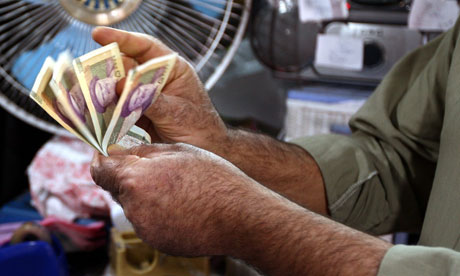
"On October 1st and 2nd Iran's rial lost more than 25% of its value against the dollar. Since the end of last year it has depreciated by over 80%, most of that in just the past month. Despite subsidies intended to help the poor, prices for staples, such as milk, bread, rice, yogurt and vegetables, have at least doubled since the beginning of the year. Chicken has become so scarce that when scant supplies become available they prompt riots. On October 3rd police in Tehran fired tear-gas at people demonstrating over the rial's collapse. The city's main bazaar closed because of the impossibility of quoting accurate prices. . . .

"Unemployment is thought to be around three times higher than the official rate of 12%, and millions of unskilled factory workers are on wages well below the official poverty line of 10m rials (about $300) a month."

Pervasive unemployment, inflation, medicine shortages, and even food riots have been reported elsewhere.

That sanctions on Muslim countries cause mass human suffering is not only inevitable but part of their design. In 2006, the senior Israeli official Dov Weisglass infamously described the purpose of his nation's blockade on Gaza with this candid admission: "'The idea is to put the Palestinians on a diet, but not to make them die of hunger." Democratic Rep. Brad Sherman justified the Iran sanctions regime this way: "Critics of sanctions argue that these measures will hurt the Iranian people. Quite frankly, we need to do just that."

Even more infamously, the beloved former Democratic Secretary of State Madeleine Albright - when asked in 1996 by 60 Minutes' Lesley Stahl about reports that 500,000 Iraqi children had died as a result of US-imposed sanctions on that country - stoically replied: "I think this is a very hard choice, but the price - we think the price is worth it." So extreme was the suffering caused by sanctions in Iraq that one former UN official, Denis Halliday, resigned in protest, saying that the sanctions policy met the formal definition of "genocide". More


Tuesday, October 2, 2012

EU nuclear reactors need 10-25 bln euros of safety spending

BRUSSELS, Oct 2 (Reuters) - Europe's nuclear reactor fleet needs investment of 10 billion to 25 billion euros, a draft Commission report said, following a safety review designed to ensure there is never a repeat of the Fukushima nuclear disaster.

The report is expected to be finalised by Thursday and debated by EU ministers later this month.

After that, the Commission intends in 2013 to propose new laws, including on insurance and liability to "improve the situation of potential victims in the event of a nuclear accident", the draft seen by Reuters said.

Of the 134 EU nuclear reactors grouped across 68 sites, 111 have more than 100,000 inhabitants living within a circle of 30 kilometres.

Safety regimes vary greatly and the amount that needs to be spent to improve them is estimated at anywhere between 30 million euros and 200 million euros per reactor unit - or a total of 10-25 billion across the fleet.

The lesson of Fukushima was that two natural disasters could hit at the same time and knock out the electrical supply system of a plant completely, so it could not be cooled down.

The stress test findings include that four reactors, located in two different nations, have less than one hour available to restore safety functions if electrical power is lost. More


Monday, January 16, 2012

13 Reasons For The US Not To Attack Iran

 A U.S. ambassador in Europe was recently asked by an Israeli ambassador what could be done to improve the lousy relations between Prime Minister Benjamin Netanyahu and President Obama. He replied: “Every once in a while, say thank you.”

The American ambassador added a couple of other thoughts. “Maybe, once in a while, ask the president if there’s anything you can do for him. And above all stay out of our election-year politics.”

This sharp riposte reflects Obama’s fury at several things: the way Netanyahu has gone over his head to a Republican-dominated Congress where he is a darling; Netanyahu’s ingratitude for solid U.S. support, including the veto of an anti-settlements resolution at the United Nations last year and opposition to the unilateral Palestinian pursuit of statehood; the delaying tactics of Netanyahu reflecting his conviction Obama is likely a one-term president; and Netanyahu’s refusal to pause a second time in settlement building for the sake of peace negotiations.

I would add a further piece of advice to Netanyahu if he cares about his dysfunctional relationship with Obama — and he should because Israelis know the United States matters and might be disinclined to re-elect a man who has poisoned relations with Washington. That advice is: Do not attack Iran this spring or summer.

Netanyahu is tempted to bomb Iran in the next several months to set back its opaque nuclear program and — despite a call from Obama last Thursday and messages from Defense Secretary Leon Panetta — has declined to reassure the United States that he will not. Several factors, Iranian and American, incline Netanyahu to move soon.

The first is the Israeli judgment that Iran is close to “irreversibility” in its pursuit of the various elements — from uranium enrichment to trigger mechanisms — needed for a nuclear warhead. The start of enrichment at the Fordow underground facility near Qum intensified these concerns, as has Iran’s bellicose tone in response to threatened oil sanctions. More


Tuesday, January 10, 2012

The US-Iran Economic War compliments of American Israel Public Affairs Committee (AIPAC)

 This amendment - for all practical purposes a declaration of economic war - was brought to you by the American Israel Public Affairs Committee (AIPAC), on direct orders of the Israeli government under Prime Minister Benjamin "Bibi" Netanyahu. 

Here's a crash course on how to further wreck the global economy.

A key amendment to the National Defense Authorization Act signed by United States President Barack Obama on the last day of 2011 - when no one was paying attention - imposes sanctions on any countries or companies that buy Iranian oil and pay for it through Iran's central bank. Starting this summer, anybody who does it is prevented from doing business with the US.

This amendment - for all practical purposes a declaration of economic war - was brought to you by the American Israel Public Affairs Committee (AIPAC), on direct orders of the Israeli government under Prime Minister Benjamin "Bibi" Netanyahu. 

Torrents of spin have tried to rationalize it as the Obama administration's plan B as opposed to letting the Israeli dogs of war conduct an unilateral attack on Iran over its supposed nuclear weapons program. 

Yet the original Israeli strategy was in fact even more hysterical - as in effectively preventing any country or company from paying for imported Iranian oil, with the possible exceptions of China and India. On top of it, American Israel-firsters were trying to convince anyone this would not result in relentless oil price hikes. 

Once again displaying a matchless capacity to shoot themselves in their Ferragamo-clad feet, governments in the European Union (EU) are debating whether or not to buy oil from Iran anymore. The existential doubt is should we start now or wait for a few months. Inevitably, like death and taxes, the result has been - what else - oil prices soaring. Brent crude is now hovering around $114, and the only way is up. 

Get me to the crude on time
Iran is the second-largest Organization for Petroleum Exporting Countries (OPEC) producer, exporting up to 2.5 million barrels of oil a day. Around 450,000 of these barrels go to the European Union - the second-largest market for Iran after China. 

The requisite faceless bureaucrat, EU Energy Commissioner Gunther Ottinger, has been spinning that the EU can count on Saudi Arabia to make up the shortfall from Iran. More