Tell Congress to move now to end these signature strikes, save innocent lives, protect America from the blowback of killing innocent civilians, and restore the rule of law.
Sign and share this petition to end signature drone strikes:
Follow the campaign @WarCosts and fb.com/warcosts
Showing posts with label collective punishment. Show all posts
Showing posts with label collective punishment. Show all posts
Wednesday, September 18, 2013
Signature Strike Investigation


Friday, June 21, 2013
John Brennan dismisses drone 'critics' who dismiss him right back
In his first media interview this year, CIA Director John Brennan dismissed civilian critics of his agency's drone program who "talk about these issues very callously" and "are not part of it." But what about drone critics inside the administration?
 |
| John Brennan |
In its July issue, GQ magazine asked Brennan if the CIA's drone program is creating more terrorists than it's killing off. It mentioned that some view the program as "mowing the lawn," a quote that was relayed to the magazine by the Brookings Institution's Peter Singer (who, full disclosure, works with FP's Noah Shachtman in his capacity as a non-resident fellow at the think tank).
In response, Brennan dismissed the notion of "mowing the lawn" and where it was coming from. "There are a lot of people who talk about these issues very callously, on the outside. Because they're not a part of it," he said. "If we don't arrest the growth of Al Qaeda in a Yemen, or a Mali, or a Somalia, or whatever else, that cancer is going to overtake the body politic in the country, and then we're going to have a situation that we're not going to be able to address."
Responding to the charge that he's an outsider and therefore can't understand the nature of the program, Singer tells Killer Apps that the "mowing the lawn" quote doesn't even come from him.
"The quote on ‘mowing the lawn' is not me but Bruce Riedel, a 30 year veteran of the CIA, who served on the NSC for 4 presidents and led Obama's first Afghanistan-Pakistan policy review," Singer said. It is here. I've referenced it a number of times, as Bruce encapsulates it well, but I can't take credit for it."
"I very much understand the perspective of the ‘outside-inside' dynamic that is referenced, but in this case it is not only ‘outsiders' who have expressed concerns about the risk of an over reliance on targeted killing becoming ‘self-perpetuating, yielding undeniable short-term results that may obscure long-term costs,'" he said. He went on to list a who's who of official statements from national security insiders.
"Among the ‘insiders' who have expressed the very same concerns are the President of the United States (Obama in his 2013 NDU speech), the highest ranking US Military officer (Admiral Mullen speech at 2012 Aspen Ideas Festival), the former US Military commander in Afghanistan (General McChrystal's January 2013 interview with Reuters), the former Director of National Intelligence (Dennis Blair's 2011 New York Times op-ed on the topic," he said. "The list could go on and on."
Just a little food for thought the next time someone dismisses the remarks of drone critic "outsiders."
(As an aside, Singer emphasized that he himself isn't a critic of targeted killings, but has been concerned by how the drone program has been conducted on transparency and legal grounds.)
"I've been calling for a more strategic, more long-term, and more transparent approach. That course correction is now taking place -- and the irony is that Mr. Brennan played a key role in that shift." More
Wednesday, May 22, 2013
In a First, U.S. Admits Drones Have Killed 4 Americans
WASHINGTON — One day before President Obama is due to deliver a major speech on national security, his administration on Wednesday formally acknowledged that the United States had killed four American citizens in drone strikes in Yemen and Pakistan.

In a letter to Congressional leaders obtained by The New York Times, Attorney General Eric H. Holder Jr. disclosed that the administration had deliberately killed Anwar al-Awlaki, a radical Muslim cleric who was killed in a drone strike in September 2011 in Yemen.
The American responsibility for Mr. Awlaki’s death has been widely reported, but the administration had until now refused to confirm or deny it.
The letter also said that the United States had killed three other Americans: Samir Khan, who was killed in the same strike; Mr. Awlaki’s son Abdulrahman al-Awlaki, who was also killed in Yemen; and Jude Mohammed, who was killed in a strike in Pakistan.
“These individuals were not specifically targeted by the United States,” Mr. Holder wrote.
While rumors of Mr. Mohammed’s death had appeared in local news reports in Raleigh, N.C., where he lived, his death had not been confirmed by the United States government until Wednesday.
According to former acquaintances of Mr. Mohammed in North Carolina, he appears to have been killed in a November 2011 drone strike in South Waziristan, in Pakistan’s tribal area. Mr. Mohammed’s wife, whom he had met and married in Pakistan, subsequently called his mother in North Carolina to tell her of his death, the friends say.
Mr. Holder, in a speech at Northwestern University Law School last year, laid out the administration’s basic legal thinking that American citizens who are deemed to be operational terrorists, who pose an “imminent threat of violent attack” and whose capture is infeasible may be targeted. That abstract legal thinking — including an elastic definition of what counts as “imminent” — was further laid out in an unclassified white paper provided to Congress last year, which was leaked earlier this year.
But Mr. Holder’s letter went further in discussing the death of Mr. Awlaki in particular, an operation the administration had previously refused to publicly acknowledge. He said it was not Mr. Awlaki’s words urging violent attacks against Americans that led the United States to target him, but direct actions in planning attacks.
Mr. Holder alleged that Mr. Awlaki not only “planned” the attempted bombing of a Detroit-bound airliner on Dec. 25, 2009, a claim that has been widely discussed in court documents and elsewhere, but also “played a key role” in an October 2010 plot to bomb cargo planes bound for the United States, including taking “part in the development and testing” of the bombs.
“Moreover, information that remains classified to protect sensitive sources and methods evidences Awlaki’s involvement in the planning of numerous other plots against U.S. and Western interests and makes clear he was continuing to plot attacks when he was killed,” Mr. Holder wrote. More
Monday, March 11, 2013
Are sanctions against Iran legal? Or are they collective punishment?
Iran, Pakistan Begin Border Gas Pipe Amid Sanctions Threat
The presidents of Pakistan and Iran inaugurated work on the cross-border leg of a gas pipeline that the U.S. has warned may breach a sanctions regime aimed at curbing the Persian Gulf nation’s nuclear program.

Pakistan’s benchmark KSE 100 share index plunged 2.5 percent in Karachi, the biggest drop in almost two months, as the news sparked concerns the U.S. would impose penalties.
Asif Ali Zardari, on his second trip to Iran within a month, joined Iran’s Mahmoud Ahmadinejad and the country’s Oil Minister Rostam Qasemi in the southern port city of Chabahar for the ground-breaking ceremony, Pakistan state television showed. The leaders offered a prayer for the project’s success and uncovered a plaque at the construction site.
Once completed, the 1,931-kilometer (1,200-mile) natural gas pipeline would help alleviate the energy crisis in Pakistan, where 18-hour blackouts last summer forced factories to close and triggered street protests. Iran is under U.S. and European Union restrictions over its atomic activities, measures that have curbed oil exports and complicated the repatriation of cash from crude sales.
Pakistan’s decision to proceed with the $1.3 billion energy link comes amid a bid to repair relations with the U.S., the South Asian nation’s biggest aid donor, after damaging setbacks including the killing of Osama bin Laden by American commandos in Pakistan in 2011 and a cross-border U.S. airstrike that killed 24 Pakistani soldiers. The U.S. needs Islamabad’s support as it withdraws combat forces from Afghanistan.
Oil Refinery
Ahmadinejad attacked opponents of the pipeline in a speech at the ceremony, drawing parallels between Iran and Pakistan.
“Foreigners are seeking to create divisions between nations in the region in order to control them and rob them of their wealth,” he said. “The only way for regional nations to safeguard their independence, identity, culture and wealth is through cooperation and unity.”
Iran has completed 900 kilometers of the pipeline on its side of the border, according to the website of Pakistan’s Interstate Gas Systems Pvt. Ltd., which will oversee construction in Pakistan. Under an accord signed in June 2010, Iran will provide about 21.5 million cubic meters of gas a day to Pakistan for 25 years. The deal can be extended by five years and volumes may rise to 30 million cubic meters a day.
The two countries are also expected to sign an agreement today to build a $4 billion oil refinery in Pakistan’s Gwadar, the state-run Press TV news channel reported.
‘Serious Concerns’
Work on extending the pipeline into Pakistan has been delayed by difficulties in arranging funding. The ground- breaking ceremony comes just days before Pakistan’s government, headed by Zardari’s party, is to hand over power to a caretaker administration ahead of parliamentary elections in May. The president’s term expires in September.
The U.S., which has offered to help Pakistan secure gas via an alternate route from Central Asia, has recently reiterated its concerns over the pipeline.
“If this deal is finalized for a proposed Iran-Pakistan pipeline, it would raise serious concerns under our Iran Sanctions Act,” Victoria Nuland, U.S. State Department spokeswoman, told a weekly briefing in Washington March 7. The U.S. hopes Pakistani won’t “go in a direction that would cause sanctions to kick in,” Nuland said, according to a transcript posted on the State Department website.
While Pakistan is aware of concerns in Washington, “all our friends including the U.S.” should show greater understanding of the country’s energy needs, Pakistan Foreign Office spokesman Moazzam Ahmad Khan told reporters March 7. More
Fourth Geneva Convention, Part 111, Article 32- 33
Art. 32. The High Contracting Parties specifically agree that each of them is prohibited from taking any measure of such a character as to cause the physical suffering or extermination of protected persons in their hands. This prohibition applies not only to murder, torture, corporal punishments, mutilation and medical or scientific experiments not necessitated by the medical treatment of a protected person, but also to any other measures of brutality whether applied by civilian or military agents.
Art. 33. No protected person may be punished for an offence he or she has not personally committed. Collective penalties and likewise all measures of intimidation or of terrorism are prohibited.
Pillage is prohibited.
Reprisals against protected persons and their property are prohibited.
http://www.icrc.org/ihl.nsf/full/380
Under the 1949 Geneva Conventions collective punishments are a war crime. By collective punishment, the drafters of the Geneva Conventions had in mind the reprisal killings of World Wars I and World War II. In the First World War, Germans executed Belgian villagers in mass retribution for resistance activity. In World War II, the Nazis carried out a form of collective punishment to suppress resistance. Entire villages or towns or districts were held responsible for any resistance activity that occured in them. Additional concern also addressed the United States' atomic bombings of Hiroshima and Nagasaki at the war's end, which, in turn, caused death and disease to hundreds of thousands of Japanese civilians.[3] The conventions, to counter this, reiterated the principle of individual responsibility. The International Committee of the Red Cross (ICRC) Commentary to the conventions states that parties to a conflict often would resort to "intimidatory measures to terrorize the population" in hopes of preventing hostile acts, but such practices "strike at guilty and innocent alike. They are opposed to all principles based on humanity and justice."
It could therefore be argued that sanctions are a type of economic warfare, in which case the Geneva Conventions should apply. Therefore, the Fourth Geneva Convention, Part 111, Article 33 would apply, prohibiting any measure to cause physical suffering to Protected Persons. Editor
Monday, October 8, 2012
Iran sanctions now causing food insecurity, mass suffering
Yet again, the US and its allies spread mass human misery though a policy that is as morally indefensible as it is counter-productive.
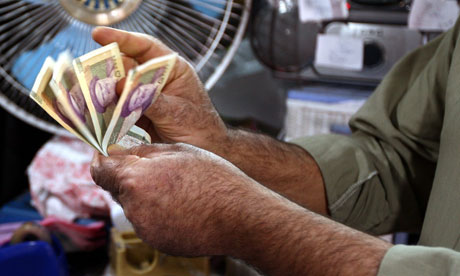 The Economist this week describes the intensifying suffering of 75 million Iranian citizens as a result of the sanctions regime being imposed on them by the US and its allies [my emphasis]:
That sanctions on Muslim countries cause mass human suffering is not only inevitable but part of their design. In 2006, the senior Israeli official Dov Weisglass infamously described the purpose of his nation's blockade on Gaza with this candid admission: "'The idea is to put the Palestinians on a diet, but not to make them die of hunger." Democratic Rep. Brad Sherman justified the Iran sanctions regime this way: "Critics of sanctions argue that these measures will hurt the Iranian people. Quite frankly, we need to do just that."
Even more infamously, the beloved former Democratic Secretary of State Madeleine Albright - when asked in 1996 by 60 Minutes' Lesley Stahl about reports that 500,000 Iraqi children had died as a result of US-imposed sanctions on that country - stoically replied: "I think this is a very hard choice, but the price - we think the price is worth it." So extreme was the suffering caused by sanctions in Iraq that one former UN official, Denis Halliday, resigned in protest, saying that the sanctions policy met the formal definition of "genocide". More
Pervasive unemployment, inflation, medicine shortages, and even food riots have been reported elsewhere."Six years ago, when America and Europe were putting in place the first raft of measures to press Iran to come clean over its nuclear ambitions, the talk was of "smart" sanctions. The West, it was stressed, had no quarrel with the Iranian people—only with a regime that seemed bent on getting a nuclear bomb, or at least the capacity for making one. Yet, as sanctions have become increasingly punitive in the face of Iran's intransigence, it is ordinary Iranians who are paying the price.
"On October 1st and 2nd Iran's rial lost more than 25% of its value against the dollar. Since the end of last year it has depreciated by over 80%, most of that in just the past month. Despite subsidies intended to help the poor, prices for staples, such as milk, bread, rice, yogurt and vegetables, have at least doubled since the beginning of the year. Chicken has become so scarce that when scant supplies become available they prompt riots. On October 3rd police in Tehran fired tear-gas at people demonstrating over the rial's collapse. The city's main bazaar closed because of the impossibility of quoting accurate prices. . . .
"Unemployment is thought to be around three times higher than the official rate of 12%, and millions of unskilled factory workers are on wages well below the official poverty line of 10m rials (about $300) a month."
That sanctions on Muslim countries cause mass human suffering is not only inevitable but part of their design. In 2006, the senior Israeli official Dov Weisglass infamously described the purpose of his nation's blockade on Gaza with this candid admission: "'The idea is to put the Palestinians on a diet, but not to make them die of hunger." Democratic Rep. Brad Sherman justified the Iran sanctions regime this way: "Critics of sanctions argue that these measures will hurt the Iranian people. Quite frankly, we need to do just that."
Even more infamously, the beloved former Democratic Secretary of State Madeleine Albright - when asked in 1996 by 60 Minutes' Lesley Stahl about reports that 500,000 Iraqi children had died as a result of US-imposed sanctions on that country - stoically replied: "I think this is a very hard choice, but the price - we think the price is worth it." So extreme was the suffering caused by sanctions in Iraq that one former UN official, Denis Halliday, resigned in protest, saying that the sanctions policy met the formal definition of "genocide". More
Subscribe to:
Posts (Atom)